You are viewing a read-only archive of the Blogs.Harvard network. Learn more.
Stop Torture » Torture

Stop Torture

The Harvard Anti-Torture Coalition

Archive for the 'Torture' Category

Torture Goes Down the Memory Hole

Posted by stoptorture on 8th December 2007

Below is a brief non-exhaustive list of the torture evidence the government has thrown down the Orwellian memory hole.

Truths We Have Lost:

  1. CIA torture tapes
  2. Countless Abu Ghraib photos and videos collected in the US Army’s “Amnesty Box” (Watch “Ghosts of Abu Ghraib” for more information).
  3. Rumsfeld memorandum posted at Abu Ghraib authorizing torture techniques with a handwritten note: “Make sure this happens!!”

Truths We Risk Losing:

  1. Guantánamo litigation papers

Posted in Human Rights, Torture | 1 Comment »

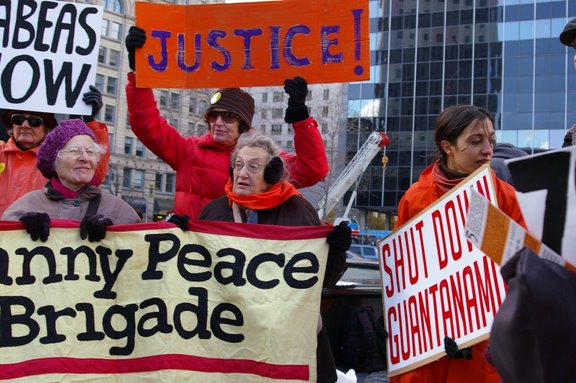
Students and Activists Demand Habeas Now

Posted by stoptorture on 6th December 2007

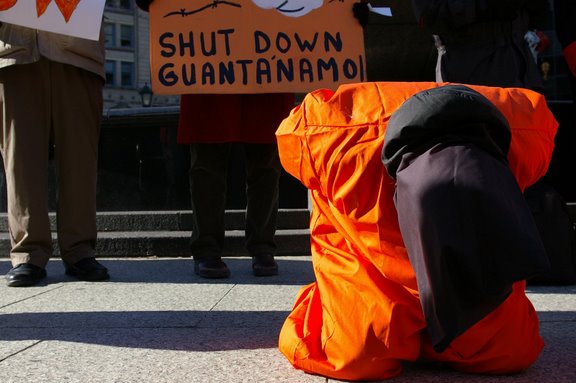
Students and activists held protests on campuses and in front of federal court houses in solidarity with Guantánamo detainees in the lead up to the Supreme Court hearing oral arguments December 5, 2007.

The Court in the Boumediene case is set to decide the question of whether detainees can challenge the lawfulness of their detention in court through the centuries old legal guaranteed of habeas corpus rights. Currently, the government claims the detainees, held indefinitely without charge on the island prison, have no right to appear before a judge.

Members of Witness Against Torture protested in front of the Supreme Court itself, making for a striking juxtaposition of the symbols of injustice and supposed justice.

At a protest in front of New York’s federal circuit court building involving NYU students and activist leaders, Betty Brassel, 77 and member of the Granny Peace Brigade and the Raging Grannies, said “everyone deserves a fair trial.” NYU student Elena Landriscina explained that the protest was to “to raise public consciousness about the issue of habeas.”

Nina Catalano, one of the coordinators of a protest on Harvard campus involving mock renditions, distilled the question before the Court in Boumediene in a less legalistic way: “If you are in a cell and there is no judge to hear you when you scream, do you make a sound?”

The protests were coordinated in large part through the work of Susan Hu at the Center for Constitutional Rights.

M�chel Angela Martinez, 2007 M�chel Angela Martinez, 2007

Photo Credit: Míchel Angela Martinez, 2007

Posted in Activism, Events, Human Rights, International Law, Torture, U.S. Law | Comments Off on Students and Activists Demand Habeas Now

Supreme Court Hears Oral Arguments in Boumediene, Guantanamo Detainee Case

Posted by stoptorture on 5th December 2007

Listen to the audio recording or read the transcript.

Posted in Events, Human Rights, Torture, U.S. Law | Comments Off on Supreme Court Hears Oral Arguments in Boumediene, Guantanamo Detainee Case

Waterboarding in History (Part III): Jim Crow–A lesson dedicated to Schumer and Feinstein

Posted by stoptorture on 13th November 2007

[UPDATE: Shertaugh at IsThatLegal? posted about the Fisher case–also in Mississippi and four years after the White case below–in which the Mississippi Supreme Court called the “water cure” (waterboarding), torture.]

The following rejection of waterboarding comes from the Supreme Court of Mississippi in 1922, during the Jim Crow era:

Gerrard White, an 18-year-old black youth, was threatened and waterboarded by a group of armed white planters into “confessing” to the murder of a white shopkeeper in Mississippi in 1921. White was convicted and sentenced to death. He appealed. Describing waterboarding as “brutal treatment” and “barbarous circumstances,” the Mississippi Supreme Court ruled in 1922 that all the “confessions” obtained by the white planters were inadmissible. Mind you, the lower courts had already excluded the “confession” obtained during the waterboarding itself. Not even the state’s lawyer dared to argue that one was admissible. Rather, the case turned on whether two other“confessions” obtained by the planters minutes before and a few days after the waterboarding were also inadmissible.[1] The Court ruled all the confessions inadmissible.

Is it possible that a Jim Crow Mississippi Supreme Court—with its racist language, in a decision dealing with a black youth accused of murdering a white man—rhetorically condemned the use of waterboarding more readily than did our current Attorney General, Michael Mukasey?

EXCERPT:

White v. State, 129 Miss. 182 (1922).

Holden, J., delivered the opinion of the court.

The appellant Gerrard White, a negro boy eighteen years of age, employed as a farm hand, was arrested by the sheriff during the day, and taken to the scene of the murder, where it appears he was released, but was again taken into custody by a Mr. Gilbert, a planter, who took him into the store where the dead man lay, and, after locking the door, proceeded to obtain a confession from him. The store was a small building, and there were gathered in the building several other white men, plantation owners and managers, some of whom were armed. Among the dozen white men in the store was Mr. Gilbert, who testified that the appellant told him, alone, in the corner of the store, that he (appellant) was present and participated in the killing of Mr. Gross; that he (appellant) did not strike any of the blows, but saw Buck Kenard strike Mr. Gross with an ax, and that Ben Pickens struck him with a hatchet; that the purpose of the killing Was robbery, etc. None of the white men in the store testified to this confession except Gilbert. A few minutes after this alleged confession the hands of appellant were tied behind him, he was laid upon the floor upon his back, and, while some of the men stood upon his feet, Gilbert, a very heavy man, stood with one foot entirely upon appellant’s breast, and the other foot entirely upon his neck. While in that position what is described as the “water cure” was administered to him in an effort to extort a confession as to where the money was hidden which was supposed to have been taken from the dead man. The “water cure” appears to have consisted of pouring water from a dipper into the nose of appellant, so as to strangle him, thus causing pain and horror, for the purpose of forcing a confession. Under these barbarous circumstances the appellant readily confessed that he knew where the money was, and told them that it was out at the “dredge ditch.” They then took the appellant to the dredge ditch to find the money, but there was no money found there or anywhere else so far as this record shows. Following this appellant was taken to the Greenville jail and in a few days thereafter the same Mr. Gilbert and Mr. Robertson visited appellant at the jail, and they testified that appellant again voluntarily confessed the crime while in his cell at the jail.

Now let us see what were the facts and circumstances under which the first confession at the store was made. Here was an ignorant negro boy, arrested and taken from his work in the field, and brought to the scene of the horrible murder. The sheriff had questioned him with reference to his guilt and whereabouts, and apparently concluded that he was not guilty, and thereupon released him, and after he was released, or, according to one view of this record, after he was turned over to a deputy, he fell into the hands of Mr. Gilbert and the other infuriated planters and plantation managers gathered there at the scene of the murder. They took him into the store building, locked the door behind him, and there, in the presence of the bloody corpse so foully murdered but a few hours before, and with the crowd of armed white men there assembled for the purpose of obtaining a confession, he was asked to confess, and under these circumstances he told Mr. Gilbert, and it seems that no one else heard it, about his connection with the crime, and who participated in it. Following this, a few minutes afterwards, the brutal treatment described as the “water cure” was administered to him, which succeeded in obtaining a second confession. It is well to state at this juncture that the negro boy denied confessing to the killing until after he was threatened, frightened, and mistreated as described by Mr. Gilbert himself. The word of the helpless negro boy was of no avail to him; though a human being, his situation was indeed hopeless and fearful…

We do not hesitate to say that a confession obtained under these conditions and circumstances is not free and voluntary…

At all events the confessions at the store were involuntary, and it may be that the one at the jail was also involuntary because induced by the same wrongful influence which induced the previous ones…

Reversed and remanded.

[1] Gerrard White had made three “confessions,” the first while cornered by the apparent leader of the armed white planters. Minutes later, the planters waterboarded White and extracted the second “confession.” White was jailed (seemingly on the basis of these first two “confessions”) and, days later, was visited by two men, one of whom had stood on White’s neck during the waterboarding. At the jail, the men extracted yet another “confession.”

Posted in Human Rights, Torture, U.S. Law | 1 Comment »

How Torture, Once a Bipartisan Wrong, Became a Bipartisan Right

Posted by stoptorture on 11th November 2007

A Timeline of Torture Flip-Flopping:

1988: President Reagan asks Senate to give advice and consent to his signature of the UN Convention against Torture.[1]

1993: Democrat-controlled Senate approves bill containing statute criminalizing torture by a vote of 95 to 4. President Clinton signs it into law in 1994.[2]

1994: The US ratifies the UN Convention against Torture, signed by President Reagan in 1988.[3]

1996: Republican-controlled Senate unanimously approves War Crimes Act, criminalizing torture and other violations of the Geneva Conventions. President Clinton signs it into law.[4]

2005: Republican-controlled Senate passes the Detainee Treatment Act by a vote of 90-9, banning cruel, inhuman, and degrading treatment of detainees under any type of US custody anywhere. President Bush issues a signing statement declaring he may ignore the law.[5]

2006: Republican Senators lead negotiations on the Military Commissions Act of 2006, which is passed, gutting much of the War Crimes Act. The vote is 65-34, including 12 “Yeas” from Democrats.[6]

2007: Democrat-controlled Senate gives advice and consent by a vote of 53-40 to Mukasey as attorney general, a man who publicly declares his wish to avoid creating legal trouble for waterboarders (read torturers) and those who approved waterboarding (read torturers).[7]


[1] President Ronald Reagan signed the UN Convention against Torture on April 18, 1988, stating, “[The Convention] marks a significant step in the development during this century of international measures against torture and other inhuman treatment or punishment. Ratification of the Convention by the United States will clearly express United States opposition to torture, an abhorrent practice unfortunately still prevalent in the world today.”


[2] The Torture Statute criminalizing torture was enacted by Congress in 1994 and signed by President Clinton into law on September 13, 1994. The Senate voted 95-4 to pass the omnibus bill containing the torture criminalization on November 19, 1993. The measure was intended to bring the US into compliance with the UN Convention against Torture, which was ratified on October 21, 1994.

[3] Id.

[4] A Republican controlled Congress enacted the War Crimes Act in 1996. The Senate passed it by unanimous consent. President Clinton signed it into law August 21, 1996. The War Crimes Act criminalized violations of the Geneva Conventions to pave the way for prosecutions of foreign officials who tortured Americans.  The original bill was sponsored by staunch conservative Walter Jones Jr. (R-NC) in the House during the Republican-controlled Congress.  DoD’s general counsel declared full support for the bill and even suggested making the list of war crimes longer.  The Pentagon, opting to set a high bar for conduct, did not oppose the fact that the War Crimes Act applied to actions by US personnel.

[5] A Republican controlled Congress banned cruel, inhuman, and degrading treatment to all detainees under US custody everywhere. The law also limited US military interrogations (though not those of the CIA) to methods outlined in the Army Field Manual. The vote was 90 to 9. President Bush purported to reserve the right to ignore the law through a signing statement.

[6] A Republican controlled Congress gutted most of the War Crimes Act by enacting the Military Commissions Act (i.e. Torture Law) on September 29, 2006. Negotiation regarding the Torture Law were concentrated in three Republican Senators. President Bush signed the Torture Law on October 17, 2006.

[7] A Democrat controlled Senate approved Mukasey for attorney general on November 8, 2007, without a filibuster attempt despite his failure to commit to meaningfully uphold either the Torture Statute or the War Crimes Act as evidenced by his refusal to declare waterboarding illegal.

Posted in Human Rights, International Law, Torture, U.S. Law | 5 Comments »

Why No Mukasey Filibuster? Dems Dealt in Torture to Score Political Points

Posted by stoptorture on 11th November 2007

The New York Times editorial this Sunday, titled “Abdicate and Capitulate,” states, “Democrats offer excuses for their sorry record, starting with their razor-thin majority. But it is often said that any vote in the Senate requires more than 60 votes — enough to overcome a filibuster.”

Apparently, a filibuster on Mukasey was not off the table, as Talking Points Memo reports here. With only 53 “Yeas” for Mukasey, a senator with a conscience capable of being shocked could have stopped the Torture Nominee. So, why didn’t someone step forward to stop the pro-Mukasey, pro-torture vote?

Hypocrisy.

The nation’s lawmakers chose to place politics above the law. Wanting to score a rhetorical point before engaging with President Bush in a debate about the Iraq and Afghanistan wars, the Democrats let the whole torture thing slide. Mind you, the deal struck was not a compromise about anything substantive in relation to those wars. Rather, as Talking Points Memo explains, it appears to have been a ploy to grant the Democrats a slight debater’s edge.

Is it too much to ask the party that controls Congress to make some headway in stopping the war, without having to condone torture in the process? The Senate leadership, in preparing to confront the president over one of the most unpopular wars in US history, cut a “deal” with Republicans to send half a trillion dollars to the military to show themselves to be pro-troops. Apparently, vowing to withdraw troops from combat is not enough of a “pro-troops” debater’s edge. Or maybe the Democrats are just lousy debaters. In return, Dems granted the Republicans Mukasey as a chief prosecutor, the man who has expressed a desire to shield the Bush administration from criminal prosecution for war crimes.

To re-cap: Dems get to send $500 billion to the military before taking an anti-war position on the most unpopular war led by the most unpopular president in nearly 40 years. Republicans get a get-out-of-jail-free card for war crimes.

Who advises them on these deals anyway? Karl Rove in a donkey suit?

Posted in Human Rights, Torture, U.S. Law | Comments Off on Why No Mukasey Filibuster? Dems Dealt in Torture to Score Political Points

Waterboarding Survivors Speak Out

Posted by stoptorture on 10th November 2007

The following entry is taken from a press release by Torture Abolition and Survivors Support Coalition International. All quotes are from survivors of torture, and members of that coalition.

Nasim, a survivor of waterboarding from Ethiopia, who does not want her last name in the press, says that she is “brought back to the torture chambers every time I hear the sound of splashing water. In the shower, when water hits my face, I must remind myself that I am not strapped to a board and that my lungs will not fill up with water until I lose consciousness. Though it has been years, the fear and pain are still there. There can be no debate that waterboarding is torture.”

Anthony Ibeagha, a survivor from Nigeria, said that “this confirmation is disrespectful to me as a person and only exacerbates the pain of torture which has come to be my life.”

Dianna Ortiz, a US nun and survivor of torture in Guatemala, said that “the Senate may have substituted the name Mukasey, but they voted for torture. What congress and Judge Mukasey have said loudly and clearly is that they have no concern for those of us who were tortured. First we were betrayed by our torturers; now we are betrayed by the government of the United States. Those who voted for torture will go unconcerned to their dinners and cocktail parties, while we go home to our nightmares.”

Sister Ortiz wrote of her experience watching the Senate Judiciary Committee’s vote on Mukasey here: http://torturelaw.org/blog_post.php?post=41

Posted in Human Rights, International Law, Torture, U.S. Law | 1 Comment »