Ana-al-Haq انا الحق
April 30th, 2012
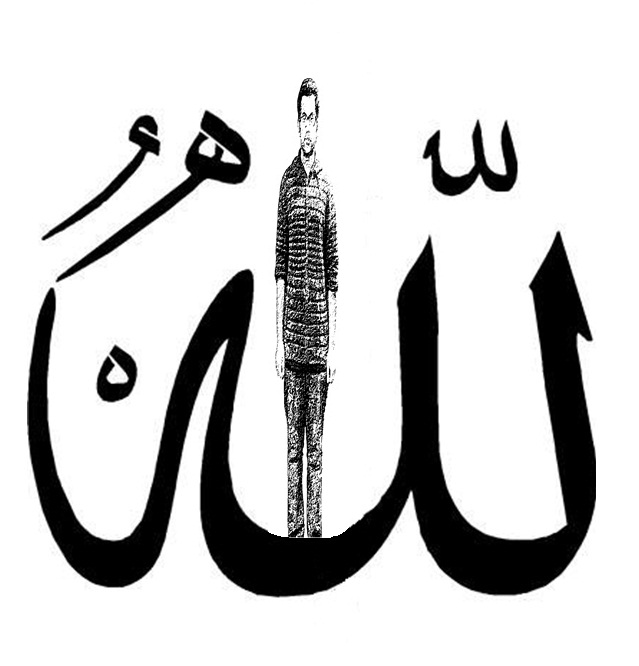
Analysis
This piece was made in response to Farid-ud-Din Attar’s “Conference of the Birds”. The text relates the story of a large gathering of birds as they set out to travel across a vast landscape in search of the legendary simourgh that will become their leader, only to find in the end a large pool of water in which they observe their own reflections. The lesson of the text is deeply personal to each person who reads it. For me, Attar’s message mirrors closely that of Al-Hallaj and his famous declaration “Ana al Haq”, or “I am the truth”. The message is key to the understanding of divine reality in the Sufi tradition. At the time of Alastu when God asked of creation “Am I not your Lord”, the created world did not exist in the same manner that it is understood to exist today. All creation was unified with God and proclaimed its love for Him. When man was created and given life and form, he was separated from God. The aim of the Sufi tradition is to reunite man with God, but in order to do so, the sufi apprentice must understand that God is not a distant or external entity but rather an inherent part of the self. By letting go of the ego and the markers of self identification that separate the human from God, the human being can achieve a state of reunification with God, which is a state of pure ecstasy reminiscent of the state of Alastu.
In my response, I have used a template of Allah rendered in a digital calligraphic script. The alif, which is the first letter of the word Allah, has been removed. The alif is written in Arabic using a straight vertical line. In my response, I have replaced the alif with a human form and thus incorporated the human element into the name of God. The whole idea of Attar’s text and Al-Hallaj’s doctrine was based on the premise that God is not an entity that is external to the human being’s existence. As such, by incorporating the human form into the name of Allah, I have evoked the primordial relationship between man and God: they are both inextricably linked.
Ghazal
April 30th, 2012
Were not we once as one, till life thus afflicted me?
How dare this created world and body separate you from me?
You reigned over the night, the moon pristine and pure,
Till rose the wicked sun and chased you far from me.
Come swiftly saki and bear the noble wine in your hallowed cup,
And pray ,my love, that it dissolves the veil that conceals you from me.
Dead you are now to my cries of pain and ardent supplication,
Awaken, gorgeous idol, and return the heart you stole from me.
The nightingale and moth are my peers in this divine anguish,
Breathe your perfumed breeze this way and lift this curse from me.
——————————————————————————–
Analysis
This Ghazal was composed as a response to our reading ‘Ghazal and Taghazul’ by C.M. Naim. The poem follows the conventions of the traditional ghazal form, with the characteristic rhyme pattern of aa ba ca da ea.
The ghazal begins with a ‘Matla’ in which the radif of “from me” is established. The first couplet is inspired by the Sufi notion of “alastu”, which often features in the ghazal tradition under the guise of the “night of union.” When the poem asks “were not we once as one,” there are two possible meanings that can be understood. Firstly, that the aashiq and the beloved were together at one point in the past and have since been separated from each other. Secondly, that the human being was, at the time of “alastu”, part of the greater entity of God and did not exist as a separate being, until he was created in the human form and separated from God so that he could eventually find his way back to Him. The second verse of the Matla continues this idea of the human being eventually overcoming this reality and casting away the human form to return to the eternal beloved, God.
The second couplet incorporates the image of the moon that is a prominent motif in the ghazal tradition. The beloved is represented by the moon, which is beautiful and pristine. Again, the imagery of the night of unison reappears in this couplet as we are told that the ashiq and his beloved (the moon) were together in the night when the moon was clearly visible, but as the sun rose and morning appeared, the unfaithful beloved disappeared. As the ghazal continues, the saki, or spiritual leader, is summoned. The verse commands the saki to “bear the noble wine”, a clear nod to the imagery of intoxication that is characteristic of the ghazal tradition. As the poem makes clear, the purpose of the wine is not intoxication itself but rather the use of intoxication as a means to remove the barrier between the ashiq and the beloved.
In its penultimate couplet the ghazal employs the motif of the “sanam” or stone idol. The ashiq is so lost in his love that he supplicates to the idol instead of to God. Alternatively, the verse can be interpreted as a complaint against God, calling him idol-like and therefore unresponsive and unyielding. As the ghazal draws to a close, three more elements of traditional ghazal imagery are introduced: the moth, the nightingale and the perfumed breeze. Each of these represents a romantic pairing of a yearning ashiq and a proud beloved: the moth is in love with the flame, the nightingale with the rose, and the breeze with the rosebush. By calling them his peer, the poet joins the ranks of these legendary lovers who continue in their quest for the beloved.