Archive for November, 2014

Umbrella of Islam

Saturday, November 1st, 2014

20141031_212948

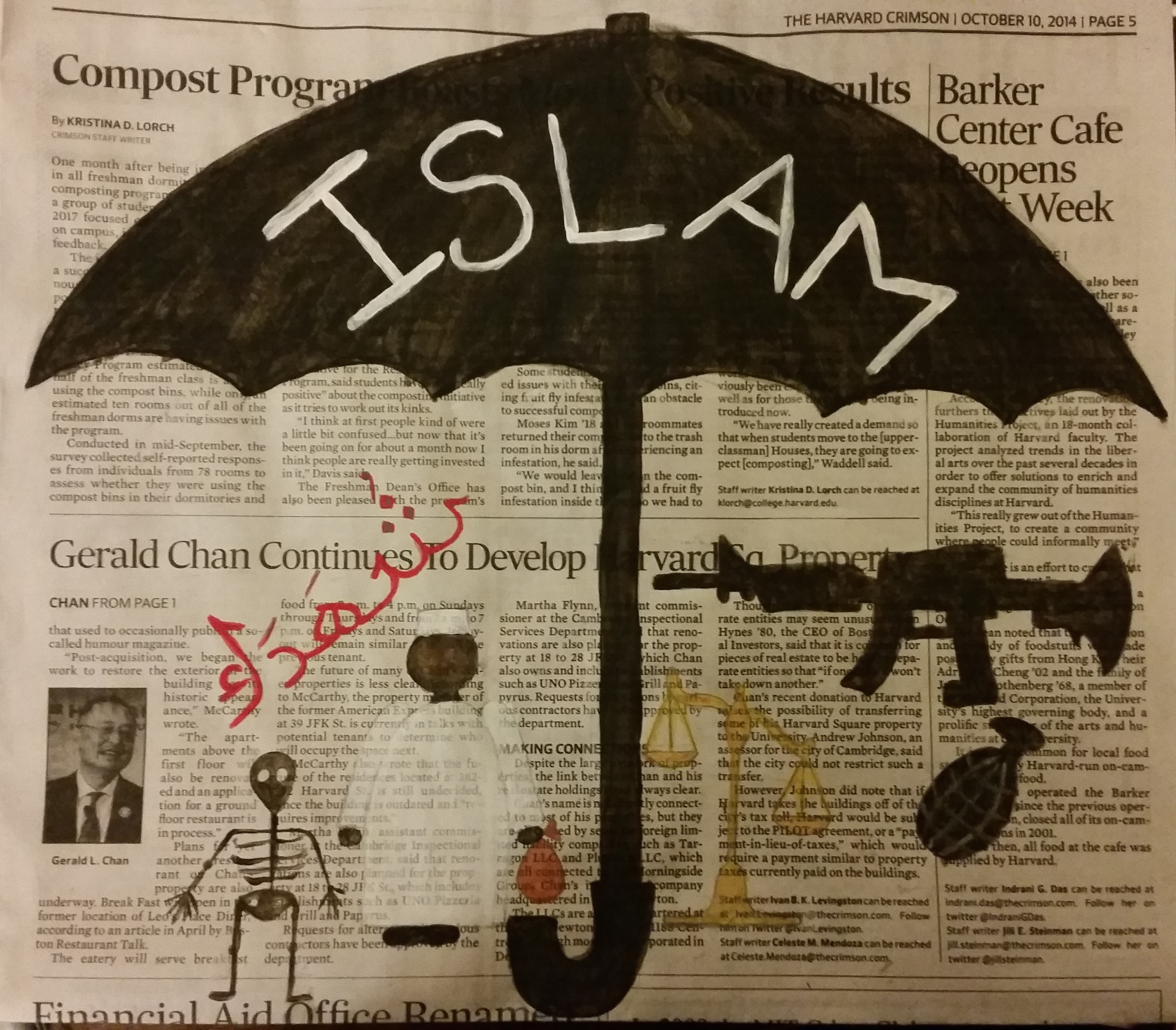
The term “Umbrella of Islam” is one of the most commonly used terms in Sudan to describe governmental actions. In Persepolis, we were given insight into the Islamic revolution in Iran . The book told stories of horrible actions committed by the new Islamic regime against it’s people. Sadly, this idea of an oppressive, Islamic government is not unique to Iran. It is very common in the Arab world. In Sudan, we witness atrocities being committed on a daily basis by our government falsely under the name of Islam. That is why I chose to paint an umbrella (with the word Islam written on it). The umbrella basically provides shade for and covers a rifle and grenade (to represent war), an unbalanced balance of justice (to represent injustice and the forgone rights of the people), a fat man wearing a “jalabiya” (traditional Sudanese dress) carrying a bag of money next to a skeleton (to represent theft by government officials from the sudanese citizens who are starving because they cannot afford to live) and the word “Shuhada’a” in Arabic (to represent the martyrs that die in pointless wars started by the government in the name of islam). Another aspect to this piece is the newspaper I painted it on. The news paper is written in English to represent western media that shows a biased view of Islam. Thus another interpretation of the piece is the idea that media negatively portrays these horrible things as being part of Islam.

Listen…. Feel….. Repeat

Saturday, November 1st, 2014

20141031_213019

We often discussed in the seminar the Qur’an being an audio experience. When it was first revealed to the Prophet Mohamad PBUH, the Qur’an was not in a written form. It was recited to him by Gibreel, an angel sent by Allah. The Prophet himself did not know how to read or write so he memorized the Qur’an that Gibreel recited to him. Nowadays, however, more emphasis is placed on the written form of the Qur’an. The book with the written words of Allah is highly respected within the Muslim community. Although the recited Qur’an is also respected, there is a huge difference in the degree of respect given to each. This is seems odd as the oral Qur’an can reach more people than the written Qur’an. Not everyone knows how to read and write. Furthermore, when the Qur’an is presented to people in the oral form, everyone gets to claim power over it and interpret the meaning behind it based on their own experiences. The written Qur’an on the other hand, is restricted to those who can read and write. These people claim power over it and offer interpretation to the general public based on their personal experience which does not seem fair.

This piece is just a representation of that. It shows that more emphasis needs to be placed on the auditory experience of the Qur’an. There’s the ear and waves next to it representing the sense of hearing. I also included a drawing of the “Mushaf” which is the book of Qur’an. There’s a verse from the Qur’an in Arabic Caligraphy and a radio because it is the most common way to listen to the Qur’an in Sudan.

Holy Lamp

Saturday, November 1st, 2014

20141031_213038


In the Saint’s Lamp, we introduced to a traditional village in Egypt. The villagers seemed to place high religious regard to a lamp that is said to belong to “Zainab” (also known as Umm Hashim) the prophet’s grand daughter. Any oil from that lamp is said to be holy and a cure to any disease. The oil is said to be blessed, but where does this blessing come from? If we look at the religion of Islam, it is noticeable that the family of the Prophet is highly regarded amongst Muslims. Even in our prayers, we pray for the Prophet’s family. So, it only seems logical for people to believe that items associated with the Prophet’s family would be blessed to. The second question that arises is why this particular object? Why a lamp? Again, looking back in time, the Prophets sent by God were a source of guidance to humanity. In a way, you could even say they are using light given to them by God to guide humanity. A lamp is an object that gives out light and was often carried around by people to light their way. So, if Prophet Mohamad PBUH was one source of light, his descendants must also carry some of that light within them. Hence, Zainab, who carries some of that light within her, is represented by the lamp.

In this piece, I decided to paint my own lamp. The lamp is filled with arabic calligraphy as it is usually linked to Islam. The words are mainly some of the names of Allah, the Prophet’s name and some of the women in his life. The main focus of the painting is the word “Zainab” which is at the center of the lamp and the only upright word just to highlight that this is a representation of her lamp.

Islam and Culture

Saturday, November 1st, 2014

20141031_213007

The Beggar’s Strike made me think about the links between culture and religion. In the book, I found it interesting how the culture of the characters, even though it contradicts many of the teachings and rules of islam, was incorporated into their religion. Somehow, a link between the culture and Islam was found and developed. In fact, Islam in general cannot exist without a culture. It was given to people within a certain culture. If we look around the world, different muslims have managed to base Islam on their culture. This goes to show how Islam, a religion I once thought was merely a set of rules, is open to multiple interpretations based on the context/culture.

This led me to think about Islam in Sudan, my home country. It feels like Islam has become such an integral part of the Sudanese culture and cannot be distinguished from it. This piece shows a woman and a man, both dressed in traditional attire, with a stamp of the words “muslims” and “muslim” respectively. The idea is to show the religion as part of the culture and an identifier for Sudanese people and our traditional sudanese dress is the best representative of our culture. I also chose the colors black, white, green and red as these are the colors of the Sudanese flag.

Hello world!

Saturday, November 1st, 2014

Welcome to Weblogs at Harvard Law School. This is your first post. Edit or delete it, then start blogging!