Archive for March, 2014

Experiencing Islam in East Africa

Sunday, March 23rd, 2014

In this post, I want to combine responses to Professor Asani’s stress on the cultural context crucial to the study of religion and to the J. Knappert reading, Myths and Legends of the Swahili regarding devotional practices and myths from East Africa. I have spent the past two summers in Tanzania working for a small NGO. I was fortunate enough to stay with an incredibly loving and generous  homestay family in the tiny Muslim subvillage of Urangini within Bwawani ward. Because I lived with this family of devout Muslims for nearly two months, and especially because my time with this family coincided with Ramadan, I hope to speak to the manner in which this particular family practiced Islam in the cultural context of a small East African village. I also hope to speak to my experiential understanding of Islam within this context.

In most Tanzanian villages, there is a “mwenyekiti,” or village leader, with whom our NGO would consult and defer to regarding all decisions that would affect his village. In Urangini, the mwenyekiti worked closely with the imam of the small mosque, and because the constituents of the village were predominantly Muslim, having the respect of the imam was as important as gaining the trust of the mwenyekiti. I established a strong relationship with the imam, and he was enormously helpful in directing especially young Muslim men to our health education teachings. My homestay family had five children: Zulfa, Hajerah, Fauzia, Omari, and Shania. The girls and the boy left their heads uncovered except when going to the mosque or going to school, in which case the girls wore white, pressed hijabs. The boy and his father, Juma, went to the mosque several times a day in between tending the fields behind the house, while the mother went less frequently as she was busy taking care of the household. The call to prayer, as I recall, was mostly audible for the night prayers and the morning prayers. During Ramadan, the family fasted and broke the fast with porridge, “uji,” and a small iftar meal, usually composed of beans, corn, and kassava. They would then eat dinner, and would also wake up and eat a meal before sunrise at about 4:00 am. During the holiest days of Ramadan, I remember hearing congregations of people parading down the small dirt roads of the village singing and chanting in a mix of Swahili and Arabic to various drums and other instruments. I was back in Arusha Town by the time of Eid, during which a huge celebrations and dancing occurred, accompanied by massive amounts of delicious street food, sweets, and “Eid Mubaraks.”

Consideration of the Mi’raj & Isra’ from the Temple Mount

Sunday, March 23rd, 2014

In this post, I reckon with the importance of the Mi’raj and the Isra’ to the prophethood of Muhammad and to the Muslims who live by his example. I explored the Mi’raj and the Isra’ experientially during my visit to the Temple Mount and the Dome of the Rock, the third holiest site in Islam. The Isra’ is the night journey that the Prophet made to the site of the Dome of the Rock, while the Mi’raj is the ascent, either physical or spiritual, of the Prophet during which he rode on the form of the buraq – a mystical creature with the head of a human and the body of a horse. Especially for more mystical Islamic sects, the Mi’raj is the prototype for the ascent of their own mortal souls to higher spiritual realms. In order to visit the Dome of the Rock, along with several of my cohorts on the Harvard College Israel Trek, I woke up at 5:30 am so that we could get to the line by 6:30 am and be first in line when the Dome of the Rock opened for the day. Evoking again the idea of the People of the Book within this Holy City and the various cultures and peoples that intertwine along the winding streets of Jerusalem, we bought challah for breakfast and waited in a line just parallel to the line for the Western Wall – the holiest site for the Jewish people.

In order to enter the Dome of the Rock itself, which is built around the rock from which the Prophet Muhammad ascended, and in order to enter the adjacent mosque, one must be a practicing Muslim and be able to recite the shahadah along with a select verse from the Qur’an. Those like myself were able to walk along the beautiful grounds in the shadow of the glistening Dome. The Dome pervades the skyline of Jerusalem unlike any other building of the Old City. As the sun rose, it hit the golden panels of the Dome, and our taxi driver emphatically yelled as we rounded the curve and our eyes met the Dome, “There it is! Isn’t it beautiful?!” To stand in the presence of the Dome was a transcendent experience, especially in the earliest hours of the morning. The beautiful Arabic calligraphy along the periphery spelled out verses of the Qur’an and embraced the geometric azure and green designs. The grounds themselves were serene – completely flat and marked with stone structures including a beautiful pink marble pulpit. Please enjoy the following photos while keeping the following Qur’anic verse in mind:

“Praise be to Him who made His servant journey in the night from the sacred sanctuary to the remotest sanctuary.” Sura al-Isra’

Ahl al-Kitab in the Holy City

Sunday, March 23rd, 2014

In this post, I want to speak to the concept of “ahl al-kitab,” or “People of the Book.” “People of the Book” refers to Christians, Muslims, and Jews. According to the Qur’an these people share commonality in that they have been selected by God to have been endowed with holy scripture through revelation to a prophet. The prophets preceding Muhammad, the last prophet, are recognized and revered in the Qur’anic revelation as brothers of Muhammad. Historically, where and when Islam has been hegemonic, People of the Book have been protected under the law. Because they are believed to have followed “paradigms of righteousness,” Christians and Jews have not been forced to convert to Islam and have benefited from the protection of Muslim armies under Islamic governance. Qur’anic verse 3.84 states, “We believe in God and what has been revealed to us and what was revealed to Abraham, Ismail, Isaac, Jacob, and the tribes, and in what was given toMoses, Jesus and the prophets from their Lord. We make no distinction between one and another among them and to Him (God) do we submit.”

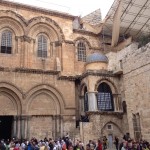
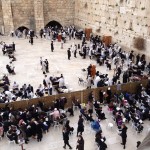
Over Spring Break, I was lucky enough to visit Israel and the West Bank with the Harvard College Israel Trek. During the several days we spent in Jerusalem, I was able to see in the layers of the Old City the manner in which this city had been fought over, divided, destroyed, built up, and shared by the People of the Book. The Holy City, viewed from the Mount of Olives, holds the secrets, the triumphs, and the tribulations of these three peoples like nowhere else in the world. At once, I could hear the call to prayer from the local mosques, the church bells of the various Christian denominations, and the rhythmic prayers from the Western Wall. I hope you enjoy the following brief photographic exhibit composed of pictures I took during my time in Jerusalem. I hope they serve to collectively evoke the multilayered histories of the People of the Book.