You are viewing a read-only archive of the Blogs.Harvard network. Learn more.
20 September 2006

Negative results

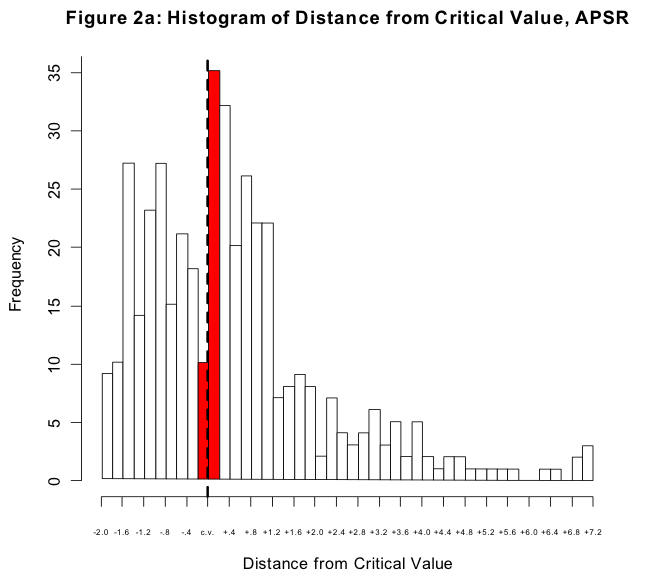
I’ve often complained to my colleagues that we pay far too little attention to negative results. Negative results from our data don’t tell us as much as positive results, but that hardly means that we learn nothing from them. At the very least, we can learn what directions have not worked out in a research program and what efforts not to repeat.

Thus, the following from over at Crooked Timber caught my eye this morning:

Now, if you write a paper describing negative results—a model where nothing is significant—then you may have a hard time getting it published. In the absence of some specific controversy, negative results are boring. For the same reason, though, if your results just barely cross the threshold of conventional significance, they may stand a disproportionately better chance of getting published than an otherwise quite similar paper where the results just failed to make the threshold. And this is what the graph above shows, for papers published in the American Political Science Review. It’s a histogram of p-values for coefficients in regressions reported in the journal. The dashed line is the conventional threshold for significance. The tall red bar to the right of the dashed line is the number of coefficients that just made it over the threshold, while the short red bar is the number of coefficients that just failed to do so. If there were no bias in the publication process, the shape of the histogram would approximate the right-hand side of a bell curve. The gap between the big and the small red bars is a consequence of two things: the unwillingness of journals to report negative results, and the efforts of authors to search for (and write up) results that cross the conventional threshold.
Technorati Tags: , ,

Posted in IvoryTower on 20 September 2006 at 9:07 am by Nate
11 September 2006

Holocausts of various sorts

The word “holocaust” denotatively means a destruction or consumption by fire. It came to stand in specifically for the Nazi’s machinery of the infatuation of the death of Jews, gays, gypsies, Slavs, and so forth because of the fire they used to destroy the remnants of their victims. Disease are often described as burning through a population, as being a sort of natural holocaust.

In the commemoration of the terror attacks of 11 September 2001 today, I’ve read or heard many of the victims’ survivors talking about the incomprehension of how so many people they knew could so immediately and simultaneously cease. How it shook their faith in some sort of Ultimateness. How it shook their understanding of themselves.

But this feeling has been nothing new to those gay men I know who saw everyone around them cease within a tiny bit of time. And it’s nothing new to those Jewish people who lived through the camps. Or to the Hutus in Rwanda. Or to countless others.

I’m not trying to downplay the very real wounds of that day five years ago. I, like everyone, can never forget that day: the images, the looks on faces, the phone calls from all over the world, the weeping student of mine whose father died.

I cannot make sense of this, and I don’t expect to be able to understand it rationally. But even so, we have to understand it in some fashion, so as to know when the evil of holocausts rises within each of us, overtaking us, and living on its own.

Technorati Tags: , , , , , ,

Posted in RmAuNsDiOnMg on 11 September 2006 at 11:50 pm by Nate
21 August 2006

Um, disturbing

More than 300 cats that look like Adolf Hitler.

I’m just disturbed by this. Not deeply, but still….

Technorati Tags: , ,

Posted in OnTheWeb on 21 August 2006 at 10:16 am by Nate
8 August 2006

Bikely nicely

A new site: Bikely.com is a social networking site for sharing your bicycle ride routes. Enter them into the database, and they get shared with site visitors, including a trace of the route on a Google Map.

Technorati Tags: , ,

Posted in OnTheWeb on 8 August 2006 at 9:39 am by Nate
25 July 2006

Floyd and doping

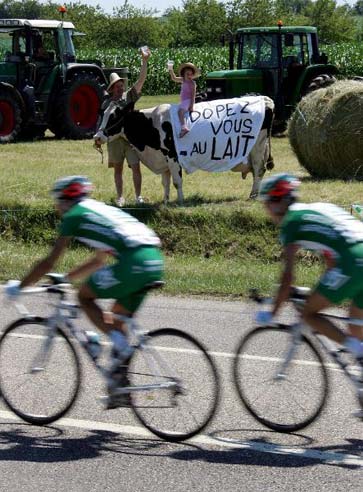
I wanted to believe that Tyler Hamilton hadn’t doped two years ago. I think Lance Armstrong probably doped at some point or another (which I don’t think takes away from his achievement at winning 7 straight Tours). (His achievements as a person, however….) And I hope that the only doping that Floyd did was this sort:

Dopez vous au lait!


Here’s some of the reasoning that I think helps to support the idea that Floyd hasn’t doped:

The numbers on Wednesday, Lim said, showed that Landis’s collapse was not caused by a single factor like lack of food or water. Rather, his bad day was much like what eventually happens to a sleep-deprived student at exam time: his overtaxed body forced him to take a break. After he slowed down and lost the lead, Mr. Landis’s average power output fell by about one-third.

Before cyclists began adopting illicit methods for boosting their levels of oxygen-rich red cells during the 1990’s, such events were so common that French riders called them “jours sans,” or “days without.” During this year’s Tour, which saw several favorites excluded because of doping investigations, jours sans have made something of a comeback.

For Landis, Lim said, the enforced break from the action during his collapse probably gave him an edge on the following, winning day.

Technorati Tags: , ,

Posted in RmAuNsDiOnMg on 25 July 2006 at 10:32 am by Nate
24 July 2006

DFW on life

I ran across this in a larger transcription of a speech David Foster Wallace gave at Kenyon College over a year ago. Just posting it for my own posterity and for general interestingness.

But if you really learn how to pay attention, then you will know there are other options. It will actually be within your power to experience a crowded, hot, slow, consumer-hell type situation as not only meaningful, but sacred, on fire with the same force that made the stars: love, fellowship, the mystical oneness of all things deep down.

Not that that mystical stuff is necessarily true. The only thing that’s capital-T True is that you get to decide how you’re gonna try to see it.

This, I submit, is the freedom of a real education, of learning how to be well-adjusted. You get to consciously decide what has meaning and what doesn’t. You get to decide what to worship.

Because here’s something else that’s weird but true: in the day-to day trenches of adult life, there is actually no such thing as atheism. There is no such thing as not worshipping. Everybody worships. The only choice we get is what to worship. And the compelling reason for maybe choosing some sort of god or spiritual-type thing to worship — be it JC or Allah, bet it YHWH or the Wiccan Mother Goddess, or the Four Noble Truths, or some inviolable set of ethical principles — is that pretty much anything else you worship will eat you alive. If you worship money and things, if they are where you tap real meaning in life, then you will never have enough, never feel you have enough. It’s the truth. Worship your body and beauty and sexual allure and you will always feel ugly. And when time and age start showing, you will die a million deaths before they finally grieve you. On one level, we all know this stuff already. It’s been codified as myths, proverbs, clichés, epigrams, parables; the skeleton of every great story. The whole trick is keeping the truth up front in daily consciousness.

Worship power, you will end up feeling weak and afraid, and you will need ever more power over others to numb you to your own fear. Worship your intellect, being seen as smart, you will end up feeling stupid, a fraud, always on the verge of being found out. But the insidious thing about these forms of worship is not that they’re evil or sinful, it’s that they’re unconscious. They are default settings.

They’re the kind of worship you just gradually slip into, day after day, getting more and more selective about what you see and how you measure value without ever being fully aware that that’s what you’re doing.

And the so-called real world will not discourage you from operating on your default settings, because the so-called real world of men and money and power hums merrily along in a pool of fear and anger and frustration and craving and worship of self. Our own present culture has harnessed these forces in ways that have yielded extraordinary wealth and comfort and personal freedom. The freedom all to be lords of our tiny skull-sized kingdoms, alone at the center of all creation. This kind of freedom has much to recommend it. But of course there are all different kinds of freedom, and the kind that is most precious you will not hear much talk about much in the great outside world of wanting and achieving and [unintelligible — sounds like “displayal”]. The really important kind of freedom involves attention and awareness and discipline, and being able truly to care about other people and to sacrifice for them over and over in myriad petty, unsexy ways every day.

That is real freedom. That is being educated, and understanding how to think. The alternative is unconsciousness, the default setting, the rat race, the constant gnawing sense of having had, and lost, some infinite thing.

Technorati Tags: ,

Posted in OnTheWeb on 24 July 2006 at 4:14 pm by Nate
15 July 2006

Letter to the Boston Globe

In reaction to today’s front page story:

To the editor:

Oh, boo hoo. Some residents of Provincetown signed a public petition on a vital, highly contested matter of public policy. They went on the public record — in a town known worldwide as a safe haven for gay and lesbian people — as opposing a basic civil right for a substantial portion of the population. And they are surprised when their action bears consequences and public reproval? Please.

Being called a “breeder” doesn’t even begin to compare with the words that gay and lesbian people get called on a regular basis, many of which cannot be printed in this paper. Nor does it compare with the actual physical danger that most gay people would face if they, for example, walked down a street in South or East Boston holding hands. And why does this incident become front page news when similar acts in the opposite direction don’t even rate coverage from the Globe? Worse slurs against gays and racial minorities get uttered here in Harvard Square each day, but the Globe writes nothing about that.

Marriage equality currently constitutes much of the public and political discussion in this state and country. The expression of even an opinion on the matter becomes a public and political act. Signing a petition to ask the state and its citizens to change the constitution is public and political act to an even greater degree.

Political philosophers and statesmen have long recognized that the only anonymous public act in a democracy lies in voting in an election. Everything else is on display, and rightly so. A public politics may make for some uncomfortable (and even regrettable) interactions. But such is the only way to preserve our democracy in spirit and in truth.

If the anti-gay-marriage residents of Provincetown go on the record as such, they should have the courage to accept the consequences of their convictions. And if they do not like the way that their interlocutors bring the matter up, those residents might try getting over it and themselves.

Sincerely,

Etc., etc.

Technorati Tags: , ,

Posted in Politicks on 15 July 2006 at 9:07 am by Nate
13 July 2006

Dixie the tiny dog

I found this on the web, wandering about in the dachshund part of the internet…. Apparently, it’s also a song.  Regardless, it does seem to describe the dachshund attitude quite well, especially the part about not being owned, just fed and bought.

“Dixie The Tiny Dog” by Peter Himmelman

I’m a tiny dog named Dixie
I have small feet which pitter patter on the linoleum floor, you can hear my toenails in the middle of the night
My tag says I belong to the Johnsons, but they don’t own me, they just feed me, they just bought me one day
No one owns me, I’m Dixie the tiny dog
And in the middle of the day I sit in the sun and I hear young children call me a weiner dog, perhaps that’s what I am
The Germanic term is dachshund, and I like that
I’m thin and I’m proud and no one can make fun of me
I can slip through the bars of a prison if I were ever incarcerated, but I don’t know what I would do wrong
My body yields no evil inclination, I’m a pure weiner dog
My name is Dixie, and I go dancing ‘cross the floor in the evening of the Johnsons when everyone is sleeping
Sometimes I look for a morsel of food, but they’re so clean they’re almost anal-retentive in their cleanliness habits and there’s nothing for me
But I don’t despair
Because I know tomorrow my Gaines Burgers will be there, and they will unwrap the plastic from them and then feed me this succulent dish, and I will eat
And oh, I’ve watched the German Shepherds with their long necks, their graceful necks, dipping into the toilet to drink whenever they want to have a drink of cool water in that well
But I must plead, I must beg, I must whine for Mr. Johnson to put out my bowl, or one of the Johnson boys to refill it after I drink it, because I’m Dixie the dog and I like water
And in the middle of the night you can see me dancing a small Fred Astaire tap dance, with my little toenails
They go click click click against the linoleum, and I run down the hall and I slide
And the back of my goes in front of me…slowly
I’m long and I’m thin, I’m Dixie the tiny dog and I like it.

Technorati Tags:

Posted in OnTheWeb on 13 July 2006 at 8:51 am by Nate

Breath of sensible air

Rowan Williams puts it nicely:

We may be in a thorough mess, but at least we shall not mislead anyone into supposing that the power and wisdom of God depend on the smooth coherence of the Church of England’s workings.

Technorati Tags: ,

Posted in Rayleejun on 13 July 2006 at 8:41 am by Nate
4 July 2006

Independence Day

I listen to Garrison Keillor’s Writer’s Almanac most mornings after I’ve gotten up, walked the dog, and made some coffee.

Today’s poem was the last stanza of what we know as “The Star-Spangled Banner.” Read it carefully, for it’s not as martial as you may remember, and it may even be an indictment of certain tendencies in American life.

Oh! thus be it ever, when freemen shall stand

Between their loved home and the war’s desolation!

Blest with victory and peace, may the heav’n rescued land

Praise the Power that hath made and preserved us a nation.

Then conquer we must, when our cause it is just,

And this be our motto: “In God is our trust.”

And the star-spangled banner in triumph shall wave

O’er the land of the free and the home of the brave!

And, in a funny note, Keillor points out the following:

On this day in 1931, James Joyce married Nora Barnacle at the Kensington Registry Office in London. They had been living together for twenty-six years. She once complained about Joyce’s late hours, “I can’t sleep anymore … I go to bed and then that man sits in the next room and continues laughing about his own writing. And then I knock at the door, and I say, now Jim, stop writing or stop laughing!”

On a completely different note, we’re fascinated by Portuguese Man O’ Wars this morning, because there have been a number in Massachusetts Bay of late. Did you know that they’re actually not jellyfish? They’re actually made of four animals living in symbiosis.

Posted in Books on 4 July 2006 at 9:10 am by Nate