Archive for October, 2015

We Sinful Women

Wednesday, October 28th, 2015


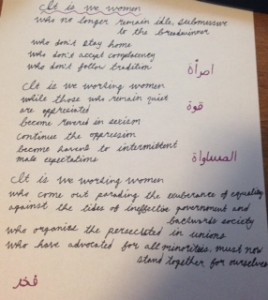
We Sinful WomenMuslim Poem

 Originally reading the background of the authors and then their poems, it was clear feminists writings from women in the middle east are particularly moving given much of the oppression present in this region of the world. Having now read and discussed the significant impact of language, in particular, poetry in Islamic culture, the poems can be read as the highest form of argument through which the women writers present their point. I enjoyed many poems, especially “O God of Heaven and Earth” which I would have been happy to explore, however I settled on We Sinful Women because I felt it had the most feminist undertones and transcended time in a way that few pieces can. As a result, I felt the best way for me to deepen my understanding of the poem and how it could still apply today would be to attempt my own. Written more in the voice of a 21st century western woman, I felt as if the poem could easily be transcribed to any period with any group of woman that suffered from discrimination and inequality. Writing in this perspective was a unique experience for me and forced me to not only sympathize but empathize with women from both the middle-east and western society. Regardless of the problems encountered by women, there is a uniting factor that oppression carries which ultimately leads to its downfall. For this reason it is interesting to compare various works written by the oppressed and study how deeply seeded their resentment for dehumanization is and how easily it spreads and relates to those who share their circumstances.


Children of the Alley

Wednesday, October 28th, 2015

Islamic Presentation Being Catholic, the religious allusions were immediately apparent. However what also became apparent was the virtual nonexistence of comparable Christian literature. In this story the author embraced each religions major character while it would be very difficult to find such work written by a Christian or Jewish writer. I thought this interpretation spoke more to the importance of the idea of these religious figures as opposed to the physical characteristics of the people which are shamelessly quarreled over. This idea inspired my collage which is composed of the various people alluded to in Children of the Alley and their images as seen by various societies across the world. It features a black Jesus, a Jewish Jesus, a middle-eastern Abraham and many others. The point is not their image but rather what they stand for and I think that this is realized when seeing all these different figure together. With Islam embracing and acknowledging the significance of the multitude of Jewish and Christian figures, many of whom appear in the Quran, it takes a place as a religion that can understand its peers much better than those of other faiths understand Islam. It is likely that this is a blessing and a curse. A blessing because Islamic people are less likely to divert attention to religious fanatics because they understand the misinterpretations of those fanatics, be they Christian, Jewish or of another faith. However it is a curse because of the significant amount of people who do not understand basic Islamic teachings and thus are subjet to gross generalizations as a result of their own religious extremists.

Rethinking Contemporary Islam

Wednesday, October 28th, 2015

Three Pictures

This has been far and away the most impactful piece I have read this semester. My knowledge of Islamic culture and faith was limited to new reports and fictional literature, which I now realize may have been worse than having no knowledge at all. Three things that stood out to me and provided context throughout the future discussions I learned from this reading. The first was the context of the versus that discuss Muslim actions towards muslims and non-muslims. Muhammad was suffering under the persecution of Middle Eastern Jews and Christians and thus would likely have been speaking out of the necessity of his own safety. The differences in Sunni and Shia was the second piece of information I collected from the readings and discussion. I found it very interesting when juxtaposed to different Christian sects. The differences in Islam come from the descendants of their most esteemed prophet, while in Christianity these differences arise as a result of specific biblical interpretation. And can essentially be attributed to the verse Matthew 16:18, in which both Catholics and Protestants reference in support or denial of a singular head of church. The final lesson I take into account when contextualizing prior discussions is the hierarchy of Islamic leaders and the plethora of diverse interpretations that range from state to state, school to school, and religious leader to religious leader. This has specifically helped me in dialogue on contemporary literature which requires an underlying understanding of Islamic culture. My first discussion was with Professor Ali in which I was directly able to discuss these three elements I drew from the article. Doing this allowed me to further generalize each point and broaden the scope through which I could apply it. My picture is a combination of the three settings integrated into one to provide a tangible reminder of what I need to be aware of when reading contemporary texts.


The Wedding of Zein

Wednesday, October 28th, 2015

Wedding of Zein

I really liked this story because of the uniqueness of the character Zein and the responses it elicited form my classmates. Among many great points, one that I hadn’t thought of was the feminist implications of Zein and the treatment of women throughout the story. While I viewed the women’s glorification by Zein as not necessarily misogynistic or sexist, I realized the view of many of my peers was that while Zein’s behavior may have not been intentional in objectifying women, it led to the objectification of those girls he admired through-out the village. Even the mom’s wished for their daughters to be pedestaled by Zein because it quickly led to a more qualified suitor approaching her daughter. The women were also subject to much controversy in our discussion. Their image is supposed to be one of virtue, chastity and modesty however the closest girl to transcending this paradigm, Ni’ima can only do so because she fits this image. In what is slightly paradoxical Ni’ima struggles with her forced conformity to the structures of the society. However it is unclear how she would react to being in such a position is she was poor and ugly. Surely her physical attributes make it easier for her to carry herself above the expected behavior of a woman in this society. This story also featured the presence of an Iman in what was seemingly a critique of the Islamic hierarchy and authority of these religious leaders. The Iman often elicits an action contrary to how he intended his message to be interpreted. This is a result of his out of touch expectations and poor communication skills. This fact originally escaped me but after reflecting on the first week’s readings after our group discussion about the Iman in the story and the general place of them in society, I felt much more comfortable with identifying the purpose of his presence in the story. The picture illustrates the prevalence of the characters and Islamic stereotypes based on colors. The more color in the figure, lead by Zein and Ni’ima, the truer the character holds to the author’s view of Islam.

Hello world!

Monday, October 26th, 2015

Welcome to Weblogs at Harvard Law School. This is your first post. Edit or delete it, then start blogging!