Archive for March, 2014
Shi’i Garden and Ta’ziyeh Theatre
Wednesday, March 19th, 2014Week Five Blog – Shi’i Garden and Ta’ziyeh Theatre
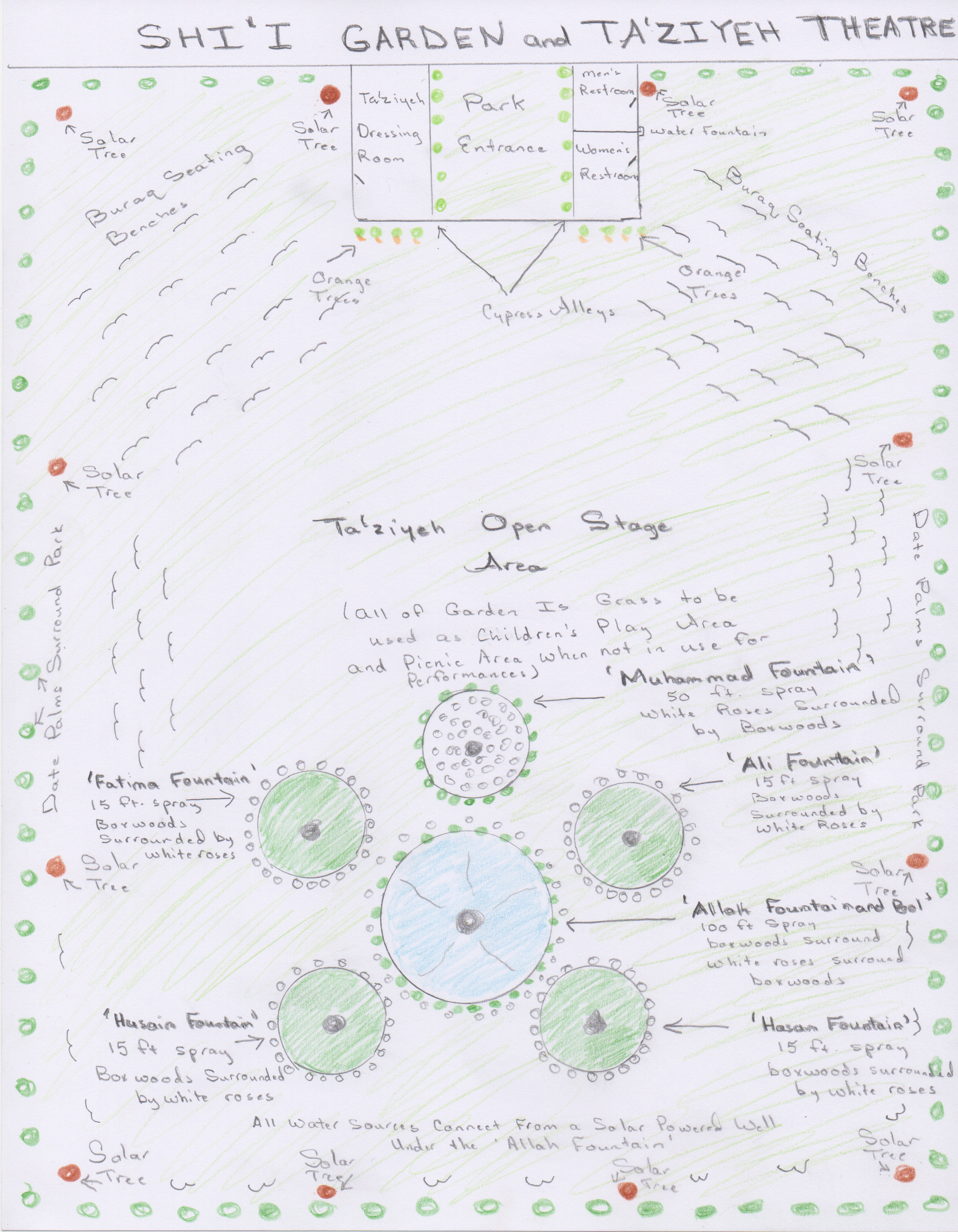
Wednesday, March 19th, 2014Ta’ziyah Theatre Park – Shi’i GardenWhen reading the fascinating articles edited by Peter J. Chelkowski, Ta’ziyeh Ritual and Drama In Iran and also reading The Miracle Play of Hasan and Husain I was deeply inspired by the unique and unusual religious passion play . I wanted to create a beautiful environment for the Ta’ziyeh Ritual to be seen by a large audience in a big city. Gardens in Muslim countries are viewed as a vision of paradise so I thought that I would create a large garden that would have a performance area. I wanted to use Shi’i imagery and symbols for the garden to reflect the early background of the Ta’ziyeh plays and the Shi’i interpretation of Islam.
Professor Asani showed a diagram in class of five small circles surrounding a larger circle that I thought would be useful for the water features in the garden. The circles represent the importance of the family of Muhammad. Muhammad is at the top, with Ali and Fatima below, and Hasan and Husain below them. The middle circle represents Allah. These circles would become water fountains surrounded by flower beds. All of the fountains would be fed from the same source of water , a well that sources the “The Allah Fountain”, and this would symbolize the continuous connection with God. The “Allah Fountain” is surrounded by a large pool and has a 100 foot spray going in five directions towards the other fountains. It would be surrounded by green boxwoods with white roses surrounding the boxwoods. Professor Asani mentioned that white roses were associated with Muhammad, so for the “Muhammad Fountain” I have a 50 foot water spray surrounded by white roses and edged with green boxwoods. In our reading it was noted that the family of Muhammad were often clothed in green in the Ta’ziyeh plays. The other four fountains for Ali, Fatima, Hasan, and Husain each have 15 foot water sprays and are surrounded by green boxwoods with a boarder of white roses – to emphasize their connection with Muhammad.
All of the water fountains and irrigation are fueled by solar powered palm trees with the solar panels shaped like large palm leaves. These solar trees also provide light for the performance and in the evening provide park lighting. The entire park would be grass, surrounded by date palm trees. Orange trees, with their beautiful scent, would flank the park entrance and a Cypress alley lines the entrance to the park. At the entrance their are restrooms, a water fountain, and the Ta’ziyeh dressing room. The large open grassy stage area can also be used as a children’s play area and picnic area when not in use for performances. Unique Buraq shaped seating benches surround the open stage area.
I hoped to create a garden that had unique symbols that would be understood by Shi’i Muslims and that could also be environmentally sound. I also wanted to create a beautiful gathering place for children and adults that would also preserve the tradition of the Ta’ziyeh performances.Ta’ziyah Theatre Park – Shi’i Garden
Week Three Blog – The Qur’an
Wednesday, March 19th, 2014The importance of the Qur’an is at the heart of what it means to be a Muslim. For Muslims, the Qur’an is the word of God, as revealed to his Prophet Muhammad. This week we listened to, and read about, the recitation of the Qur’an in various parts of the world, examined the art of calligraphy and the Qur’an, and also read about some unique practices involving the Qur’an in different Muslim cultures. Kristina Nelson discussed the divinity of the Qur’an in her article, The Sound of the Divine in Daily Life, and stated, “The Qur’an is considered the miracle of Muhammad’s prophethood. The proof of its divine source is in its inimitable euphony, eloquence, and wisdom, for Muhammad was neither poet nor sage, but an unlettered merchant. Most Westerners find the claim to the Qur’an’s inimitable beauty baffling, for they have had access only to the written text, whether in translation or in the original Arabic. The ears hear more than the eyes see in the written text, and it is only in the sound that the full miracle is realized. Thus, while the meaning of each word may be translated from the Arabic, the Qur’an itself is untranslatable” (Nelson, 258). Abdullahi Asman El-Tom in his article Drinking the Koran: The Meaning of Koranic Verses In Berti Erasure discussed the importance of memorizing the Qur’an and the unique practice of drinking the Qur’an among the Berti of the northern Darfur Province of the Republic of the Sudan, “The Koran is regarded as containing divine power; thus, to possess the Koranic texts renders an individual powerful and protects him against misfortunes and malevolent forces. The highest form of the possession of the Koran is its commitment to memory, which amounts to its internalization in the head, the superior part of the body, whence it can be instantly reproduced by recitation. But the Koran can also be internalized in the body by being drunk. Although drinking the Koran is seen as being far less effective than memorizing,it, it is superior to carrying it on the body through the use of amulets” (El-Tom, 416).
I was deeply moved and inspired by the film that we saw in class “Koran by Heart”. During the film the recitation of the Qur’an took place, often with eyes shut, and seemed to transport the reciter into another world. Often the children did not understand the Arabic words that they were saying but they were still deeply moved by the powerful words of the Qur’an. Girls and boys from all over the world took part in the Qur’an recitation competition. Kristina Nelson discussed the transcendent quality of Quranic recitation and observed, “Quranic recitation is more than an art” and that “The meaning of the Qur’an is not restricted to the words: the meaning transcends the words” (Nelson, 259). Sometimes the children were so engrossed in their recitation that they were moved to tears. In my collage I wanted to show the beautiful and luminous faces of the young Qur’anic reciters as they were transported by the sound of the Qur’an recitation and the sense of achievement that they felt. I was able to find a photo of the young girl from the movie, who was struggling with her father in the search of more education and opportunities, and was very happy to put her in the collage.
In the collage children who are reading and reciting from the Qur’an surround the opening pages of, what I felt to be, the most beautiful version of Qur’anic calligraphy. Irvin C. Schick talked about the divine origin of the Qur’an and the importance of calligraphy in his article Writing the Body in Islam and noted, “This divine origin has burdened Muslims with the important mission of preserving the word of God in a worthy vessel, and that is precisely the impulse that lies at the root of the art of Islamic calligraphy. The holy mission with which Arabic writing is thus charged has in turn endowed it with a special status in Islamic culture: the script that preserves the word of God is perceived as a Godly script. In this regard, the identification of Arabic script with the religion of Islam is profound and perhaps unequalled” (Schick, pg. 2). The manuscript that I chose to use is the opening pages of a Qur’an from Turkey from the time of the Ottoman Dynasty. The original manuscript was painted in ink, various colors, and gold on paper. The art of calligraphy is seen at it’s best in this glorious manuscript. I put the first verse of the Qur’an surrounding the Qur’an and then surrounded it by the faces of the children as they recited the verses. I wanted to use the real faces of Islamic children from a wide range of ethnic backgrounds to show the diversity within Islam and that the Qur’an is a uniting element within the Islamic faith. These children also show great beauty in their commitment and sincerity as they connect, internalize, and commune with God. While the collage turned out rather awkward – it is a great reminder of a lovely movie that gave me my first understanding of a “living Qur’an” and exemplified Kristina Nelson’s thought about Quranic recitation, “The ears hear more than the eyes see and that it is only in the sound that the full miracle is realized” (Nelson, pg. 258).
Week Two Blog – Mary Petersen-Unger
Wednesday, March 19th, 2014In week two many of the readings dealt with the difficulties of understanding the Qur’an and the different levels of understanding the Qur’an. I was feeling a great deal of frustration. I felt that I would never be able to gain any, but a slight cursory, access to what Muslim’s believe to be the divine word of God. How could I possibly grasp an understanding if even many of the translations were fraught with errors and misunderstandings as was discussed in the article by Ziauddin Sardar, Reading the Qur’an – The Contemporary Relevance of the Sacred Text of Islam? As Sardar pointed out, a translation can only present an interpretation of the Qur’an (Sardar, pg. 41). I wanted to understand the actual living words revealed by God to the Prophet Muhammad! What is it in the Arabic language that would draw people to tears when they were reading the Qur’an? Sardar, a Muslim from Pakistan, wrote about the warm feelings he felt when his mother read the Qur’an to him when he was young and how he was able to internalize the Qur’an through her reading, “…for mothers start reading the Qur’an and getting the child to repeat the words, again and again, till the Arabic sounds become familiar and can be recited from memory. And so it is that our connection to the Qur’an is infused with associations of the warmest and most enduring of human bonds. The Qur’an enters our lives as an integral part of home and domesticity, the environment in which we become aware of ourselves as a person” (Sardar, pg. 3). As a westerner how was I ever going to have this kind of warm association and intimate knowledge of the Qur’an? Sardar spoke about the difficulty of accessing the Qur’an, “The Qur’an does not yield its meaning without a struggle with its text. To see the significance of an allegory or metaphor, to separate the truth from the simile, the eternal from the transient, the universal from the local, one has to struggle with words and concepts, contexts and interconnections, and the structure and style of the Qur’an. This is not an easy or quick task. It requires effort and patience” (Sardar, pg. 11). My poem expressed the frustration that I was feeling during week two over trying to understand the Qur’an without understanding Arabic and with little understanding of the Muslim faith.
Sardar points out four reasons that scholars have used against translating the Qur’an from Arabic: The supposed superiority of the Arabic language; the unifying of Muslim nations of one faith and one language; the problem with translations being an interpretation of the Qur’an; and finally that translations could subvert the meaning of the Qur’an (Sardar, pgs 41-42). Sardar gives a final justification for the need for translations of the Qur’an, “Moreover, it would be an odd God who, having established diversity and citing different languages and people as one of His signs in the Qur’an, then proceeded to defy it by requiring that He can only be understood in a single language” (Sardar, pg. 41). I finally came to the conclusion that I would just need to let myself absorb the Qur’an over time. The only way that I would have any understanding of the Qur’an would be through absorbing the beauty of the Arabic language and the words, even though I would not be able to understand them, and by closely examining the artistic endeavors that have been created by followers of the Islamic faith. With a completely open heart and mind I would hopefully come closer to understanding the religion. Perhaps understanding Arabic will be in my future – but at this point I will need to rely upon translations, however imperfect, and to listening and looking at the various art forms to give me an understanding of the Qur’an and of Islam.