More evidence of problems with distance education at Harvard

distance education at Harvard Extension
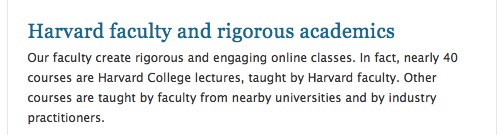
Distance education marketing material from Harvard Extension School

It’s so disappointing to hear about experiences like the one described below, but at the same time, I am not at all surprised. It’s the story of yet another earnest student signing up for distance education at Harvard Extension School, hoping to get access to “Harvard faculty and rigorous academics” and “engaging online classes” (as the ad above describes) and instead being treated to this:

Last term was my first semester at HES and I was surprised at the lack of assignment and test feedback that I received in the courses.

In my first course, I didn’t receive a grade or comments back on a ten page essay that was worth 15% of my final grade or on my final exam that was worth 25% of my final grade.

In my second course, I never received any feedback or grade on a book review that was submitted in mid-November, on 50 page group project, or on the final exam. In the aggregate, these three items represented 55% of my final grade.

My third course consisted of a series of smaller assignments worth either 5% or 10% of my final grade each. The instructors provided grades and comments for most of these assignments, but at the end of the course, feedback and grades for the final couple of assignments wasn’t provided.

The responses to “DesertDog” are telling. “Unfortunately your experiences are not foreign to me,” said one person, who has been taking distance education courses for years at the Extension School. Another Extension School student said, “Last semester, I took a course and did not receive notification of any grades until the final grade was posted at the end of the semester. I got no feedback at all. It was quite frustrating,” A third online education student reported that “Some of my professors didn’t give me any feedback on my final projects and essays even when all the final grades were posted and even while I asked them several times.”

Defenders of distance education at Harvard fight back

I’ve written about distance students being given a watered-down distance educational experience by the Harvard Extension School in the past (see “A sad day for the Harvard Extension School” to read yet another case). The usual responses? “You don’t know what you are talking about!” (even though I have taken distance education for credit) and “how dare you belittle distance education students!” (even though I am criticizing the Extension School and its policies, as opposed to students who try hard to get a good education).

Of course, not all faculty teaching distance education at Harvard Extension School are unresponsive. But regular reports like the ones above are a sign that many students feel misled about the Extension School’s promise of access to Harvard faculty and a true Harvard experience.

Stanford free classes review: “Online lectures suck”

Stanford free classes reviewThere has been a huge buzz in the world of computer programming and online education over Stanford’s move to open up computer science lectures to the public. The ambitious move to offer free Stanford classes takes online learning beyond the model established by MIT OpenCourseWare — not only can members of the public have access to some of the highest-quality college-level instruction on the planet, but they are taking the same classes as Stanford students.
But not everyone is satisfied with the offerings. A Stanford student who tried one of the classes on machine learning says it was watered down and provided a poor substitute for in-person Stanford lectures. Here’s an excerpt of his Stanford free classes review:

… Since the video lectures were excellent in the class, I’ll start with the programming exercises. At the beginning, some of the programming assignments were challenging since I wasn’t used to matlab/octave programming or machine learning. However, the level of difficulty dropped off drastically as the quarter progressed. At its worst, I completed a few programming assignments without even knowing that the corresponding lectures had been released (I have never done machine learning in the past) …

… If these classes are going to be labeled as Stanford classes, then they should be taught as such. CS229a has by far been my easiest CS class (besides maybe the final project) I’ve taken at Stanford. Normally, I wouldn’t have had a problem with this, except now that Winter quarter registration has opened and I have found that half of my classes are now open to the public in the online format, I’m worried that the rest of the classes will follow this trend. If all of my classes suddenly become as easy 229a, I will be seriously disappointed. I came primarily to Stanford to learn and study – classes like CS229a don’t satiate that desire. Perhaps it’s a fluke and the other online classes will be much more difficult, but it is still worrisome. Stanford needs to keep rigor even in their online courses – it’s useless to lower the bar so low that it only takes a small step to get over. …

… Online lectures suck. Sure, they’re great for rainy days or people learning at a distance or people that don’t go to Stanford. However, these new classes are getting rid of in-person lectures completely. I met barely anyone in my CS229a class. Everything was done alone in my room, which is kind of crappy especially when there is such a nice campus right outside. If Stanford is going to offer these classes, then by all means offer them, but don’t make students take them as well. Have the professors teach as many students as they can in-person and the rest can watch online.”

(Be sure to read the reaction in the comments at the bottom of the post. There is more discussion of the class and Stanford’s online lectures on Hacker News)

Stanford free classes: A watered-down educational experience?

The concern about content being watered down is also valid one — the school apparently put the interests of the public ahead of its own students, which understandably does not sit well with them. However, there are several ways to serve both populations without sacrificing the interests of either group, such as not watering down the content or keeping the two groups separate when it comes to designing for-credit content.

As for issues with the online format, this post should be a wake-up call for Stanford administrators and people who assume that online coursework can be substituted for an in-class learning experience. While there are benefits, there are many pitfalls. I’ve been a critic of online education for years, based on the developments I’ve seen at the Harvard Extension School as well as my own experience taking an online precalculus class for credit at UC Berkeley.

Opening up education to everyone via the models established by OpenCourseWare and Khan Academy lets learners get access to once-exclusive knowledge, and is an admirable goal. But when watered-down online coursework is offered as an equivalent of an in-class experience, or are offered for credit, that’s when the value proposition is thrown into sharp focus.

(Interested in learning about programming with jQuery? My company publishes a book about jQuery plugin development.)

Harvard Extension School citation program killed off

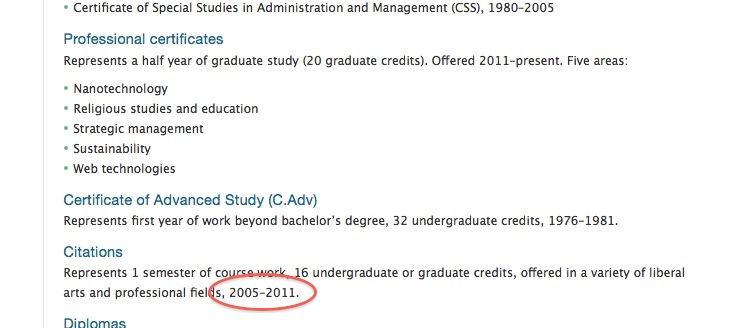
Spotted recently on the Harvard Extension School website: Evidence that the Harvard Extension School citation program has been killed off:

Harvard Extension School citation program 2005-2011

The Harvard Extension School citation program was good while it lasted. It let people who wanted to concentrate in a specialized field show their accomplishments and differentiate their degree — a significant issue for people in the Liberal Arts ALM, who don’t receive diplomas that reflect their course of study.

But the rules were terribly frustrating, in terms of what counted and the relatively short window for completing it. I sent this email to the school in 2008 asking about the possibility of getting a citation, based on my coursework and research:

I am a soon-to-be ALM graduate (History), and I have a question about citations. I see from the Extension School website that the window of opportunity for a citation in East Asian Studies lasts three years, and I would like to know if the following four courses — which were all taken and completed within a three-year period, starting in the summer of 2004 — would count. They are:

  1. ANTH S-171 – Archaeology of the Silk Road
  2. HIST E-1834 – Chinese Emigration in Modern Times
  3. History S-1855 – Film and History in Postwar Japan and Post-Mao China
  4. HIST E-499 – ALM Thesis (Title: Making a Case for Quantitative Research in the Study of Modern Chinese History: The New China News Agency and Chinese Policy Views of Vietnam, 1977-1993.)

You may recall that I asked about this a few years back, but that was before I completed my thesis, under the direction of Alastair Iain Johnston, the Governor James Albert Noe and Linda Noe Laine Professor of China in World Affairs. Getting such a citation would accurately reflect my overall studies at the Extension School, considering much of my coursework and all of my thesis research at the Extension School has been on East Asian history — especially China.

The answer: No, because the thesis didn’t count. This was despite the fact that the thesis was directly related to modern Chinese history, was directed by a tenured faculty member and expert in the field, and took 10 times as much effort than any single class at the Extension School.

In addition, I had taken another eligible class in early 2003 (History E-1830: The Emergence of Modern China). But again it couldn’t count toward a citation, as it was outside of the three-year window for a citation — hardy a rare occurrence, considering most students don’t have the luxury of being able to take classes so rapidly and certain courses aren’t offered every semester.

Harvard Extension School citation vs. Harvard Extension School certificate

Back to the retirement of the Harvard Extension School citation program. According to two curt emails sent to me by the Harvard Extension School staff member in charge, the school discontinued the citations in favor of Harvard Extension School certificates.

This doesn’t make sense. Certificates have nothing to do with most liberal arts master’s degrees offered by the Extension School, which was the focus of the citations. Rather, certificates are a profitable, short-term continuing education scheme for people in various industries, although the program page notes you can apply the course credit in four out of the five programs to professional ALM degrees. Several of the certificates, such as Web technologies, are entirely online — no face-to-face contact with fellow students or instructors required!

If you are earning a liberal arts ALM, and wanted to get additional recognition for your work in a certain field, you are out of luck. But that’s no surprise. The liberal arts character of the Extension School, not to mention the in-person classroom experience taught by Harvard professors that defined the Extension School experience beginning 100 years ago, has lately been given short shrift, in favor of scalable, impersonal online coursework that limits contact with actual Harvard professors and is oriented toward profitable professional education. I won’t get into that here, but you can read more about my thoughts on these and other Harvard Extension issues.

Another Harvard Extension School impostor

(Update at bottom) There is another sad tale of a Harvard Extension School student attempting to pass himself off as a Harvard College freshman. (Or maybe not; the person claims he went to the Extension School, but the school hasn’t confirmed it). I say “sad” because similar tales erupt every few years. They involve people who so want to be part of an elite group, that they lie about their backgrounds and use tricks to dupe other members of the Harvard community. Sometimes crimes are committed by the impostors, while at other times the friends or contacts from the larger Harvard community feel like their trust has been abused.

That’s bad enough. But there’s another element, too. When cases of Harvard Extension School impostors are exposed in such a public fashion, they perpetuate the notion that Extension School students are trying to pass themselves off as Harvard College students. I once thought these were isolated, rare examples. But I’m sorry to say that the more cases I see like this (at least four that have been reported in the press), coupled with vague or misleading claims by some Extension School students and alumni (e.g., saying “I’m a Harvard graduate” but going out of their way to avoid any mention of their Extension School affiliation), the more I realize that there are quite a few Extension students who have unhealthy identity issues and/or obsessions with the Harvard “brand”. It distracts from the positive experiences and contributions that many other Extension School students have made during their time at the University, and reflects poorly on us all. Thanks to the coverage in The Crimson of these cases, many or most of the members of the College classes from 2000-2015 have been exposed to news of Extension School posers actively misrepresenting themselves in an attempt to be viewed as Harvard College students.

How to fake being a Harvard College student

The Crimson has the story about the latest case:

… A 27-year-old student at Harvard Extension School was escorted out of Weld Hall on Thursday by Harvard University Police Department officers after sleeping in friends’ rooms in the freshman dormitory and telling students that he was a freshman at the College.

Over a period of two months, the Extension School student told Harvard College students that he lived in Weld, a dorm in Harvard Yard. He sometimes spent the night there when invited by freshman acquaintances.

The student also created a presence at Harvard online, posting frequently to the Harvard University Class of 2015 Facebook group and becoming friends on the social networking website with Harvard students he had never met in person. Pictures of him taken in freshman dorms and posted on Facebook added to his credibility, acquaintances said. Since Thursday, his account has become unsearchable and his posts to the Harvard freshman group are gone.

He was convincing enough with his words and online social networking profiles to dupe many students, including staff at the Crimson, who featured him in a magazine special earlier this year. But others knew he was lying, as he wasn’t in the Freshman Register and needed help getting access to certain buildings.

The Harvard Independent has more details about the ruses he used, as well as the text of a police report indicating stolen property (an ID card) was involved. He admitted to The Crimson that he lied about his College status and forged an ID card.

A lot of information is being disputed (read the comments of the Harvard Independent article), and there are allegations that the administration is trying to keep it out of the media, but it’s sure to be noticed. While the charges against him are relatively minor, his time at Harvard is over and the story is not good for the Extension School.

Update: The backlash has started. The story has spread to the national media (Gawker and HuffPo) and lots of negative comments on many of the articles. See the linked Crimson article, above, to understand the tone of the conversation.

What do people sell on Craigslist?

I have compiled a large dataset of what people are selling on Craigslist. This is for my mobile classifieds startup (UPDATE: the app is no longer available). The small release is from Boston Craigslist only, and it’s only raw percentages. One interesting finding is how vehicle-related classifieds dominate Craigslist. Another is the huge swings among some categories, depending on what time of the day/week/year the sample is taken. Read the Invantory blog post to learn more.

Craigslist -- online communityI have other Craigslist data as well, including estimates of market size, average price, and data from other times and from other areas. I’ll probably release some of it in the weeks or months to come, but really want to focus on our new software platform for local classifieds.

One interesting fact about the dataset is the connection to my Extension School studies. My ALM thesis was based on a computer content analysis of a news database to discern various policy trends. For many months, I spent my nights and weekends sitting in front of a computer screen, copying and pasting results from the LexisNexis Academic to a gigantic Excel spreadsheet, and then taking sample news articles and subjecting them to a computer content analysis using a software program called Yoshikoder. The Craigslist data was compiled in a similar way. While I didn’t use Yoshikoder this time around, I did perform a manual coding process on the Craigslist Boston data which I used to create market sizing estimates. To learn more about my ALM thesis at the Extension School, google “Harvard Extended” and read the first entry.

Harvard Extension School Admissions: Is it hard?

I hear a lot of anxiety from prospective degree candidates about Harvard Extension School admissions. They are worried about whether or not they will be admitted to their respective programs at the Extension School. One recent example involved an out-of-state student who wanted to join the Museum Studies ALM program. He emailed me after reading my blog about Harvard Extension, and was clearly very worried, particularly because he felt his undergraduate GPA was too low. He also had taken classes at other educational institutions. Could he get in to the Harvard Extension School?

My response:

… Don’t worry about admissions. I have NEVER heard of anyone who meets the stated admissions requirements of an EXT degree program being rejected.

And the requirements for admission are very clear: If you meet the Extension School GPA and course requirements (3 Extension School classes, including the recommended classes, with a 3.0 average), have an accredited degree from an undergraduate institution, answer the essay questions and other admission packet requirements, and pay the fees … that means you’re in.

You graduated from [redacted] with a diploma; therefore your undergraduate GPA does not matter. Besides your undergraduate degree, as long as you have taken the required EXT classes and gotten the minimum GPA, there is nothing stopping you from matriculating.

Even if you screw up the admissions essay (unlikely for anyone who has taken the prerequisite classes and gotten a 3.0 GPA), they will send the essay back, tell you what’s wrong, and ask you to resubmit.

Your other grades from [redacted] and any other educational experience has no bearing on your application.

Seeing as that you have graduated from college, the most important thing for you to do to get into this program is to start taking the recommended EXT classes and making sure you do really well at them. You don’t have to be a Mass. resident to apply to the Extension School, but I advise any student interested in the Extension School to relocate to Cambridge in order to get a true Harvard experience and real interaction with Harvard faculty, students, and facilities. For the Museum Studies program, this is a requirement, as there are few online courses available for this major.

My piece of advice in the last paragraph about taking classes on campus applies to all programs. If you want a Harvard education, being on campus is crucial. I think the current forms of distance education at the Harvard Extension School are providing students with an incomplete Harvard experience, usually with little or no interaction with faculty and fellow students. I have written about this extensively in the past, including on my Harvard Extension School blog:

Online education is a huge growth area for the Extension School, but the technologies used today are not a suitable replacement for in-class instruction and discussion. Unlike traditional face-to-face classes at the Extension School, contact with Harvard faculty in the online classes is limited. Even though many distance education students work extremely hard on assignments and tests, watching videos on the Extension School website and participating in limited online discussions does not represent a “Harvard-caliber” academic experience, as the Extension School claims. I strongly disagree with the Extension School’s liberal online credit policies, which allow students in the undergraduate ALB and graduate ALM in IT programs to complete upwards of 90% of their coursework online, without ever sitting in the same room with their classmates or professors. Tellingly, neither Harvard College nor Harvard’s professional schools offer online classes to their own students for degree credit.

I have additional thoughts about online education at the Harvard Extension School here on the Ipso Facto blog.

One last thing: If you read the above information, and still have questions about Harvard Extension School admissions, don’t ask me. Pick up the phone, and call the Extension School to speak with an admissions advisor. It costs nothing, and will save you lots of time and unnecessary worry. The number is (617) 495-9413.


A sad day for the Harvard Extension School

Dean Shinagel has just served notice that the Extension School will no longer try to build its core competencies based around live instruction and interaction with real Harvard faculty. Rather, more convenient, scalable,  and profitable “distance education” is the future of the Extension School, and the next Extension School dean will be charged with “leading Harvard’s efforts in online learning, distance education, and the productive use of technology in pedagogical innovation, as well as shape our academic curriculum for the future, a positive move for the continuing success of Harvard Extension.” The note doesn’t even mention traditional in-class education, which for more than 100 years has given a high-fidelity, interactive educational experience featuring exceptional Harvard faculty to hundreds of thousands of students.

A future based on online education is not necessarily a “positive move,” nor is there any proof that the Extension School’s academic programs will be “strengthened.” Indeed, Shinagel has in the past acknowledged many serious limitations of distance education. I have extensively discussed this in my review of his book “The Gates Unbarred.”

I’m not the only critic. Professor Michael Sandel, Professor Harry Lewis, and the Extension School’s own technology director Henry Leitner have all expressed reservations with current online education systems (Sandel: “I don’t believe that it’s possible fully to replicate the in-person classroom experience using new technology”), although Lewis and Leitner insist that technology will at some point in the future solve the limitations of in-class instruction.

Tellingly, not one of these professors has publicly advocated for Harvard College students or graduate students at Harvard’s professional take online classes for credit. Rather, the Extension School’s students serve as guinea pigs for Shinagel’s grand educational experiments, and are even encouraged to take a majority of their degree credit online, despite the limitations reported by faculty, students, and Shinagel himself. If online education is not good enough for the rest of Harvard, why is it being forced on the Extension School?

Complaints from students should be setting off alarm bells at FAS. I have cited some examples in earlier blog posts, but I also spotted this on the ExtensionStudent.com message board:

… Most of my distance classes were recorded lectures of College classes from the current semester. I had problems in both of my prerecorded classes that were related to the fact they were prerecorded and the professors were not involved. In one class, I had an outstanding TF and she made a huge difference; in the other things went badly and students complained. The professor was not accessible and this was not explained prior to the start of the class. It might not have mattered if the TF was great, but he wasn’t. …

I had a horrible time trying to fill general requirements when I was physically there. A happy mistake changed my final three classes from requirements to electives, but if it had not, I would not have graduated this past spring. I needed in-person only classes and it was slim pickings.

These problems — inaccessible faculty, poor or nonexistent feedback, and limited in-person class options — will only get worse as a new dean charged with prioritizing online education.

Update: More evidence of problems with distance education at Harvard