Harvard Extension faculty and the Harvard Instructor requirement

So you’re thinking about attending the Harvard Extension School, or you want to know more about the degree programs. A common question that prospective candidates have is whether students are taught by real Harvard faculty. Others are interested in whether Harvard Extension faculty are tenured professors at the University.

The short answer: It depends on the concentration and the classes being taken.

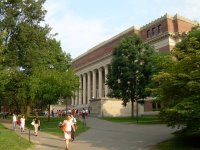
Instructors with appointments at Harvard Widener Library
Harvard Widener Library

Looking at the Harvard Extension Faculty Directory, the first page of results contains numerous associate and assistant professors, lecturers, and preceptors from FAS, the Harvard Medical School, the Harvard School of Public Health, Widener Library, and other units. The page also lists faculty from other area universities (Boston College, Suffolk, Northeastern, UMass, etc). There are many non-academic-affiliated instructors, too, who teach in the Extension School’s professional programs.

Generally speaking, the liberal arts and science classes are more likely to have Harvard faculty, including tenured professors. The Extension School has a “Harvard Instructor” requirement for the liberal arts masters degrees, requiring 7 out of 9 courses to be “a faculty member with a teaching appointment” at Harvard.

Harvard Extension faculty and Harvard Summer School classes

However, the school has different rules for Summer School classes. All Harvard Summer School instructors are regarded as Harvard Instructors, even if they don’t have a teaching appointment. That’s not just for Extension School students taking Summer School classes; a similar set of rules apply to Harvard College students attending the same classes — most on-campus Summer School coursework counts for credit for attending Harvard College students, with some conditions. Online classes offered by the Summer School cannot be taken for credit by Harvard College students, though.

I was a history concentrator in the Extension School’s Master of Liberal Arts program from 2003-2008, taking all of my classes on campus. Here’s the Harvard/non-Harvard faculty breakdown:

  • 2 classes taught by tenured Harvard faculty members
  • Thesis project directed by a tenured Harvard faculty member
  • 1 class taught by a non-tenured Harvard lecturer
  • 2 classes taught by Harvard post-docs/research affiliates
  • 1 class taught by a visiting professor from Boston College
  • 1 class taught by a visiting professor from Northwestern
  • 1 class taught by a visiting professor from Western Michigan University
  • 1 class taught by Museum of Fine Arts research affiliate

The 3 or 4 courses I took during the summer generally had non-Harvard instructors, but counted toward the Harvard Instructor requirement based on the Summer School exception described above. The Northwestern and Western Michigan lecturers had received AB/JD and PhD degrees from Harvard and had visiting scholar affiliations at Harvard, while the late Professor Thomas H. O’Connor of Boston College was considered the leading scholar in his field.

For other liberal arts concentrations, it’s possible to choose classes so most or even all instructors are tenured Harvard faculty or tenure-track professors. I know students who have done this, or even applied for (and received) Special Student status to take GSAS/College classes taught by Harvard faculty.

As for the professional programs (Finance, Digital media arts, etc.) there are no longer any Harvard Instructor requirements. This is not surprising, considering many of the topics being taught have no equivalent in Harvard College or any of the professional schools. Practically speaking, this means it’s possible to receive a degree from Harvard without ever taking a class with Harvard faculty. It’s ridiculous, and reflects very poorly on the Extension School, as I noted in another post several years ago:

… The professional degree programs have failed to fit the model established by the Extension School to offer a Harvard academic experience led by Harvard faculty members to students. It further sets a precedent for launching new professional degree programs that have no connection to the University’s existing areas of study, and opens the door to criticism that Harvard Extension School degrees aren’t “real” degrees because they no longer represent study under Harvard’s top-notch faculty.

I advise students considering these programs to make every effort to take actual classes with real Harvard faculty. For some fields, it’s impossible because there are no Harvard instructors available or willing to teach in these areas. But for others, there may be course offerings from time to time. In the ALM Management program, as of 2020 it is possible to select some courses taught by tenured faculty, including faculty from the Harvard Business School:

V.G. Narayanan is the Thomas D. Casserly, Jr., Professor of Business Administration and has been teaching accounting at Harvard Business School

For online courses, there is an additional dimension to Harvard Extension faculty participation: Whether the classes are “live” with a participating professor, or whether they are prerecorded lectures with no opportunity to interact with faculty. In such classes, online discussion and assignments are handled by non-faculty TAs. Many students don’t know this before they sign up, and are disappointed by the experience, as one student discovered:

… Most of my distance classes were recorded lectures of College classes from the current semester. I had problems in both of my prerecorded classes that were related to the fact they were prerecorded and the professors were not involved. In one class, I had an outstanding TF and she made a huge difference; in the other things went badly and students complained. The professor was not accessible and this was not explained prior to the start of the class. …

In summary: If you are looking for a real Harvard experience, take as many classes on campus with real Harvard instructors as you can.

Harvard headlines: Clickbait and the Extension School

Last week there was a flurry of Harvard headlines, after a male student attacked a senior citizen at Logan airport. I won’t get into the details of the story itself, but wanted to talk about the sensationalist coverage and the collateral damage to the Harvard Extension School.

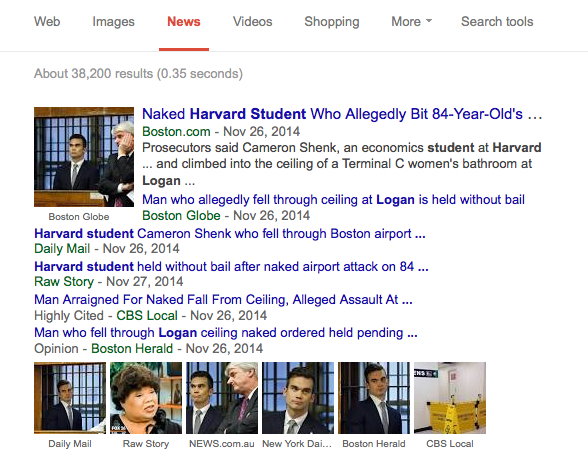
When the story first hit the Internet, it was all about the Harvard connection:
Harvard headlines extension school
Many of the initial headlines, including those from Boston .com, the Huffington Post, and other national and international outlets, omitted the fact that the student, Cameron Shenk, was an Extension School student. In the absence of such context or knowledge of the Extension School, many people skimming the news would assume it was a Harvard College student, even though Mr. Shenk and his lawyer did nothing to insinuate otherwise. It’s a common assumption, as I’ve cited repeatedly on this blog (see my earlier article about Harvard Extension School resume guidelines).

Predictably, when the Internet commenters and follow-on coverage appeared, the angle turned from tragic crime to criticism of the Extension School and its students. Boston .com’s Eric Levenson claims that Extension School students “just need an interest to learn and some money to spend,” neglecting to mention the wide gap between casual class takers and degree candidates who have to prove they can do coursework at a high level before being admitted.

As I said in the comments section of the Boston .com article, there are a couple of issues at play when it comes to mainstream media stories about the Extension School:

  1. Clickbait headline writers who want to play up any story involving weird/unstable/criminal behavior and “Harvard”
  2. A continuing education division that is not well understood (for example, there are casual class takers as well as degree candidates) and often gets defined by strange headlines or fakers.
  3. A student and alumni population which includes a fair number of people who are apt to play down their Extension School affiliation or deliberately mislead others into thinking they attended Harvard College or one of the highly competitive professional programs, such as the Business School.

I think journalists such as Eric Levenson deserve much of the blame Unfortunately, previous stories about Extension/College imposters, combined with a large number of alumni who claim “Harvard” while hiding “Extension” are adding another negative context to this story.

It’s unfortunate, because the Extension School has some great classes and degree programs, and have helped hundreds of thousands of people further their educational goals. Most of them are good people and are honest about the Extension School affiliation, yet the fakers and bizarre headlines are increasingly defining what it means to be an Extension School student.

I welcome your comments below.

Harvard Black Mass debacle and the damage to the Extension School

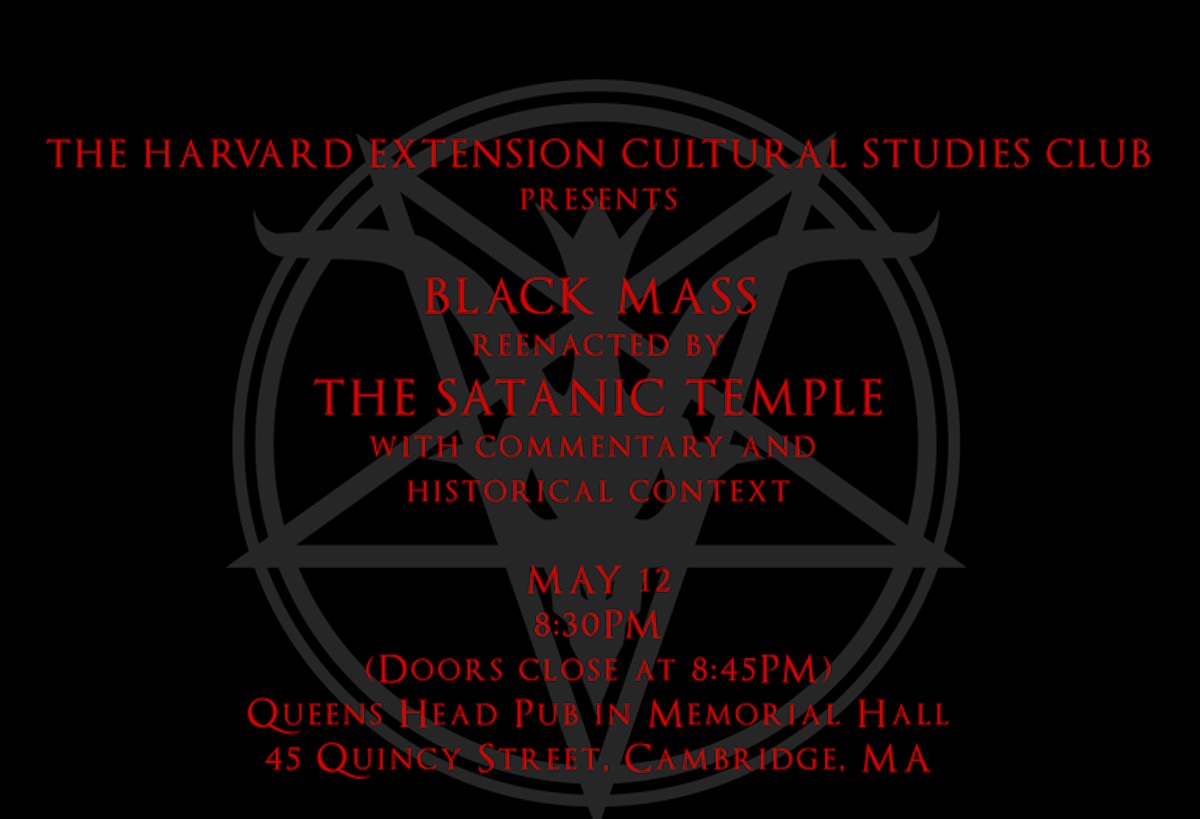
Harvard Black Mass flyer
Harvard Black Mass announcement (click to see full size)

Once again, a Harvard Extension School club has caused great offense on campus. In 2011, it was a student group inviting a panel of anti-gay Christian conservatives to campus. Yesterday, it was the Harvard Extension School Cultural Studies Club inviting a New York Satanic society to campus to hold a “Black Mass”, a deeply offensive ritual meant to mock core Catholic beliefs. The Harvard Black Mass event, originally scheduled to be held in the basement of Memorial Hall, was moved to the Hong Kong restaurant after outrage exploded across campus and the national media.

There should be little surprise that the event drew such outrage. Boston is still a heavily Catholic town, and the event’s Harvard association magnified the interest and controversy. But I was saddened to see the frustration directed at Extension School students who had nothing to do with the event. I was also disappointed in the poor response by the Extension School and the non-response by Extension School student leaders, namely the officers of the Harvard Extension Student Association (HESA).

Reaction to news of Harvard’s Black Mass

The comments on The Crimson website in reaction to the Harvard Black Mass news illustrate how the reputation of the Harvard Extension School and its students became collateral damage, with some people going so far as to call into question the necessity of the Extension School:

Harvard ’14 Lowell House:

I hate this school. Especially demoralizing that this is coming from the extension school.

Increase Mather:

Most annoying about this is the fact that people reading/hearing about this stupidity in the media will not focus on that word “extension,” which basically means this is an organization of random people who paid Harvard a couple hundred dollars to take a dumbed-down evening course. They are not “Harvard students,” and in most instances they are not even taught by “Harvard faculty.” They are outside posers who use Harvard’s classrooms in the evening — period. Then they go around either lying by omission — “When I was at Harvard” — or outright — “I graduated from Harvard,” ultimately damaging the brand for all the rest of us simply by being who they are and claiming to be who we are.

We have enough problems with controversy generated by legitimate Harvard students and faculty. Why is it that this sort of thing always seems to come from extension school students or visiting “executive education” pole dancers in the business school or some other abomination abusing Harvard’s good name?

Quoiquilsoit:

Why are the Extension School and its students included in “Harvard?” When last I looked, the Extension School provided a way for a limited number of local people to pay and physically attend courses by Harvard faculty and earn, conceivably some day, in the case of a very few of them, a peculiar degree–not a BA. This must have been an exercise in 19th century-style Community Relations. Care has always been taken to keep these locals rigorously segregated from “real Harvard students.”

It seems to me that EdX renders this instrumentality, with all the questions it raises as to selectivity of admissions and the rights and discipline of Extension students, finally obsolete. Our faculty doesn’t need the very modest supplemental income.

Assuming academic integrity, quality and degree content could be assured, which they could right now, I feel great assurance that even so, and despite accelerating advances in medical science, no one capable of reading this will live long enough to see the day when degrees are awarded to EdX students (who, in contradistinction to Extension, are NOT “Harvard students”). The reasons for this are entirely financial.

But, OK. Why go on offering some weird degree? Lop off the decorative old branch and let EdX grow, even though it won’t be green.

This is not the first time that the Harvard Extension School’s reputation has been tarnished by the actions of individual students. Negativity has been brought to the fore when fake Harvard College students with Extension School backgrounds are outed or Extension Student alumni publish C.V.s that avoid mentioning their Extension School affiliation.

Official Response To The Black Mass Event From The Harvard Extension School

The Extension School’s response to the Black Mass was to portray this as a student free speech issue, and attempt to equate the Black Mass with other club events, such as a Shinto tea ceremony. Meanwhile, the elected leaders of HESA — including the director of club affairs — were nowhere to be seen. This would have been an opportunity to reject the Black Mass as totally offensive and unwelcome, and point out that the actions of a few naive and misguided students do not reflect the attitudes of the rest of the student body.

For the Black Mass event, the cultural club went through the trouble of creating an online flier (since removed from weebly) but I couldn’t find any record of the names of the club officers. The organizers of the Black Mass were defended by Harvard on the grounds of free speech rights, but nowhere did they actually have to clearly identify themselves or stand behind their pronouncements.

My advice to Harvard, the Harvard Extension School and HESA: If clubs from any part of Harvard can use “free speech” as a reason to organize any event on campus, then the club organizers have to publicly take responsibility for the event and any fallout or damage that transpires. If club leaders insist on anonymity, then they shouldn’t be granted official club status — and the events should take place off campus.

See also: Harvard Extension School success stories from the past year

Harvard Extension School ALM in Management vs. full-time MBA

(Updated) I received an email from a prospective student asking about the Harvard Extension School’s ALM in Management program. He wanted me to compare the ALM in Management vs. a full-time MBA.

In my reply, I noted that I have never taken any ALM in Management classes. My ALM concentration was history. But I have followed the Management program since it was introduced and have a full-time MBA under my belt, and feel qualified to make some comparisons.

Harvard Extension School ALM in Management vs. MBA: Where the programs differ

From my point of view, while the ALM in Management has a price that’s hard to beat, it does not compare with a full-time MBA. Here’s where I think the ALM in Management program comes up short:

  1. There is no cohort experience, vital for building a network that can serve you long after after the program concludes. The Extension School has made some moves to boost the sense of community and establish limited cohorts, a positive step.
  2. Even though many of the classes are similar to those you would find in a business school, the ALM in Management degree is technically not an MBA. It’s a liberal arts degree in management (!). This fact may cause skepticism among some potential employers.
  3. Many instructors are not Harvard faculty, and there is no affiliation with the world-famous Harvard Business School (however, HBS faculty are now apparently allowed to teach HES courses, see below).
  4. While online classes are a lot of work for students, they are not a substitute for in-person learning experiences. Extension School students have complained about some of the deficiencies in the past.
  5. Some recruiters view any part-time business degree with skepticism.
  6. Among recruiters, the reputation of the school has been damaged by HES graduates who have omitted their Extension School background on their resumes. In some cases graduates have innocently followed the Harvard Extension School resume guidelines, but in many cases there have been deliberate attempts to portray themselves as graduates with a Harvard MBA or Harvard College degree.

In other words, it’s a mistake to assume the ALMM is like a Harvard MBA lite. That said, I think there is real value in some of the on-campus classes that expose students to important business concepts. There are takeaways that can be brought back to the workplace, or help students shift their careers in a new direction. For students who cannot enroll in a full-time MBA program, ALM in Management classes are an attractive alternative.

2020 Update: At one time the ALM Management faculty list did not have any faculty with Harvard Business School affiliations, but that has now changed, as the example below demonstrates. It’s a great development, and an opportunity for ALM Management students to study under HBS faculty.

V.G. Narayanan is the Thomas D. Casserly, Jr., Professor of Business Administration and has been teaching accounting at Harvard Business School

See also: Harvard Extension School success stories from the past year


Harvard Extension School résumé guidelines are bogus

If you are a graduate of the Harvard Extension School, how should you list this accomplishment on your résumé, or on LinkedIn?

That’s easy. You type “Harvard Extension School” in the place where the university name is supposed to go. For the degree name, write out “Bachelor of Liberal Arts” or “Master of Liberal Arts”, or type the official designation, ALB or ALM. Then add “Museum Studies”, “History”, “Biology”, “Information Technology”, “Management”, or other concentration in the place where the field of study is listed.

Simple, right? It clearly identifies the school you attended, the degree you received, and what you studied.

However, for some Harvard Extension School graduates, it is not so simple. For evidence of this, take a look at this comment on a recent Atlantic essay about the Extension School:

I have a master’s degree from Harvard obtained through the HES. My diploma says Harvard University (in latin no less). I have had headhunters and recruiters question me on it and state that it was misleading for me to list Harvard University as my school. My diploma says Harvard University, my classes were all taken on campus at Harvard (before online classes were popular), so many had to be taught by Harvard professors and not instructors, I completed all the degree requirements. I don’t see anything misleading and I don’t know how else to list it on my resume.

The headhunters are right. It is misleading. Every student and alumnus at Harvard identifies with the school he or she is affiliated with. Harvard Medical School students will tell people they go to the Harvard Medical School, or “the Med school.” Harvard Business School students identify with the “B-school” or HBS. Law School. Divinity. Ed school. Kennedy school. And so on.

To outsiders, things are a bit different. “Harvard” or “Harvard University” is synonymous with “Harvard College” in the eyes of the public, and many people in the corporate world. At the graduate level, “Harvard University” is associated with the Graduate School of Arts & Sciences programs that lead to MAs and PhDs. The Extension School is very different than the College or the advanced programs in GSAS.

As for the comment that she doesn’t know how to list the name of her school on her resume, why not list “Harvard Extension School”?

This question gets to the heart of the identity issue. Some graduates don’t want to admit they attended the Harvard Extension School – even though Harvard Extension School transcripts enable some graduates to take up advanced study at Harvard, Oxford, and elsewhere, other Extension School graduates deliberately take advantage of the “Harvard University” umbrella to mislead people into thinking they attended highly selective College or GSAS programs. Indeed, every few years in The Crimson there are reports of Extension School students (matriculated or not) insinuating or outright claiming to be College students to other people at Harvard. It happens all the time.

But there’s another possibility: The Extension School tells its graduates that it’s actually OK to use “Harvard University” as long as graduates also include the bogus “in Extension Studies” designation when spelling out the name of the degree (NOTE: The guidelines changed in 2014; please see the update at the bottom of this post):
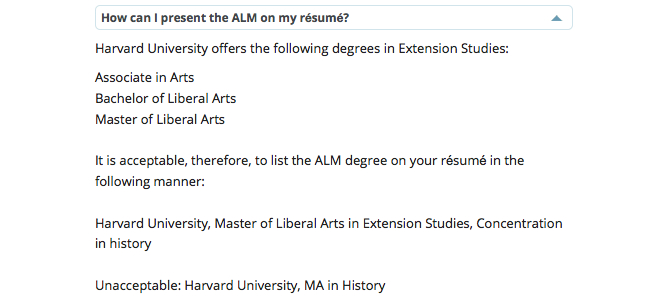
Harvard Extension School Resume Guidelines

No one at the Harvard Extension School majors in “Extension Studies”, so why do we have to state this on our résumés? The only reason I can think of is to compensate for the misleading use of “Harvard University”. But if you are clearly stating the name of the school (e.g., Harvard Extension School) instead of “Harvard University” there is no need to add this inaccurate and demeaning qualifier to the name of the degree.

The requirement to use “in Extension Studies” can cause real problems, as one ALB graduate found out a few years ago and described on a now defunct online Extension School forum:

Want to add my 5 cents to the problem. I graduate with ALB in 2014; currently enrolled in ALM, Software Engineering.

For the last 6 months I’ve been looking for jobs in the US (I’m a remote foreign student). HES doesn’t provide student visas for foreign students, so it was already a challenge to find companies that would even consider interviewing someone with a US degree, but without a temporary permit to work after graduation (so called OPT). I was aware of that from the very beginning, but didn’t expect to that so few companies actually work with foreigners without experience. In case you’re interested, I didn’t get a single offer in Boston even though I tried really hard to move there. Luckily NYC and San Francisco were much more visa-friendly cities.

After I found a couple of companies who were ready to interview despite the required visa sponsorship and almost lack of experience, I had to explain “liberal” part of the degree name (nobody actually paid attention to “Extension School” words). It wasn’t too bad since most HRs and engineers I talked to were more interested in my actual knowledge and whether I can confirm that I know the things I listed in my resume. Liberal/extension “flaw” wasn’t much of a concern for them (including big companies, e.x. Google, Microsoft). And I personally felt fine about that since my program of study really wasn’t that rigorous compared to the college one (I skipped a couple of math classes that I wasn’t interested in).

However, after I got a job offer and started to work with the lawyers the real troubles came into play. The degree officially says “in extension studies” rather than “in Computer Science” whereas the transcripts specify concentration (sciences), field of study (computer science) and a minor (thesis/research). The lawyers immediately saw an inconsistency between transcripts and the diploma. For a couple of days I was explaining to them how HES works, provided links to the web site and even contacts of HES admission office for further inquiries. In the end, my attorney said that they’ll have to send my degree for special evaluation to confirm Computer Science concentration because the transcripts specify one thing and the diploma a different one.

I’m sure it will all work out and I’ll get an additional paper from some evaluation service that will confirm that my degree is a real computer science degree, but Harvard should feel embarrasses that lawyers have to send a degree from Harvard with transcripts to verify the field of study mentioned in the transcripts.

In short, I don’t complain about “liberal” arts or requirement to specify Extension School in my resume and about frankly explaining to employers what school I attended and why. I slightly object the lack of F1 support because that wasn’t the case before 2009. However, I strongly feel that the degree conferred in Harvard Yard in Tercentenary Theatre with all other Harvard diplomas should not be a subject for any additional verification or legal doubts.

This young student is absolutely right. There should not be any doubt or questioning about the degree he received, yet he was subjected to something that graduates from other Harvard schools would never experience. Three stupid words — “In Extension Studies” — threatened his ability to work at a job that he was otherwise qualified to do. (Note, however, that some Harvard Extension School grads have been able to get jobs at major tech companies, such as this ALB grad who got hired by Google).

A convenient excuse

Of the Extension School graduates who do state “Harvard University” on their resumes and LinkedIn profiles, most leave out the required “In Extension Studies” label that the Extension School demands. Their argument: “Harvard Extension School is one of the 13 degree-granting schools, therefore I have the right to use ‘Harvard University’.” It’s a convenient excuse that lets them sidestep the stigma and questions from colleagues and recruiters. The comment above as well as many of the responses to this blog post reflect this attitude.

There is an exception to the official Harvard Extension School résumé guidelines: People who have completed the ALM in Management (ALMM) program are supposed to use “Harvard University” and “Extension School”, but not “In Extension Studies”. Here’s the screen shot from the current Extension School website (NOTE: this is no longer accurate, see 2020 note at the bottom of this post):
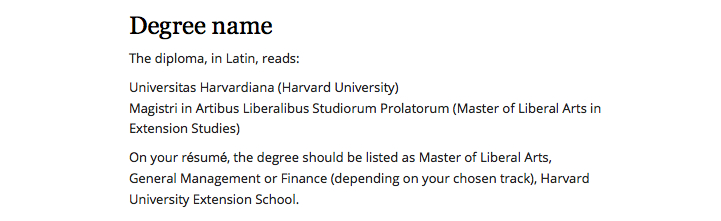
Harvard Extension School ALM Management resume guidelines

Why this exception? My guess is the Harvard Business School got tired of fakers running around suggesting that they had completed the Harvard MBA program …. or the Extension School wanted to avoid friction with the B-School.

The Old Guidelines Were Bogus, Too

It should be noted that the guidelines have changed several times since I started the original Harvard Extension blog. For instance, the 2008 website’s official resume guidelines did not require “Extension Studies” or “Extension School” anywhere:
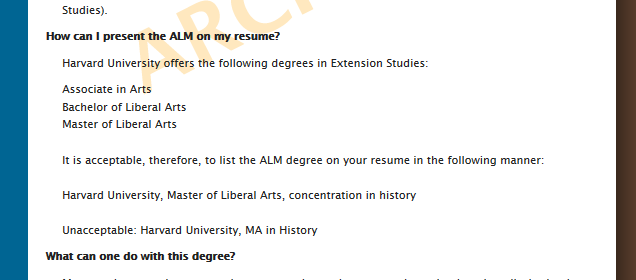
old Harvard Extension School resume guidelines

I never followed those guidelines, either. I felt “Harvard University, Master of Liberal Arts, Concentration In History” was misleading and not representative of the degree that I earned through the Extension School. It could easily be confused with a Harvard GSAS degree. I have always used “Harvard Extension School” on my LinkedIn profile and paper versions of my resume, and clearly state this fact on this blog and elsewhere.

Bottom line:

  1. Be proud of your school. As anyone who has completed the ALB or ALM programs know, it requires years of dedicated study and some extremely challenging academic requirements, from the Harvard Extension School admissions requirements to the ALM graduate thesis. People who take online classes have it even harder, as there are no nearby students to turn to for support and it’s often impossible to ask questions during class or interact with faculty.
  2. The Extension School’s official guidelines obfuscate the degree and serve no one except for those graduates who want to claim “Harvard” on their resumes while avoiding the actual name of the school (no longer true since the Extension School updated its guidelines to allow “Harvard University Extension School” while dropping “in Extension Studies”).
  3. If you insist on using “Harvard University” on your resume while knowing that most people reading it will assume it refers to Harvard College or GSAS, you’re either fooling yourself or are deliberately misleading people. When people find out, it not only makes you look bad, it reflects badly on all of us.
  4. Be clear about where you attended school at Harvard, and be clear about what you studied. People expect it, and it’s the right thing to do.

2014 Update: A comment on this post in October 2014 alerted me to the change in the official guidelines. The school now allows two methods of listing your Extension School degree on your resume:

  1. Bachelor [or Master] of Liberal Arts, Harvard University Extension School. Include concentration or field of study, minor, and degree honors when applicable.

  2. Bachelor [or Master] of Liberal Arts, Extension Studies, Harvard University

Clearly the school wants alumni to include “Extension” somewhere in the listing.

2019 Update 1: Another comment on this post notes that the guidelines have changed yet again. Now, the concentration is removed:

On your résumé, the degree name may be listed as either:

Bachelor [or Master] of Liberal Arts, Harvard University Extension School.
Bachelor [or Master] of Liberal Arts, Extension Studies, Harvard University.

But “Extension” is clearly stated in both cases.

2019 Update 2: An Extension School fan/follower says he received via email the following clarification from the Extension School regarding how to list degrees on resumes/CVs, which follows the 2014 guidelines:
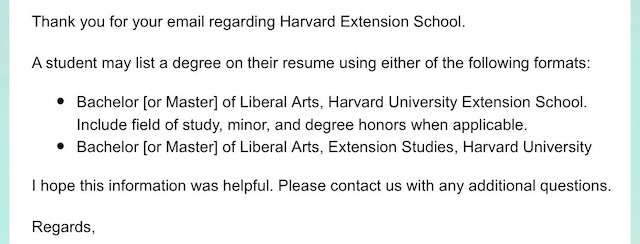
Harvard Extension degree listing via Jay Waters 052219

However, as of May 22, 2019, the Extension School website still shows this:
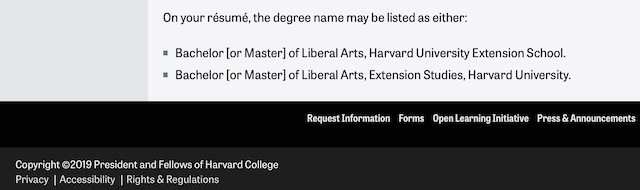
Harvard Extension School resume listing May 2019

Meaning anyone who reviews the official Harvard Extension School guidelines on the Extension School website will still think it’s not OK to list the concentration. That is, it’s either “in Extension Studies,” or nothing.

As someone noted on Twitter, “It’s absurd to think it’s unethical to mention your concentration or field of study on your resume.”

2019 Update #3: The Harvard Extension School has reverted the language back to 2014, thanks to a persistent supporter and (I suspect) Dean Huntington Lambert being tagged in a Twitter thread about the issue. First, what the site now says:
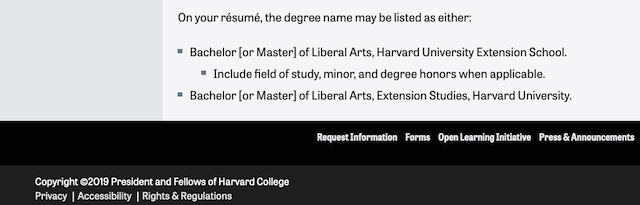
Harvard Extension School diploma listing

Second, the context as explained in an email to a Harvard Extension supporter:
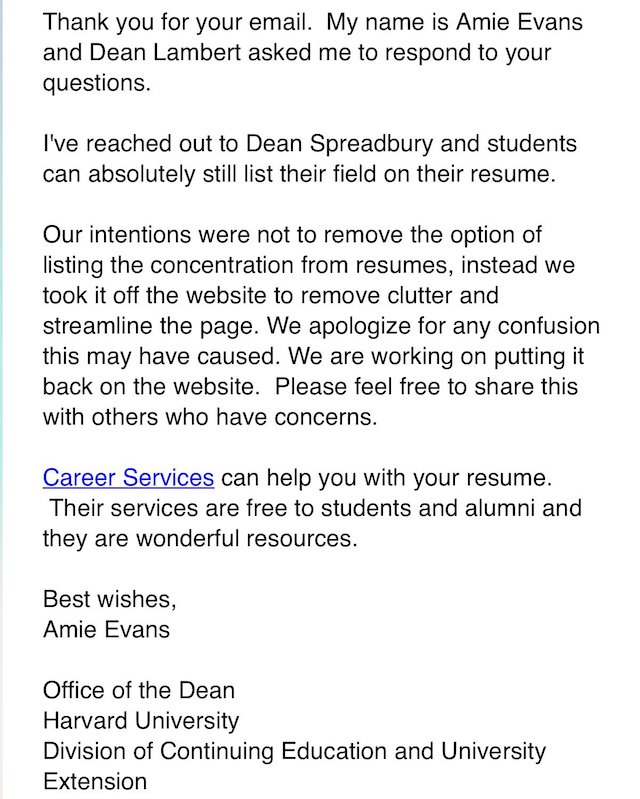
Resumes are important to HES alums and new grads, and it seem amazing that the web page explaining the official resume guidelines would be treated so cavalierly. I give credit to Lambert and his staff for quickly correcting this oversight, but it also makes me wonder what else has been stripped away from the official Extension School website in order to “reduce clutter.”

2020 Update: A comment by Laura alerted me to the fact that the official resume guidelines for ALM Management degrees are now grouped with the guidelines for other Harvard Extension School degrees.

See also:
 

RIP: Professor Thomas H. O’Connor

Professor Thomas O'Connor. Photo: Boston Globe
Professor Thomas O’Connor. Photo: Boston Globe

I was saddened to learn of the death of Professor Thomas O’Connor, one of the great historians of Boston’s modern history. I took a class with Prof. O’Connor at the Harvard Extension School in 2005 — his last, as it turned out. On the final day of classes Dean Shinagel came into the lecture hall with a small marching band to present an award.

Professor O’Connor absolutely deserved it. He was a marvelous instructor who had an innate grasp of the life of the city from Colonial times to the present, and really explained the commercial/political/social forces that shaped the modern city. He was a great storyteller, and brought Boston politics from the early 20th century to life with interesting anecdotes and asides.

Professor O’Connor was also a witness to many of the historical trends he discussed. He grew up in South Boston, and saw urban renewal, the bussing crisis, and the terms of many important mayors, including Mayor White and I believe Mayor Curley.

Worth sharing is this quote in the preface of The Hub:

“By eventually adapting to change and accommodating itself to modern ways — although at times grudgingly, often angrily, and almost always slowly — Boston has continued to be a live, functioning urban community that has not given into the nostalgic impulses that can so often turn a once-famous city into a lifeless historical shrine. …

The most serious challenge Boston faces in the future, however, is not longer confined to the construction of high-rise buildings, multilane highways, or extravagant commercial developments. The current challenge is the extent to which Boston will be able to retain its own distinctive identity as a city whose moral standards, civic virtues, and intellectual accomplishments once inspired a nation.”

(2001)

Professor O’Connor had a way of making his large classes feel personal. For instance, I remember him talking about the jazz clubs he used to frequent as a young man, or what Scollay Square used to be like before successive Boston mayors (Curley, White, Flynn) changed the face of the city with various urban renewal projects.

He will be missed.

What do students think about online education?

What do students think about online education?The Chronicle of Higher Education has a great two-part feature, “Did anyone ask the students?” It’s an absolutely relevant question that is missing in almost all discussions of the future of higher education (for evidence of this, look no further than last week’s Harvard’s edX announcement and related coverage, which featured lots of administrators and experts talking, but not a single student.)

Anyway, back to the Chron article. The writer, Jeff Selingo, went out and talked with hundreds of students at all kinds of colleges (SNHU, Georgetown, Arizona State, the University of Central Florida, Valencia College, Franklin & Marshall College) and asked them what they thought of the technological revolution that’s blossoming across higher education. He got some surprising answers, particularly concerning the value of online education. Although the students have grown up in an online, mobile world, and have these technologies deeply integrated into their lives, they see huge value in the face-to-face educational experience:

Face-to-face education matters even more now. Because these students see the world through screens (mobile, tablet, and laptop), I expected them to embrace the idea of online education. Just the opposite. They want to engage with a professor and with their classmates, they crave the serendipity of classroom discussions, and they want the discipline of going to class. Even the adult students I met preferred a physical classroom. Online “you’re pretty much paying to teach yourself,” a Valencia student told me. “It’s like text messages. There’s no tone of voice.”

That doesn’t mean these students like everything about traditional higher ed. They’re over the lecture, they like the idea of “flipping the classroom,” and they do seek out online resources to brush up on certain subjects. “A lot of professors are petrified by online classes,” one Georgetown student said. “They really want to improve the classroom experience.”

However, there is some sample bias here. The students Jeff talked with are already talking in-person classes. Talking to online students, some different perspectives come up. I have written extensively about online education at the Harvard Extension School. Some students lament the lack of contact and interaction with Harvard professors and their classmates. But others who put more of an emphasis on convenience, such as this ALM in IT student who didn’t see much value in attending Extension School classes in person:

The [Harvard Extension School] doesn’t offer an internet degree yet, to Kendra Kratkiewicz’s regret. This semester, she’s forced to make the long drive from Billerica to Cambridge as she toils toward her master’s degree. Nothing would please her more than a chance to complete her Harvard education without having to show up at Harvard.

In the rush to celebrate the convenience of sitting in front of a computer at home, Harvard Extension School and some of its students forgot how important face-to-face interaction is.

Shaquille O’Neal’s UoP master’s degree brings out the haters

Shaquille O’Neal received his doctoral degree in education last week. It wasn’t an honorary award — he earned it from Barry University, a private Catholic institution in Florida. It’s an admirable achievement that required lots of hard work, both on campus and off — he took many courses through distance education, but also had presentations and other activities on campus, as in the photo provided by Barry (the other person in the photo is David M. Kopp, Chair of the Organizational Learning and Leadership and Human Resource Development Programs).

Shaq doctorate degree - Shaquille O'Neal attended UoP
Shaquille O’Neal attended UoP and later earned a doctorate degree

But I noticed an interesting thread in the Gawker story about Shaq’s graduation. The entertainer and former basketball star received a master’s degree from the University of Phoenix prior to getting his doctorate from Barry. The Gawker story only mentioned Shaquille O’Neal’s UoP degree in passing, but it brought out a lot of spirited comments, many of them highly critical of University of Phoenix degrees.

MicMutt started off the thread with this comment:

Does “a Master’s degree from University of Phoenix” even mean anything?

A bunch of sarcastic comments followed (“It means your check to the University of Phoenix cleared”, “I hope so, that’s where I received my MD. Surgery rotation was cake”, etc.). But there was a serious response, too:

aaxan:

Lots of companies (and government agencies) pay for their employees to return to school for MBAs and such, and a substantial number of those people end up at UoP. It’s one of the top destinations because a lot of the time the employee just needs those extra letters behind his/her name, and the curriculum isn’t really that different from any other program.

However, one UoP supporter fired back at MicMutt with this:

You know what, if I ran a business I would take a UofP MBA over a BC/Columbia MBA every day of the week. Usually the people taking online classes are doing so because they are already out in the workforce, not everyone had daddy paying their tuition.

Focus on Shaq’s UoP master’s degree highlight concern over UoP standards

From there the conversation turned into a bitter war about privilege, ability, standards, career opportunities, and whether or not UoP degrees are legit. Example:

You know what? I do run a business and, as MicMutt said, a UoP MBA counts for very little. Traditional public and private not-for-profit universities offer online programs, and there are only two reasons someone would choose UoP:
1. Couldn’t get accepted to a program with legitimate admissions criteria;
2. Not sophisticated enough to realize that UoP is among the most expensive choices and has among the worst reputations.
This is not the sort of person I am interested in hiring for anything other than low-level grunt work.

These comments are cruel and unfair to students who put in a lot of work to earn their degrees. However, they do reflect real problems with UoP standards (which are affected by its for-profit mission) and perception in the marketplace. I wrote about this issue six years ago on another blog, and the post attracted more than 100 comments from UoP supporters and critics.

My publishing company counts newer for-profit schools as well as nonprofit educational institutions among its customers, with our LinkedIn book being one of the top sellers for students from both types of schools. It really shouldn’t come as a surprise. Regardless of which school they attend, many grad students want to improve their career opportunities. It’s not just about getting a bigger paycheck, but also being able to network with other professionals and finding new job opportunities via LinkedIn’s huge jobs database.

Update: According to Essence, “this doctoral degree is [O’Neal’s] proudest accomplishment.”

What’s missing from Harvard’s edX announcement for HarvardX

Harvard EdX is partnering with MIT

The presidents of MIT and Harvard had a major announcement this morning regarding EdX, a non-profit venture to make certain Harvard and MIT courses freely available to anyone with an Internet connection. Unlike MIT’s decades-old OpenCourseWare initiative, which basically involved posting course curricula and problem sets online along with a few videos, edX goes much further. MITx and soon HarvardX has more video, structure, community, and even testing mechanisms to students can track their progress. EdX will be an independent umbrella organization to help run the two programs and share certain resources.

EdX is not really news for MIT. MITx was announced late last year, and made a huge impact. Hundreds of thousands of students have signed up to take MIT’s science and engineering classes. MIT even announced that people completing a set of courses would receive some sort of non-degree certification. MITx (and Khan Academy) made a lot of universities wake up to the possibilities of supplemental learning for society at large. Harvard was apparently starting to feel left behind; a source told the Boston Globe that Harvard felt “we didn’t want to look like we were playing catch-up.” Indeed, while MITx is already operational and serving its mission, HarvardX won’t offer any classes until later this year.

HarvardX and the Harvard Extension School

In addition, I noticed something peculiar about the HarvardX side of the venture. Harvard has been running Internet-based distance education continually since the 1990s through the Harvard Extension School. The announcement said that EdX would be separate from this and other existing distance education offerings through the Harvard Business School and Harvard Medical School. In the press conference, Harvard’s provost briefly mentioned the expertise that the Extension School had developed, but it looks like there is no connection between HarvardX and the Havard Extension School.

Indeed, I am wondering if the free Harvard offerings from edX will compete with the Extension School’s own desire to get paying students to “sample” Harvard courses online. If casual students see that they can sample Harvard courses for free via edX, why should they pay thousands of dollars to take an Extension School class online? The Extension School can say that they offer credit for online courses. But to casual students paying $2000 or more for educational credit that will probably never be used, this doesn’t seem like a good value considering Harvard-branded knowledge can be obtained elsewhere for free.

Highlighting user stories

For years, I’ve found the best way to illustrate what’s going on at the Harvard Extension School is to talk about the students and their experiences. Through interviews, personal blogs, emails, and message board postings I have been able to highlight both the good and the bad using voices that are totally authentic.

For instance, several years ago I spotted this blog post by a student who had just finished the Harvard ALB program. He was ecstatic about his experience learning under some of Harvard’s renowned faculty:

Overall I feel that I received the best undergraduate education possible. It was a great honor to study and then be a TA under Tom Hayes and run the Physics 123 lab — I think it’s entirely possible that Tom is the best introductory circuit design teacher in the world, and I know I am in great company. It was also a great honor to study cyberlaw at the Berkman center of Harvard law — as an undergraduate, I was able to take more IP, patent, copyright and digital law classes than are available at most law schools, including Larry Lessig’s former class “The Technology and Politics of Control”. I also learned Spanish with Professora Zetterstrand, studied the history of Boston under Robert Allison, and of course studied number theory, probability, topology, calculus, linear algebra, group theory, graph theory, etc. under professors Martinez, Boller, Winters, Bamberg, Towne. Astronomy at the Harvard Smithsonian Center for Astrophysics, Physics in the science center… comparative religious ethics and modern/contemporary American fiction in Harvard Hall. Museum studies with Mary Malloy (and the future directors of a couple dozen museums in the museum studies program), game theory with Neugeboren (who himself studied under Schelling, whose son Robert is also a close personal friend), psychology under Fersch, and the history of electronic music with Marshall all were brilliant courses also. So many of these professors were the best at what they do — leaders in their fields, the ones who wrote the books. And even though this was a “night school” program, Harvard refused to lower the bar and never failed to challenge me; many of the professors talked about how the curriculum in the college vs. night school was exactly the same, and in a number of cases the student projects and work in the night school exceeded that produced by the day students.

It’s through other user stories that I’ve been able to understand the problems with distance education at the Harvard Extension School. A group of students commenting on their distance education experience lamented the lack of interaction with their professors, despite the Extension School’s promise of “Harvard faculty and rigorous academics.”

User stories in other fields

User stories aren’t just limited to higher education. Through blogs and online reviews it’s possible to learn about all kinds of products, services, and new ways of doing things. The people telling the stories are often customers and people who practice/experience whatever they happen to be talking about.

Highlighting user stories with a C. diff case study
C. diff case study

One thing I hope to do with my nascent publishing venture is to highlight the user stories of some of my readers. The books are intended to educate people on a variety of mildly complex topics, ranging from digital technologies to science and medicine. Many readers are coming to these topics and have basic questions (“What is LinkedIn” or “What is C. diff“). I have begun to highlight some of the reviews on the book websites, but have also taken the time to talk to readers and highlighting their questions. Then there is the C. diff book, which highlights real C. diff case studies.

The next frontier for such user stories may be video. I have already found one YouTube video about one of my books and I think other people will take this route to share their experiences because it’s so easy to create the videos on a phone or computer.