Posts Tagged ‘Economics’

India’s Budget: The Powerless Chidambaram

Saturday, March 2nd, 2013

Palaniappan Chidambara, Finance Minister of India

“Of course, the idea that one man armed with a budget speech can alter the path of a $2 trillion economy is ridiculous.”
“India’s Budget: Once in a Lifetime”, The Economist.

Growing up, I would always know when it was budget time because I would see my father crouched in front of the TV (watching it live, no less) with a notebook and a calculator in hand. As a banker, he had a keen interest on what the budget meant, both for his profession and for his own personal finances. More importantly, he belonged to a generation of people who actually cared about the country and looked at the substance of politics, not the rhetoric. And you knew it was important because there would be utter silence in the house for the entire duration, and even the electricity board knew better than to interrupt the budget broadcast with power-cuts.

So, compared to the consensus-esque decision making process that exists in the U.S., I’ve always wondered about the effectiveness of a one-man army to set the economy right.

But that is not to say it hasn’t happened — the current Prime Minister of India, Manmohan Singh, is a living cliche of the fact that power corrupts and that absolute power corrupts absolutely. But in a past life, Singh was the Governor of the Reserve Bank of India who went on to become the Finance Minister of India. Armed with a Ph.D. in Economics from Oxford, Singh was single-handedly responsible for liberalizing the Indian economy, despite opposition to his policies from a very socialist India of that time. He opened up the markets, and that brought in a glut of foreign investment that brought India to limelight on the global stage.

However, Singh is an exception, not the rule. He had the blessing of the then-Prime Minister, P.V. Narasimha Rao, who for all his faults, was a patriot. In contrast, Palaniappan Chidambaram, is stuck between a rock and a hard place. While I would question Chidambaram’s own willingness to do the hard thing, this is exacerbated by the fact that the ruling coalition is more interested in splurging for the vote banks than in true fiscal discipline. And taxes? Forget about it. Only 2.5% of Indians pay taxes, given the arcane tax structure and a culture that is used to dealing in cash (makes bribes easier, you see).

The controversial Indian politician and former Harvard Professor Subramanian Swamy stated that Chidambaram, with his MBA from Harvard Business School, is essentially a businessman and not an economist. This distinction is important because businessmen understand and deal in transactions with an eye on the bottom line while economists are more interested in statistics and long-term planning. Chidambaram’s actions in dealing with the Indian economy make this evident: he’s more interested in political compromise and equivocality than in true action. His actions signify a level of myopia that is at-once appalling and mind-boggling, given what’s at stake. I only hope that come budget time, that changes.
BRIC Economies & American Foreign Policy

Friday, January 25th, 2013

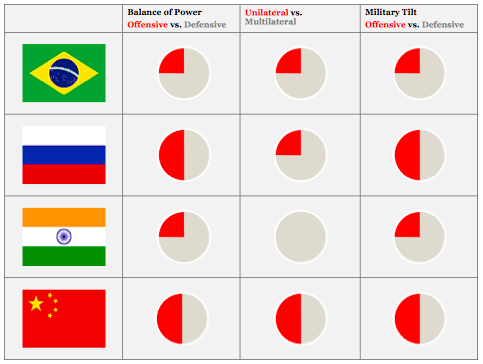
For my American Foreign Policy class taught by Professor Shawn Ramirez, I decided to write my final paper on BRIC Economies and how they relate to American Foreign Policy.

Often, political and economic factors are analyzed comparatively, but not analyzed jointly. In this paper, I examine the historic origins of BRIC and how certain economic factors (trade, debt etc) could affect political and military stance (e.g. military tilt).

BRIC Economies & AFP: Sample Baseball Card

You can find a copy of the paper here: BRIC Economies & Foreign Policy: An Analytical Study.

Development as Freedom

Saturday, January 23rd, 2010

I rarely recommend textbooks as good reads. Not that they aren’t, of course, but they often tend to be academic in nature and therefore of little interest to anyone other than academics (and unfortunate students).

However, I’m taking a class by Professor Stephen P. Marks on World Poverty & Human Rights this Spring, and one of the textbooks is Amartya Sen‘s rather excellent book Development as Freedom.

The book was such an engaging read that I finished reading it even before the start of my semester. Sen’s writing is very humanist in nature, peppered with a wry sense of humor in parts, all the while maintaining a tone that is at once both philosophical and pragmatic to the world’s problems.

Amartya Sen: Development as Freedom

Sen starts out addressing the question of whether or not freedom is conducive to development. He feels that such a question is at best defectively formulated, for reasons given below.

Sen ponders over how freedom is often dissociated from development, and considered a pleasant consequence thereof. However, Sen counters that freedom in itself should be the goal of development, and it is both constitutive and instrumental to development. He makes the argument that freedom (political, economic or societal) is central to achieving development; while freedom may result from such development, it would be unwise to ignore the inverse relationship, and true development will only happen through the proliferation of such freedoms. Furthermore, if the definition of development is to move beyond GNP and include freedom, unfree societies aren’t really quite developed.

Sen also argues against the “Lee Hypothesis”, named after the first Prime Minister of Singapore, Lee Kuan Yew. The idea behind the “Lee Hypothesis” is that democracy and freedom are luxuries that only developed societies can afford, and to become developed, less-developed societies will need to push forth agendas that may be at odds with democracy and freedom. Furthermore, a more ardent view would be that “non-democratic systems are better in bringing about economic development” for such societies.

In the same vein, he also takes to task the interpretation that “Asian Values” are inherently unsuitable and unfit for democracy, where Asia is defined not by region but through culture. The argument goes that discipline and obedience are critical traits to the Asian cultural psyche and as such, democracy is at odds with such a principle. This particular notion has had the unfortunate reputation of being exploited by authoritarian governments across Asia.

Sen counters both the “Lee Hypothesis” and the “Asian Values” argument by offering the example of the biggest democracy in Asia — India. While India has made several economic mistakes through the years, the fact that it continues to be free democracy hsa helped its economy grow while preserving the freedoms of its citizens. Sen also counters that the “Asian Values” argument isn’t necessarily unique to Asia, and that even within Asia, there have been differing schools of thought, including those that question blind allegiance to the state.

And of course, this book also touches upon Sen’s (now-famous) insight on famines and democracies. He argues that famines are not necessarily caused by lack of declines in food production but rather due to instability in the political, economic, or societal structures that leaves sections of the population unable to fend for themselves. Sen further proposes that countries that are “free” in the economic sense would have citizenry with a consistent income flow, and this income can be used to borrow or import basic necessities in times of need.

But at the end of the day, Sen concludes that true development cannot be measured through mere tangibles (e.g. GNP). Freedom remains the only true measure of development, and when there is freedom, development will follow.

IPE Research Paper: Asian Financial Crisis & Exchange Rate Regimes

Thursday, January 14th, 2010

The topic and abstract for my IPE term paper that I had originally planned turned out to be a little too broad in its scope. As a result, my final paper had a much tighter focus.

Fluctuation & Flexibility: A Case Study of Exchange Rate Regimes from the 1997-1998 East Asian Crisis

The choice between fixed and flexible exchange rate regimes has long-lasting impacts on a nation’s economic security, and consequently, its political outlook. However, such a freedom of choice is almost always limited by the fiscal and monetary health of the nation. This paper evaluates the extent of such a freedom, and how choices in exchange rate regimes affect a country’s economic performance. Specifically, this paper uses the East Asian economic crisis as a case study to examine the effects of exchange rate policies.

The case study was performed on the basis of an exchange rate regime model by Patrick Osakwe, and was built using data before and after the Asian Crisis. The data and the results from the model were then utilized to review the original assumptions, and this laid the foundation for the conclusions drawn from the case study.

You can find my paper — Fluctuation & Flexibility: A Case Study of Exchange Rate Regimes from the 1997-1998 East Asian Crisis — and the referenced Patrick Osakwe’s paper on choice of exchange rate regimes in emerging markets.

Finally, a quick caveat that this was a class term paper that’s effectively going to be a working paper to extend and validate Osakwe’s model. So, please treat it as such.