Archive for March, 2012

The 7 heavens

Thursday, March 8th, 2012


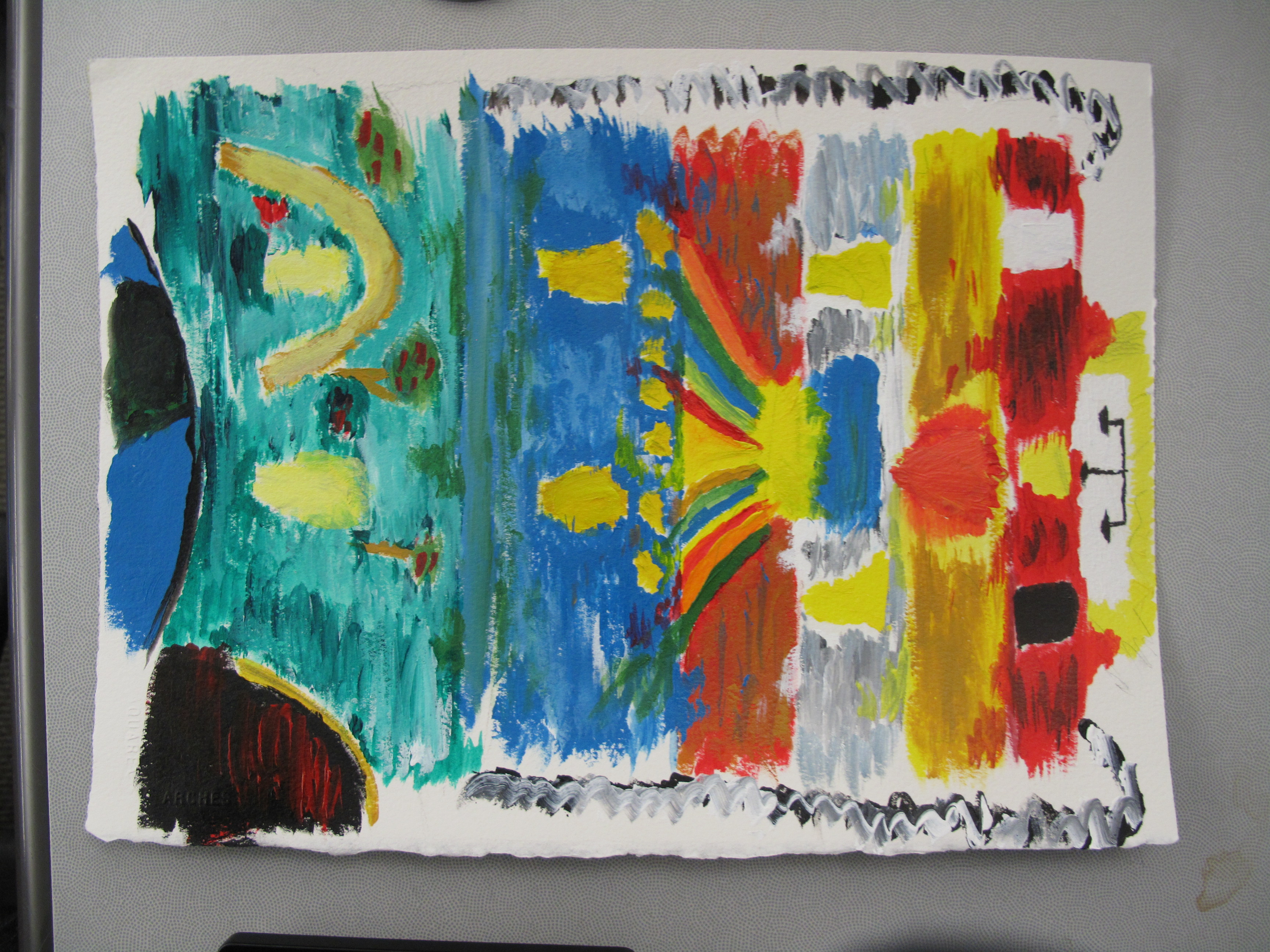
The painting was inspired by the Miraj, where Muhammad visits heaven in one night and meets the prophets that preceded him and receives instruction. From the Myths and Legends of the Swahili reading, the description of the 7 heavens (and hell), by Muhammad was so vivid that it prompted me to try and represent it visually (although I have no experience in painting). Though some elements in Muhammad’s description of the heavens are missing in the painting, I try and capture all the prophets and angels he meets shinning in gold, representing the light of Muhammad which was passed to all the prophets in some measure. At the very bottom of the painting is the earth, above which the heavens start. In the first heaven there is Adam in front of two arches, and on his right lies the garden of paradise and to his left lies the gates to hell. Above this first level is the so called sea of life, which leads to the second level where Jesus, John the Baptist, and an angel with numerous heads are found. In the third heaven there is Joseph, who I have tried to present in the colours of his magnificent robe of many colours. In the heaven resides David and Solomon and a sea representing Noah’s sea. In the fifth heaven resides the prophet Moses, and in the sixth there sits the angel of death with two lists, one (white) with the names of those that will live in that hour and another one (black) with names of those who will die. I represented the seventh heaven with scales which are said to be found there, and all of these heavens are subsumed by an angel whose feet are on earth and whose head is above the seventh heaven.

Tazyieh Rendition

Thursday, March 8th, 2012


This composition is meant to mirror the drama that ensued in the Tazyieh that depicts Hussein’s martyrdom at Karbala. The piece starts in a slow and sorrowful tone to reflect the lamentations of Hussein at the beginning of the excerpt where he express great sorrow at the fact that he has no one to fight with him and his son has been killed. The music then gets louder and more agitated and this is meant to signify the abuse that Shimar and the rest of the enemy pour on Hussein, basically taunting him, which then deepens his lamentations and the music becomes slow and sorrowful again. When Hussein and his party realized that they are trapped on both sides by Yazid’s troops with no escape, the music tries to mirror that and becomes a bit more purposeful again but is more restless and is not allowed to drift too far to extreme octaves signifying the situation of Hussein. The music then moves into a more lyrical and melodic section which describes the dialogue that ensues between Hussein and the visitor who has brought water for Hussein’s daughter. This is a moment of temporary reprieve in the story as the dialogue is no longer one of pity but Hussein’s strength and spirit is displayed as he proclaims his lineage and the power that he has through God. After this visitor leaves, the Darwish army then comes to Hussein’s side responding to his cries for help. Here, the music tries to imitate the sound of horses galloping and the dialogue that takes place between the Darwish leader and Hussein. The army after that is turned back and the music slows down and assumes a steady rhythm as Yazid’s forces start to stone Hussein. As Hussein is subdued and comes under the mercy of Shimar, the last passage in the composition is a quiet and melodic section that tries to express the beauty of Hussein’s act of martydom, and reflects a mix of sorrow at his demise but also joy due to his heroic deed.

A Call To Prayer

Thursday, March 8th, 2012

A Call To Prayer

As steady as the cock crow,
Answering the call from Adam’s meadow,
All creations rise and proclaim,
The one and true glorious name,
Those who can hear listen,
The Greatest we serve is in heaven,
There is no other but the One,
From the fading of the moon to the rising of the sun,
His message passed through Ahmad,
Who taught us the way of salat,
For which we now humbly prepare,
In search of peace for those in despair,
God is the greatest, God is the greatest,
Let all creation answer the call and bear witness.

This poem draws from a number of sources encountered in the course so far. Primarily, it draws from the Adhan, the Muslim call to prayer. Every line of the Adhan as recited by Sunni Muslims is represented in this poem in some form or another. However in composing the poem, I was trying to express the idea that all of creation in a sense is a testament to Allah and express some form of his nature, drawn from the idea that nature itself is a sign or Ayah of Allah. Therefore rather than having the voice of someone reciting the Adhan, I tried to portray the idea that nature itself, as it proclaims Allah’s greatness should therefore call Muslims to pray before God. Furthermore, I also tried to use ideas drawn from other sources, such as the Miraj that describes Muhammad’s visit to heaven, in the first heaven, he meets Adam who is guarding the entrance to the garden, and in that garden there is also a cock that is the lord of all cocks such that when it crows, all the other cocks on earth follow it. The poem in its entirety therefore draws from hadith or stories about Muhammad, the Qu’ran, custom and Islamic theology in order to present the call to prayer in a more unified form that in itself portrays many elements of the ideas of Islam. I also tried to follow a rhyme scheme that is in the style of Arabic poetry in order to make it aesthetically pleasing, because sound is such a big part of the experience in Islam, I thought it important that this call to prayer be aesthetically pleasing as well as functional.

Hello world!

Thursday, March 8th, 2012

Welcome to Weblogs at Harvard Law School. This is your first post. Edit or delete it, then start blogging!