Archive for April, 2018

Conference of the Birds

Wednesday, April 25th, 2018

The Conference of the Birds, a Persian epic poem, Farid ud-Din Attar, who is commonly known as Attar of Nishapurin, was written in the 12thcentury. In the poem, the birds gather to decide who is to be their sovereign, as they have none. The hoopoe, the wisest of them all, suggests that they should find the Simorgh- King of Birds. Hoopoe leads the birds, who each represent a human vice, which impedes them from the path them along this journey. The Valley: ”

  1. Valley of the Quest, where the Wayfarer begins by casting aside all dogma, belief, and unbelief.
  2. Valley of Love, where reason is abandoned for the sake of love.
  3. Valley of Knowledge, where worldly knowledge becomes utterly useless.
  4. Valley of Detachment, where all desires and attachments to the world are given up. Here, what is assumed to be “reality” vanishes.
  5. Valley of Unity, where the Wayfarer realizes that everything is connected and that the Beloved is beyond everything, including harmony, multiplicity, and eternity.
  6. Valley of Wonderment, where, entranced by the beauty of the Beloved, the Wayfarer becomes perplexed and, steeped in awe, finds that he or she has never known or understood anything.
  7. Valley of Poverty and Annihilation, where the self disappears into the universe and the Wayfarer becomes timeless, existing in both the past and the future.” (Attar translated by Sholeh Wolpé)

The Hoopoe gives advice throughout the poem such as

“Dear nightingale, this superficial love makes you quail, Is only for the outward show of things” (27).

Through this, he guides them to the Sufi path which is represented by the 7 valleys listed above. This pathway is leads to the removal of material and worldly desires in exchange for the full annihilation of yourself in the Divine’s grace. Often in lecture and section, we speak of how poetic language, like the Qur’an, must be experienced not recited. The ability to watch the Conference of the Birds in Boston and how it incorporated full kinesthetic and dance movements for expressing this journey was very unique. It serves as how this journey is spiritual and not needed to be expressed in words but experienced with the soul.


Sufism: Kinesthetic Spiritualism -‘Whirling Dervish’

Wednesday, April 25th, 2018

Sufism is not deemed to a sect of Islam, but is instead an esoteric and spiritual outlook of the world. Thus, one can be Sunni and Sufi, Shia and Sufi, and so on.  Muslims express their faith through literature, dance, dhikr (remembrance of God), music and other modes of practice. During the time of the great poets like Rumi, many Sufi orders were created and made their own specific ways of practicing their spiritualism.

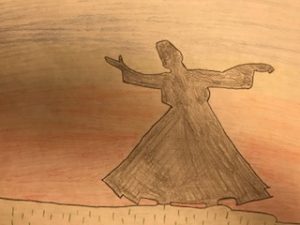
The Mevlevi order was founded by followers of Jalaluddin Rumi which is also none as the ‘Whirling Dervishes.’  They have a famous practice of whirling as a form of dhikr. Dervish is a common term for an initiate of the Sufi path; the whirling is part of the formal Sama ceremony. This Sama represents a mystical journey of humanity’s ascent through consciousness and love to the Divine’s grace. The human must let go of their own desires and egos, and fill their hearts with divine love, light, and truth.  In Ersnt’s The Shambala Guide to Sufism chapter “Sufi music and dance” he states:

“The novices during their 1001-day training studied this poetry as they were trained in the dance, learning to whirl in place by spinning around a large nail placed between the big toe of the left foot and toe next to it. Musical accompaniment came from the plucked tambur, the bowed rebab, and above all the reed flute, or ney, which has a prominent symbolic role in Rumi’s poetry.” (192)

This is exactly what is represented by the Whirling Dervish I drew. Currently, the order is only allowed to practice for touristic purposes as Sufi groups gave faced persecution and even illegally banned over the past decades (193). With this reproduction of Sufi music for new audiences the concert stages have:

“redefined this spiritual practice as an aesthetic event for spectators in which music takes priority over the word.” (198)

 Despite this, the spiritual journey and connection to the divine remains at the heart of the practices of offers like the Mevlevi Order.

Hip Hop Qawwali

Wednesday, April 25th, 2018

The term Sufism comes from a western connotation that was created out of interactions between the many charismatic ways Muslim express their faith and the west. Contrary to western belief, Sufi’s were not truly missionaries yet still played a pivotal role in conversion and development of vernacular languages. Especially for modern day Iran, Pakistan, and India, Sufi’s stretching and twisting languages, have shaped the development of modern day Farsi, Gujarati, and Urdu(etc.) literature. Their use of symbols, allegories, and metaphors as a way to express their experience, in human language, has left a profound effect on not only these languages but on the readers, themselves.

When we look at the Christi orders of India and Pakistan, their Qawwali music plays a huge role in music rituals. Through it, like in any other Sufi music, the theme of the “Day of Alast” or the primordial covenant between God and the uncreated souls of humanity when God demanded:

“Am I not your Lord” (Qur’an 7:172)”

They seek to once again find that intertwined love and connection between our souls and God. The beautiful sound of music, through its aesthetics, stirs our souls and reminds humanity of their creator. Specifically, the Christi Qawwali performances, as mentioned in Ersnt’s The Shambala Guide to Sufism chapter “Sufi music and dance”, are:

“a highly structured ritual that is performed at Sufi shrines on the death of famous saints and on other religious holidays” (187)

I hoped to mash a famous Qawwali “Chadhta Suraj” by Aziz Naza with a hip-hop beat which could be relatable to the youth of today. With this idea, I hoped to merge cultures and people from nay ages together to create a sound that is hip and spiritual at the same time. The Qawwali describes humanity’s attachment to the material world and reminds us we can take nothing with us to the grave:

Excerpt of Lyrics of Qawali Chadhta Suraj Dhire Dhire with English translation:

huye naamwar benishan kaise kaise

Look how the world forgot the names signs of famous people

Zamin kha gayee naujawan kaise kaise

Once who were heroes look now they are in graves, the grave has eaten them

aaj jawaani par itranewale kal pacthhtayega

Today Oh Man Proud of your youth tomorrow you will repent, regret

aaj jawaani par itranewale kal pacthhtayega

Today Oh Man Proud of your youth tomorrow you will repent, regret

chadhta suraj dhire dhire dhalta hain dhal jayega

The rising sun will set slowly, Sun will set

Slowly rising upwards Sun will slowly move to downwards

chadhta suraj dhire dhire dhalta hain dhal jayega

The sun, which is rising slowly, will finally set

dhal jayega dhal jayega

will finally set will finally set

dhal jayega dhal jayega

will finally set will finally set

Tu yaha musafir hain, yeh saray panee hain

You are just a guest, visitor, here this world is just an illusion

Continued…….

The Qur’an as an Experience

Friday, April 20th, 2018

Prophet Muhammed, peace be upon him, is believed by Muslims to be the final prophet of God. He often meditated in Mount Hira for contemplation and reflection which is 3 miles north of his birthplace: Mecca. One day as Muhammed was meditating, he was struck by the voice of Angel Gabriel telling him to “read” which he replied, “I am unable to read.” Then suddenly the Angle commanded him to recite the following verses:

“Recite in the name of your Lord who created – Created man from a clinging substance. Recite and your Lord is the most Generous – Who taught by the pen – Taught man that which he knew not.” [Quran, 96: 1-5]

These verses ultimately became the first verses of the Qur’an revealed to Muhammed.

With this otherworldly experience, the prophet felt as if he was being pressed and went home weeping to his wife Khadija. After coming to terms with the significance of the revelation, Muhammad accepted his role as a prophet and eventually would forever change the world.

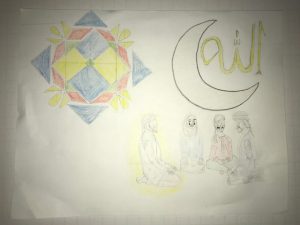
My drawing is capturing a moment of Prophet Muhammed in a trance like state as his recites Divine revelation to a few of his followers. This experience of him reciting represents the oral traditional of the Qur’an where the aesthetics in words represent its divine origin that cannot be made by man. At the time of pre-Islamic Arabia, poetry was a prodigious part of Arabian culture; thus, Muhammed was often thought to be a poet by those who first encountered them. However, the Divine makes the remark:

“Say: If the whole of mankind and Jinns gather together to make out a book like this Holy Qur’an, they could not do it even if they back up each other with help and support.” (Holy Qur’an, 17:88)

I depicted the followers of the prophet in tears, as the aesthetics and beauty of the verses would stir the hearts. In Popular Expression of Religion, Kristina Nelson mentions:

“For the Qur’an must be heard, not merely read. As the word of God transmitted to the Prophet Muhammad, it is considered to be the actual sound of the Divine, the model of perfect beauty, and a testimony to the miracle sound of human and divine interaction” (257). “Indeed, the approved response to Quranic recitation is weeping; it is a sign that one is profoundly moved by the experience” (260).

The top left corner contains a geometric shape which expresses a physical manifestation of what the Prophet is reciting. The geometric shape and ornament represents the beauty, infiniteness, and esoteric knowledge being shared by the prophet. John Renard in his book Seven Doors describes such Islamic art as alluding to:

“transcendence, infinity, power, and majesty by its use of variations of vegetal and geometric arabesque, an infinitely repeatable pattern” (129)

I view the combination of Prophet Muhammad reciting and experiencing the Qur’an combined with the geometric shape, as a way of representing a physical and spiritual manifestation of what Muhammed is saying. I also include the moon and the name of Allah, as not a political symbol like that of the Ottomans, but as a reference to the moon’s spiritual condition in Islam (Ex: Islamic calendar relying on it) and Allah in Arabic to represent his divine, presence in what Muhammed is sharing with mankind.

Ghazal- Oh! The straight path is never straight…

Monday, April 16th, 2018

Rumi’s Ghazal: Little by Little the Lovedrunk Arrive (Andak Andak)

Little by little, the group of the lovedrunk arrive
Little by little, the worshipers of wine arrive

They are on their way; Comforting and gentle
Like flowers from the flowerfield they arrive

Little by little, from this world of Being and non-Being
The non-existent leave and the existent arrive

They come with hands and clothes full of gold 
For the poor and hungry they arrive

The gaunt, exhausted from the trials of Love
Strong and healthy they arrive

Like the rays of the Sun , the lives of the Pure
From those heights to the lowly valley they arrive

Green and fresh the garden for the pure
With new fruits from the love drunk they arrive

Their essence is grace and grace they unfold and expand
From the garden towards the garden they arrive


My Ghazal: Oh! The straight path is never straight…


Thirst of the tongue, the travelers of dehydration follow the jagged path

Thirst of the tongue, the submitters to dehydration follow the jagged path


Thirst of the tongue, the travelers are not burdened more they can bear

With trust amongst chaos, creation follows the path


The lonely come with their shirts ripped and shoes lost

For the spring water of the path


The lost and confused, exhausted from chaos

With closed eyes and mouths following the path


The flowing water is there, just must be scene

It flows endlessly with no beginning, ending or path


The water gushes from the spring

With movement and progression, the travelers follow the jagged path


How the river must be scene to flow

The travelers of dehydration, drink the purpose of the windy-straight path


The poem I wrote is in style of a Ghazal or a Sufi Love Lyric which became prominent during Islamic Persia. Out of this era came the famous Poet Jalaludin Rumi who is famous for writing many ghazals, The Masnawi which has been termed the ‘Qur’an in Persian’, and other types of spiritual, love poetry. The ghazal I wrote- Oh! The straight path is never straight…– is in the style of Rumi’s famous Little by Little the Lovedrunk Arrive (Andak Andak)ghazal. Throughout his original poem he stirs readers through his use of language and metaphors to express his spiritual experience, and I try to do the same. To keep in touch with the style of traditional ghazals, a refrain (a repeated word or phrase) appears at the end of both lines of the first couplet and at the end of the second line in each succeeding couplet.

My reference to the thirsty traveler is that of a person in life seeking purpose and fulfillment in their lives. The path is jagged because it is not easy, but is instead a challenge to find your path in life.

The second couplet refers to a Surah Al-Baqarah where God promises that the circumstances they are given in life is never more than they can bear. If people can have trust in belief is this and themselves then they can follow a successful path:

“Allah does not burden any human being with more than he can bear” [Qur’an, 2:286]

The next couplets refer to materialism and obsessions in the world that lead people astray, confused, and lost. Through this they have no awareness of the true reality of their and the universes’ existence. This is beautifully constituted by the following:

“And We have certainly created for Hell many of the jinn and mankind. They have hearts with which they do not understand, they have eyes with which they do not see, and they have ears with which they do not hear. Those are like livestock; rather, they are more astray. It is they who are the heedless.” [Qur’an, 7:149]

However, the last few couplets refers to how one must just open their eyes of their heart to the see true reality- God. With this, I bring the beloved intellectual poet Muhammed Iqbal’s reference to Islam being self-development and progression through a spiritual sense for my ghazal. Lastly, I refer to Sura Al-Fatihah where mankind prays to be guided to the straight path. I call this a “windy-straight path” for the fact in our physical world the path may not be clear and easy to follow, but if we trust our awakened hearts, salvation and peace can be found:

“In the name of God, the infinitely Compassionate and Merciful.
Praise be to God, Lord of all the worlds.
The Compassionate, the Merciful. Ruler on the Day of Reckoning.
You alone do we worship, and You alone do we ask for help.
Guide us on the straight path,
the path of those who have received your grace;
not the path of those who have brought down wrath, nor of those who wander astray.” [Qur’an, 1:1-7]

 

The Nur(Light) of God

Monday, April 16th, 2018

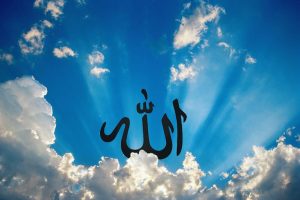
The picture I created is Allah’s name in Arabic being represented in the sky as the ‘light of the heavens and earth’ which represents the Verse of Light (Nur):

“God is the Light of the heavens and the earth; the likeness of His Light is as a niche wherein is a lamp – the lamp in a glass, the glass as if it were a glittering star –kindled from a Blessed Tree, an olive tree that is neither of the East nor of the West, whose oil well-nigh would shine even if no fire touched it; Light upon Light; God guides to His Light whom He wills. And God strikes similitudes for man, and God has knowledge of everything.” [Qur’an 24:25]

Many questions arise from this verse: Is the light to be taken literally or spiritual? What exactly is the lamp represented of? What does the olive tree not being of the east or west mean? These are many of the questions that are asked when trying to interpret this Qur’anic verse.

The light could be seen as God’s love, mercy, or truth illuminating the universe. To experience this light, one must go from being ego-centric: worldly to be becoming God-centric: where God’s will and love fills your heart. It is believed the prophets, or specifically Prophet Muhammed, is the lamp though which God’s light is passed continuously on.

In the Shia tradition, this light is believed to be passed through the Shia Imam’s as ‘Ahl Al-bayt’ or “People of the House (of the prophet).” This light is believed to be passed by divine designation as predecessors of the Prophet power is  intrinsic, God-given. Through this, the Shia Imam is believed to be an intermediary or intercessor for seeking forgiveness and welfare for people. In more Sufistic outlooks of certain Shia groups, the Imam’s light serves allows them to serve as a spiritual guide for this life. As an example, The Shia Imami Ismaili Muslim’s are the only Shia group with a present living Imam-  The 49th Imam Shah Karim al-Husayni. He often cites his role as not only giving spiritual guidance to his followers but improving theirs and that of mankind’s living standards through development, education, and the sponsorship of pluralism:

“[S]pirituality should not become a way of escaping from the world but rather a way of more actively engaging in it.” 

(Imam Shah Karim al-Husayni Acceptance Address- Tutzing Evangelical Academy’s, 20 May 2006)

Hello world!

Tuesday, April 3rd, 2018

Welcome to Weblogs at Harvard. This is your first post. Edit or delete it, then start blogging!