Archive for March, 2022

Mystical Muhammad.

Sunday, March 27th, 2022


Muhammad, to many Muslim, is not just a human but a mystical being; in week 4 of the lectures, a significant theme was an introduction to seeing Muhammad in a spiritual light. Muhammad is considered as the Shafa’ah (intercessor), and he has the power to forgive sins. Millions of Muslims around the world recite the Salawat daily in order to as Muhammad for blessing. Muslims believe Muhammad to be the last of God’s messengers, to whom was revealed the final installment of revelation (Asani pp,115). In this piece, I highlight Muhammad’s Miraj journey. “Praised be he who traveled with his servant from the sacred mosque to the farthest sanctuary (masjid al-aqsa)” Sura 17. The Miraj journey seeks to explain how Muhammad attain this level of spiritual power. The first picture is a picture of Muhammad as he talks with Buraq. The chronology of the Miraj story is represented in the collage to it; we can see Muhammad on the back of Buraq, and eventually, Muhammad is surrounded by fire. This is the stage where Muhammad has become one with the Devine. Buraj is believed to be a mystical creature, which also signifies love. Muhammad, on this journey, transcended the egotistic nature of humanity and operated under the guidance of love. This idea is that humans are limited by their desire to rationalize everything and are inhibited from attaining mystical status. It is only through love that we can transcend. This story is replicated again in a more contemporary art piece of a mural. we can see Muhammad on this journey. These depictions are essential for Muslims, especially because Muhammad is considered the ideal Muslim, and artwork like this allows people to visualize Muhammad’s Journey.
Experiential Beauty

Sunday, March 27th, 2022

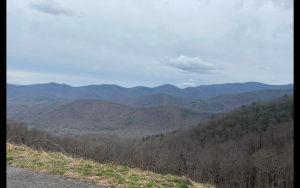
Blue Ridge Mountains (Photo by Justice Ajogbor)

In Islam, there is an intrinsic relationship between the spiritual world and the physical creation of God. In John Renard seven doors to islam reading for week 3, he quotes Dust Muhammad ” If a form is not worthy of astonishment, it is not worth the touch of the brush” (Renard, pp 268). God shows himself to us through his creation. My creative piece for this blog is a picture that i took over spring break of a section of the Blue Ridge Mountain range. Standing there and looking at the collection of mountains it looked like a painting to me. Indeed it was a form worthy of the God’s brush. This creative piece also drew me back to the idea of how Gods creation worships God through their beauty and the ability of nature to draw humans closer to the Devine. There is also the natural sounds from being in nature that is in it  own form an Adhan (call to prayer). The unity between the physical  and spiritual world goes back to a theme in class about how we can see gods beauty by looking at God’s creation. The Quran was given to Prophet Mohammad in the form of recitation, and the codification of the text did not happen for a long time after. So in this sense, poetry is a language of God, and the Adhan shows how Muslims view this. The lecture reading for this week talked about how recitation changes the experience of the Quran in traditionally Islamic countries from the West. The Adhan especially becomes a representation of Islamic identity, when you hear it, it immediately signals that there is a mosque near by. The ecstasy we experience from witnessing God’s beauty through our environment and sound becomes a way of creating a spiritual experience for all Muslims.


First Post. Who am I (poem)

Sunday, March 27th, 2022

I am a Muslim
I appreciate the diversity of cultures
I live in downtown New York
I play the violin
I see Allah in the people around me
I am a Muslim
I believe in peace
I am devote my life to serving others
I worry about the lack of love I see around me
I let Allah’s light shine through me

I am a Muslim

The question of who a Muslim is has been debated for many years. The result is that the scope of who a Muslim is has been shaped by what professor Asani considers as “Loud Islam”. Furthermore, in the West, the identity of a Muslim has been shaped by the 9-11 bombing. Viewing a Muslim from this framework is limiting and untrue to who a Muslim is.
A very simplistic definition of who a Muslim “is a label for a person who adheres to a religion we call Islam” (Asani pp, 2). Another definition is that a Muslim is one who submits to the will of God. This definition highlights the idea that there is a direct relationship between the participants and God. The third definition of Muslim is grateful to God. These different definitions of who a Muslim is make it impossible to standardize what a Muslim should look like. The prejudice against Muslims arises from the lack of understanding of who a Muslim is. The professor Asani’s piece he quotes Elizabeth,“. . . when we understand with our rational minds what is happening within a religious tradition across time and space, we can also challenge ourselves and others to confront the gut-level prejudices that are often masked by intellectual tolerance” (Asani pp, 5). Therefore is in important to highlight the traits of Muslims to educate non-Muslims on the real nature of Islam.
My creative piece for week one highlights this idea. A Muslim is both a person with the Hijab and a lady who chooses not to cover her hair. The underlying connection between these people is their submission to Allah and their gratefulness to God.