You are viewing a read-only archive of the Blogs.Harvard network. Learn more.

seeking god wherever they may be found

Month: April 2018

Ayaz’s Sickness

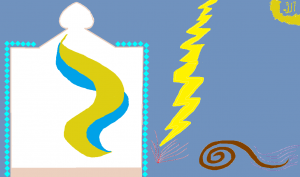
For my final post, I took inspiration from a section of Attar’s The Conference of the Birds, a 12th-century Persian epic poem, or mathnawi, that serves as an extended allusion to the Sufi mystical path towards union with God. The section that spoke most to me is called “Ayaz’s Sickness,” serves as one of the hoopoe’s birds parable-like responses to the birds excuses to undertake their journey to search for the one who would be their king, the Simorgh. The plot of Ayaz’s Sickness is quite simple: Ayaz falls ill due to the curse of the Evil Eye, and the king Mahmoud, who loves him, sends his messenger with utmost speed to convey his love and guard Ayaz, but when the messenger arrives at Ayaz’s respite, he finds that the king has outpaced him somehow and is willing to submit to Mahmoud’s punishment, but Mahmoud is merciful as the messenger “could not know the hidden ways by which we lovers go.”

Ayaz’s Sickness, in my reading, is used to exhort people on their spiritual paths by reminding them that God’s love is already present in their lives, if only they could become aware of it. I interpret Mahmoud as God, Ayaz as humanity, or more specifically, a spiritual seeker, and the messenger as religious authorities who do have a divine command to inform humanity of God’s will to love us but are not that love itself.

As a gay person, the fact that a same-sex loving relationship could be so positively used as to illustrate divine love is beyond encouraging.

This digital painting shows the scene of Ayaz and Mahmoud’s reunion as the lightning flashes and the messenger has not yet arrived, though he is moving quickly. The characters are identified as the word Allah in the top right corner is drawn in a matching color to Mahmoud. Their tight embrace is the hope and promise of divine union.
Do You Love Me Above All?

“And [mention] when your Lord took from the children of Adam – from their loins – their descendants and made them testify of themselves, [saying to them], “Am I not your Lord?” They said, “Yes, we have testified.” [This] – lest you should say on the day of Resurrection, “Indeed, we were of this unaware.” Sura 7:172

The Day of Alast, or “Am I not?”, is a foundational tenet of Sufi spirituality. It has its origin as a concept in the above quoted verse of the Qur’an. In Sufi thought, God asks this question, “Am I not your Lord,” (“alast-u bi rabbikum?”) of the uncreated creation in the time before time. It is creation’s response, “Yes, we have testified,” that is a precondition to their existence. For Sufis, this was a time of wild happiness, when the new creation (including humans) had not yet forgotten God and were intoxicated with the love of and for God. It is this moment that the mystical path is intended to bring us back to, a path marked out with love, divine love, certainly, but also human love as a mirror of that divine love.

Sacred chant is an art form I learned as a Christian contemplative practice. There are four movements to sacred chant. The first is breathing, to remind us that the divine connection we seek and the tool we have to seek it with (our body) depends on breath and spirit. The second is tone or resonance, which can be a simple hum. Through the vibrations of the humming, we feel our bodies become sources of divine sound, from our nasal passage, through our throats, reverberating in our chests, and deep to our bellies. The third movement is intention, which we achieve by bringing words into the mix. In order to keep our intention as fixed on God as possible, the best chants have simple words and musical notes. The words I composed for this chant are inspired by the Day of Alast and the idea that our existence is ultimately dependent on loving God more than anything, even ourselves. Finally, the fourth component of sacred chant is community. Ideally, each voice listens and reacts to the voices around them, not in musical harmony necessarily, but rather, being balanced in volume and intention. I had to record this chant by myself, but I would love to join voices with you sometime. 🙂

The Best of All Creation

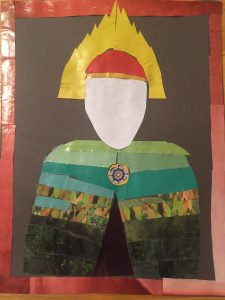
In Week 4, we learned about one of the fundamental aspects of Islam–devotion to the Prophet Muhammad. We discussed the various roles the Prophet occupies in the Muslim religious imaginary: divine messenger, religious authority, moral guide, unparalleled intercessor, and mystical paradigm. This piece, a paper collage I entitled, “The Best of All Creation,” references the Prophet’s role as an intercessor without equal between believers and God.

One of the stories I found the most interesting this semester was that of the 13th-century Egyptian poet and mystic, al-Busiri, who, as he was recovering from a stroke that left him paralyzed, wrote an ode popularly known as al-Burda or, “The Mantle.” The title is a reference to a story that one of the Prophet’s poetic rivals, Ka’b ibn Zuhair who repented of his hostility to Muhammad and wrote a poem asking for mercy. In response, the Prophet is said to have thrown his mantle or burda around Zuhair, thus creating a new symbol for the prophet’s forgiveness. Al-Busiri, in the 13th century, then had a dream where the Prophet was so pleased with the poem that he placed his burda around al-Busiri and the latter woke up healed. Since then, the later poem, whose actual title is “The Celestial Lights in Praise of the Best of Creation,” has become a staple of popular Muslim devotion.

In my collage, the mantle or Burda takes prominence with its striking use of different shades of green to denote the Prophet’s cloak. I took inspiration for the color from the Turkic manuscript illustrations of the Prophet’s isra and mi’raj. As in some portrayals, I covered the face of Muhammad in white and his whole head is framed in the fire of prophethood.

Dhikr (Reminder)

I long to remember the remembrance of my soul

at certain times at least.


In the beginning, the Called One says,

we were so fresh from the dust of our response to the Call.

We sat in wonderment for a time and a time of times.

And then, did we grow bored of wonder

and tired of such knowledge?


Now, there are fragments of a memory;

faint tendrils of a rose’s scent.

The whispers don’t even add up to a full echo.

They are more like a haunting, sometimes.

Still, the Caller bids us. Never does he tire of bidding us.

Like the birdsongs of his praise, how myriad is the call to remember.


Still, this mottled and mumbled forgetting is all I can muster.

And it is provisional. For what I will long for tomorrow,

this distant doubter’s heart doesn’t know;

but perhaps, a hope, that the call comes in clearer,

And the remembering surer.


The relationship between the Qur’an, Islam, and poetry is unique and beautiful and I knew from the beginning of this course that I would write my own poem. This free-verse short lyric addresses one of the central tenets of Qur’anic theology: that human beings were created with full knowledge of God but are forgetful, and thus, need reminders to remember who God is and who they are. As Michael Sells puts it:

The Qur’an does not propound a doctrine of the original or essential sinfulness of humanity. Human beings are not born sinful, but they are forgetful. This forgetfulness can be countered only by reminder (dhikr), which the Qur’an calls itself.

Michael Sells, Approaching the Qur’an: The Early Revelations, 18.

As a Christian, I am nevertheless enchanted with this theological re-calibration of sin as forgetfulness and religion and religious texts not as means of punishment but of remembering, of recalling a very sweet memory of wholeness and holiness. The Qur’an also sees itself as a revelation and Muhammad as a prophet in a lineage of divine revelations to humanity, a lineage that from the Qur’anic perspective, began with the biblical story. Thus, God is always calling us to remember God.

In this poem, I seek to tie a broad overview of my spiritual journey, it’s high and low points, to this Qur’anic narrative of human forgetfulness and God’s constant, insistent call to remember.

Every Day is Ashura, Every Land is Karbala

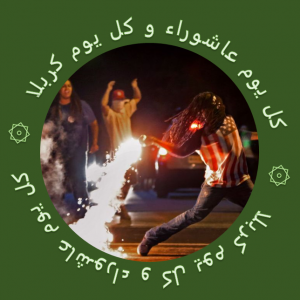
In Week 5, we learned about how Shii Muslims view the cosmic significance of the massacre of the Imam Husayn and members of the Ahl al-Bayt (the family of the Prophet Muhammad) at Karbala in Iraq in 680 CE, in short, that it was not, in their view, just a political-historical tragedy, but rather a result or example of the eternal battle between Justice and Injustice.

In August 2014 and the months following, I was riveted by the death of Michael Brown, an 18-year old black teenager who was shot and killed by Darren Wilson, a white police officer in Ferguson, MO. A few months, later in November, Wilson a grand jury declined to indict him. This turn of events breathed new life into a national movement against the inordinate use of state-sanctioned violence against black and brown people, especially black men, now known as Black Lives Matter.

The Pulitzer Prize-winning photograph I used for this digital montage was originally taken by Robert Cohen of the St. Louis Post-Dispatch on the night of Aug. 13, 2014. Edward Crawford is throwing a tear-gas canister back at police. To me, this image represents not just the specific tragedy of Michael Brown’s death, nor even the larger, systemic violence of police brutality in this country, but rather, the eternally cosmic battle between Good and Evil, between Justice and Injustice. Taking the original image, I digitally imposed it on a field of green, representing the Prophet and his family, with the words, “Every day is Ashura and every land is Karbala” surrounding it in white.

Ideology or Orientation

In our first class, Prof. Asani made clear the difference between Islam as an ideology, with a capital “I”, and islam as an orientation, an Arabic verbal noun meaning “submission.” Viewing Islam as an ideology requires it to be a concrete, discrete “thing” with clear boundaries between who belongs (Muslim) and who does not (non-Muslim) and between Islam and other religions. However, viewing islam from within the tradition, one’s perspective is expanded and a muslim, “one who submits,” can be anyone who, in their own way, submits to God as they understand God. From this orientation, even Christians and Jews can be seen as muslims. This approach places religious traditions not in ideological opposition but along a continuum or within a matrix. If a scholar seeks to understand religious traditions from this viewpoint, then one can’t pay attention to just a tradition’s stated creeds, written theology, and legal judgments, but rather investigate it from multiple angles, including its popular and artistic expressions.

For this piece, I used alcohol-based inks on glossy card stock. The effect is achieved because although the alcohol evaporates, the non-porous surface does not allow the ink to seep into the material. Thus, when another drop is applied, the dye of the first ink reacts with the later ink, making an artform that is almost alive, one drop blending with all the drops that had come before.

As the drops in this piece mixed with and changed what had come before, I saw this conception of religion play out in vibrant color before my eyes.