Snapshot: Emily Balter ’13

As an undergraduate, Emily studied art history at Princeton; at HLS, she has developed an interest in the ways that law and morality intersect. Her winter term 2013 project — to research and write a paper assessing the role and place of morality in the restitution of art looted during the Holocaust — took her to London. Her research focused on the Spoliation Advisory Panel, a government entity that was formed to consider, in an extra-judicial setting, restitution claims concerning artworks hung in Britain’s national museums. “Once the Panel has made its recommendation, the tension between moral and legal obligations is in stark relief,” Emily noted. During her time in London, she interviewed British attorneys representing Holocaust survivors and their heirs, as well as counsel representing British museums and representatives from major auction houses. “The moral questions that come before the Panel are so nuanced and often difficult to answer — much more so that I had expected before beginning this project,” Emily explained. Her paper also looks at the moral judgments that were made in establishing the Spoliation Panel and others like it in Europe, and at whether the moral questions identified and considered by the Panel should become part of U.S. law and factored into judicial decision-making.

(Please visit “Winter Term 2013: Snapshots from Students” to read about other recent projects.)

Cravath Fellow Victor Ban, JD ’13, on spending winter term in Japan

Victor Ban “I’m spending J-term in Japan researching agricultural trade policy. Specifically, I’m interested in Japan’s shift from multilateral negotiations in the World Trade Organization to bilateral Economic Partnership Agreement (“EPA”) negotiations and the extent to which this structural transition in international law has impacted policy dynamics. I’m in the middle of a quick trip to Tokyo, where I’m meeting with government officials and picking up some documents and books. Meetings today were very helpful; officials from two agencies, normally on opposite sides of the agricultural liberalization debate, gave a fairly consistent and candid picture of the transition to EPAs, and also shared insights on trade policy more generally. Tomorrow, I’ll meet with an interest group representative well versed in EPA matters and then head to the National Diet Library.

Many thanks to the Cravath International Fellowship Program and the International Legal Studies team for making this project possible.”

To learn more about Cravath International Fellowships, please click here.

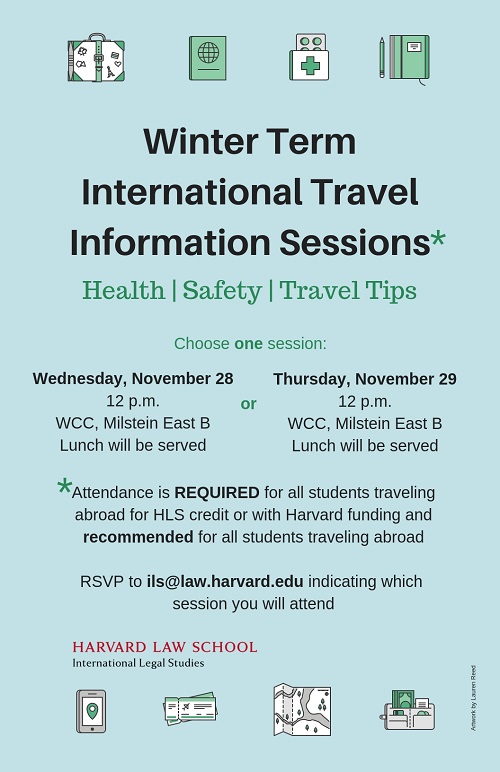
Winter Term International Travel Pre-Departure Sessions

International Legal Studies will hold a one-hour briefing for students who will be abroad over winter term. The session is REQUIRED for students who receive winter term international travel grants and is open to others who wish to attend. The session will offer information about preparing for winter term projects as well as health, safety, and other travel considerations, and facilitate interaction among students who are going to particular regions and those who have spent time there.

In order to accommodate students’ schedules, we will offer this single session on two different days:

Tuesday, November 27
12 p.m. – 1 p.m. 
Milstein East AB, Wasserstein Hall

and

Friday, November 30
12 p.m. – 1 p.m. 
Milstein East AB, Wasserstein Hall

Students are welcome to bring their lunches – dessert and beverages will be served. For more information or to determine which sessions will focus on particular regions, please e-mail Alexis Boyce at aboyce@law.harvard.edu.

Photo:  Jaime Latcham (JD ’12) and Joslyn Massengale (JD ’12) at a rally for the South Sudan Referendum in Tel Aviv, Israel, where they worked at the Refugee Rights Clinic at Tel Aviv University.


Winter Term Opportunities: Writing and Clinical Projects and International Travel Grants

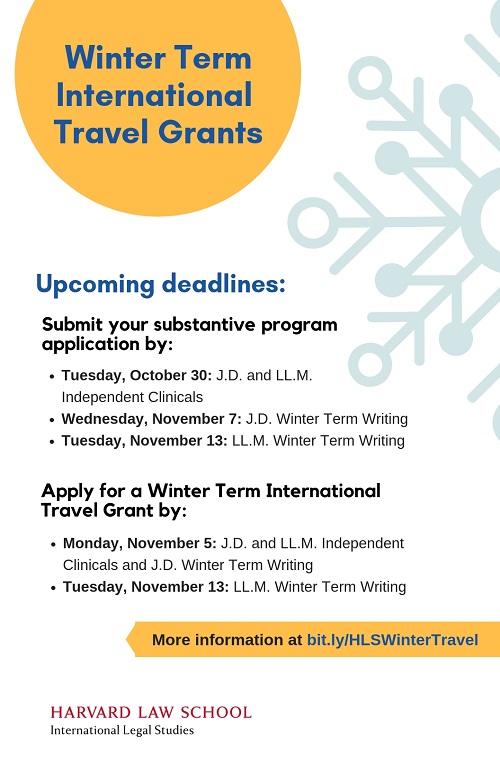
All Harvard Law School students enroll in Winter Term for three weeks in January.  While all first-year students take a Problem-Solving Workshop at HLS, second- and third-year and LL.M. students may choose among a number of options for winter term.  Some of our students enroll in HLS courses offered in the winter term and receive law school classroom credits.  Other students devote the winter term to doing the research for or to writing a substantial paper under the supervision of an HLS faculty member through the Winter Writing Program. Students with prior approval may travel—domestically or abroad—to conduct research that they have shown cannot be done in Cambridge and is necessary to the success of the project. Students interested in a legal practice experience may participate in a clinical program during the winter term, which allows them to spend the three week term doing direct client services or research and writing for a non-profit, government, or public interest organization.  Recent Winter Term projects have enabled students to work for the South African Judicial Inspectorate of Prisons, examine antiquities trafficking in Guatemala, and study security regulations in Korea. Other projects have taken HLS students to China, Guyana, Haiti, India, Kenya, and Switzerland, to name just a few.  The Winter Term International Travel Grant Program provides funding to students for overseas travel during Winter Term.

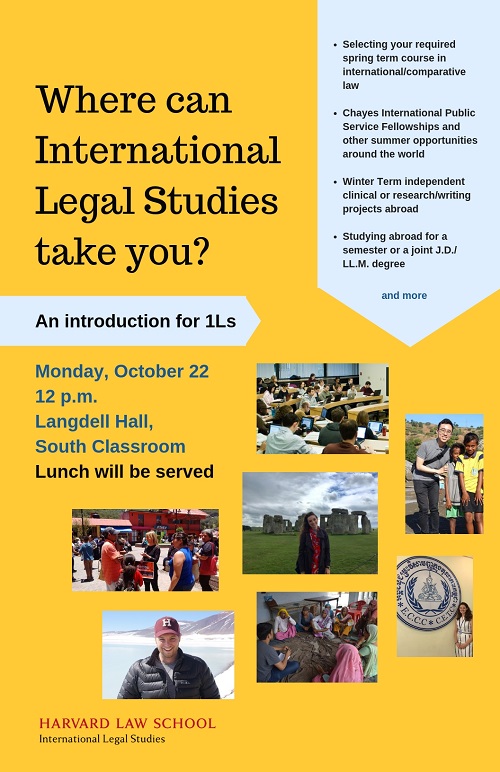
Please join us on Tuesday, October 2 at 12 p.m. for an information session on Winter Term Opportunities:  Writing and Clinical Projects and International Travel. The session will be held in Wasserstein 2004; lunch will be served.

{Photo:  In January 2011, Randall Gonzalez-Villalobos (LLM ’11) and Maggie Morgan (JD ’11) conducted research on behalf of the Ghana Legal Resources Centre as part of Professor Lucie White’s course “Making Rights Real: The Ghana Project.”}


Amanda Barry, Program Coordinator, on the Linklaters India Internship presented by the Program on the Legal Profession

“This January I worked on site for the Linklaters India Internship program in Mumbai and Delhi. The program gives students an insight into working in the legal sector of the closed Indian legal market while also conducting research for academic papers. This year we had 10 students interning at 4 firms and one corporate counsel.  Adjusting to working in a new city is both challenging and exciting. The students were already masters of the city by the time I arrived a week into the program. Their ability to adapt to and absorb the culture was astounding. Meeting with the host firms and Jindal Global Law School fostered greater collaboration and support for student research.”