You are viewing a read-only archive of the Blogs.Harvard network. Learn more.

Archive for the 'John Overholt' Category

Harmless drudgery

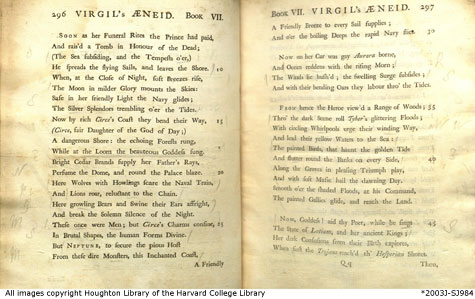
Perhaps the most labor-intensive part of the making of the Dictionary was the process of finding quotations from literature to illustrate the use of each word. Johnson was very particular in his choice of writers to quote from; he refused to cite those, such as Hobbes, whose prose he admired but whose principles he rejected. Quite beyond reproach, of course, was Virgil, and this 1740 translation by Christopher Pitt is one of two books in the Hyde Collection marked for use in the Dictionary (another 11 survive in other libraries).

I apologize for the faintness of the marks in this scan. I tweaked the settings to bring out the light pencil marks as much as possible. I hope you will be able to make out Johnson’s system, which involves underlining the word in question, noting its first letter in the margin, and bracketing the passage to be quoted. Apparently this book fared much better than some which Johnson employed; he was notorious for returning borrowed books to his friends so heavily marked in dark pencil as to be unreadable.

Virgil Dictionary

Published in:John Overholt |on August 22nd, 2006 |Comments Off on Harmless drudgery

There’s no place like home

The trust that maintains Dr. Johnson’s former house in Gough Square in London has a spiffy new web site. And if you’ve got £650 to spare, you can even rent it out for a night.

Published in:John Overholt |on July 31st, 2006 |Comments Off on There’s no place like home

Let’s not.

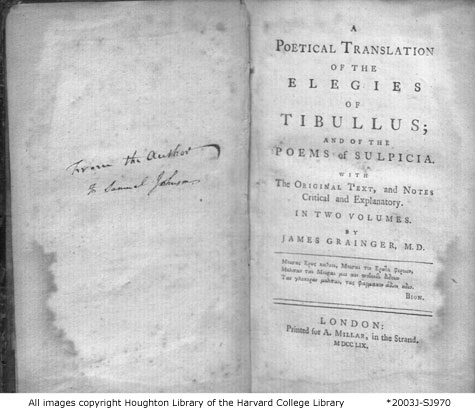
This inscription isn’t technically accurate, since this book was not a gift to Samuel Johnson from the author, the Roman poet Tibullus, who died about 1800 years before it was published. It’s actually from the translator, James Grainger, who in addition to being Johnson’s friend was a physician and accomplished man of letters. Perhaps unfairly, Grainger may be best remembered for the unfortunate reception of his poem The Sugar-Cane. Boswell reports that “This poem, when read in manuscript at Sir Joshua Reynolds’s, had made all the assembled wits burst into a laugh, when, after much blank-verse pomp, the poet began a new paragraph thus: ‘Now, Muse, let’s sing of rats.'”

Dr. Grainger

Published in:John Overholt |on July 25th, 2006 |Comments Off on Let’s not.

Paris when it sizzles

In addition to the Hyde Collection books and manuscripts, the bequest from Mary Hyde Eccles included money for the support of the collection, such as to hire curators and catalogers (thanks, Lady Eccles!) as well as funds for new acquisitions to the collection. One such recent arrival is this remarkably bound copy of W. D. Fellowes’ Paris, During the Interesting Month of July 1815 — the month of Napoleon’s defeat at Waterloo and abdication, as reported by an Englishman living there. Fellowes was a friend of Hester Piozzi’s, and presented this copy to her. As was her custom, she made several annotations in the margins. The binding dates from almost a century later, done by the famous London bookbinders Riviere & Son. They invented a style called the Cosway binding, named after the English miniaturist Richard Cosway, for the painted ivory miniature inset in the front cover.

Cosway binding

Published in:John Overholt |on June 18th, 2006 |Comments Off on Paris when it sizzles

Johnson in the NYRB

Unfortunately, this isn’t available to non-subscribers, but the new issue (6/22) of the New York Review of Books has a lengthy review by Frank Kermode of a number of recent Johnson-related books. Several of these were published to coincide with last year’s 250th anniversary of the publication of the Dictionary.

Published in:John Overholt |on June 13th, 2006 |Comments Off on Johnson in the NYRB

Lord Auchinleck, don’t make me angry. You wouldn’t like me when I’m angry.

I was very pleased to find that we have a copy of Thomas Rowlandson’s hilarious Picturesque Beauties of Boswell in the rare original wrappers. The vast majority of copies would have been bound, or broken up to display the plates, and the wrappers discarded. The engravings depict scenes from Boswell’s Journal of a Tour to the Hebrides with Samuel Johnson, L.L.D., albeit filtered through Rowlandson’s wickedly satirical imagination. It would be difficult for me to pick a favorite, but for obvious reasons I’m especially fond of this one showing a confrontation between Johnson and Boswell’s father. Although Rowlandson has almost certainly exaggerated the intensity of the disagreement for comic effect, the depiction may owe something to the infamous story of Johnson assaulting the bookseller Thomas Osborne with a stout folio.

Beauties1

Beauties2

Published in:John Overholt |on June 12th, 2006 |Comments Off on Lord Auchinleck, don’t make me angry. You wouldn’t like me when I’m angry.

A good man to have in your corner

If you were picking someone to write an insightful and powerful argument in your defense, Samuel Johnson would probably be high on the list. So I would guess that Edinburgh printers Thomas and John Robertson were pleased that their attorney, Boswell, enlisted Johnson to help write the brief in their case. The Robertsons published a newspaper called the Caledonian Mercury, in which they poked some very modest fun at the pretensions of the Society of Solicitors. (Boswell writes of the incident “It has been said, that the Scottish nation is not distinguished for humour; and, indeed, what happened on this occasion may in some degree justify the remark.”) The Solicitors were sufficiently unamused to sue for libel, and Boswell was hired for the defense.

Johnson, amused at the pettiness of the suit, composed the concluding paragraphs of the brief, deftly deflating the self-importance of the Society of Solicitors. “We consider your Lordships as the protectors of our rights, and the guardians of our virtues; but believe it not included in your high office, that you should flatter our vices, or solace our vanity; and, as vanity only dictates this prosecution, it is humbly hoped your Lordships will dismiss it.”

This copy is Boswell’s own, marked by him to indicate the portion written by Johnson.

Legal brief

Published in:John Overholt |on June 4th, 2006 |Comments Off on A good man to have in your corner

Pedagogues seeking students

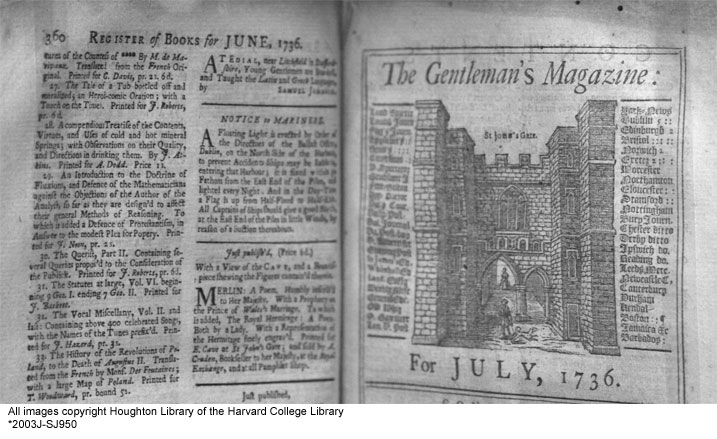
Shortly after his marriage to Elizabeth Jervis, Johnson settled in the town of Edial, just outside of Lichfield, his birthplace. Having unsuccessfully tried to work as a teacher in other schools, and not yet receiving any substantial income from his literary efforts, Johnson established his own school, for which he attempted to solicit students by placing an advertisement in the June, 1736 issue of Gentleman’s magazine. (It’s at the top of the right column on the left page)

“At Edial, near Litchfield in Staffordshire, Young Gentlemen are Boarded, and Taught the Latin and Greek Languages, by Samuel Johnson.”

The advertisement failed to provide the hoped-for boost to enrollment, and Johnson was forced to close the school just eight months later, but Johnson’s time as a schoolmaster did have one lasting impact on his life. One of his students, David Garrick, went on to become the dominant figure in the world of theater in the 18th century, and Johnson’s lifelong friend.

Edial school

Published in:John Overholt |on May 25th, 2006 |Comments Off on Pedagogues seeking students

The grocer of London

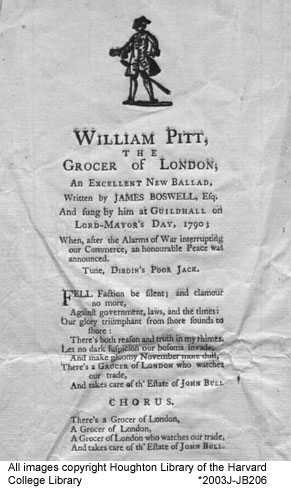
James Boswell’s noted love of the after-dinner ballad and his desire to secure political preferment combine in this broadside, William Pitt, The Grocer of London. After having tried unsuccessfully for several years to establish friendly relations with the Prime Minister, Boswell took the occasion of a feast honoring the installation of a new Lord Mayor of London to address William Pitt with this laudatory song. Combining news of a highly favorable trade agreement with Spain and Pitt’s honorary membership in the Company of Grocers, the song salutes Pitt for securing Britain’s commercial interests.

Accounts differ as to whether Pitt was in fact present for Boswell’s performance of the song, on November 9, 1790, but there is agreement that it was a great hit with those assembled, who demanded five encores from Boswell. In any event, it failed to achieve its goal, as Boswell’s overture to Pitt was not reciprocated.

This broadside, printed privately as a souvenir of the event, must have been produced in very small quantities, and this is one of only three copies known to exist today.

Grocer of London

Published in:John Overholt |on April 7th, 2006 |Comments Off on The grocer of London

Spare change, Mister?

This will be old news to British Johnsonians, but I just found out that the British Royal Mint last year issued a commemorative fifty pence coin for the 250th anniversary of the publication of Johnson’s Dictionary in 1755. In addition to the general circulation coin, serious collectors can spring for the gold proof. It is not, however, the first Johnsonian coin.

Published in:John Overholt |on April 3rd, 2006 |Comments Off on Spare change, Mister?

One day, all this could be yours

Not literally, but it’s the next best thing. Houghton is looking for candidates for one of the best jobs in librarianship: Curator of the Hyde Collection and Early Modern Books and Manuscripts. All you need is a library degree, an advanced degree in a relevant discipline, experence in a special collections library, knowledge of two European languages, and the ability to leap tall folios in a single bound. If that’s you or someone you know, please click on the link, and apply today.

Published in:John Overholt |on March 28th, 2006 |Comments Off on One day, all this could be yours

So that’s how it works

It can be difficult to explain to an unfamiliar audience how a book is composed of large sheets folded down to the size of the indivdiual leaves. This German translation of Rasselas will make an excellent visual aid in the future, however. It’s a relatively rare example of a book that was never folded and bound, so it still exists in loose sheets just the way they came off the printing press. This book has an octavo format, meaning that there are 8 leaves or 16 pages on one sheet. Having this particular sheet intact also proves something I might have guessed at from the finished product: the first four leaves of the book and the last four were printed together, and would have been cut apart before binding to go in their correct places.

Uncut sheet

Published in:John Overholt |on March 24th, 2006 |Comments Off on So that’s how it works

Mark your calendars now

2009 will mark the 300th anniversary of Samuel Johnson’s birth, and Houghton Library will be celebrating with a major exhibition and symposium. Obviously, we’re still working out the details, but this should be your best-ever opportunity to see the spectacular collections that Rick and I have been feverishly cataloging for the past two years. Bookmark the page linked in the title of this post for updates as they become available.

Published in:John Overholt |on March 23rd, 2006 |Comments Off on Mark your calendars now

When it says Lives, Lives, Lives on the label, label, label

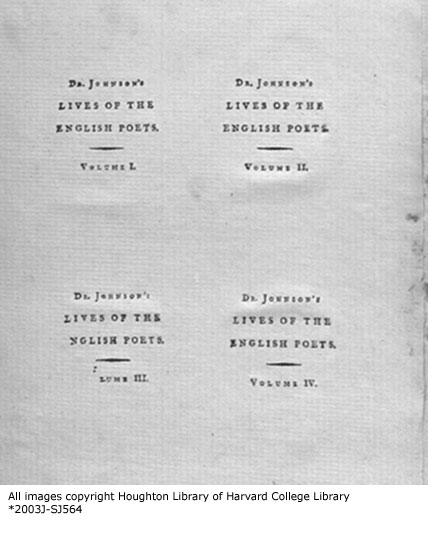
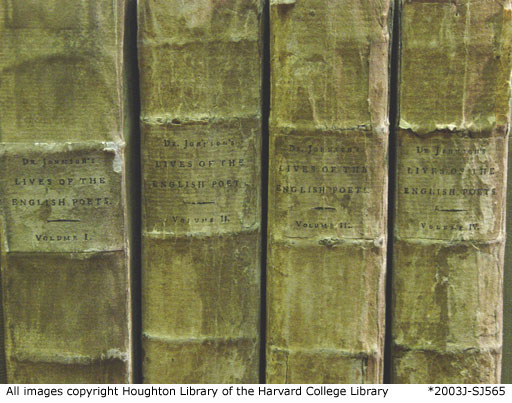
As I’ve mentioned before, one of my favorite things is to discover some feature of a book as it was originally issued, that has been lost in most of the copies of the book as they exist today. This copy of Johnson’s Lives of the English Poets has just such a feature. When new, all copies of this four-volume set included a sheet of spine labels that the purchaser could affix to the spines of the temporary pasteboard bindings the set was sold in. The vast majority of purchasers would have either cut this sheet out to put the labels on, or simply thrown it away and put a more permanent leather binding on the books. That’s why it’s nice to find a copy with the sheet of labels intact and unused, 225 years later. I’ve also included a photo of another copy, where the labels were applied as intended.

Labels of Johnson's Lives of the English Poets
Spines of Johnson's Lives of the English Poets

Published in:John Overholt |on March 10th, 2006 |Comments Off on When it says Lives, Lives, Lives on the label, label, label

Poison pen letter

I found the following rather extraordinary denunciaton on the front endsheet of an otherwise unremarkable book of poems. There is no provenance information in this copy, and nothing to suggest what the origin of the poem is, or at whom its vitriol is aimed.

“Verses to the author of a letter in the public advertiser, signed Graystock: &[?] refused admittance into that paper
What wretched Grubstreet scribbler of the day,
Who prostitutes his venal pen for pay,
At Surry dares the envenomed shaft to aim,
And with invective loads his patriot name.
That the firm virtues of his generous mind
Defy a host of foes like thee combined,
Miscreant, take back thy charge of infamy,
Sot, slave, & coward, thou art all the three.
Base sot, in cellars bred, in brothels spawn’d,
Vile slave, whose principles for bread are pawn’d,
Impotent coward, skulking from the light,
Whose poniard* like the assassin’s stabs by night.
Come forth, grim phantom, & a form assume,
Burst the dark shelter of thy native gloom;
And mark me when thou darst a man appear
A man shall meet thee–till then thy sincere
Despiser”
*(from Johnson’s Dictionary) Poniard: A dagger; a short stabbing weapon. “She speaks poniards, and every word stabs” (Sha.)

Google, Granger’s Index to Poetry, and Eighteenth Century Collections Online have all failed to turn up the source of this first-class invective, leaving me to wonder if the poem is original to my book. Do any Catablog readers recognize the source of this screed, and if so, who was on the receiving end? Send me an email if you know the answer.

Published in:John Overholt |on March 5th, 2006 |Comments Off on Poison pen letter