Mohsin Hamid’s book entitled The Reluctant Fundamentalist profiles the identity crisis of Changez, a young man from Lahore, Pakistan who is a successful businessman on Wall Street when 9/11 happens. Attending Princeton and securing a top-notch banking job, Changez – an immigrant – appears to be living the “American dream.” However, after the 9/11 attacks, his identity in The United States changes drastically. The film, directed by Mira Nair, visualizes this change by showing Changez being strip-searched at an airport and tormented in his workplace by his co-workers.
The movie talks about how American patriotism became a way for people to protect themselves from the terrorist attacks. Hamid sums it up by saying “small flags stuck on toothpicks featured in the shrines” (p. 79). The overwhelming imagery of patriotism in New York City is coupled with thoughts that “we are America…the mightiest civilization the world has ever known” (p. 79). This unification of America resulted in a seemingly all-time high of patriotism, but it also excluded anyone who didn’t “appear” to be American, such as Changez.
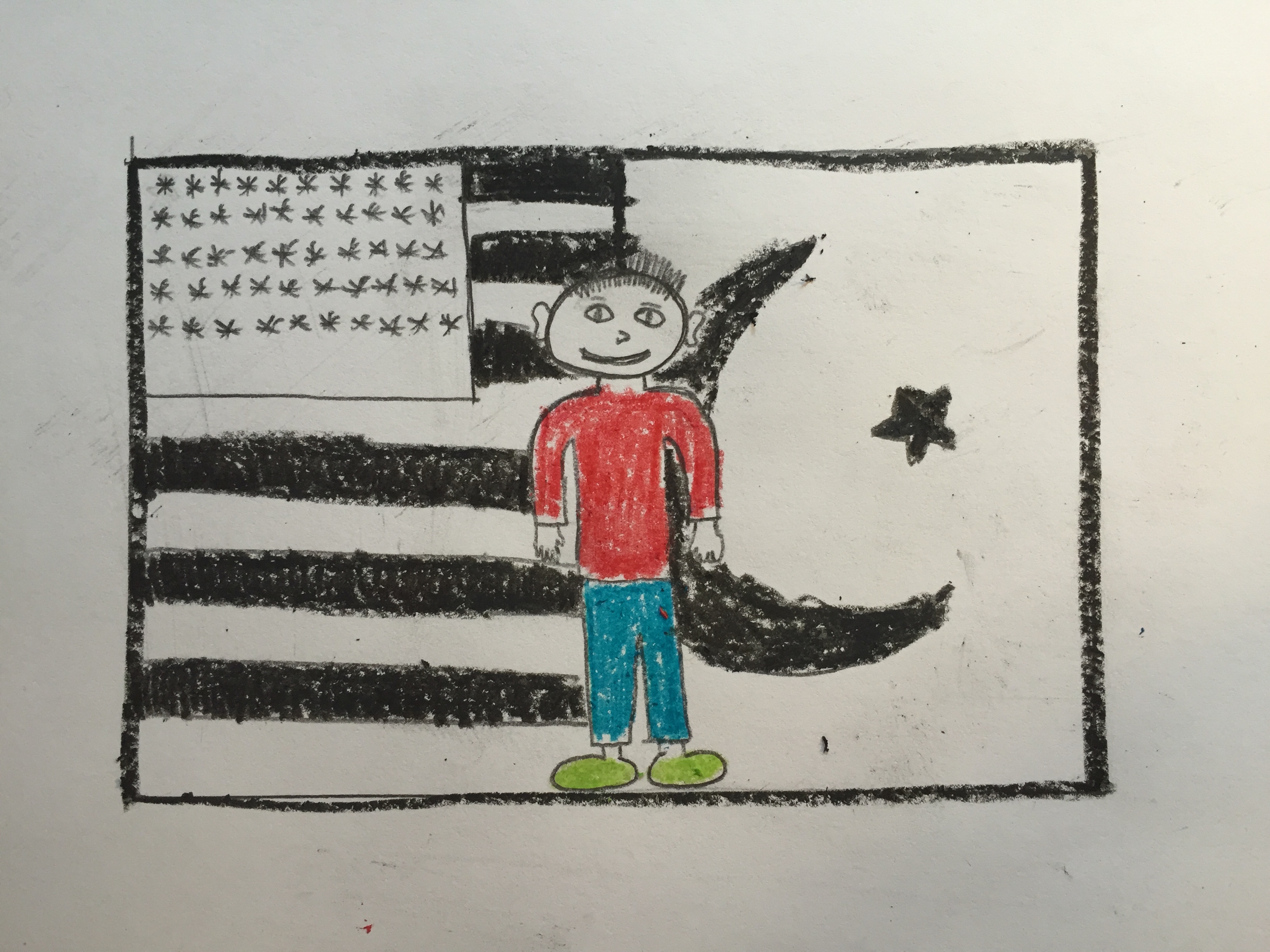
For the final week’s blog post, I decided to do a drawing that shows Changez’s identity conflicts profiled throughout both the movie and the book. Changez – in color – is standing in between half of an American flag and a Pakistan flag, which are both black and white. The black and white nature of these flags hints at the “us vs. them” sentiment highlighted in both the movie and the book. In the United States, Changez’s identity is really black or white – he is Pakistani or he is American, as if the two are mutually exclusive.
Is it good to be different? In our increasingly globalized society, identities are forced to overlap. Yet there still remains to be a taboo nature of being Muslim in America. In order to work towards a more unified world, we must try understand why people are different, and understand how these differences can in fact strengthen globalized cultures.