You are viewing a read-only archive of the Blogs.Harvard network. Learn more.

f/k/a archives . . . real opinions & real haiku

March 22, 2008

invoking the Big Kingmaker in the Sky

Filed under: lawyer news or ethics,Schenectady Synecdoche,viewpoint — David Giacalone @ 10:25 pm

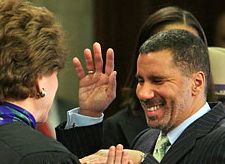
This year’s Blog Against Theocracy — a project encouraging weblogs to post over Easter weekend in support of Freedom of Religion and the Establishment Clause in the U.S. Constitution (see our prior post) — serendipitously came up on my radar screen right after I had listened to the swearing in of New York’s new Governor, David A. Paterson, last Monday, March 18th. Indeed, after shaking my head over remarks made in the preliminary invocations, I was feeling grateful for our new Governor’s low-keyed reference to the Divinity in his inaugural speech. BAT08 provides a good excuse for trying to explain my discomfort hearing the religious invocations that preceded Paterson’s swearing-in.

Gov. Paterson taking the oath of office.

The ceremony last Monday was opened with two religious invocations — offered by the Rev. Msgr. Wallace Harris, pastor of St. Charles Borromeo Church in Paterson’s home community of Harlem, and by Rabbi Shmuel Lefkowitz of Agudath Israel of America, Brooklyn. You can read the text of Rabbi Lefkowitz’s Invocation for Governor David Paterson at the Yeshiva World website. I have tried repeatedly, but have not been able to find the text of Msgr. Harris’ invocation; that is unfortunate, as his words were the more troubling, and I would like to be able to quote him directly (and invoke perhaps in readers the same squeamishness that I felt).

[larger, or in color; SE Corner, Church & State Sts., Schenectady, NY. photo by David Giacalone 2008]

There’s no way that I can (or want to) get into the legal issues raised by having official public, governmental meetings open with a prayer. Despite believing they are inappropriate in a pluralistic society with an Establishment Clause in its Constitution (and a passel of deists among its Founding Fathers), I cannot envision our having a Supreme Court any time soon that would ban them. See the many postings on invocation issues and lawsuits, at Prof. Howard M. Friedman’s Religious Clause weblog; and this recent article by Michigan News on prayer practices before public meetings in Michigan, for proof there is plenty of discussion and disagreement over the opening of public governmental meetings with prayer or other forms of religious invocation.

Out of respect for the belief of others, I’m willing to sit politely through a short prayer at the start of a special public event without complaining (but probably not without rolling my eyes). However, both of the Paterson inaugural invocations went a bit too far in a nation that came along long after the Divine Right of Kings was put to rest, and that was never into the Mandate of Heaven notion. [pause for a related smile] Each invocation seemed especially quaint to me, as I do not believe in a divine being that intervenes in human affairs — much less in one working behind the scenes to bring chosen people into high political office.

(more…)

February 17, 2008

spring comes early at Simply Haiku (along with a little haiga controversy)

Filed under: Haiga or Haibun,Haiku or Senryu,viewpoint — David Giacalone @ 10:17 pm

Gray on gray is the predominant color scheme in Upstate New York this time of year. My friend Yu Chang lives here in Schenectady (teaching electrical engineering at Union College and bringing the haiku spirit to all he does), so he knows that fact all too well. Nonetheless, if you stopped at the website of Simply Haiku Journal this weekend, you would have found a colorful reminder of the promise of Spring (beginning with the cover photo by Carol Raisfeld). Indeed, the Spring 2008 issue of Simply Haiku (Vol. 6:1) includes a portfolio of modern photo-haiga by Yu, which are guaranteed to overcome any light-deprivation-sadd-ness you might be suffering during the ides of February. [Haiga is a haiku-related genre that combines a painting, photo or other graphic image with a “linked” poem.]

If you’re more than a bit tired of grayscale, just click the link next to these b&w thumbnails from two of the haiga by Yu, to feel the magic of Spring:

[orig. haiga]

spring —
pink robe
at her ankles

…………………

[orig. haiga]

May morning
a window
ajar

…………………. by Yu Chang, from Modern Haiga in Simply Haiku Journal (Spring 2008, Vol. 6:1)

In addition to four other pictures by Yu Chang, you’ll find many more antitdotes to wintry grays and whites in the new issue of Simply Haiku — including haiga images from Pris Campbell and Collin Barber, as well as Carol Raisfeld and Ashe. And, for some forward-looking commentary, check out George Swede’s last “Tracks in the Sand” column, where he talks about his new duties as editor of Frogpond.

mid-argument–
a bumblebee
stumbles in clover

………………………………….. by Matt Morden – Stumbles in Clover (2007)

Despite trying to avoid stressful online arguments lately, I don’t feel that I can in good conscience refer you to the Modern Haiga at Simply Haiku without raising an important issue concerning the essence of haiga excellence. Beyond my chronic complaint over the use of far too many “tell-em”/”psyku” poems (which tell you rather than “showing” you what is on the poet’s mind), I’ve been seeing far too many haiga that incorporate what I call “label-ku” — poems that describe what is happening in the accompanying graphic image, rather than being “subtly linked” to that image; the haiku appears to be a caption or title describing the image.

My introduction to modern haiga came through the intervention and inspiration of my friend Aurora Antonovic, who is the Haiga Editor at Simply Haiku (and much more). She encouraged me to try my hand at creating photo haiga (resulting, e.g., in this portfolio at SH). From the start, Aurora made it clear to me: quality haiga have subtly-linked poems. As she says in her Introduction to Modern Haiga at Simply Haiku:

Haiga, of course, is poem-art, but it is so much more than a three or five-line poem accompanying an image. The poem must not merely describe the image, nor is it to be confused as a slogan, but rather as an integral part of the whole. . . .

Work must possess simplicity, modesty, minimalism, beauty, and truth. Both image and haiku must be strong enough to stand alone, but together, form a completely new and enhancing artistic expression that would not have been possible otherwise.

The haiku and image need not be overtly associated with the other. In fact, the subtlest and gentlest associations often work best.

Here’s a haiga that fits Aurora’s description, from Simply Haiku (Spring 2008):

[orig. haiga]

village common
showers of snow melt
on someone’s cobs

……………. by Matt Morden

Because I’ve taken Aurora’s words to heart, I have been rather disheartened by some of the haiga selected for inclusion in Simply Haiku and other well-known haiga forums over the past year — journals that set the standard and teach by example. There have been far too many “label-ku-haiga.” As I suggested with tell-ems, I believe that haiga editors should be sending promising haiga that include label-ku back for a re-write, rather than putting them into top-tier publications — no matter how respected the haijin might be who submitted the piece.

Rather than point here to the work of a haijin who I do not know well and do not admire, I’m going to link to the new SH portfolio by one of our f/k/a family favorites, Matt Morden [see our rave review of his recent haiku collection Stumbles in Clover, from Snapshot Press]. At his weblog, Morden Haiku, Matt habitually illustrates his fine haiku with intriguing, often gorgeous, photography. Or, we might say, he uses intriguing haiku and senryu to help describe or explain his fine pictures.

Nowhere at Morden Haiku does Matt call his work haiga. I have always assumed that Matt did not use that term, because he does not consider the mere combination of a picture (no matter how artistically successful) with a poem that describes it (again, no matter how artistically successful) to be sufficent to create a haiga (at least not journal-worthy haiga that lives up to the Morden name for haikai excellence). Therefore, when I saw Matt’s name included in the Modern Haiga section of the new Simply Haiku, I was thrilled — anticipating great haiga that would fuse his fantastic photography and haiku-writing skills, and show us neophytes (as well as haiga veterans) how to create the “new and enhancing artistic expression” that is the goal of haiga, through the subtle linkage between words and image.

Sadly — and I truly hate to say this, because I have long admired his poetry (and photography) and Matt has so often said encouraging and generous things about my own — I was disappointed when I clicked through his new haiga portfolio. Except for the one haiga shown above, the selections simply failed to offer “subtle or gentle” associations between the words and often striking images. Because of the source — created by Matt Morden and selected by Aurora Antonovic for Simply Haiku — I am afraid that publishing such haiga gives the wrong signals, or gravely confusing ones, about what makes great haiga.

Sure, it’s possible that I’m too simple-minded, new to the genre, or definition-bound, to understand the subtleties in the concept of “subtle linkage.” If so, I humbly seek more instruction and explanation. It cannot simply be that “label-ku” [called “captional style” haiga by some experts] are acceptable if the picture or the words are each individually superb, or somehow offer many layers of interpretation and meaning. Every first-rate photo and first-rate poem is packed with myriad layers — or the potential to evoke them from the reader/audience. For me, the subtle link is at the core of the best haiga. Without it, we have illustrated haiku, not publication-worthy haiga.

I can find beautiful photos and excellent haiku in many places. When I go to the best haiga journals (which receive untold numbers of haiga from which to choose for publication), I expect much more than label-ku. To my haijin friends, Matt and Aurora, I apologize for raising this issue and giving us all more agita; I know you are both more than capable of withstanding the bite of this little gadfly. I will listen with an open, “beginner’s mind” to your responses, and to those of other haiga lovers, creators, and editors.

update (Feb. 19, 2008): With his usual class, Matt Morden has pointed his readers to this posting, saying: “Those of you who worry that an ingratiating culture of mutual congratulation may eventually lead to English-langauge haiku eating itself, will enjoy the folks at f/k/a‘s critique of my own attempts at something that may resemble haiga.” Of course, I’m still hoping he’ll weigh in on the questions I’ve raised about the essence of quality haiga and using captional-style haiku with photographs.

[orig. haiga]

metropolitan museum
i join the line
to mesopotopia

………… by Yu Chang, Simply Haiku (Spring 2008)

Afterthoughts (Feb. 19, 2008): Unlike myself, the folks at HaigaOnline have given a lot of thought to the theory of image-poem linkage in haiga. For example, see “HAI + GA: Exercises in Linking Test and Image,” written by its editor Linda Papanicolaou, for the journal’s current edition (Issue 8-2, autumn/winter 2007). You are hereby encouraged to peruse and muse over Linda’s Haiga Workshop essay and associated display of photos and haiku. It begins:

“Modern haiga encompasses a wide range of approaches and styles, but every artist works towards the same goal—an art that’s more than the sum of its parts. The secret is in the link: how the text and the image relate to one another. In good haiga, both haiku and image should be able to stand on their own aesthetically, yet in juxtaposition with each other find new, deeper or richer resonance. The haiku does not simply describe the image—there’s a shift that creates openness in their relationship. This allows readers to engage and complete the meaning through their own experience.”

Linda is very reluctant to have “shoulds” and “musts” — believing it is better to show than to tell about haiga linkage theory and practice. As she says, “However one chooses to name the various modes of linking, the only real way to learn how they apply to haiga would be to choose a photo and haiku it in as many ways as possible.” Therefore, using four pictures taken by photographer-poet Ray Rasmussen, the Workshop — with nine participating authors experienced in haikai linkage — has “assembled the haiga in flash slideshows that give each text its turn with the image,” and includes a comparison chart to use as you click on the thumbnails and page through the workshop results. It’s an intriguing and helpful exercise.

Linda tells us:

“In the end, indeed, we found that the poetry of haiga depends on an open relationship between text and image. As one participant said, ‘I like the idea of the haiku capturing the mood of the haiga without repeating exactly what’s in the photo.”

January 27, 2008

we again stifle our obama oratory

Filed under: Haiku or Senryu,viewpoint — David Giacalone @ 12:25 pm

After last night’s results in South Carolina, the temptation to break the f/k/a Christmas Eve no-political-punditry pledge is even greater today than it was after the Iowa caucuses, and during the past few weeks of bilious Billderdash on the campaign trail. However, as we said back on January 4th, “we’ve never been able to have just one drink at the punditry bar, so I just put the cork back on that bottle of opine wine.”

Nevertheless, I will say two things: (1) I joined “Obama for New York” last night, plan to be one of the honkees at the Honk for Hope rally this afternoon in Albany, NY, and have just bookmarked the Obama Capital District NY Blog. And, (2) No matter how much I might agree with the agenda of whoever is chosen to live in the White House this November, I do not want to live through another four or eight years with a President who is personally loathed (not merely a gender or racial dislike or preference) by scores of millions of Americans. We need a unifier.

first full moon NoYabutsSN .
breaking the last
new year’s resolution

……………………………………… by dagosan (see the original haiga, at Magnapoets)

Meanwhile (and this goes greatly against the Prof. Yabut and ethicalEsq grain), I’ll let others do the talking: See “A President Like My Father,” by Caroline Kennedy; and “The Billary Road to Republican Victory,” by Frank Rich (New York Times, January 27, 2008); “Questions for the Clintons,” by Bob Herbert; and “Two Presidents Are Worse Than One,” by Garry Willis (New York Times, January 26, 2008); also, Althouse on Who Favored Hillary in SC.

What’s the antidote to the urge to pontificate? Besides having fun with Ann with mirrors, it is — as always — good one-breath poetry:

family plot–
all but forgotten
the sibling rivalry

high noon
the boys refill
their water pistols

……………………… by Tom Painting
“high noon” – July Selection, Snapshot Press 2005 Haiku Calendar
“family plot–” – Acorn No. 19 (Fall, 2007)

NoYabutsSN

new year
the neighbor tidies up
his side of the woods

waking to a new year . . .
his side of the bed
already cool

mother-daughter outing —
deep shadows
in the lotus seed pod

…………… by Carolyn HallAcorn No. 19 (Fall, 2007)

January 21, 2008

MLK, Jr Day: service, justice & nonviolence

Filed under: Haiku or Senryu,viewpoint — David Giacalone @ 10:16 am

It’s Martin Luther King, Jr. Day, and as we did last year, the f/k/a Gang re-commits to a Day of Service in his honor, as well as beginning “40 Days of Nonviolence: Building the Beloved Community.” Other f/k/a MLK Day themes that deserve a repise:

  • all of us who are responsible for the operation of our legal and judicial system (that’s every American, but especially the legal profession) can use the pro-se/self-help-law movement to help ensure that wealth is no longer the key to the courthouse and that our justice system fairly serves every American.

Martin Luther King Day…
the weight of ice
on a magnolia branch

. . . by ed markowski

Martin Luther King Day – NoYabutsSN
the kid says it’s too cold
to march

. ……………… . by dagosan

[Don’t forget the 2008 Martin Luther King Day Edition of Blawg Review [#143].]

January 16, 2008

papa g’s night train

Filed under: Haiku or Senryu,viewpoint — David Giacalone @ 8:58 pm

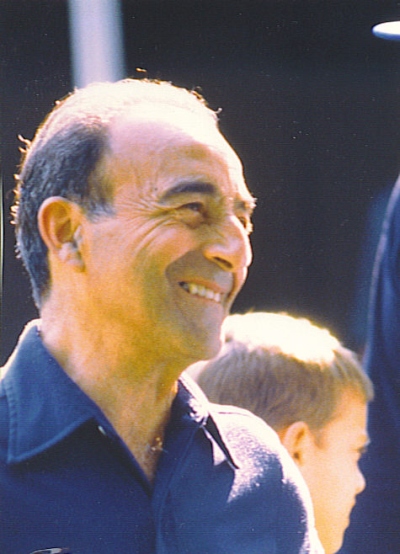
[Jitterbug Stamp] My retired mail-carrier Dad, Arthur P. Giacalone, loved swing music and famously loved to dance. When we went as a family to wedding receptions or other big parties, Papa G. always brought along a change of clothing, so he could shed the damp ones before the last dance with Mama G. [I wrote about Papa G. on his 87th birtday in 2006, and last September, when he and Mama G. celebrated their 60th Anniversary (lots of photos here).]

[big] At his funeral on Monday, one of Dad’s very favorite nieces reminded us that their eyes would meet whenever a band started to play “Night Train,” and then they would jitterbug together like crazy to the delight of all. (Click for jitterbug history, and this fun 1944 instructional video)

jitterbug gene —
dad’s skipped
a generation

………………….. dagosan

Cousin Rose Palazzo’s fond memory of dancing with Uncle Art. got me searching for a video clip of Night Train yesterday, and refreshed my recollection on many dad-and-music-related topics from my childhood. When I learned that Louis Prima did a well-known version of “Night Train,” I smiled broadly — recalling the fun I had with my parents as a (not-yet-jaded, pre-teen) kid, watching the antics of trumpet-playing band leader and “hepcat” Louis Prima and his deadpan, lovely, songstress wife Keely Smith (who can be heard in a 20-minute NPR Fresh Air presentation, from 2002, “Queen of Swing“). As one commentator explains, Italian-American Louis Prima was “one of the few obviously ethnic entertainers who never turned his back on his roots once mainstream success hit.” For example,

“He always revived — to his audience’s delight — Italian novelty numbers [e.g., titles like “Felicia No Capicia” (more),” “Baciagaloop (Makes Love on the Stoop),” “Please No Squeeza Da Banana,” and “Josephina, Please No Leana on the Bell.” ], and much of his performing persona could be traced to the wildly energetic Italian kid who never grew up.”

With much anticipation and satisfaction I located a Prima-Butera Night Train Video version of the song, which had been released on Louis Prima’s “The Wildest!” Album (Capitol Records, 1957), and has an amazing sax solo by Sammy Butera. I don’t think of myself as a swing or jazz fan, but this instrumental made me grin and tap my feet, and immediately recall the great Night Train lyrics (by Lewis C. Simpkins) that dad would occasionally sing — in what was surely my first exposure to an anti-domestic violence theme:

Night train,
That took my baby far away.
Night train,
That took my baby far away.
Tell her
I love her more and more each day.

(Chorus) [“The Wildest!cover]

My mother said I’d lose her
If I ever did abuse her,
Shoulda listened.

My mother said I’d lose her
If I ever did abuse her,
Shoulda listened.

Now I have learned my lesson
My baby was a blesssin’,
Shoulda listened.

[I plan to click on the Prima video link often, to let Night Train help “bring my daddy back to me.” Listen to Eddie Jefferson’s more optimistic version of the song, in which the night train brings his baby back.]

funeral dirge —
we bury the one
who could carry a tune

……… david giacalone – Frogpond 31:2 (2008) – selected for “white lies: Red Moon Anthology 2008

Since my arrival in my original hometown of Rochester, New York, on Saturday, I’ve been treading water in the emotional pond formed by losing a parent. Despite a few tearful episodes, it has mostly felt like a soothing communal hot-tub, warmed with the love and affection of family and friends.

Here are a few more poems that came to mind during my 4-hour trip back to Schenectady today on the New York Thruway:

driving home
from papa’s funeral —
thin noon moon half-empty

bequest wish list
a father’s smile
at the top

dad’s empty chair –
mom lets me cook the pasta
al dente

…………………………… dagosan

Here are a few one-breath poems, by members of our f/k/a haijin family, which in one way or another remind me of a man who was sadly short of breath and unable to jitterbug the past couple of decades.

winter woods
seeing myself
in black and white

………………….. by yu chang – Upstate Dim Sum 2005/1

the pinwheel stops
grandpa catches
his breath

………………… by Randy Brooks, from School’s Out (Press Here, 1999)

one of your sighs
has stayed with me
forty years, so far

……………………… by John Stevenson – Upstate Dim Sum (2005/I)

Discovery channel –
an older male vanquished
heads for the hills

within the red wine
a nap in my chair

my wife catches me
picking from our trash
again

letting her
walk all over me
ladybug

without consent
my old sneakers
in the trash

yardwork:
some of the old tire water
on my shoes

the river
full of ice
broken free

……………………. Tom Clausen
“Discovery channel” and “within the red wine” – Upstate Dim Sum (2003/II)
“me wife catches me” – from Upstate Dim Sum 2007/1
“letting her” — being there (Swamp Press, 2005)
“without consent,” “now that I’m over,” and “yardwork” – from Homework (2000)
“the river” Upstate Dim Sum (2005/II)

update (Jan. 17, 2008): f/k/a “Cousin” Ed Markowski knows a lot about family love and loss, and caring for friends. He sent me three poems overnight that belong here in this post:

funeral procession
the silence of the engine
dad tuned last april

winter funeral
a bead of holy water
freezes in mid-air

dad’s funeral
this morning uncle walt
ties my tie

[mama g, 1948]

afterglow (Jan. 18, 2008): That cutie my Dad fell in love with in 1947 loved Glenn Miller, too, and we often heard “Moonlight Serenade” at Casa Giacalone (click for YouTube version), as well as “In the Mood“. Ed Markowski sent us this little gift, which incorporates another of my favorite insects:

moonlit serenade
fireflies appear just beyond
the jitterbugs

…………………………………………. ed markowski

Meanwhile, the rarely-sentimental Prof. Yabut penned this tell-em, and caught me in a weakened condition, so I’m passing it along (with apologies to Groucho Marx):

in the mood
innuendo goes
out the window

afterwords (Jan 21, 2008): Thanks to Gideon at Public Defender Stuff, for including this posting in his stirring 2008 Martin Luther King Edition of Blawg Review [#143].

p.s. A Butterfly Connection: Go here to learn why, from now on, butterflies will remind me of my Dad, and to find a couple dozen butterfly poems by our Honored Guest poets. I’ve uploaded a “butterfly haiku memorial collection for Papa G.,” which is a Word document that you can print from this website, to create a two-sided, trifold brochure. It contains most of the poems found in the butterfly haiku posting.

sunset stroll –
searching snowbanks
for butterflies

……………………………….…………………………… by david giacalone
[in mem., Arthur P. Giacalone; haiga photo by Yu Chang]

December 29, 2007

you tell-em: hold the anchovies

Filed under: Haiku or Senryu,viewpoint — David Giacalone @ 10:40 pm

A recent article in the Schenectady Daily Gazette about police using too much sick leave and comp time to avoid the busiest patrol shifts caused a jarring bit of guilt on my part. Clearly, I’ve been shirking my duties on the haiku quality control beat, in the 6 months since issuing my fragnum opustoo many tell-ems: psyku lower haiku quality.”

You may recall that I’ve been lamenting the escalating trend of haiku journals publishing “tell-ems”, in which the poet “tells” what is on his or her mind (stating an insight or intellectual conclusion, or naming an emotional state) rather than “showing” us through images based on sensory experiences. As I said last May:

They may in fact constitute wonderful insights into the world, humanity, or the poet’s psyche. A few might belong in a list of the wisest epigrams or wittiest bon mots. Some readers might think they are excellent free verse poems despite their brevity. Nevertheless, psyku do not belong in our finest haiku journals and anthologies as examples of the best haiku or senryu being written in English — even if their authors are among the most respected haijin alive and the poem is structured to look or feel like haiku.

Sadly, despite voluminous research and quotes from a multitude of leading haiku scholars and luminaries, my complaints have been no more successful than similar attempts at this weblog to uphold the quality of legal services and viability of lawyer ethical rules and standards. Although I have recently sworn off lawyer punditry and playing the role of the conscience of the profession, I’m going to persevere a bit longer in pestering the haiku community about the dangers of “psyku” — especially, because the gap between my views and those of leading editors and awards-judges seems to be increasing, while my pleasure in reading many haiku journals, collections and anthologies is rapidly declining.

[orig.] Anchovies on the side: Some in the haiku community of poets, editors, scholars and readers might believe that tell-ems and the whole “psyku genre” are like literary anchovies — just a matter of an acquired taste (rather than of quality or definition), an option that deserves to remain on the menu of the best journals. If they are merely a matter of taste, tell-ems are a haikai flavor I am simply not willing to ingest, while waiting for my taste buds to be subdued, converted or numbed. Nor, as with anchovies, am I willing to succumb to pressure from purportedly more-adventurous or sophisticated peers, and to order up publications that contain tell-ems, with the understanding that I’ll just ignore them, eat around them, or place them to the side.

Every tell-em in a leading haiku journal, or in the winner’s circle of a kukai or award ceremony, is taking the spot that could have contained a better poem, while leaving an unwanted aftertaste and the growing risk of one-breath reflux on a tide of half-baked, three-line pseudo-tanka.

Crankshaft

The anchovy analogy came to mind recently when I ran across one of my all-time favorite senryu in the course of a book review:

first date–
the little pile
of anchovies

. ……………… by Roberta Beary – from The Unworn Necklace (Snapshots Press, 2007); Frogpond (Winter 2007), 1st Place, Haiku Society of America’s 2006 Gerald Brady Senryu Contest

This poem works so well as haiku/senryu because Roberta took a familiar concept (that could easily have resulted in a poetic cliche) and deftly illustrates it for us, rather than spelling it out. She tells us what was experienced, not what she thought about, or what we should conclude on the subject. She leaves it up to the reader to fill in blanks and ellipses with insights, or empathy, or questions about what was on her mind and on her lips that night.

In the hands of a lesser poet — or one who was simply not willing to take the time to invoke “the first-date anchovy experience” with a sensory image rather than a mere explanatory phrase — we could have wound up with an epigrammatic “insight,” a wry-ku bon mot such as:

i know the rule:
no first-date
anchovies

Or, perhaps a palpably inferior, regretful “sigh-ku,” like:

no goodnight kiss —
why did I have anchovies
on our first date?

The Beary Anchovy example seems to me to be a great teaching tool: an example that reminds us that the best haiku and senryu do not merely embody an interesting notion written in 17 syllables or less. The challenge of haiku — the task in crafting the highest quality haiku, at least as it has been practiced over the past few decades by those writing in the English language — is to share an experienced moment of insight, awe or heightened awareness and connection, by showing not telling.

As I said in my original tell-em essay,

Crafting the right juxtaposition of sensory images to evince the insight the haiku poet wants to share or suggest is not always easy, even for the best haijin. That’s actually my point: doing it right can be difficult, requiring special skill, creativity and focused effort. Taking the shortcut of direct explanation makes the poem — however else it might succeed — a second-rate haiku.

A tell-em is built on a lesser aspiration and gives the reader a lesser, restricted role in the overall exerperience of the poem.

Angry Anchovies logo

I’m still reluctant to draw direct attention to any particular psyku examples that I find in print or online. Although I’ve been willing to aggravate lawyers at this weblog over the past few years, I am not eager to alienate haijin — whose skin often seems considerably thinner than that of my legal brethren. Indeed, the perpetrators of some rather prominent tell-ems are in fact among my favorite poets, and even my best friends.

Nonetheless, I thought I might use anchovy parody poems to playfully illustrate the pitfalls of the tell-em phenomenon. For example, the Grand Prix winner of a recent A-Bomb memorial contest inspired me to pen this fishy shadow version of an anti-war “haiku”:

first date turmoil —
anchovies stifle the wishing
of the aging matchmaker.

Yes, the original poem was almost this loaded and awkward (and in fact read like a sentence written on three lines, and actually ended with a period).

Similarly, I don’t know what the HSA Executive Committee was eating when it chose the “best” poem from a recent issue of Frogpond, but it sure gave me indigestion. Although the original was written by one of the most honored and talented haijin on the planet, it precipitated the following, analogous small-fish “sighku/psyku” nightmare:

date’s end —
what made me think I needed
anchovies

As I encounter tell-ems in high places, I will probably craft more anchovy parodies, so watch this space for updates. Of course, I’d much prefer that haiku poets and editors heed my plea from last May:

If only to spare themselves the pain of reviewing the ever-rising flood of wryku and sighku by the less talented [and more pompous] among us, editors should draw the line and exclude (or segregate) tell-ems. They shouldn’t be shy about returning a poem to its author with a note saying “nice idea with good potential; please see if you can convert this psyku into a genuine, first-rate haiku by substituting a sensory image for your explanatory phrase.” If it happens often enough, haijin will submit fewer tell-ems and produce better poetry — and our journals will contain noticeably better haiku.

update (April 10, 2008): As I mentioned, in our posting on the 2008 Anita Sadler Weiss Awards, one of the honored poems — which is favorably compared to a couple of classic poems that solely use sensory images — has won a place among our anchovie-ku:

between constellations
and anchovies
all I don’t know

That last line turned an interesting poem into an instantly trite psyku — half a haiku attached to a cliche. I can’t imagine how this poem — by an author of many fine haiku — garnered so much praise.  And, despite not wanting to offend the cream of the haiku community, I humbly offer my dissent.

December 24, 2007

breaking hillary’s heart (the end of an error)

Filed under: q.s. quickies,viewpoint — David Giacalone @ 12:44 pm

There are people who will never vote for me. It breaks my heart, but it’s true.”
………. Sen. Hillary R. Clinton (quoted in NYT, Dec. 19, 2007; orig. image)

If I thought Hillary had a heart worth sparing (a heart that loved something more than the notion of Presidential power), I’d feel a little guilty about telling her this on Christmas Eve:

“Hillary, I will never vote for you. Indeed, if you’re nominated by my Democratic Party as its 2008 presidential candidate, I might end up casting my first vote for a Republican for President. If the GOP candidate seems even less honest, trustworthy and genuine than you, I’ll find a third party candidate to support, or skip voting for the top office next November. But, Never for Hillary is a certainty for this law-trained, liberal-leaning Baby Boomer, despite decades of supporting gender equality and women candidates . . . . . ..

. . . . . the f/k/a Gang interrupts this Dear Hillary letter to announce the end of political and (especially) law-related punditry at our weblog. Sure, we’ve said this before — see, e.g., our May 2004 post “poetry not punditry” when the site ethicaEsq was renamed f/k/a — but this time there will be no punditry relapses. Neither “our” hearts nor souls, brains or bodies, are up to playing the role of political commentator (or advocate), much less carrying the much bigger burden of the “conscience of the legal profession” (a futile and thankless job if ever there was one).

When Carolyn Elefant asked last week “Is Blogging an Antidote to Lawyer Depression?,” I immediately thought “not the way I do it; it’s a catalyst for more.” And when I discussed the role of cognitive dissonance in the phenomenon of lawyer depression, on December 17, I knew that I would have to come clean and acknowledge that making moral or ethical judgments, and calling into question the conduct of others is simply at odds with my own core beliefs about my function on this planet. And, that this time I will have to act on that bit of personal insight, and live it.

In spite of the ego-gratification or reassurance that comes from voicing an opinion and being heard (and getting little attaboys and even awards from people I admire), there is no pundit-payoff for me — other than the travails of cognitive dissonance and malaise of ignored values. I can’t even offer the excuse of the depressed lawyer who is making a good living at the expense of his or her soul or sanity. Some people enjoy playing opinionated pundit; but the role sucks me dry of energy and joy, and daily fills me with dread.

So, as of today, there will be no new posting here that looks or sounds like legal ethics or political punditry. Other than continuing to highlight new poetry by our two-dozen fine Honored Guests, I’m not sure just what I will do at this space — although the short-lived Haibun Pundit might soon make his return. Of course, the archives of this weblog contain far too much good haiku and important analysis of legal ethics and clients’ rights to tear the site down.

frozen river–
snow hides
the elm’s reflection
……………………… dagosan – Mainichi Daily News (March 5, 2005, No. 669)

As for Election 2008, I’ll let Maureen Dowd, and Stuart Taylor Jr, and maybe Althouse, along with the other candidates tell you the “The Trouble with Hillary.” I wish I could say that plenty of others will ride herd on the Bar on behalf of the consumer of legal services, but I can’t let the need suck me into this personal maelstrom again. Thanks again to all our readers and fans. We’ll understand if you drift away, and be mighty pleased if a more-enlightened, self-actualized version of the f/k/a Gang holds your interest.

big thaw overnight —
reflections
on the river

……………………… dagosan – from loose change: Haiku Society of America, 2005 Members’ Anthology

December 16, 2007

christmas and winter don’t mix

Filed under: Haiku or Senryu,Schenectady Synecdoche,viewpoint — David Giacalone @ 11:17 am

The Ides of December have once again betrayed our budding/brooding holiday spirits. Tens of millions of Americans, from Missouri to Maine, are waking today to the many horrors of a winter Nor’easter. See “Second Storm in a Week Moves East” (Wash. Post/AP, Dec. 16, 2007) Here in Schenectady, the Daily Gazette headline says “Wintry weather expected to take its toll on region” (Dec. 16, 2007). Not only are roads treacherous, with snow “expected to change to sleet and freezing rain by mid- to late morning,” but the hectic rush to complete holiday shopping chores will have to wait for snow removal duty — with shoveling made especially strenuous due to the heaviness of “wintry mix” precipitation, and snow blowers of dubious assistance dealing with the “dense, icy mess.”

wintry mix
we make a snow buddha
for Santa

—- by dagosan, in Holiday Haiku from Schenectady (Dec. 2007)

It looks like a Winter Wonderland, but it has me wondering yet again why we jeopardize our physical and psychic health every year trying to perform an already-stressfully long list of holiday chores – – and accomplish the related travel — in the time of year that is most likely to have the most inhospitable weather. Whenever I make that observation, I am told (in tones of total resignation), “it’s traditional.” To be honest, such reasoning almost never makes sense to me when a change can greatly improve a situation, and can be done in a cost-effective way that shouldn’t offend reasonable people.

sitting
where I sat as a child
I wait out the storm

……….. by Hilary Tann, in Holiday Haiku from Schenectady (Dec. 2007)
orig. pub. in Upstate Dim Sum (2004/I)

holy family. As you surely know, the historical person whose birthday is being celebrated on Christmas, was almost certainly not born anywhere near the 25th of December. As the website All About Jesus Christ respectfully tells us in Was Jesus born on December 25?:

“It wasn’t until A.D. 440 that the church officially proclaimed December 25 as the birth of Christ. This was not based on any religious evidence but on a pagan feast. Saturnalia was a tradition inherited by the Roman pagans from an earlier Babylonian priesthood. December 25 was used as a celebration of the birthday of the sun god. It was observed near the winter solstice.

“The apostles in the Bible predicted that some Christians would adopt pagan beliefs to enable them to make their religion more palatable to the pagans around them. Therefore, some scholars think the church chose the date of this pagan celebration to interest them in Christianity.”

The All About Jesus site also explains why it is far more likely that Christ was born in in the spring or fall than in a cold month:

“The Bible itself tells us that December 25 is an unlikely date for His birth. Palestine is very cold in December. It was much too cold to ask everyone to travel to the city of their fathers to register for taxes. Also the shepherds were in the fields (Luke 2:8-12). Shepherds were not in the fields in the winter time. They are in the fields early in March until early October. This would place Jesus’ birth in the spring or early fall. It is also known that Jesus lived for 33.5 years and died at the feast of the Passover, which is at Easter time. He must therefore have been born six months the other side of Easter – making the date around the September/October time frames.”

So, “tradition” surely need not be a barrier to choosing a more sensible time of year for staging our society’s biggest holidays — unless, we still want to make Christianity more appealing to the pagans among us and we are going to let the pagans dictate our schedules. Needing to have snow on the ground to be in a holiday mood seems, let’s be frank, a rather childish, and far too Northern-Euro-centric notion. We need to get over it — if only to help assure that as many of our loved ones as possible can travel in safety and with some assurance that they will arrive and depart when planned. As a bonus, we wouldn’t have to dig our cars out, before heading (in bulky, hot clothing unsuitable for indoor shopping), on treacherous roads with ineffective defrosters, to mall parking lots cluttered with space-stealing snow banks.

update (Dec. 21, 2008): Encore post “let’s move Christmas to May“.

red bows decorate
the ‘Closed for the Season’
sign

…… by Hilary Tann, in Holiday Haiku from Schenectady (Dec. 2007)

For now, we’re stuck with Christmas in December. If the current storms are impacting negatively on your holiday spirits or plan today, or you simply want to amplify your Christmas-season joy, click on our newly-created collection of “Holiday Haiku from Schenectady” (December 2007), which has two dozen poems written by three haijin who hang out in Schenectady: Yu Chang, Hilary Tann, and myself. [They are presented in a Word Document that can be printed on both sides of a letter-size sheet and made into a tri-fold brochure.] A few of the haiku and senryu are sprinkled in a joyously seasonal mix throughout this post. Many thanks to Hilary and Yu for agreeing to join in this project.

December rain
a starlet
sheds her tears

……………… Yu Chang, haiga in Holiday Haiku from Schenectady (Dec. 2007)

warm yule
the ice-fishing hole
mostly hole

……………………. by david giacalone

replacing
the paperweight –
another snowstorm

……………….. by hilary tann

Christmas snow
my father’s footsteps
bigger than mine

………………….. by yu chang

Holiday Haiku from Schenectady” (December 2007) – real haiku & senryu by Yu Chang, David Giacalone & Hilary Tann, from Schenectady, NY, USA – click to print the free brochure.

.

December 11, 2007

unconscionable silence over Graubard’s $42 million contingency fee

Filed under: lawyer news or ethics,viewpoint — David Giacalone @ 3:26 pm

..SlicingThePie ……. Alice Lawrence v. Graubard Miller ……..

Note: For a comprehensive look at the “standard contingency fee”, see our 4-part essay on the ethics of contingencies fees, including the importance of risk and the lawyer’s ethical duties; and our post on related fiduciary duties.

Two weeks ago, a New York appeals court issued its 4-to-1 decision in Lawrence v. Miller (2007 NY Slip. Op. 09348; Nov. 27, 2007). In an opinion by presiding judge Richard T. Andrias, the First Department’s Appellate Division refused to declare a 40% contingent fee “unconscionable on its face.”

In a general dictionary, unconscionable means “Not restrained by conscience.” In legal terms, a contract or bargain is “unconscionable” when it is “so unfair to a party that no reasonable or informed person would agree to it.”

In Lawrence v. Miller, the appeals court held that a trial would be needed, in this probate case dating back to the death of real estate mogul Sylvan Lawrence in 1981, to determine whether the $42 million fee charged by the law firm Graubard Miller to 80-year-old widow Alice Lawrence in 2005 — for about four months’ work, and on top of $18 million in hourly fees and $5 million in “gifts” already paid, and a retainer for an added $1.2 million in hourly billing for that year — was unconscionable under the circumstances, or otherwise met criteria needed to be deemed fair and reasonable under ethical standards for lawyers.

In a lengthy, thoughtful dissenting opinion, Justice James Catterson dissented explained why he concluded that the fee was unconscionable as a matter of law, the agreement should be voided, and the defendants should be referred to the Department Disciplinary Committee.

update: See “N.Y. High Court Skeptical of $40 Million Payoff From Contingency Fee Deal” (New York Law Journal, Oct. 24, 2008), a lengthy news article, which describes oral argument in this case at the New York Court of Appeals on Oct. 23, 2008.  It notes that “Members of the court appeared skeptical during an hour of oral arguments about the size of the fee and several questioned the propriety of Graubard Miller seeking to collect the entire amount.” And, that “Judge Robert S. Smith echoed several of his colleagues when he wondered whether a legitimate contingency agreement, ‘where it works out so favorably to the lawyer, where it is so much money for so little work,’ could be considered unconscionable.” (via Overlawyered.com)

With greedy lawyers as villains, an octogenarian widow as victim, and sharply disagreeing jurists, it’s the kind of story that you’d expect to get lots of press — especially after the New York Times featured it in the article, “Court Calls a 40% Fee to Lawyers Defensible” (NYT, Nov. 29, 2007). Online, the Daily Brief column at the Conde Nast Portfolio noted “It’s Been a Bleak House Kind of Week in Court” (Nov. 30, 2007). The ABAJournal News quickly posted a nice summary, in the piece “Court Doesn’t Void $42M Contingency Deal Reached Before Settlement” (Nov. 29, 2007). And Law.com republished Anthony Lin’s excellent discussion of the case from the New York Law Journal, in “Late 40 Percent Retainer Pact Survives Widow’s Dismissal Bid” (Nov. 29, 2007).

Even more than a good story for the mainstream and legal press, Lawrence v. Miller would seem to be a perfect topic for the blawgisphere — the world of weblogs by and for lawyers, where attorneys, law professors and students, plus various ideologues, “reformists” and pundits, love to show their expertise and biases, engage in both scholarly and unruly debate, and boast of the important role of blawgs in educating the public about law and lawyers. As Allison Shields at Legal Ease noted, in “High Legal Fees May Not Be Unconscionable” (Nov. 29, 2007), the case involves “an issue near and dear to lawyers’ hearts – their fees.”

questionDude Lawrence v. Miller does indeed raise some very interesting questions to discuss and debate, preach and pontificate over, or educate and entertain with. Mark Zauderer, who represented the Grauber Miller law firm, told the NYT: “What the courts recognize is that a fee agreement is not unconscionable simply because it can produce a big fee. You have to look at the value rendered to the client.” Others involved in the case were a bit more specific:

In his opinion for the Lawrence majority, Judge Andrias noted that:

  • “circumstances underlying the agreement must be fully developed, including any discussions leading to the agreement, as well as the prospects at that time of successfully concluding the litigation in favor of Mrs. Lawrence. . . . What is in dispute are the circumstances surrounding the revision of the parties’ retainer agreement and the value of the Graubard firm’s services in effecting a final settlement of the decades-old litigation involving distribution of the estate.”
    • “Prior to the revised retainer agreement, Mrs. Lawrence had personally negotiated with her nephew, the late exector’s son, and received a $60 million offer from the executor’s estate, but such offer did not result in a settlement.”
  • “The basic requirement in any retainer agreement is that it be fair and reasonable. In the case of an amended agreement, the attorney has the burden of showing that the client understood the terms of the agreement and that the attorney did not exploit the client’s confidence in negotiating the terms of the agreement.”
  • “The issue of unconscionability . .. cannot be resolved without determining Mrs. Lawrence’s capacity (the fact that she was nearly eighty, by itself, is insufficient to put her mental capacity into question); what she was advised; and whether she understood the ramifications of the revised agreement.”
    • [The Court of Appeals recent decision in King v. Fox, 7 NY3d 181, 2006] “merely holds that it is inherently difficult to determine the unconscionability of contingent fee agreements and it is not necessarily the agreed-upon percentage or the duration of the recovery that makes such a fee arrangement unconscionable, but the facts and circumstances surrounding the agreement, including the parties’ intent and the value, in hindsight, of the attorney’s services in proportion to the fees charged (id. at 192).”

In his dissenting opinion, Judge Catterson argued that “Regardless of the procedural aspects of the parties’ negotiations, no court can condone such an exhorbitant fee,”

  • “where the risks taken be Graubard were virtually nonexistent (having been paid $18 million in legal fees already and negotiated another $1.2 million for the ensuing year, plus its disbursements)” . . .
  • “and the Graubard firm only added, at most, another seven months of legal work to its 22 years of service. . . .” and,
  • “Without the costs and risks generally associated with contingency fee arrangements, such a fee agreement is nothing short of plain greed.” See King, 7 N.Y.S.2d at 841 (policy behind allowing contingency fee arrangements is based upon providing access to the courts and the fact that attorneys risk their time and resources in endeavors that could prove fruitless).

Press coverage also echoed these questions. In her “Bleak House” column, Conde Nast‘s Karen Donovan noted that “Big contingency fees are nothing new, of course. But they are usually associated with the risk-taking personal injury lawyers who go after Big Pharma and Big Tobacco.” And she quoted New York University School of Law professor Stephen Gillers, who pointed out that “No one won this; it was put off to another day,” and added:

“I found the conduct of the lawyers troubling, and it will be important for the conduct eventually to be thoroughly reviewed by the court, following the development of the information that the appellate division required.”

Similarly, in the NYLJ article, Anthony Lin explained: noloShark

“Though contingent fees of such magnitude are not uncommon in personal injury cases, they are rarer in estate cases. Moreover, such deals normally date from the beginning of the litigation and are in lieu of hourly fees, meaning a law firm bringing a case on a contingent-fee basis normally faces a risk of nonrecovery.”

“But Graubard Miller’s contingent-fee deal was signed in January 2005, only months before the settlement. The 1983 retainer agreement in effect prior to that only specified hourly billing. In his dissent, Justice Catterson said the contingent fee might have been reasonable if agreed upon at the beginning of the case or if the firm had agreed to refund its previous fees.

“Without the costs and risks generally associated with contingency fee arrangements, such a fee agreement is nothing short of plain greed,” he wrote.

With such meaty issues and tasty facts, we’d expect pundits, scholars and practitioners to be salivating at their keyboards, eager to chew over and savor the Lawrence case and its lessons, and anticipating the next stage in the litigation. Even if they avoided drawing definitive conclusions on the appropriateness of the fees in question, blawgers could anticipate an eager audience. Just telling us how to think about the issues raised by Lawrence, and how thousands of practitioners deal with them every day across the nation, as they enter into contingency fee arrangements, would have enaged lawyers and clients alike, and made a great record for future reference.

However, when we look to see how Lawrence v. Miller has been treated over the past fortnight in the blawgisphere, we find it mentioned in only a handful of posts; we discover what I consider to be an unconscionable silence:

If educating the bench, bar and public about the ethics and equities of contingency fees is our goal as members of the legal profession, or as blawgers, we should be asking a lot of questions about the dearth of discussion on the issues raised by Lawrence v. Miller. We should be wondering who is benefiting from this conspiracy of silence, who is hurt by it, and just who is enabling it (hint: all of those within our profession who seem to worry more about tacky tv ads by p/i lawyers than about their strange demand for at least a third of every client’s damages, no matter how easy the case or how little their risk). The answers should shock our consciences into action.

Sadly, the silence is no longer surprising, given the subject matter. You see, the appropriateness of the particular contingency fee charged an individual client, and the notion that any “standard” percentage charged — such as 33 and 1/3rd or 40% — might be excessive, clearly fall within an unspoken Code of Omerta among lawyers (a Pin-Striped Barbed Wire Barricade similar to the police Blue Wall of Silence). The One-Third-Or-More Standard Fee is truly a Third-Rail Issue for any member of the legal profession who needs to win a popularity contest (like a judgeship or bar presidency), or who merely hopes to walk into the Lawyers Lounge at court without encountering a chilly rebuff from their brethren in the personal injury bar, or to operate a blawg without without facing charges of being an anti-consumer, anti-justice, pro-insurer, evil-doin’ “tort-reformer.”

In fact, it’s difficult to think of any comparable issue of legal ethics and client rights that is so adamantly and blatantly ignored by the practitioners directly involved in the practice. For example, try to find a p/i lawyer who is knowledgeable about, and willing to discuss the ramifications, of ABA Formal Ethics Opinion 94-389, which is described at length here). Although frequently mentioned by courts, the risk-percentage issue is also avoided by the regulators we’ve deputized to police lawyer conduct (see, e.g., “blame bar counsel for the Capoccia Scandal”); and even by lawyer-funded consumer advocates who focus on legal services issues (see our “Challenge to Public Citizen“).

FYI [since the contingency-fee bar won’t tell you]: As we’ve stated previously, ABA Formal Ethics Op. 94-389 persuasively — and with no apparent philosophical or political axe to grind, nor financial conflicts of interest — takes into account the ethics history of contingency fee regulation (in Model Codes and Rules, as well as ABA ethics opinions, and legal scholarship), and the modern utilization and economic role of contingency fee arrangements. It sets forth two basic requirements for the ethical use of contingency fee arrangements. The lawyer must: (1) fully inform the client of all relevant factors, so that agreements can be entered into knowingly and intelligently; and (2) treat each case and client separately, when deciding on the appropriateness of the arrangement and the reasonableness of the agreed-upon fee.

Given their ethical and fiduciary duties, the expectation is that the lawyer will make a good faith, professionally-informed estimate of anticipated effort and risk (of non–recovery of costs or inadequate compensation), and explain the evaluation to the client, prior to their coming to an agreement on a contingency fee. [Go here to learn why this is not an unreasonable burden to ask of lawyers who clearly do assess risk before accepting a client and do an excellent job of rejecting the too-risky case.]

In addition, because these obligations are so often “honored in the breach” by the Bar, the authors of Op. 94-389 urged that the legal profession “redouble its efforts to assure that the ethical obligations associated with entering into a contingent fee arrangement are fully understood and observed.”

Since my toe is already on the Third Rail, I’ll summarize by saying that the reasonableness of a contingency fee in a particular case will depend on how much risk the lawyer assumed of working extensive hours and incurring expenses without adequate compensation, and how much skill and exertion it will take to perform the tasks involved. The validity of the fee arrangement will also depend on whether the client was adequately informed (given his or her level of sophistication and knowledge) of the relevant factors when negotiating the fee level with the lawyer. The necessary corollary is that applying a “standard” fee to each client without taking the degree of risk into aaccount is unethical, because it will inevitably overcharge many clients. [For more detail, see our 4-part essay on the ethics of contingencies fees, including the importance of risk and the lawyer’s duties; and our post on related fiduciary duties.]

But, “wait a minute,” you might now be saying, why do you think there is a Taboo against mentioning the relationship of risk to the level of a contingency fee? Hasn’t f/k/a often reminded us that even the American Trial Lawyers Association (now humbly known as the American Association for Justice), agrees about the importance of risk? Indeed, we’ve quoted ATLA’s 2003 Statement to the Utah Supreme Court (at 12) that:

“Attorneys should exercise sound judgment and use a percentage in the contingent fee contract that is commensurate with the risk, cost, and effort required” and has explained that “The percentage charged in contingent fees may vary from case to case depending on the circumstances, including but not limited to, the risk of recovery, the impact of the expense of the prosecution, and the complexity of the case.”

“. . . Attorneys should discuss alternative fee arrangements with their clients. The passage is not merely information given to clients, but is taken verbatim from a resolution on professional ethics regarding the use of contingent fees, adopted by ATLA’s Board of Governors in 1986. This resolution continues to be ATLA’s policy regarding the ethical obligations of its members.”

. . . . . . . . . . . ATLA: the at least one third bar assoc.

Unfortunately, that passage — which was used by ATLA in its successful attempt to avoid limitations on fees under certain Early Offer Fee Proposals — has also been ignored by its members in their daily practice of law. At best, they cling to the word “risk” and act as if any risk at all justifies charging the maximum permitted percentage to every client.

So, why does the contingency fee gang impose and nurture ARTO (its anti-risk-talk Omerta rule) and a One-Third-Third-Rail policy?

In case the answer is not obvious, I’ll spell it out: Any discussion about the possible invalidity, unreasonableness, or unethical nature, due to inadequate risk in a particular case, of a one-third or 40% fee charged to any particular client, presupposes that contingency fees are supposed to relate to the actual perceived risk in each separate case. It directly undermines the attitude of the p/i cartel that the existence of any risk justifies any percentage rate that is permitted in the jurisdiction, or any rate agreed-to by the client (absent, perhaps, actual fraud or felony on the lawyer’s part, or the extreme mental incompetence of the client). And, it particularly condemns the near-universal practice of presenting as a fait accompli a “standard” percentage rate to virtually every client — a rate that is usually the maximum permitted in the State absent special judicial consent to go higher.

Similarly, to even ask whether a lawyer added sufficient value to the client’s case to warrant a contingent fee based on the entire award or settlement damages, undermines the contingent fee cartel’s fiction that the client’s case had no value until the lawyer does his or her magic and labors to produce the value, and that the outcome achieved automatically represents a good value for the client, well-worth applying not a tidy incentive bonus for doing the job they already should have been doing (their best job), but a significant portion of the entire pie, set at the maximum percentage rate permitted in the jurisdiction. (For more on the value issue, see our prior post)

So, in the wake of the decision in Lawrence v. Miller, who’s been talking about what makes a contingency fee conscionable, or fair and reasonable? Who hasn’t? And, why not?

another hot day
an old man scratches
his lottery ticket

…………. by Pamela Miller Ness

(more…)

December 3, 2007

“good cops” and the blue code of silence

Filed under: Haiku or Senryu,Schenectady Synecdoche,viewpoint — David Giacalone @ 2:49 pm

Our disdain for the Omerta Code among lawyers — the legal profession’s wide-spread Code of Silence and willingness to overlook the transgressions of its members, and its failure to diligently regulate itself — is no secret. [See, e.g., our discussion of the Silent Associate (concerning the 2004 Connecticut case Daniels v. Alander); ; the great contingency fee cover-up; and lawyer discipline and disclosure issues.] But, our motto “sometimes, silence is not golden (it’s yellow),” is perhaps even more appropriate, and the stakes are surely more important, when the tribal silence and guild secrecy is perpetrated by the very people society trusts to fairly and effectively enforce its criminal laws — the police. (But, see, our May 2004 post “scandal-ridden cops more popular than lawyers“)

in her silence
the tea kettle
announces winter

his headstone
rises with the moon
above the silence

………………………………….. by Andrew Riutta
“his headstone” – Full Moon Magazine (2005)

That’s why I want to draw your attention to a column written yesterday for the Schenectady, NY, Sunday Gazette, by its venerable, inveterate, often pointedly insightful, curmudgeon, Carl Strock. It’s called “Open letter to Sch’dy’s good cops” (Dec. 2, 2007). Here are some prime excerpts, which I hope will motivate you to read Carl’s entire piece, no matter where you live (emphases added):

StrockCarl Dear Good Cops,

I’ve heard a lot about you over the years, about how you greatly outnumber the supposedly “few bad apples” in the Schenectady Police Department, . . . so I’m writing to you directly to offer my regards along with a few suggestions.

You probably know who you are. You are the officers who go about your jobs honestly and conscientiously. . . . . You do the job that you are paid to do, without cheating, as indeed many other people do, and I salute you for it.

But here’s what I wonder about. We always hear about how brave you are, about how every day you lay your lives on the line for the rest of us, and yet you don’t seem to be brave enough to stand up to the laggards, the cheats, the crooks, the bullies, the malingerers, and occasionally even the criminals that you work side by side with. How is that?

How come you don’t have the courage to denounce and expose them? . . . It shouldn’t be difficult if you constitute a majority. . .

How come you keep quiet? And not only keep quiet, but sometimes, when one of your own is arrested and plausibly charged with criminal behavior, you make a show of defiant support on the courthouse steps, brows furrowed and arms folded, and consent to your union funds being used to pay for the accused’s legal defense.

Let me guess one possible answer: You’re afraid your fellow officers will resent you and will no longer cover your back when you’re in trouble on the street. They’ll call you a rat.

That’s what I have often heard, and it may be true, but it does call into question the claim that you are a majority and the bad apples are few. . . .

Anyway, I’m eager to believe that most of the members of the department are good, but maybe I have a more expansive idea of “good” than simply doing the job one is paid to do and looking the other way when it’s convenient.

. . . Simply going along to get along, after all, is what low-lifers on the street do. Sure, facing down an armed drug dealer takes courage. But so does standing up for what’s right on the job.

My one nit to pick with Carl is his suggestion: “Act with the same vigilance and the same integrity that the good members of other professions exhibit when they find corruption in their ranks.” That’s because, as far as I can tell, no self-policing profession does a very vigilant job of exposing its own dirty laundry. Of course, that is no excuse — especially when the profession(s) in question has as its core mission preserving the effectiveness, fairness and justice of our legal system.

For more information on the current problems in Schenectady, see “City Council will analyze police report” (Daily Gazette, by Kathleen Moore, Dec. 3, 2007), which describes a grand jury formed after Detective Jeffrey Curtis pled guilty to stealing and smoking crack cocaine, much of it taken from his own vice squad’s drug evidence safe. The Report cites a “secret society” and “a dysfunctional continuum” that dated back decades. According to the Gazette, the grand jury “strongly suggested that better supervision and promotion by merit, rather than seniority, are needed to deal with the ongoing problems at the department.”

after the big flock
silence
geese flying north

the village of nondrinkers erasingSF
is silent . . .
plum blossoms

……………………. by Kobayashi ISSA, translated by David G. Lanoe

his side of it
her side of it
winter silence

…………. Lee Gurga – from Fresh Scent (1998)

update (Dec. 4, 2007): Scott Greenfield at Simple Justice augments the theme of this post today in “The Blue Wall Revisited (Again).” Scott blames the public’s state of denial over whether we have a problem, saying “we believe that they are there to protect and serve, regardless of the evidence to the contrary.” In a Comment at Simple Justice, I suggest that a large portion of the public condones excessive force used by police, and would be quite unhappy with a police department filled with nothing but Dudley Do-Rights. Looking the other way when “deserving” bad-guys get a little extra justice, sets the stage for out-of-control policing.

Meanwhile, at his New York Personal Injury Law Blog, Eric Turkewitz reported yesterday on ” Medical Malpractice and the White Coat of Silence,” which begins “A study released today shows that almost half the nation’s doctors fail to report unethical, incompetent or dangerous colleagues.”

.. You may be amazed, and surely will be disappointed by the information found in “POLICE CODE OF SILENCE: FACTS REVEALED, ” which was presented to the 2000 Annual Conference of the International Association of Chiefs of Police, by Neal Trautman, Director of The National Institute of Ethics. Here are just a few of the survey results revealed by Trautman:

Facts About Academy Recruits

Twenty-five basic law enforcement academies from 16 states took part in the research by administering and collecting 1,016 confidential questionnaires completed by academy recruits. The findings included that:

· 79% said that a law enforcement Code of Silence exists and is fairly common throughout the nation.

Facts About Current Officers erasingS

The sampling of current officers was comprised of 2,698 fulltime officers from twenty-one different states. . . .
· In response to “Please describe the first time you witnessed misconduct by another employee but took no action,” 46 percent (532) advised they had witnessed misconduct by another employee, but concealed what they knew.

· In response to the question “At the time of the incident occurred, what did you think would happen if you revealed what had taken place?” the five reasons listed most often were: I would be ostracized (177 times); the officer who committed the misconduct would be disciplined or fired (88 times); I would be fired from my job (73 times); I would be “blackballed” (59 times); the administration would not do anything even if I reported it. (54 times)

· 73 percent of the individuals pressuring officers to keep quiet about the misconduct were leaders.

erasingSF The Report offers many recommendations. Here a just a few of the important

Conclusions

1. The police Code of Silence exists.

4. The Code of Silence breeds, supports and nourishes other forms of unethical actions.

6. The Code of Silence in law enforcement is more dominant and influential than most other vocations or professions.

9. Whistle-blowers are generally not supported by the administration of law enforcement agencies.

15. The Code of Silence typically conceals serious law enforcement misconduct for years before the corruption is revealed.

16. Some officers who participate in the Code of Silence rationalize their behavior by convincing themselves that what they are doing is not actually hurting anyone, while others intentionally replace the facts with a self-serving version because it is emotionally painful to admit the truth.

17. The majority of officers who have been in law enforcement for several years have directly participated in the Code of Silence.

18. The Code of Silence is prompted by excessive use of force incidents more than for any other specific circumstance.

22. The Code of Silence and the “Us versus them” phenomenon often bond together.

32. The “rotten apple” theory that some administrators propose as the cause of their downfall has frequently been nothing more than a self-serving, superficial façade, intended to draw attention away from their own failures.

See, also, Walking With the Devil: The Police Code of Silence (2004) by Michael W. Quinn

For additional illuminating materials on the problem of police and their Code of Silence, see:

  • POLICE CULTURE AND THE “CODE OF SILENCE,” by John Westwood, Ph.D (re: British Columbia, Canada)
  • Cracking the Code of Silence” by Stephanie Salter, San Francisco Chronicle (March 9, 2003), which begins “The public face of the San Francisco Police Department is angry and indignant in the wake of grand jury indictments of Chief Earl Sanders, his assistant chief, three deputies and five officers.”
  • Police Stress: Code Of Silence,” by Ronald Terry Constant. which has a good discussion of Tribal Values.
  • Finally, learn more about the most famous cop whistle-blower, Frank Serpico.

open mic
the silence after
a haiku sequence

death register
nothing fills silence
as the ink dries

……………… Matt Morden – Morden Haiku

As Martin Luther King, Jr, said in his famous Letter from the Birmingham Jail, “We will have to repent in this generation not merely for the hateful words and actions of the bad people but for the appalling silence of the good people.”

silence
the baby finds
the breast

……………………. Yu Chang from Upstate Dim Sum

A clear hot day
the silence
behind the butterfly

………………………………. by Rebecca Lilly, from Shadwell Hills (Birch Prees Press, 2002)

November 30, 2007

“best of” lists: the unbearable truth bared

Filed under: Haiku or Senryu,viewpoint — David Giacalone @ 2:03 pm

In the wake of the controversy (see, e.g., Kevin O’Keefe, Eric Turkewitz, David Gottlieb, and Carolyn Elefant) created by the recently-announced “ABA Journal Blawg 100” list of the “best web sites by lawyers, for lawyers” (featured in our prior post), and just in case you’re too dull-witted or naive to have figured it out, I thought I’d provide a quick list of things to keep in mind when you encounter a best-of list created by a newspaper, magazine, or other publication, or any website, or produced by either a for-profit or nonprofit organization or interest group:

  • virtually no one puts together a “best of” list merely because a bunch of people really deserve to have their efforts or abilities honored
  • the List-Maker [“Lister”] has an ulterior motive for the compilation, usually to garner attention for itself or him/herself, in order to create more of whatever it needs to achieve corporate or personal goals (such as, making income, swaying opinion, raising money, getting dates, etc.)

losing the contest
I discover
the lord’s mum won

…………………………….…… by Kobayashi Issa, translated by David G. Lanoue

  • therefore, a publication or website is surely trying, with its Best Of List, to get more readers, by attracting individuals especially interested in the topic covered by the list, getting coverage in other media, getting lots of word-of-mouth referrals (and, eventually, getting more advertisers, and hopefully an audience for the next edition of its List)
  • human nature being what it is, the Lister especially expects the Honorees on the Best of List to tell as many people as possible about the great Honor and to refer/point others to the source of the List
  • because the staff compiling a list, especially if merely human, has only limited knowledge about the universe of actors, and because the Lister has its own ulterior motives and related perspective, it is very likely that the list will be both under-inclusive and over-inclusive if your actual standard is excellence and worthiness
  • it is even more certain that those not selected (and their kith and kin, or friends and fans) will be miffed, irked, insulted about failing to make the list and that those who complain the most in public have their own motives for doing so
  • people with “niche” or specialized interests, or who dwell in tiny demographic categories or market segments, often feel left out of global, generalist Best of Lists — as Honorees, fans, and consumers (and they need to get over it)

the best New Year’s
present!
her pink cheeks

…………………… by Kobayashi Issa, translated by David G. Lanoue

  • it’s always very difficult to decide how large to make a Best of List. [In “When Will Jesus Bring the Pork Chops?,” George Carlin, remarks on the strange popularity of the number ten, and winnows the Commandments down to just two (be honest, be loyal).] If the List is too small, the Lister doesn’t get enough built-in Honoree Goodwill, and runs the risk of insulting someone powerful and important within its sphere of interest.
  • If the List is too big, getting the honor is not as valuable, and — more important — the utility of the list plummets, as it’s no longer an easy tool for finding high-quality Listees and fails to eliminate the transaction costs of searching (which is an actual important side-effect of Best Of Lists).

In early October, when expected to come up with a Ten-Best-Blawg list of my own, your humble f/k/a editor lamented, opined and confessed:

Purporting to choose the “best blawgs” is especially difficult and misleading because (very much like choosing the “best” poem in a haiku contest), what you’re really doing is revealing your particular preferences and predilections (”favorites and friends”?) and — unless you happen to be Ed at Blawg Reivew or Bob Ambrogi, who regularly peruse hundreds of weblogs — demonstrating the very limited scope of your normal blawg-surfing habits.

Given the above “truths” about Best of Lists, it should surprise no one that the ABA Journal:

  1. probably created its Blawg 100 list mostly to do what every publicly-issued, bottomline-oriented publication wants to do: get attention for itself and more readers (and, thus, eventually be able to charge more for online and in-print advertising)
  2. was successful in motivating Honorees to spread the word
  3. focused on weblogs that — as it explicitly touts — are “for lawyers” rather than for clients and other humanoids
  4. tended to include topics/segments within the profession that are of greatest interest to ABA leaders and potential advertisers (and even the poor staffers who got stuck with the thankless job), and exclude those — like family law and personal injury law — that for some reason are not of foremost interest to bar leaders and likely advertisers

Of course, there are many, many blawgs that did not make the ABA Journal Blawg 100 that are well-worth the attention of the general public, the legal profession, and especially the narrowly-focused seeker of legal information (which might be why the ABA Journal‘s Blawg Directory includes thousands of weblogs in about 80 categories). No Best of List is immaculately conceived and none will ever be miraculously perceived as perfectly executed nor universally acclaimed.

p.s. It goes without saying, here at the home of Prof. Yabut and skepticalEsq, that the entire notion of an online voting competition for “best” or “favorite” weblog in particular categories is statistically meaningless and, in general — to use a little legal jargon — silly as hell. If you’ve read this posting, you will be able to figure out a few of the reasons why the ABA Journal decided to hold the contest anyway.

worm-eaten–
the best chestnut!
the best!

spring rain–
better than the flowers of others
my little thicket

…………………… by Kobayashi Issa, translated by David G. Lanoue

. afterthought (7 PM, est): Speaking of Blawg 100 Honorees and the related Popularity Contest: Have you noticed that almost all of the blawggers (but, thankfully, not Ernie nor “Ed“, or even our show-boating Prof. Yabut) have chosen to display a “badge” designed by the ABA Journal that says “Vote for this Blog“? (Indeed, some are using a really big version of that message.) You might be surprised to know, therefore, that we all had the option to post a badge saying “Vote for your favorites.” Now, I don’t want to be judgmental, ’cause I’ve long advocated allowing lawyers to be tacky despite the profession’s image problems. But, I wonder what the chosen badge says about the needs and creeds of the lawyer-weblogger.

better than me
at long distance!
the fart bug

…………………… by Kobayashi Issa, translated by David G. Lanoue

afterthought/afterlife (Dec. 3, 2007): Speaking of lists and controversy, Blawg Review #137 is up at the oft-entertaining and insightful Infamy or Praise weblog.  Unfortunately, by completing his Dante-themed Blawg Review trilogy and thus focusing #137 on the Divine Comedy‘s third cantica, Paradiso, Colin Samuels (who led me into temptation regarding Purgatory a year ago) has again taxed my patience and consumed far too much of my blawg-surfing time this morning. (If you like that sort of artsy-pretentious thing, or are enjoying a Snow Day and have plenty of time to kill, I guess you’ll have a divine experience, but it has confirmed my beliefs both about the disutility of themed-blawg-reviews — they are often “annoying, strained and distracting” — and about the tediousness of spending eternity in Paradise.)

his quiet funeral—
a man who did
most of the talking

……………….. by barry george – from frogpond XXVIII: 1

The only redeeming element of Blawg Review #137 is that it comes in the form of written words (rather than a podcast), so that I easily could skip and skim the excess verbiage, such as Dante quotes and parody verse, and find the highlighted hyperlinks to deserving recent blawg postings (such RiskProf’s look at Risk and Race, questioning the application of Civil-Rights-Act disparate impact analysis in the context of credit scoring).

father’s eulogy…
it’s not the first commandment
i’ve shattered

. . . . . …………….. . . by ed markowski

Colin did note that f/k/a is one of only three weblogs to be featured in each of his Blawg Reviews. Thanks, CS, the check’s in the mail. On the other hand, his reference today to this very post about Best of Lists, states that “David Giacalone of the f/k/a blog was somewhat dubious about the value of the ABA’s list. He questions the magazine’s motives. . .” I don’t think I’ve questioned the value of Blawg100, nor denigrated the ABA Journal‘s motives. I’ve merely pointed out the probable motives, to help readers avoid the expectation of perfection and decide for themselves on its value. Like Anne Reed, quoted at Blawg Review #137, I think that “whatever the effort’s weaknesses, some good will come of it.”

Colin, you’ve done your penance (and hopefully learned your lesson), and I look forward to a more seemly, unthemed Blawg Review, the next time you host this carnival of legal weblogs.

the son who
argues everything
I study his face in a puddle

………………………………………. by George Swede – Almost Unseen (2000)

November 23, 2007

pity the baby-boomer raconteur

Filed under: Haiga or Haibun,Haiku or Senryu,viewpoint — David Giacalone @ 11:41 am

questionDude He’s always styled himself the family’s raconteur. Around the holiday table, where food, weather and health reports tend to be the primary topics of the elder generation, he would spice the conversation with odd tales from the internet, barbs for politicians and celebrities in the news, and opinions on new movies and recently-read books.

the pretty one?
not even
on the tip of my tongue

……………………… by dagosan

This year, though, he’s driving to Thanksgiving Dinner with a suitcase overstuffed with self-doubt. After years of joking about his “peri-dementia,” the joke is getting stale and the reality far from funny.  That damn tip-of-the-tongue phenomenon seems to happen all day, every day. And, frankly, the lost name or word sometimes is nowhere near the tip of his tongue.

erasingF “All the wrong synapses seem to be broken,” he said a few weeks ago, after flawlessly singing all the words to “Off My Cloud” and “Angie” on a Halloween party dance floor, but forgetting the name of the lovely, recently-divorced judge who convincingly exchanged her black robe for a cheerleader costume that night.
Heading down the Thruway, he can’t seem to recall the title (nor the plot) of either of those films he watched on dvd and really enjoyed earlier this week — much less the names of their Generation X leading men.  And, he can only picture the face of that annoying Senator from, um, that Rocky Mountain Red State, who wants to round up all the aliens at the meat-packing plants in one of those primary states.  He wonders if he’ll get a chance to see that new movie while home; the one based on the novel he praised so much a year or two ago, by — you know — that guy who wrote that trilogy and won the Pulitzer (or was it a Nobel)?

Uncle Vito’s scratchy voice returns from four decades ago, saying the pudgy 10-year-old “tells jokes like a girl” — restarting twice and forgetting the punchline. He wonders whether Vito’s widow will be bringing her infamous jello salad concoction, and if her hip operation was a success.

the octagenarian
fills in my blank ………….
again

………………………………. by dagosan, a/k/a david giacalone

The Joy of a Peanuts Christmas” by Charles Schulz (Hallmark Books, 2000; cartoon originally published, Nov. 21, 1990)

mountain village–
the old man doesn’t know
the dance

cuckoo
what did you forget?
retracing steps

……… by Kobayashi Issa, translated by David G. Lanoue don't forget

early Alzheimer’s
she says she’ll have . . .
the usual

………………… by John Stevenson from Quiet Enough

mid-argument
the senior partner
has a senior minute

. . . . . . . . . . . . . . . . . . . by dagosan

November 16, 2007

derek buckner delivers (after an e-shaming push)

Filed under: Haiku or Senryu,viewpoint — David Giacalone @ 7:00 pm

Such a pleasant surprise at my mailbox this afternoon: A padded envelope with a Pevely, MO, return address, containing the 12 dvds that comprise the Destinos: An Introduction to Spanish video instructional series (52-half hour shows produced by by WGBH in Boston). There was no name in the return address and nothing inside the envelope other than the dvds, in paper sleeves. Still, I’m pretty sure the package comes from the only person I know who purports to have a Pevely address: Derek Daniel Buckner, the subject of our November 12th post, “should we e-shame Derek Buckner (the cyber-peddler not the City-painter)?.”

Our earlier post describes in detail “my highly unsatisfactory consumer interaction” with Mr. Buckner (not the Brooklyn painter with the same name), who was a very responsive correspondent before I sent my check, but who had failed to send Destinos, a month after that check had cleared. His last “communication” was a Yahoo Auto Response claiming that he could not access his email in-box but had shipped all items to his DB Liquidations customers as of October 25, 2007.

Because the metered postage label on the package that I received today has the date “Nov 14, 07,” and Derek hasn’t sent any explanation for the delay or timing, it looks like it was our “e-shaming” of him that nudged Mr. Buckner to fulfill his obligations as a Cyber-Seller. So, I’m quite happy that I took the time to memorialize our transaction, and that the post achieved such robust search engine presence. [Today, it’s the 7th result in the Google search /”Derek Buckner”/ (despite the many links featuring the popular painter), and the first result for the query /“Derek Buckner” Missouri/.]

e-shaming can work (at least, when you have a well-linked weblog): I probably would have never received the purchased product or a refund of my money from Derek, had I not brought our situation to the internet. He had apparently lied about his bank holding my check for ten days, and then about shipping the item by October 25th and getting back in touch after establishing a new email account, so there’s little reason to think he was suddenly going to act in good faith and send the Destinos discs.

The Abuse Department at craigslist wrote back a few days ago, saying that they would not be able to do anything for me, and “this may be a matter for law enforcement.” They suggested that I might try “consumer mediation services available in your area” (with someone several states away who I had no way to contact and no reason to trust!) and that I file a complaint with the Internet Crime Complaint Center (not noticing that I had attached the complaint I had already filed with IC3 and mentioned it prominently in my e-mail complaint to craigslist — nor that their reply to me had that same IC3 complaint attached to it.).  On the law enforcement front, the St. Louis County Police internet fraud officer called this morning, saying they wouldn’t take any action over a $60 dispute (unless they get more complaints about the same seller). So, it looks like a little cyber self-help was apparently my best bet, and it worked this time.

Nonetheless, I am sensitive to the issues raised by law professor Daniel J. Solove in The Future of Reputation (which f/k/a reviewed on Nov. 8, 2007), about permanently shaming a person on the internet. Therefore, I need to decide what to do with my original posting about Derek Buckner. Naturally, I will place an update blurb in the post tonight, saying that I have now received the merchandise. But, should I expunge it, or otherwise help give Derek a chance to rehabilitate his reputation?

For many reasons, I’ve concluded that I should not remove the earlier post (or details identifying Derek Buckner of Missouri) — at this time. Here’s why:

  • as indicated in the earlier post, this does not appear to be the first time Derek Buckner, d/b/a “DB liquidations” or “wrestling_king”, has given buyers unsatisfactory service of this nature;
  • Derek was willing to mistreat me as a customer, despite my first telling him (truthfully) that I was on disability and a very limited budget, and was therefore very pleased to find his low price for Destinos; and, even after I informed him that I’m a retired lawyer, but active consumer advocate, with a weblog, who expected fair treatment. That information merely got the dubious stalling response that his bank was holding my check for ten days. So, I finally got a bit more specific, telling Derei:

Unless you give me a very good reason not to do so, I will begin tomorrow to send alerts to Craigslist and other online vendors about doing business with you, and contact US Postal authorities (mail fraud is serious business), and local law enforcement in Missouri.

I will also be posting at my weblog about the risk of doing business with you. My website has about 2500 visits a day and is the #1 Google result for many of the topics discussed there.

ooh That message basically made Derek go into hiding, and garnered the Yahoo Auto Response saying that his email In Box was broken, but he had shipped all orders.

after biting the horse
the horsefly hides out…
lotus blossoms

………………………… by Kobayashi Issa, translated by David G. Lanoue

  • Clearly, Derek Buckner, who calls himself “midwestpokerplayer” at his MySpace.com webpage, was gambling that I would not do anything over losing a mere $60.00.
  • Standing alone, then, Derek’s decision to mail me the merchandise — two days after I wrote about him here at f/k/a and received healthy search engine results — with no explanation and no way to reach him, is not much of a guarantee that Mr. Buckner has resolved to be an honest Seller in all transactions from this point forward.

For the sake of others who might be considering a purchase from cyber-peddler Derek Daniel Buckner — especially doing so directly, without an organization offering recourse –I believe the message in our Nov. 12th post needs to stay online, where it will be easy to find using Google or Yahoo or other search engines. It will be informative for other consumers, who mostly do not have the leverage of a weblog with relatively good visibility to encourage Derek to be on his best behavior.

Sunset Clause: Nonetheless, Dan Solove is correct: forever is a very long time. So, I’d be willing to sunset my e-shame post about Derek in two years, if he contacts me requesting that I remove the identifying information in the post (which also has useful lessons and links for consumers). At that time, if my research shows no continuing misbehavior by him as a seller online, I will sunset the e-shaming aspects of the post.

selling morning-glories
wet with morning dew…
a tough character

waiting and waiting
for sunset…
the willow tree

rain from the eaves
drip-drip…
a late sunset

……………………………. by Kobayashi Issa, translated by David G. Lanoue

special delivery –
a smile from
the pregnant mailman

………………………………. by dagosan

November 12, 2007

should we e-shame Derek Buckner (the cyber-peddler not the City-painter)?

Filed under: Haiku or Senryu,viewpoint — David Giacalone @ 1:25 pm

In his new book The Future of Reputation: Gossip, Rumor, and Privacy on the_ Internet (Yale Press 2007; which f/k/a reviewed at length on Nov. 8, 2007), GWU law professor Daniel J. Solove asserts that “People should avoid Internet shaming,” and bloggers should “ask permission before speaking about others’ private lives.” Dan worries that, even if truthful, internet shaming is inappropriate because it becomes a permanent Scarlet Letter that can limit the target’s future opportunities and chance for rehabilitation, and can result in punishment that is out of proportion to the “crime.”

……………………………………………. (Daily Mail)


unaware of the thief’s
eyes, melons
cooling in water

………………………. Kobayashi Issa, translated by David G. Lanoue

On the other hand, in the post “e-shaming and lawyer conduct” (March 2005), I’ve suggested that using the internet to focus attention on a person’s misdeeds — if truthful and done with enough detail to avoid presenting a misleading context — might have a deterrent effect on unwanted behavior, while giving useful information to people who might be considering a relationship with the shamee-target of the accusations.

In addition, if the conduct in question involves commerce — and especially internet-assisted commerce — or (as with lawyers or politicians) a special position of government-assisted trust or authority, the person has taken the matter out of the realm of his or her “private life.” Therefore, I’m going to tell you the story of my highly unsatisfactory consumer interaction with an internet seller named Derek Daniel Buckner of St. Louis, Pelvey, Arnold, and many other addresses in the State of Missouri, USA. It includes a description of my mistakes as on online consumer, along with some tips and links for avoiding internet sales fraud (and, naturally, a spattering of one-breath poetry). Let us know in the Comments section whether you think my giving this account is appropriate and helpful — and, whether forever is too long for this information to haunt Mr. Buckner.

the world today–
even for mountain chestnuts
a night watchman!

………………………. Kobayashi Issa, written 1822, translated by David G. Lanoue

update (Nov. 16, 2007):  Good News: “derek buckner delivers (after an e-shaming push)” (Nov. 16, 2007).  It looks like this posting worked to solve my consumer problem.  But this post is going to stay as is for at least two years; click the link above for details, and why I believe a Sunset Clause makes sense.

Are you considering the purchase of a product online from Missouri “powerseller” Derek Buckner, who has sold under the name “db liquidations” on Craigslist, and elsewhere (often wholesaling shoes), and as “wrestling_king” at eBay? He calls himself “midwestpokerplayer” on his MySpace.com page (where the married, 28-year-old declares “…Damn It Feels Good To Be A Gangsta’ “), and “DDak” at the “Christian-based” ForU.ms; he’s plain “derekbuckner” at PokerSource.com. His date of birth appears to be June 18, 1979. [Please Note: I’m not referring to the Brooklyn painter Derek Buckner, but very much like the look of his urban landscapes.]

This mug is up at Derek’s MySpace site.

Before doing business with Derek, you might want to read this posting. I wish someone had written something similar to this online, or that I had spent more time digging up information about Derek, before I sent him a check on October 1, 2007, for a set of Spanish language instruction dvds. To date, as discussed in inordinate detail below, I have not received them, Mr. Buckner is no longer at the address he gave me, and he has closed down his email account, with a general message to all buyers that all merchandise was shipped as of October 25, 2007.

……………….. “Once a Thief” (movie soundtrack)

the thief
is just as he is…
hazy moon

…………………………… Kobayashi Issa, translated by David G. Lanoue

Here’s what happened: After at least three decades saying I wanted to learn Spanish, I finally started a Spanish for Beginners Adult Ed class the last week of September, and went online looking for inexpensive student resources that I could use at home. I had only recently heard about Destinos, the 1992 PBS tv series, produced by WGBH in Boston (and apparently still running in late-night slots on many public tv stations). It seemed like a great way to learn Spanish, and I wondered if it might be available in dvd or VHS versions.

Why Destinos? Presented in the 52 half-hour installments, Destinos is an immersion-style Introduction to Spanish, structured as a “telenovela” (Spanish soap opera), with native speakers in many countries participating in an entertaining story purportedly filled with adventure, mystery and romance. As WGBH describes the plot, “The story begins with a wealthy Mexican patriarch, nearing the end of his life, who reveals a secret he has kept from his family for years. Raquel Rodriguez, a mexican-American lawyer, is hired to help him learn the answers to some important questions.”

The good news: The series has been taken under the wing of the Annenberg Media education project (which originally helped fund it), and is indeed available in both dvd and VHS. The bad news was the price, which was far beyond my budget:

$468 for the 12 dvds at LanguageQuest

[below the fold you will find the rest of this melodramatic story, along with some consumer tips and links, and a few more haiku and senryu.]

(more…)

« Newer PostsOlder Posts »

Powered by WordPress