You are viewing a read-only archive of the Blogs.Harvard network. Learn more.

f/k/a archives . . . real opinions & real haiku

June 14, 2008

Tim Russert dies far too soon

Filed under: Haiku or Senryu,viewpoint — David Giacalone @ 8:05 am

Many others have expressed their sadness over the death yesterday of NBC’s Tim Russert. I can’t match the eloquence, emotion or personal anecdotes offered by Tim’s many friends and colleagues. But, I must say that I will miss Tim Russert on Sunday mornings. His skill, preparation and persistence helped millions of Americans to be better informed about our nation’s politics — without shrillness or bias and with a straight-forward, common touch. See “Tim Russert, host of ‘Meet the Press,’ dies of a heart attack at age 58” (Buffalo News, June 13, 2008); “Tim Russert, 58, NBC’s Face of Politics, Dies” (New York Times, June 14, 2008); “Obituary: Journalist Revitalized Washington Talk Shows” (Washington Post, June 14, 2008); “An Appreciation of Tim Russert” (Charlie Rose, June 13, 2008, includes videos with Charlie interviewing Russert).

WaPo columnist David Broder says this morning, “What the television audience did not know was how generous Tim was in his personal relationships. Family came first, but he took the time for friendships, and he nourished them. That is why his death yesterday leaves such a large void in this community.” (“The Many Gifts of Tim Russert,” Washington Post, June 14, 2008) Like Tim, I am 58 years old. His premature death reminds me to live each day more fully — with passion and commitment to family, friends, and excellence. And, to keep my punditry “pointed but polite.” update (June 15, 2008): Tom Brokaw moderates a special edition of Meet the Press, Remembering Tim Russert.

the blooming cockscomb
dies
standing up

one dies out
two die out…
lanterns for the dead

planting a pine too
for after I die…
evening cool

……… by Kobayashi Issa, translated by David G. Lanoue


[Forest Lawn Cemetery, Buffalo, NY]


poem: David Giacalone
photo: Arthur Giacalone

– orig. pub. Simply Haiku, Modern Haiga, Autumn 2008 –

May 30, 2008

consumer beware the “standard” deal

Filed under: Haiku or Senryu,lawyer news or ethics,viewpoint — David Giacalone @ 4:09 pm
  • lawyers with “standard” contingency fees
  • real estate agents charging the “standard commission”
  • used car dealers offering the “standard warranty”

After shopping last week for a “pre-owned vehicle,” I’ve just added Used Car Dealers here in New York State to my list of sellers who use the word “standard” (1) to avoid negotiating with consumers and competing with other sellers, and (2) to imply that the State requires that they offer only the particular option that is being proffered to the consumer on a take-it-or-leave it basis. The word “standard” is employed to convince the consumer that the deal being offered is fair and written in stone.

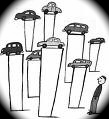
It’s no secret that lawyers, real estate agents and used car salesmen are consistently rated among the least respected or least trusted professions. See, e.g., here, and here, there and there; and this cartoon. In my opinion, the standard-deal ploy alone goes a long way to justify the poor reputations.

This posting will focus on the “standard used car warranty” issue. We’ve discussed the first two culprits on the list in prior posts:

  • lawyers offering only the “standard contingency fee” in personal injury cases, rather than basing their fee on the level of risk being assumed by the lawyer, as required under ethics standards — see, e.g., our four-part essay on contingency fees
  • realtors requiring that you pay the local “standard commission” when selling a house and taking other steps to stifle innovation and competition — see our post “realtors and legislators are selling you out” (Oct. 21, 2005); and the American Antitrust Institute Symposium on Competition in the Residential Real Estate Brokerage Industry (2005). But, note a very recent, positive antitrust outcome: “Justice Dept. Announces Settlement NAR: Settlement Will Result in More Choices, Better Services and Lower Commission Rates For Consumers” (U.S. Department of Justice, Press Release, May 27, 2008). The settlement is discussed by the AAI, in “DOJ-NAR Real Estate Settlement a Milestone for Consumers, But…” (May 27, 2008); and by Consumer Law & Policy Blog (May 29, 2008); and Antitrust Review (May 27, 2008)

While p/i lawyers apply the word “standard” to what is actually the maximum contingency fee percentage permitted in their jurisdiction, used car dealers (in New York State, and probably other states with similar laws) use the term “standard” to describe what is really the minimum warranty periods and terms required by the State, and often to suggest that the State won’t let them offer longer warranties.

Disclaimer: Before I begin this discussion, I want to make clear that I did not start out last week to do an investigation of used car warranty practices. Quite simply, I needed to purchase an inexpensive, reliable, fuel-efficient vehicle — which meant that I’d be buying an older used car, probably with lots of mileage on the odometer. In addition, having no professional or personal experience with Lemon Laws ,or buying used cars from dealers in New York State, I only had a vague recollection that there was some kind of state-mandated warranty.

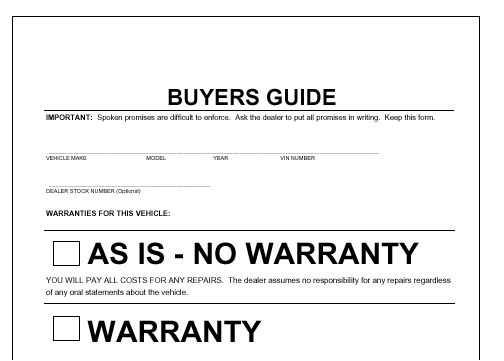
On the other hand, the very first time I saw a Buyers Guide in a used car window last week, I flashed back to a prior life of mine: Thirty years ago, I was an Assistant to the Director in the Federal Trade Commission’s Bureau of Consumer Protection, and one duty was to review the staff’s findings and recommendations in the Commission’s Used Car Rule investigation. In that role, I was (to my knowledge) the very first person to suggest that the FTC require all used car dealers to say in writing, and show it prominently in the window of each car by checking a box, whether the dealer was giving a warranty with the vehicle or selling it “As Is.” That might have gotten my old Consumer and Competition Advocate juices flowing. [At the time, I told my boss Albert Kramer the idea came to me while waiting to play tennis on a Saturday morning, and Al — who typically worked 7-day a week — liked the idea so much he said I should play tennis more often.]

Now that I have had a chance to look at the relevant NYS law and FTC regulation, I realize that many of the dozen dealerships I stopped at last week were in blatant violation of the rules for displaying the warranty information. I am not going to discuss that problem, but hope the NYS Attorney General’s office will start monitoring compliance more closely.

New York State has a Used Car Lemon Law Consumer Bill of Rights (General Business Law, section 198-b. Sale or Lease of Used Motor Vehicles). Under the Bill of Rights, a consumer must be given a written warranty, covering a list of specific systems and items, if he or she purchases or leases a used car sold for (or valued in the lease at) “more than one thousand five hundred dollars . . . from anyone selling or leasing three or more used cars a year.” In addition (emphasis added):

b. Written Warranty required; terms.

1. No dealer shall sell or lease a used motor vehicle to a consumer without giving the consumer a written warranty which shall at minimum apply for the following terms:

(a) If the used motor vehicle has thirty-six thousand miles or less, the warranty shall be at minimum ninety days or four thousand miles, whichever comes first.

(b) If the used motor vehicle has more than thirty-six thousand miles, but less than eighty thousand miles, the warranty shall be at minimum sixty days or three thousand miles, whichever comes first.

(c) If the used motor vehicle has eighty thousand miles or more but no more than one hundred thousand miles, the warranty shall be at a minimum thirty days or one thousand miles, whichever comes first.

See the New York State New Car Lemon Law Consumer Bill of Rights (PDF)

Despite the clear statutory language indicating that the law mandates minimum periods for the required warranty (depending on the vehicle’s mileage), and not a maximum or immutable warranty term, every salesman I asked about the length of the warranty immediately used the non-statutory phrase “standard warranty,” and most added a few garbled words that indicated that the State set the terms, and appeared to blame the state for the lack of a longer period.

At one new-car dealer, a young salesman was (or acted) totally befuddled at the notion that a warranty could be extended beyond the statutory period. The notion was so foreign to him, you would have thought I had asked him to throw in his first-born son, or the dealer’s cute daughter (who appears in their tv ads). He finally said he was certain the dealership — which obviously had its own large service department — would not consider making the warranty longer (which was only 30 days on the vehicle in question). Not even worth walking over to his supervisor to broach the subject.

Raising the “standard warranty” flag is meant to cut off the discussion of warranty periods. But, for many wary, mechanically-challenged consumers, the length of the warranty can be very important. It is an indication of the dealer’s faith in the condition of the vehicle, or willingness to back up words with deeds. As such, it seems to me that at least some dealers should be willing to compete — if not in ads, then to close or sweeten a particular deal — by offering more than the rather short statutory minimum terms. That is especially true if the dealer “self-insures” by performing any needed repairs itself. As with lawyers and real estate agents, however, the Standard Ploy appears to also signal to other sellers that no competition will break out over that aspect of the sale.

My life-long belief as a consumer advocate is that information and options fuel competition and help assure that consumers can achieve fair results in the marketplace. Not knowing that the required State warranty is a minimum requirement greatly hampers the ability of the consumer to bargain for longer coverage and to motive dealers to compete over warranty terms. Unfortunately, the New York State Attorney General — who enforces the law and is the prime source of educational materials on the subject — shoulders a large amount of the blame for the lack of information and the resulting dealer-based misinformation.

For example, the NYS Used Car Lemon Law Fact Sheet does not mention anywhere that the warranty periods are minimums. Indeed, it compounds the problem, fueling the Standard-Statutory-Ploy by showing the following table, which is labelled “Statutory Warranty Length:”

Statutory Warranty Length:

Miles of Operation Duration of Warranty

18,001-36,000 miles 90 days or 4,000 miles
36,001-79,999 miles 60 days or 3,000 miles
80,000-100,000 miles 30 days or 1,000 miles

In addition, the booklet New York’s Used Car Lemon Law: A Guide for Consumers (revised January 2008) does not mention the length of the warranty until page 4, and does not use the statute’s “at minimum” language, or say anything at that point about it being the shortest period permitted:

14. HOW LONG IS THE LEMON LAW WARRANTY PROTECTION?

Miles at time of Duration of
Purchase or Lease Warranty (the earlier of):
_______________ _______________
18,001 to 36,000 90 days or 4,000 miles
36,001 to 79,999 60 days or 3,000 miles
80,000 to 100,000 30 days or 1,000 miles

It is not until page 6 of the Consumers Guide that we see this question and answer:

18. CAN A DEALER GIVE ADDITIONAL WARRANTY PROTECTION?

Yes. A dealer may agree, as part of the sale or lease, to give you more warranty protection than the law requires. The lemon law warranty sets only minimum obligations for dealers.

Those two sentences are the only mention in this 36-page document of the dealer’s ability to “give” or agree to a longer warranty period. Nowhere is the consumer directly told of his or her right to ask or bargain for a longer period.

Indeed, although the actual Used Car Lemon Law Bill of Rights specifically says that the “warranty must be provided for at least” 30, 60 or 90 days, depending on the mileage, it appears that many dealers — in violation of the law’s requirement [subsection e] — do not give a copy of the Warranty, with the Bill of Rights, to the buyer “at or before the time the consumer signs the sales or lease contract for the used motor vehicle.” Instead, dealers — including the one that I bought my car from this week — wait until the car is being delivered to the buyer to provide those documents.

In its literature about its Used Car Buyers Guide — which must be posted in every used car sold by any dealer selling five or more vehicles a year — the Federal Trade Commission does a better job highlighting the ability of consumers to bargain for a longer warranty. For example, in its “Facts for Consumers: Buying a Used Car” [PDF] [en español], the Commission says:

“When you buy a used car from a dealer, get the original Buyers Guide that was posted in the vehicle, or a copy. The Guide must reflect any negotiated changes in warranty coverage.” And,

“Dealers who offer a written warranty must complete the warranty section of the Buyers Guide. Because terms and conditions vary, it may be useful to compare and negotiate coverage.”

Unlike New York, the FTC also provides “A Dealer’s Guide to the Used Car Rule.” The Dealers Guide includes this section, which clearly anticipates bargaining with the consumer over warranty terms:

Where Should Negotiated Warranty Changes Be Included?

If you and the consumer negotiate changes in the warranty, the Buyers Guide must reflect the changes. For example, if you offer to cover 50 percent of the cost of parts and labor for certain repairs, but agree to cover 100 percent of the cost of parts and labor after negotiating with the customer, you must cross out the “50 percent” disclosure and write in “100 percent.”

Having had no luck at all getting personal injury lawyers to drop the use of a standard contingency fee, I have no great hope that used car dealers and their sales personnel will drop the “standard warranty” language, stop acting as if the State prevents them from offering longer periods, and/or let consumers know that they are willing to bargain over the length of a warranty. I do hope, however, that this posting — plus the nudge I will be sending to New York Attorney General Andrew M. Cuomo, and to a few media outlets — will help inform the used car buyer of the option to bargain over warranty terms. If a new wave of competition breaks out, please let the f/k/a Gang know.

Meanwhile, I have no option but to offer our readers a few auto-related haiku and senryu:

checking the driver
as I pass a car
just like mine

……………………. by John Stevenson from Some of the Silence

cloud-free dawn . . .
the dent in the fender
holds its darkness

……. by George Swede in “dust of summers: RMA 2007
orig. pub. Acorn 18

pickup g

traffic jam
a plastic dog
keeps on nodding

……………. Yu ChangUpstate Dim Sum ((2002/I)

mud-spattered pickup-
four dogs watch
the tavern door

…………. Billie WilsonThe Heron’s Nest (Feb. 2001)

first date –
her eyes linger
on the rusted fender

…………….. by dagosan

May 20, 2008

trumping reality with the sexism card

Filed under: viewpoint — David Giacalone @ 4:48 pm

  . . . . . . . .    The recent rash of articles asking whether sexism is the cause of Hillary Clinton’s failure to win the nomination for the presidency has the f/k/a Gang again frustrated by our pledge to avoid political punditry. As the besieged moderator of many weblog alter egos, I’ve decided to present links to a sampling of the materials on sexism and gender in the presidential campaign (with a few excerpts), quote at length below the fold from a particularly good rebuttal to the sexism charge from the Liberal Values Blog, and spend a little time asking what sexism is and isn’t and when playing the sexism card is inappropriate.

Here are links to a few relevant pieces dealing with the sexism/gender issue in the Democratic presidential primary campaign, which were published over the past week:

  • Gender Issue Lives On as Clinton’s Hopes Dim” (New York Times, by Jodi Kantor, May 19, 2008), where Geraldine Ferraro claims Obama is “terribly sexist,” and one Clinton supporter says “Sexism has played a really big role in the race.” In contrast, presidential historian Doris Kearns Goodwin, opines that “When people look at the arc of the campaign, it will be seen that being a woman, in the end, was not a detriment and if anything it was a help to her,” and that Mrs. Clinton’s campaign is faltering because of “strategic, tactical things that have nothing to do with her being a woman.”
  • [update: May 20th, 10 PM]: “Clinton chastises press for ignoring sexism” (CNN.com, May 20, 2008) Clinton “also said she doesn’t believe racism has played a role in the presidential campaign. But the New York senator said sexist attitudes among voters and members of the media have been a constant detriment to her White House hopes.” [note: She wants the press to take the occasional actions of individual members of the public — e.g., the man with an “Iron My Shirt” sign — as seriously as the purported race-baiting tactics of her own campaign. It is not news that there are some sexists and some racists in America; it is news if a candidate is playing to one of those groups.]
    • update (May 21, 2008): For a serious response to the Sexism Charges, done with a humorous twist, see “My Sexist reasons for not voting for Hillary” (by Ouroboros, at Daily Kos, May 20, 2008). It provides an excellent issue by issue list of reasons why some of us won’t vote for Hillary.
  • WAMC FM, my local public radio station, had a Roundtable segment yesterday, focusing on this week’s (poorly-phrased) question from Time Magazine, “Do women have an obligation to support a serious woman candidate?” You can find an array of answers from listeners in the Comment section of the WAMC Inside weblog.
  • In “Clinton’s supporters decry sexism in campaignHillary1000 weblogger Donna Darko (May 16, 2008), claims “No voting block in my lifetime has been so utterly disrespected, vilified unjustly with accusations of racism, and basically had to endure endless harangues, while the Democratic Party and so called “progressive” coalition has shown more disrespect to women supporting Clinton than the Republican Party, treating Clinton supporters as second class citizens, especially if you happen to be named Hillary Clinton.”
  • The Feminist Divide Over Obama” (Time.com, by Amy Sullivan, May 16, 2008); and “Clinton’s ‘sexism’ dodge” (Boston Globe, by Scot Lehigh, May 16, 2008)
  • Ann Althouse’s post “If Hillary is not to be the first woman President, is there a woman President on the horizon?” (Althouse, May 18, 2008), in which the opinionated law professor exclaims,

“I think people were open to the idea of a woman President, but Hillary Clinton did not suit us. We don’t want someone else like her. We want someone different. For starters, how about a woman who did not build her political career through her husband?”

  • In his column today “The Sisters are Steamed” (May 20, 2008),” Washington Post columnist Howard Kurtz says:

“On an emotional level, it’s easy to understand why many female voters feel they’re been robbed. For the first time in their lifetimes, they could see one of their own occupying the Oval Office. And, in the space of a few weeks, that dream began to evaporate.

“Had the contest gone the other way, certainly many African American voters would have felt they had been deprived of a historic chance to elect the first black president.

“But there is a certain degree of identity politics in this narrative, one that the media haven’t been shy about pushing this season. Should all women vote for Hillary because she’s a woman, and assume that men who oppose her are sexist (and women who back Obama are traitors)? Should all African Americans support Obama because of his race and assume that whites who vote against him are racist? Doesn’t that reduce both candidates to one-dimensional symbols and ignore the substance of what they have to say or how they would govern?”

The best succinct rebuttal to charges that sexism will be the cause of Hillary Clinton’s failure to secure the Democratic presidential candidacy can be found in “Sexism and the Clinton Campaign” (Liberal Values Blog, by Ron Chusid, May 17, 2008), where Ron Chusid says:

“I doubt anyone would say that there is no sexism at all, but this is hardly the major factor why Clinton is losing. . . . If Democrats were opposed to a woman president, they wouldn’t have given her this early support. . . . The problem is not that Democrats do not want a woman nominee. They just do not want this woman for reasons having nothing to do with her gender.” At the bottom of this posting [click “more” if you’re reading from our main page], I’ve provided extensive excerpts from Chusid’s piece.

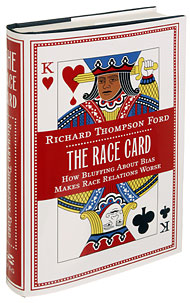
Although his main topic is when racism and other forms of discrimination should be deemed unlawful, Stanford law professor Richard Thompson Ford offers some relevant thoughts in his recently-published book “The Race Card: How Bluffing About Bias Makes Race Relations Worse” (2008). Prof. Ford notes, for instance that:

[at 32 -33] “The success of the civil rights movement inspired many others to frame their struggles in similar terms. Feminists, gays and lesbians, the disabled, and the elderly are just a few of the groups who have successfully made explicit analogies to the cause of racial justice. . . . At best, these claims seek to extend the priciples underlying civil rights to new situations. At worse, these claims seem to define ‘bigotry’ so broadly that the losing side of almost any social or political conflict can claim to be the victims of racelike bias. Today almost anyone can play the race card by ,making claims of what I’ll call racism by analogy.”

“Chapter Two [of The Race Card] looks at the explosion of racism-by-analogy claims. . . . Because the law often offers little or no redress for garden-variety unfairness, many people are tempted to recast their grievance in terms that the law will recognize: in other words, to play the race card.”

[at 105] “Racism by analogy is both inevitable and problematic. We can’t banish analogy, but we must manage and limit it with attention to the significant distinctions among different forms of discrimination. In the abstract, racism, sexism, religious intolerance, bias against the aged, and contempt for the disabled all involve analogous wrongs — bias, intolerance, bigotry — and call for comparable remedies. But, in practice each involves different policy choices, different trade-offs, and different legal mandates.”

[If you’d like to sample more of this thoughtful, moderate book, see the first chapter here (New York Times, Feb. 6, 2008); and three excerpts from Slate.com.]

Of course, in this modest weblog posting, I’m not trying to figure out when the law should have remedies for sexual discrimination. The much more humble issue here is when, in general, it is appropriate to brand an action or result as sexism, and an individual — or vast sectors of our populace — sexist.

. . What is Sexism? . .

Our first task is asking just what sexism is. The American Heritage® Dictionary of the English Language (Fourth Edition, 2000) says sexism is “1. Discrimination based on gender, especially discrimination against women. 2. Attitudes, conditions, or behaviors that promote stereotyping of social roles based on gender.”

Wikipedia’s entry on the subject explains further that:

“Sexism is a belief or attitude that one gender or sex is inferior to or more valuable than the other. It is also called male and female chauvinism and can also refer to a hatred or distrust towards the opposite or same sex as a whole (misogyny and misandry), or imposing stereotypes of masculinity on men or femininity on women.

“Sexism refers to any and all systemic differentiations based on the sex of the individuals not based on their individual merits, and is commonly considered to be sex discrimination, which in some forms is illegal in some countries.”

And, a sociology reference site helpfully adds that sexism is:

“Similar to the dynamics of racism. Males are believed to be superior to females and when this belief is put into action it leads to females being treated as objects, the last to be hired, first to be fired, being paid less for equal work, etc.”

With the above definitions in mind, and drawing upon my own understanding of the subject (which has interested me for many decades – and had me “manning” the phones for the Women’s Campaign Fund 30 years ago in D.C.), I believe that sexism does not exist unless the actor/speaker has hatred or contempt for the other gender, or believes that one gender is superior to the other, or is attempting to maintain or impose stereotypes of masculinity on men or femininity on women in order to limit their freedom by restricting the gender to particular roles.

I hope we can all agree on at least a few basics:

  • Every mention of sex or gender, and everything sexual or sexy is not sexism (as Dahlia Lithwick pointed out at Slate.com in 2006, in a disagreement with lawyer feminists over a sexy woman in a clothing ad that appeared in a legal periodical; see our prior post).
  • Every mention of a general gender difference is not sexism. And,
  • Every outcome that is not favorable to a woman is not the product of sexism, nor is every outcome unfavorable to a male.

There are a few more things that seem obvious to me about sexism, the most important of which is that it is far too potent a charge to be made lightly by serious people or those who wish to be considered serious. This suggests to me that:

  • Gender Joshing is not sexism (absent the requisite hatred, superiority complex, or intent to stifle gender freedoms) — not when women kid men about their refusing to ask for directions, flatulence, or preoccupation with certain female body parts; and not when men (who, by the way, bond with their equals and friends through banter and kidding and poking fun) playfully mention stereotypes about parallel parking or periodic crankiness of women, or the like.
  • The gender-related rudeness, crudeness, or insecurities of a small minority of persons — much less their inadvertent lapse into jargon or turns-of-phrase that a minority of the other gender consider insulting, condescending or antiquated — should not be used to besmirch the actions of a much-broader group of people.
  • If similar behavior has been aimed at, or could be expected, when the other gender is in a similar situation, claiming sexism is rarely called for. [Thus, in reference to complaints about the current primary campaign, note that John Edwards has been ridiculed for his pretty face and hair; Al Gore’s clothing got a lot of attention in 2000; males seeking the presidency have had their tears, ears, height and weight, and the timbre of their voices scrutinized and ridiculed; and Dennis Kucinich or Bill Richardson would surely have been urged to leave the race by now, if they were in second-place in the delegate count (with no real chance of catching up sans scandal), or appeared to be hurting the frontrunner’s election chances with their campaign tactics.]

In sum, absent indications of hate, or superiority, or freedom-limiting stereotyping, it makes little sense to play the sexism card. That is especially true when people of good faith have indicated significant non-gender reasons for their actions; and when a reasonable person would have expected similar behavior if someone of the other gender had been involved. As I have stated before at this weblog:

Those who worry about the continuation of old stereotypes need to pay very close attention to the new stereotypes they may be creating by their actions and positions. Being seen as thin-skinned, humorless proponents of iffy legal analysis and bad attitudes is scarcely the way to win over the hearts or the minds of those who might still want to perpetuate the unwarranted stereotypes. Indeed, it might just lose you a few allies or make them wary to come to your assistance every time you “cry wolf.” Even the most open-minded and fair people can find it rather difficult to think of whiners [sore losers or spoilers] as equals.

maleSym femaleSym All this breathless punditry needs a bit of offsetting one-breath poetry, don’t you think? Here are a few senryu by members of our f/k/a family of haiku poets:

another argument unfolds the futon

………………. by W.F. Owen – Frogpond; Bottle Rockets

at the height
of the argument the old couple
pour each other tea

……… by George Swede – Almost Unseen (2000)

through the open door . . .
her smile doesn’t forgive
all my sins

. . . . by Randy Brooks – School’s Out (1999) doorFront

it’s pink! it’s purple!
sunset inspires

more bickering

………… by david giacalone – Frogpond Vol. XXVIII, #2 (2005); also, a haiga incorporating this poem

doorFrontN screen door between angry words

. . . . by Tom Painting – A New Resonance 2 & Frogpond XXI:1

sua sponte
her honor
catches me staring

. . . by dagosan

Finally, as promised above, here are major excerpts from “Sexism and the Clinton Campaign” (Liberal Values Blog, May 17, 2008), by Ron Chusid:
(more…)

May 16, 2008

two selfish old fools vandalize my river

Filed under: Schenectady Synecdoche,viewpoint — David Giacalone @ 9:46 am

Don’t get me wrong: I know well — and firsthand — the joy of seeing the Mohawk River from your own home or backyard. What I do not know is how two men in their 60’s could be so selfish and reckless that they (allegedly) had three hundred trees clear cut — on property owned by the NYS Canal Corporation — in order to improve the view of the Mohawk River from their homes. According to our local news media and police, that is exactly what Brian Gain, 67, and Raymond Tannatta, 63 (of the Schenectady suburb of Niskayuna) did recently in order to improve the view of the River from their Middle Street homes, near the Rexford Bridge. See “Two Arrested for Illegally Cutting Trees” (Fox News 23, May 15, 2008), which includes a before-and-after video clip).

As Fox News 23 reporter Jeff Saperstone told us last night:

“Large, lush trees bordered the Mohawk River coastline last year. Now looking at that same coastline, one man says, “…it’s just empty.”

“. . . . FOX23 News spoke with several concerned neighbors, who did not want to go on camera, but they told us they are very disappointed those trees came down because it ruins this very nice natural landscape. Photos given to FOX23 by those neighbors show a number of trees that no longer stand. In some of the photos you can see bald eagles, red foxes and other creatures that call this place home.

“The fear here is that because there are no trees left on the cliff side, any kind of rainstorm could cause a mudslide of sorts thus filling in the lagoon beneath the cliff.”

[photo of the Mohawk R. at the Schenectady Stockade — about a mile from the Niskayuna despoilation — by D.A. Giacalone, May 2008]

According to Capital News 9, “Gain and Tannatta are charged with third-degree criminal mischief, making a false written statement, along with the violations of illegally cutting trees, causing damage to canal property and occupying canal property without a permit. . . They were issued appearance tickets for the Town of Niskayuna Court on May 28.” Today’s Schenectady Gazette online gives a comprehensive report on the story, in “2 accused of cutting trees on state land” (by Steven Cook, May 16, 2008). The Gazette tells us:

“State police investigated after receiving a complaint about three weeks ago that there were trees in the river. They soon realized the land behind the houses had been clear-cut, with about 300 trees taken down and left where they fell.

. . . . “The people who allegedly did the actual cutting are expected to face environmental conservation law violations for leaving the trees in the river, [State Police Zone Sgt. Mark] Phillips said. They were brought in believing the land belonged to the nearby homeowners.

. . . “If they are found guilty, they could face fines of $250 per tree, Phillips said. That would be in addition to any penalty on a criminal mischief conviction.”

The Gazette article notes that “A judge could also order them to restore the property to its prior state.” The tragedy, of course, is how impossible such a restoration would be (at least in my lifetime). In addition, I believe that damages should be assessed using a multiple many times more than a fine per tree. The overall marring of the landscape and scenery is far greater than the sum of the trees gone.

I wish the Niskayuna Zoning Board could have read Mr. Tannatta’s mind, when it granted his request for a zoning variance (scroll to item #6) to build on the lot at 832 Middle Street in 2005. In the Channel 23 piece, one of Tannatta’s neighbors says, “We are sure our neighbors are good people who just made a selfish choice.” Frankly, I am not quite so sure. Right now, I am too angry at Gain and Tannatta to even attempt to find a haiku or two to end this posting.

If my “neighbors” in the white house across the River from me in Scotia ever get the notion to cut down the trees blocking their view of the Mohawk, they better worry about a citizen’s arrest and a nice lawsuit.

On a cheerier ending note, check out the lovely photos I took earlier this week at the Albany Tulip Fest; they’ve been added at the bottom of our May 9th posting “tulips-R-us.”

May 11, 2008

outcry earns a reprieve for Schenectady’s Library

Filed under: q.s. quickies,Schenectady Synecdoche,viewpoint — David Giacalone @ 7:48 am

After revealing last week that our Central Library would close in a few weeks for up to 18 months as part of its expansion project (see our prior post, where we are collecting links to relevant articles, Letters), Schenectady County officials apparently saw the signs of public outrage on the wall and trembled. They announced yesterday that they will be seeking bids on two alternative renovation plans that they believe “can limit closings to a matter of weeks, which could be staggered or broken up to minimize patron disruption.” See “Library construction plans change: Facility will not close July 1; county seeking new bids” (Schenectady Daily Gazette, by Tatiana Zarnowski, May 10, 2008); and “Plan reduces library closure: Schenectady County officials adjust plan to limit service disruption” (Albany Times Union, May 11, 2008)

update (May 23, 2008): See the Daily Gazette article, “Library addition project shelved: Work to involve only heating, electrical systems” (May 23, 2008) — “The systems replacement work will likely result in some short-term closures at the main branch this summer, said board President Esther Swanker.”

The TU reported this morning that: “Susan E. Savage, Schenectady County Legislature chairwoman, said in a prepared statement contractors are being asked to respond to both the original bid specifications and two alternate bids meant to lower costs and shorten the period when the main branch will be closed.” The article explained that:

“One alternate plan focuses on replacing major systems in the building including removing asbestos, installing a new heating and air-conditioning system and improvements to the first floor.

“The second alternative focuses on using the upstairs of the facility to house library programs, eliminating the need to change the basic footprint of the building. The second-floor space is now used for administrative space and book storage.”

Of course, such minimal disruptions would have been incorporated into any reasonable construction plan from the start — to respect the needs and desires of the public and in line with the usual practices of contractors. So, I’m not about to fall all over myself praising the County for their quick, survival-0riented responsiveness to the will of the people. (Nor fall for Legislator Gary Hughes’ attempt to let us know the was “concerned” — but impotent? — from the start.) Bernard Allanson, who has to work with Library and County officials as the president of Friends of Schenectady County Public Library, was a bit more diplomatic than I feel like being today. The Gazette reported that:

“Allanson said then he thought the Legislature pushed the original project through without public discussion. On Saturday, he was encouraged to hear officials were backing off.

prayingHandsS “ ‘I would say that the public has had a significant impact on the Legislature. I applaud the Legislature for listening,’ he said.”

I wish Chair Savage had put her prepared statement on the County website, so we could read it directly. The Gazette tells us that “construction won’t happen until the end of summer at the earliest, since officials have postponed the deadline to seek the additional bids. They had planned to review bids May 22.” Naturally, I am quite pleased that the Central Library will probably be able to stay open with only the normal occasional closings and reduced hours that are expected during a major construction.

Clearly, we need to continue to be wary, as the new bids are solicited and reviewed — to remember just how cavalierly (savagely?) officials were willing to damage our community in order to save a few dollars, while being totally oblivious about the need for and impact of such a lengthy closing. Our County leaders need to understand that the public is willing to pay a premium, if necessary, to assure minimal disruptions in the vital services and role that our Central Library plays in the life of this community.

Despite our relief, I hope many concerned citizens will attend the County Legislature’s May Meeting Tuesday at 7 PM, to let them know that their first approach was totally unacceptable — both the lack of public input and the lack of respect for the Library and its users — and that our leaders are, at best, on probation and will be monitored closely by the Library’s friends.

Many thanks to all the members of the public, including the Friends of Schenectady Public Library, who quickly and effectively put pressure on County officials to reverse their disastrous plan.

p.s. It is not all sturm-und-drang in Schenectady County this weekend. I want to express my love and gratitude to Mama G. on Mother’s Day.

spring sun
warm on my back
mother’s day

Sunday morning –
humming a tune
my mother taught me

…………… [Schenectady’s] Yu Chang from Upstate Dim Sum

And, to show you this lovely view from my backyard last night (May 10, 2008), looking across the Mohawk River from the Schenectady Stockade across to Scotia (click for a larger version).

May 6, 2008

Schenectady ponders: 18 months without our Central Library

Filed under: Haiku or Senryu,Schenectady Synecdoche,viewpoint — David Giacalone @ 5:31 pm

update (May 11, 2008): See our post “outcry earns a reprieve for Schenectady’s Library” (May 11, 2008), which explains new plans by County officials to ask for alternative renovation bids that hopefully would reduce disruptions in service at the Central Library.

Despite our relief, I hope many concerned citizens will attend the County Legislature’s May Meeting Tuesday at 7 PM, to let them know that their first approach was totally unacceptable — both the lack of public input and the lack of respect for the Library and its users — and that our leaders are, at best, on probation and will be monitored closely by the Library’s friends.

Many thanks to all the members of the public, including the Friends of Schenectady Public Library, who quickly and effectively put pressure on County officials to reverse their disastrous plan.

Update & Notice (May 10, 2008): County Legislature May Meeting: Members of the public will have the opportunity to speak their minds about closing the Library during its renovation on Tuesday, May 13, at 7 PM, at the County Legislature’s monthly meeting (held at the County Office Building, 620 State St., 6th Floor). However the May Meeting Agenda does not contain any resolution concerning the Library expansion project, and no formal action can be taken on that topic. The agenda is quite lengthy, so there will be a long wait before the floor is opened to the public for general comments.

Compromise Plan: It appears that County leaders (e.g., Kathy Rooney the County Manager, Susan Savage, Legislative Chair, and Gary Hughes, chair of the Legislature’s Library Committee) have heard the public outcry and are working on a compromise plan that would improve the way the Library’s current building is used (e.g., putting public space on the 2nd floor), and replace the operating systems, without changing the current shell of the building, and in a manner that will greatly reduce the period(s) in which the building will need to be closed. I have no idea how the Legislature could be accepting bids — or contractors crafting their bids — on the project before the revised plan is adopted.

Rally Against Closing the Library: (May 12, 2008, Monday, 8 AM): The Rally has been canceled, due to the news about alternative plans that would avoid a long closing. I’m betting it is merely postponed, as we will very likely need to nudge along our “leaders” on this project long before the construction is over.

Original Posting:

It is difficult to get a man to understand something when his job depends on not understanding it.” . . . Upton Sinclair, US novelist, investigative journalist & socialist politician (1878 – 1968)

There are times when the inane actions of our local “leaders” or our justice system here in Schenectady County [NY] leave me merely amused or bemused — affectionately shaking my head, as I often do over the foibles or feeble-mindedness of relatives and friends. But, there are other times — as with my sustained objection to sex offender residency restrictions — when I am truly outraged by the combination of duplicity, incompetence and high-handed arrogance that leads to inexplicably dreadful decisions by our so-called civil servants and political leaders.

The totally-unexpected announcement last week (after years of “planning”) that our Central library would shortly have to close for 18 months, due to the expansion and reconstruction of the building, clearly calls for outrage rather than bemusement.

See “Library to shut during project: Trustees: Closure will make expansion quicker, cheaper” (Schenectady Daily Gazette, by Kathleen Moore, May 1, 2008).

As I have already left rather tart Comments online about the closing in response to this, and this, and that Gazette article, I shall attempt to be more dispassionate in this posting, despite my frustration.

At the bottom of this posting (under the fold, if you are reading this from our homepage), I’ve listed the major articles, editorials and Letters to the Editor about the library closing that have appeared in the Daily Gazette since the “plan” was announced publicly five days ago. I’ve included particularly illuminating quotes from each piece. In addition you can find continuing coverage and comments about the library closing at Schenectady’s Virtual Internet Community, and the Rotterdam NY Internet Community website. The f/k/a Gang will attempt to keep that list up to date as this story unfolds.

SchdyCountySeal Want to express an opinion to our elected or appointed officials? Click here for the Schenectady County Government website, and here for contact information on our County Legislators. Library contact information is here.

Members of Friends of the Schenectady Public Library have responded quickly and forcefully to this crisis. See, e.g., “Library closure plan draws fire” (Daily Gazette, by Michael Lamendola, May 6, 2008); and “Speak out against plan to close Sch’dy library” (Letter to the Editor, Daily Gazette, by John Karl, May 6, 2008). The Library has attempted to diminish the importance of the closing by noting that while 1400 people use the Central Library every day, a mere 10% of that “traffic” comes from the downtown 12305 zip code, where the Library is located. (Their implication, I guess, is that since the others are driving to the Central Library, they can just drive to a nearby branch. For the record, I live a mile from the Central Library and go there almost every day. It will cost me about $2 in gas to go instead to the nearest non-tiny branch.)

In an Op/Ed piece on Sunday, Phil Sheehan did a good job showing how bogus those numbers are. See “18-month library shutdown a major disservice” (Daily Gazette, May 4, 2008) However, even if the 1400 average daily traffic number is accurate (measuring all those who come to the Library, and not just those who use their card), it is an impressive number. Fourteen hundred people is 1% of Schenectady County’s population, which was 144,000 as of 2005. One percent of our population goes to the Central Library every day.

How important is the Central Library to the Schenectady County Public Library system? SCPL has ten branches/locations. Nevertheless, according to the Library’s 2007 Annual Report, last year (using my math and their numbers) the Central Library accounted for:

  • 44% of total circulation to Patrons
  • and 42% of total circulation to other libraries
  • 55% of all Adult library volumes; and 32% of the more widely spread juvenile volumes
  • 71% of all Reference services provided
  • 83% of all Adult Programs offered, and almost 92% of all attendees at adult programs
  • In addition, there were 152,606 visits to the Central Library’s Technology Center in 2007 (averaging over 430 persons per day).

Clearly, as should be obvious even without culling the statistics, the Central Library plays a key role in achieving SCPL’s Mission, which is:

“. . . to satisfy our community’s educational informational, cultural and recreational needs by providing free and open access to a comprehensive range of materials, services and programs.”

As “citizen” Library Trustee John Karl aptly noted in voicing his opposition to the closing: The operation of the Central Library “is the most cost-effective and efficient service in the whole county.” Deciding to close the vital heart (and lungs and brain) of the County’s library system is such a bad idea that even a cynic has a hard time imagining what was going on in the minds of the politicians and bureaucrats responsible for the idea. I’m willing to believe that Library Director Andy Kulmatiski was told “endorse, fight for, and implement the 18-month closing or lose your job.” (Thus, as Upton Sinclair predicted, making it hard for Andy to “understand” the uproar of his staff and the community.) But, for the life of me, I can’t even guess what motives could possibly be behind such lousy policy coming from our County Government.

Despite the failure to reverse similar lame-brained and force-fed schemes concocted by our “leaders” (particularly Susan Savage, the Chair of the County Legislature), I’m hopeful that a combination of political courage (there’s gotta be one Democratic on the Legislature with a little backbone) and public outcry will somehow bring about a far more palatable solution.

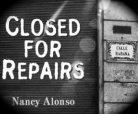
In closing, some schadenfreude: This book might make you feel a little better about our plight in Schenectady County: It’s Nancy Alonso’s Closed for Repairs, with 11 short stories about conditions in Castro’s Cuba.

my children
don’t want to stop
historical market

… by Tom Clausen – Upstate Dim Sum (Vol. 2008/1)

Some Upstate Dim Sum might be your best bet for local (haiku) culture, if the Central Library does close (and even if it stays open). UDS is a “biannual anthology of haiku and senryu,” published by the Route 9 Haiku Group, which is comprised of four well-known haiku poets who live in Upstate New York. Two of the members, Hilary Tann and Yu Chang are professors at Union College.

The newest issue of Upstate Dim Sum (Vol. 2008/1) came in the mail this afternoon. Here are three poems each from Yu and from Hilary:

old farmer
his gift to his widow
a blueberry field

mid-October
choosing a warm spot
to wait for your call

late night ice cream
our cat licks
around the spoon

….. by Hilary Tann – from Upstate Dim Sum (Vol. 2008/1)

end of the storm
sunlight returns
to the kitchen

Indian summer
chocolate kisses
on my cheek

white chopping board
beet greens
in a pool of red

………. by Yu Chang – from Upstate Dim Sum (Vol. 2008/1)

– – Below [click “more” if you are on the f/k/a homepage] you will find links to articles and opinion from the Schenectady Daily and Sunday Gazette, and other source, concerning the closing of the Central Library, along with excerpts from the pieces. —

(more…)

May 4, 2008

sound mind and body? TCL is too much

Filed under: lawyer news or ethics,viewpoint — David Giacalone @ 8:33 pm

Don Hutcheson, the Editor/Publisher of the online magazine The Complete Lawyer, is a valued friend of mine. Nonetheless, I have to say this:

TCL is too big — too complete. Every edition has far too many interesting, useful, often challenging, articles and features for me to read and digest. It simply doesn’t leave me with enough time to get my weblog written, friends and family attended to, haiku crafted, and naps taken, so that I’ll feel like a well-rounded (retired) member of the legal profession. And, the topics covered by TCL are almost always too important to ignore.

Case in point: The newly-posted current edition of The Complete Lawyer (Vol. 4 No. 3, May-June 2008), which focuses on A Sound Mind in a Sound Body. It reminds us that “Nearly 75% of TCL readers are at risk for burnout and 45% suffer from high levels of acute stress.”

The burnout is “the result of high levels of stress over time, [and] is associated with fatigue, overwork, and not enough time to get things done.” And, as you lawyer already know, the “Acute stress shows up in anxiety, difficulty concentrating, poor memory, and indecisiveness.”

To help lawyers avoid burnout and anxiety, and achieve a “sound mind in a sound body,” the new issue “focuses on proven antidotes to stress: some are traditional, such as regular exercise and improved sleep; others, like meditation, yoga, and taking cognitive rest breaks during the day, are less mainstream but have proven to be equally effective.” Among the 40+ articles and columns in the current issue, you will find:

. . . . and much, much more (including mind-hygiene exercise tips from Idealawg‘s Stephanie West Allen). That’s the problem. Frankly, I got tired (and synapses started misfiring) just selecting and listing 10% of the TCL pieces for you. I challenge you to read the entire new edition of TCL and still have energy left to hide your unfinished weekend to-do list, much less to achieve a sound mind and body.

pinataG What are we supposed to do tonight? Finish reading the newest TCL, or start preparing our Menudo Soup for Cinco de Mayo? [See our prior post “may 5th menudo” for Cinco de Mayo lore.]

After glancing at the table of contents for the May-June 2008 issue of The Complete Lawyer, our cranky Prof. Yabut was heard mumbling: “What ever happened to the good old days, when a guy could peruse all the good stuff at an online website for lawyers while his first cup of coffee was brewing?”

new issue
of TCL
the sun sets without me

… by dagosan

May 3, 2008

NY judges looking black-and-bluish

Filed under: lawyer news or ethics,viewpoint — David Giacalone @ 4:18 pm

judgeAngryFN Some of New York’s black-robed judges are engaging in their version of the Blue Flu, in order to pressure the Legislature to give them (long-overdue) pay raises: They are “recusing” themselves — taking themselves off a case due to bias or a conflict of interest — if a party is represented by a law firm that employs a state legislator (especially Assembly Leader Sheldon Silver’s firm of Weitz and Luxenberg). See Eric Turkewitz’s posting “New York Judges Slowing Cases From Legislators’ Law Firms Over Pay Raise Issue” (NYPILaw Blog, May 2, 2008, with hat tip to Overlawyered.com); and “JUSTICE OF THE CEASE: REVOLT OF ROBES AS STATE JUDGES STALL ‘POL CASES'” (New York Post, April 27, 2008).

Also, see the Advisory Judicial Ethical Opinion (No. 08-76, April 24, 2008), which concluded that the judges’ pay raise lawsuit does not require recusal, but also stated that an individual judge must step aside if he or she has “genuine doubts” regarding the ability to be fair

This time last year, I was chastising Chief Judge Judith Kaye for her tacky use of Law Day Ceremonies to threated a lawsuit to get their pay raise. This year, she is — at least publicly — doing her best to prevent the judicial work slowdown, and deny its existence. See “Chief Judge Writes N.Y. Governor to Deny Work ‘Slowdown’ by State’s Judges” (New York Law Journal/Law.com, April 30, 2008); and “Chief judge cautions against recusals as protest” (AP/Syracuse Post-Standard, May 2, 2008). The AP story says:

fjudge Kaye, who after turning 70 will retire at the end of the year, in an e-mail Thursday cautioned them not to refuse to hear lawmakers’ cases as a form of protest. She wrote that “using recusal as a strategy rather than as a matter of individual conscience” would be perceived as retaliatory and weaken their cause.

sua sponte
her honor
catches me staring

. . . by dagosan

Fr.VentaloneS Our rabble-rouser weblog friend Scott Greenfield at Simple Justice disagrees with Judge Kaye, and instead is egging on the judges to “stand up for themselves” and ignore calls to maintain their judicial dignity, because “there’s nothing dignified about poverty.” As I told Scott in a Comment at his website,

It is not a matter of dignity (and you know how often I deride our profession’s Dignity Police at my weblog); it is a matter of duty. No judge has the right to fabricate reasons to recuse himself or herself as they are doing here in order to pressure legislators.

I believe that judicial salaries should be higher, but that does not justify using a judicial variant of the Blue Flu. If pay is intolerably low, then an individual judge should resign. There are dozens of competent lawyers (some making far less now and some much more) who would gladly fill each of their slots on the bench at current salary levels. [Indeed, in many locales across the State — including Schenectady County — fulltime judges are among the highest-paid members of the legal profession (starting at $108,800), and they get plenty of other perks.]

This work action will indeed cause the judiciary (and unfortunately the entire justice system) to lose the respect of the average New Yorker.

My position here is similar to my opposition to the illegal boycott tactics used in Massachusetts by their “bar advocates,” in their fight for higher assigned counsel fees. It may be old fashioned, but I really do hold lawyers and judges to a higher standard than I hold your run-of-the-mill politician or bureaucrat — especially when the dispute really comes down to a matter of money.

My bottom line:

  • judges should know better than anyone else that good ends do not justify unethical or coercive means — especially when the “end” (no matter how dressed up in cries of constitutional crisis) comes down to personal financial gain
  • if any particular judge “doubts his/her ability to remain impartial” merely because a lawyer works for a firm that includes a NYS legislator, he or she does not have sufficient judicial temperament to stay on the bench and should leave

Hey, it’s Saturday afternoon, and thoughts of haiku (not court hi-jinx) should be on my mind. Before Mainichi News posts its May haiku offerings, here are a pair of poems from its April edition, by two of f/k/a‘s Honored Guests. I had planned to post these poems before I decided to write about the judicial slowdown. So, any resemblance to a judge dead or living is purely coincidental.

spring thunder
dust from a slap
on the horse’s rump

…… by w. f. owen – Mainichi Daily News Haiku (April 2008, No. 706)

offshore breeze —
a girl with wild gestures
where the wave breaks

…….. by Jim Kacian – Mainichi Daily News Haiku (April 2008, No. 706)

April 30, 2008

the summer gas tax holiday: hot air from the panderpols

Filed under: lawyer news or ethics,viewpoint — David Giacalone @ 5:15 pm

Pump-Pandering Politicians: It’s great to see that so many news sources and websites are putting a penetrating spotlight on the proposals by the presidential candidates, as well as other federal and state politicians (like Messrs. Bruno and Tedisco in New York), to remove the gas tax over the summer. A Newsday editorial summed it up: “A proposal for such tiny, temporary, iffy savings is a political gimmick, not meaningful relief.” (“No such thing as a free tank: No gas tax for the summer is a bad idea“, April 30, 2008). For more analysis, see:

  • Tax cut could push gas prices higher” (CNNMoney.com, April 29, 2008) “Despite claims from McCain and Clinton, temporary cut in gas taxes could lead to more demand and push prices higher – leaving taxpayers to cover shortfall.”
  • Candidates’ Plans Could Indirectly Raise Gas Prices: Senators Back Steps That Portend Higher Pump Costs,” Wall Street Journal, April 30, 2008
  • Dumb as We Wanna Be” by Thomas L. Friedman (New York Times, April 30, 2008), which opines, “It is great to see that we finally have some national unity on energy policy. Unfortunately, the unifying idea is so ridiculous, so unworthy of the people aspiring to lead our nation, it takes your breath away. . . This is not an energy policy. This is money laundering: we borrow money from China and ship it to Saudi Arabia and take a little cut for ourselves as it goes through our gas tanks. What a way to build our country.”

See the video clip — “Who Can Lower Gas Prices? The Candidates’ Plans: The Gas Squeeze: Will lifting the gas tax provide some relief?” — from Good Morning America/ABCNews (April 30, 2008)

And, listen to analysis on the Gas Tax Holiday from the PBS NewsHour — RealAudioDownload (April 30, 2008), or read the transcript.

  • Democrats Divided Over Gas Tax Break” by John Broder, The New York Times (29 Apr 2008), which has a description of the presidential candidates’ current and prior positions on gas taxes, and points out (emphasis added):

“The highway trust fund that the gas tax finances provides money to states and local governments to pay for road and bridge construction, repair and maintenance. Mr. McCain and Mrs. Clinton propose to suspend the tax from Memorial Day to Labor Day, the peak driving season, which would lower tax receipts by roughly $9 billion and potentially cost 300,000 highway construction jobs, according to state highway officials.”

update (May 1, 2008): Today’s NYT editorial “The Gas-Guzzler Gambit” also uses the word pander and explains why “it is an expensive and environmentally unsound policy that would do nothing to help American drivers.”

The federal tax on gasoline is 18.4 cents per gallon, about 5% of the average price today. Savvy f/k/a readers probably didn’t have to read an article to wonder why we would expect the oil companies to automatically pass on the savings from a gas tax hiatus. In addition, if you’ve been reading about the plight of many independent gas stations, you might also expect the stations to try to pocket some of the tax savings for themselves. See, e.g., “Stations hope you fill up with more than gas: Fuel is loss leader for many; they make money in convenience stores,” (msnbc.com, April 1, 2008)

If you want to feel even worse about all this, and the related subject of reducing our nation’s gasoline consumption, read a little about the Price Elasticity of Demand for Gasoline; and see “Soaring Gas Prices Will Not Reduce Demand.”

Where do the Presidential Candidates Stand? We’re not naming names (due to our political-punditry hiatus), but see “Clinton Criticizes Obama Over Gas Tax Plan: Knocks Obama’s Opposition To Summer ‘Gas Tax Holiday,’ Which She And McCain Support” (CBSNews.com, April 28, 2008); “Obama Dismisses Gas Tax Holiday: Senator Says Gimmick Won’t Help Consumers, Designed To Get Rivals Through Election” (AP/CBSNews.com, April 29, 2008); and “McCain wants a gas tax ‘holiday.’ It’s a no-brainer, right?,” (The Oil Drum: Europe, April 15, 2008)

update (May 2, 2008): Yesterday, former Democratic National Committee Chairman Joe Andrew, a superdelegate, switched his presidential endorsement to Barack Obama. See “Longtime Clinton ally Joe Andrew defects to Barack Obama” (Los Angeles Times, May 2, 2008) At a news conference Thursday, Andrew said:

“Clinton’s support for a federal gas-tax holiday over the summer was symbolic of a poll-driven candidacy proposing something ‘politically expedient to give a quick pander to Hoosier voters,’ in contrast to what he called the ‘principled’ campaign Obama has run.”

We think the gas-tax-holiday issue can tell us a lot about our so-called leaders. Who is willing to tell us the truth? Who treats voters like adults? Who is worried about the long-run and not just the next election? It also tells us a lot about the voting public: Who will demand a simplistic “solution” even if it might in fact be counter-productive, just to get a few extra bucks in their pocket now.

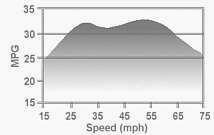
– for other posts on issues related to gasoline consumption see: post-Earth Day spread: speed limits and efficient driving; Open Letter to Gas Whiners and Another Silly One-Day Gas Boycott

update (May 25, 2008):  Jim Tedisco, Republican leader in the NYS Assembly, continues to pander over the Memorial Day weekend, in the Op/Ed piece “To help achieve lower gas prices, make your voice heard” (Sunday Gazette, May 25, 2008).

follow-up (May 8, 2008): There’s an excellent editorial in today’s NYT, “The Tax Trickery Spreads(New York Times, May 8, 2008) Among points made:

  • “Unfortunately, their [Senators Clinton and McCain] demagoguery is growing into a real problem, setting off a chain reaction of “me too” proposals across the country to suspend state gasoline taxes, which tend to be much larger than the 18.4-cent-a-gallon federal levy. If the pandering spreads, it would go a long way in setting the nation’s energy strategy in precisely the wrong direction.”
  • “These ideas share a common purpose: appearing to be doing something to ease hard-pressed voters’ pain at the pump. Not only are they costly, but they will not do that. Suspending the federal tax would cost $9 billion. In New York, the suspension would blow a $500 million hole in state finances. Consumers in some states could benefit from lower state gas taxes because wholesalers could import gas from other states. Still, with refineries producing almost at full capacity, the tax break would prompt a jump in demand that would push up prices.”

If you’ve read and considered all of the above, you surely deserve a treat. Here are more poems from the newest issue of Acorn (No. 20, Spring 2008) — which, among its 100+ poems, contains contemporary haiku by a number of our f/k/a Honored Guest Poets:

nearby clouds
nearby mountains
the rescue helicopter hovers

… by Gary Hotham

a cat at a threshold I can’t see sniffs something I can’t smell

icy night
a saw-whet etches
the silence

………. by jim kacian

spring at last
letting the stallion out
into the pasture

….. by Randy M. Brooks

quick-running brook . . .
a stone from the bottom
lighter than imagined

……………… by paul m.

fumbling
with coat buttons
autumn rain

……………. by Yu Chang

Lightning-cracked rain —
his palm rests against
the bottle’s black label

Dead-end road —
shadows of skinny cows
through old barbed wire

……… by Rebecca Lilly

All Souls
a third day
of candy

………….. by John Stevenson

April 29, 2008

obama’s tort reform creds?

Filed under: lawyer news or ethics,viewpoint — David Giacalone @ 10:31 am

As you probably know, Barack Obama appeared on Fox News Sunday on April 27, 2008 (to the apparent dismay of many liberal bloggers who support negotiating with our nation’s enemies, but are boycotting Fox in order to “delegitimize” it. Please, kids, grow up with all your litmus tests.). Click for a Transcript of Obama on FNS.

For the purpose of this post, what interested us was this exchange between moderator Chris Wallace and Sen. Obama:

WALLACE: Some of your detractors say that you are a paint by the numbers liberal and I’d like to explore this with you. . . . As a president, can you name a hot button issue where you would be willing to cross (ph) Democratic party line and say you know what, Republicans have a better idea here. . . .

OBAMA: . . . I would point out, though, for example, that when I voted for a tort reform measure that was fiercely opposed by the trial lawyers, I got attacked pretty hard from the left.

At Point of Law.com, guest-blogger Carter Wood responded to this brief remark with the posting “Obama Cites His Tort Reform Credentials” (April 27, 2008). Wood notes:

“He’s no doubt referring to his February 2005 vote for S. 5, the Class Action Fairness Act, which passed 76-26. Ted Frank analyzed Obama’s CAFA vote and tort reform record in this December 2006 post, concluding, ‘As a reform supporter, I’m far from convinced that this makes him someone willing to cross the plaintiffs’ bar.’ Senator Clinton voted no.”

In his earlier Point of Law piece, “Obama and liability reform” (Dec. 27, 2006), Ted Frank weighed in on whether Sen. Obama had any tort-reform creds, discussing his vote for what Frank calls “the eminently sensible Class Action Fairness Act.” After noting that “Obama may have annoyed the lunatic left with his vote for CAFA,” Ted says, among other things:

“Obama didn’t participate in the negotiations to get Democratic support, and he voted for every Democratic attempt to eviscerate the bill with amendments. . . Obama didn’t break with the Democrats on any seriously contested tort reform measures: he filibustered medical malpractice reform, and was one of the votes to kill the asbestos reform bill (which effectively failed by one vote) . . . Obama claimed to support medical malpractice reform in his Senate campaign (or, at least, made pro-reform swing voters think that he did), but, then, so did Kerry and Edwards in their 2004 presidential campaign.

“Obama co-sponsored the MEDiC bill with Hillary Clinton; it was a federally-funded variation of the so-called “Sorry Works” proposal . . . But it’s hardly the move of someone daring to flout the trial lawyers who dominate the Democratic Party these days.”

I don’t believe that Barack Obama has ever tried to portray himself as a full-blooded, knee-jerk Tort Reformer. As far as I’m concerned, neither being totally for nor totally against every tort-reform proposal makes good sense or good public policy. The issues raised are complicated and need to be looked at with regard to the legitimate rights of both injured plaintiffs and accused defendants — assuring that all litigants get justice and our justice system is efficient and fair. There is no simple fix that can assure that those truly injured by bad-actors are fully compensated and that defendants are treated fairly both when blame is assigned and when damages are measured.

From my perspective as a consumer advocate and citizen looking for an effective and fair justice system, it seems that: Rabid proponents of tort reform mostly want to pay injured plaintiffs as little as possible, while rabid opponents of tort reform — mainly the “trial” or personally injury bar — want to be able to extract as much money as possible from defendants while assuring the biggest fees possible for plaintiffs’ lawyers.

In this context, I’m pleased that Barack Obama has not totally embraced “tort reform,” and — as a Democrat who worries about interest groups strangling the party and skewing its positions and priorities — am even more pleased that the Senator is unwilling to simply rubber stamp the position of trial lawyers by serving as their mouthpiece, puppet or platitude-peddling political paladin, rather than looking at each issue or piece of legislation on its merits.

I continue to hope that Sen. Obama will produce a comprehensive statement about our litigation system and necessary reforms and restructuring (including the need for full access to the courts). By choosing not to embrace either Tort Reformers or Trial Lawyers, Barack Obama increases his creds as a refreshingly different kind of politician.

prof yabut Prof. Yabut says: This posting is a follow-up to one of the most-visited posts in our five-year history was: “Inquiry to Obama on Tort Reform” (Aug. 4, 2004), from which we hoped to find out the position of Democratic presidential candidate Senator Barack Obama on tort reform and related issues. We never received any response from the Obama Campaign. [Note: Our Editor is a lifelong Democrat and has recently noted his support for Sen. Obama.]

Reminder: The f/k/a Gang [the Editor and his alter egos] are not “tort reformers” — we do not advocate arbitrary or blanket limits on the size of personal injury awards. We have, however, written extensively on the topic of the standard contingency fee (charging virtually every personal injury client the same percentage fee regardless of how risky or easy the case might be), which we believe consistently extracts excessive fees from clients. See, e.g., our four-part essay on the ethics and economics of contingency fees.

SlicingThePie This position has drawn the ire of the so-called “trial lawyers,” “consumer protection lawyers” and “justice lawyers,” who seem to have much power over traditional Democratic politicians (especially those seeking campaign contributions). For example, the supposedly pro-consumer Clinton Administration opposed a bill that would have merely told consumers that they have the right to negotiate the level of a contingency fee. [aside (May 1, 2008): See my Comment #5 below about a reaction to the above mention of standard contingency fees.] Now, finally, let’s go to the point of this posting:

April 27, 2008

at least they’re upscale nudists

Filed under: Haiku or Senryu,q.s. quickies,viewpoint — David Giacalone @ 1:56 pm

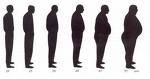
Nakations? The New York Times tells us today that there’s a big trend of Americans heading to nudist resorts for their vacations — dubbed “nakations”. See “No Shoes, No Shirt, No Worries” (by Michelle Higgins, April 27, 2008). The article came just a couple days after I wrote to a friend that, “American obesity has taken a lot of the fun out of watching the change from winter to spring wardrobes.” So, I’ve got to confess that the general notion of Americans wearing no clothes is not a big draw (much less a turn-on) for me.

nude beach
a man and a woman
collect shells

nude beach
the jet ski instructress
tells me to “concentrate”

………….. . . . by ed markowski [“shells” from The Heron’s Nest.]

On the other hand, our cranky contrarian Prof. Yabut pointed to the NYT statement that:

“the real boom in nude vacations is coming at the high end of the business, as upscale hotels and resorts, and even some luxury cruise lines, have begun to see the economic potential in the no-clothes crowd — particularly those who want to shed their clothes but not their pampered lifestyles.”

keep your shirt on, buddy

As a lifelong (and long-lived) practitioner of lookism, Yabut added, “at least they’re upscale nudists.” That got me thinking about the widespread assumption that the rich are not as fat as the poor in America. I turned to Mr. Google for help, and went first to the Wikipedia entry on obesity, where a relevant section states:

Social determinants

“. . . In particular, a class co-factor consistently appears across many studies. Comparing net worth with BMI scores, a 2004 study found obese American subjects approximately half as wealthy as thin ones. When income differentials were factored out, the inequity persisted—thin subjects were inheriting more wealth than fat ones.

A higher rate of a lower level of education and tendencies to rely on cheaper fast foods is seen as a reason why these results are so dissimilar. Another study finds women who married into higher status are predictably thinner than women who married into lower status. [Ed. note: my empirical evidence definitely jibes with that last statement.]

“A 2007 study of more than 32,500 children . . . indicated that BMI change in friends, siblings or spouse predicted BMI change in subjects irrespective of geographical distance. The authors concluded from the results that acceptance of body mass plays an important role in changes in body size .”

family picnic
the new wife’s rump
bigger than mine

… by Roberta BearyThe Unworn Necklace (Snapshot Press 2007)

That sounded about right. See also: “Lower-income Neighborhoods Associated With Higher Obesity Rates” (Science Daily, Feb. 10, 2008) (“A new study appearing in the journal Nutrition Reviews reveals that characteristics of neighborhoods, including the area’s income level, the built environment [e.g., “barriers to physical activity”], and access to healthy food, contribute to the continuing obesity epidemic.”); “DIETING LINKED TO INCREASED WEALTH, STUDY FINDS” (Research News, July 2005) (“Overweight Americans who lose a lot of weight also tend to build more wealth as they drop the pounds, according to new research.”); and “Obesity Often Linked to Income” (npr, Aug. 18, 2004) (“Americans spend a good deal of money eating out, a habit tied to the nation’s obesity epidemic. Researchers say the less people can pay for food, the more calories they consume.”)

dia de los muertos —
the anorexic looks
envious

……. dagosan

Nonetheless, the f/k/a Gang doesn’t [usually] just stop its research as soon as we find materials confirming our own assumptions. And, when we looked at a few additional Google results for the search “obesity [income OR wealth]”, we quickly saw that — like just about everything we talk about at this site — things are not as simple or clearcut as we first thought.

For example:

  • Obesity surges among affluent” (by Nanci Hellmich, USA TODAY, May 2, 2005) According to this article, “Obesity a condition that for decades has been more prevalent in the poor, is skyrocketing among affluent Americans, a new study finds. Defined as 30 or more pounds over a healthy weight, obesity has increased nearly threefold over a 30-year period among Americans who earn more than $60,000 per year, according to researchers at the University of Iowa College of Public Health.” Since the 1970’s, obesity rates “went from 9.7% to 26.8% . Among those making less than $25,000, the increase was much smaller, from 22.5% to 32.5%.”

These are scary numbers, but they do no necessarily contradict the Rich Is Thinner notion, since — for most Americans — “rich” and “affluent” refer to people making a lot more then $60,000 per year. I’d like to see how the numbers break down for the “truly rich” who can afford to go upscale. But, what about:

  • Children’s Risk of obesity soars with family income” (Sept. 17, 2008) According to the Daily Mail, “Children with wealthy middle class parents are more likely to be overweight or obese than those from poor households, a study has revealed.” The article goes on to say that:


“The findings go against conventional wisdom that Britain’s poorest families have the worst diets – showing the risk of obesity actually soars with family income. . . . Researchers linked the problem to the rise of highly-paid working mothers – who are often forced to leave a nanny or nursery in charge of their child’s diet and physical exercise.

“High consumption of snack foods and sweetened drinks, long hours spent watching television and low rates of breastfeeding – shown to prevent obesity – were also said to be factors”.


As the article notes, this seems to be a warning to middle-class parents, “who often ‘assumed’ their children were living healthy lives.”

the naked child crawls–
the blooming
poppies

.. by Kobayashi Issa, translated by David G. Lanoue

It’s sad that the children of the well-off are also caught up in the Western world’s obesity epidemic. Thankfully, as today’s Times article points out: “No matter how popular and upscale nude resorts become, one social convention is unlikely to change: Nudity and family vacations don’t always mix.” Thus, nakationers can probably avoid having to look at the fat, naked kids of wealthy Americans and Brits. That’s definitely a relief.

Buddha’s birthday–
fat little sparrows
and their parents

a chubby girl
offered pickles…
soot sweeping

my child
in the barley field wind…
nicely plump

.. by Kobayashi Issa, translated by David G. Lanoue


no thanks: nudist camp weight-loss center cartoon

roly-poly pigeons
growing fatter…
a long day

being so fat
he’s not a good jumper…
frog

giving these skinny legs
new life…
a pheasant

.. by Kobayashi Issa, translated by David G. Lanoue

Does Richer Mean Thinner? We don’t get paid enough to have a definitive answer to the Are Rich Nudists Thinner question. Nevertheless, we note the section of today’s NYT article devoted to the notions of U. Berkeley psychology professor Dacher Keltner:

“Today, America’s increasing obsession with health and wellness may be contributing to the rise of clothing-optional vacations. “Americans have moralized healthy bodies,” said Dacher Keltner, a professor of psychology at the University of California at Berkeley, who has studied moral emotion and judgment. He added that “a case could be made that people are traveling to these places to be pure for moral reasons — to achieve harmony in nature.” It’s really a form of self-expression, he added, that dates back to Walt Whitman and John Muir, as well as Thoreau, all of whom advocated being as true to yourself as possible. “The truest you can be is taking off those clothes,” he said.”

It seems to the f/k/a Gang that most of the folk who would agree with and abide by Prof. Keltner’s explanation are likely to be the educated American elite, who tend to be rich rather than poor (and from California rather than Indiana). Therefore, if we had to be dropped into the middle of a nudist resort — and not ones like the Times says “turn away single men” — we hope it’s one of the upscale nakation spots, perhaps the kind that caters to a lot of those “women who married into higher status” mentioned at Wikipedia.

cloudburst–
a naked rider
on a naked horse

.. by Kobayashi Issa, translated by David G. Lanoue

the old couple’s legs femaleSymmaleSym
skinny and white as
mine

empty cookie tin —
letting out last year’s
santa suit

……….. by dagosan

April 23, 2008

post-earth-day pledge: speed limits and efficient driving

Filed under: viewpoint — David Giacalone @ 4:42 pm

It’s Earth Day Plus One: Now it’s time to see whether we really want to make a difference — by changing our habits in a meaningful way, despite the inconvenience.

Earth Day –
recycled bottles
in a three-car garage

… by dagosan [April 24, 2005]

If politicians and the public were serious about achieving fuel economy — in order to save money and save Earth from greenhouse gases — they would start enforcing our speed limit laws and rollback the highway speed limit to 55 mph. [followup (July 4, 2008): see our post “speed limit politics“]

Fuel economy decreases rapidly above 60 mph, according to the FTC. And, as we reported on May 2, 2005, “driving at 10 miles an hour above the 65 miles-per-hour increases fuel consumption by 15 percent.” (See NYT, “Unmentioned Energy Fix: A 55 M.P.H. Speed Limit,” May 1, 2005)

supplemental update (April 24, 2008): Eartheasy.com‘s Fuel-Efficient Driving page tells us that “The keys to climate control are in your hands.” It states:

You can boost the overall fuel-efficiency of your car as much as 30% by simple vehicle maintenance and attention to your style of driving. Here are some tips on fuel-efficient driving that will not only reduce greenhouse gas emissions and other pollutants, but could save you hundreds of dollars a year in fuel costs.

The Eartheasy piece succinctly summarizes this EPA fuel efficiency graph:

Drive steadily at posted speed limits. Increasing your highway cruising speed from 55mph (90km/h) to 75mph (120km/h) can raise fuel consumption as much as 20%. You can improve your gas mileage 10 – 15% by driving at 55mph rather than 65mph (104km/h). Note how quickly efficiency drops after 60 mph.

You can find more detailed and technical information at How Stuff Works.com. Its article “What speed should I drive to get maximum fuel efficiency?” states, for example, that:

  • “[F]or most cars, the ‘sweet spot’ on the speedometer is in the range of 40-60 mph. Cars with a higher road load will reach the sweet spot at a lower speed.”
  • “In general, smaller, lighter, more aerodynamic cars will get their best mileage at higher speeds. Bigger, heavier, less aerodynamic vehicles will get their best mileage at lower speeds.”
  • “If you drive your car in the ‘sweet spot’ you will get the best possible mileage for that car. If you go faster or slower, the mileage will get worse, but the closer you drive to the sweet spot the better mileage you will get.”


So, we have an easy but significant fuel economy solution — with one big problem: human nature. Politicians don’t have the guts to call for any real sacrifices and we plain folk — myself included — like driving fast and getting to our destinations quicker. Of course, I’ve learned that no matter how much the f/k/a Gang nags, we don’t change many minds or habits.

you!Me. The only person I can control is myself, and I pledge today to follow the speed limit on all highways and (as explained below) adopt habits that will enhance my driving efficiency. In addition, I’m going to actively campaign for both the enforcement of our speed limit laws and the return to 55 mph as the speed limit on our highways. Of course, you are welcome to join the pledge.

traffic patrol A 2005 survey by the Governors Highway Safety Association confirmed what we already knew: almost every state allows drivers to regularly and significantly exceed the speed limit before they are stopped — and “Nearly all respondents reported a public perception that there exists a cushion above a posted speed limit in which officers will not cite offenders. The range most often reported was 5-10 miles per hour above the posted limit. “(NewsMax.com, AP, “Survey: Most States Allow Speed Cushion,” June 13, 2005; Survey Executive Summary). One news report noted:

“Authorities patrolling U.S. highways tend to give motorists a cushion of up to 10 miles per hour above the speed limit before pulling them over, says a survey by a group of state traffic safety officials. The group found that 42 states allow drivers to regularly exceed the speed limit before they are stopped. [Editor’s Note: only 47 states responded to this survey; at least one of the non-responders — New York — clearly also has the speed cushion.]

“This cushion truly exists across the country and in some cases is more than 10 miles above posted limits,” said Jim Champagne, the GHSA’s chairman.

Law enforcement needs to be given the political will to enforce speed limits and the public must get the message that speeding will not be tolerated,” said Champagne . . .

. . . “Since 1994, 38 states have increased their speed limit, the report said. Congress in 1995 allowed states to raise limits above 55 mph in urban areas and 65 mph on rural roads.

“[And, yes, speed both costs and kills:] A study released in 1999 by the Insurance Institute for Highway Safety estimated an increase in deaths on interstates and freeways of about 15 percent in the 24 states that had raised their speed limit in late 1995 and 1996.”


earthSG In 2005, I opined: “I hate to be cynical, but I don’t think there’s any chance that the American public — or their courageous leaders — will go along with lowering speed limits to 55 mph in order to save billions of gallons of oil a year.” This is another time when I would love to see one of my predictions proven wrong.

An AP article in yesterday’s Schenectady Gazette, like similar ones over the past few years, told of consumer angst over high gasoline prices but failed to mention anything about non-commercial drivers reducing speed to reduce gas consumption. See AP/Gazette online, “Drivers, eyeing gas prices now averaging $3.50 a gallon nationwide, say they feel squeezed” (April 22, 2008)

The only exception are trucking companies: “The American Trucking Associations on Monday said it will host a ‘fuel strategies workshop’ in June to help fleet operators cope with soaring prices. ATA Chief Economist Bob Costello said fuel has now surpassed labor as the trucking industry’s biggest cost, prompting some companies to install devices that prevent drivers from speeding.” [And see, “Truckers Back a National 65-mph Speed Limit,” US News & World Report, March 26, 2008]

Since far too few drivers are likely to regulate themselves and slow down without an incentive, the first step is obvious (and easy): Our Governors and law enforcement officials need to bite the bullet and declare that — oh-my-god! — we’re going to enforce the speed limit; and then they need to do it. Filling depleted state coffers with the speeding fines will just be an added bonus — and should cover the extra cost of diligent, deterrent, habit-shaping enforcement.

update (May 25, 2008): Rather than call for enforcement of speed limits, tough-on-crime politician Jim Tedisco, Republican leader in the NYS Assembly, continues to pander over the Memorial Day weekend, in the Op/Ed piece “To help achieve lower gas prices, make your voice heard” (Sunday Gazette, May 25, 2008).

Sadly, despite the use of alternative fuels and the purported switch to cars with better mileage, the Federal Trade Commission’s Oil-Gas webpage recently noted, “the Energy Information Administration forecasts that gasoline consumption will continue to increase through 2030.” (FTC Gasoline Column, March 7, 2008) However. there are things you and I can do individually today (and, hopefully, tomorrow) to reduce fuel consumption without buying a new car.

As the FTC consumer alert “Saving Money at the Gas Pump: A Bumper-to-Bumper Guide” (FTC Consumer Alert 2006) reminds us: “When it comes to stretching your gas budget, how you drive can be almost as important as how far you drive.

55 limit n So, please join me in my pledge to drive smart and increase my fuel efficiency. Here are some useful tips from the 2005 FTC Consumer Alert “Good, Better, Best: How to Improve Gas Mileage“:

On the Road: Drive More Efficiently

* Stay within posted speed limits. Gas mileage decreases rapidly at speeds above 60 miles per hour.
* Stop aggressive driving. You can improve your gas mileage up to five percent around town if you avoid “jackrabbit” starts and stops by anticipating traffic conditions and driving gently.
* Avoid unnecessary idling. It wastes fuel, costs you money, and pollutes the air. Turn off the engine if you anticipate a wait.
* Combine errands. Several short trips taken from a cold start can use twice as much fuel as one trip covering the same distance when the engine is warm.
* Use overdrive gears and cruise control when appropriate. They improve the fuel economy of your car when you’re driving on a highway.
* Remove excess weight from the trunk. An extra 100 pounds in the trunk can reduce a typical car’s fuel economy by up to two percent.
* Avoid packing items on top of your car. A loaded roof rack or carrier creates wind resistance and can decrease fuel economy by five percent.

And, At the Garage: Maintain Your Car

* Keep your engine tuned. Tuning your engine according to your owner’s manual can increase gas mileage by an average of four percent. Increases vary depending on a car’s condition.
* Keep your tires properly inflated and aligned. It can increase gas mileage up to three percent.
* Change your oil. According to the U.S. Department of Energy (DOE) and Environmental Protection Agency (EPA), you can improve your gas mileage by using the manufacturer’s recommended grade of motor oil. Motor oil that says “Energy Conserving” on the performance symbol of the American Petroleum Institute contains friction-reducing additives that can improve fuel economy.
* Check and replace air filters regularly. Replacing clogged filters can increase gas mileage up to ten percent.


To help keep myself on track, I plan to report back regularly with frank assessments of my compliance with this very doable but also somewhat daunting checklist of good driver practices in the fuel-reduction game. My first big test may come on Mother’s Day, when I drive the 220 miles to see Mama G. I’m going have to get out the door a bit earlier to stay on schedule while abiding by the speed limit. I’m looking forward to seeing my gas-savings at the pump driving the New York Thruway at 65. Watching all those cell-phoning, tail-gating fools pass me along the way might just inspire a senryu or two.

gasNozzleG – for further related reading see our posts: “summer gas tax holiday: hot air from the panderpols” (April 30, 2008); Open Letter to Gas Whiners and Another Silly One-Day Gas Boycott

update: See the op-ed column “Government at all levels can — should — take steps to help with gas crunch,” (by Joe Slomka, Schenectady Sunday Gazette, April 27, 2008). Among other good points, Joe says:

“I’m as mad about high gas prices as the next guy, but what I’m really mad about is the fact that this is a problem we created for ourselves and are doing virtually nothing to solve. And solving it would involve so little sacrifice. . . . What I’m talking about, mostly, is motorists — especially the ones who drive those guzzlers — slowing down.”

good news (but no excuse to speed): “As Gas Costs Soar, Buyers Flock to Small Cars” (New York Times, May 2, 2008) “[T]here are some indications that the trend toward smaller vehicles will reduce the nation’s fuel use. In California, motorists bought 4 percent less gasoline in January than they did the year before, a drop of more than 58 million gallons, according to the Oil Price Information Service.”

more resources (May 3, 2008): For a lot of information and inspiration (and some great bumper stickers) zoom over to iDrive55.org – the Drive 55 Conservation Project.

And “carpool for a better tomorrow” with RideSearch.com.

Good news (May 8, 2008): Our local News Channel 13 in Albany, NY, had a segment yesterday called “Some drivers reduce speed to save gas” (wnyt.com, May 7, 2008), which points out that “Researchers say today’s cars are most fuel efficient at speeds between around 30 and 60 miles per hour. Mileage drops sharply at speeds above 65 as engines work harder.” The piece includes a poll asking whether you are slowing down due to high gas prices.

more good news (May 10, 2008): “Gas prices sends surge of riders to mass transit” (New York Times, May 10, 2008). “Some cities with long-established public transit systems, like New York and Boston, have seen increases in ridership of 5 percent or more so far this year. But the biggest surges — of 10 to 15 percent or more over last year — are occurring in many metropolitan areas in the South and West where the driving culture is strongest and bus and rail lines are more limited.”

update (May 16, 2008) Don’t forget the Sierra Club’s Memorial Day Pledge — “I can drive 55.” See our post.

p.s. What’s Your Carbon Footprint? A Carbon Footprint is a measure of the impact our activities have on the environment in terms of the amount of greenhouse gases we produce. It is measured in units of carbon dioxide. Earth Day (or any day) is a good time to calculate your carbon footprint. At Carbon Footprint.com you can also calculate the (incredibly large amount of ) CO2 you’ll use by flying to a destination.

April 16, 2008

please watch and discuss “Sick Around the World”

Filed under: viewpoint — David Giacalone @ 9:07 am

The pbs FRONTLINE show “Sick Around the World” contains facts, analysis, and a message that every thinking and responsible American needs to hear, see, consider, and act upon. In it, correspondent T.R. Reid examines the healthcare systems of five other advanced capitalist democracies — United Kingdom, Japan, Germany, Taiwan and Switzerland — to see what ideas might help the U.S. reform its broken healthcare non-system. The show premiered last night but is available on demand to watch online (or, you can order a dvd for $24.95).

As Mike Hale said yesterday in his tv preview for the New York Times:

“… This fast-moving and entertaining hour starts from the premise that the American health care system … is a failure. And Mr. Reid makes the case (in about 10 minutes per country) that other capitalist democracies have not just cheaper more equally available health care, but also better care over all, with longer life expectancies and lower infant mortality rates. …”

Seeing nations comparable economically to our own, where the people and government take for granted that universal coverage and access to quality health care is a basic human right, where no one need ever fear going bankrupt because of a health care crisis, and where doctors do not demand to be rich in order to practice their profession, was enough to put real tears in my eyes (tears of hope and of shame for our nation). Of course, the show demonstrates ably that Universal Coverage does not have to mean Socialized Medicine: “Reid finds out it’s not all ‘socialized medicine’ in the rich capitalist democracies he visited. But he also finds out they don’t trust health care entirely to the free market — they all impose limits.”

Here are links to some of the materials available at the Frontline website for Sick Around the World:

home + introduction + watch online + five countries + interviews + analysis + join the discussion + q & a with t.r. reid + teacher’s guide + readings & links + dvd + transcript + press reaction

Check out the analysis of several health care experts, who tell us what lessons we can learn from the other nations. And, in 7 o 10 days, you’ll be able to print out a transcript of the show.

If you like Pope Benedict’s open-hearted, brother’s-keeper approach to social justice (see our prior post), or if you liked the message of Michael Moore’s film Sicko, but have been looking for a presentation that is sarcasm-and smirk-free to share with family and friends, Sick Around the World is the answer.

waiting undressed
for the new doctor –
cold feet

thin walls
the doctor gives someone else
bad news

… by dagosan

One final point: several of the experts interviewed were quite skeptical that our politicians will actually find a true solution to the American health care crisis. They noted that neither Obama nor Clinton is offering true reform and that universal coverage is unlikely to solve our nation’s health care crisis without greatly reducing the excessive cost of American medicine. We all need to make sure that the debate and movement toward universal health care is informed with the lessons that are there for us to learn from other economically-advanced democracies.

April 15, 2008

reprise: Benedict, Caritas and Conservative Catholics

Filed under: viewpoint — David Giacalone @ 7:43 pm

BenedictAmerica Two years ago this week, I wrote a piece about Pope Benedict XVI’s encyclical “God Is Love,” noting that Conservative Catholics seemed to be ignoring his message of social justice and charity, while they claim to be the only true Catholics and take positions on immigration, minimum wage, universal health care, and many other social issues that are inconsistent with the teachings and spirit of the Church and Jesus Christ.  With Benedict’s arrival today in the USA for a get-acquainted visit, I’m going to reprint the entire posting here, and hope that Benedict continues his message of caritas and the need to live your faith when acting in the political realm.

update (April 5, 2012):  From my retiree rocking chair, I’ve been waiting to see when Conservative Catholics, such as Rick Santorum, will start supporting universal health care for all Americans.  Both the Vatican and the U.S. Conference of Bishops (e.g., see here) have declared that health care is a fundamental human right.  Pope Benedict XVI reaffirmed the Church’s position in November 2010, insisting that “Justice requires guaranteed universal access to health care.”  And, see Daily Kos (Feb. 18, 2012)

Catholic Conservatives Ignore Benedict on Political “Caritas”

(originally published April 19, 2006)

Pope Benedict XVI has apparently disappointed America’s “conservative” Catholics by not coming out swinging on their favorite issues. (Washington Post, “Pope’s 1st Year Lacks An Ideological Edge,” by Alan Cooperman; npr, “New Pope Surprises American Catholics,” by Greg Allen; April 19, 2006). Well, I’ve finally read Benedict’s first encyclical, “Deus Caritas Est“(”God Is Love”), dated Dec. 25, 2005, and I’m pretty sure America’s Catholic conservatives are disappointing their Pope.

BenedictAmerica Pope Benedict XVI cover of America (March 13, 2006)

Ever since learning late last year that the Papal Letter, Deus Caritas Est [”DCE”], discusses “caritas” or “charity,” and the relationship between justice and charity, I’ve been waiting for conservative Catholic webloggers to analyze DCE — hoping to see how Catholic teachings affect their stance on important public policy issues. I’m especially interested, because prominent law professors — including Steve Bainbridge, MoJ’s Rick Garnett, and Deans Thomas Menger (St. Thomas Law School) and Mark Sargent (Villanove Law) — have insisted that we need a revival of serious that is “unapologetically and actively committed to discerning and expressing distinctively Catholic approaches to law and lawyering.” (our prior post)

Call it an apostate’s natural suspicion, but the lack of discussion by conservative Catholics (and Catholic conservatives) — of DCE made me suspect that the Encyclical might have called for a bit too much caritas in the public sphere, or too high a level of commitment to charitable politcal activism by laypeople, for their liking.

What pushed me into actually finding and reading the DCE text, in fact, was Prof. Bainbridge’s discussion last week about the minimum wage, in response to was an article by Kevin Drum at Washington Monthly, dated April 11, 2006.) (our prior post) Steve’s thoughts were endorsed by Volokh Conspiracy’s Jim Lindgren. At Prof. B’s, VC, and WM, there were dozen of Comments, and the basic tone was so uncharitable and unloving — so miserly and spiteful — regarding the poor in America, that I decided it was time to see if Benedict XVI could help me figure out the issues. What the Pope had to say made my suspicions about a Catholic conservative cover-up appear quite justified.

Is Deus Caritas Est relevant to debates on issues such as minimum wage laws? I believe it absolutely is — for the Catholic faithful and for those who see in the core teachings of Jesus a universal ethics of human connection, interdependence, and responsibility. In summarizing Catholic teaching on caritas and justice, on the roles of both the Church hierarchy and the faithful, the Encyclical calls for an active, engaged commitment among the laity to improve the plight of the poor — not merely through Church institutions and personal acts of charity, but also by using political processes in the public forum. (Such a “distinctively Catholic approach to law and lawyering” is one that Your Editor would welcome at American law schools.)

Here’s what I discovered in Benedict XVI’s first encyclical letter, Deus Caritas Est: BenedictAmerica

The Letter first addresses at length the subject of God as love. Benedict eventually turns to the topic of “Jesus Christ – the incarnate love of God,” and explains that Jesus has “truly united” love of God and love of neighbor. Benedict explains [para. 16], for example, that through the parable of the Good Samaritan:

“The concept of “neighbour” is now universalized, yet it remains concrete. Despite being extended to all mankind, it is not reduced to a generic, abstract and undemanding expression of love, but calls for my own practical commitment here and now. The Church has the duty to interpret ever anew this relationship between near and far with regard to the actual daily life of her members.”

Benedict closes the section with this reminder:

“Lastly, we should especially mention the great parable of the Last Judgement (cf. Mt 25:31-46), in which love becomes the criterion for the definitive decision about a human life’s worth or lack thereof. Jesus identifies himself with those in need, with the hungry, the thirsty, the stranger, the naked, the sick and those in prison. “As you did it to one of the least of these my brethren, you did it to me” (Mt 25:40). Love of God and love of neighbour have become one: in the least of the brethren we find Jesus himself, and in Jesus we find God.”

JesusMoney jesus/moneychangers

Before you protest that this pious love-your-neighbor stuff belongs in the context of each Catholic’s personal life, please read on.

Part II of the Letter, titled “Caritas” begins by describing the centrality of charity to the essence of the Church. It then attempts to clarify the relationship between charity and justice. After dismissing the Marxist rejection of charity, Benedict nevertheless states [para. 26] (emphases added):

“It is true that the pursuit of justice must be a fundamental norm of the State and that the aim of a just social order is to guarantee to each person, according to the principle of subsidiarity, his share of the community’s goods. This has always been emphasized by Christian teaching on the State and by the Church’s social doctrine.

“Historically, the issue of the just ordering of the collectivity had taken a new dimension with the industrialization of society in the nineteenth century. The rise of modern industry caused the old social structures to collapse, while the growth of a class of salaried workers provoked radical changes in the fabric of society. The relationship between capital and labour now became the decisive issue—an issue which in that form was previously unknown. Capital and the means of production were now the new source of power which, concentrated in the hands of a few, led to the suppression of the rights of the working classes, against which they had to rebel.”

After “admitt[ing] that the Church’s leadership was slow to realize that the issue of the just structuring of society needed to be approached in a new way,” the Letter notes that the illusion of a Marxist panacea for injustice has vanished. However [para 27]:

“In today’s complex situation, not least because of the growth of a globalized economy, the Church’s social doctrine has become a set of fundamental guidelines offering approaches that are valid even beyond the confines of the Church: in the face of ongoing development these guidelines need to be addressed in the context of dialogue with all those seriously concerned for humanity and for the world in which we live.”

An editorial in Catholic Weekly, “A More Excellent Way” (Feb. 13, 2006), explains the Church’s role “with respect to justice”:

[note from your editor:] “Jesus Was a LiberalJesusLibS

“The letter also makes a familiar and necessary distinction between the charitable work of the church and that of partisan, ideological movements. It affirms that justice is primarily the work of the state.

With respect to justice, the church’s role is that of teacher and critic. It hands on its social doctrine, guides consciences and helps identify the goals of authentic justice in society. ‘The church is duty-bound to offer, through the purification of reason and through ethical formation, her own specific contributions towards understanding the requirements of justice and achieving them politically,” Pope Benedict writes.

While not replacing the state, ’she cannot and must not remain on the sidelines in the fight for justice.’

A similar explanation can be found in Greg Sisk’s posting at Mirror of Justice. The curious mind has to be wondering, “Well, if the Church’s insitutional role in achieving justice — defined by Benedict as “guarantee[ing] to each person, according to the principle of subsidiarity, his share of the community’s goods” — is indirect, who and how will the just society be achieved?

Benedict tells us the Church wants “dialogue with all those seriously concerned for humanity and for the world in which we live.” Naturally, he also expects that it is individual Catholics who will be the most receptive, who will have the most highly-enlightened consciences, and will in the forefront in securing justice and social caritas.

scales rich poor How do I know? Not because any conservative weblogger has told me! I know because Benedict tells us explicitly in Deus Caritas Est:

“The direct duty to work for a just ordering of society, on the other hand, is proper to the lay faithful. As citizens of the State, they are called to take part in public life in a personal capacity. So they cannot relinquish their participation “in the many different economic, social, legislative, administrative and cultural areas, which are intended to promote organically and institutionally the common good.” [21] The mission of the lay faithful is therefore to configure social life correctly, respecting its legitimate autonomy and cooperating with other citizens according to their respective competences and fulfilling their own responsibility. [22] Even if the specific expressions of ecclesial charity can never be confused with the activity of the State, it still remains true that charity must animate the entire lives of the lay faithful and therefore also their political activity, lived as “social charity”.[23] (emphases added)

I dare you to find either the sentence “The direct duty to work for a just ordering of society, on the other hand, is proper to the lay faithful,” or the clause “charity must animate the entire lives of the lay faithful and therefore also their political activity, lived as ’social charity,’” in any of the political, economic, or religious commentary and punditry of the leading conservative Catholic webloggers. Indeed, you won’t find them on any obscure weblogs either (except for the Edmund Rice Justice Bulletin, which looks a little lefty to me).

JesusLibSN You can learn more about the Catholic notion of “social charity,” and “social justice” here. For example, the Catholic Catechism tells us that “The principle of solidarity, also articulated in terms of “friendship” or “social charity,” is a direct demand of human and Christian brotherhood.” Also, “Solidarity is manifested in the first place by the distribution of goods and remuneration for work.” And, “The equal dignity of human persons requires the effort to reduce excessive social and economic inequalities,” because economic “differences encourage and often oblige persons to practice generosity, kindness, and sharing of goods.”

JesusMoney Of course, any Catholic conservatives (or libertarians) who have read this far are already shaking their heads and thinking: (a) true justice can only come from the free market and its economic principles; (b) charity is a private matter and only the smallest government can be a just government; (c) the American form of government is as just as humankind will ever achieve, and doesn’t need more tinkering — especially of the welfare-state variety; or (d) no matter what you say, it’s immoral to take/tax money that I earn and redistribute it to poor people.

Pope Benedict anticipated such reactions. In DCE, Benedict therefore reminds the Faithful:

tiny check The just ordering of society and the State is a central responsibility of politics. As Augustine once said, a State which is not governed according to justice would be just a bunch of thieves. [para 28a]

tiny check Justice is both the aim and the intrinsic criterion of all politics. Politics is more than a mere mechanism for defining the rules of public life: its origin and its goal are found in justice, which by its very nature has to do with ethics… The problem [what justice is] is one of practical reason; but if reason is to be exercised properly, it must undergo constant purification, since it can never be completely free of the danger of a certain ethical blindness caused by the dazzling effect of power and special interests. [para 28a]

Benedict16

tiny check Love—caritas—will always prove necessary, even in the most just society. There is no ordering of the State so just that it can eliminate the need for a service of love. Whoever wants to eliminate love is preparing to eliminate man as such. There will always be suffering which cries out for consolation and help. There will always be loneliness. There will always be situations of material need where help in the form of concrete love of neighbour is indispensable.

tiny check The Church . . . has to play her part through rational argument and she has to reawaken the spiritual energy without which justice, which always demands sacrifice, cannot prevail and prosper.

tiny check [The] Encyclical Ut Unum Sint emphasized that the building of a better world requires Christians to speak with a united voice in working to inculcate “respect for the rights and needs of everyone, especially the poor, the lowly and the defenceless.” [para. 30]

tiny check Christian charitable activity must be independent of parties and ideologies. It is not a means of changing the world ideologically, and it is not at the service of worldly stratagems, but it is a way of making present here and now the love which man always needs.

tiny check The modern age, particularly from the nineteenth century on, has been dominated by various versions of a philosophy of progress whose most radical form is Marxism. Part of Marxist strategy is the theory of impoverishment: in a situation of unjust power, it is claimed, anyone who engages in charitable initiatives is actually serving that unjust system, making it appear at least to some extent tolerable. . . . What we have here, though, is really an inhuman philosophy. People of the present are sacrificed to the moloch of the future—a future whose effective realization is at best doubtful.

Benedict16

Perhaps most tellingly, Benedict tells ideologues of the Left and the Right: “One does not make the world more human by refusing to act humanely here and now. We contribute to a better world only by personally doing good now, with full commitment and wherever we have the opportunity, independently of partisan strategies and programmes.” [para. 31b]

That’s strong stuff. It seems directly relevant to political issues ranging from the level of the minimum wage, and the creation of universal health care rights, to the treatment of illegal (but otherwise law-abiding) immigrants.


When it comes to issues of social justice — and social caritasit seems clear that Jesus was indeed a Liberal. Living past 30 didn’t change that, and I’m sure the past two millennia haven’t either. The Sermon on the Mount, with its Eight Beatitudes, deserves the full respect of stare decisis. Jesus didn’t have a means test when he distributed the loaves and fishes. When the multitudes were hungry, He fed them — he didn’t tell them to figure out for themselves how to fish, or how to swim.


Conservative Catholics like First Things’ Richard John Neuhaus may be disappointed to see Benedict XVI playing the role of pastor now, rather than “enforcer.” But, even old cynics like myself believe that The Job often dictates the role that an incumbent must play. No job calls for the love of pastor and shepherd — and conscience for the faithful — like the papacy. I just hope the faithful are listening to Deus Caritas Est and will choose to live up to its call for political action in the name of social justice and charity.


afterthought (April 20): When it comes to feeding (or clothing, sheltering, healing, educating) the poor, the working poor, or even His more-comfortable “neighbors,” Christ was no Cafeteria Catholic. Can we say the same for America’s Catholic conservatives? Are they disappointing Jesus and His current Vicar, Benedict XVI? Are they leaving the social-justice heavy lifting to the non-religious (like myself), who they so often claim can have no solid moral foundation, and to the Liberal Catholics, who they so often deride as not really being Catholic at all?
 

TaxWhinerTUCummingsS larger Albany Times Union/Barbara Cummings – see our most-recent discussion of tax whiners:
ghosts of tax days past (Scrooge was surely a tax-whiner)

tiny check From the early 19th Century, Japanese Master haijin Kobayashi Issa offers a few closing haiku:


they curse the first snow
like it’s a beggar…
rest stop


in vain
the baby bird begs…
a stepchild


Great Japan!
even a beggar’s house
has a summer banne


even birds
make their nests…
beggars under the bridge


autumn wind–
a beggar looking
sizes me up


they must have kids–
bridge beggars
calling fireflies


deutzia tree–
among gods and beggars
it blooms


a pretty kite soars
a beggar’s shack
below


Issa, translated by David G. Lanoue


BenedictAmericaF

« Newer PostsOlder Posts »

Powered by WordPress