Whether we’re reporting on dui cherry cordials and the motorist with the “wrong kind of hot chocolate,” or memorializing the hijinks of the Musty Money Mob, the widow sued for calling an aging counselor a “so-called lawyer,” the sad “man in a tree,” or the deadly argument over treating a seizure victim, f/k/a is known for sharing the strange legal news out of Schenectady, New York, and the nearby Capital Region. [And see the picture-frame burglar tale.] Now, thanks to the unveiling on Tuesday of the revamped, again-free Daily Gazette website, we can confidently begin a regular W.A.S. — Weird Around Schenectady — News roundup, letting you know when the Daily Gazette or other media sources in our neighborhood have uncovered remarkable stories from our local justice system.
after the verdict
the tireless lawyer speaks
in falling snow

first murder trial–
the D.A. arrives
in new gloves…………………………………………. by Barry George, J.D.
Due to a minor slip-n-fall accident yesterday, the f/k/a Gang is nursing a bum arm and will have to start slowly (and visit a friendly orthopod) this morning, with just two tales out of criminal court.
W.A.S. News #1:
 Hiring a Stripper Could Get You a Sex Offender Label: If James “Jed” Conboy, the D.A. in next-door Montgomery County gets his way, 22-year-old Greg L. Soucia will be slapped with the label Sex Offender for “using a stolen credit card to hire strippers.” The Gazette explains, in “Case is Montgomery County’s first under new sex law: Defendant must register as offender” (Dec. 13, 2007), that Soucia “is the first defendant in Montgomery County to be prosecuted under a new law that stiffens penalties for sexually motivated crimes.” Gazette reporter Edward Munger continue:
Soucia [of the Schenectady County village of Delanson] told an investigating deputy that he took a Visa credit card from inside the [burgled] house and while at the residence, he used the credit card to hire two strippers from Sheer Pleasure in Schenectady.
The investigation report states that the two strippers “performed in front of him for about an hour,” and charged him $600 for the service.
Since there was a sexual motivation for the crime, Conboy said, Soucia was prosecuted under the “Sex Offender Management and Treatment Act,” which became state law in April. . . . “If you commit a burglary and your goal is because of your own sexual gratification, it’s a sexually motivated felony,” Conboy said.
The law in question is the SEX OFFENDER MANAGEMENT TREATMENT ACT (Laws of New York, 2007, Chapter 7, Article 10), which our Division of Criminal Justice says “establishes an Office of Sex Offender Management and creates a new crime of a ‘Sexually motivated felony,’ and provides for enhanced terms of post-release supervision for all persons who commit felony sex offenses.” SOMTA’s § 10.03 gives us the following definition:
(s) “Sexually motivated” means that the act or acts constituting a
designated felony were committed in whole or in substantial part for the
purpose of direct sexual gratification of the actor.
Of course, I’m not an expert in criminal law like Scott at Simple Justice and Jeralyn at Talk Left, or professors Yung at Sex Crimes and Berman at Sentencing Law & Policy, but I’m going to go out on a limb and use some fancy legal terminology and analysis: No matter how much of a hard-on politicians have for sex offenders, “stiffening” the penality for crimes — and saddling people with the Sex Offender Label and all the consequent registration and supervisory obligations — whenever a prosecutor “proves” that a felony was motivated in “substantial part” for the defendant’s “sexual gratification” is simply un-American. It will throw a lot of cold water on a lot of immature male hormones. Increasing penalties because a person commits a non-sexual crime while presently or imminently horny, is a rather broad-sweeping approach to stopping sex abuse and sexual predation. Prosecutors should consider reading a constitution or two, or taking a cold shower, prior to drawing up charges under SOMTA.
D. A. Conboy told that Gazette, that in the absence of the sexually motivated felony, Soucia could have faced a prison term of one to three years. Instead, he faces a three-year determinate sentence with five years of post-release supervision.” As with the sex offender residency laws covered so often around here, I’ve got to say that, if this kind of law makes you feel more righteous and — especially — like you’re making our children and women-folk a lot safer, you appear to need a major reality check, and a significant boost in your EQ.
Final Note: A recent article in the Arizona Daily Star, “Arrest made in sexually motivated crime cases” (Nov. 2, 2007), suggests that law enforcement agencies may be applying the same over-reaching approach across the nation. The Tucson Police Department told the Star that: “a sexually motivated crime could include obscene phone calls, pictures or indecent exposure.
mid-argument –
Her Honor
catches me staring
……………………………………………….. dagosan
update (Dec. 16, 2007): Columnist Carl Strock of the Daily Gazette reported today that “Law creates new way to become a sex offender” (at B1, Dec. 16, 2007). Here’s a little of Carl’s analysis: “This means that if I, as a horny American crook, break into a house and steal money so I can wine and dine a woman I have my eye on, with a view to getting her into bed, she being entirely willing, I too would be a sex criminal, per New York law, and if the residents of Scotia, for example, learned I was later living on their block they would put up yellow caution tape on their hedges and would not allow their grandchildren to visit for fear I might attack while their backs were turned. Elected officials would flourish tape measures at public meetings to show how close I was living to innocent children.”
 Respected House-Call Doctor on Trial: Another story in the local news deserves a lot more attention than I can give it today, but should interest aficionados of either criminal law or health care reform. Dr. David Hornick, 64, was well known and appreciated for making house calls to his severely disabled patients, and basically operating out of his “mobile pharmacy” car. He was arrested 18 months ago and charged with serious drug-dealing crimes (see “Doctor Charged With Stealing Pills From Patients” (North Country Gazette, June 7, 2006). He is now, however, facing “only” eight misdemeanor counts, alleging he illegally possessed painkillers and failed to document them properly. You can get a good taste for the story from the Daily Gazette, in “Defense calls prosecution of doctor a ‘witch hunt’: Hornick accused of mishandling meds” (Dec. 12, 2007), and in the Albany Times Union, “House call doctor may take stand in drugs case” (Dec. 12, 2007).
Here’s how the Gazette described the government’s approach to the case:
Prosecutor Michele Schettino portrayed Hornick in her opening statements as a doctor who didn’t follow strict rules for handling, dispensing and destruction of such medication. That medication included morphine, Oxycodone and Fentanyl.
“This case is about one man who thinks his license to practice medicine extends to him a blanket shield from criminal prosecution,” Schettino told the jury, “and a blanket shield to disobey the law.”
The Fentanyl patches found in his trunk, according to testimony, were sealed, but not in their normal boxes and did not include the required information about where they came from.
Hornick’s attorney had quite a different take, per the Gazette:
In his own opening statement, defense attorney Joseph Gardner called Schettino’s account of the evidence “quite optimistic” and the prosecution a “witch hunt.” The evidence, he said, does not support the charges. “This is persecution, rather than prosecution,” Gardner said.
Hornick, he told the jury, has practiced medicine for nearly 40 years and runs an unconventional practice. He sees severely disabled patients, many of whom suffer tremendous pain. The drugs, Gardner told the jury, were for his patients.
That, Gardner said, is something that he is allowed to do under the law. The investigators from the state Bureau of Narcotic Enforcement don’t understand that, he said.
If convicted, Hornick faces up to a year in jail. The effect on his ability to practice medicine is unknown (at least to me and the local reporters).
his side of it
her side of it
winter silence………………. Lee Gurga – from Fresh Scent (1998)
update (Dec. 18, 2007): Dr. Hornick was convicted yesterday on on seven misdemeanor counts of illegally possessing and dispensing prescription painkillers. According to the Daily Gazette, in “Doctor found guilty on drug counts: Jury’s decision surprises Hornick” (Dec. 18, 2007), “The decision came as a surprise to Hornick, who could have pleaded guilty to one count of misdemeanor improper record-keeping before the trial began. Hornick refused the deal, saying he would bring the issue to trial “no matter what.” His lawyer, Joseph Gardner says Hornick will appeal. He will remain free on bail until his sentencing, set for Feb. 12. He faces up to two years in jail or $7,000 in fines.
update (Dec. 19, 2007): Should Dr. Hornick be allowed to continue his medical practice? Schenectady D.A. Robert Carney seems to have the right approach. See “Prosecutor: Niskayuna doctor should keep license” (Daily Gazette, Dec. 19, 2007). “What they ought to be looking to do,” Carney said of the state Department of Health’s Office of Professional Medical Conduct, “is allow him to continue practicing, but ensure that he follows the rules.” According to the Gazette, “A [Health Department] spokeswoman said a criminal conviction itself was considered misconduct. What consequences there would be could be determined after a hearing.”
update (July 3, 2008): See the Daily Gazette article, “Doctor fined over drugs in trunk of car: Judge says case is about following rules” (July 3, 2008) Although he did not fault Dr. Hornick’s motives, City Court Judge Vincent Versaci decided that there had to be a punishment because rules were broken. The District Attorney had asked for no jail time, but wanted the maximum fine to be imposed, $4000. The Judge imposed a total fine of $1,000. Defense council Deborah Feathers indicated that Dr. Hornick plans to appeal to County Court.
We’re pleased that no jail time was imposed, and that Judge Versaci, according to the Gazette, “also admonished Hornick for his practice of keeping medication in his car [where they could be readily stolen], especially the powerful painkillers.” The state Office of Professional Medical Conduct will consider sanctions against the 65-year-old Hornick because of the conviction, but both the District Attorney and the Judge hope the doctor will be able to continue the practice of medicine.
 To Help Your Favorite Holiday Hostess: We usually only “do” haiku-like poetry around here, but I really want to share a poem I discovered yesterday. It’s from the book Selu: Seeking the Corn-Mother’s Wisdom, by Marilou Awiakta (Fulcrim Publishing, 1993). Flipping through Selu yesterday at the Whitney Used Book Store, I found the following brief verse that underscored my traditional pangs of guilt this time of year — when I notice that my female friends and kin seem to be doing almost all of the preparations for the holiday season.
Awiakta says “I think most of what I learned about being a woman and a poet can be summed up in one poem.”
On Being a Female Phoenix
Not only do I rise
from my own ashes,
I have to carry them out!
As Ann Althouse said yesterday in a different context, “I hear you,” working women and female poets of the world. dagosan shared a similar sentiment recently:
men washing dishes –
an early alarm
ends her Thanksgiving dream………………………………………. dagosan
 …….
……. 
 In a lengthy, thoughtful dissenting opinion, Justice James Catterson dissented explained why he concluded that the fee was unconscionable as a matter of law, the agreement should be voided, and the defendants should be referred to the Department Disciplinary Committee.
 Lawrence v. Miller does indeed raise some very interesting questions to discuss and debate, preach and pontificate over, or educate and entertain with. Mark Zauderer, who represented the Grauber Miller law firm, told the NYT: “What the courts recognize is that a fee agreement is not unconscionable simply because it can produce a big fee. You have to look at the value rendered to the client.” Others involved in the case were a bit more specific:
 Press coverage also echoed these questions. In her “
 If educating the bench, bar and public about the ethics and equities of contingency fees is our goal as members of the legal profession, or as blawgers, we should be asking a lot of questions about the dearth of discussion on the issues raised by Lawrence v. Miller. We should be wondering who is benefiting from this conspiracy of silence, who is hurt by it, and just who is enabling it (hint: all of those within our profession who seem to worry more about tacky tv ads by p/i lawyers than about their strange demand for at least a third of every client’s damages, no matter how easy the case or how little their risk). The answers should shock our consciences into action.

 bar assoc.
 In case the answer is not obvious, I’ll spell it out: Any discussion about the possible invalidity, unreasonableness, or unethical nature, due to inadequate risk in a particular case, of a one-third or 40% fee charged to any particular client, presupposes that contingency fees are supposed to relate to the actual perceived risk in each separate case. It directly undermines the attitude of the p/i cartel that the existence of any risk justifies any percentage rate that is permitted in the jurisdiction, or any rate agreed-to by the client (absent, perhaps, actual fraud or felony on the lawyer’s part, or the extreme mental incompetence of the client). And, it particularly condemns the near-universal practice of presenting as a fait accompli a “standard” percentage rate to virtually every client — a rate that is usually the maximum permitted in the State absent special judicial consent to go higher.
 Yesterday, CNN’s
  “Our purpose is not to invite sex offenders to move onto Sesame Street. . . Our point is to overcome the destructive effects of too much regulation.”
 Although I respect Terry Kindlon’s legal skills and greatly appreciate his pro bono efforts on behalf of sex offender (and in other civil liberties cases), I want to point out a couple of disagreements that I have with his choice of issues to emphasize in recent media interviews.
 The
The 
 As part of its weblog focus, the new ABA Journal includes the article “
 As we
As we 
 Therefore, the question Richard Susskind prefers to ask is: “from the clients’ point of view, what tasks of lawyers will be better undertaken in the future by systems?”
 The f/k/a Gang won’t bet on whether the End of Lawyers is near, but we confidently predict that there will always by a demand for haiku from lawyer poets such as
  …………………….. by

 The Georgia Supreme Court ruling said even sex offenders who comply with the law “face the possibility of being repeatedly uprooted and forced to abandon homes.” It noted that the offender would be in violation of the law whenever someone opts to open a school, church or other facility serving children near the offender’s home.
 “It’s important to note [says Prof. Yung] that this decision was entirely premised on a takings challenge because the Georgia statute as applied didn’t “grandfather” existing residences. As the opinion itself makes clear, most other states have not followed the Georgia approach. So, in itself, this decision doesn’t call into question most residency restrictions across the nation. Still, it’s a big victory for the
  . . . .
  In true blue collar “lunch pail” fashion, defying the predictions of political pundits,

 Troy’s most famous historical figure,


 On the steps of the New York Supreme Court in Manhattan, “Catherine Christian, president of the New York County Lawyers’ Association, said Pakistani lawyers ‘are showing the world what it means to be a lawyer — fighting for liberty and an independent legal system.'” And, “Kathryn Madigan, president of the New York State Bar Association, also called for lawyers to speak ‘with one voice in defense of the rule of law” in Pakistan.” “
 [AP
[AP  The Albany, NY, rally took place on the front steps of the highest court in the State. I drove about 18 miles from Schenectady to be there. When it started, about 30 people were there, and a few more straggled in later. The weather was “fair & breezy,” with the temperature in the low 50’s. Unlike
  I was happy that the speakers took the US Administration to task for its lukewarm reactions to the Pakistani crisis. However, to be honest, I was a bit turned off by the self-congratulatory air of some who attended, and by the refusal to say anything negative about the vast numbers of private and government sector lawyers who work in Albany but could not be bothered to show up. The NYCLU rep said he was thrilled with the turnout. I was not.
 David Lat at
  The Washington DC Rally was pretty anemic, when you think about how many lawyers were in that compact city around noon today. Terry Carter, writing for the ABA Journal, reports “More than 300 lawyers marched today on Washington in solidarity with lawyers arrested in Pakistan.” Writing for the organization that sponsored the march, Carter says “They were among thousands of U.S. lawyers galvanized by photo and video images of Pakistani lawyers battling in the streets in protest of the state of emergency—de facto martial law—imposed by Gen. Pervez Musharraf.” See “
 Apologies to those who count on f/k/a for a regular serving of haiku. Events have kept me from finding new poems to post today. I just realized, looking at my
 When the snappily-
 More important, having read his book, I want to sound the alarm Dan has raised, and I can now cite a respected and knowledgeable law professor if credentials are helpful. As Seton Hall Law Professor
  Confession: I even enjoyed reading many of the reviews of FoR, and I’m going to quote from and point to a few of them in this post. Inspiring thoughtful reviews is often the sign of a valuable book. The Future of Reputation is doing that, and many members of the public who wouldn’t be likely to pick up and peruse the volume will benefit from their summaries of the issues and themes, as well as their constructive criticism and suggestions for further study and inquiry. I hope Dan will continue to

 Therefore, The Future of Reputation insists that a balancing of free speech and privacy issues is necessary, and “speech of private concern should be given less protection than speech of public concern.” Among the many pertinent points made by Solove in FofR, you’ll find:
 In her review for the New York Sun, “

 It’s rare that I want a non-fiction book to be longer, but The Future of Reputation would have been more satisfying if it went into more depth on many of the issues it raises (and especially on the solutions offered) — if only in appendices for readers needing further explanation. For example:


 If I wore one, I’d be taking my hat off this morning to the Pakistani lawyers who’ve been literally standing up by the thousands — despite the very real immediate risk of physical injury and arrest — “demanding an end to emergency rule and vowing to keep up their dissent until President Pervez Musharraf resigns.” “
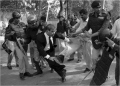 NYT photo, via
 ABA President William Neukom did come out with a Statement yesterday urging “President Musharraf to rescind these actions immediately,” and noting that “shutting down a nation’s lawful institutions of justice will hurt, not help, the fight against terrorism.” But, even from a safe distance in America, Neukom and the ABA won’t even ask for civil disobedience, but instead call “on all governments, bar associations and other civil society organizations to support the rule of law, by using every peaceful, legal means to persuade President Musharraf to restore justice to the people of Pakistan.” “
 Although
  Japan’s Haiku Master,
 [
[ “I like to call myself a lunch pail lawyer.”
 Of course, I do not even want to speculate on what a “lunch pal lawyer” might be.
 “Hot dog lawyering and courtroom histrionics are the mark of an unprepared prosecutor. Blather and bluster do not win convictions; good sound case building, diligent preparation and vigilant watch for the unexpected wins convictions.” (And see,
  Frankly, Rich’s explanations left me with an unclear picture and more questions — especially after visiting
 Or
Or  Will he work late a lot and need an old-fashioned
  Or, although McNally contrasts himself with D.A. DeAngelis, and insists he will follow the rule of law, with justice more important than any convictions rate, is he secretly a
 but surely not a
  Baseball: 1)
 “Adrien is the definition of a lunch pail player. He fights for every rebound, every loose ball, and puts his heart into everything he does on the court .”
 tennis – Jim Courier [
 Tracking the public’s use of the term has given me a better understanding of the “lunch pail” moniker. It symbolizes hard work, out of the spotlight, without flash. And, always with deep blue-collar roots.
 “That gives him name recognition, but Greg Cholakis, in our view, isn’t running on his family name.”
 I come from a family of eight children; I have five sisters and two brothers; Our parents worked hard to provide for us. Raising eight children was not easy. We weren’t by any stretch of the term “wealthy”.

 . .
. .  “is increasingly unlikely to tolerate expensive lawyers for tasks (guiding, advising, drafting, researching, problem-solving and more) that can equally or better be discharged, directly or indirectly, by smart systems and processes.” And,
 will the federal competition agencies (Department of Justice and Federal Trade Commission)
 In addition, the Legislature voted to create the Schenectady County Council to Prevent Sex Offenses, a large committee composed of various office holders and community representatives, which was given the job of studying the overall issue of preventing sex offenses against children, and ordered to report back in 90 days. The Legislature would then have 30 days to act upon the Report.
 Carl Strock: The View from Here (Schenectady
  All observers and participants would surely agree that Community Representative Jeffrey Parry, of Scotia, was the most active participant in the first SOC meeting. He first came to our attention at the Public Hearings on the sex offender laws, where he supported strong measures. The Daily Gazette article “
 I believe that a fair reading of the literature on this topic makes it clear that your preoccupation is far greater than is warranted by the facts, by experience, and by common sense. The materials cited and discussed in our series of
 update (Oct. 26, 2007): A truly scary Halloween scenario from today’s Schenectady Daily Gazette — an
  update (Oct. 12, 2007): Prof. Douglas Berman asked today, at his Sentencing Law & Policy weblog, “
 They’re Useless in Utica and Nuts in Newton. As our
  Ohio State law professor Douglas A. Berman (of the award-winning
  You may recall that your f/k/a Editor
  ” ‘I think we’ve waited long enough for the state to act. We have to take steps to protect our citizens,’ Newton Deputy Mayor Joseph Ricciardo said. ‘You have to do something’.”
 All this talk of pandering politicians (and thinking we can hope to change them) got me thinking of

