You are viewing a read-only archive of the Blogs.Harvard network. Learn more.

f/k/a archives . . . real opinions & real haiku

May 3, 2008

NY judges looking black-and-bluish

Filed under: lawyer news or ethics,viewpoint — David Giacalone @ 4:18 pm

judgeAngryFN Some of New York’s black-robed judges are engaging in their version of the Blue Flu, in order to pressure the Legislature to give them (long-overdue) pay raises: They are “recusing” themselves — taking themselves off a case due to bias or a conflict of interest — if a party is represented by a law firm that employs a state legislator (especially Assembly Leader Sheldon Silver’s firm of Weitz and Luxenberg). See Eric Turkewitz’s posting “New York Judges Slowing Cases From Legislators’ Law Firms Over Pay Raise Issue” (NYPILaw Blog, May 2, 2008, with hat tip to Overlawyered.com); and “JUSTICE OF THE CEASE: REVOLT OF ROBES AS STATE JUDGES STALL ‘POL CASES'” (New York Post, April 27, 2008).

Also, see the Advisory Judicial Ethical Opinion (No. 08-76, April 24, 2008), which concluded that the judges’ pay raise lawsuit does not require recusal, but also stated that an individual judge must step aside if he or she has “genuine doubts” regarding the ability to be fair

This time last year, I was chastising Chief Judge Judith Kaye for her tacky use of Law Day Ceremonies to threated a lawsuit to get their pay raise. This year, she is — at least publicly — doing her best to prevent the judicial work slowdown, and deny its existence. See “Chief Judge Writes N.Y. Governor to Deny Work ‘Slowdown’ by State’s Judges” (New York Law Journal/Law.com, April 30, 2008); and “Chief judge cautions against recusals as protest” (AP/Syracuse Post-Standard, May 2, 2008). The AP story says:

fjudge Kaye, who after turning 70 will retire at the end of the year, in an e-mail Thursday cautioned them not to refuse to hear lawmakers’ cases as a form of protest. She wrote that “using recusal as a strategy rather than as a matter of individual conscience” would be perceived as retaliatory and weaken their cause.

sua sponte
her honor
catches me staring

. . . by dagosan

Fr.VentaloneS Our rabble-rouser weblog friend Scott Greenfield at Simple Justice disagrees with Judge Kaye, and instead is egging on the judges to “stand up for themselves” and ignore calls to maintain their judicial dignity, because “there’s nothing dignified about poverty.” As I told Scott in a Comment at his website,

It is not a matter of dignity (and you know how often I deride our profession’s Dignity Police at my weblog); it is a matter of duty. No judge has the right to fabricate reasons to recuse himself or herself as they are doing here in order to pressure legislators.

I believe that judicial salaries should be higher, but that does not justify using a judicial variant of the Blue Flu. If pay is intolerably low, then an individual judge should resign. There are dozens of competent lawyers (some making far less now and some much more) who would gladly fill each of their slots on the bench at current salary levels. [Indeed, in many locales across the State — including Schenectady County — fulltime judges are among the highest-paid members of the legal profession (starting at $108,800), and they get plenty of other perks.]

This work action will indeed cause the judiciary (and unfortunately the entire justice system) to lose the respect of the average New Yorker.

My position here is similar to my opposition to the illegal boycott tactics used in Massachusetts by their “bar advocates,” in their fight for higher assigned counsel fees. It may be old fashioned, but I really do hold lawyers and judges to a higher standard than I hold your run-of-the-mill politician or bureaucrat — especially when the dispute really comes down to a matter of money.

My bottom line:

  • judges should know better than anyone else that good ends do not justify unethical or coercive means — especially when the “end” (no matter how dressed up in cries of constitutional crisis) comes down to personal financial gain
  • if any particular judge “doubts his/her ability to remain impartial” merely because a lawyer works for a firm that includes a NYS legislator, he or she does not have sufficient judicial temperament to stay on the bench and should leave

Hey, it’s Saturday afternoon, and thoughts of haiku (not court hi-jinx) should be on my mind. Before Mainichi News posts its May haiku offerings, here are a pair of poems from its April edition, by two of f/k/a‘s Honored Guests. I had planned to post these poems before I decided to write about the judicial slowdown. So, any resemblance to a judge dead or living is purely coincidental.

spring thunder
dust from a slap
on the horse’s rump

…… by w. f. owen – Mainichi Daily News Haiku (April 2008, No. 706)

offshore breeze —
a girl with wild gestures
where the wave breaks

…….. by Jim Kacian – Mainichi Daily News Haiku (April 2008, No. 706)

April 30, 2008

the summer gas tax holiday: hot air from the panderpols

Filed under: lawyer news or ethics,viewpoint — David Giacalone @ 5:15 pm

Pump-Pandering Politicians: It’s great to see that so many news sources and websites are putting a penetrating spotlight on the proposals by the presidential candidates, as well as other federal and state politicians (like Messrs. Bruno and Tedisco in New York), to remove the gas tax over the summer. A Newsday editorial summed it up: “A proposal for such tiny, temporary, iffy savings is a political gimmick, not meaningful relief.” (“No such thing as a free tank: No gas tax for the summer is a bad idea“, April 30, 2008). For more analysis, see:

  • Tax cut could push gas prices higher” (CNNMoney.com, April 29, 2008) “Despite claims from McCain and Clinton, temporary cut in gas taxes could lead to more demand and push prices higher – leaving taxpayers to cover shortfall.”
  • Candidates’ Plans Could Indirectly Raise Gas Prices: Senators Back Steps That Portend Higher Pump Costs,” Wall Street Journal, April 30, 2008
  • Dumb as We Wanna Be” by Thomas L. Friedman (New York Times, April 30, 2008), which opines, “It is great to see that we finally have some national unity on energy policy. Unfortunately, the unifying idea is so ridiculous, so unworthy of the people aspiring to lead our nation, it takes your breath away. . . This is not an energy policy. This is money laundering: we borrow money from China and ship it to Saudi Arabia and take a little cut for ourselves as it goes through our gas tanks. What a way to build our country.”

See the video clip — “Who Can Lower Gas Prices? The Candidates’ Plans: The Gas Squeeze: Will lifting the gas tax provide some relief?” — from Good Morning America/ABCNews (April 30, 2008)

And, listen to analysis on the Gas Tax Holiday from the PBS NewsHour — RealAudioDownload (April 30, 2008), or read the transcript.

  • Democrats Divided Over Gas Tax Break” by John Broder, The New York Times (29 Apr 2008), which has a description of the presidential candidates’ current and prior positions on gas taxes, and points out (emphasis added):

“The highway trust fund that the gas tax finances provides money to states and local governments to pay for road and bridge construction, repair and maintenance. Mr. McCain and Mrs. Clinton propose to suspend the tax from Memorial Day to Labor Day, the peak driving season, which would lower tax receipts by roughly $9 billion and potentially cost 300,000 highway construction jobs, according to state highway officials.”

update (May 1, 2008): Today’s NYT editorial “The Gas-Guzzler Gambit” also uses the word pander and explains why “it is an expensive and environmentally unsound policy that would do nothing to help American drivers.”

The federal tax on gasoline is 18.4 cents per gallon, about 5% of the average price today. Savvy f/k/a readers probably didn’t have to read an article to wonder why we would expect the oil companies to automatically pass on the savings from a gas tax hiatus. In addition, if you’ve been reading about the plight of many independent gas stations, you might also expect the stations to try to pocket some of the tax savings for themselves. See, e.g., “Stations hope you fill up with more than gas: Fuel is loss leader for many; they make money in convenience stores,” (msnbc.com, April 1, 2008)

If you want to feel even worse about all this, and the related subject of reducing our nation’s gasoline consumption, read a little about the Price Elasticity of Demand for Gasoline; and see “Soaring Gas Prices Will Not Reduce Demand.”

Where do the Presidential Candidates Stand? We’re not naming names (due to our political-punditry hiatus), but see “Clinton Criticizes Obama Over Gas Tax Plan: Knocks Obama’s Opposition To Summer ‘Gas Tax Holiday,’ Which She And McCain Support” (CBSNews.com, April 28, 2008); “Obama Dismisses Gas Tax Holiday: Senator Says Gimmick Won’t Help Consumers, Designed To Get Rivals Through Election” (AP/CBSNews.com, April 29, 2008); and “McCain wants a gas tax ‘holiday.’ It’s a no-brainer, right?,” (The Oil Drum: Europe, April 15, 2008)

update (May 2, 2008): Yesterday, former Democratic National Committee Chairman Joe Andrew, a superdelegate, switched his presidential endorsement to Barack Obama. See “Longtime Clinton ally Joe Andrew defects to Barack Obama” (Los Angeles Times, May 2, 2008) At a news conference Thursday, Andrew said:

“Clinton’s support for a federal gas-tax holiday over the summer was symbolic of a poll-driven candidacy proposing something ‘politically expedient to give a quick pander to Hoosier voters,’ in contrast to what he called the ‘principled’ campaign Obama has run.”

We think the gas-tax-holiday issue can tell us a lot about our so-called leaders. Who is willing to tell us the truth? Who treats voters like adults? Who is worried about the long-run and not just the next election? It also tells us a lot about the voting public: Who will demand a simplistic “solution” even if it might in fact be counter-productive, just to get a few extra bucks in their pocket now.

– for other posts on issues related to gasoline consumption see: post-Earth Day spread: speed limits and efficient driving; Open Letter to Gas Whiners and Another Silly One-Day Gas Boycott

update (May 25, 2008):  Jim Tedisco, Republican leader in the NYS Assembly, continues to pander over the Memorial Day weekend, in the Op/Ed piece “To help achieve lower gas prices, make your voice heard” (Sunday Gazette, May 25, 2008).

follow-up (May 8, 2008): There’s an excellent editorial in today’s NYT, “The Tax Trickery Spreads(New York Times, May 8, 2008) Among points made:

  • “Unfortunately, their [Senators Clinton and McCain] demagoguery is growing into a real problem, setting off a chain reaction of “me too” proposals across the country to suspend state gasoline taxes, which tend to be much larger than the 18.4-cent-a-gallon federal levy. If the pandering spreads, it would go a long way in setting the nation’s energy strategy in precisely the wrong direction.”
  • “These ideas share a common purpose: appearing to be doing something to ease hard-pressed voters’ pain at the pump. Not only are they costly, but they will not do that. Suspending the federal tax would cost $9 billion. In New York, the suspension would blow a $500 million hole in state finances. Consumers in some states could benefit from lower state gas taxes because wholesalers could import gas from other states. Still, with refineries producing almost at full capacity, the tax break would prompt a jump in demand that would push up prices.”

If you’ve read and considered all of the above, you surely deserve a treat. Here are more poems from the newest issue of Acorn (No. 20, Spring 2008) — which, among its 100+ poems, contains contemporary haiku by a number of our f/k/a Honored Guest Poets:

nearby clouds
nearby mountains
the rescue helicopter hovers

… by Gary Hotham

a cat at a threshold I can’t see sniffs something I can’t smell

icy night
a saw-whet etches
the silence

………. by jim kacian

spring at last
letting the stallion out
into the pasture

….. by Randy M. Brooks

quick-running brook . . .
a stone from the bottom
lighter than imagined

……………… by paul m.

fumbling
with coat buttons
autumn rain

……………. by Yu Chang

Lightning-cracked rain —
his palm rests against
the bottle’s black label

Dead-end road —
shadows of skinny cows
through old barbed wire

……… by Rebecca Lilly

All Souls
a third day
of candy

………….. by John Stevenson

April 29, 2008

50th anniversary of Law Day

Filed under: Haiku or Senryu,lawyer news or ethics — David Giacalone @ 4:15 pm

. . . . . . . 1958 to 2008. . . May 1st is Law Day . .

We’ve pretty much said all we need say about Law Day in prior years — see, e.g., “Law Day, Not Lawyers Day” (2004); “towards a better Law Day” (2005); “lawdy, lawdy another Law Day” (2006); and “Law Day with Chief Judge Kaye” (2007). This year, I’d like to point out that this is the 50th Anniversary of Law Day, which was started with a proclamation by President Dwight D. Eisenhower in 1958.

In other years, President George W. Bush issued Law Day proclamations a few days before May 1st. In 2005, he did not mention lawyers in his Law Day proclamation, in Law Day, U.S.A., 2006 he did. Although President Bush has recently recognized Malaria Awareness Day, and Older American Month, along with Loyalty Day (which is also on May 1st) and Education and Sharing Day, there is no Law Day proclamation up at the White House Proclamation Page, as of 4 PM Eastern Time today, April 29, 2008. Some wags might conclude that he likes loyalty and lot more than the rule of law. update (April 30 May 1, 2008, 8 AM): Still no Law Day Proclamation from the White House, but National Physical Fitness and Sports Month did get honored overnight.

Better Late (May 1, 2008, 9:30 AM):  The White House has finally issued its proclamation for Law Day 2008.  It starts: “The right of ordinary men and women to determine their own future, protected by the rule of law, lies at the heart of America’s founding principles.  As our country celebrates the 50th anniversary of Law Day, we renew our commitment to the ideals on which this great Nation was established and to a robust system of ordered liberty.”  And continues, “We pay tribute to the men and women in America’s legal community.”  President Bush also looks toward “a hopeful future as we work to secure the liberty that is the natural right of every man, woman, and child.”

Prof Yabut, having recently watched both Frontline’s “Sick Around the World” and Michael Moore’s Sicko,, and having just read Pres. Bush’s proclamations for Loyalty Day, Older American Month, Education and Sharing Day, Malaria Day, and National Volunteers Week, wonders yet again: How can all those other nations pay for everyone’s health-care and education (and assure month-long vacations to workers) when our rich and caring country fails to do so?

The 2008 Law Day theme at the American Bar Association is The Rule of Law: Foundation for Communities of Opportunity and Equity. The ABA’s Law Day materials explain

Why Is This Theme Important?

Advancing the rule of law helps achieve an
array of public benefits. We all have a stake in
the rule of law, and we all can do our part to
strengthen it.

The rule of law refers to a system of self-
government with a strong and accessible legal
process. It features a system based on fair,
publicized, broadly understood, and stable
laws, and diverse, competent, and independent
lawyers and judges. This foundation is essen-
tial to foster sustainable communities of
opportunity and equity.

Frankly, I’m not too sure what that means, but there are a lot of materials at the ABA Law Day 2008 website to help understand the topic and even teach it to others. If you want to see whether there are Law Day activities in your area, check out their Law Day Events Calendar.

LawDayBalloons If you like tacky, don’t forget the ABA Law Day Store. (scroll down our 2006 Law Day post for thoughts on the Law Day Store) update (April 30, 2008): Anne at Court-o-rama says: “Not to be outdone by Hallmark, the ABA has a Law Day Store selling Rule of Law yo-yos, mugs, backpacks, balloons, postcards (send one to a despot!), and carabiners: the keychains of the future!!!.”

If you long for the days when Law Day was still celebrated by the Bar as if it really were Lawyers Day, go to the Resources Page of The Billable Hour Company and check out their Legal Holidays and Events Calendar. The calendar is meant:

To help raise the morale of legal professionals by spreading information about all of the federal, state and local holidays that celebrate lawyers and legal professionals.

Since the rest of the world is “not quite ready for Love Lawyers Day,” lawyers may just have to be satisfied with loving themselves.

afterthought (7 PM): KipEsquire at a Stitch in Haste is not happy with Pres. Bush’s proclamation making May 1st a National Day of Prayer, saying “Bush again insults and marginalizes atheists” (hat tip to Ed at BlawgReview)

If you’ve read down this far and are saying to yourself, “hey, where’s the haiku?,” here are a few from the brand new edition of Acorn (a journal of contemporary haiku, that is edited by Carolyn Hall). We’ll share more from Acorn No. 20, Spring 2008, very soon.

a cold cup
from a cold cupboard —
morning moon

… by Peggy Lyles –

pale moon the thinning of days into winter

… by Billie Wilson

here
for now
first snow

…… by John Stevenson

century oak —
waiting it out
inside the drip line

country road
the Nam vet
revs his Harley

…….. by Tom Painting

p.s. Tom’s second poem reminded me of articles I’ve been seeing lately like this one: “older riders adding to motorcycle fatalities” and “rusty baby boomers on bikes.” Be careful out there, Boomers. Don’t forget the rules of law nor the laws of nature (and physics).

obama’s tort reform creds?

Filed under: lawyer news or ethics,viewpoint — David Giacalone @ 10:31 am

As you probably know, Barack Obama appeared on Fox News Sunday on April 27, 2008 (to the apparent dismay of many liberal bloggers who support negotiating with our nation’s enemies, but are boycotting Fox in order to “delegitimize” it. Please, kids, grow up with all your litmus tests.). Click for a Transcript of Obama on FNS.

For the purpose of this post, what interested us was this exchange between moderator Chris Wallace and Sen. Obama:

WALLACE: Some of your detractors say that you are a paint by the numbers liberal and I’d like to explore this with you. . . . As a president, can you name a hot button issue where you would be willing to cross (ph) Democratic party line and say you know what, Republicans have a better idea here. . . .

OBAMA: . . . I would point out, though, for example, that when I voted for a tort reform measure that was fiercely opposed by the trial lawyers, I got attacked pretty hard from the left.

At Point of Law.com, guest-blogger Carter Wood responded to this brief remark with the posting “Obama Cites His Tort Reform Credentials” (April 27, 2008). Wood notes:

“He’s no doubt referring to his February 2005 vote for S. 5, the Class Action Fairness Act, which passed 76-26. Ted Frank analyzed Obama’s CAFA vote and tort reform record in this December 2006 post, concluding, ‘As a reform supporter, I’m far from convinced that this makes him someone willing to cross the plaintiffs’ bar.’ Senator Clinton voted no.”

In his earlier Point of Law piece, “Obama and liability reform” (Dec. 27, 2006), Ted Frank weighed in on whether Sen. Obama had any tort-reform creds, discussing his vote for what Frank calls “the eminently sensible Class Action Fairness Act.” After noting that “Obama may have annoyed the lunatic left with his vote for CAFA,” Ted says, among other things:

“Obama didn’t participate in the negotiations to get Democratic support, and he voted for every Democratic attempt to eviscerate the bill with amendments. . . Obama didn’t break with the Democrats on any seriously contested tort reform measures: he filibustered medical malpractice reform, and was one of the votes to kill the asbestos reform bill (which effectively failed by one vote) . . . Obama claimed to support medical malpractice reform in his Senate campaign (or, at least, made pro-reform swing voters think that he did), but, then, so did Kerry and Edwards in their 2004 presidential campaign.

“Obama co-sponsored the MEDiC bill with Hillary Clinton; it was a federally-funded variation of the so-called “Sorry Works” proposal . . . But it’s hardly the move of someone daring to flout the trial lawyers who dominate the Democratic Party these days.”

I don’t believe that Barack Obama has ever tried to portray himself as a full-blooded, knee-jerk Tort Reformer. As far as I’m concerned, neither being totally for nor totally against every tort-reform proposal makes good sense or good public policy. The issues raised are complicated and need to be looked at with regard to the legitimate rights of both injured plaintiffs and accused defendants — assuring that all litigants get justice and our justice system is efficient and fair. There is no simple fix that can assure that those truly injured by bad-actors are fully compensated and that defendants are treated fairly both when blame is assigned and when damages are measured.

From my perspective as a consumer advocate and citizen looking for an effective and fair justice system, it seems that: Rabid proponents of tort reform mostly want to pay injured plaintiffs as little as possible, while rabid opponents of tort reform — mainly the “trial” or personally injury bar — want to be able to extract as much money as possible from defendants while assuring the biggest fees possible for plaintiffs’ lawyers.

In this context, I’m pleased that Barack Obama has not totally embraced “tort reform,” and — as a Democrat who worries about interest groups strangling the party and skewing its positions and priorities — am even more pleased that the Senator is unwilling to simply rubber stamp the position of trial lawyers by serving as their mouthpiece, puppet or platitude-peddling political paladin, rather than looking at each issue or piece of legislation on its merits.

I continue to hope that Sen. Obama will produce a comprehensive statement about our litigation system and necessary reforms and restructuring (including the need for full access to the courts). By choosing not to embrace either Tort Reformers or Trial Lawyers, Barack Obama increases his creds as a refreshingly different kind of politician.

prof yabut Prof. Yabut says: This posting is a follow-up to one of the most-visited posts in our five-year history was: “Inquiry to Obama on Tort Reform” (Aug. 4, 2004), from which we hoped to find out the position of Democratic presidential candidate Senator Barack Obama on tort reform and related issues. We never received any response from the Obama Campaign. [Note: Our Editor is a lifelong Democrat and has recently noted his support for Sen. Obama.]

Reminder: The f/k/a Gang [the Editor and his alter egos] are not “tort reformers” — we do not advocate arbitrary or blanket limits on the size of personal injury awards. We have, however, written extensively on the topic of the standard contingency fee (charging virtually every personal injury client the same percentage fee regardless of how risky or easy the case might be), which we believe consistently extracts excessive fees from clients. See, e.g., our four-part essay on the ethics and economics of contingency fees.

SlicingThePie This position has drawn the ire of the so-called “trial lawyers,” “consumer protection lawyers” and “justice lawyers,” who seem to have much power over traditional Democratic politicians (especially those seeking campaign contributions). For example, the supposedly pro-consumer Clinton Administration opposed a bill that would have merely told consumers that they have the right to negotiate the level of a contingency fee. [aside (May 1, 2008): See my Comment #5 below about a reaction to the above mention of standard contingency fees.] Now, finally, let’s go to the point of this posting:

April 19, 2008

have you ever been punched by a client?

Filed under: Haiku or Senryu,lawyer news or ethics,Schenectady Synecdoche — David Giacalone @ 8:57 am

boxer smf Schenectady attorney Brian Mercy evoked tears of joy earlier this week from a client who had been in jail since last August, but was released from a drug charge when the vehicle search was held to be warrantless and illegal. But, Brian wasn’t quite so lucky yesterday with another jail-house dwelling client. According to the print edition of today’s Schenectady Daily Gazette (“Man punches attorney during court appearance,” April 19, 2008, p. B2):

“A man facing a jail assault charge apparently didn’t like the plea offered to him Friday.

“Charles Ardley, 21 [street name “Murder”], who was being held at the Schenectady County jail since last fall, responded by punching his attorney in the face, officials said.

‘He got mouthy with the judge and reached over and punched me in the side of the head,’ said attorney Brian Mercy, who was not injured. ‘I saw it coming.’

. . . “Mercy, who is no longer representing Ardley, said his former client was expected to be charged with contempt and harassment.

“The offer was apparently withdrawn.”

Although I’ve on occasion been tempted to slap a client or two upside the head (a couple divorce mediation husbands come to mind), I’ve never been punched, slapped or even pushed by a client. I have had a couple scary parents of my Law Guardian clients make not-at-all subtle threats when they did not like my opinion as to who should get custody or more visitation, or whether foster care was necessary. [These guys usually had biceps larger than my head.]

What about you, Mr. or Ms. Lawyer? Have you ever been punched or assaulted by a client? Are criminal lawyers more at risk than matrimonial lawyers or estate planners? Let us know with a Comment or a blurb at your weblog.

update (2 PM EDT): Hat tip to Ed of BlawgReview for sending me a YouTube Link to “Lawyer Punched in Face in Court,” on which Dustin Wadsworth shows a clip of a public defender being punched by his robbery-suspect client in a court room in Georgetown, KY. (ABC2Newscast, Feb. 6, 2008). This lawyer (not identified) got walloped.

afterglow (April 21, 2008): Thanks to all the blawgers who have pointed to this posting from their weblogs, including Holden at What About Clients, Gideon at A Public Defender, Kevin at Real Lawyers Have Blogs, and David at Above the Law.

If this post interested you, you might want to take a look at “poorly framed in Schenectady,” where I ask whether a local public defender should have refused to present an obviously-bogus alibi (which included using a photo from a picture frame in pointing to an imaginary perpetrator). If you are the defensive-lawyer type, it might make you want to punch someone (i.e., me).

boxer gray . . . . . . boxer gray flip

streetwalker
with a black eye halo
around the moon

….. by George Swede from Almost Unseen

empty punchbowl
husband and wife
avoid the mistletoe

…… by dagosan

all fools day
my daughter gets in first
with a pinch and punch

…….. by Matt Morden – The Heron’s Nest (June 2001)

new year’s morning
like every other
we punch the clock

………………… ed markowski

mosquitoes
the slap of a beaver tail
at twilight

. . . by Alice Frampton – The Heron’s Nest (Sept. 2005)

singing a song
and slapping his butt…
with a fan

from his hole
the snake pokes his head…
the cat slaps it

swat! swat!
the escaping fly buzzes
with laughter

… by Kobayashi Issa, translated by David G. Lanoue


April 16, 2008

we all missed Be Kind to Lawyers Day on April 8

Filed under: lawyer news or ethics — David Giacalone @ 12:11 pm

noloShark Non-lawyer Steve Hughes has a weblog of his own and lots of experience in advertising and sales promotion in St. Louis. Yet, he apparently failed to let any members of the blawgisphere know about the launching of the very first National Be Kind to Lawyers Day, which was “celebrated” on April 8, 2008.

Of course, if Steve had Googled or Yahoo!’d “Lawyers Day,” he might have saved himself a lot of effort and felt a bit less ignored. The very first search result is our posting from last September, which suggested that the world is “not quite ready for Love Lawyers Day.” It echoed a theme that we had sounded two years prior, when we pointed to the lukewarm reception for the August 31st event called “Love Litigating Lawyers Day.”

I don’t know why N.B.K.L.D was such a flop (other than the universal dread and dislike of lawyers). Hughes, who has worked with lawyers “for several years in the presentation skills arena,” would seem to have been the right person to launch the Day. According to his weblog, Steve is “the Presentation Guy,” and his bio boasts of years in advertising and sales promotion with top firms. His Hit Your Stride organization — which has the slogan “helping clients create & deliver world-class presentations” — calls itself

“a high-impact communication resource for organizations who want to create, deliver and profit from world-class presentations.”

On March 31st, Hughes and Hit Your Stride put out an upbeat press release for Be Kind to Lawyers Day. The press release said:

Tuesday, April 8th is the first-ever National Be Kind To Lawyers Day and is designed to give an ounce or two of respect to the men and women who daily tip the scales of justice. “In most surveys lawyers rank as the least respected profession and that includes celebrity paparazzi and used car salesmen,” says National Be Kind To Lawyers Day creator Steve Hughes.

It goes on to explain that “The early April date was selected because it is ideally situated between April Fool’s Day and Tax Day April 15th.” Steve adds that “The best part of National Be Kind To Lawyers Day is that people can participate as much or as little as they choose.” Sadly, whether or not they knew it, the American public chose not to participate. As far as I can tell, the holiday went virtually unnoticed. Indeed, I have the feeing that very lawyers received one of the two free Be Nice To Lawyers Day greetings cards from 123greetings.com.

lawyer cellphone small flip You can click to read more about The N.B.K.T.L. Story, including suggestions — better late than never — on just how to particpate. [One of the better suggestions: “If you can’t abstain, tell your funniest lawyer joke but switch out the lawyer with your profession. (I bet it’s still funny.)” Your Editor bets it’s not quite as funny.] There’s even a page of allegedly “Cool Lawyer Facts.” I’d say most of them — like reminding us that Ozzie Nelson had a law degree — are just room temperature.

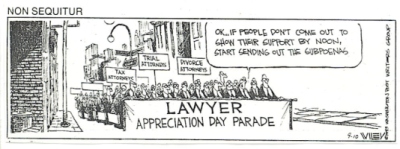
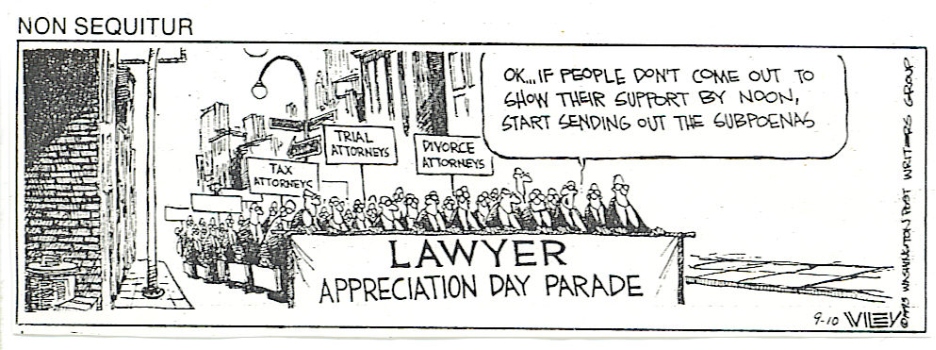
All in all, I can’t whip up enough enthusiasm for National Be Kind to Lawyers Day to even come up with a related haiku or senryu poem. Instead, I’ll leave you with the image of Lawyer Appreciation Day that Wiley first presented at Non Sequitur in 1993:

.. larger ..

April 12, 2008

poorly framed in Schenectady

Filed under: Haiku or Senryu,lawyer news or ethics,Schenectady Synecdoche — David Giacalone @ 6:43 pm

Even by Schenectady standards for silly and strange legal news (see examples here), the burglary conviction of 50-year-old Gregory Barnes is noteworthy. Last February, after a two-week trial, Barnes was found guilty of three counts of first-degree burglary, plus menacing and harassment charges [for threats and sexual comments to the victim]. According to the Albany Times Union:

“Barnes broke into his sister-in-law’s James Street home and attacked her with a screwdriver in March 2007. At the time, he was high on crack cocaine and incensed at the woman for cutting him off from family activities, Assistant District Attorney Anne Bair said.”

What makes the case peculiar and interesting can be culled from the headlines it garnered in the two major local newspapers: “Burglar convicted after alibi collapses: Defendant tried to pin violent break-in on imaginary criminal” (Albany Times Union, by Paul Nelson, Feb. 22, 2008); and “Burglar gets added time for trying to frame a frame” (Schenectady Daily Gazette, by Steven Cook, April 12, 2008). As the TU explains further:

“Barnes tried to pin his crime on an imaginary person — even providing a photo of a dapper picture-frame model to make his case.

. . . “A few weeks before the trial started, Barnes presented an alibi to his lawyer, public defender Kent Gebert. Barnes gave Gebert a picture of a man he contended was responsible for the crimes against his sister-in-law and gave the man’s name as Wayne Heittleman, Gebert said. That photo was used as an exhibit to bolster the case.

. . . “Gebert said Barnes testified in court that he had only arranged for Heittleman to scare the victim and that Heittleman ‘went beyond the assignment” by burglarizing the place and attacking the woman.”

Public Defender Kent Gebert told the Times Union he initially had no reason to doubt Barnes’ story. Luckily, the prosecutor’s office was not quite as gullible as Gebert. You see, this is the “photo” submitted by Barnes and Gebert to identify the alibi perpetrator:

The TU tells us that “A subsequent background check of Heittleman by county investigator Dave Mantei came up empty,” and “We knew it (photo) was phony, cropped and cut out from some type of catalog, but didn’t know where,” ADA Bair added. Then, serendipity helped uncover the truth:

“As luck would have it, Cathy Dobies, who works in the district attorney’s office, saw the photo in a picture frame while browsing in the Glenville Wal-Mart where her son works.”

The Schenectady Daily Gazette filled out the story in its article today:

“Investigators spent the better part of 12 hours trying to find the man, Bair said. When the photo surfaced, they had immediate suspicions, but had to prove it.

“It was Cathy Dobies, who works in the district attorney’s office, who solved the mystery. She knew she had seen the face and suspected it came from somewhere, but didn’t know where. She checked several advertisements. Then, after work, she went to Wal-Mart.

“Within minutes, she found ‘Mr. Heidleman.’

“ ‘I went to the picture frame aisle and there they were, tons of them,’ Dobies recalled today. . . .

“It turned out the man in the picture was nowhere near Schenectady last March — or apparently ever. Officials called the company that produced the frames and was told he lived in Florida.”

Taking Ms. Dobies’ lead, I headed to the same Wal-Mart store this afternoon, and also quickly found “Mr. H.”, and scanned it for this posting (after spending $1.47 for the frame). The photo is part of the packaging in a series of picture frames with the brand name “megapix,” manufactured by MCS Industries, Inc., and sold at Wal-Mart. It comes on a thin piece of cardboard, in the odd size and shape shown above. There is no way a thinking adult could have been fooled by it.

Acting Schenectady County Court Judge Richard Giardino was clearly correct to be angry about the lies told to judge and jury by defendant Barnes in his courtroom, and right to add years to his sentence. On Friday, Judge Giardino sentenced Barnes — who had a prior burglary conviction 20 years ago — to the maximum 18 years in prison. Per the Daily Gazette:

judgeAngry “As upsetting as this crime is, what is also upsetting to the court is that you came and put your hand on the Bible and lied in front of the jury,” Giardino told Barnes. “You tried to put this off on someone else, and in doing so you damaged the integrity of the whole criminal justice system.”

The prosecutor had only asked for 12 years. Public Defender Gebert had the chutzpah to ask for five years, arguing that Barnes had stayed out of trouble for 20 years, and still has a chance to be a productive member of society.

After the verdict, Gebert told the TU in February that he was “thoroughly ticked off” and that Barnes sheepishly gazed down when he realized the prosecution had refuted his story and had the picture frame to prove it. He also asserted that he:

“wouldn’t knowingly put something in evidence if I knew it was false.”

We’re not doing legal ethics punditry these days here at f/k/a, but I’d like to do a little Concerned Citizen Commentary. Frankly, I don’t buy lawyer Gebert’s excuses — and I would not like to think that the ethical and “professional responsibility” duties of an officer of the court could be so lax as to allow him to look the other way, while his client tried to pin the crime on a picture-frame model. I’m hoping that my weblogging friend Scott H. Greenfield, of the Simple Justice weblog, and many other criminal defense and legal ethics experts [such as the proprietors of CrimProfBlog, Doug Berman at Sentencing Law & Policy, Skelly Wright at Arb& Cap, Mike Frisch at Legal Profession Blog, and maybe even Scott at Grits for Breakfast] will help us sort out Gebert’s obligations. And, I hope some non-criminal lawyers who care about protection of the public and the honor of the profession will also chime in and help us understand what kind of due diligence is due from a criminal defense lawyer confronted with a fishy tale.

Did Gebert “know” the alibi was false and the picture phony? It seems to me he would have to be consciously leaning backwards, averting his gaze, and holding his nose, to avoid seeing the truth. Such willful ignorance is not the same as not knowing. Here are a few of the reasons why I believe no responsible lawyer should have — in the totality of the circumstances — allowed the alibi to go forward:

  • Barnes’ victim was his own sister-in-law, who surely could identify her attacker; this raises the alibi threshold in my mind;
  • The photo came in a size and on a type of stock paper that is not consistent with home photography — and it plainly looks like a male model (rather than a likely co-conspirator button-man, likely to act as a heavy in crack-head Barnes’ campaign to scare his relatives)
  • If Gebert had Googled the name of the so-called actual perpetrator — either “Wayne Heittleman” per the Times Union, or “Wayne Heidleman” per the Gazette — he would have found not one responsive link back in February. Today, the only Google results for either name are articles about this story. Indeed, there appears to be no person ever mentioned in cyberspace with the surname “Heittleman.”

By letting Barnes present that clearly bogus alibi evidence, public defender Gebert did a great disservice to the justice system and to the public and his profession. (Without that alibi, would there have been a two-week jury trial wasting public and private resources?) Of course, as a practical matter, he helped garner the maximum sentence for his client. I hope his managing attorneys have taken note, along with the appropriate bar officials.

after the verdict
the tireless lawyer speaks
in falling snow

first murder trial–
the D.A. arrives
in new gloves

…………………………………………. by Barry George, J.D.

A final thought or two: ADA Anne Bair told the TU that the attempted ruse was “something out of the movies.” My response to that remark is similar to that of Albany area investigator “John D” at his weblog Nobody Move! (“STUPID CROOK TRICKS: EVERY PICTURE TELLS A STORY”, March 2, 2008):

Movies? What movies? Dumb and Dumber? The Jerk? The beauty of this is that it’s a twofer; a stupid crook trick, and a stupid lawyer trick. Too bad we couldn’t have worked in a stupid politician trick for the trifecta. Maybe next time.

This being Schenectady, I doubt the stupid-trifecta will be long in coming.

school photo
the frown my sister
grew into

… by Roberta Beary [honorable mention, penumbra 2004 haiku contest]

school staff photos
an early retirement leaves
a patch of glue

in black and white
the smiles of men
who made it home

…. by Matt Morden, at Morden Haiku
school staff photos” (Sept. 15, 2007) –
in black and white” – (Oct. 15, 2006, with photo)

kids51


ancient snapshot
their last smiles
for the camera

…. by dagosan [Sept. 1, 2004]

Speaking of cropping, click this image for a creative use of scissors from “ethicalheretic” Michelle Rhea, who does not appear to make haiga, but does often combine photos and poetry.

winter woods
seeing myself
in black and white

old passport
the tug
of my father’s smile

………………….. by yu chang –
“winter woods” – Update Dim Sum 2005/1
“old passport” – UDS, 2001/II; The Loose Thread: RMA 2001

the old days . . .
autumn colors
black and white

. . . . . . . . . . . . . . . by andrew riutta – Full Moon Magazine (2005)

family album–
the black and white
of my youth

…. by Jim Kacian – from pegging the wind

home for Christmas
the golden afterimage
of a camera flash

……………. by Alice Frampton

March 29, 2008

“toilet paper check” story ignored by blawgisphere

Filed under: Haiku or Senryu,lawyer news or ethics — David Giacalone @ 8:37 am

You may have seen a short blurb from the Associated Press or UPI about Ronald Borga’s attempt to use a check “neatly written on three squares of floral print, two-ply toilet paper” to pay his disputed water bill (see, e.g., Newsday, Forbes). You can read a full account about it from the city where it happened in “City man uses toilet-paper check to try to settle water-bill dispute” (Press & Sun-Bulletin, Greater Binghamton, NY, by John Hill, March 27, 2008). That’s Borga in the photo from the Binghamton newspaper (taken by Joseph Geronimo), along with Robert Behnke, the Broome County attorney, who refused to take the check.

Many non-lawyer weblogs pointed to the story yesterday (March 28, 2008), including Republican Storm and Free Money. But, as of 9 AM EDT this morning, you won’t find it yet in the blawgisphere — the thousands of weblogs written, edited or hosted by lawyers, law professors, and law students. I just tried searching for /”toilet paper” check/ at Google’s Blog Search, and not one of the listings was from a blawg. So, I checked Justia’s Blawg Search; then went to Legal Blog Watch; (the newly snazzy-looking) Overlawyered.com, and even Anne Reed’s Deliberations. Not a word on a blawg about this fun, intriguing story — one that could use a lawyer’s perspective to help educate the public.

toiletpaperG Heck, I’m retired and never liked or practiced Commercial law, so don’t look to the f/k/a Gang for an instant expert advice explanation of what constitutes a legitimate bill of exchange, negotiable instrument, or “bank draft,” that can be used as a check, or for advice on when a government entity can refuse a home-made check (or the “$2,000 in nickels and dimes” Borgna may be trying to scrounge up). But, maybe the WSJ law blog, or business law professor Stephen Bainbridge could tell us. Or, perhaps one of those smart guys at Prawfsblawg, or the Business Law Prof Blog. I’d settle for a law student who’s recently taken a course on the Uniform Commercial Code [UCC].

Until the experts weigh in, check out this discussion and definition of “check” from the ‘Lectric Law Library Lexicon.

update (11 AM): I’m interrupting a perfectly good Saturday shower to note my vague recollection that Vern Countryman told our class in Commercial Transactions 101, back in the mid-70s, something like: “you can write a check on anything — even toilet paper.” But, don’t quote Vern nor me on that, please. The real question here, of course, is whether a payee has to accept the check when it is proffered (especially when it customarily does accept personal checks, and as here is a government entity), not whether the bank has to honor it.

Meanwhile, you should know, as reported by the Press & Sun-Bulletin that:

An argument that ensued in the sixth-floor county law office grew testy but involved no physical confrontation. It ended with Borgna being peacefully escorted out of the building by a Broome Security officer.

Bill Ullmann, an attorney with the Federal Reserve Bank in Kansas City, said the IRS has in the past accepted a check written on a T-shirt as payment for a tax bill. But, because toilet paper is easily destroyed, it may have been difficult to clear the check.

“I can understand why someone would be hesitant to accept a check written on toilet paper,” Ullmann said.

I’ve often heard what a great resource lawyer weblogs are for the public. But, I’m not a believer in that propaganda. Here’s a tale that needs a little legal expertise. Seems to me it’s a perfect time for the profession to show it has a sense of humor and a timely interest in educating the public on topics of interest to the average bloke — and even to cranky ex-lawyers like myself, who can’t quite recall his bar exam prep from three decades ago, and has not kept up on the law of commercial paper. I sure hope someone has written on this in time for George Wallace’s upcoming edition of Blawg Review# 153 — on Monday [update: which George has —arrggh!— dubbed Blarrgh Review! and imbued with a piratical theme].

unemployed
the uneven edge
of a quahog shell

a spring wind
coins in the cup
of a sleeping beggar

……. by paul m.
“unemployed” – The Heron’s Nest Award (Sept. 2005)
“a spring wind” – The Heron’s Nest (June 2000)

my New Year’s resolution toiletpaperG
buy
toilet paper

…… by David G. Lanoue – from Haiku Guy, a novel (Red Moon Press 2000)

borrowed mystery –
toilet-paper
bookmark

…. by dagosan

spring equinox –
the toilet paper roll
off-center

almost payday
the wind tugs at
my pocket

. . . . . . . . . . . . . . . . . by Laryalee FraserSimply Haiku Autumn 2006, vol 4 no 3

March 25, 2008

getting his musty money back

Filed under: lawyer news or ethics,Schenectady Synecdoche — David Giacalone @ 9:19 am

past due There may finally be a legal resolution to the case of Casadei v. Skoog, which we first covered here at f/k/a in December of 2004, but which began in a musty basement of a historic house in Schenectady in October of 2003, with a handyman’s discovery of a Hefty bag that purportedly contained over $200,000 in cash. We dubbed it the Musty Money Mob caper, and have long been intrigued by the twisted and twisting tale of consumer folly, financial intrigue, greed, law enforcement incompetence, and lawyer over-reaching. Indeed, we called it “a ready-made, multi-subject law exam question for students, professors or lawyers wanting to show off their issue-spotting skills,” and added, “It’s a tale that leads one to ask: Is there intelligent life in this once prosperous home of Thomas Edison, GE, and legal giants?”

Interesting follow-up (Dec. 15, 2009): The Albany Times Union reports today, in an article headlined “Bank fraud counts filed: Owner of appraisal company allegedly had role in mortgage fraud” (Dec. 15, 2009, by Paul Nelson) that:

The owner of a Capital Region appraisal company facing federal bank fraud charges for his alleged role in a mortgage fraud and property-flipping scheme that authorities say reaped more than $200,000 over a three-year period says the accusations against him are a “mystery.”

The defendant in that indictment is said to be “Michael Cassadei.”  Every indication is that he is the same person as the Michael Casadei discussed in this posting.  (For example, when suing the County for return of his money, he spelled his named “Cassadei.”  The AAA Allstate Appraisal firm is listed in an online directory as being  located at 241 Union Street, the site of the Musty Money Caper. Also, both “Michael F. Casadei” and “Michael F. Cassadei” are listed as being from Schenectady and Saratoga County, and 53 years of age, by the online people-search firm Intellus.)  The U.S. Attorney alleges that “the illegal business dealings lasted from December 1998 to January 2001.  The money stashed in the wall of Casadei’s Stockade house was over $200k and went missing in 2004. (Also see the Schenectady Gazette article “Businessman indicted on fraud charges,” by Kathy Bowen, Dec. 15, 2009.)

By the way, in our research we found more Cassadei perfidy:  See the 2005 decision of New York’s 3rd Dept. Appellate Division captioned Cassadei v. Nationwide Mutual Insurance (decided August 11, 2005, Dkt. 97628).  In 1987, acting as “attorney in fact” for his mother, Cassadei signed over to himself a deed for his parents’ home on 4th St in Schenectady.   That same year, his mother gave a deed to his sister for the property.  A court later found Cassadei’s deed to himself to be a nullity (as the result of improper self-dealing) and declared his sister the owner.  That did not stop Cassadei from filing and continuing a claim for water damage to the vacant house in 2000.  The detailed and interesting 3rd Department appellate decision rejects Cassadei’s insurance claim with a lot more restraint than I would have mustered on that appeal panel.

Bank Fraud follow-up:  According to the Schenectady Gazette,”Pair admit Capital Region mortgage scheme” (Feb. 18, 2010; subscription req’d), “Cassadei, 54, of Galway, and McIndoo, 53, of Watervliet, both pleaded guilty to one count of bank fraud in U.S. District Court. Though both could face up to 30 years in jail, prosecutors are asking for Cassedei to receive a four-year sentence and McIndoo a three-year sentence.”  Cassadei also faces a million dollar fine.  The article explains how the complicated scheme worked.

In addition, Cassadei is at the center of a zoning board permit controversy at his place on Galway Lake.  See the Albany Times Union article, “In Galway, politics and zoning collide; part-time building inspector fired” (Oct. 14, 2010).

Mortgage Scam Update:  Mr. Cassadei/Casadei was sentenced to 27 months in federal prison on Wednesday, Dec. 29, 2010.  The judge used the sentencing guidelines in place at the time of the crime, not the current, harsher guidelines for white-collar crimes.  Casadei’s lawyer,  Donald Kinsella, argued that he has turned his life around with a home-heating fuel coop that helps people, and should merely get house arrest.  See “Prison in mortgage scam,” Albany Times Union, Dec. 29, 2010).  According to the Schenectady Gazette, on the courthouse steps his ex-girlfriend opined “He has no morals and he has no regrets.” (“Galway man gains fed term for bank scam,” Dec. 30, 2010).

[back to the original posting]

While listening to the 9 A.M. news on WAMC, my local npr station, I learned from their Roundtable newscaster — as amplified in today’s Albany Times Union — that:

sleuth “State Supreme Court Justice Vincent J. Reilly Jr. ruled in a written decision dated March 17 that the $177,700 in question does belong to Michael Casadei, owner of the home at 241 Union St. That’s where handyman Kevin Skoog says he found the money while doing work installing a security system in October 2003.”

See “Owner gets back hidden cash stash: Judge rules money found in home by handyman needs to be returned to resident” (by Lauren Stanforth, Albany Times Union, March 25, 2008); and “Judge: Money handyman took from basement belongs to homeowner” (Newsday, march 25, 2008).

The Schenectady Gazette reports: “Reilly noted Casadei testimony that he placed the cash there and Skoog did not have permission to remove it. “Under the circumstances, the cash cannot be considered lost or abandoned property which may be subject to the rights of the finders,’ Reilly wrote.” See “Owner wins cellar cash stash” (March 25, 2008) Skoog’s lawyer Paul Callahan is quoted saying he will ask Judge Reilly to reconsider the decision. Callahan asserts that the judge never considered his written argument.

Actually, even if Judge Reilly’s decision is not appealed, this may not be the final resolution, because Casadei — who has never quite explained where the money came from and why he did not initially contact the Schenectady Police Department over the theft — says there was as much as $210,000 in the bag, $48,500 of which Skoog had quickly spent, and another $32,300 is unaccounted for, but which he wants back from the ex-con handyman.

By the way, my first job after moving to Schenectady in 1988 was a temporary stint as law clerk to Judge Reilly, in Family Court. I’ve never discussed the case with the Judge, but never had much doubt that Mr. Skoog had no right to that money. Also, in my opinion, there is no chance that Judge Reilly failed to consider any pleading filed by Skoog’s lawyer.

The Roundtable‘s Joe Donahue asked the question that still bothers me this morning: Why would anyone hide $200,000 in hundred dollar bills in a basement (but leave it in a place where it could be found by a mysterious roving handyman)? Under the fold, I have reprinted our original 2004 posting about the Musty Money Mob, and I guarantee (your money back, of course) you’ll find it an interesting and fun story.


small talk
in the cellar
spring rain

….. by Kobayashi ISSA, translated by David G. Lanoue

(more…)

March 22, 2008

invoking the Big Kingmaker in the Sky

Filed under: lawyer news or ethics,Schenectady Synecdoche,viewpoint — David Giacalone @ 10:25 pm

This year’s Blog Against Theocracy — a project encouraging weblogs to post over Easter weekend in support of Freedom of Religion and the Establishment Clause in the U.S. Constitution (see our prior post) — serendipitously came up on my radar screen right after I had listened to the swearing in of New York’s new Governor, David A. Paterson, last Monday, March 18th. Indeed, after shaking my head over remarks made in the preliminary invocations, I was feeling grateful for our new Governor’s low-keyed reference to the Divinity in his inaugural speech. BAT08 provides a good excuse for trying to explain my discomfort hearing the religious invocations that preceded Paterson’s swearing-in.

Gov. Paterson taking the oath of office.

The ceremony last Monday was opened with two religious invocations — offered by the Rev. Msgr. Wallace Harris, pastor of St. Charles Borromeo Church in Paterson’s home community of Harlem, and by Rabbi Shmuel Lefkowitz of Agudath Israel of America, Brooklyn. You can read the text of Rabbi Lefkowitz’s Invocation for Governor David Paterson at the Yeshiva World website. I have tried repeatedly, but have not been able to find the text of Msgr. Harris’ invocation; that is unfortunate, as his words were the more troubling, and I would like to be able to quote him directly (and invoke perhaps in readers the same squeamishness that I felt).

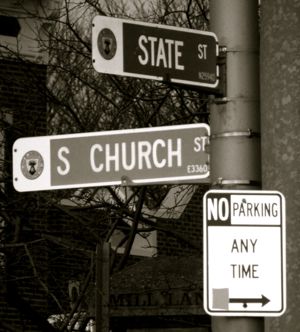
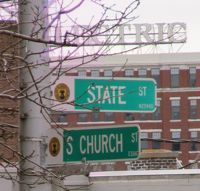
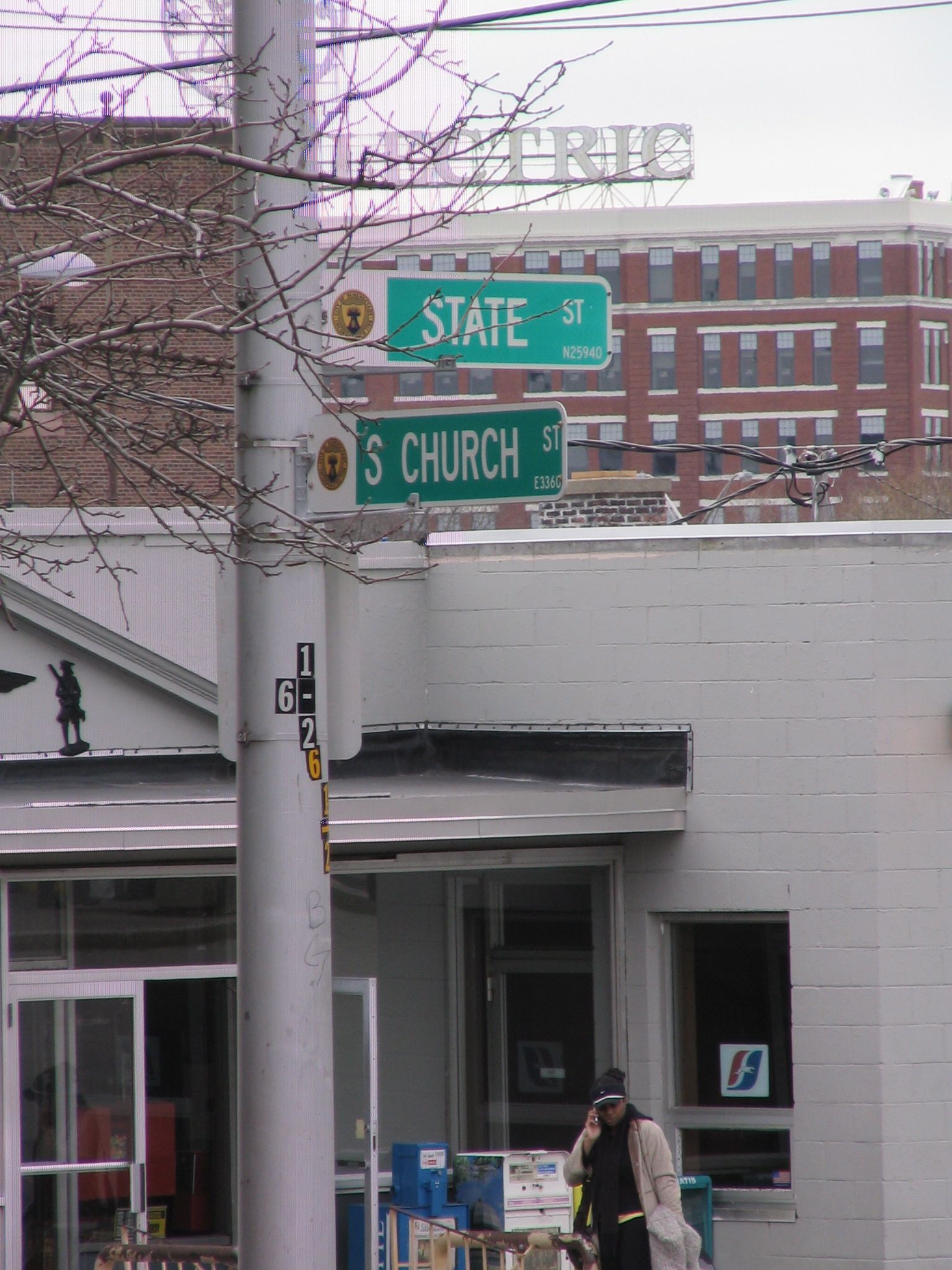
[larger, or in color; SE Corner, Church & State Sts., Schenectady, NY. photo by David Giacalone 2008]

There’s no way that I can (or want to) get into the legal issues raised by having official public, governmental meetings open with a prayer. Despite believing they are inappropriate in a pluralistic society with an Establishment Clause in its Constitution (and a passel of deists among its Founding Fathers), I cannot envision our having a Supreme Court any time soon that would ban them. See the many postings on invocation issues and lawsuits, at Prof. Howard M. Friedman’s Religious Clause weblog; and this recent article by Michigan News on prayer practices before public meetings in Michigan, for proof there is plenty of discussion and disagreement over the opening of public governmental meetings with prayer or other forms of religious invocation.

Out of respect for the belief of others, I’m willing to sit politely through a short prayer at the start of a special public event without complaining (but probably not without rolling my eyes). However, both of the Paterson inaugural invocations went a bit too far in a nation that came along long after the Divine Right of Kings was put to rest, and that was never into the Mandate of Heaven notion. [pause for a related smile] Each invocation seemed especially quaint to me, as I do not believe in a divine being that intervenes in human affairs — much less in one working behind the scenes to bring chosen people into high political office.

(more…)

March 19, 2008

Easter weekend: blogging for religious freedom

Filed under: lawyer news or ethics,q.s. quickies — David Giacalone @ 10:46 am

BAT08Blog Against Theocracy 2008 – is taking place this upcoming Easter weekend, March 21 – 23, 2008 across the blogisphere. Among its organizers are BlueGal and Tengrain of Mock, Paper, Scissors, who designed the logo. (via the greenbelt) They remind us:

The theme [of the blogswarm], like always, is the Separation of Church and State — we are for it. But the variations on the theme are many. . . . This is not a bashing of religion – peeps can believe what they choose, however they choose — but it is a reminder that the Government should keep out of religion, and Religion should keep out of the government.

Over at First Freedom First, you’ll find a Petition asking elected and appointed government officials to make a commitment to the separation of church and state and Freedom of Religion. The f/k/a Gang hopes that many law-related weblogs will participate — especially Constitutional Law heavyweights like Eugene and his posse at The Volokh Conspiracy, the gang at the ACLU Blog, and Howard M. Friedman at Religion Clause, but also the rest of us, who remember just enough about the Constitution to be dangerous, and who know the Religion Clause won’t be preserved by faith alone.

chocolate bunnies —
the hollow ones
eaten last

………………… by dagosan

[SW corner, Schenectady, NY; photo by D. A. Giacalone; original with Bus Station]

Here in Schenectady, we actually have an intersection of Church & State (with a monumental icon of that fickle deity GE looming in the background), and I’m hoping it will inspire me to produce a worthy piece for BAT 2008.  update: See our BAT08 posting, “invoking the Big Kingmaker in the Sky” (March 22, 2008).

The last Religion Clause controversy that I can recall here in Schenectady related to a Muslim Iman giving the prayer invocation at a City Council meeting just before Memorial Day 2005 (scroll down to the “tolerant in Schenectady?” blurb); earlier that year, we also had a crisis related to goat-slaughtering by recent immigrants.

  • Yes, our no-political-punditry promise is still in effect. Nonetheless, and consistent therewith we believe, we want to thank Barak Obama for taking the national discourse about race a fews steps higher yesterday with his speech on race. (click that link for a full transcript and video). See See “Mr. Obama’s Profile in Courage” and “Black, White & Gray” in today’s New York Times (March 19, 2008). Update (March 20, 2008): I usually agree with Schenectady Gazette columnist Carl Strock, but dissented in a lengthy Comment to his posting “Obama transcends nothing” at his Strock Freestyle weblog today.
  • And, thanks to the new governor of New York, David A. Paterson, for doing the right thing by discussing his prior extramarital affairs. At his press conference yesterday, Gov. Paterson said he wanted to avoid being blackmailed: “I didn’t want to be compromised, I didn’t want to be blackmailed, I didn’t want to hesitate taking an action because the person on the other end might hurt me or my family.” “New Governor and Wife Talk of Past Affairs” (New York Times, March 19, 2008). As we said in our posting on Spitzer last week, sexual misbehavior while in office is especially irresponsible, because it gives “people who are unstable, immature (e.g.,. Monica Lewinski), unsavory or unscrupulous (e.g., organized crime members) the ability to blackmail you for money or political favors.”

[larger]

Spring arrives –
peeps melting
on the dashboard

…………………… by dagosan – poem at Simply Haiku (Vol. 3, No. 4, Winter 2005); haiga photo-poem at MagnaPoets Japanese Form; 1953 photo by Mama G.

  • Thanks to Scott Greenfield at Simple Justice for spreading the word and urging participation in BAT08. (And, yes, it was fun seeing one of my photos gracing another weblog. I recently came into possession of a digital camera and have been playing with it around my neighborhood, and posting a few images here at f/k/a — for example here and here. The intersection of Church & State Streets is about 3 blocks from my home.)

February 27, 2008

An Almost Life — p/i lawyer Kevin Mednick’s fine first novel

Filed under: Book Reviews,lawyer news or ethics,Schenectady Synecdoche — David Giacalone @ 6:59 pm

An Almost Life” by Kevin Mednick (The Permanent Press, December 2007; 240 pp; ISBN-13: 978-1579621575; interview with the author; cover image)

Mini-Review: This first novel by lawyer Mednick is fully satisfying and genuinely successful. Its protagonist is a frank, witty, self-deprecating personal injury attorney in a small upstate New York city, who is going through midlife and mid-career crises. If you enjoy novels about (realistic) lawyers and lawyering, or you’re looking to be entertained by characters you care about, while learning a bit about the human predicament and the workings of an important (and often misunderstood) social institution, you should read An Almost Life. Despite having the “rather-be-napping” winter blahs all last week, I finished this book (which has no murderous socio-paths or life-and-death escapes driving the narrative) in two days, reading well past midnight, and wishing it were longer. (scroll down for the full review)

new novel
the sun sets
without me

… by dagosan/ david giacalone, The Heron’s Nest (March 2005)

Kevin Mednick is a plaintiff’s personal injury lawyer in the small Schenectady-NY-based firm of Bendall & Mednick, which has three attorneys and a branch office in Atlanta. His publisher says Kevin’s “legal career includes stints as an Assistant District Attorney, house counsel for an insurance company, associate counsel for a large personal injury defense firm, and law clerk for a County Court Judge.”

Mednick has been with B&M for 15 years. They call themselves “Real Lawyers for Real People” in low-key tv ads and at their informative and purposefully unflashy website. Among lawyers in the New York Capital Region, Bendall & Mednick is known for doing high-quality work in complicated p/i and medical malpractice cases. When I’m asked for the name of a p/i firm by friends or acquaintances, I always suggest B&M. Nonetheless, although Kevin is only a few years younger than myself, and I pass the lovely old house that serves as his office on my way to the supermarket each week, I’ve never met him, nor spoken on the phone with Kevin, and the only internet/email correspondence we’ve had consisted of my request for a copy of his book to review here at f/k/a, and his short reply saying he had no copies but would have one sent. (I did meet the firm’s founder, James W. Bendall, once around 1990.)

In fact, I only heard about Kevin’s novel during a chance meeting with a local judge I admire, in a line at the Post Office mailing Valentine parcels, about two weeks ago. When I did a Google Blog Search later that day and found no review of the book, and no mention of it on any blawg, I decided I owed it to our town and profession to check out this novel.
What I’m trying to say, of course, is that — despite our geographic proximity and this rave review — I did not pick up this book out of devotion or friendship for Kevin or his law firm, and I doubt that he even knew my name when I contacted his firm about An Almost Life (unless I’m infamous among his p/i colleagues for my stance on standard contingency fees, or lionized for my defense of lawyer advertising and battles against the Bar’s Dignity Police).

I first heard Kevin Mednick’s voice when he was doing his weekly Real Law segment, on Thursday, February 14, 2008, on the very popular Don Weeks morning radio show on 810 WGY-AM at 7:50 AM. That segment focused on baseball steroids and Slip and Fall accidents (hear it here), and I paid particular attention because I recently experienced a slip-n-fall of my own on a neighbor’s icy sidewalk. Kevin made good sense on that topic (as does the brief description of the issues involved in S-n-F cases on the B&M website). This morning, I heard Kevin again in this interview about his practice and his novel, at B&M’s under-used weblog (which is hosted by the firm’s youngest member, Atlanta lawyer and comedy-club owner, Jamie Bendall). Frankly, though, neither exposure to Kevin — the sensible, competent p/i lawyer — made me want to brave a Schenectady winter, with its mid-February crop of potholes and slippery roads, to head down Union St. to make his acquaintance and shake his hand. However, reading An Almost Life definitely did. The author who gave the character Mike Samuels his voice is clearly worth meeting.

An Almost Life” makes it easy to answer my two basic questions when reviewing a book: 1) Was my time spent reading the book a good investment? and 2) Who (if anyone) is likely to benefit from (or enjoy) reading it?

Time Well Spent? As simple “pleasure reading,” AAL was a constant treat. The main character, Mike Samuels (who surely has a lot of Kevin Mednick in him, even if they might have had different reactions when that exotic dancer wanted to show Samuels her breast-surgery scars in his office) is recognizable, insightful, likable and entertaining. Whether he’s trying to figure out just when most of himself “stopped bothering” and started to leave for places unknown, or how his secretary can always be in such a good mood and so often save him from himself, or how to feel about the ex-wife who left him for a Bigger-Better-Deal, Samuels charms, entertains, and endears himself to the reader. Ditto when he describes his relationships with a teenage son and daughter, or with an anti-anxiety medication that somehow causes both drowsiness and insomnia, while really taking “the edge off.”

As a novel about lawyers and lawyering, An Almost Life was even more rewarding for me. As Publishers Weekly reports, when Samuels “accepts the case of Evelyn Walker, who is suing her former employer over a debilitating job-related injury, Mike is forced to shake off his ennui and get focused to defend his client.” What we are allowed to see is not the tacky tort lawyer who assaults us in tv and radio ads, nor — thankfully — the self-aggrandizing martyr-champion of the downtrodden, the whiny victim of the nasty tort-reformers, the happy-face (or chest-beating) warrior who appears so often online, or the death-defying, miracle-working hero of blockbuster books and movies. Instead, a good lawyer and good man gives us a peek at his fears and insecurities, while pointing out the foibles of others, and painlessly explaining the psychology and strategy that goes into making a personal injury negligence case and bringing it to trial.

The review in The Independent got it right:

“Despite Medrick s narrative skill in keeping readers curious about the outcome of Evelyn s case, which will be tried in a small town in upstate NY, the book s most compelling and incisively funny – sections have to do with Mike s commentary and asides on lawyers, judges, justice and contemporary culture, including the inanity of golf, the psychology of the working-class in rural America, the pathetic comedy of small-claims night court, and the fear of jurors who want to run home and barricade their doors and remove themselves from a world that’s too complicated, too confusing and too dangerous.

Four authors are quoted on the dust-jacket of An Almost Life, and have spot-on remarks. Andrew Neiderman, who wrote The Devil’s Advocate, says “Kevin Mednick’s depiction of an attorney’s stream of conscious and his capture of a distinct narrative voice enables the reader truly to appreciate the American justice system. An Almost Life is a witty, entertaining novel and a great effort by a budding new talent.” Three lawyer-novelists add their thoughts, with which I concur:

  • Bruce Ducker, author of Bloodlines, deposes and says, “Kevin Mednick’s novel is that rare combination — a great read told in spot-on prose. The staccato dialogue, the sure sense of place, and the parade of quirky characters give the reader a telling insight into the life of a small-town courthourse lawyer.”
  • John Keegan, author of A Good Divorce, opines: “Mike Samuels breaks all the old lawyer cliches — he’s self-conscious, he’s tentative, and he’s almost human. It’s as if he’s just kicking a dented beer can down the street. Mednick has a gift for self-deprecating, intelligent humor. His book is a deft exploration of the schism between who we are and what we do for a living. An Almost Life sneaks up on you and won’t let you go.” And,
  • Peter Friedman, author of Ideal Marriage, swears to tell the whole truth: “I felt myself in the hands of not only a fine story teller, but also a lawyer with a wonderful grasp of the battles that rage over every case. I don’t recall ever reading such an engaging illumination of how a trial lawyer actually makes — or doesn’t make his money. I finished An Almost Life almost regretfully, as it reads so well.”

Speaking of the dust-jacket, it is the only thing about An Almost Life that I would change. Mike Samuels might have felt as if he were invisible, but no book should be stuck with a cover image that makes the novel nearly invisible in a store display. The cover photo was taken by Kevin’s senior partner, Jim Bendall, but the kindness of that gesture does not make up for its ho-hum effect. Let’s hope the second printing, or paperback edition, has more pizazz.

A Novel for Just About Everybody. So, who do I think would benefit from An Almost Life? Just about every adult with a sense or humor and justice, and five or six hours to devote to the pleasures of a fine first novel. Read it for the sheer entertainment; for its insights into middle-aging, or finding yourself, your mate, or your place in the world; or (whether you’re a non-lawyer or an attorney looking in from another part of the profession) to get a realistic impression of the job and the role of a personal injury lawyer who is in it for more than the money and glory. I’m glad I got to meet Mike Samuels and — since he works right down the road — hope to meet his creator, before Kevin Mednick flees to that lovely land where successful lawyer-novelists dwell.

snack room —
the litigator takes
one-third of the donuts

…………………………………….. dagosan
– looking for more lawyer-related haiku? well, click that link —

p.s. I must admit that the local setting (even if masked with fictitious characters and place names) made parts of Mike Samuels’ musing even more amusing and enjoyable for me. For example, like myself, lawyer Samuels is bemused over the “party hacks” (and sports heroes) who too often get to be judges around here, despite having virtually no experience in trying or negotiating a case. [We have elected judges, but I soon found out after arriving in Schenectady that county party chairmen at times select themselves for important judgeships, and the parties often cross-endorse each other’s chosen candidates.] Don’t fear, though, the book won’t leave you disenchanted with all judges, and your living outside of upstate New York won’t reduce the experience of reading An Almost Life.

– Below the fold, you’ll find a few great quotes from An Almost Life. –

(more…)

February 8, 2008

rats! unmasking an anonymouse blawg maven

Filed under: Haiku or Senryu,lawyer news or ethics,q.s. quickies — David Giacalone @ 8:39 pm

Happy Lunar New Year! It is, of course, the Year of the Rat. While Westerners tend to have a rather negative image of the poor, misunderstood rodent, in Chinese culture the Rat is the symbol of hope, cleverness and illumination. And, according to the Las Vegas Sun, Chinese New Year brings the “second-biggest gaming weekend of the year.”

hidden in shadows
a laughing mouse…
New Year’s inventory

the kettle’s lid
rattle, rattle…
New Year’s herbs

bedtime sake–
whether the new year comes
or not

………………………. by Kobayashi Issa, translated by David G. Lanoue

As Paul Noll reminds us, “People born in the Zodiac Year of the Rat [2008 and 12-year intervals] are noted for their charm and attraction for the opposite sex. They work hard to achieve their goals, acquire possessions, and are likely to be perfectionists. They are basically thrifty with money. Rat people are easily angered and love to gossip. Their ambitions are big, and they are usually very successful.” If you’re born in a Year of the Rat:

You are imaginative.
You are generous.
You can be quick tempered.
You will be happy as a writer, critic or publicist.

. [“Rat Pack”/LV Sun] Except for the “quick tempered” facet, this description of “Ratters,” reminded me quite a bit of the person I was having a long lunch with yesterday, while ringing in the Lunar New Year in downtown Schenectady, NY, a couple blocks from the landmark GE Sign. However, although he did order a cheese omelette, I can not confirm whether my pleasant luncheon companion is, indeed, a zodiac Rat. You see, he’s the infamously anonymous “Ed,” editor of Blawg Review. And, although he made a special stop in Schenectady — coming by Amtrak from LegalTech NY 2008 in Manhattan and heading to Buffalo to meet with clients — the mysterious Ed would not reveal his true identity.

sprinkled in
with the new year’s rain…
flitting snow

………………………. by Kobayashi Issa, translated by David G. Lanoue

Naturally, I was truly honored that the man who gave f/k/a the Blawg ReviewCreative Law Blog Award” in 2005, placed us on his ten-best blawg list last year, and has been our best long-distant proofreader and cheerleader for three years, made a stop in our humble little city, just to meet me. But, let’s be frank (in addition to the initial letdown when I realized Ed was not in fact Anne Reed of Deliberations weblog): I’m both disappointed and irked that Mr. Editor didn’t take me into his confidence and reveal his true identity. As I told Ed, “You’re the first pseudonymous lunch companion I’ve ever had.” And, let’s hope, the last.

PhantomMask Although I understand how this Anonymity Thing started, and can sympathize with the almost-captive nature of the Anonymous Editor Mystique, I believe I owe it to readers and bloggers across the blawgiverse to help unmask the man behind the unseemly secrecy shtick. In addition to this Law.com headline: “EDD uncertainty looms over LegalTech,” the frustration of weblogging lawyers who encountered Ed at LegalTech NY this week can be seen in posts by Robert Ambrogi at Lawsites (“Sighted: Anonymous Blawg Review Editor,” Feb. 7, 2008) ; Eric Turkewitz at New York Personal Injury Law Blog; (“Anonymous Blawg Review Editor Spotted at ALM’s LegalTech Trade Show,” Feb. 6, 2008); and John Bringardner at LegalBlog Watch (“LTNY 2008: Anonymous Blawger Sighting“, Feb. 7, 2008).

for drinking buddies
the usual New Year’s pilgrimage…
sake shop

the cat steals
a New Year’s nap…
sitting room

……………………………….. by Kobayashi Issa, translated by David G. Lanoue

Eric (here) and Bob (there, see the figure in black, in profile, on the far left) each tried to photograph “Ed,” but were foiled, with disappointing results. Therefore, although I was too cowed and polite yesterday to whip out my Canon PowerShot and steal Ed’s soul, I decided this morning that I had to help identify this self-proclaimed Mummer Blawgger. Despite doing a little bit too much Year of the Rat revelry last night, I sat down with a retired police sketch artist and worked for hours to reproduce the likeness of the man who sat across from me for so many hours yesterday. To the best of our ability, we came up with what I believe is a striking likeness:

Ed Post,”Blawg Review ‘s Anonymous Editor

Because the complete drawing depicts a dramatization of a felonious action that is a bit spotty in my memory, and may not have occurred exactly as shown, I’m only including a mug shot of “Ed Post” in this posting. Our hope, of course, is that someone out there will be able to make — perhaps aided by the profile and chin shots taken by Bob and Eric, and some high-tech facial recognition software — a definitive identification of the man known in the blawgisphere as Ed of Blawg Review (f/k/a Ed Post).  Please let us know, if you can help in our effort. Anonymous comments shall, however, be ignored.

into the snake’s hole
oh foolish
mouse

………………. by Kobayashi Issa, translated by David G. Lanoue

mistaken for a mime –
the vampire bites
and blogs about it

……………………. by dagosan

loft cleaning —
the mouse nest in a gift
from amsterdam

………. by matt morden – Morden Haiku

December 17, 2007

now that’s depressing

Filed under: Haiku or Senryu,lawyer news or ethics,q.s. quickies — David Giacalone @ 1:06 pm

The Wall Street Journal and the blawgiverse have once again discovered the issue of Lawyer Depression. It started with Sue Shellenbarger’s Work & Family column for WSJ, on Dec. 13, 2007, titled “Even Lawyers Get the Blues: Opening Up About Depression.” She says that “More attorneys . . . are breaking taboos against talking about mental-health problems,” and bar associations, firms and law schools are learning lessons about “allaying isolation, easing overload and making career choices with care.”

Peter Lattman responded to Sue’s column in his WSJ Law Blog, by asking (again) “Why are so many lawyers so depressed?” (Dec. 13, 2007). He notes “some studies show nearly 20% of lawyers battle depression . . . because of the adversarial nature of the work and the non-stop deadlines. Others, including the ABA, criticize the billable-hours system as ‘corrosive’.” As is her wont, Carolyn Elefant summarizes coverage, and added an interesting twist question, in the post “Is Blogging an Antidote to Lawyer Depression?.” See also “Lawyer Depression Comes Out of the Closet” (ABA Journal News, Dec 13, 2007); and Jim Calloway’s discussion at his Law Practice Tips weblog.

This is an important topic that deserves continuing coverage (and action). Our post in March 2006, “do lawyers choose to be unhappy?,” is sharply opinionated about possible causes of lawyer depression (and the tough choices that individuals must make about their values and sustaining them); it has useful links. Four years ago, we wrote about Professor Patrick Schiltz’s “Sermon” on lawyer happiness and mental health, and still believe it should be required reading for anyone who cares about lawyers. Read and consider: “On Being a Happy, Healthy, and Ethical Member of an Unhappy, Unhealthy, and Unethical Profession,” 52 Vand. L. Rev. 871 (81 pp pdf.; condensed version here). Here are some quick thoughts about the current wave of online discussion:

  • A small but important point: It’s great that more lawyers are willing to discuss their depression, get counseling, and find group support. One thing the profession should do for them, however, is to help make sure that seeking professional help doesn’t end up disqualifying the lawyer when he or she seeks disability insurance. See our post “Lawyer Therapy Can Affect Disability Insurance ” (March 8, 2004), which notes that many insurers deny coverage to a lawyer who has (even in the distant past) been on antidepressants and seen a therapist — because depression is at the top of the list of reasons why lawyers seek disability.
  • More important: It seems that too many of the proffered “causes” for lawyer depression seek to blame the system, with the individual lawyer as the victim, rather than focusing on the responsibility of each lawyer to understand his or her own values and take the steps necessary to find, shape, create a career position that jibes with those values. For example, you can’t complain about a crushing billable-hours quota — which is meant to generate a certain amount of fees from your work — if you are not willing to work for less income (elsewhere, if necessary). Far too many lawyers entered into the profession because they wanted wealth and status. The fact that so many realize how hollow those goals are, and how seldom they lead to personal satisfaction, is a good thing. I’ve come to believe that depression [Mr. D] is our psyche telling us “you’re not living right. Know your priorities and act on them.”
  • It’s a nice coincidence that this depression story arose again the same week that Legal Times ran the article “The Man That Got Away: Judges dreamed of having Barack Obama as their clerk. Why did he turn them all down?” (by Tony Mauro, December 10, 2007). It says a lot about the strength of Obama’s values that he knew what he wanted to accomplish with his law degree and walked away from prestigious clerkships, when he graduated from Harvard Law School, to go home to work on civil rights and poverty issues. It says even more about the legal profession that we are so shocked that any graduate would “give up” that prestige and the train to glory, power and riches that it promises.
  • Too many young people go into law without doing the hard self-assessment and reality-testing (about what lawyers actually do) that such an important decision deserves and requires. (For example, law school was for me a “default position” when I didn’t know what I wanted from life and wanted to keep my options open.) It is very good, therefore, that schools are putting more emphasis on “career decisions.” But, as our Prof. Yabut explains and proclaims in “1L of a decision” and the road to “L” is paved with inattention (Sept. 4, 2005), the work needs to be done before entering law school, and then throughout the academic years — and continued as you and your career evolve or devolve.

ooh Cognitive dissonance — “a psychological term describing the uncomfortable tension that may result from having two conflicting thoughts at the same time, or from engaging in behavior that conflicts with one’s beliefs” — can often be the cause of depression (see, e.g., “Cognitive Dissonance, Halo Effects, and the Self-Esteem Trap” by Daniel S. Levine, discussing the problem of ” (a) high self-esteem combined with (b) frustration about inability to get what one wants from others.”) Because so many lawyers, by nature and training, live in their heads and readily see and understand contradictions and inconsistencies, I believe that Cognitive Dissonance is at the root of much lawyer depression. That’s because we as a profession constantly profess to principles — e.g., putting the client’s interests first, seeking justice, demanding the highest ethical standards — that are demonstrably violated or ignored in daily practice. For example:

  1. Jim Calloway said this week that “We search for the truth in adversarial courtroom settings.” But, many lawyers instead see their role in the adversarial process (as required by our ethical duties) as tailoring the presentation of the “truth” so that their client is most likely to win, and not so that some objective truth or justice is accomplished. They let the judge figure it out (or hope she doesn’t.)
  2. Despite the PR about highest ethical standards, isn’t it more accurate to say that our codes of professional responsibility in many ways represent the lowest-common-denominator standards, and are then poorly enforced? (see our “sustained objection” to the inadequate discipline system)

WolfDudeN Speaking of the potential for Lawyer Cognitive Disonance, here are a couple examples from current stories in the news:

California Lawyers are Still Fighting Malpractice Insurance Disclosure: Bar groups love to tell you that they are toiling hard to improve the profession for the sake of our clients and the public. [we think they act more like turf-protecting, rent-extracting guilds] For more proof that lawyers in gangs work for for their own financial interest, see “Calif. Bar Panel Amends Proposal on Malpractice Insurance: One member says whole idea should be canned for sake of solos and small-firm lawyers” (The Recorder/Law.com, Dec. 17, 2007); and “Calif. Bar Board Members Butt Heads on Malpractice Insurance Disclosure” (The Recorder, Nov. 13, 2007). See our California coverage and discussion here, ; HALT’s submission on behalf of consumers; and also our general argument on behalf of malpractice disclosure.

. noloShark It’s estimated that one-third of all lawyers carry no malpractice insurance. The unified California Bar proposed last year that — since clients in general believe lawyers have such insurance and consider it important, the profession likes to tout that we do, and (heck) we are supposed to be fiduciaries — California lawyers should let clients know in writing when they do not have malpractice coverage. They quickly ran into a firestorm of opposition — led by the very bar groups that love to call themselves “consumer” and “justice” lawyers — because (gosh) lawyers without malpractice insurance might have lower self-esteem. (see our turn offs post) We’re not psychotherapists here at f/k/a, but we bet that this behavior might indeed cause a bit of Cognitive Dissonance among the more thoughtful and sensitive members of the bar.

Meanwhile, in Florida, the Lawyer Dignity Capital of the Nation, Sean Conway is being disciplined for negative remarks he made about a judge in comments at a weblog. (Howard Bashman first picked up this story, “Lawyer may lose license for blog entry on Broward judge,” Sun-Sentinel, Dec. 13, 2007) At LegalBlogWatch (Dec. 14, 2007), Carolyn Elefant says: “Yes, we all recognize that the lawyer could have criticized the judge in a more tactful manner. But does he deserve a formal reprimand or suspension of his license? Hardly.” And see, “Lawyer’s License at Risk for Blog Post” (Dec. 14, 2007); Lattman at the WSJ Law Blog; and Greenfield at Simple Justice. The Sun-Sentinel reported:

In the Halloween 2006 posting on a blog, Conway denounced Alemán for what he said was an “ugly, condescending attitude” and questioned her mental stability after, he says, she unlawfully forced attorneys to choose between unreasonable trial dates or waiving their clients’ rights to a speedy trial.

“She is clearly unfit for her position and knows not what it means to be a neutral arbiter,” Conway wrote in his commentary.

The Florida Bar signed off on its finding that Sean Conway may have violated five bar rules, including impugning the judge’s qualifications or integrity.

Fred Haddad, Conway’s lawyer, sums it up well:

“There’s absolutely no reason that politicians, and that’s all judges are here in Broward County, aren’t open to criticism.” . . . “We’ve got a [Florida Bar] grievance committee that can’t even conceptualize the First Amendment.

Conway stands by his words, saying: “She was giving people one week to prepare for trial and as soon as the blog exposed it through powerful words she stopped it.” He concluded: “And that’s why I stand by what I did. Sometimes the language the bar approves of doesn’t get the job done.”

In September, we agreed with the federal district judge Arthur Tarnow, who threw out similar charges against against the far less likable Jeffrey Feiger, in Michigan. Vague disciplinary rules that go after lawyer speech outside the courtroom or pleadings, because they are deemed to be “undignified or discourteous conduct” toward judges, are simply too vague and overly broad to be allowed under the First Amendment. If, however naively, we believed that the lawyer disciplinary process is there to help protect clients and improve the justice system, we might surely find ourselves awash in yet more cognitive dissonance.

lipstick on his
coffee mug —
steam rising

[orig. haiga here]

..

.

Need a nonprescription antidote to depression, or holiday season blues? Jim Calloway’s tip last week –“be alert for your own mood changes and to take care of yourself this holiday season” — points the way for us: check and (and maybe even print out) our new brochure Holiday Haiku from Schenectady, which has two dozen haiku and senryu by Yu Chang, David Giacalone & Hilary Tann, from Schenectady, NY, USA . We’re going to do just that from our desk along the Mohawk River, in the Schenectady Stockade District (and maybe even get those @%&*!! Christmas cards finally written, before this time-consuming weblog creates even more dissonance in my life.)


red envelopes
the sound
of children’s laughter

three generations
peering down a gopher hole
winter solstice

Christmas snow
my father’s footsteps
bigger than mine

  ……………………… by Yu Chang  

Holiday Haiku from Schenectady. . . click to print the free brochure 


« Newer PostsOlder Posts »

Powered by WordPress