You are viewing a read-only archive of the Blogs.Harvard network. Learn more.


Digital Media and Learning HASTAC Competition

McArthur’s Digital Media and Learning HASTAC Competition has announced their 2008 Innovation in Participatory Learning Awards and Young Innovator Awards. The awards support individuals and institutions at the forefront of participatory learning:

Participatory Learning includes the ways in which new technologies enable learners (of any age) to contribute in diverse ways to individual and shared learning goals. Through games, wikis, blogs, virtual environments, social network sites, cell phones, mobile devices, and other digital platforms, learners can participate in virtual communities where they share ideas, comment upon one another’s projects, and plan, design, advance, implement, or simply discuss their goals and ideas together. Participatory learners come together to aggregate their ideas and experiences in a way that makes the whole ultimately greater than the sum of the parts.

This is a great award that supports students and teachers of all ages

to think boldly about “what comes next” in participatory learning and to contribute to making it happen.

For past winners, check out the 2007 Winners Hub, featuring projects like Critical Commons, a fair use guide for educators, and Black Cloud, a participatory pollution monitor.

Also check out social media guru Howard Rheingold, one of the winners, who has been running a HASTAC forum on participatory learning on Seesmic. In the Social Media Classroom Co-labrotory, Howard Rheingold explores the idea of participatory learning with the new HASTAC Scholars explores the affordances of SEESMIC (think YouTube video with responses running along the bottom as the video plays to highlight the conversation) as a learning tool.

For more on the HASTAC awards, check out their website and request for proposal.

Digital Natives around the world: introduction

Hello, my name is André Valle and I will be blogging here in the Digital Natives Blog on fridays. I am a Educational Technologist and undergraduate student at the University of São Paulo, Brazil, interested in researching how different cultures interact with different types of technology, speciffically within the educational environment.

I am now based in Brazil, where I have been living for the past 25 years, and I intend to present to you a different perspective of the Digital Natives concept. In Born Digital, John Palfrey and John Palfrey investigate the Digital Natives’ interpretations of what it is to be connected, they map when this new generation of Digital Natives starts to be born and discuss how they conceptualize the technologies that sourround them, ubiquitously.

Some questions that will drive my blog posts are:

– What is a digital native in places where technology has been developed in a different way, such as developing countries, for instance?
– How to situate the digital natives who have less or no access to technology due to their social or economical conditions?
– How is technology developed according to specific conditions and necessities of a certain area?

To exemplify this concern of mine, I want to tell a story that describes the moment when I realized that we can interact differently with different types of technology.

Sometimes we are so used to the environment that sourround us and the tools that are available for us to do our day-to-day activities, that it is hard to train our observation in order to identify these different layers of interaction.

I was once asked by my grandmother to help her with the task of sending an e-mail. Back then, I was going to leave in Montreal for one year, and she wanted to have the chance to communicate with me by herself. I instantly asked her to have seat and start turning the computer on, which she did exactly as she was taught by her computer teacher. When the computer was ready to work, I asked her to select the Internet Browser and it was only then that I realised that my question assumed a whole lot of premisses that I had never thought of. When my grandmother was trying to select the Internet Browser that I pointed on the screen, I realised that the mouse arrow was actually shaking in a weird and unnusual way. It was only then that I realised that my grandmother did not know how to hold the mouse properly, what demanded an extraordinary effort by her in order to move the arrow.

My point here is the following: obviously, my grandmother does not fit in any of the Digital Natives definitions, but she made me realize that she had to adapt her usual activities to fit them in the computer era, nowadays she knows how to send an email, but she still thinks in a linear way, following always the same path to reach a goal (she cannot understand that we can turn a program off by pressing ALT+F4 or selecting the X on the top-right side of the openned window, she always needs to select File and, then, Close).

While my grandmother had to adapt her way to write, communicate, etc into a computer, I myself remember of the first time I had a computer at home and how my uncle taught me to send e-mails.

My question is: what happens with my cousin, who is now nine years old and, as a baby, had among his toys an old keyboard to play with? How will he interact with the technology that sorrounds him more and more?

In the following discussions, I intend to bring stories that I can find here in Brazil to identify issues related to Digital Natives and their interaction with new technologies. Also, I intend to bring up some stories concerning the Digital Divide, which gets broader as high technologies get concentrated only in hands of some users, while others don’t have any access or don’t want to have it.

– André Valle

Koobface: Hacking the Credibility of Friends

In the past two weeks, I’ve received a number of Facebook messages with unprintable subjects and what resembled YouTube links. It turns out I’m a little late on this, but these messages are really the Koobface worm that has been making the rounds on Facebook and MySpace since early August. Suspecting spam, I had deleted the messages right away. But then I took a step back and thought, “Why don’t I see more viruses on Facebook?” This was the first time I had encountered a worm on Facebook, and I can’t find any reports of it happening on the site before.

Don’t get me wrong, I’m perfectly happy with that situation; I’m just surprised more people haven’t taken advantage of it. What the Koobface is worm purposely exploits is the social credibility that drives online networking. We lend more credibility to our friends than a complete stranger, and that difference may be enough to make us click the link. To use Facebook as a particular example, the value of the site lies in how easily it allows users to share and receive information with people whom they care about. Every Page I “fan,” every band I put in my profile, every group I join is essentially an endorsement capitalizing on my credibility within my social network. The Social Ads campaign attempted to monetize this principle, and perhaps the backlash to that campaign, all top of privacy issues, was also colored by the unease of one’s credibility being used for the monetary gain of a third party.

This credibility of friends concept has been thoroughly exploited through email attachment viruses, such as the Love Bug. From a security standpoint, Facebook is in a much better position than individual email hosting services to eliminate any worms in its system. (Perhaps early action is the reason this isn’t more common?) It is in Facebook’s interest to protect the credibility of its users and thus the integrity of its site, so their response has been immediate and serious. A Facebook Security page is dedicated to dealing with these issues.

The whole subject of computer viruses reminded of the excellent Mattathias Schwartz article on trolling in NYT Magazine. It has already been covered from a different angle, but I wanted to pull out a quote that especially struck me. Despite these attacks that aim to undermine the very credibility of friends, the view out is not necessarily pessimistic:

So far, despite all this discord, the Internet’s system of civil machines has proved more resilient than anyone imagined. As early as 1994, the head of the Internet Society warned that spam “will destroy the network.” The news media continually present the online world as a Wild West infested with villainous hackers, spammers and pedophiles. And yet the Internet is doing very well for a frontier town on the brink of anarchy. Its traffic is expected to quadruple by 2012. To say that trolls pose a threat to the Internet at this point is like saying that crows pose a threat to farming.

In drafting up this post, I tried looking for research on how youth determine with credibility of friends and applied that to the digital world. What I found was a good deal more information on youth and the credibility of media, including the excellent “Digital Media, Youth, and Credibility” volume of The MacArthur Foundation’s series on Digital Media and Learning that John Palfrey blogged about just last week. (I had also spent the summer interning at MacArthur – it’s good to be back blogging with Digital Natives.) The issues of friends and credibility are complex and extend well into the offline world, but I’m curious to explore this a little further. If anyone has any resources, insights, opinions to share, leave them and a follow-up post may be in order!

– Sarah Zhang

Born Digital: How To Deal With Online Aggression?

(cross posted from Urs Gasser’s blog)

Almost synchronously with the release of Born Digital in the U.S., the Swiss conservative party CVP has made headlines with a position paper that outlines actions to proactively deal with the problems associated with online aggression in Switzerland. The strategy proposed by the conservative party focuses on youth and addresses Internet violence (including cyberbullying) in general and violent games in particular. Among the measures suggested in the position paper are:

* Introduction of a nation-wide, harmonized rating and classification system for movies, games and MMS services, analogous to the Dutch NICAM2 model;
* Amendment of the Swiss Penal Code, sec. 135, in order to ban the sale and making available of games with violent or (other) adult content to children and teenagers;
* Incorporation of a federal Media Competence Center for electronic media that would administer the classification system, run information and prevention campaigns to educate parents, teachers, etc., and study online addiction, among other things;
* Commission and release of a study on cyberbullying by the Swiss Federal Council;
* Formalized collaboration among the Swiss cantons in order to protect youth from violent content;
* Mandatory inclusion of media literacy classes into the curriculum at public schools (including sessions on the effects of extensive use of media);
* Information campaign to educate parents and teachers;
* Conversations between teachers and parents in cases of under-performance of school children due to excessive media usage.

We’ve discussed several of these strategies in Born Digital, chapter 9. The summary paragraph of our analysis reads as follows:

The best regulators of violence in our society, whether online or not, are parents and teachers, because they are the people closest to Digital Natives themselves. Parents and teachers have the most time with kids—and, ideally, their trust. As in other contexts, parents and teachers need to start by understanding what their Digital Natives are up to. From there, it’s important to set limits, especially for young children, on gaming and exposure to violent activities. Parents and educators can and should work overtime to channel the interest of Digital Natives in interactive media into positive directions. But companies need to step up, too, and to exercise restraint in terms of what they offer kids. And despite the hard free-speech questions implicated by these kinds of interventions, the government needs to be involved, too. As we’ve emphasized throughout the book, the answer isn’t to shut down the technologies or reactively to blame video games for every tragedy, but rather to teach our kids how to navigate the complex, fluid environments in which they are growing up. That’s easier said than done, but we don’t have much choice but to take this problem head on. The stakes could not be higher.

With regard to the role of governments – also in the current debate about the Swiss party’s position paper the most controversial issue –, we write:

Governments can play a role through educational efforts, whether via schools or at the level of general public awareness. Governments can also help to foster collaborative efforts by public and private parties to work to reduce unwanted exposure by young kids to extreme violence. The Safer Internet Plus program, sponsored by the European Commission, is one such initiative that combines a series of helpful educational and leadership functions by governments. If all else fails, governments should restrict the production and dissemination of certain types of violent content in combination with instituting mandatory, government-based ratings of these materials. The production and distribution of extreme types of violent content—including, for instance, so-called snuff movies, in which people are filmed being killed—can and should be banned by law. Similar restrictions on access to such materials, based on age ratings, are in place in Germany, the United Kingdom, Canada, and Australia, among other places. These types of controls must be very narrowly tailored to pass constitutional muster in the United States, appropriately enough, given the force and breadth of First Amendment protections. We already have most of the legal tools needed to mitigate the effects of this problem, but rarely are these tools use effectively across the relevant platforms that mediate kids’ exposure.

Interestingly, the position paper presented by the Swiss CVP (disclosure: of which I am not a member) is getting pretty close to what we have envisioned in Born Digital. Obviously though, devil is in detail, and the proposal by the CVP has to be analyzed in much greater detail over the weeks and months to come. In any event, CVP certainly deserves credit for starting a public conversation about violence in the digital society and for making a strong case that we all share responsibility.

First Few Reactions to Born Digital

(cross posted from John Palfrey’s blog)

After about four years of planning, research, and writing, Born Digital officially came out this week. Urs Gasser and I have so many people to thank; we have been blessed with such great teammates and friends and helpful critics along the way. (Much of the work that the team has done is recorded, and will be updated, on the project’s web site, wiki, and so forth.)

I admit to being very sheepish about what comes next. Several people have sent kind emails that say, basically, “congrats on the book coming out and good luck with the promotion.” Thinking about “promoting” ourselves and our book (wrapped up, now, in our identity, as “authors”) makes me very queasy. I much prefer the idea of our participating in an ongoing public conversation about youth and media, a conversation that is well underway with lots of brilliant people involved. To that end, I’ve been thrilled to see the first three web 2.0-type reactions to the book.

– The Shifted Librarian comments — by photo! — on buying Born Digital for her Kindle. This is so fitting, and cool. (As I commented on her post, I got teased at a book talk at Google the other day that the Kindle edition was initially priced at over $20.00, which was more than the hard-cover cost of $17.00 and change; it’s since come down some.)

– I am grateful to the Librarians! Law Librarian blog has a post, which (justifiably enough, and in a mere few words; very economical) juxtaposes the marketing description of the book against what we actually say inside its covers; and,

– A brand-new friend — who contacted my via Facebook about his blogpost — JohnMac is wondering about where he fits into the scheme. I suggested that he is probably a Digital Settler, which is a fine thing to be, (and thought I’d point out this post, in which I responded to critiques from Henry Jenkins and danah boyd and others about the terminology we work with in the book). I have a feeling we’ll be doing a lot of explaining, and perhaps defending, these choices of terms — but that, it seems, is in fact part of the point!

Thanks to all who have contributed to this discussion already, and looking forward to much more — some of it playing out in the public parts of cyberspace.

Born Digital Released!

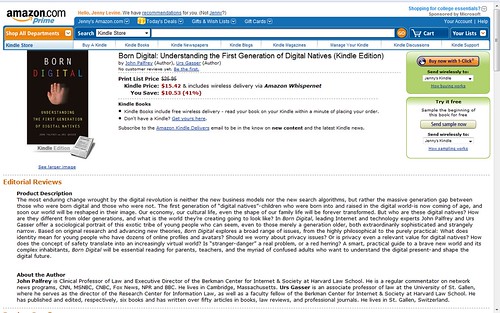
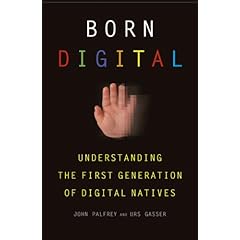
Born Digital, written by our principal investigators John Palfrey and Urs Gasser, is officially released! For over a year now, we’ve been interrogating arguments, exploring hypotheses with kids, and thinking about what new digital practices mean in the context of law, education, and business. It is so exciting to see this first major publication of the project go live. Huge congratulations to John and Urs!

In keeping with ethos of the book, Born Digital is available in digitally in Kindle format, to the Shifted Librarian‘s enjoyment.

from The Shifted Librarian's flickr photostream
(from The Shifted Librarian’s flickr photostream)

And of course, available in analogue form as well.

I’m not going to give too much away, but I will share what I take away as one of the major messages of the book: Parents, teachers, policymakers and digital natives need to work together to both take advantage of the potentials of the digital world and address the issues that are raised. How do we do this? First step is to engage in dialogue between those that are at home with digital technologies, and those that are not. Just as parents and teacher who may not be fluent in the online space have much to teach youth, kids who are immersed in digital technologies have much to teach their older counterparts that are less knowledgeable about the digital space. Learn from each other.

In this ethos, the photo below, courtesy of WeAreWhatWeDo
reflects for me an important message of the book. WeAreWhatWeDo aims to inspire people to change the world through everyday actions. In looking to shape the future of life online – to take advantage of the opportunities while addressing the risks in digital space – here’s one action that is a first step in helping us get there.

“Talk to old people. They know cool stuff you don’t.”
“Talk to young people. They know cool stuff you don’t.”

– Miriam Simun

Digital Media, Youth, and Credibility

(cross posted from John Palfrey’s blog)

The final book in the MIT Press/MacArthur series on Digital Media and Learning (well, final only in terms of my getting around to writing up a review of it on this blog!) is “Digital Media, Youth, and Credibility,” edited by Miriam J. Metzger and Andrew J. Flanagin. It’s not last because it is the least important or least good, but rather it’s the taken the longest time to think about it and its message.

The topic of credibility (and the related themes of information quality and access) is incredibly important — and also very, very hard to get a grip on. It turns out that my co-author on Born Digital, Urs Gasser, is among the world’s experts on this topic in law, so I was in luck. He did most of the research and drafting on our chapters on Quality and Overload. This work also bumps up against what we at the Berkman Center have been struggling with for some time in the context of old and new media and credibility, with our conference on Blogging, Journalism and Credibility and, more recently, the Media Re:Public project.

In their introduction, the editors start out with a summary of each chapter — abstracts, almost — which together serve as a helpful device for those readers who don’t hav the time or inclination to make it through the entire volume. Not suprisingly, the summaries are worthy and faithful to the articles themselves.

Together, the editors have also written a first chapter on opportunities and challenges in the context of online credibility. Their section on “Defining Credibility” and related context (pp. 7 – 9) is useful and could serve as a reference point for other articles on the topic. Their grounding, more generally, of credibility in the youth digital learning environment got me thinking hard about the power of the search algorithms (Google’s PageRank, of course, chief among them) and the impact that these engineering decisions have on what young people are learning and will be learning. A few people in the private sector may never have had such power over a key aspect of learning in history.

The second essay by Metzger and Flanagin also includes “a call to arms to researchers, educators, policy makers, and others concerned with these issues to understand how youth think about credibility in the digital media environment and to devise a plan to assist youth in finding and evaluating the information they need.” (p. 17) Sounds right, but also sounds like a huge challenge.

The summary finding from the editors that grabbed me the most: “Perhaps the most consistent theme across all these stakeholders is that digital technologies complicate traditional notions of hierarchies and authority structures.” (p. 18) Quite right: hierarchies and authority structures don’t go away, they are just shifted around, with new players in the mix. Hierarchy and authority aren’t gone, and won’t go, they’re just different, in ways we are only beginning to understand. (Hence, in my view, the growing importance of librarians and many forms of teachers.)

The book also includes a second “call to arms,” this time in favor of “teaching credibility assessment.” (p. 155) Frances Jacobson Harris notes, quite rightly, that “meaningful access to digital information resources and systems in schools is about much more than a physical connection to the Internet. Digital natives are not necessarily skilled or critical consumers of digital information. Many are still novices when it comes to searching, selecting, and assessing the meaning and value of the information they find.” (p. 155) This is one of the key themes that we explore in Born Digital, and which has previously been built out effectively by Henry Jenkins, Eszter Hargittai, and others. Overall, this essay is totally wonderful: clear, compelling, and with a great conclusion. (pp. 172-3)

David Lankes, in “Trusting the Internet,” offers a nice piece on what he calls “information self-sufficiency” and its implications. It’s well-grounded in the technology and the tools under development on the net. (See especially pp. 115 – 7) I liked this line: “Just like libraries used to produce pathfinders and annotated bibliographies, users will soon be able to find a piece of information, such as a Web site, and follow that information to all of the other public information used in a given conversation.” (p. 114)

One of the sub-themes in the DML series has been the overlay of health and information in the lives of young people. That theme is picked up here in Gunther Eysenbach’s piece on credibility and information related to health online. He introduces and evaluates an interesting model, called DIDA, on the flow of information online. (pp. 132 – 3) The punchline, as one might imagine, is that many people go first to the Internet and second to their doctor for health information today; and there’s still a rich mix of people who consider online information credible and those who are more likely to be skeptical of it (certainly squaring with our own research on young people and digital media, to be sure). (pp. 125 – 6)

Fred Weingarten of the ALA’s Office for Information Technology Policy concludes the volume with a constructive essay on the (limited) role of government in respect to the credibility of information online, which he summarizes into three easy-to-understand categories. (pp. 181 – 2)

So, we are left with two clear calls to arms, some helpful frameworks, and a huge challenge ahead of us. The answer, as unfulfilling as it sounds, has to be to work on critical thinking skills through the schools, libraries, and traditional modes of parenting and peer-learning. Though technology can help, it won’t solve the problems and it may bring about some new problems of its own; I don’t think there will be any short-cuts. But the pay-off of serious engagement on this topic could be enormous in terms of acess to information and new ways of teaching, learning, and engaging in civic life.

Thanks, so much, to the team that Connie Yowell and the MacArthur Foundation and MIT Press put together to develop this series of six books. What a rich resource the collection is, as bound volumes; free downloads; and directions for future research and leadership.

Trolling for Trouble

This week, a guest post by Daniel LaMagna, National Center for Missing and Exploited Children summer intern.

This past summer I interned at the National Center for Missing and Exploited Children. While researching for an online communication mini-documentary the other interns and I were working on (Dr. Palfrey and Miriam Simun kindly contributed!), I came across Matthias Schwartz’ fascinating New York Times Magazine article “Malwebolence- The World of Web Trolling.” While this phenomenon is not directly related to online child safety, it raises some interesting issues with regard to ethical questions of online behavior.

Anyway, it’s obvious that these particular web dwellers (on image/message boards) are a pretty nasty bunch. They seem to really get their “lulz” (naughty troll “kicks”) out of making other people miserable. As mentioned in the article, they don’t simply tease or taunt or “verbally” abuse their “targets,” but also threaten and harass them (both online and sometimes offline). If they want to be really rotten, they’ll even steal someone’s identity (social security number and all) and post it on an online public space for the world to see. This, of course, is criminal activity, but they’ve found ways to use the anonymity of the internet to avoid getting caught. Some espouse philosophical theories/ideals to justify their actions, but I think they’re just saying this to either:

1. Lie and confuse others just for the sake of it (for the lulz)
2. Rationalize their behavior
3. Sound complicated and “deep” (and way smarter than the rest of us)

Apart from the purely vicious and “see- how- bad- I- can- be” elements, a lot of this meanness seems to be about social acceptance (from the other trolls) and posturing. When you read what they write or say (whether online or offline in Schwartz’ interviews), they all seem to have one common tendency: to imagine (or at least want to imagine) themselves as all-powerful Internet gods. And with all their bragging and threatening and lusting for “lulz,” it’s pretty obvious that they, like most gods, want others to believe in their “awesomeness” as well. And thou best not question them or challenge them, for thou shall incur their wrath. Gulp. Note: See the nytimes.com reader’s comments section on the article, and you’ll find that they say this repeatedly. It’s clear to me that despite their claims to the contrary, they desperately care about how they are perceived.

For example, one of the trolls was clearly trying to impress Schwartz by picking him up in a Rolls Royce. Another troll took a picture of Schwartz’s debit card number and proudly showed him the image of it on his cell phone. I guess it was supposed to make him seem “dangerous.” The segment of the article ends there; Curiously, Mr. Schwartz has no response. Maybe he was afraid that a little moral judgment would lessen the objectivity of his story? Or maybe he was afraid of what the trolls could do if they decided that he’d make a nice “target.”

The lack of any clear ethical or moral opinion from Schwartz has made the article, at least to me, seem to agree with the trolls boasts and add to their credibility and sense of empowerment. The implication was “Wow, this guy really is as scary as he claims to be. Don’t mess with him.” Unfortunately, this has probably achieved exactly what trolls wanted. It has elevated the “legend” of the invincible troll out from under the bridges and caves of cyberspace and into the mainstream consciousness. There is a good chance that, like offline criminals always have (pirates, outlaws, gangsters, etc…), they will be both feared and admired (at least by some). For the first time in their lives, normal people might actually think they’re “cool” (which is what they really want). Interestingly enough, I can’t think of anything more “human” (and less “godlike”) than the desire to be acknowledged and “respected” by others.

Well, that’s my opinion. I’d like to hear your views on Schwartz’ article and on internet trolls in general. And in particular:

1. Are trolls dangerous? What threat do they pose to individuals and the Internet as a whole?

2. Will their influence “normalize” and/or popularize deviancy (In a social, sexual, political, etc… context)? If so, to what extent?

3. What effect could they have on mainstream society?

4. How can (or should) they be stopped? Should they be simply ignored, as some have suggested, or should they (especially those who commit crimes) be actively resisted (“counter-trolling,” increased law enforcement efforts, etc…)?

5. One troll referred to himself as “a normal person who does insane things on the Internet.” Do you think this statement reveals anything about the effects that online communication can have on people?

6. Your other concerns?

Visit the National Center for Missing and Exploited Children or its NetSmartz Workshop department if you are interested in learning more. The film featuring Dr. Palfrey and Ms. Simun will be posted on the NetSmartz website in (probably) a few months, after production is complete.

– Daniel LaMagna

David Kosslyn: Studying Online (Part I)

[kml_flashembed movie="http://www.youtube.com/v/ZvlJ1aA2p9g" width="425" height="350" wmode="transparent" /]

So far we’ve explored many areas of a digital native’s life – from privacy, piracy to digital information overload- but now we bring you the more positive efforts that Digital Natives are making. It seems that everything is accessible online in today’s world- then why not studying?

We sat down with David Kosslyn, a rising sophomore at Harvard, who along with two other friends, is starting up an online academic networking site named StudyBuddy. We talked to him about issues that this may bring about for non-digital natives but also about how studying online can either aid or hinder a digital natives learning process.

The following video, produced by Kanupriya Tewari, is part one where we explore the aims and accomplishments StudyBuddy hopes to acheive.


Come back next week to watch part two of David’s story!

Following your religion…. the Digital Native way

India is renowned for its exotic tourist attractions, sumptuous cuisine and diverse cultural origins. Even though a majority of the population is Hindu, the country has been lead by a Sikh Prime Minister, a Muslim President and an Italian originated woman, Sonia Gandhi. Thus, India has, to a large extent, shown great tolerance for other religions and proved itself to be a truly multi-cultural state. And religion has always been important – you can’t turn a corner without seeing a temple. But this religious fervor is now being taken to the next level, in ways both traditional and novel, including online.

In many contemporary cultures, the older generation lament straying from the old ways and attempt to incite young people to show more faith, become more spiritual and, of course, stay away from ‘Western Influences’. Ironically, it is some of these ‘western influences’- namely social networking sites and blogs, – which are spreading the religious fervor among youth. People have always advocated for greater tolerance between Hindus and Muslims in India, and this is now also reflected online – online blogs like the Indian Muslims Blog describes itself as a window into the Indian Muslim life and regularly feature bloggers who discuss issues like greater tolerance between the two communities. However, sites such as these are balanced with a larger number of sites solely aiming to spread religious fervor among Digital Natives surfing the net. It seems to be working. Recent polls show that more and more young people (under the age of 25) feel themselves to have greater belief in their religion now. So, how are Digital Natives getting in touch with their religion?

Well, they don’t really have to do anything new – one click on YouTube allows you to listen to multitudes of different bhajans (devotional songs), on Facebook you can join religious groups or even become a ‘fan’ of your religious idol and if you want to check up on a old religious fable all you need to do is Google it or check up on blogs with archives of stories – like the Hindu Blog. So, for a Digital Native, following religion online is actually more convenient, and so easier, than doing so offline. To read, discuss, debate or listen about their respective religion online is much more convenient than it is to actually do so by searching through libraries or even go shopping – and this may be the incentive behind the increase in religious fervor in the country. This would then also explain why now it is easier to criticize other peoples’ religion online than offline.

In the midst of efforts for greater religious tolerance, there is a backlash- Digital Natives now in India are finding it easier to criticize each others religious traditions, whereas in virtual settings they have to face less severe consequences. Thus, now each new video posting on YouTube is accompanied with at least a couple of negative comments and each new Facebook group seem to always be having a heated argument on its comments thread. In fact, many times the debate will even turn to criticisms and comparisons of religions; with Muslims questioning the way in which Hindus worship idols etc.

So, are Digital Natives in India are becoming more religious, or simply more vocal about their religious contemplations?

Good? …. Bad? …Well that’s yet to be seen.

-Kanupriya Tewari