You are viewing a read-only archive of the Blogs.Harvard network. Learn more.


Where the Wild Things Are: 8 Links for Parents

The Internet can feel like a jungle to the uninitiated—full of weird sights and sounds, a little terrifying, and very hard to navigate. We gave a talk to parents at the incredible BB&N high school last week, and to commemorate the event, I put together a list of 8 essential links for parents who want to understand their childrens’ world a little better. So: click around! Explore! It’s what all the cool kids are doing these days.


Learning 2.0: 23 Things

This list of 23 services and activities to try out on the Internet provides
a guided, exploratory tour of a small slice of what the Internet has to
offer. The best way for parents to better guide their children through the
ins and outs of the Internet is for the parents to understand it better themselves. Completing these fun digital adventures is a huge step toward understanding the capabilities and dangers of the Internet.

Net Family News
Make sense of the latest developments in children’s privacy and activities online. Net Family News publishes a blog and a weekly email newsletter that address these issues and explain their relevance and implications for
parents.

Connect Safely
Great forums where parents can ask questions about children’s privacy and activities online. Also associated with Net Family News. Includes a prominent focus on cyberbullying.

Parent.Thesis Blog
Two tech-savvy parents explore the ways that technology intersects with
their lives and the lives of their children. A great way to learn about
cutting-edge technologies.

Totally Wired
Although Anastasia Goodstein no longer updates this blog, it remains an invaluable resource for parents seeking to understand the online worlds of
their children. Note especially the right-hand list of links; categories
like “Where Teens Blog” provide an unusually comprehensive collection of
sites that parents should be aware of. This list of links serves as an
essential jumping-off point for any parent hoping to delve into
understanding the online realities their children face.


PBS Frontline: Growing Up Online: Parenting in the Internet Age

Frontline’s recent documentary, “Growing Up Online,” provides an essential (if somewhat alarmist) view into the digital world that children encounter on a daily basis. The documentary’s site also serves as a thorough compendium of resources and information on the topic. This particular page offers expert perspectives on how to conceptualize the task of parenting when so much of young people’s activity occurs “invisibly” online.

Why Youth Heart Myspace
This classic talk by Berkman fellow danah boyd provides an essential primer on the appeals of social networking. Though this talk was later expanded into an academic paper, the notes to the original presentation provide an engaging introduction to the matter.


A YouTube Primer for Parents

Short video, from 2006 but still relevant, telling parents what they need to know about YouTube.
Digital Natives in the Press

Today’s New York Times features an article about differences in content creation among girls and boys:  Pew reports that girls in the US are bigger bloggers and upload more photos, while boys are bigger vidders.  Why?

Just follow socializing of gender for generations – it’s still the same, just migrated online.  As quoted in the NYT:

“With young women it’s much more about expressing yourself to others in the way that wearing certain clothes to school does,” said John Palfrey, the executive director of the Berkman Center. “It ties into identity expression in the real world.”

Harvard Magazine reports about Urs Gasser and John Palfrey’s upcoming book, Born Digital.  Here, Palfrey highlights the issue of the digital dossier:

Palfrey believes companies should be required to disclose—either in plain English or on an icon resembling a nutritional label—what they do with the information they collect. “What is it that you collect and store about me?” he would ask. “Is it only what I put in, or is it my browsing habits? Do you share [data] with any third parties? How long do you keep all of [it]?”

– Miriam Simun

My favorite DIY videos

There’s been so many great videos this weekend – hats off to the DIY curatorial team for really putting together a great show!  It’s been great fun to see the videos usually seen in tiny little windows on the big screen.  A few videos particularly stood out to me, and not too surprisingly, many of them made by young vidders.

Chongalicious:  a great spoof on the song “Fergalicious”

Slip of the Toungue:  A girl at a bus stop responds to the question ‘what is your ethnic makeup?’

Black Doll White Doll – a strong and sad discussion of race by talented young girls.  Pre-schoolers still choose the white doll.

In My Language – an incredibly original, eloquent and powerful vlog by an autistic woman.  Watch it.

Ballad of Black Mesa  –  this piece that will blow away most of the videos on MTV.  The program describes it as “Half-Life 2 meets iPod commercial meets stomp.”

Bush vs. Zombies – George Bush addresses the zombie threat.

Mad as Hell – walking manifesto about work, life, and vlogging

Bomb, Bomb, Bomb.  Bomb, bomb Iran – scary. funny. scary.  watch this if you’re even thinking about voting for John McCain.

George Bush don’t like Black People – very cool remix about Katrina

The summit will be putting many of the videos screened up on their site soon.   Be sure to check them out!

– Miriam Simun


Frontline’s “Growing Up Online”: What about the digital dossier?

PBS recently aired “Growing Up Online” (and posted the entire episode on their website) – an inquisitive look into the lives of so-called Digital Natives.  The program presented a world of young people spending much of their lives immersed in digital media – constantly connected to friends and others via mobile phones and web sites such as MySpace and YouTube. These are the lives of young people who are the first generation to grow up online, or those “born digital”, to borrow the term from John Palfrey’s and Urs Gasser’s forthcoming book of the same title.  Frontline addressed several of the key issues the Digital Natives project is investigating, including education in the age of internet, online identity play, cyber-bullying, and online sexual predators.

While the documentary hinted at the types of creative expression and activity taking place online, the focus was very much on the risks associated with socializing on the internet.  Discussion of young people’s private lives, which are increasingly taking place online, touched upon the shifting notions of privacy among youth raised with a mouse in-hand, and a number of the issues regarding the wide and unknown audience they present themselves to.  Hats off to Frontline for taking a fair – and realistic – stance in addressing the sexual predator issue.  Despite media portrayal of sexual predators lurking behind every corner of the internet – NBC’s “To Catch a Predator” has quite a good hand in this – research is beginning to show that this is a seriously, and dangerously, overblown threat.  A Cal State study by Larry Rosen mentioned in the program found that young people on MySpace are rarely approached for sexual liaisons, and those that are tend to be seeking these types of interactions.  Our research on the Digital Natives project has supported these findings – the overwhelming majority of teens are very aware of sexual predator concerns and are incredibly savvy at navigating the internet and avoiding contact with creepy strangers.  In fact, most youth we spoke with largely avoid online contact with anyone they don’t know personally.

The risks associated with teens socializing online were further highlighted by Davina, a high school student interviewed who took part in a lunchroom fight that ended in chair-throwing and a video that proceeded to earn her YouTube fame.  Davina is now legitimately concerned that this video – and her behavior –  is now permanently available for all to see – including college admissions officers. While kids socialize in online spaces they often feel are out of the realm of adults, college admission officers and prospective employers are trolling sites like MySpace and Facebook, searching for evidence of illegal or unsavory hijinks to deny offers of admission or employment. A media blitz last spring highlighting stories of employers discriminating against college grads based on unsavory Facebook photos and police officers searching for evidence of underage drinking on MySpace, appears to have affected youth behavior, to a degree.  We have found that youth, particularly those attending more elite high schools and universities, are increasingly becoming wise to these issues. They are taking charge of their social networking sites’ privacy settings, or removing all together those frat-party videos that seemed so funny last Saturday night. A serious issue is the inequality of awareness we have found among the students we talked to – in more affluent schools, college counselors and teachers are adamantly warning students from the start to be careful what they post online, while students from lower performing schools were more likely to hear the warnings from after-school programs they were involved with, or else, wait for the warnings to be passed down from friends.

One issue of a life online which was completely ignored by Frontline is the digital dossier:  the accumulation of personal data collected as people use digital technology.  In focusing the program so heavily on social networking sites, it is surprising that there was no discussion of the repercussions of the availability and permanence of online personal data – not to sexual predators or college counselors, but in mass form, to service providers and marketers.  As teens socialize online they share photos, videos, blog posts and personal musings – all of this content is hosted by sites that wield enormous power over what they do with these data, and who they share them with.  As children grow up online – starting with NeoPets at 4, to MySpace at 14, to Facebook at 24 – they document everything, and leave this documentation in the hands of companies that have profit, rather than kids’ best interest, at heart. For example, Facebook collects information about users and then reserves the right to share all the amassed information with third parties.  When signed in to email or blogger, Google is keeping tabs on every search the user conducts.  In twenty years, marketers may know a six-year-old’s interests and habits better than he knows them himself.

Our research has shown that while many young people are disinterested about data collection issues, they are also largely unaware of what is being collected, how it is being used, and what the repercussions may be.  Some who are more aware, cite the inevitability of compromising their privacy if they are going to engage in the social world, which, for the 12-24 age group, has migrated online.  As one student we talked to – a particularly thoughtful high school senior – said “… anyone can have access to your stuff. [..] do you accept that because you participate in using internet and technology like that or is there a way to fight that and create ways in which you can keep stuff private and keep stuff yours? [..] People Google everything because they just think to. They don’t know where this information goes. They don’t know that [..] when you log on to certain sites [..] they keep track of [..] when you log on and what you write. [..] It’s the fact that people don’t know. ..There’s not enough transparency for young people to know and they participate very unknowledgeably. That’s what scares me because you don’t know what that will end up looking at later on.” Perhaps rather than focusing efforts on bills like DOPA that limit access to social sites in response to sexual predator fear, congress should focus on protecting the mass amounts of information service providers like MySpace and Facebook amass from the millions of young people that live their lives on these sites.

In spite of the current lack of attention among US lawmakers to these concerns, issues of privacy stemming from the use of new technologies are becoming increasingly relevant not only for digital natives, but for all citizens living online.   In Europe, stricter privacy laws are bringing more attention to these issues: the Council of Europe has organized the second annual “Data Protection Day” (January 28, 2008) marked by campaigns to raise awareness amongst middle school and high school students about how and why personal information is collected, and what is done with these data. As part of this initiative, the transatlantic privacy perspective will be discussed at Duke University Center for European Studies. Education about issues of privacy must be extended beyond fears of sexual predators and trolling college admission officers or potential employers.  The reality and implications of the widespread and largely unregulated collection and dissemination of private data must be taught to youth that spend so much time living and sharing online.  In order to be successful, this is an effort which must be undertaken by the many stakeholders involved – parents, schools, young people themselves, and policy makers. It is not only necessary to reform current laws in order to make service providers act responsibly in the collection and sharing of user data, but also to help young people understand the online world they inhabit, so that they may engage in knowledgeable and critical ways.

 – Corinna di Gennaro & Miriam Simun

MacArthur/MIT Press Series on Youth, Media, and Learning

(Cross posted from Dr. Palfrey’s blog.

Last month, the MacArthur Foundation, along with MIT Press, announced the release of a series of new books on youth and new media. The series is a treasure trove.

I have been working my way through the six books over the past several weeks as I’m simultaneously working on late drafts of the book that Urs Gasser and I are writing on a similar topic, called Born Digital (forthcoming, Basic Books, 2008).

I’d highly recommend to anyone remotely interested in the topic to read these books. They are academic in style, structure and language, but remarkably accessible in my view. I’m not a social scientist, nor an expert in most of the fields that are represented by the authors (in fact, I’m not sure if there are any lawyers at all in the list of authors!), but the editors and authors have done a lovely job of making their fields relevant broadly.

For starters, the series Foreword, by the group of “series advisors,” is wonderful. I can’t imagine how six people came to agree on such a clear text, but somehow they did. There must have been a lead author who held onto the pen; it’s far too coherent to have been written by committee. (The advisors are: Mizuko Ito, Cathy Davidson, Henry Jenkins, Carol Lee, Michael Eisenberg, and Joanne Weiss. One imagines that the voice of the program officer at the MacArthur Foundation who made it all possible, Connie Yowell, is in there somewhere too.)

The Foreword is worth reading in full, but a few key lines: “Unlike the early years in the development of computers and computer-based media, digital media are now commonplace and pervasive, having been taken up by a wide range of individuals and institutions in all walks of life. Digital Media have escaped the boundaries of professional and formal practice, and the academic, governmental, and industry homes that initially fostered their development.” Those are simple statements, clear and right on. One of the reasons to pay attention to this topic right now is the pervasiveness, the commonplace-ness of the use of these new media, especially by many young people.

Also, their working hypothesis: “those immersed in new digital tools and networks are engaged in an unprecedented exploration of language, games, social interaction, problem solving, and self-directed activity that leads to diverse forms of learning. These diverse forms of learning are reflected in expressions of identity, how individuals express independence and creativity, and in their ability to learn, exercise judgment, and think systematically.” The work of the series authors, I think, bears out this hypothesis quite convincingly.

At the same time, the series advisors make plain that they are not “uncritical of youth practices” and note that they do not claim “that digital media necessarily hold the key to empowerment.” It is this spirit of healthy skepticism that one can hear through most of the essays in the series — and which is essential to the academic enterprise they’ve undertaken.

So far, I’ve finished the book on “Youth, Identity, and Digital Media” (ed. by David Buckingham) and “The Ecology of Games: Connecting Youth, Games, and Learning” (ed. by Katie Salen) and am part of the way through each of the others. Each one is excellent.

In the ID book, I found particularly helpful the first piece on “Introducing Identity” by David Buckingham, which took on the hard definitional and discipline-related questions of identity in this context. He put a huge amount of scholarship into context, with sharp critiques along the way. The essay by our colleague danah boyd (on “Why Youth (heart) Social Network Sites,” a variant of which is online) is already a key document in our understanding of identity and the shifts in conceptions of public and private (”privacy in public,” and the idea of the networked public — related to but not the same as Yochai Benkler’s similar notions of networked publics). And the notion of “Identity Production as Bricolage” — introduced in “Imaging, Keyboarding, and Posting Identities” by Sandra Weber and Claudia Mitchell — is evocative and helpful, I thought. The many warnings about not “exociticizing” (danah often using the word “fetishizing”) the norms and habits of young people and their use of technology, as well as echoes of Henry Jenkins’ work on convergence and his and Eszter Hargittai’s study of the participation gap came through load and clear, too. (I am pretty sure I can hear dislike of the term “digital natives” in between certain lines, as well.)

There’s much more to like in the book, and much more to work into our own understanding of ID in this environment, than I can post here. There’s an equal amount of insight in the Games book too. (The class I am co-teaching with David Hornik starts in 31 minutes and I should probably prepare a bit more than I have already.)

John Palfrey

Text Messaging and Public Graffiti

There was a great article in the Boston Globe yesterday about two Boston area companies, Aerva Inc. and LocaModa Inc., that are pioneering so-called “public graffiti spaces.” In essence, they are connected displays that show content submitted via text messages. It is also broadcast online so that others can tune in to a given location and even submit content themselves. As “out-of-home” displays become more popular, I’d like to discuss the current and future applications of this idea, as well as the implications it holds for digital identity and privacy.

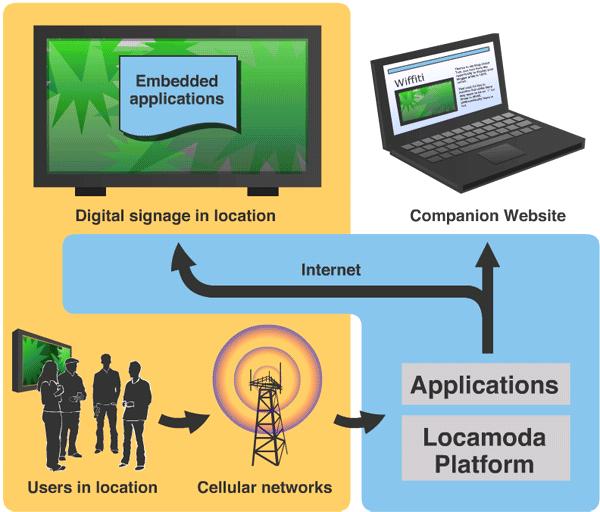
LocaModa Inc., which provides a service called Wiffiti (short for wireless graffiti) views interactive out-of-home displays as the answer to consumers’ “insatiable desire for connectedness” and the shift from a “’lean back’ TV experience to a more active ‘lean forward’” one. Traditional narrowcast displays, like those found in Wal-Mart or other retail stores, have been vehicles for open loop advertisements that do not respond to users or incorporate user-generated content. Wiffiti works by having a display in a public place, like a café or club, to which users can send text messages that will be immediately displayed on screen. A particular establishment can extend the effectiveness of the device by prompting the audience to, say, submit music requests, vote on their favorite bartender, or answer trivia questions. The model for this is shown below:

Public Texting

Marketers love this idea and view it as the new way to connect with potential customers. The Economist reports that Proctor & Gamble ran a promotion inviting women to text “secrets” to giant screen in Times Square that would also be broadcast on the secret.com website. (A representative message confessed, “I cut my sister’s hair when she was younger and told my parents that she did it herself.”) Executives at the company praised the promotion for dramatically increasing brand awareness.

Public text messaging appeals not only to the need for connectedness that some of us have, but also to marketers and the owners of a venue because of the inherent data collection ability. A user’s cell phone number acts as a unique identifier (like a cookie on a website) that can track the screens to which someone submits, what they actually said, and could possibly be combined with other databases of personal information. Of course, the availability of those other databases depends on the data sharing policies of companies with which one engages in business. Unfortunately, most people never read the fine print when they sign up for rewards cards at retail stores or other promotions. If the store has a lax data sharing policy and collected your cell phone number when you signed up, then the club or café across town might be able to associate you with previous purchases and be able to target advertisements, offers, or anything else in your direction.

But advertising companies are treading carefully; the trust of a consumer is of extremely high value and firms are anxious to preserve that. The founder of LocaModa notes that “the future of out-of-home screen media is unlikely to follow [an] Orwellian model.”

An important question about this technology is whether or not it helps the social nature of the location. Some would say that the last thing we need is another excuse to pull out a cell phone in a café or club. In my own experience, it is common for digital natives to be in a social, public space and message friends that aren’t present. During the time it takes to communicate, the DN displaces him or herself from the environment they are in. They are temporarily closer to the recipient of the message, miles away, than other people just a few feet apart from them. (For more on this, see Sherry Turkle’s excellent piece, Always-on/Always-on-you: The Tethered Self.) Proponents of social graffiti spaces say this is just the opposite; it is immersive in the way it connects an individual to the people in the same space.

What do you think about social texting? Would you engage in it at a café or club? Do you think it helps or hurts the real life social relations between people?

– Tony P.


“Digital natives” under attack! (as a metaphor)

MIT professor Henry Jenkins is one of several bloggers who have criticized the Digital Native/Digital Immigrant metaphor in recent weeks. Jenkins argues the metaphor oversimplifies and exaggerates generational distinctions, in the process letting adults “off the hook” for getting involved with technology and how kids use it.

Last week, I had the privilege of seeing Jenkins discuss these concerns, along with many other issues, on stage with two other brilliant luminaries: Katie Salen, a game designer and professor at the Parsons School of Design, and Howard Gardner, a professor at the Harvard School of Education.

When Jenkins’s “native/immigrant” critique came up, Gardner responded that though the metaphor may be used simplistically, it still has value. “There’s clearly a difference between people who use these things easily and naturally and reflexively, and people for whom everything has to be translated into kind of another language.”

Jenkins acknowledged this, with what struck me as the ideal point of view.

“Metaphors are powerful things. They allow us to see some things clearly and they blind us to other things. And so I’m not saying we should throw out the metaphor and what it allows us to talk about. I’m saying we should constantly interrogate the metaphor for what it blinds us to seeing.”

Indeed. All along with this project, we’ve made a point to continually search for nuance and question our assumptions. In that spirit, over the next few days I’ll be writing more here about some of the questions that have been raised, both at last night’s forum, and in the blogosphere.

That said, I should make clear that the debate over metaphors constituted only a small part of an extremely fascinating 90 minutes, spanning a multitude of topics such as online ethics, cyber-bullying, media literacy, games, commercialism, curricula, and more. Video and audio of the forum is available from the Global Kids’ Digital Media Initiative blog, and I highly recommend checking it out.

Although there was way too much great material at the forum to cover it all on this blog, I do plan to write more about Katie Salen’s ideas about gaming’s social and educational aspects. I found them perhaps the most fascinating part of the whole evening, largely because the subject is one I was hardly aware of coming in.

In the meantime, what do you think of our much-maligned metaphor? Does it oversimplify, or simplify just enough? In Jenkins’s words, what does it show us, and what does it blind us to? Sound off in comments!

Jesse Baer

Digital Niche Communities

Prof. Oke’s comment a couple posts back and the coming end of the year reminded me of something I’d much rather forget — college applications. Early college decisions are coming back this Friday, and as a college freshman, the anxiety and the nerves of last year are still fresh on my mind. The stress of college applications naturally spilled over into my online life, so fall of my senior year, I began frequenting the forums at College Confidential.

College Confidential
bills its forums as the “Most popular on the Web!” The community is largely devoted to undergraduate college admissions, and its boards are populated with threads about college essays, interview tips, and choosing the right college college. There are a sizable number of parents and administrators on the site, but the large majority of posters are anxious teens.

As I have blogged about before, it makes sense that DNs will go to an online community for support and advice in times as stressful as college application season. Although I learned a great deal from those forums, I always came away vaguely uneasy. Whatever I gained was undoubtedly balanced out by the added stress from being in such a distorted environment. The site, unsurprisingly, caters mostly to students aiming for elite colleges. College Confidential is the kind of place that scoffs at 2400s and 4.0s. This isn’t be very healthy, is it?

The Internet can connect you with virtually anyone anywhere in the world, but we invariably choose to connect with individuals with whom we have common interests and goals. This creates self-perpetuating niche communities that may be skewed away from the mainstream. There, one can find acceptance for many different sets of values. High-pressure college admissions is a relatively innocuous example, but what if that niche community was, oh say, a pro-anorexia site?

The possible danger here is that DNs are at ages when their values are still being shaped, and the Internet can foster behavior that is healthy neither physically nor mentally. The Internet certainly did once have a reputation for being the hangout of loners and freaks. While I no longer hold this to be true, what is true is that there are communities that encourage maladjusted behavior. The proliferation of pro-anorexia sites is a particularly disturbing example, where members get tips for suppressing hunger and purging. A typical post might go something like this:

“Today was good. Only 200 calories + 5 hours at work where i’m on my feet all day. I feel a little dizzy, but the happy and proud feeling is 100x better. Although, i’m dreading tomorrow. I have to go to a restaurant with my friends for lunch.”

[Disclaimer] I hope this doesn’t come off as paranoid, as I do believe the vast majority of online discussion (not including spam of course) is productive and healthy.

Microcelebrity and Managing Online Identity

Clive Thompson of WIRED recently wrote a piece called The Age of the Microcelebrity. In it, he describes the phenomenon of being well known, followed, and even discussed by a group of followers, however small. Sure, well know bloggers like Scoble are followed by thousands of enthusiasts, but they are explicitly aware of this and, in my opinion, fall outside the realm of “microcelebrity.” As Thompson discusses interesting anecdotes of people being live blogged as they chat at a conference or his own experience finding a discussion about “whether it’s healthy for [him] to have a nanny look after [his] son during work hours ,” I started to consider how DNs negotiate this reality every day. How has the broadcasting of DNs affected their assumptions and how they operate?

Thompson suggests that “we are learning to live in front of a crowd,” and to some extent, I agree. It is normal on a Monday morning to receive e-mails that you have been “tagged” in photo albums that sprouted over the weekend. I imagine that bloggers with small followings experience the thrill of their posts being debated or discussed. For much of the information we post online about ourselves, privacy is not of paramount concern because we control it ourselves and—often, but not always—tailor the content for our target audience. But in some cases we may want to, as Thompson puts it and as I mentioned in an earlier post, use pseudonyms or private accounts to “wall off” personal details. And here is where many users of online services may go wrong. Although our profile may be hidden, the Terms of Use often allow the service provider to do anything it chooses with that data in the future. A false sense of security can be more harmful than none at all.

What are the effects of this (over)exposure to the rest of our social group and even beyond? Is it good to take care in what we say and do, for fear that we may be misrepresented? Or does that make normal conversation and expression rife with politics? Certainly the strains of managing one’s “personal brand” are felt more by working professionals than DNs still in school, but the skill to manage an online identity is a good one to have.

Thompson finishes with the keen observation that this may not be such a new thing: “Small-town living is a hotbed of bloglike gossip. “ It is true that networked communities dissolve geographic boundaries to give the feeling of that small down, but there are critical differences. Expression in the online world is replicable, searchable, oftentimes irremovable (from the web, once it circulates) and can be viewed by so-called invisible audiences. These differences are part of the digital literacy that is so important for DNs and other users of services to have and apply when negotiating their foray into the online world from the offline one.

   – Tony P.

Discussing ‘Born Digital’ with European Students

(Cross posted from Dr. Gasser’s blog)

John Palfrey and I are getting tremendously helpful feedback on the draft v.0.9 of our forthcoming book Born Digital (Basic Books, German translation with Hanser) from a number of great students at Harvard and St. Gallen Law School, respectively. Last week, John and I had an inspiring conversation about the current draft with our first readers on this side of the Atlantic: a small, but great and diverse group of law students here at www.unisg.ch. The students, coming from Switzerland, Germany, France, Singapore, and the U.S., were kind enough to share their feedback with us based on reaction papers they’ve drafted in response to assigned book chapters.

Today, the second session took place. John and I are currently revisiting the final chapter of the book. The “final” chapter, of course, is by no means “final” – even not if it once becomes a chapter of the printed book. What we’re trying to do is simply to synthesize some of the things we’ve said so far, and to look ahead once again and ask ourselves how the digital world will look like for our kids given the things we know – and we don’t know – about their digital lives. In this spirit, the last chapter of the book in particular is an open invitation to join the discussion about the promises and challenges of the Internet for a population that is born digital. Against this backdrop, we prepared three discussion questions for today’s session here in St. Gallen.

First, what do you think is the greatest opportunity for Digital Natives when it comes to digital technologies? Second, what are you most concerned about when thinking about the future of the Internet? Third, what approach – generically speaking – seems best suited to address the challenges you’ve identified?

Here are the students’ thoughts in brief:

Greatest opportunities:

  • Democratizing effect of the net: DNs can build their own businesses without huge upfront investments (Rene, Switzerland)
  • ICT enables networking among people across boundaries (Catrine, Switzerland)
  • Encourages communication among DNs (Pierre-Antoine, France)
  • Increased availability of all kind of information, allows fast development and sharing ideas among DNs (Jonas, Germany)
  • Availability of information, DN can go online and find everything they’re looking for; this shapes, e.g., the way DNs do research; as a result, world becomes a smaller place, more common denominators in terms of shared knowledge and culture (Melinda, Switzerland)
  • Efficiency gains in all areas, including speed of access, spread of ideas, … (Eugene, Singapore)

Greatest challenges, long-term:

  • Problem of losing one’s identity – losing cultural identity in the sea of diversity (Eugene, Singapore)
  • Dependency on technology and helplessness when not having the technology available; DNs are becoming dependent on technology and lose ability to differentiate b/w reality and virtuality; other key challenge: bullying (Melinda, Switzerland)
  • Who will get access to the digital world – only the wealthy kids in the West or others, too? Digital divide as a key problem (Jonas, Germany)
  • Addiction: DNs are always online and depend so much on Internet that it may lead to addictive behavior (Pierre-Antoine, France)
  • DNs can’t distinguish between offline and online world, they can’t keep, e.g. online and offline identities separate (Catrine, Switzerland)
  • Notion of friendship changes; DNs might forget about their friends in the immediate neighborhood and focus solely on the virtual (Rene, Switzerland)

Most promising approaches:

  • Teach digital natives how to use social networks and communicate with each other; law, in general, is not a good mode of regulation in cyberspace (Rene, Switzerland)
  • Technology may often provide a solution in response to a technologically-created problem like, e.g., privacy intrusion (Catrine, Switzerland)
  • Don’t regulate too much, otherwise people won’t feel responsible anymore; education is key, help people to understand that it’s their own responsibility (Pierre-Antoine, France)
  • The laws that are currently in place suffice (except in special circumstances); learning is key, but who shall be the teacher (since today’s teachers are not DNs)? (Jonas, Germany)
  • Generic legal rules are often not the right tool, problems change too fast; instead, kids need general understanding of how to handle technology; goal could be to strengthen their personality in the offline world so that they can transfer their confidence, but also skills to the online world (Melinda, Switzerland)
  • Technology will most likely help DNs to solve many of the problems we face today; education is the basis, but focus needs to be on the question how to put education from theory into practice (Eugene, Singapore)

As always, we were running short in time, but hopefully we can continue our discussion online. Please join us, and check out our project wiki (new design, many thanks to Sarah!), our new DN blog, or for instance our Facebook group. John, our terrific team, and I are much looking forward to continuing the debate!

-Urs G.