You are viewing a read-only archive of the Blogs.Harvard network. Learn more.


MacArthur/MIT Press Series on Youth, Media, and Learning

(Cross posted from Dr. Palfrey’s blog.

Last month, the MacArthur Foundation, along with MIT Press, announced the release of a series of new books on youth and new media. The series is a treasure trove.

I have been working my way through the six books over the past several weeks as I’m simultaneously working on late drafts of the book that Urs Gasser and I are writing on a similar topic, called Born Digital (forthcoming, Basic Books, 2008).

I’d highly recommend to anyone remotely interested in the topic to read these books. They are academic in style, structure and language, but remarkably accessible in my view. I’m not a social scientist, nor an expert in most of the fields that are represented by the authors (in fact, I’m not sure if there are any lawyers at all in the list of authors!), but the editors and authors have done a lovely job of making their fields relevant broadly.

For starters, the series Foreword, by the group of “series advisors,” is wonderful. I can’t imagine how six people came to agree on such a clear text, but somehow they did. There must have been a lead author who held onto the pen; it’s far too coherent to have been written by committee. (The advisors are: Mizuko Ito, Cathy Davidson, Henry Jenkins, Carol Lee, Michael Eisenberg, and Joanne Weiss. One imagines that the voice of the program officer at the MacArthur Foundation who made it all possible, Connie Yowell, is in there somewhere too.)

The Foreword is worth reading in full, but a few key lines: “Unlike the early years in the development of computers and computer-based media, digital media are now commonplace and pervasive, having been taken up by a wide range of individuals and institutions in all walks of life. Digital Media have escaped the boundaries of professional and formal practice, and the academic, governmental, and industry homes that initially fostered their development.” Those are simple statements, clear and right on. One of the reasons to pay attention to this topic right now is the pervasiveness, the commonplace-ness of the use of these new media, especially by many young people.

Also, their working hypothesis: “those immersed in new digital tools and networks are engaged in an unprecedented exploration of language, games, social interaction, problem solving, and self-directed activity that leads to diverse forms of learning. These diverse forms of learning are reflected in expressions of identity, how individuals express independence and creativity, and in their ability to learn, exercise judgment, and think systematically.” The work of the series authors, I think, bears out this hypothesis quite convincingly.

At the same time, the series advisors make plain that they are not “uncritical of youth practices” and note that they do not claim “that digital media necessarily hold the key to empowerment.” It is this spirit of healthy skepticism that one can hear through most of the essays in the series — and which is essential to the academic enterprise they’ve undertaken.

So far, I’ve finished the book on “Youth, Identity, and Digital Media” (ed. by David Buckingham) and “The Ecology of Games: Connecting Youth, Games, and Learning” (ed. by Katie Salen) and am part of the way through each of the others. Each one is excellent.

In the ID book, I found particularly helpful the first piece on “Introducing Identity” by David Buckingham, which took on the hard definitional and discipline-related questions of identity in this context. He put a huge amount of scholarship into context, with sharp critiques along the way. The essay by our colleague danah boyd (on “Why Youth (heart) Social Network Sites,” a variant of which is online) is already a key document in our understanding of identity and the shifts in conceptions of public and private (”privacy in public,” and the idea of the networked public — related to but not the same as Yochai Benkler’s similar notions of networked publics). And the notion of “Identity Production as Bricolage” — introduced in “Imaging, Keyboarding, and Posting Identities” by Sandra Weber and Claudia Mitchell — is evocative and helpful, I thought. The many warnings about not “exociticizing” (danah often using the word “fetishizing”) the norms and habits of young people and their use of technology, as well as echoes of Henry Jenkins’ work on convergence and his and Eszter Hargittai’s study of the participation gap came through load and clear, too. (I am pretty sure I can hear dislike of the term “digital natives” in between certain lines, as well.)

There’s much more to like in the book, and much more to work into our own understanding of ID in this environment, than I can post here. There’s an equal amount of insight in the Games book too. (The class I am co-teaching with David Hornik starts in 31 minutes and I should probably prepare a bit more than I have already.)
John Palfrey

The Digital Native Divide

When we talk about Digital Natives, are we just talking about privileged kids with access to technology? Siva Vaidhyanathan, author of an upcoming book on Google, thinks so:

Invoking generations invariably demands an exclusive focus on people of wealth and means, because they get to express their preferences (for music, clothes, electronics, etc.) in ways that are easy to count. It always excludes immigrants, not to mention those born beyond the borders of the United States. And it excludes anyone on the margins of mainstream consumer or cultural behavior.

In the case of the “digital generation,” the class, ethnic, and geographic biases could not be more obvious.

Unfortunately, there’s a lot of truth to this. In a recent talk at Berkman, sociologist Eszter Hargittai discussed her finding that “the only statistically significant predictor of engaging in creative activities at all is parental education.” And communication researcher John McMurria has observed that “a glance at the top 100 rated, viewed and discussed videos, and most subscribed channels [on YouTube] reveals far less racial diversity than broadcast network television.”

“It’s not just about access to the technology,” Henry Jenkins explained at the Totally Wired forum. “It’s access to defining skills and experiences. This is the new hidden curriculum.”

Unlike Vaidhyanathan, however, I see this as no reason to throw out the Digital Native metaphor. To the contrary. Unlike Baby Boomers or Generation X, Digital Natives are growing up now. When we use the term, we not only describe the past, but also look ahead to a future we can still change.

So let’s keep using the term, but as an aspiration as well as a description. Rather than pretend all kids are Digital Natives, let’s make that our goal. Because if we don’t act, the problems could get even worse. At her Berkman talk, Hargittai said she’s concerned unequal opportunities will become a vicious cycle:

I do think it’s going to create a greater divide, because I do think that for those who have the opportunities and have the skills, there really is so much out there. … It’s the people who don’t have the education, who don’t have the networks to figure it out, who aren’t going to be benefiting.

So how do we avoid this? I see hope in projects like One Laptop Per Child. Although that program is specifically aimed at the 3rd world, it points to the possibility of making laptops and wireless internet affordable to everyone, bypassing the time limits, crippled access, and dated technology too often found on the public computers at libraries and schools. Connecting to my last post, I’m also excited about the ideas coming from Katie Salen and her cohorts in the “edutainment” field.

These are just the first thoughts that come to mind. What do you think? How can we confront the problem of unequal access? And do you think the term “Digital Native” helps or hurts the cause? Comment away!

-Jesse Baer

Text Messaging and Public Graffiti

There was a great article in the Boston Globe yesterday about two Boston area companies, Aerva Inc. and LocaModa Inc., that are pioneering so-called “public graffiti spaces.” In essence, they are connected displays that show content submitted via text messages. It is also broadcast online so that others can tune in to a given location and even submit content themselves. As “out-of-home” displays become more popular, I’d like to discuss the current and future applications of this idea, as well as the implications it holds for digital identity and privacy.

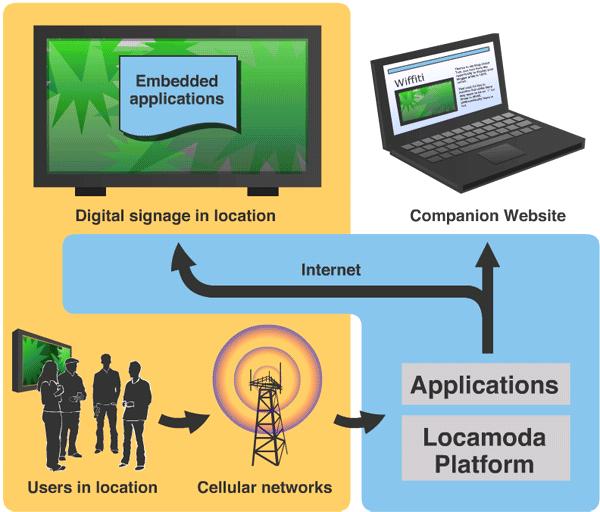
LocaModa Inc., which provides a service called Wiffiti (short for wireless graffiti) views interactive out-of-home displays as the answer to consumers’ “insatiable desire for connectedness” and the shift from a “’lean back’ TV experience to a more active ‘lean forward’” one. Traditional narrowcast displays, like those found in Wal-Mart or other retail stores, have been vehicles for open loop advertisements that do not respond to users or incorporate user-generated content. Wiffiti works by having a display in a public place, like a café or club, to which users can send text messages that will be immediately displayed on screen. A particular establishment can extend the effectiveness of the device by prompting the audience to, say, submit music requests, vote on their favorite bartender, or answer trivia questions. The model for this is shown below:

Public Texting

Marketers love this idea and view it as the new way to connect with potential customers. The Economist reports that Proctor & Gamble ran a promotion inviting women to text “secrets” to giant screen in Times Square that would also be broadcast on the secret.com website. (A representative message confessed, “I cut my sister’s hair when she was younger and told my parents that she did it herself.”) Executives at the company praised the promotion for dramatically increasing brand awareness.

Public text messaging appeals not only to the need for connectedness that some of us have, but also to marketers and the owners of a venue because of the inherent data collection ability. A user’s cell phone number acts as a unique identifier (like a cookie on a website) that can track the screens to which someone submits, what they actually said, and could possibly be combined with other databases of personal information. Of course, the availability of those other databases depends on the data sharing policies of companies with which one engages in business. Unfortunately, most people never read the fine print when they sign up for rewards cards at retail stores or other promotions. If the store has a lax data sharing policy and collected your cell phone number when you signed up, then the club or café across town might be able to associate you with previous purchases and be able to target advertisements, offers, or anything else in your direction.

But advertising companies are treading carefully; the trust of a consumer is of extremely high value and firms are anxious to preserve that. The founder of LocaModa notes that “the future of out-of-home screen media is unlikely to follow [an] Orwellian model.”

An important question about this technology is whether or not it helps the social nature of the location. Some would say that the last thing we need is another excuse to pull out a cell phone in a café or club. In my own experience, it is common for digital natives to be in a social, public space and message friends that aren’t present. During the time it takes to communicate, the DN displaces him or herself from the environment they are in. They are temporarily closer to the recipient of the message, miles away, than other people just a few feet apart from them. (For more on this, see Sherry Turkle’s excellent piece, Always-on/Always-on-you: The Tethered Self.) Proponents of social graffiti spaces say this is just the opposite; it is immersive in the way it connects an individual to the people in the same space.

What do you think about social texting? Would you engage in it at a café or club? Do you think it helps or hurts the real life social relations between people?

– Tony P.


“School play”

As I mentioned in my last blog post, one of the most interesting things about the Totally Wired forum was hearing Katie Salen talk about games in education.

In her introduction (PDF) to a new volume entitled “Ecology of Games,” Salen quotes Nobel laureate Herbert Simon: “the meaning of ‘knowing’ has shifted from being able to remember and repeat information to being able to find and use it.” Salen believes that games are a perfect way to teach these “new media literacy skills.”

The use of games in school is controversial, and it’s easy to see why.

On one hand, learning through play is so fundamentally natural that it transcends species.

Moreover, games are especially relevant to digital natives. A recent study found that games are the most popular use of the internet among kids in the US aged 6 to 11 — far more than homework, email, music, video, or just surfing.

On the other hand, playing games in school clashes with a long held cultural belief in the separation of work and play.

“Education and entertainment are two different processes,” Iowa State journalism professor Michael Bugeja recently told the Chronicle of Higher Education. “They require two different interfaces. Our whole society is being eroded by entertainment.”

Personally, I have no doubt that kids can and do learn a lot from games. Salen has amply proven this with a plethora of ideas and insights she’s gained by looking at education through the eyes of a game designer. I came away from Totally Wired wondering what other sundry subjects could be illuminated by game design, Freakonomics-style.

Still, I wonder how much of this game-based learning needs to happen in schools. Obviously kids need no encouragement to play. Why not focus on making educational games kids will want to play on their own time, and invest school time in activities most kids won’t do on their own, like read Shakespeare, or build robots?

To be fair, kids will undoubtedly learn more from games when guided by teachers and well designed curricula. As for traditional literacies, Salen acknowledges their importance, and believes they should be taught in tandem. In fact, she told the audience last week, “for kids and even for us, it’s not a huge distinction anymore.”

At any rate, soon Salen’s theories will be put to a dramatic test. She’s currently spearheading development of The Game School, an experimental public school in New York City that, according to its website, “will use game design and game-inspired methods to teach critical 21st century skills and literacies.” Talk about an exciting experiment! From a July article in Wired News:

Right now, the ideas are vague but intriguing: Alternate reality games could be used to study science, as those players typically seek out and analyze data, and then propose and test their hypotheses. Salen also envisions harnessing the creative urges that kids already express through fan fiction, blogging and the creation of avatars and online identities.

How well this works remains to be seen. One thing’s for sure though: a lot of fun will be had finding out.

Music, public spaces, civic engagement, and how to not let copyright stand in the way

Just came across Undersound, a very cool project at http://www.undersound.org/

It’s a prototype being developed that fuses Mp3 players, file sharing, and riding the Tube in London and brings it to the next level – kind of a futuristic, interactive labyrinth of music sharing. People riding the Tube upload and download songs from various stations, and from others that are in the same carriage as they ride the tube. The designers‘ goal is to infuse “riding the Tube and listening to the Mp3 player” with social interaction, a sense of place, and a lesson in one’s role in the globally connected world (and that you do have an impact):

“Through the stories that each of the [music] tracks tells us, I can now see that my personal choices have a global effect and, if I so desire, I can alter my course of action with this new knowledge in hand.”

Such a project seems such a logical extension of mobile technology practices and culture of sharing that are the norm in the Digital Native life. It is also so filled with promise – not only in looking towards a solution in issues that are creeping up in regards to the loss of a social public (as Robert Putnam and Sherry Turkle point to) due to mobile technologies (and their propensity to take us “elsewhere” than where we physically are), but also to encourage civic engagement. Our research is showing that youth that are engaged in social or political issues do use digital tools to learn more about, promote and discuss their cause, but it doesn’t *seem* as though the web itself (and the capabilities if offers) actually encourages such engagement. It seems as though a project like Undersound – where you actually see your ripple/global effect upon the system and others, would very much encourage civic engagement among a new generation…and on their own (filesharing) terms.

But how can such a project co-exist with copyright regulations? Well, how about Creative Commons? By allowing a system to only accept files with appropriate CC licenses – projects like Undersound can become legal, and thereby, become reality. In the digital world, when there’s a problem, think about the technological solution! As my colleagues at Berkman point out, systems can be put in place to read the metadata off any file, filtering out any files that are shared with out artist permission. Beyond social and civic potentials in Undersound, one can see how such a project just become a huge opportunity for unsigned artists.

Currently, file sharing happens on grand anonymous scales, and people travel throughout cities often disconnected from the space they’re in, and the people around them – Undersound brings together file sharing and mobile technology, and brings with it the benefits of social connection, of enabling people to see their impact on a larger system, and of course, of sharing music.

Hey, I’d enjoy my morning T-ride a whole lot more 😉

– Miriam S.

Discussing ‘Born Digital’ with European Students

(Cross posted from Dr. Gasser’s blog)

John Palfrey and I are getting tremendously helpful feedback on the draft v.0.9 of our forthcoming book Born Digital (Basic Books, German translation with Hanser) from a number of great students at Harvard and St. Gallen Law School, respectively. Last week, John and I had an inspiring conversation about the current draft with our first readers on this side of the Atlantic: a small, but great and diverse group of law students here at www.unisg.ch. The students, coming from Switzerland, Germany, France, Singapore, and the U.S., were kind enough to share their feedback with us based on reaction papers they’ve drafted in response to assigned book chapters.

Today, the second session took place. John and I are currently revisiting the final chapter of the book. The “final” chapter, of course, is by no means “final” – even not if it once becomes a chapter of the printed book. What we’re trying to do is simply to synthesize some of the things we’ve said so far, and to look ahead once again and ask ourselves how the digital world will look like for our kids given the things we know – and we don’t know – about their digital lives. In this spirit, the last chapter of the book in particular is an open invitation to join the discussion about the promises and challenges of the Internet for a population that is born digital. Against this backdrop, we prepared three discussion questions for today’s session here in St. Gallen.

First, what do you think is the greatest opportunity for Digital Natives when it comes to digital technologies? Second, what are you most concerned about when thinking about the future of the Internet? Third, what approach – generically speaking – seems best suited to address the challenges you’ve identified?

Here are the students’ thoughts in brief:

Greatest opportunities:

  • Democratizing effect of the net: DNs can build their own businesses without huge upfront investments (Rene, Switzerland)
  • ICT enables networking among people across boundaries (Catrine, Switzerland)
  • Encourages communication among DNs (Pierre-Antoine, France)
  • Increased availability of all kind of information, allows fast development and sharing ideas among DNs (Jonas, Germany)
  • Availability of information, DN can go online and find everything they’re looking for; this shapes, e.g., the way DNs do research; as a result, world becomes a smaller place, more common denominators in terms of shared knowledge and culture (Melinda, Switzerland)
  • Efficiency gains in all areas, including speed of access, spread of ideas, … (Eugene, Singapore)

Greatest challenges, long-term:

  • Problem of losing one’s identity – losing cultural identity in the sea of diversity (Eugene, Singapore)
  • Dependency on technology and helplessness when not having the technology available; DNs are becoming dependent on technology and lose ability to differentiate b/w reality and virtuality; other key challenge: bullying (Melinda, Switzerland)
  • Who will get access to the digital world – only the wealthy kids in the West or others, too? Digital divide as a key problem (Jonas, Germany)
  • Addiction: DNs are always online and depend so much on Internet that it may lead to addictive behavior (Pierre-Antoine, France)
  • DNs can’t distinguish between offline and online world, they can’t keep, e.g. online and offline identities separate (Catrine, Switzerland)
  • Notion of friendship changes; DNs might forget about their friends in the immediate neighborhood and focus solely on the virtual (Rene, Switzerland)

Most promising approaches:

  • Teach digital natives how to use social networks and communicate with each other; law, in general, is not a good mode of regulation in cyberspace (Rene, Switzerland)
  • Technology may often provide a solution in response to a technologically-created problem like, e.g., privacy intrusion (Catrine, Switzerland)
  • Don’t regulate too much, otherwise people won’t feel responsible anymore; education is key, help people to understand that it’s their own responsibility (Pierre-Antoine, France)
  • The laws that are currently in place suffice (except in special circumstances); learning is key, but who shall be the teacher (since today’s teachers are not DNs)? (Jonas, Germany)
  • Generic legal rules are often not the right tool, problems change too fast; instead, kids need general understanding of how to handle technology; goal could be to strengthen their personality in the offline world so that they can transfer their confidence, but also skills to the online world (Melinda, Switzerland)
  • Technology will most likely help DNs to solve many of the problems we face today; education is the basis, but focus needs to be on the question how to put education from theory into practice (Eugene, Singapore)

As always, we were running short in time, but hopefully we can continue our discussion online. Please join us, and check out our project wiki (new design, many thanks to Sarah!), our new DN blog, or for instance our Facebook group. John, our terrific team, and I are much looking forward to continuing the debate!

-Urs G.

Hollywood Writers: putting their pencils down to strike, bloging to communicate

The other day I was browsing videos on youtube.com when I stumbled upon a video called “The Office is Closed”. In this video a number of writers from the ABC show “The Office” were venting their frustration and supporting the writers’ strike. Almost a month ago, on November 5th, 2007, members of The Writer’s Guild of America began the first strike Hollywood has seen in 20 years. As you have probably seen on the news or read online, the writers of the WGA have stopped all work and have forced TV series and talk shows to revert to reruns. I had heard about the strike but didn’t know much about the specifics, so I decided to do some research. I went to the WGA official website and found a list of demands. The first demand listed on their official website is the following: “address coverage and minimums for writing for the Internet and other non-traditional media…” This particular demand captivated my attention because, while I don’t watch TV, I definitely sneak in episodes of The Office in between checking my email and doing research online. After reading the list of demands, I found my way to unitedhollywood.com. There, I watched a three minute youtube video titled “Why We Fight” where I learned everything I needed to know about the strike. It seems that writers are not receiving any compensation for the episodes that are aired online in websites such as abc.com, or nbc.com. As a growing number of fans begin to watch their favorite shows online, writers worry, and I think rightly, that their compensations will continue to shrink.

The strike is not only massive in its presence on the streets, its presence on the Internet is growing every day and it is reaching more and more people. An article in the Associated Press titled “Striking Hollywood Writers Vent Online” mentions different blogs and videos on youtube.com that have been created by the writers and supporters expressing their frustrations. Individuals are responding to the writers’ blogs either expressing their support, or disagreeing with the riots. Many have decided to stop watching shows online until the writers get their fair share, while others have made their own youtube videos to voice their opinions.

If you have been browsing the Internet recently you might have seen how the writers have taken on the Internet – the same tool the studios and networks have been using to increase their earnings through online ads, while avoiding compensations to the writers – as a tool to bring in supporters and to communicate their demands. Digital Natives are more susceptible to content online and are more likely to pay attention and respond if this content is creative and innovative. Given their strong presence online, writers and their supporters are certainly reaching a larger audience with their creative use of digital media.

CNN YouTube Debates

Tonight, CNN and YouTube hosted the republican complement to the successful democratic debate they hosted last June. The premise is the same: allow anyone to submit a question on YouTube, and then pose selected ones to candidates. Many would agree that this is a good step towards a participatory democracy (see John Palfrey’s post about it here), but some still want more. The New York Times has a series of Op Eds about what a “real, new-media debate would look like.” The responses range from cynical to creative, with some well planned enough to see possible implementation. Here I’d like to discuss some of the most thought provoking.

Kevin Kelly, an editor at large for Wired magazine, notes that “the truth becomes something you assemble with the help of friends” and on a continuous basis. He suggests having the lives of candidates constantly documented so citizen journalists can fact check and note not only the “oops” moments but also the “aha” ones.

Andrew Rasiej and Micah Sifry, the co-founders of TechPresident.com, offer a simple and effective way to better cull the videos submitted by users: let other users vote. I agree that, in theory, this would be more representative of the population, but it allows for viral videos to overtake other ones that may be more important to ask. But who currently decides what is most important to ask? Right now, the answer is still a panel of journalists that review the submissions and try to cover the most salient issues. The panel selects videos in light of viewing all the rest, whereas a voting public likely will not.

Matt Bai, contributing editor for the New York Times magazine, proposes that the candidates have laptops behind the lecterns and type comments that would be displayed on an overhead monitor while the other candidate answers a question. In his full Op Ed piece he provides some comical examples of its use.

Obviously, the suggestions in the collection of Op Eds were designed as fantasy; an imaginative view of what a super cutting edge debate would be. Who knows how many of the ideas will be implemented, in one way or another, in the future as more DNs become politically active and engaged in elections.

What are your ideas for making the debates truly participatory?

-Tony P.

Ready, Get Set, Write!

Writing a novel is one of those tasks many us want to accomplish “someday,” but for most of us, that “someday” never comes. Never fear, for National Novel Writing Month is here. NaNoWriMo, which takes place in November, challenges any aspiring writer to pen a novel of at least 50,000 words in one month.

If you’re questioning how NaNoWriMo is important to Digital Natives, consider its current success Could have NaNoWriMo have existed before the digital age? Well yes, it did. It began in1999 as a localized project among 21 friends who had some time to kill. But could it have been the success it is today with 79,000 worldwide participants? Perhaps the most appealing part of NaNoWriMo is the sense that We are in this together. Writing a novel is all-consuming exercise, and writing a novel in a month is something close to creative suicide. NaNoWriMo hosts a virtual network of support groups for experienced writers and budding novelists alike. What started out as a simple group of friends evolved into a Yahoo group and then into extensive online forums, with the number of participants exponentially increasing each time. Digital Natives have taken advantage of this online community to participate in NaNoWriMo.

NaNoWriMo naturally draws out of the fanfiction (fanfic is considered a legitimate genre) and online writing community, which are composed of a relatively high number of young people. NaNoWriMo’s forums are subdivided into age groups, and it is under the Teens section where Digital Natives have come out in full force. This is apparent not only in quantity—the volume of posts in the Teens section is twice that of any other age group—but also in the nature of their interactions. While many of the posts are related to writing and NaNoWriMo, the forum is also peppered with threads like “Band geeks unite here!” and “Sweet sixteen birthday coming up.” For Digital Natives, the Internet isn’t a big, bad, scary place but a community within which conversations are to be had and friends to be made. There are plenty of posts asking for advice on how to juggle NaNoWriMo and college apps, and there are plenty of posts asking for relationship advice. These threads as well as the manifold threads in which Digital Natives swap their digital identities – screennames, LiveJournal, deviantART, MySpace, etc. – with others forum members exhibit a desire for interaction beyond just writing buddies. This is something unique to the Teens forum and nowhere to be found in forums geared toward older writers.

At a time with “mash-up” and “remix” are the current creative buzzwords, the novel isn’t the sexiest art form. The success of NaNoWriMo, then, has lots to do with the online community that has organically arisen in response to the inane challenge of writing a novel in one month. With NaNoWriMo, even an old art form like the novel—and maybe even the very process of writing a novel—is being dusted off and thrust into the Internet world by Digital Natives.

For something even more connected with the Internet world, check out NaBloPoMo – National Blog Posting Month. http://www.nablopomo.com/


-Sarah Z.