Archive for March, 2016

3. Prophetic Light and Mutaqil; PLEASE NOTE: The drawing will not fully display; please drag it to your desktop and view it from there. Thank you!

Tuesday, March 22nd, 2016

new doc 2_3

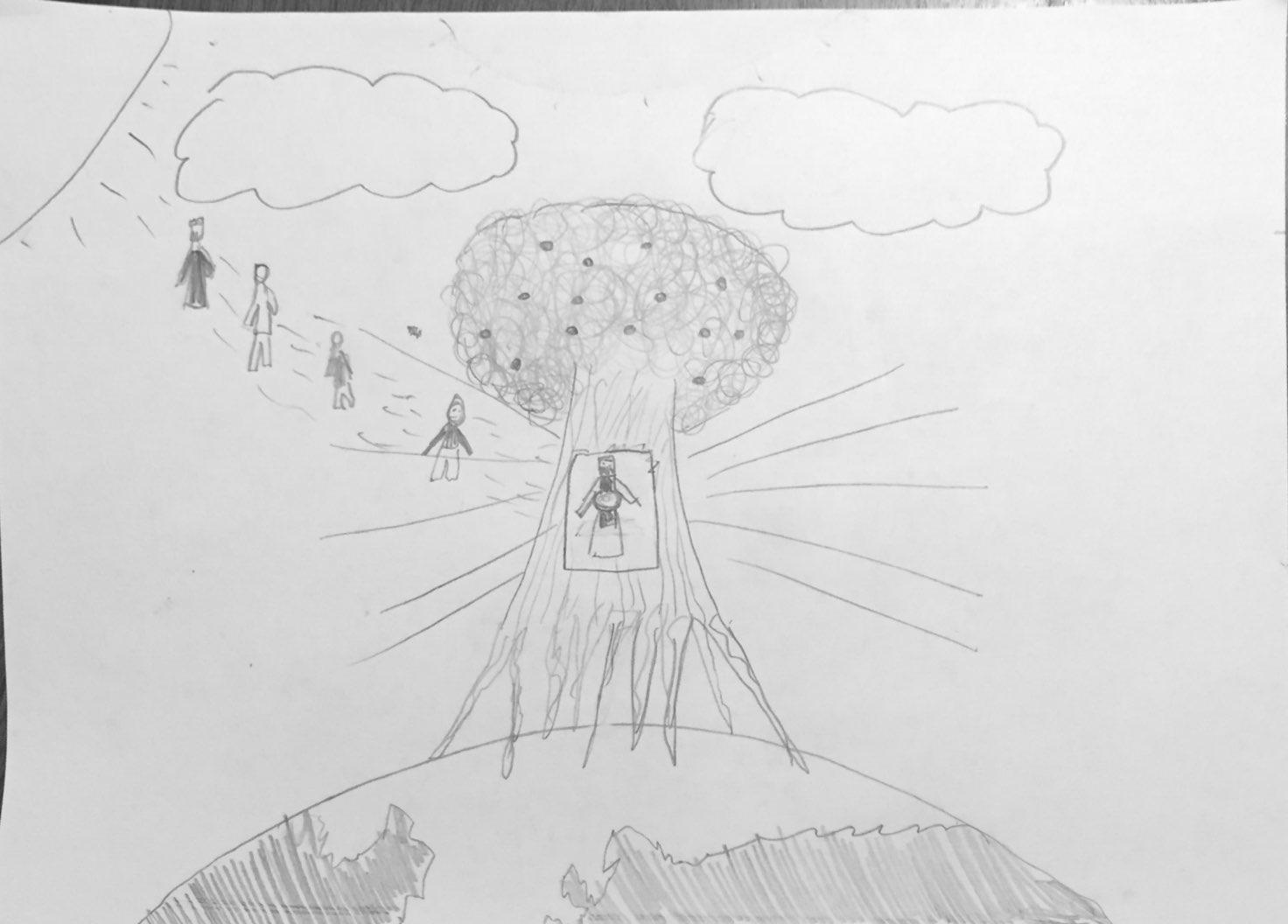
I chose to make one of the projects for my portfolio based on the light verse in the Qu’ran, and on Muqatil ibn Sulayman’s interpretation of it, for several reasons. For one, this is a very famous verse, and thus deserving of artistic interpretation. Secondly, it has really vivid imagery, lending itself to visual art, and using pencil specifically allows me to best incorporate shading and textures in the tree and the trunk. Thirdly, I really like the pluralist aspects of the Qu’ran, and Mutaqil’s interpretation speaks to this.

The light verse, Qu’ran 24:35, is well-known, and speaks of God as a light within a lamp in a star-like glass from a heavenly olive tree with magical powers. I drew this light in a lamp in a glass in a blessed olive tree. The tree in my artwork is hovering above the Earth, so it is not in the East or the West. I drew both the heavens and the Earth, with the tree between them. Within the tree, I drew a lamp, which has light radiating all over the world.

However, as Prof. Asani notes in Chapter Three of his book Infidel of Love, Muqatil ibn Sulayman and scholars that agree with and expand on his exegesis believe that the lamp represents the Prophet, so I drew Muhammad’s body as the lamp, in the tree. They believe that prophetic light has been passed from Adam through the other prophets, finally residing in Muhammad, so I drew light passing down from a series of figures to Muhammad, whose light radiates over the world.

I really like this interpretation because of its pluralism; the idea of connecting the prophets of different peoples really spoke to me. As someone who does not come from any one religious background (my mother’s family is Jewish and very secular, my father’s is Catholic and less so), I’ve always looked for and admired ideas that bring together religions and look for their fundamental similarities instead of those that drive them apart and look for their differences. Sulayman’s interpretation was really meaningful to me because it connected a majority of the worlds’ peoples through their prophets, and it did so through a verse that is particularly meaningful to many Muslims.


2. Allah and Salaam; PLEASE NOTE: The drawing will not fully display; please drag it to your desktop and view it from there. Thank you!

Tuesday, March 22nd, 2016

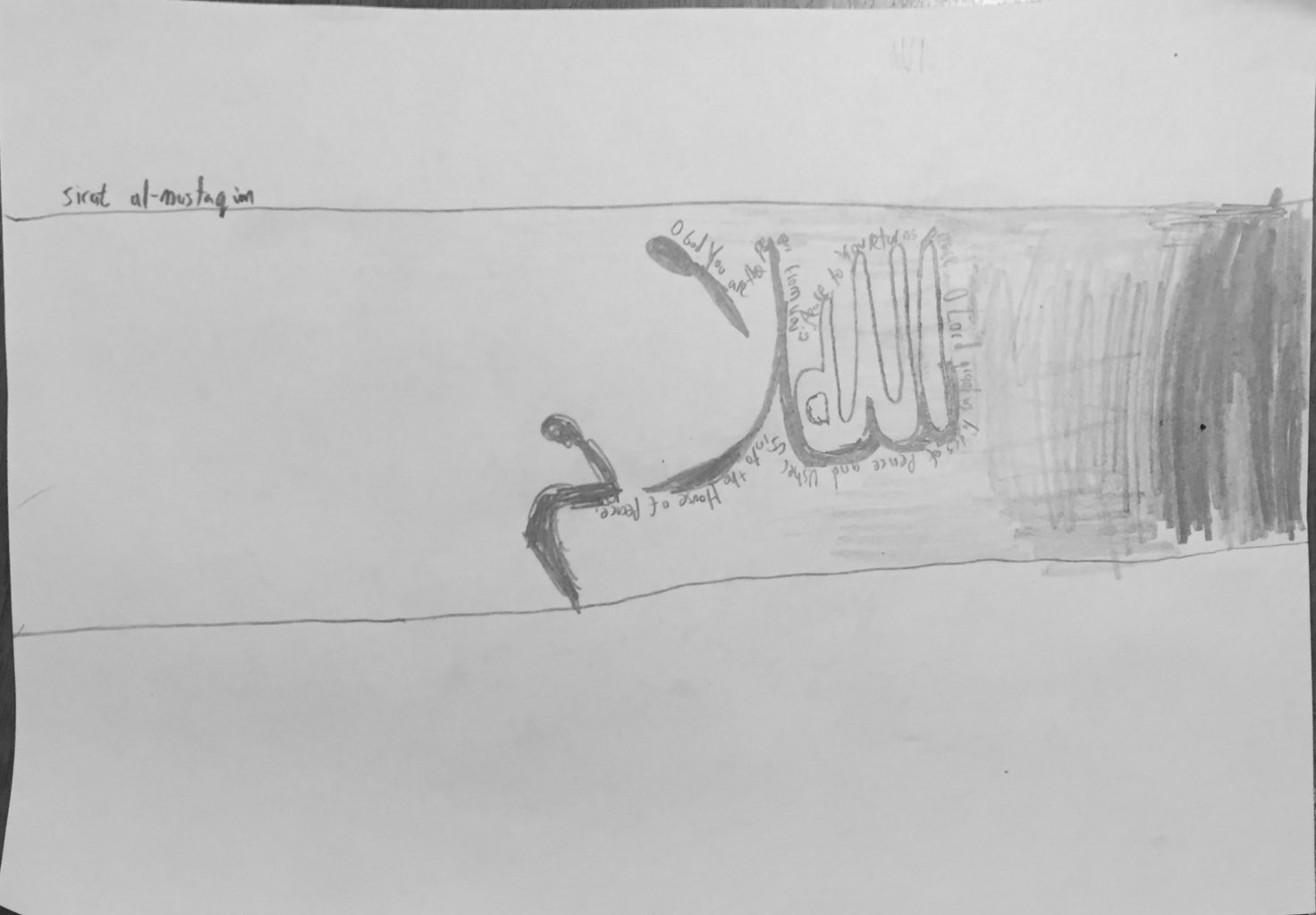
I really liked the calligraphy project we did earlier in this class, and I enjoyed learning a little Arabic, so I wanted to expand on that for at least one project in my creative portfolio. I especially liked the calligraphy we saw that had double meanings, such as the words Allah and God written in the same word. This project shows the word Allah in Arabic (in light characters) nestled in the word salaam (in dark characters). I chose these two words to be physically connected because the connection between God and peace is an important one in Islam, and an especially key one to understand given the misconceptions of Islam in the world today, as Prof. Asani’s Infidel of Love explains in Chapter Two. 

As Prof. Asani notes in his book, As-Salaam (“The Peace”) is one of God’s main attributes in the Qu’ran, as shown in the prayer “O God You are the Peace; from You is Peace; to You returns Peace; O Lord grant us lives of Peace and usher us into the House of Peace”, which I wrote encircling the calligraphy in my project. This course reading was particularly meaningful to me because Prof. Asani wrote it; it’s great to find a reading I respect so much and be able to interact with its author.

Additionally, in 5:16, as Prof. Asani notes, the Qu’ran says that “God guides those with whom He is pleased to the ways of peace, guiding them along the straight path from darkness into light.” I drew this straight path, known as the sirat al-mustaqim, in the picture, containing the calligraphy. Like the Arabic language, it goes from right to left, as evidenced by the decrease in dark shading, or transition from darkness into light. Using pencil as the medium for this drawing allows me to incorporate this shading.
I thought this was an important topic given the many 21st-century perceptions of Islam as violent, due to the actions of a few extremists that have committed their actions in the name of Islam. Because the vast majority of Muslims are peaceful human beings, and submission to Allah is the literal definition of Islam, I thought that it was important for my art to unify the ideas of Allah and peace. Also, because some non-Wahhabi Fundamentalist Muslims use calligraphy and even see it as mystical, I thought this piece counteracts fundamentalism by using a beautiful, arguably anti-fundamentalist art from.


1. Al-Ghazali’s Qu’ran external recitation rules; PLEASE NOTE: The drawing will not fully display; please drag it to your desktop and view it from there. Thank you!

Tuesday, March 22nd, 2016

This drawing was inspired by Al-Ghazali’s ten guidelines for Qu’ran recitation and interpretation. I display his most ideal reading of the Qu’ran by showing a man following all of his guidelines. In addition to being art, this piece can also serve as a visual guide to Al-Ghazali’s work. The Arabic numbers for 1-10 are written throughout the piece, each corresponding to how the man displayed is following that guideline. To me, it makes sense to display these guidelines through visual art, since they are external guidelines. I think it is important that this drawing is ink, because using ink imitates the Qu’ran itself and connects it to it.


The first guideline instructs that it is best to face the Ka’ba in Mecca, which is displayed through a small window in the direction the man is facing. It also instructs that one should stand. This is also displayed by a quote to the left of the man, which implies that he is a “person of understanding” because he is standing as he recites. Thirdly, the guideline specifies that recitation is excellent when it happens at night, which is implied by the darkness and the moon in the window to the left.

The second rule, which specifies that the Qu’ran should not be read too often or too rarely, specifies that the Qu’ran should be read two or three times per week. It is shown that the man in the drawing is following this rule because of the calendar, which has 2-3 days per week marked, implying Qu’ran recitation on those days.

The third rule indicates a preference for dividing the Qu’ran into seven parts, which is shown by the chart to the immediate right of the man, which has one-seventh filled in.

The fourth rule states that it is acceptable to mark the Qu’ran to specify recitation, as shown by the marked letters next to the man.

The fifth rule indicates a preference for tartil, or slow, clear reading. The man is thinking about the Arabic word for slow, which indicates that he is taking his time to recite the Qu’ran.

The sixth rule is that one should weep while reading the Qu’ran.

The seventh rule states that a reciter of the Qu’ran should prostrate himself when the sura he is reading calls for it. However, as shown by the man’s thoughts about the Sura of Sad, he is reading that sura, which does not call for prostration, so the man is not prostrated.

The eighth guideline indicates statements that should be made before, during, and after reading the Qu’ran. The man is making the appropriate statement for commencing recitation in a bubble to his left.

The ninth guideline states the Qu’ran should be read aloud, as shown by the sound waves to this man’s right.

The tenth guideline is that the Qu’ran should be read beautifully, as shown by the musical notes next to the man, although of course some Qu’ran scholars would not call Qu’ran recitation music.