Send in the consultants

I’ve recently moved into a new job at Novell, working on our strategy for worldwide services and planning for our next fiscal year is keeping me busy.  But I still, fortunately, deal with real clients and real problems too.  This one is classic: the client has several hundred old Unix and RHEL servers that they want to move to SLES.  Great!  We want to help.  So they negotiate the server deal and then want to know the cost to migrate.  How much is it going to cost, in total, to go from what they have today to what they want tomorrow?  They ask for estimates on a per-server basis; how many hours would it take to migrate a Solaris server to SLES?  Ten hours?  A thousand hours?  So they bring in the consultants, the dreaded consultants.  They’ve tried to avoid slowing down the deal but there’s no avoiding it now.

Well, you’ve done this before, they say, you’re grizzled veterans of the data center; is it two or ten hours for a server?  And the consultant — and I’ve been in this situation, believe me, it sucks — has to say, “Well, it depends.  It could be a thousand hours.”  Which is what everyone is expecting him to say because you can’t get a straight answer out of a consultant.  They’re always going to tell you “it depends.”  Right.

And even if there is all the time in the world, this particular answer needs to be in writing on the buyer’s desk by EOD today or the sales guy isn’t going to make his number for the quarter which means that he’s not going to make ‘club’ (his incentive travel event), which his wife is really looking forward to, so this damned consultant is not only not answering a simple, reasonable question from the beloved customer but they are also very directly making his wife mad at him, with the attendant consequences.

Perhaps you think I joke?  Or exaggerate?

Making matters worse, some nerd named Chad has downloaded OpenSUSE onto a machine in their testing lab and moved a couple of apps without incident (some directory changes, a few lines of code) and based on that experience has estimated that moving the three hundred servers will take approximately an hour each.  Seriously: we have clients who want us to tell them that moving unknown production workloads from one operating system to another will take less than two hours per server.

So the consultant sighs and starts to ask questions: What do the workloads on these servers actually do?  Online banking is different from warehouse management.  What platforms are they running?  (What version of J2EE?  What version of RHEL?  What version of Manugistics?)  Are they going to change anything else besides the operating system when they do this move?  Is the software custom or off-the-shelf?  What’s it written in?  If they say something like current Java apps running on a 2.6 kernel going to the same JVM on another distribution, that would be one thing.  If you are looking at non-ANSI C custom code on RHEL 3 on a complex multi-tiered app, that’s something else.  (Moving from the 2.4 kernel to the 2.6 kernel on any distribution is much harder than moving from one current distribution to another.)  What about storage, and backup, and disaster recovery?  Systems management?  There are a thousand more architectural details that you need to understand (one data center or many?  resource utilization?) but everyone is getting impatient with you and your endless questions.

Then you start getting into the enterprise-y aspects, which is where the real time and cost come in.  There’s a difference between Chad moving an app from one platform to another as a technical exercise and the actual time that it takes production applications to go from one to another.  What’s the testing regime?  I would expect that production code moving from one distribution to another would require real testing (stress/performance, UAT, etc.).  Would you include that in the estimate?  What about security?  Does the new OS have to go through a security audit at the company?  (Answer: yes, and it’s going to take a long time for the online banking app, believe me.)  Documentation?

This is all super-boring and bureaucratic and definitely not technical so the nerds aren’t interested and think it’s worthless and the sales guy is hearing his wife screaming at him and the buyer is saying, “Why is this so complicated?”

So, should we skip the backup part?

Really, the way to do this kind of thing is to do a quick assessment and figure out some kind of prioritization and rough sequencing, but that would require the client to spend time and money helping you to figure out how much to charge them and they are naturally leery of such a thing.  You desperately want to avoid getting locked into a fixed figure because you still have no real idea how complex the problem your being asked to solve is, but that is what the client and the others are asking for.

So you end up with a fudge; you commit to moving some edge servers and a cluster of supposedly simple apps and you sign up to do a security-approved core build and an assessment for the rest so that the project can get started and the customer can show progress to their boss and the sales guy can make his number.

Now you’re faced with months in the lab at the client site with Chad explaining to you how completely screwed up their environment is and how there’s no way that he’s going to give up his Solaris servers and anyway they’ve tried to do this themselves a bunch of times already and it never works because it’s not really a current release of Manugistics and they did some customization that they probably shouldn’t have…

Head in the clouds

Michael Nygard has his head in the computing clouds, suggesting that not only is cloud computing in our future, but that there’ll be many of them. He’s right.

Everyone who runs a large data center is today faced with the same set of interconnected environmental problems; space, power, and heating/cooling. And these are environmental not just in the sense of tree-hugging but also in a straightforward practical sense: there is no more space, there is no more power, there is too much heat and not enough cooling. These problems were the domain of junior people a few years ago, worrying about where, physically, to locate all the new Windows boxes. Then it was middle managers trying to sort out power and HVAC issues: “If we deploy a new phone system in our building we won’t have enough power to do any upgrades in the data center,” that sort of thing. Now environmental issues are front-and-center for senior IT management and if you’re a “red-shift” kind of company, for senior corporate leadership too.

You can cloak it if you want to in green terms but businesses are faced with real operational issues that they need to address regardless of their perspective on global warming or riverine dolphins.

Alongside these environmental issues, data centers are also facing a crisis of manageability. A large enterprise data center is a staggeringly complex thing, too complicated. Also, if the truth be told, most of them are not that well run; would you expect, for example, that an auto parts distributor would have great technology management skills? No, of course not, and the fact is that they probably wouldn’t want to spend the money to acquire that talent and technology even in they could; their differentiation, the competitive advantage of their business, lies elsewhere. So they have a complicated, and sub-optimized, technology infrastructure.

The answer to all of these problems — Monday edition — supposedly lies in virtualization. Novell gets brought into these conversations because inevitably data center managers have a roadmap that looks something like this:

Continue reading

The Fossa Project

penguins At Brainshare, Novell’s annual user conference in Salt Lake City, our CTO, Jeff Jaffe, announced a new technology vision, code-named “Project Fossa,” [pdf] intended to enable computing and collaborating with agility. The fossa is a cat-like mammal from Madagascar, sort of related to raccoons, weasels, and palm civits. (Fossas may be viverrids like civits or the falanouc, another Madagascar endemic; the taxonomy seems to be contested.) Fossas are supposed to be very agile, and if you have little kids you know them as the villains in the animated movie Madagascar. The project’s name is also a play on Free and Open Source Software (FOSS).

Here‘s some press coverage including the priceless hed “Novell focuses future strategy around endangered mongoose” from the UK edition of ZDNet.

Mysteries of the East, #2: The Enigma of Harwan

A year ago now, I wrote:

For the Indology nerds: there are a set of clay tablets at the Guimet, I think on the second floor, which have as their provenance a Buddhist monastery in Kashmir. The panels have raised images on them which are clearly not Buddhist. I suspect they’re Ajivika and I seem to remember an article, which of course I can’t track down now, describing how the Buddhists reused the materials from an Ajivika complex as the flooring in their monastery, as an insult. But I can’t pinpoint the source and it’s driving me nuts.

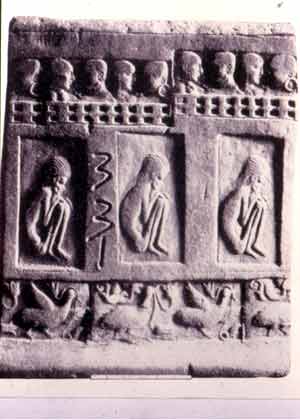
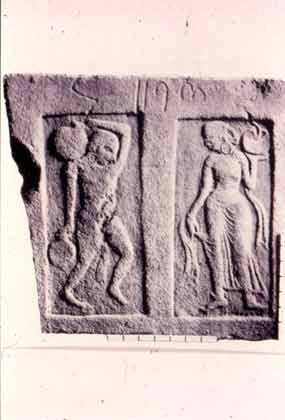
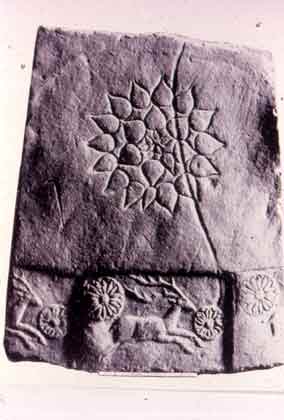
Since then, I figured out that they were from Harwan, a site outside of Srinigar, next to the Shalimar Gardens. But I still couldn’t find the article I was thinking of or, really, any good information on the deeply Harwan tileenigmatic tablets.

This past fall, the Asia Society in New York sponsored an exhibit entitled The Arts of Kashmir, which — despite my best intentions — I never got to visit. (Here’s a review by the great New York Times Asian art critic Holland Cotter.) Consoled with the catalog to the exhibit by Pratapaditya Pal, I found some helpful references.

The beautiful catalog itself is much more substantial than a typical exhibit catalog — it’s really a collection of art historical survey articles about Kashmir, including architecture, sculpture, painting, calligraphy, and crafts.

The Harwan tiles appear in John Siudmak’s piece on religious architecture, which seems to summarize what we know about the site:

The earliest surviving Buddhist site is at Harwan, near the Mughal Shalimar Gardens, probably dating from the fifth century and of Hephthalite patronage, and mostly known for its terra-cotta tiles impressed with figural and floral designs used to decorate a large circular terrace on the hillside, which was destroyed by an earthquake. […] Similar terraces have been found elsewhere in the valley; the most extensive at the site of Hutamura, in the Lidder valley. Their religious affiliation still remains a mystery. However, excavations of a rectangular courtyard in a lower terrace uncovered the triple basement of a stupa, a number of cells, and several terra-cotta figural fragments and three plaques impressed with stupa images (fig. 37.) […] The stupas on the Harwan plaques compare closely with three Gandhara bronze examples, one also with columns at the corners, and confirm a Gandhara influence. (pp. 55-56)

So there are more of these sites, besides Harwan, although “their religious affiliation remains a mystery.” And nothing about the Ājīvikas. The second half of this redacted excerpt is on firmer ground, unraveling the Buddhist elements of the site; the complex symbolism of the stupa is a favorite topic of study and Siudmak’s comments helpfully locate early Kashmiri, presumably wooden, examples in the timeline between Greco-Bactrian Gandhara and later versions, especially Tibetan. (Tibetan and Central Asian religion and art is deeply indebted to Kashmir.) Note, by the way, that the tiles or plaques with clearly Buddhist stupa images are different — made differently and different in appearance and style — than the rest of the Harwan tiles.

But most interestingly to me is a footnote at the end of this excerpt, to a 1989 article by Fisher. Unfortunately, the scholarly apparatus of the catalog is shoddy and there’s no further referenceHarwan tile to Fisher in the bibliography.

The curator of the exhibit, Pal, has a long useful essay (the metal sculpture section alone is fantastic) entitled “Faith and Form” in the catalog which also refers several times to the Harwan tiles:

The earliest sites that have yielded terra-cotta objects, which, according to tradition, go back to the Kushan period, are Semthan, Harwan, Hutmora, Ushkur, and recently Kutbal. These sites are particularly noteworthy because of the large, stamped tiles with figural and symbolic forms that represent an independent local artistic tradition. Although tiles for paving floors and walls of monasteries were used in Gandhara, they are not as richly and diversely decorated as those from Kashmir. The figures in the Harwan tiles further show both Indian and foreign ethnic types, strange crouching ascetics unique in the Indian plastic tradition and convincingly rendered flora and fauna. Both the Harwan and the Kutbal finds reflext a mature and confident state of artistic skill but, strangely, the tradition did not continue. There is no certainty about the exact dates of these sites, although the consensus is between the third and the fifth century. (p. 66)

So now we have a whole set of sites related to Harwan, including Siudmak’s afore-mentioned Hutamura — presumably the same as Pal’s “Hutmora” — plus Semthan, Ushkur, and Kutbal! Again, though, the scholarly apparatus of the catalog fails us, since the endnotes in this passage aren’t correctly referenced; #9 appears twice in the excerpt above and only once in the notes; the only usable reference (a pers. comm.) is to the recent Kutbal find. And still no Ājīvikas.

Even though I couldn’t get an exact citation, some heavy duty googling yielded reference to a 1982 article by a Robert E. Fisher in Art International, a now-defunct (I think) journal. For the record, it’s:

Fisher, Robert E. The enigma of Harwan, Art International, 1982, XXV(9)33-4

There may be a later, 1989, Harwan article by Fisher, too, as Siudmak suggests, but I haven’t been able to find it. (Fisher’s early 1980’s Ph.D. dissertation at USC was on the Buddhist architecture of Kashmir.)

Harwan tileI think that Fisher’s article, the one that I was looking for and finally tracked down, thanks to my wife and the wonders of inter-library loan, more or less definitively addresses the enigma of Harwan. Fisher proves — at least to my satisfaction — that the tiles are part of an Ājīvika religious site, later reused in a nearby Buddhist monastery. (Thus Siudmak’s reference to [monastic] cells adjoining the stupa.)
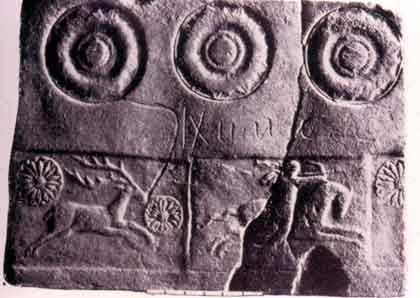
Fisher, although not cited in the 2007 Kashmir catalog, acknowledges Pal in his endnotes: “It was his belief that there is more to Harwan than has been published as well as his careful screening of my evidence that inspired this essay.”  And, although I haven’t yet had a chance to read it, Pal discusses (pp. 223-224) a tile in the LACMA collection, described as “Tile with Ajivaka (?) Ascetics” in vol. 1 of his Indian Sculpture (Los Angeles: Los Angeles County Museum of Art, University of California Press, 1986) book.

Alright, if you’re still with me, some quick background on our suspects:

We really don’t know much about the Ājīvikas, except from what we read about them from their successful rivals, including Buddhists and Jains. It’s a similar situation to, say, gnosticism in late antiquity in the eastern Mediterranean: most of what we knew, up until the Nag Hammadi finds, about gnosticism was hearsay, and the hearsay treated the tradition as heretical.

The founder of the Ājīvika tradition, Gosala, supposedly was a contemporary of Mahavira, the founder of Jainism and thus a near-contemporary of the Buddha and possibly from the same north-central region of Harwan tileIndia. (Fisher points to a 1951 book by A.L. Basham, History and Doctrine of the Ājīvikas, which I haven’t read yet. There’s also a workmanlike Wikipedia article.) They were famously ascetic, and one story that really left an impression in my mind was that they supposedly meditated (or committed slow suicide) inside of clay pots. This is such a disturbingly powerful idea that just thinking about it makes me start to physically panic. Whether or not this has any basis in reality, of course, is another matter, but Ājīvikas are closely associated with pots, pottery, and the like. Thus, as you might have guessed, all the clay tiles. And look again at the ascetic figures in the tiles; don’t they seem like they could be crouching in pots?

Fisher, citing Basham, notes that caves in Bihar, with Ājīvika inscriptions from the 3rd century BC, had three foot deep deposits of clay fragments in them when excavated by Alexander Cunningham in the 19th century. These caves, it’s important to note, had what Fisher calls “an unusual shape”:

apsidal in plan with a circular construction at the far end. If Buddhist, this arrangement would indicate the presence of a circular stupa. According to Basham, these caves may originally have been stone replicas of the earliest Ājīvika meeting-place, a circular thatched hut at the end of a courtyard. (p. 43)

If, like me, your vocabulary doesn’t include “apsidal,” Wikipedia comes to the rescue. It’s a form of “apse“:

In architecture, the apse (Latin absis “arch, vault”; sometimes written apsis; plural apses) is a semicircular recess covered with a hemispherical vault. In Romanesque, Byzantine and Gothic Christian abbey, cathedral and church architecture, the term is applied to the semi-circular or polygonal section of the sanctuary at the liturgical east end beyond the altar. Geometrically speaking, an apse is either a half-cone or half-dome.

And, you may have guessed correctly already, that is the same plan as the Harwan site.

Furthermore, other images — especially flowers, elephants, and swans –common in the tiles have Ājīvika associations, based on our very limited knowledge of their beliefs.

In his article, Fisher goes to great lengths to disprove other associations: that Harwan is not exclusively Buddhist, that the images have connections to but are different than other traditions, and so on. So he surveys Hindu and Buddhist images for ascetics, and crouching figures, and floor tiles, and looks at Parthian evidence for the horse rider images and the potential architectural connections between Parthain fire temples and the Harwan site. But he concludes this section with the following comment (p. 39):

Amidst all these images, be they foreign or Indian, one stands apart with compelling force. The repeated portrayal of a crouching ascetic forms a dramatic border to the variety of lively forms of the floor and provides the most enigmatic problem for the entire site.

And this, to me, is the central issue; a really enigmatic problem. These figures look like nothing else: in Pal’s words, the “strange crouching ascetics [are] unique in the Indian plastic tradition.” I can still remember the surprise I felt seeing the tiles at the Guimet, how odd and otherworldly they seemed.

I think that Fisher’s solution, the Ājīvika attribution, is a brilliant contribution, one that’s unfortunately not been widely accepted. (This, I suspect, is due to issues of distribution not disagreement.) If we add in the comments from the Kashmir catalog that Harwan is one in a set of similar finds, including Hutamura/Hutmora, Semthan, Ushkur, and the supposedly spectacular Kutbal site, we have suggestive evidence for a large Kashmiri Ājīvika movement in the early centuries of our era, ca. 300 – 500 C.E..

On the architecture of Naypyidaw

Via BoingBoing, fascinating photos of Burma’s new capital from, literally, the first tourists there. It seems to me from these pictures that the government wanted a new city that was more like Singapore or southern California and less like, well, Burma.

Check out these houses:

Burmese bungalows

Note that each of them has a garage — in a country that is essentially without roads. Garages make sense (well, as far as it goes) in Orange County but not so much in a country like Burma. The oddness of these houses in that context cannot be overstated.

My guess is that these houses are inspired by similar-looking developments in suburban Bangkok or perhaps Singapore or Shanghai.  Those housing developments — in their overall master plan and in the particulars of the architecture — in turn draw directly on American suburban housing, especially in southern California. All of that seems reasonable to me: Burmese generals visit Bangkok and see new housing developments which are influenced by Thais returning from, say, Irvine. As much as Burma has any contact with the outside world, it’s with Bangkok and Singapore.

The southern California gated community with attached housing, in turn, draws directly on the experience of the mass-produced single family houses of the new suburbias created after World War II for returning veterans and their growing families: Levittown and all that. These communities, in an oft-told tale (see, among others, Anthony King’s history, The Bungalow) mass-produced the idealized American house, derived from the popular craftsman bungalow style of the turn of the century. This style was influenced by the British arts & crafts movement — itself a response to industrialization — and the houses, which they called bungalows, built by returning colonial administrators, especially from India.

In India, these colonists lived in grand houses called “bungalows,” a word whose etymology is disputed but probably derives from Gujarati via the Hindi for “Bengali” (“bangla” thus “Bangladesh”, “land of the Bengalis”) since Calcutta was where the British first built their private houses.

Thus, I think you can draw a line, not too straight, but a connection nonetheless, from these bizarre new Burmese houses to neighboring Bangladesh, via Bangkok and Irvine Ranch and Long Island and Surrey and Simla.