As a kid I used to spend hours in front of the laboratory computer Wikipedia page hopping while I waited for my parents to finish working. My favorite page was an entry on mermaids. I was accosted by words like “etymology” and “mythology,” names and references to the esoteric and arcane. Obviously I had no ideas what any of these words meant and so I set out clicking each highlighted blue word I came across that felt unfamiliar. Though seemingly unrelated the larger conceptual ideas that prefaced an otherwise unitary concept like “mermaids” actually found a foundation of knowledge that extended across the differentiating disciplines. This method of self teaching and self exploration is the Platonic ideal of pedagogical models. Moreover, the sustainability of the unbroken internal links ensure that a complementary source can always be found: creativity is nurtured, veracity is guaranteed.
The other day I was watching a fascinating documentary on Netflix called Lo and Behold” narrated by the hilariously idiosyncratic filmmaker, Werner Herzog when I came across Ted Nelson’s Xanadu project.
In his own words, Nelson describes Xanadu as “an entire form of literature where links do not break as versions change; where documents may be closely compared side by side and closely annotated; where it is possible to see the origins of every quotation; and in which there is a valid copyright system – a literary, legal and business arrangement – for frictionless, non-negotiated quotation at any time and in any amount.”
As with many things, this is best rendered through a visual representation:
http://xanadu.com/XanaduSpace/btf_files/fwDemoOrigins-panorama2.png
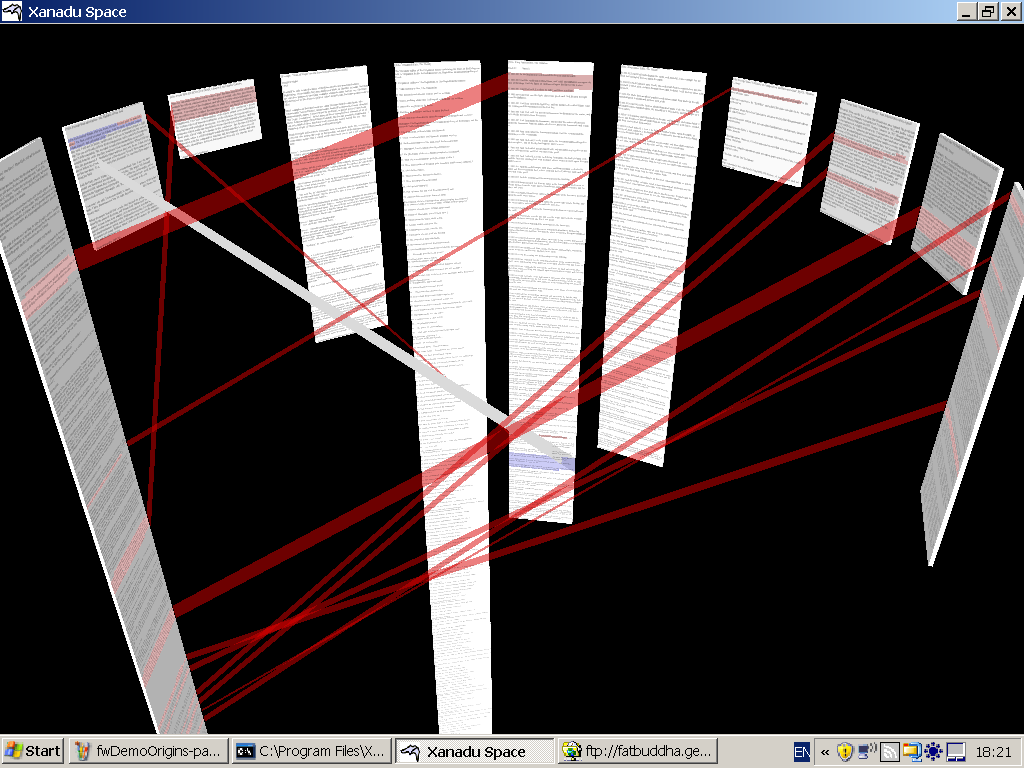
And even more compelling in my opinion through an interactive sample prototype:
http://xanadu.com/xanademos/MoeJusteOrigins.html
For me, there is an exciting and promising field encompassing the intersections of technological innovation and educational development that could take advantage of this particular type of information display.
Unfortunately, much of the learning software I have seen in classrooms is merely a computerized iteration of the traditional classroom. Whereas I believe that technology offers a uniquely personalized learning experience, it has thus far not been adopted as such.
Although the Xanadu project ultimately lost out to the scalable hierarchy of link breaking domains, I still think it presents a brilliant alternative way of pursuing knowledge.
While my more math and CS inclined friends tell me that Xanadu is no more than a humanity major’s pipe dream I still believe that a visual information projecting and tracing format similar to Xanadu could revolutionize the way in which we seek and verify information.
One Comment
Xanadu was a great vision, and tremendously influential. I was working in the area of text editing and libraries at the time, and everyone was trying to figure out how to do the kinds of things that Nelson was talking about.
One of the big differences between the Xanadu vision and what we now have is that Xanadu tried to make everything consistent– everyone would point to the same source for a quote, and links would never break. But this kind of vision is hard (to impossible) to scale. One of the more interesting changes in computing over the past 20 or so years is the growth of areas where we have decided to accept inconsistency or “approximately right” so that we can scale. You don’t want to do this with your bank account, but it works fine for Google searches or your Facebook timeline.
Post a Comment