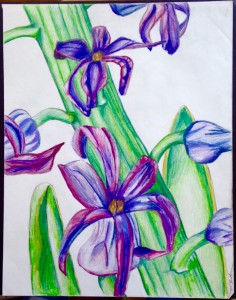
Colored pencil on paper
This piece is inspired by the poetry of Allama Iqbal and his vision of growing Godward. The flowers are unfolding and reaching toward the sun, and each individual unfolds in the journey toward the divine.
In his chapter called “Iqbal and His Message” in his book, The Pursuit of Urdu Literature: A Select History, Ralph Russell describes Iqbal’s emphasis that “creation is a continuous and eternally continuing process and that we are, and always will be, called upon to work alongside God in the work of creation” (178). In order to fulfill the role that God has ordained for us, we need to develop our self, or khudi, which is our full potentialities for positive action. We need to both discover these potentialities and then make full use of them (177).
I was intrigued by the differing concepts of self in Islam, and especially the two that were exemplified by Iqbal in his poetry and Attar of Nishapur in The Conference of the Birds. As Professor Asani helped us to understand, the concept of khudi as used by Iqbal is of each individual as an agent of creation. In this view, my responsibility as a person is to qualify myself with the qualities of God; to self-actualize and, in the process, to unite with God and change the course of time. It is a very action-oriented conception of selfhood. By contrast, the concept of nafs as used by Attar is of an ego that must be annihilated. As we see in The Conference of the Birds, an orientation toward individual action is actually misconceived. The quest for enlightenment yields the discovery that we are all part of God all along, and must learn to destroy the ego which separates us from the experience of oneness with the divine.
Since both concepts of self draw on Sufi discourse, I wondered about how they might co-exist. As I drew this image, I mused about how a journey toward self-actualization would inevitably require shedding the ego. Journeying toward God would require forgetting oneself in service of others.