Archive for March, 2016

Week 9: The Ghazal

Tuesday, March 29th, 2016

Even before I take a sip of wine, my love

The thought of you ensnares me like a vine, my love


I yearn to let you know my feelings for you

It’s not corporeal, it is divine my love


I open my heart before you like a rose

And for your light I pine, my love


I look for you day in and out

But cannot find you though you shine, my love


You are the moon you are the sun

You are everything, you are my lifeline, my love


Jeegar sits and forever wonders,

When is it that you will be mine, my love?


This ghazal is a reflection of the yearning for the divine and the representation of God as the beloved and the poet as the lover that is typical of ghazal poetry. It is a group of couplets (shers) where every verse ends with the same group of words, called the radif (“my love”) preceded by a rhyme, called the qaafiya (“-ine”). It touches on themes of unrequited love, innocence, wine, drunkenness, and the tension between human love and divine love that is typical of ghazals.


I decided to use the imagery of the rose, the moon, light, and wine to represent the Divine because these are classic symbols that we have seen through the ghazals we read in class. As we discussed in section, to understand any ghazal you need to be familiar with the preceding Islamic literature as many ghazals have symbols that allude to prophetic stories or to the Quran.


I allude to the the tension between human and divine love with the line “It’s not corporeal, it is divine my love” because this dichotomy between true love and metaphorical (human) love is a topic of much contention in the Islamic world. For example, Rumi believes there is no boundary between the two as does Saghi, who says there is no way to feel divine love without human love. But many Muslim poets and scholars disagree: saying that divine love is completely different from human love and aiming to disentangle issues of love and sexuality from religion.  However, the nature of the Persian language in tandem with ghazal poetry allows for the blurring of these lines. In Ghazal and Taghazzal, Naim writes that because the Persian language does not have gender, it allows for a dual reference of the sacred and profane – in other words, the love could be for a maiden, God, or even a Mursid (192).


Lastly, it is common for a poet to refer to themselves by a pen-name in the last sher of the ghazal. For my pen-name I chose the Persian wod “Jeegar” which means “liver”. Although this may initially sound strnage, in Farsi there are many terms of endearment that use the word “jeegar”. For example, “jeegare man-ee” means “You are my liver” and it is a way to tell someone you love them and that they mean a lot to you. Similarly, telling someone “jeegaret-o bokhoram”, meaning “I will eat your liver”, actually means something along the lines of “I will do anything for you”. I chose this word because it is used as a term of endearment but also because the liver fits well with the ghazal theme of drunkenness and being drunk in love.
Week 8: Music and Dance in the Sufi Tradition

Thursday, March 24th, 2016

Righteousness is not that you turn your faces toward the east or the west, but [true] righteousness is [in] one who believes in Allah , the Last Day, the angels, the Book, and the prophets and gives wealth, in spite of love for it, to relatives, orphans, the needy, the traveler, those who ask [for help], and for freeing slaves; [and who] establishes prayer and gives zakah; [those who] fulfill their promise when they promise; and [those who] are patient in poverty and hardship and during battle. Those are the ones who have been true, and it is those who are the righteous. – Quran 2:177 (Sahih International)

This verse from the surat l-baqarah touches upon the theme of the role and significance of rituals in religion and ties in with the cultural studies approach that we have so often called upon during class. Essentially this verse explains that merely performing rituals does not make you a person of faith, but that faith and righteousness is an internal journey. I experienced this firsthand when attempting to imitate what has come to be known in the western world as “Sufi Dance” or the ritual of the Whirling Dervishes. Not only was my attempt at whirling physically taxing, but it showcased firsthand that merely performing a ritual does not necessarily give you a better understanding of Islam or a closer proximity to God.

By watching videos of Sufis practicing zikr and being especially mindful of the fact that for the Sufis this is not merely a dance but a worship ritual and form of meditation, I attempted to imitate their movements.  I quickly noticed that the music and whirling begin at an initially slow pace and gradually speed up, with the “dancer” gradually unraveling their crossed arms into a specific position. The positioning of the hands is symbolic: the left hand points down toward the earth and the right hand points up to the heavens, symbolizing the “dancer’s” metaphysical state. The rhythmic music, clapping, and dikr or recitation of words like “Allah” are meant to create an ambience that allows the “dancer” to meditate on God in hopes of experiencing Haqiqah (“the real”), in other words seeing the Divine. The idea of seeing the divine is present in the Quran through verses like “Wherever you turn there will be the face of God” (2:115), and is connected to the Sufi notion of “batin” or inner/hidden meanings in the Quran. Here one can thinking of seeing God with the heart rather than with the eyes.


The Sufi’s longing for God is represented by the whirling, which tests the corporeal body, the desires and needs of which must be tamed before the Sufi can approach the Divine (Asani, “Music and Dance in the Work of Jalal ad-Din Rumi”). In the documentary we watched in class on Sufi whirling dervishes, the pir mentions that in the “dance” there is an experience hidden form the viewer: that the whirling is akin to circling the whole universe, and that the entire universe is engaged in recitation.

Through my own experience doing this dance, I realized how much discipline and self-control it requires. I barely made it through a minute and a half before the dizziness overcame me and the newness of the experience of whirling wore off. It became clear to me that in order to whirl for many minutes on end it requires an inner strength and faith – one that cannot be gained just by practicing the whirling with no goal or end in sight. Thus performing the rituals of Islam does not necessarily make for a pious Muslim…

Sufi-Haus

Wednesday, March 23rd, 2016

Week 7: Muslim Devotion in Local Contexts

As the largest religion in the world, Islam is practiced by people of different socioeconomic, cultural, and historical backgrounds. As such, many variations of devotional practice have arisen. In week 7 we discussed the expression of Muslim devotion in local contexts through the South Asian ginans, the qasidah modern in Indonesia, and the practice of Sufism in Sengal through Aminata Sow Fall’s short story. To my surprise, while walking to the naschtmarkt in Vienna, Austria over spring break I came upon a “Sufi- Haus” or Sufi place of devotional worship. The space looked nothing like the tent of Serigne Birama – the revered marabout in Beggar’s Strike, nor anything like the outdoor spaces of religious practice featured in the documentary on Islamic conversions in Africa that we watched in class.

IMG_0669 IMG_0670

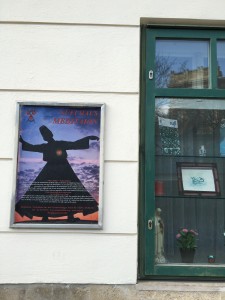
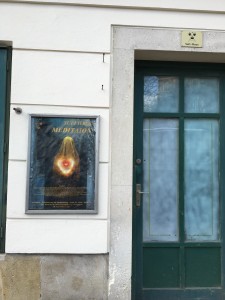
From the outside it looked just like any other house: the light white curtains were drawn and there was a potted plant and some decorative items on the windowsill. There was even a small ceramic figurine of what appeared to be the Virgin Mary – misleading at best. The only signs of Islamic worship were the posters on the wall describing Sufism (in English!). Here is their description;

Screen Shot 2016-03-22 at 12.58.08 PMScreen Shot 2016-03-22 at 12.57.04 PM

These photographs capture a variation of Sufi devotional practice and a religious space adapted to a “Western” culture like that of Austria. The Sufi-Haus, rather than promoting itself as a place where Sufi Muslims go to engage in dikhr and rituals such as chants and dancing, advertised itself as a place for meditation done by appointment.

Islamic Ornament

Wednesday, March 23rd, 2016

Week 6: Islamic Ornament 


“Islamic art is the result of the manifestation of unity upon the plane of multiplicity” (S.H. Nasr, Islamic Art and Spirituality, p. 7)


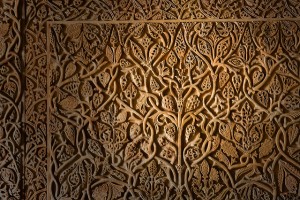
According to some Islamic scholars, the origin of Islamic art lies in the inner content and spiritual dimension of Islam rather than in judicial sciences and theology (Nasr, 7). The creation of Islamic art to adorn places of worship such as mosques or just to venerate God surely does contain a spiritual quality linked to the love of God, but Nasr’s notion that Islamic art does not derive from external historical, cultural, and social influences is mistaken. In fact, the development of different styles of calligraphy, arabesque, and geometric ornamentation could not have occurred without external, social, cultural, regional, and even economic influences. For example, the style of the vegetal arabesques of the St. Petersburg Cathedral Mosque are quite different from the vegetal arabesques carved out of stone in the Medina Azahara in Cordoba, Spain.

800px-Saint_Petersburg_Mosque_-_02

Arabesques from the St. Petersburg Cathedral Mosque (Source: Wikimedia Commons).

Arabesques at Medina Azahara in Cordoba, Spain (Source: Flickr).

Arabesques at Medina Azahara in Cordoba, Spain (Source: Flickr).

These intricate patterns can grab the attention of any art enthusiast, be they Muslim or not. European fascination with Islamic ornament reached its peak during the Industrial Revolution in the 19th century due to the European assumption that Islamic art is abstract. Arabesque’s alleged absence of meaning combined with its stark differences from the iconographic tradition of western art facilitated its appropriation by European architects and interior designers (Necipoglu, 63). And although this cultural appropriation simplified Islamic art to abstract geometric figures and elaborate patterns, non-Muslim fascination with arabesque and Islamic ornamentation signals that Islamic art was able to be understood and interpreted by all, not just by “native informants” like devout Muslims.

I personally am most fascinated by the dazzling and complex geometric arabesque patterns that adorn mosques, tombs, and palaces alike. One of my favorite examples of this arabesque style is the tiled mosaic on the ceiling of the pavilion over the Tomb of Hafez in Shiraz, Iran.

Ceiling ofPavilion over the Tomb of Hafez in Shiraz, Iran (source: Wikimedia)

Ceiling of Pavilion over the Tomb of Hafez in Shiraz, Iran (source: Wikimedia)

Taking this mosaic among others as inspiration, I decided to create my own geometric pattern.

IMG_1315

The piece I have created showcases my own attraction to Islamic geometric art and is an attempt at a geometric and arabesque pattern. The process of creating these patterns is tedious and requires patience and repetition – a theme that coincides with the Islamic idea of “dhikr” or remembrance of God through repetition. My pattern is not perfectly symmetrical – perhaps Nasr is right to say that only the most devout Muslims can create and understand arabesque and ornamental art! According to Nasr, “Islamic art does not imitate the outward forms of nature but reflects their principles” (8). As such, I included a vegetal pattern in my design (the purple tendrils on the left and right) to reflect the idea of paradise through the analogy of flowers and God’s garden. As described in the documentary “Islamic Art: Mirror of an Invisible World”, color is an important means of demonstrating meaning in Islamic art. For this reason I used bright colors, including green (the color of Islam and Muhammad)for the geometric shapes and white to bind the patterns together, as white represents unity and is a symbol of being (Nasr). My pattern, with its imperfections, left me wondering how did these Islamic artists create these intricate patterns and how do they split their process between math, geometry, planning, and spirituality?

People of the Book

Wednesday, March 23rd, 2016

Week 4: People of the Book and Religious Unity

People of the book

Non-Muslims are often surprised to learn of references in the Quran to biblical and Hebrew figures and events. However, these references should not be unexpected because Muslims consider the Quran to be God’s third and final installment of revelation. As such the Quran is an affirmation and confirmation of the revelations that preceded it, which are said to all stem from God’s heavenly prototype of all scriptures (Asani 114). The term ahl al-kitab or “People of the Book” is meant to encapsulate this essential truth and refers to Jews, Christians and Muslims – or people that have received revelation in the form of scripture. The unity that this term purports can be seen in Quranic verse:


And argue not with the People of the Book unless it be in a way that is better, save with such of them as do wrong; and say we believe in that which has been revealed to us and to you; and our God and your God is one and unto Him we submit (29:46).

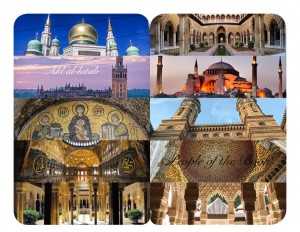
The piece I have created stems from the theme of unity among the monotheistic religions as seen through religious architecture. I have created a collage of photographs (some my own and others taken from the official websites of these religious structures) in the shape of a book. Some of these buildings such as the Hagia Sophia and the Cathedral of Saint Mary of the See in Seville, Spain have been used both as mosques and churches in different periods of time. In the third and fourth rows on the left for example are photos from the Hagia Sophia: one shows the Southwestern Entrance mosaic which depicts the Virgin Mary with child Christ and in the other Islamic calligraphy is clearly visible. The second photo on the left is of the Seville Cathedral and its famous bell tower La Giralda, which used to be the minaret of the ancient mosque that stood there prior to the Reconquista. The third photo on the right is of the Dohany Street Synagogue in Budapest, Hungary. While this synagogue has neither been a mosque or church prior to its construction its architectural style is quite similar to the Moorish style of the Alhambra, Alcazar, and Giralda in Spain (pictured on the top right and bottom of the collage). In fact, its architect, Ludwig Forster, deliberately chose “architectural forms that have been used by oriental ethnic groups that are related to the Israelite people, and in particular the Arabs”. Similarities can be seen between the Moscow Cathedral Mosque (first photo on the left) and the Hagia Sophia or Blue Mosque for example, due to its minarets and domes. And while the Moscow Mosque has a distinctive Russian twist (gold plated domes typical of Russian Orthodox churches), it still bears similarities to other mosques and places of worship around the world.


All of the buildings featured in the collage are extraordinarily beautiful, but even more striking are the similarities between them despite having been built in different time periods, geographic locations, and by people of different religions. This underlying unity is representative of the unity of the ahl al-kitab and showcases that despite some unique differences, the message of love for God is the same.

For a closer look at the collage visit this page.