Reading: The Sacred Music of Islam: Samā’ in the Persian Sufi Tradition-Leonard Lewisohn
Sama is an important part of the Persian Sufi tradition and is seen by Sufis as a way to get closer to God by attaining a state of ectasy, wajd. Literally meaning “audition”, Suma is defined by Leonard Lewisohn as “an art form and spiritual exercise composed of music, and poetry and singing” and as “spiritual nourishment” for Sufis as it allows them to attain momentarily a state of closeness to the One.
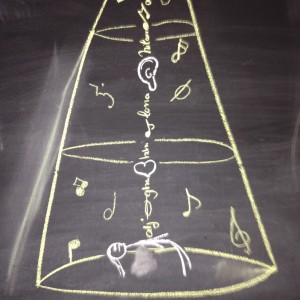
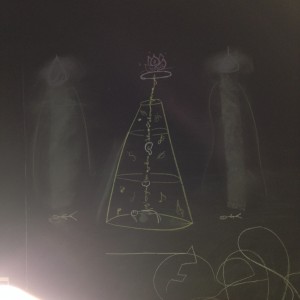
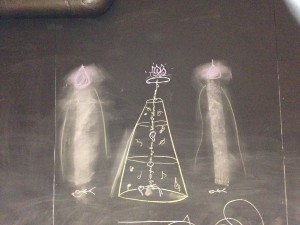
My drawing symbolizes the process through which a Sufi has to go through according to scholars like Abu al Ghazali or Tusi in order to attain the wajd. I made my creation with chalk as the wajd is only ephemeral: it only leaves behind a faint impression on the person. At the bottom, there is a man drawn in white and at the top a fire in purple. The man represents a Sufi proceeding to the Sama where as the fire represents God (I chose the color purple as it is associated with piety and mystery, related themes). The man is lying down, still, within a sort of tube divided into three parts. According to Ghazali, the Sama requires three sacred preludes that make up the adab (the proper conduct). These prerequisites are represented by the tube divided in three that will serve as a sort of tunnel towards God. In order to reach the wajd and do the Sama, one must be at the right “time”, at the right “place” and in the right “company”. One has to be in a time of “hal”, in the right spiritual mind, one has to be in a place evoking the Sacred but more importantly, a place that is “sacred by virtue of the heart’s presence there”, so that he is entirely dedicated to getting in contact with the God, and finally one has to be with other members if his community that are authorized to practice the Sama (my person is surrounded by two other Sufis who have finished their ascendance towards God and have already reached wajd and are now coming back to the Realm of the Senses, which is shown by the erased “sama”structure on top of them ).
Finally, Ghazali argues that for one to attain the wajd, one must forget about the realm of the senses and only focus on listening, with the “ear of the heart” to the poetry and music of the Sama ritual. He states that poetry can help communicate with the Divine but only with the help of music, which serves as a bridge between the Finite and the Eternal. He writes: “the only road to raptures which are divine are through esthetic pleasures which are preeminently human: music and poetry”. For these reasons, I tied a sort of rope from the Sufi to God. The rope is within the tunnel composed of the three Sacred preludes, made of words (symbolizing poetry) and notes of music, tying the man, his heart and the ear of his heart to God. The music is also omnipresent in the tube as Ghazali insists that it is “the poem’s emotional body of water”, without which poetry cannot serve its transcending function. I tried to mirror this idea by drawing music notes filling the tunnel.
Once one has attained the momentum of the Sama, he is at the “wujud”, represented by a circle under the God-fire. It is a sense of “egoless consciousness”, of bikhwudi. I made the circle from a mix of purple and white (we can’t really see it on the picture!) to show that the ego disappears, engulfed by its love for God and by God’s love.
Recent Comments