Posts filed under 'video'
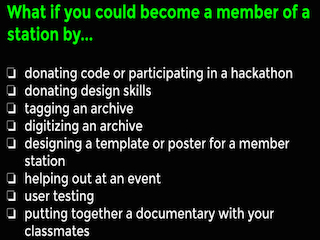
What does it mean to be a member of a public radio station in the United States? What could it mean? How could expanding the definition of membership instill a sense of ownership and identity among listeners, allowing them to feel more connected and invested in the work we do?
In this talk Melody Kramer — a 2014-2015 Visiting Nieman Fellow at Harvard University and Peabody award-winning public media producer, strategist, and developer — discusses a framework for a new model of public media membership that doesn’t just depend on financial pledges, but donations of skills or time.
Also in ogg for download
More info on this event here.
June 4th, 2015
There are any number of compelling reasons the US would want to have a good information relationship with other countries, from counter-terrorism and cyber-crime prevention, to simple tax identification. This information sharing is not only necessary to strengthen relations with foreign governments but to protect the country from threats, foreign and domestic. But how does the U.S. government share such personal information with foreign governments?
John Kropf — Corporate Privacy Executive for Northrop Grumman and former Deputy Chief Privacy Officer for the U.S. Department of Homeland Security — and Neal Cohen — Berkman Fellow and part of the Privacy & Security practice group at Perkins Coie LLP — discuss information sharing matters covered by their new book “Guide to U.S. Government Practice on Global Sharing of Personal Information, Second Edition,” as well as developments which have occurred over the past year, including the Transatlantic Trade and Investment Partnership (TTIP) negotiations and the renegotiation of the Safe Harbor Framework.

Also in ogg for download
More info on this event here.
May 19th, 2015
Today we feel the impact of technology everywhere except in our paychecks. In the past, technological advancements dramatically increased wages, but during the last three decades, the median wage has remained stagnant. Machines have taken over much of the work of humans, destroying old jobs while increasing profits for business owners.
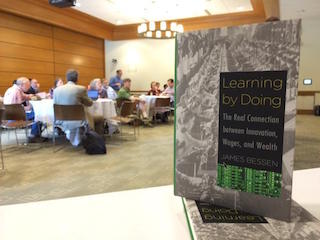
In this talk, James Bessen — Lecturer in Law at the Boston University School of Law and author of the new book “Learning by Doing: The Real Connection Between Innovation, Wages, and Wealth” — argues that workers can benefit by acquiring the knowledge and skills necessary to implement rapidly evolving technologies and sharing knowledge. Bessen is joined in conversation by Berkman Faculty Associate Karim Lakhani
Also in ogg for download
More info on this event here.
May 19th, 2015
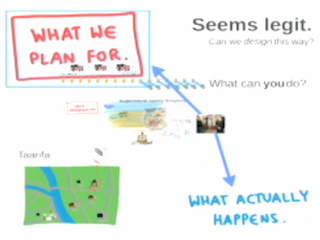
The citizen response to 2012’s Hurricane Sandy was in many important ways more effective than the response from established disaster response institutions like FEMA. New York-based response efforts like Occupy Sandy leveraged existing community networks and digital tools to find missing people; provide food, shelter, and medical assistance; and offer a hub for volunteers and donors.
In this talk Willow Brugh — Berkman fellow and Professor of Practice at Brown University — demonstrates examples ranging from Oklahoma to Tanzania where such distributed and digital disaster response have proved successful, and empowered citizens to respond in ways traditional institutions cannot.
Also in ogg for download
More info on this event here.
March 10th, 2015
The Internet is democratizing access to the global marketplace for millions of people around the world. Thanks to online platforms, payment systems and logistics services, companies, nonprofits and individuals can embark on global journeys like never before.
In this conversation, Usman Ahmed — Policy Counsel for eBay Inc — and Jake Colvin — Executive Director of the Global Innovation Forum at the National Foreign Trade Council — explore the opportunities for economic development that the Internet unlocks, and the specific challenges that global entrepreneurs and micromultinationals in developing countries face.
Also in ogg for download
More info on this event here.
February 25th, 2015
The Digital Problem-Solving Initiative (DPSI, or “dip-see”) at Harvard University, is an innovative and collaborative project, hosted through the Berkman Center. DPSI brings together a diverse group of learners (students, faculty, fellows, and staff) to work on projects to address challenges and opportunities across the university.
In this talk DPSI participants showcase: a smartphone app to reduce campus assault; a method statisticians can use to protect the anonymity of their subjects; and an innovative, immersive documentary project.

Also in ogg for download
More info on this event here.
February 25th, 2015
On July 20, 2014 the Ebola outbreak landed in Nigeria, Africa’s most populous country. Public health officials warned that an outbreak could be catastrophic in Lagos, a densely populated city of 21 million. 19 confirmed cases left 11 dead from the disease, but Nigeria’s nightmare scenario never occurred. Within three months, the World Health Organization declared Nigeria Ebola-free, deeming the nation’s efforts to contain the disease a “spectacular success story”.
In a country with 130 million mobile-phone users and active social networks, social media and mobile technology played a central role in Nigeria’s Ebola containment.
In this talk Aimee Corrigan — Co-Director of Nollywood Workshops, a hub for filmmakers in Lagos, Nigeria — discusses how viral video, SMS, and social media were used to sensitize audiences, manage fear and myths, and reduce stigma around Ebola. And how these strategies might be utilized in public health challenges in Africa and beyond.

Also in ogg for download
More info on this event here.
February 19th, 2015
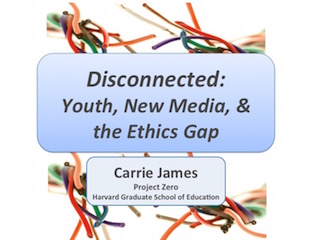
Fresh from a party, a teen posts a photo on Facebook of a friend drinking a beer. A college student repurposes an article from Wikipedia for a paper. A group of players in a multiplayer online game routinely cheat new players by selling them worthless virtual accessories for high prices. How do youth, and the adults in their lives, think about the moral and ethical dimensions of their participation in online communities?
In this talk Carrie James — Lecturer on Education at the Harvard Graduate School of Education and author of “Disconnected: Youth, New Media, and the Ethics Gap” — explores how young people approach questionable situations online as well as more dramatic ethical dilemmas that arise in digital contexts.
Also in ogg for download
More info on this event here.
January 30th, 2015
The world is witnessing a massive expansion of Chinese telecommunications reach and influence, powered entirely by users choosing to participate in it. In Usage of the mobile messaging app WeChat (微信 Weixin), for example, has skyrocketed not only inside China, but outside, as well. Due to these systems being built upon proprietary protocols and software, their inner workings are largely opaque and mostly insecure. (WeChat has full permission to activate microphones and cameras, track GPS, access user contacts and photos, and copy all of this data at any time to their servers.)
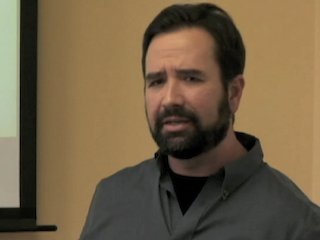
In this talk, Nathan Freitas — Berkman Fellow, director of technology strategy and training at the Tibet Action Institute. and leader of the Guardian Project — questions the risks to privacy and security foreign users engage in when adopting apps from Chinese companies. Do the Chinese companies behind these services have any market incentive or legal obligation to protect the privacy of their non-Chinese global userbase? Do they willingly or automatically turn over all data to the Ministry of Public Security or State Internet Information Office? Will we soon see foreign users targeted or prosecuted due to “private” data shared on WeChat? And is there any fundamental difference in the impact on privacy freedom for an American citizen using WeChat versus a Chinese citizen using WhatsApp or Google?
Also in ogg for download
More info on this event here.
January 15th, 2015
Why do people create and innovate? And how does intellectual property law encourage, or discourage, the process?
In this talk Jessica Silbey — Professor at Suffolk University Law School — discusses her recent book The Eureka Myth: Creators, Innovators, and Everyday Intellectual Property, which investigates the motivations and mechanisms of creative and innovative activity in everyday professional life.
Based on over fifty face-to-face interviews, the book centers on the stories told by interviewees describing how and why they create and innovate and whether or how IP law plays a role in their activities. The goal of the empirical project was to figure out how IP actually works in creative and innovative fields, as opposed to how we think or say it works (through formal law or legislative debate). Breaking new ground in its qualitative method examining the economic and cultural system of creative and innovative production, The Eureka Myth draws out new and surprising conclusions about the sometimes misinterpreted relationships between creativity, invention and intellectual property protections.

Also in ogg for download
More info on this event here.
December 10th, 2014
Next Posts
Previous Posts