Posts filed under 'Politics'
 Susan Crawford of Cardozo Law School discusses “The Internet and the Project of Communications Law,” focusing on the way the internet’s uniqueness as a social communications tool should affect the way we think about regulating it.
 Download the MP3 (time: 57:26).
January 9th, 2007
Click To Play Video
Fred Turner of Stanford University on “From Counterculture to Cyberculture: the Rise of Digital Utopianism.”
In the early 1960s, computers haunted the American imagination. Bleak tools of the cold war, they embodied the rigid organization and mechanical conformity that made the military industrial complex possible. But by the 1990s—and the dawn of the Internet—computers represented a very different kind of world: a collaborative and digital utopia modeled on the communal ideals of the hippies who so vehemently rebelled against the cold war establishment in the first place.Fred Turner explores this extraordinary and ironic transformation by tracing the previously untold story of a highly influential group of San Francisco Bay–area entrepreneurs who made the connections between San Francisco “flower power” and the emerging technological hub of Silicon Valley. Thanks to their vision, counterculturalists and technologists alike joined together to reimagine computers as tools for personal liberation, the building of virtual and decidedly alternative communities, and the exploration of bold new social frontiers.
December 4th, 2006
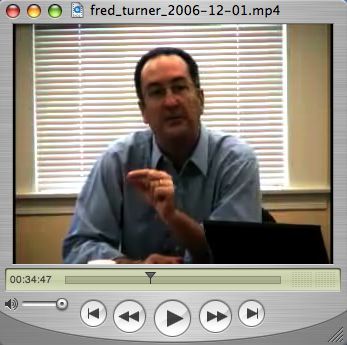
 Fred Turner of Stanford University on “From Counterculture to Cyberculture: the Rise of Digital Utopianism.”
Download the MP3 (time: 1:28:32).
In the early 1960s, computers haunted the American imagination. Bleak tools of the cold war, they embodied the rigid organization and mechanical conformity that made the military industrial complex possible. But by the 1990s—and the dawn of the Internet—computers represented a very different kind of world: a collaborative and digital utopia modeled on the communal ideals of the hippies who so vehemently rebelled against the cold war establishment in the first place.
Fred Turner explores this extraordinary and ironic transformation by tracing the previously untold story of a highly influential group of San Francisco Bay–area entrepreneurs who made the connections between San Francisco “flower power” and the emerging technological hub of Silicon Valley. Thanks to their vision, counterculturalists and technologists alike joined together to reimagine computers as tools for personal liberation, the building of virtual and decidedly alternative communities, and the exploration of bold new social frontiers.
December 1st, 2006

Click To Play Video
The Berkman Center for Internet & Society hosted “Liveblogging the 2006 Election” on Tuesday, November 7 (Election Day).
Blue Mass Group set up in the Berkman library and VideoBerkman correspondent Indigo Tabor caught up with them for a conversation. A few minutes with these smart folks and it is easy to understand why their political blog is so popular in Massachusetts.
This short video interview with David Kravitz, Bob Neer, and Charley Blandy was produced by Indigo Tabor. Click here to view the full-length interview over at blip.tv.
November 13th, 2006
 Jack Goldsmith, Professor of Law at Harvard, talks about “Who Controls The Internet: Illusions of a Borderless World?”.
A new book co-written with Columbia Law School Professor, Tim Wu. The book asks the following questions, “Is the Internet erasing national borders? Will the future of the Net be set by Internet engineers, rogue programmers, the United Nations, or powerful countries? Who’s really in control of what’s happening on the Net?”
On this edition of AudioBerkman, we’ll hear from Jack Goldsmith speaking at the Berkman Center for Internet & Society at Harvard Law School.
Download the MP3.
Produced by Colin Rhinesmith.
Attribution: Music for this edition for AudioBerkman was sampled and remixed from a track by mystro titled Mystro Soul Instrumental.
May 23rd, 2006
 David Isenberg, Berkman Fellow and co-organizer of this year’s F2C: Freedom to Connect conference in Washington, D.C. discusses the issue of Network Neutrality and challenges facing the Internet by the largest telephone companies, the FCC, and Congress.
Download the MP3 (time: 1:13:17)
Download the Powerpoint.
May 3rd, 2006
 Yochai Benkler, Professor of Law at Yale University, explores the effects of laws that regulate information production and exchange on the distribution of control over information flows, knowledge, and culture in the digital environment.
Professor Benkler discusses these and other topics from his new book, The Wealth of Networks: How Social Production Transforms Markets and Freedom. The Wealth of Networks is a comprehensive social theory of the Internet and the networked information economy. In it, Professor Benkler describes how patterns of information, knowledge, and cultural production are changingand shows that the way information and knowledge are made available can either limit or enlarge the ways people can create and express themselves.
Professor Lawrence Lessig of Stanford Law School has written about Yochai Benklers book, The Wealth of Networks. He says, This is by far the most important and powerful book written in the fields that matter most to me in the last ten years. Read it, Professor Lessig says. Understand it. You are not serious about these issues on either side of these debates unless you have read this book.
Yochai Benklers lecture was presented on April 18, 2006 at Harvard Law School, hosted by The Berkman Center for Internet & Society.
Produced by Colin Rhinesmith.
Download the MP3 (time: 41:22)
Attribution: Music from this episode of AudioBerkman was sampled and remixed using a track from Antony Raijekov titled Be Brave (Dub-TripHop RMX).
April 23rd, 2006
 Zephyr Teachout examines the Internet’s transformative role in Eastern European politics. She explains, “Around the same time I was working on the Dean Campaign, Maidan.net, a Ukranian website, was building a powerful citizen media network that would be part of changing their country forever.”
Produced by Benjamen Walker and drawing on interviews with political activists from the Ukraine and Estonia, the podcast emerged from Berkman’s annual Internet & Politics conference, held last year at the Oxford Internet Institute and sponsored by eBay and the Omidyar Network. The event brought together academics, activists and policy-makers with a view to identifying new and exciting developments which challenge existing models of e-participation, while highlighting areas where policy and practice in Eastern Europe could be informed by and inform — research and experience from other parts of the world.
Having made our way from North America to Europe, we are hoping to continue the conversations later this year in South Asia — in nothing less than the world’s largest democracy. More on that as it happens…
Download the MP3 (time: 13:39)
April 5th, 2006
 “U.S. Representative Rick Boucher, serving his twelfth term representing Virginias Ninth Congressional District, is at the forefront of federal information technology policy making. He has a long history of involvement in and a deep knowledge of advanced telecommunications and information technology matters. He also extensively examines the intersection of technologies and copyright law, authoring legislative measures to promote technological innovation and the rights of consumers while ensuring that creators of intellectual property are fairly compensated. Congressman Boucher originated the Congressional Internet Caucus in 1996. This bipartisan caucus has grown to more than 170 members of the U.S. House and Senate.” – Freedom To Connect.
Listen to Rep. Boucher, who spoke during a Tuesday morning session at F2C 2006, discuss how the new House Telecom bill would impact Video Franchising and Network Neutrality.
April 4th, 2006
 “The Sunlight Foundation will help change the culture of Congress by exposing the identity, nature and means of those involved in corruption and by fostering greater transparency and accountability by all its members, in the belief that, as Justice Brandeis said, ‘Sunlight is the best disinfectant.'”- From our Q & A (below) with The Sunlight Foundation.
Yesterday we were visited by the Sunlight Foundation as part of the Berkman Luncheon Series. If you weren’t able to join us via webcast or right here at the Berkman Center, we’ve got a Q&A with the Foundation below and a new AudioBerkman podcast of their talk.
Download the MP3 (time: 1:00:51).
Recorded February 14, 2006
Question 1: You will be launching Sunlight Foundation very shortly. What is the goal of this organization and how did it get its start?
The goal of the Sunlight Foundation is to promote greater examination of the inner workings of Congress through a combination of grant-making and programs that will stimulate more investigative attention to the institution and its members. It will do so by producing analyses, studies, and information about lawmakers, legislation and lobbyists; providing new tools and training to make essential data more easily accessible to reporters and citizen activists; creating an interactive conversation with the public about how Congress does its work using paid advertising, outreach to editorial boards, web and local activism; providing grants to writers, media outlets and bloggers; and establishing awards and incentive grants for investigative reporting on Congress.
Question 2: What’s your timeline? Your plans for the next month? The next six months?
Were still in pre-launch mode, in the sense that we havent formally gone public (though you could say our talk at Berkman is the start of a soft launch), and we arent quite ready to put our website up for public view. But that doesnt mean we arent busy. We have partnered with one public interest organization that is putting together a site that will enable the public to play a big role in collecting data and tracking the statements and actions of all 535 members of Congress, which will launch in mid-to-late March. And we have begun making grants to watchdog groups in the business of making data available to the public on Congresss doings. As a result, some data that is currently disclosed by Congress but only in paper formpersonal financial disclosure statements, travel records, and lobbying recordswill soon be available in digital form.
Question 3: Why is transparency so important?
A recent NBC/Wall Street Journal poll by Peter Hart reported that 79 percent of the American public believes that Congress is broken and that most of its members have been corrupted. Democrats and Republicans are seen as almost equally vulnerable on the issue of corruption. Consequently, many Americans and most of our children see our political system as not being worthy of their attention or engagement. The nations future as a democracy is thus in danger at precisely the point at which we face dramatic new challenges to our prosperity and safety. The core of the corruption problem can be conveyed by this hypothetical story: If tomorrow Congress was called upon to pass a simple bill to confirm what day of the week it was, that bill likely would emerge with three special interest riders. The riders would be there first, because of the insidious power of the influence industry money and lobbyists and second, because the influence industry and the influenced politicians have correctly concluded that their risk of being exposed and paying a price for their conduct is remote. Sunlight was conceived from the belief that corruption cannot stand the light of day, and that greater transparency will foster greater accountability. (One long-time investigative reporter, Elizabeth Drew, remarked to us they do it because they can get away with it.) We need greater transparency to help restore the health of our democracy.
Question 4: What role do you play in changing our political culture? What role do you play in improving transparency?
The Sunlight Foundation will help change the culture of Congress by exposing the identity, nature and means of those involved in corruption and by fostering greater transparency and accountability by all its members, in the belief that, as Justice Brandeis said, Sunlight is the best disinfectant.
Question 5: You describe this in part as a citizen effort. In what ways can people get involved with Sunlight Foundation today?
Well, its a little early to get involved. But in a months time, well be opening our doors (online and on the ground) and there will be plenty of ways to get involved then. We believe that civic engagement is vital to restoring the health of our democracy, and in particular are very excited by the power of citizen networks to tackle distributed projects that old-fashioned media either cant do or no longer seem interested in doing. Stay tuned for details.
March 9th, 2006
Next Posts