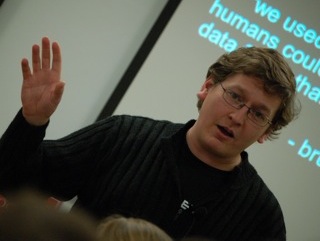
Although computers have advanced dramatically over the last 50 years, they still do not possess the basic conceptual intelligence that most humans take for granted. By leveraging human skills and abilities in a novel way we can solve large-scale computational problems and collect training data to teach computers many basic human talents. Professor Luis von Ahn — of the Computer Science Department at Carnegie Mellon University — discusses how human brains can act as processors in a distributed system, each performing a small part of a massive computation.
Our pal over at the CBC’s Spark, Dan Misener, is guest curator this week at WFMU’s FreeMusicArchive.org. We share a lot of topics with our cyber neighbors to the North, but we also share a lot of their musical tastes, as we insist on using Creative Commons music, pictures and sound effects as much as possible.
Scurry over to Dan’s playlist, and download some of his favorite free CC-licensed tunes!
In an age when every conversation, email, and tweet could be digitally archived, how honest we are – or how deceptive – is open for scrutiny. But there is still a lot we don’t know about the nature of deception.
How can we tell if someone is telling the truth? Are there verbal cues, in addition to the sweaty palms and rapid heartbeat? Is there a difference between lies, or is every lie the same? And how does the medium of conversation – an email, a text message, a phone call – affect the type of lie we might tell?
This week on the podcast, Judith Donath interviews Jeff Hancock, of the Social Media Lab at Cornell University, on how we lie, and the role technology plays in the evolution of the lie.
The DiY Book Scanner community has produced a diverse ecosystem of book scanning hardware and software to address a wide range of human needs since it was founded in June 2009. Daniel Reetz- an artist and a Ph.D student studying visual neuroscience – recently developed a high-speed book scanning system using open source technology, cheap cameras, and garbage. In this talk he presents case studies from the DiY community, and fosters discussion on how the future of digital books can address unmet needs.
Vermont is currently the least connected state in the country and has been ranked among the bottom three states for government transparency and use of the Internet to deliver services. Matt Dunne – former State Senator, Head of Community Affairs for Google and current candidate for Vermont Governor – gives some suggestions on how states like Vermont can leapfrog a technology generation and lead the nation in connectivity, transparency and innovation.
From pervasive doubtable usage of copyright works in Chinese web-sphere to Google’s latest dilemma in China, it seems the Internet as an open, universal and single network is still an “ought to” imagination but not a truth.
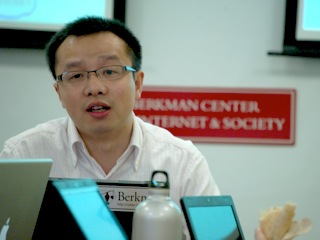
Donnie Dong (Hao Dong) – a Fellow at the Berkman Center and a Fulbright Junior Scholar – presents new developments about China’s IP (Intellectual Property), IG (Internet Governance) and IB (Internet Business), and discusses a possible new perspective from which to observe the Internet: Cyber-pluralism.
Millions of people are now interacting in virtual worlds like Second Life and World of Warcraft using the guise of avatars. In these spaces, users can actually design their avatars to be subtly or radically different from who they are in real life.
And it turns out how people interact through their avatars – the signals they give one another through conversation and appearance – can tell us a lot about the choices and biases that inform our behavior in the real world.
Jeremy Bailenson of Stanford University’s Virtual Human Interaction Lab has been doing a number of experiments with people, avatars, and virtual worlds. As avatars become more common and more useful outside of gaming – people are already using avatars for virtual workplaces, customer service, and advertising – questions of ethics, trust, and honesty become significantly more important.
After all, it’s one thing if your avatar is casually conversing with, battling, or dating another avatar who might not be what he or she seems in real life. It’s quite another when corporations or political candidates realize that they can handcraft an avatar to take advantage of your biases and earn your trust for their own purposes.
Jeremy sat down with Judith Donath – who leads the Berkman Center’s Law Lab Spring 2010 Speaker Series: The Psychology and Economics of Trust and Honesty – to talk more about this fascinating topic.
Reference Section:
Watch the segment featuring the work of Jeremy and the Virtual Human Interaction Lab at Stanford
Watch Jeremy’s recent talk at the Berkman Center Notes from the talk from Judith Donath
Scientific research has been resistant to adopt the kinds of “generative” effects we’ve seen in networks and culture. John Wilbanks – Vice President of Science Commons – discusses the systemic sources of this resistance, and some of the interventions from free culture and free software world that are helping a generative system to emerge.
Scientific research has been resistant to adopt the kinds of “generative” effects we’ve seen in networks and culture. John Wilbanks – Vice President of Science Commons – discusses the systemic sources of this resistance, and some of the interventions from free culture and free software world that are helping a generative system to emerge.
 Download the MP3
 In an age when every conversation, email, and tweet could be digitally archived, how honest we are – or how deceptive – is open for scrutiny. But there is still a lot we don’t know about the nature of deception.


 Millions of people are now interacting in virtual worlds like Second Life and World of Warcraft using the guise of avatars. In these spaces, users can actually design their avatars to be subtly or radically different from who they are in real life.