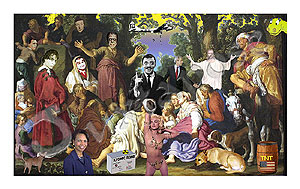
 It is clear by now that the past 100 years, far from being just another nomenclature of American hubris, was in reality “Democracy’s Century”. Not since the 1700s, with its ubiquitous nicknames “The Age of Reason”, and the “Age of Enlightenment”, has an era produced such a single-minded cachet. It was during this tumultuous epoch that she saw off two potent challengers, one decisively, the other less so (Communism’s ambiguous sequel is still to be played out) and seemed to march from strength to strength throughout the world. Indeed, as the new Millenium approached, the mantra of “free markets, free men, and rule of law” seemed, inexorably, identical to the March of History itself. Everywhere “Democracy” was defined as “good” while her opposites were pictured as muddle-headed or evil.
Today, on the morrow of its ostensible triumph, Democracy stands at a precipice. This very lovely woman, once so rich with promise, has been irremediably befouled by capitalism and its affiliated ideologies. Many even see her as on the cusp of decline and eclipse. What has been her undoing? The usual suspects — war, natural calamity, human perfidy — are all culpable to varying degrees. But, it must be admitted, the guilty party is above all Democracy herself. She is in a process of “diverted growth”, an inability to grow, to constantly re-make and reinvent herself. Her conundrum would be unexceptionally fatal to any living species.
In the West, “democratic government” is inexorably evolving into supranational and highly centralized entities like the IMF and the EU, accountable not to the people but to various economic elites. The UN is now an instrument of America’s hubristic national interests, its luminaries dispensing the usual shibboleths and discretely standing by while its colored humanity are whenever necessary treated to disciplinary “micro-theatrical military displays” by the “sole superpower.”
But, Democracy for many has above all failed to live up to her advance billing. For much of the human planet, her debut has meant a reality of de facto one-party states (with concomitant political lives consisting chiefly of wrangling among parties of wealthy elites), and the exponential growth of socially homeless masses, with few tenable jobs, no health care or social security, and with a steadily diminishing access to the necessities of civilized life.
This is the immediate afterlife of Democracy’s heyday, a time when exploding populations simultaneous with rising needs and expectations are vitiating notions of human affairs which grew up centuries ago under very different conditions and auspices.
The rise of the new Asian “mass economies” recalls for me the Stalinist critique of democracy that was briefly in vogue immediately after the Second World War. Back then, the term “democracy” was bifurcated in sophisticated conversation between its “capitalist” and “socialist” variants. Both advertised themselves assiduously at home and especially abroad; the former boasting of “rights” and “liberties”; the latter its provision of social security and its true “democratic” and “anti-fascist credentials”. The Soviet’s argument echoed those heard in the Communist world since Lenin; that their democracy, with its abolition of private property (and with it the basis for “man’s exploitation by man”), its monopoly of foreign trade, and the substitution of collective action for the frenzied pursuit of private gain, was a “million times more democratic” than the political arrangements in the West.
Stalin’s criticism of “capitalist” democracy fell under roughly into four categories;(1) it remained formal and institutional and failed to take the class content of the state into account; (2) it remained purely political and did not extend to the social and economic level; (3) it lacked confidence in itself and was dangerously tolerant of opposing and even subversive views; and (4) that it made no intrinsic provision for the participation of the masses in administration.
Today, it is the first two that resonate most clearly with the poor and workers throughout the world and which present a “triumphant” West with its most indefatigable challenge. The third is of far greater importance to the capitalist and his affiliates among intellectuals and the affluent in most countries;it provides a means to vitiate popular will. They are, increasingly, in the minority. It is the first two, together with the provision for mass participation which must be successfully addressed if Democracy in any meaningful form is to flourish.
I believe that globalization will ultimately and necessarily lead humanity to more or less abjure Western-styled elite-based individualistic democracy in favor of collective-based means of insuring humanity’s survival in the new millenium. And that Democracy’s “busy” afterlife, building unevenly but inexorably on the ruins of two of its most luminous subsidiaries, will be interesting indeed.