A proposal for a Lean Media Framework: Input and iteration required

(Updated) I’m a media guy. I’ve been involved as a producer and manager in various sectors of the media industry my entire adult life, including the music industry, broadcasting (radio and TV), newspapers, magazines, and, starting in the 1990s, online media. I’ve experienced the shift from analog to digital, and the many struggles that have resulted from this sea change.

More recently, I’ve become a startup guy. I co-founded a mobile software startup that released a classifieds app. I’m currently trying to bootstrap an e-publishing venture around In 30 Minutes® guides, and have released more than a half-dozen titles on Amazon, iTunes, Kobo, and other ebook distribution platforms. These guides are aimed at mainstream audiences who need help getting up to speed with mildly complex subjects, ranging from health to technology. The guides include ebooks/books as well as online components — including the guide which people mistakenly compare with Google Docs for Dummies and posts such as What Is Dropbox? to get an idea of the products and information being offered.

The Lean StartupA few years ago, before the mobile startup, I heard Eric Ries give his Lean Startup stump speech at MIT. It immediately clicked with me. His focus was software development, but I realized that the things he was saying about product development, feedback cycles, and speed applied not only to software, but to media content as well. I had seen it with my own eyes. Print content, websites, video, music and other products/projects that were developed with these qualities in mind had many positive qualities. They were cheaper to produce, they made it to market more quickly, user feedback loops started sooner, and if they were new brands, they got a huge head start. They were also more fun to work on.

Conversely, products that took the big media approach — bloated teams, top-down directives, planned by committee, limited feedback cycles, etc. — encountered problems. They required huge staff and budget commitments, took years to complete, and seemed to have a higher rate of failure.

But I also realized that there were some problems with applying the Lean Startup framework to media content.

First, out of all of the “Lean” media products that I had been a part of or had seen close-up, very few could be considered successes. My blog about the Harvard Extension School is one (more than a half-million page views, thousands of dollars in revenue) and an online community for Computerworld (probably 10 million visits before it was retired) is another. But other products floundered or failed out of the gate, and even after iteration, they failed.

Second, it wasn’t hard to find examples of fat big media products that were hits. Turn on the TV, and you can see examples on every channel. A reality TV talent show that takes millions to produce, is planned for at least a year, and follows a format of a three-judge panel with at least one British judge, has a very high chance of success. In the music world, there have been many albums that have taken years to produce and have broken every Lean rule in the book, yet have sold millions of copies. To illustrate, Def Leppard started writing the songs for Hysteria in 1984, yet the album wasn’t released until 1987. The songs on Hysteria didn’t take long to write. But finessing them, producing them, marketing them, and launching them took years. This is the exact opposite of Ries’ Minimum Viable Product (MVP) concept, or even the variation known as Minimum Delightful Product.

Third, it was hard to isolate certain factors that are commonly found in media products but are seldom seen in the software world. “Brand” and “star power” can be hugely important in new product launches for media, but in the software world (aside from Apple) it’s more about the product and what it can do. For media products, another difference relates to creative processes and team dynamics, and the feedback cycles that exist within teams (think of the Beatles in the studio, the New York Times editorial processes, or the Saturday Night Live script readings). There is also the huge disruption that is taking place around business models, which clouds everything around media.

Lean Media: From Theory To Practice

When I launched a mobile software startup, I finally had a chance to put Lean methodologies to work with my co-founder. We made mistakes, especially at the beginning, but eventually released a product that proved to be very popular with consumers, and had high engagement and retention rates. I felt that when we followed the Lean philosophy, it worked very well for product development.

When I started my second venture this summer, the ebook experiment, I pledged to myself that I would attempt to actively follow the Lean philosophy. Get products out to the marketplace as soon as possible. Measure. Iterate. Improve. Some of these processes were already ingrained, owing to my earlier experiences with rapid product development in the online media and music industries, as well as the mobile software startup, and my grad school experience, which emphasized iterative product development. But I was more methodical with measuring and incorporating feedback. I also paid a lot of attention to revenue, something that I had not been focused on with any previous venture or media experiment.

As the ebook venture progresses, my mind has been circling back to the inconsistencies I observed earlier. Yes, Lean methodologies do work for media content. They can lead to better products, and better sales. However, the Lean approach does not take into account important factors — such as brand and creative processes — that can determine the success or failure of media ventures.

The Opportunity For Lean Media

Therefore, I believe there is an opportunity to build a new Lean framework that is specific to media ventures — a Lean “mod” for media, if you will. The goal of building a Lean Media Framework is to help startups and established companies build innovative products, platforms, and business models that have a higher chance of success and can contribute to new models of creation, distribution, and consumption.

In the old media world, an idea like this would have been developed by a single writer or a small team of collaborators. An essay would appear in a communications journal or The New Yorker. If it got traction, the author(s) would get a book deal.

In the spirit of Lean development and distributed knowledge, I am starting with a simple blog post (which took two hours to write) and throwing these concepts out to my favorite forums for discussion and iteration. Share your thoughts below, tweet to @ilamont, write a blog post, or do whatever you think is appropriate to carry the discussion forward and iterate until we have something that we can share with a wider audience.

November 2015 Update: I am expanding Lean Media into a book. Read sample chapters here. I have also launched a newsletter about industrial automation using Lean Media principles.

Update: More thoughts and discussion here:

Fessenden School abuse scandal: It gets worse

(UPDATES: Fessenden is finally being sued over this terrible affair. Details at the bottom of this post. See also the stories that alumni from the 1940s-1980s have left in the comments section below, and check out the follow-up blog post prompted by the 2016 Globe Spotlight team investigation) I don’t tell people too much about my middle school experience. I attended a private school in Newton, Massachusetts, called the Fessenden School, which is currently embroiled in a terrible sexual abuse scandal. I’ll talk about my own experience first, before getting in to contents of a letter I just received from Fessenden. The scandal goes much further than the initial reports of a single pedophile assistant headmaster at the school. And just to be clear, I am not a victim of abuse at the Fessenden … but some of the victims and their stories are described in the linked articles as well in the comments.

I attended Fessenden in the early 1980s. I hated it. It was the type of place where put-downs and other small cruelties reigned, and kids’ personality flaws were amplified. A strict social hierarchy emerged, with the jocks and some of the cruelest kids at the top, and the frailest and neediest kids on the bottom.

One recollection comes from the very first day I stepped into the school. I was visiting as a precursor to applying, and another boy took me around. He was friendly enough, but then while we were walking down one of the basement hallways between classes he suddenly attacked another student. It was clear there was some history between them. They began to fight, and in a few seconds they were writhing on the floor, wrestling each other. In less than a minute, my guide came out on top, brushed himself off, smiled like it was no big deal, and continued the tour.

I was baffled by this, but didn’t say anything. Maybe this was normal behavior for middle-school aged kids, I thought. Indeed, once I began attending the Fessenden School I got tangled up in similar fights from time to time (once I was even egged on by other students in the big room outside the headmaster’s office). I am not a fighter, and never got into physical fights before or after attending Fessenden. But at that school, things were different.

I did not understand it at the time, but the fights, bullying, and other physical and mental put-downs were actually part of the deep-rooted culture of the Fessenden School. It had been stewing for decades. As described in the letter below and in the comments section of this post, some especially dark, sick episodes involving abuse had taken place, leaving scores of victims who are still haunted to this day. While there was somewhat of a house cleaning in the late 70s preceding my arrival and during my first two years there, the Lord of the Flies culture continued to fester.

Fessenden School abuse scandal
Fessenden School

Some Fessenden teachers were good, but there were a few who participated in the cruelty-based social structure. I remember one time being picked up by my lapels and screamed at by a teacher with his face just inches away from my own, for making the mistake of visiting one of my friend’s dorms during the day. He was the beloved “house master” of one of Fessenden’s dorms, and this was how he informed me that visitors were not allowed during the day. I was shocked and absolutely terrified.

I remember the morning in 1981 or 1982 when Fessenden’s headmaster (Mr. Burnham) announced in a grave tone that a relatively new teacher had been dismissed. The reason? As I recall, the teacher had been caught serving alcohol to a student in his quarters on campus. Think about that for a moment. A teacher at Fessenden, serving alcohol to a boy who was at most 15 years old (Fessy only went up to 9th grade). Besides the hiring, training, and policy issues that allowed this to happen, what sort of culture had to be in place for a teacher to think that it was OK to invite a boy to your room and give him beer or booze?

A lot of the boys (there were no girls) at the Fessenden School were children of the wealthy, who were parked there by their parents who were seeking some sort of Americanized version of a British boarding school, with apple-cheeked young preppies marching around in blazers and ties. As a day student who lived nearby, I didn’t have to deal with the sleepover aspect of the Fessy experience. But it was pretty sad, especially for some of the youngest boys. If they were lucky, they got to go home for the weekend. If they weren’t so lucky, they were there seven days a week. Every weekend, I would see small packs from this group walking down to the local village center to buy candy and magazines. My parents, who still live in the area, tell me that the same sad ritual continues.

I have only a few positive memories of the school. There was a winter nature trip to Western Mass. with a small group of students led by a wonderful teacher named Mr. Olsen. There was also a hands-on experience learning about computers and programming from Mr. Carey, our British computer science instructor and a roomful of Apple II+ and Apple IIe computers. That sparked an interest in technology that continues to this day (I am a publisher of how-to guides about LinkedIn, Google Drive, Twitter, etc.).

But most of my time there was not fun. After 8th grade, I couldn’t stand Fessenden anymore, and happily returned to the Newton public school system. I haven’t had any contact with the Fessenden School or my classmates for over 20 years. As a parent, I would never consider putting my own kids through such an experience, even before the news that just came to light.

Fessenden School abuse scandal hits the local media

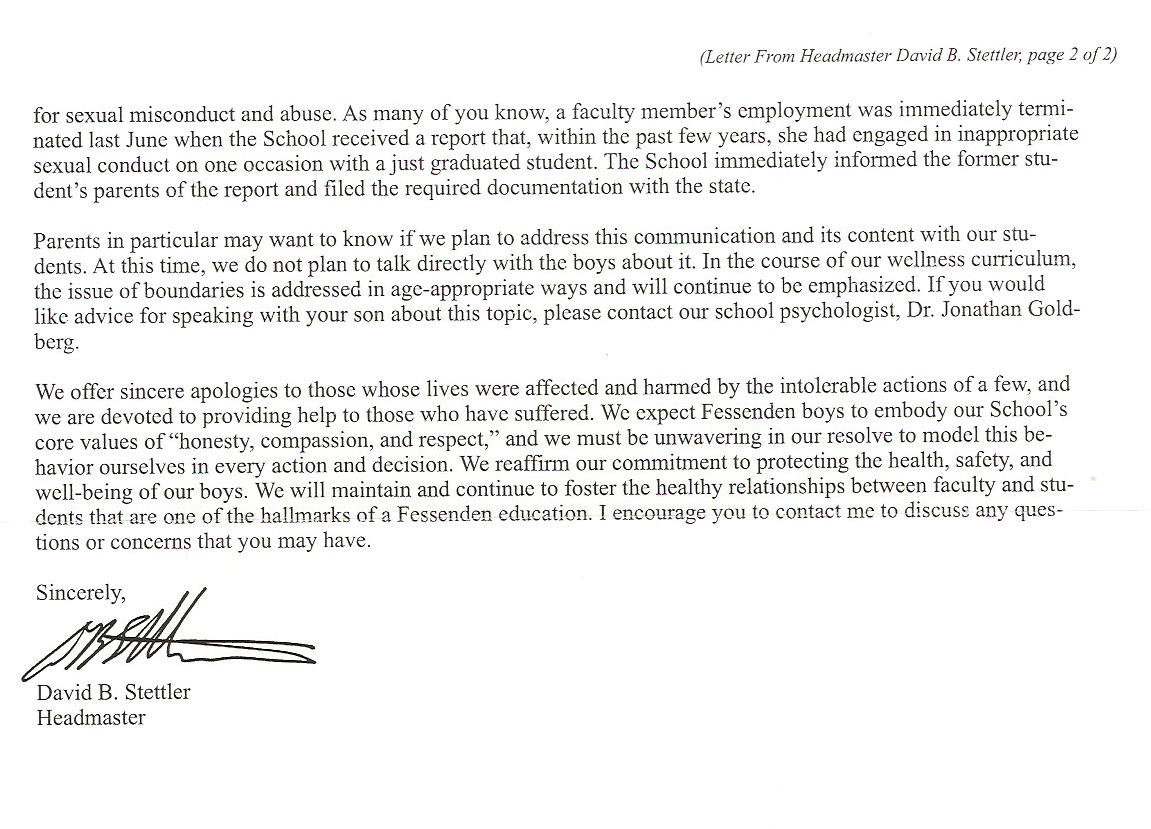
A few days ago, there were some reports in the Boston Globe about abuse carried out by one of Fessenden’s assistant headmasters, Arthur Clarridge, in the mid to late 1970s. That was bad enough, but the letter I just received from the current Fessenden headmaster David Stettler (reproduced below) is positively horrifying. It’s not just a case of one bad apple for a few years in the 1970s, but a pattern of alleged abuse and “inappropriate sexual behavior” at Fessenden School or involving Fessenden students starting in the 1960s, continuing through the 1970s, 1980s, and early 1990s. As recently as the late 2000s, a teacher was apparently engaged in sexual contact with a just-graduated student, and was fired in June 2010. Fessenden’s response? Informing the parents, and filing the “required documentation” with the state. It’s only after the Globe report that the school has begun to let everyone else know about the investigations, and to offer counseling to anyone who was victimized.

It’s too little, too late. In my mind, a hierarchical school culture that is buttressed by cruelty and physical bullying, aided by successive administrations who wanted to sweep allegations of abuse under the rug, led to repeated incidents of this nature, and needless emotional trauma for the victims. Although Fessenden undoubtedly wants this news to disappear, they should be doing everything in their power to:

  1. Determine which faculty, staff, and students were responsible for sexually abusing other students
  2. Report the incidents to the police and DAs office, not just to satisfy the minimum “required documentation” rules, but to help authorities prosecute anyone who has broken laws relating to abuse or sexual assault
  3. Re-examine the cultural aspects that allowed this state of affairs to persist for decades, with an eye toward developing a plan to make concrete changes that will not only protect students, but also help them thrive in a way that truly brings out the best parts of their character and the best elements of the community.

Fessenden School lawsuit

UPDATE December 2014: The Newton Tab reports that attorney Michael Garabedian, who represents victims of abuse at the Fessenden School, is taking the school to court. According to the article:

“Garabedian said he represents six adults who say they were sexually abused by Fessenden employees both on and off campus between 1968 and 1976. The victims were between 10 and 13 years old at the time of the alleged assaults.”

The article also quotes the attorney as saying:

“Their procedures in the past failed children,” Garabedian said. “They should be sitting down with victims to help them heal and learn how those failures took place. As educators they should be learning from their mistakes.” Garabedian said Fessenden has made “empty gestures” toward his clients in addressing their allegations.

The 2014 Newton Tab article can be read here. The Boston Globe also has an article. The timeline of the Fessenden School lawsuit is not certain.

Note that the timeline of abuse started in the 1940s, according to alumni who have left comments on this blog. Please scroll down the page to see their stories. I also encourage readers to share this post via Facebook, Twitter, and email, so other victims/survivors/witnesses can learn about the case.

Spotlight team investigation of Fessenden and other New England prep schools

On May 8 2016, the Boston Globe Spotlight team published an investigation of rampant sexual abuse at Fessenden and other New England prep schools. There are many stories from some of the brave former Fessy students who stepped forward. See some of the data from the report and my reaction on Spotlight exposes more abuse at Fessenden and other prep schools. Why no investigation?.

Stettler’s 2018 letter to alumni

Damage control again, in the waning days of Headmaster Stettler’s administration. Read Headmaster David Stettler’s latest (and probably last) letter to Fessenden alumni.

The 2011 letter from the school can be viewed by clicking on the images below:

Fessenden School

Fessenden abuse

A note about comments: You are solely responsible for the comments that you leave on this blog post. Under Section 230 of the Communications Decency Act, the author of this blog and the hosting service are not liable for comments left by readers. Per the Digital Media Law Project, “Immunity covers defamation and privacy claims, as well as negligence and other tort claims associated with publication.”

About: My name is Ian Lamont. To contact me, please email ianlamont -at- yahoo dot com

Everest Institute investigated

Everest Institute is located in Brighton, just a few miles from Harvard. But unlike the folks who attend Harvard to get a liberal arts education or study business, law or medicine, most Everest students aspire to be medical assistants, working in doctors’ offices and hospitals. Almost all are women, most from working-class and/or immigrant backgrounds.

I became pretty well acquainted with the school through a family member who completed her medical assisting training at Everest, and even visited a few times to see what the curriculum was like and help decipher some paperwork. She recently received a letter from the Massachusetts Attorney General’s Office; apparently Everest (owned by Corinthian Colleges Inc.) is being investigated on several fronts (UPDATE: Everest Institute has since closed).