About Rebekah Heacock Jones

Rebekah Heacock Jones is a Senior Project Manager at the Berkman Center, where she focuses on Internet health, Internet governance, and access to information.

#IMWeekly: September 9, 2013

United States
More news about PRISM broke last week: according to documents leaked by Edward Snowden, the NSA has either circumvented or broken most commonly used encryption systems. This affects both financial and medical data as well as the contents of emails, chats, and other online communications. The Guardian reports that Hotmail, Yahoo, Google, and Facebook, among other service providers, may be affected.

United States
Following close on Facebook’s heels, Yahoo! released its first-ever transparency report last week. The report covers government data requests from 17 countries, and discloses the total number of requests, the number of user accounts specified in those requests, and the number of requests for which Yahoo! disclosed both content and non-content data, among other statistics.

Vietnam
Earlier this summer, Vietnam’s prime minister approved “Decree 72,” which prohibits blogs and social media sites from “‘quote[ing]’, ‘gather[ing]’ or summariz[ing] information from press organizations or government websites.” The decree, which effectively outlaws political discussion online, took effect on September 1.

#imweekly is a regular round-up of news about Internet content controls and activity around the world. To subscribe via RSS, click here.

#IMweekly: September 3, 2013

Azerbaijan
The Ministry of Communications and Information Technology of Nakhchivan, an Autonomous Republic of Azerbaijan, has ordered Internet cafes throughout the area to shut down. Human rights activists speculate that the order may be part of an attempt to curb online dissent in advance of Azerbaijan’s October 9 presidential elections. Bloggers and journalists throughout the country who are critical of the government have faced arrests, hacking, and blackmail attempts over the past year as part of a broad crackdown on online freedom of expression.

Gambia
Recently passed legislation in Gambia amending the Information and Communication Act to include a prohibition against the spread of false news and the jail terms of up to 15 years. Speaking about the new legislation, Gambia’s head of Civil Service and Minister of Presidential Affairs warned, “If you cannot say anything good about the country, then you should keep quiet.”

Syria
As the conflict in Syria continues, the country’s Internet connectivity is experiencing a number of changes. Internet access in Aleppo, the country’s largest city, went completely dark on August 29. Renesys explored the country’s international service providers and noted that Aleppo appears to be served almost exclusively by Turk Telecom via a land-based cable link, while the rest of the country is served by a small handful of other providers via three undersea cables.

United States
Last week we reported on Internet.org, Facebook founder Mark Zuckerberg’s new venture to bring Internet access to the global masses. As it turns out, the previous owner of the Internet.org domain had no idea to whom he was selling it.

#imweekly is a regular round-up of news about Internet content controls and activity around the world. To subscribe via RSS, click here.
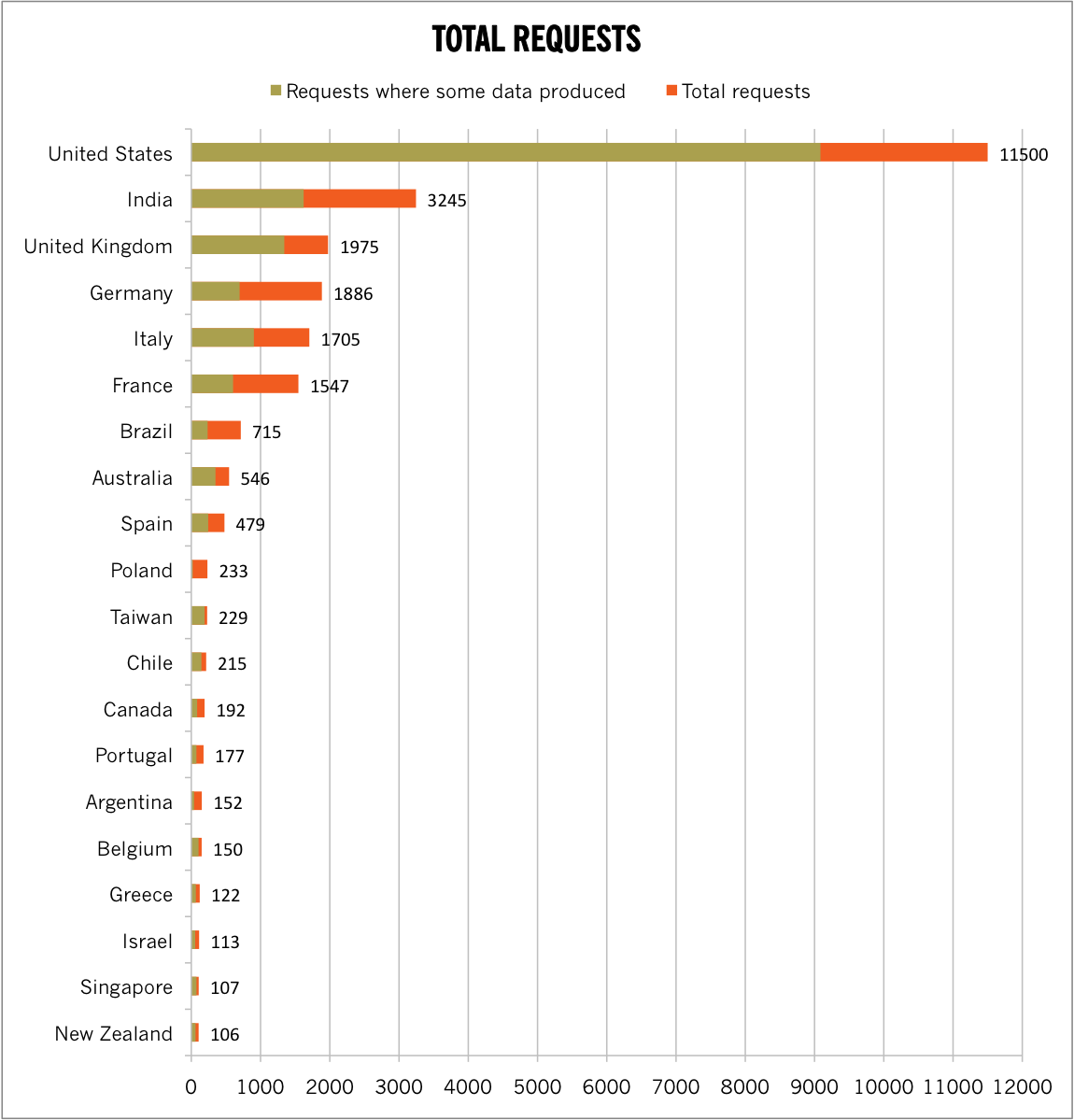
Facebook Transparency Report: US and India lead in data requests

Earlier this week, Facebook joined Google, Twitter, and other tech companies in issuing a transparency report: in Facebook’s case, aggregated counts of the government data requests it received in the first six months of 2013.

The United States leads the world in requests, with 11,000-12,000 requests covering somewhere between 20,000 and 21,000 user accounts. The US is also the only country on Facebook’s list without exact figures; the company notes that it has “reported the numbers for all criminal and national security requests to the maximum extent permitted by law” and will published updated figures as soon it obtains legal authorization.

Trailing the United States, with 3245 total requests covering 4144 users, is India, a country that has also ranked high in Google’s Transparency Report. The UK, Germany, and Italy round out the top five.

In countries with more than 100 requests, Taiwan received the greatest compliance from Facebook, with 84 percent of requests resulting in at least some data. The United States followed closely behind, with Facebook complying or partially complying with 79 percent of requests.

The current transparency report reveals only numbers—unlike in the Google and Twitter reports, no information on the types or forms of data requests is provided. Without this information, it’s impossible to tell how many of these requests are related to criminal activity such as robberies or kidnappings (two examples provided by Facebook) and how many are related to broader surveillance programs.

“You look way prettier in person than through your webcam”: #NSAPickupLines

In this week’s #IMWeekly news roundup, we reported that at least ten NSA officers have used the agency’s surveillance power to spy on their romantic partners over the past decade—a practice deemed “LOVEINT” by the Wall Street Journal, which broke the story.

Yesterday, NPR reported that Twitter users have taken the story and run with it, posting satirical pick-up lines and love poems under the hashtags #NSAPickupLines and #NSALovePoems.

Some of the most amusing tweets we’ve seen so far:

Via @samir

#imweekly: August 26, 2013

China
Chinese mobile app WeChat has a growing international presence, making it the fifth most popular mobile app worldwide. Within the country, WeChat is heavily monitored, and users are blocked from sending messages containing prohibited keywords. TeaLeafNation reports that TenCent, which owns WeChat, is now offering two versions of the app: a censored version for Chinese users, and an uncensored version for international use. The problem: the lines between the two are unclear, as shown by the suspension last week of a US-based WeChat account belonging to ChinaGate, a Chinese-language web portal hosted outside of China.

Finland
The Finnish Supreme Administrative Court ruled today that the country’s National Bureau of Investigation (NBI) was within its rights when it added an anti-censorship website to its secret list of blocked sites. The blocking took place under a 2006 law that enabled the NBI to maintain a secret blocklist of sites that distribute child pornography. The website lapsiporno.info (“childporn.info”) has been monitoring the bureau’s activities, criticizing the secrecy behind the blocklist and compiling a list of known blocked sites. When lapsiporno.info was blocked, operator Matt Nikki sued the NBI. The court ruled that even though Nikki’s site did not host any child porn, by listing blocked sites it was enabling users to find such sites, and therefore, the NBI’s blocking of lapsiporno.info was legal.

United States
Mark Zuckerberg announced last week that Facebook, along with a handful of tech companies, is launching an effort to bring Internet access to everyone on Earth. Zuckerberg told the New York Times that the project—Internet.org—is more about doing “something good for the world” than for profit, but many commentators disagree. The New Yorker’s Matt Buchanan notes that the project offers little in the way of infrastructure building, which is one of the biggest obstacles to Internet access. And The Atlantic’s Alexis Madrigal points out that the project heavily recuts a John F. Kennedy speech, stripping the original Cold War context and perhaps, Madrigal argues, changing the meaning entirely.

United States
The newest piece of the NSA surveillance scandal: LOVEINT. Last week the Wall Street Journal reported that several NSA officers have used their power to spy on their romantic partners. Approximately ten cases of this type of abuse of NSA power have emerged over the past decade, and according to NSA officials, in each case, the employee responsible was punished and/or terminated. The LOVEINT discovery comes amidst the NSA’s admission last week that in the past year alone, the agency violated privacy regulations nearly 3000 times.

#imweekly is a regular round-up of news about Internet content controls and activity around the world. To subscribe via RSS, click here.

