#imweekly: June 17, 2013

United States
The National Security Agency has confirmed that it has been operating a global electronic surveillance program, collecting information from Google, Facebook, and other tech companies under a program called PRISM, after Booz Allen employee and NSA contractor Edward Snowden leaked inside documents. The news has triggered a widespread outcry from human rights advocates and organizations.

Saudi Arabia
In March, Saudi Arabian officials declared that the country would block access to three popular voice and messaging services—Viber, Skype, and WhatsApp—if the companies did not give the government access to local monitoring services. The government has followed through on its threat, blocking Viber on June 6. On June 11, the block was rescinded, though whether Viber has complied with government demands for monitoring access is unclear.

Iran
Iranian Gmail users were reporting evidence of phishing attacks, just days before last week’s presidential elections. The attacks, which appear to be originating from within the country, have been occurring for three weeks; in a blog post, Google Vice President of Security Engineering Eric Grosse said the attacks were likely politically motivated. Google security staff said the phishing attacks appeared to be conducted by the same group that conducted attacks in Iran in 2011 using a fraudulent Google certificate.

Twitter’s Geography: Visualized and Explained

Twitter’s CEO Dick Costolo has called the popular microblogging service “the pulse of the planet.” With a little less than eight percent of the world’s population on Twitter, that pulse has room to grow. Nevertheless, recent big data research into the geography of the Twittersphere sheds light on where users tweet, with whom they tweet, and what information they share. The findings illustrate that Twitter helps people transcend geographic boundaries that restricted communication in a pre-digital age.

A research team from the University of Illinois at Urbana-Champaign examined location data from the Twitter Decahose, which includes 10 percent of tweets sent on a given day. The team examined more than 1.5 billion tweets sent from more than 71 million unique users over 39 days and documented its findings in a paper published online.

Extracting Location from Tweets
Twitter displays the long-tail phenomenon of user participation: 85 percent of tweets come from the top 15 percent of users, and one-fifth of tweets come from just one percent of users. Only 3 percent of tweets are georeferenced, meaning their metadata includes location information. Echoing the long-tail, two-thirds of georeferenced tweets come from one percent of users, representing a small subset of Twitter users.

Researchers dramatically expanded the number of located tweets through geocoding. They analyzed information from user-generated Location and Profile fields and inferred location for more than one-third of tweets from the Decahose. These fields remain fairly static as a user tweets, so future researchers may be better off geocoding users rather than tweets. This could simplify location-based Twitter research by reducing the number of data points to analyze, saving time and computing power.

Though Twitter users communicate in a variety of languages (the most multilingual areas being Hungary, Serbia, Lebanon, Israel, and the West Bank), they tend to provide their location data in English.

Where Do People Tweet From?
Where electricity exists. The map below overlays georeferenced tweets with NASA Earth’s City Lights images. Red dots represent georeferenced tweets, blue dots represent access to electricity, and white dots represent an equal balance of tweets and electricity.
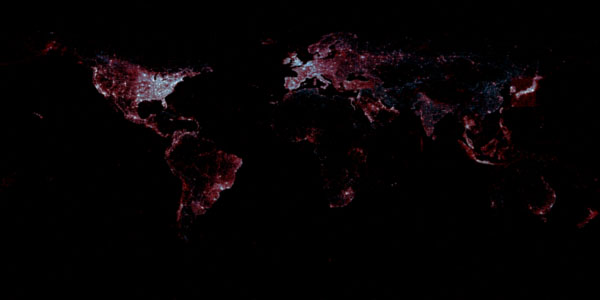
A map shows strong correlation between Twitter use and electricity accessibility.

Red dots represent georeferenced tweets, blue dots represent areas with electricity, and white dots represent both. Image via First Monday/Leetaru, et al. Click image for high-resolution version.

The map reminds us that accessibility to digital tools still relies on accessibility to tangible infrastructure, though the proclivity of red illustrates that people tweet even when electricity is scarce. (The box around Japan reflects some tweets from boats but is also the relic of old third-party Twitter clients that “handled the country’s polygonal shape a bit oddly,” Leetaru explained in an email).

Most georeferenced Twitter users joined in 2010 (shown in green on the map below), with concentrations of European, Middle Eastern, and Southeast Asian users joining in 2011 (shown in blue on the map below).
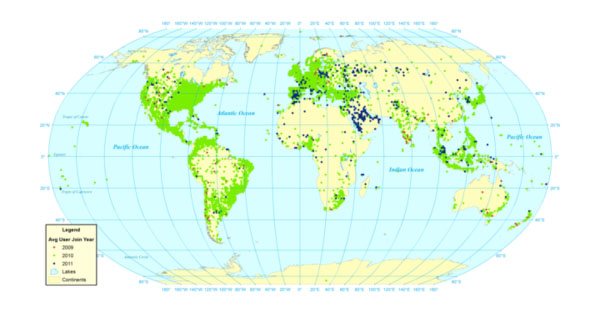
A map shows the year when Twitter users joined the service.

Green dots represent georeferenced users who joined Twitter in 2010 and blue dots represent georeferenced users who joined in 2011. Image via First Monday/Leetaru, et al. Click image for high-resolution version.

Who Do People Communicate With on Twitter?

People on Twitter retweet and reference close-by and far-away users at almost equal rates. A map of geocoded retweets reveals patterns among continental communication. The researchers write:

“Latin America is more closely connected to Europe than to the United States, while Asia connects more closely to the U.S. and the Middle East connects to both the U.S. and Europe. The east coast of the United States is a clear nexus point for the country, through Europe appears to be more dominant than the United States in producing content retweeted by the rest of the world.”
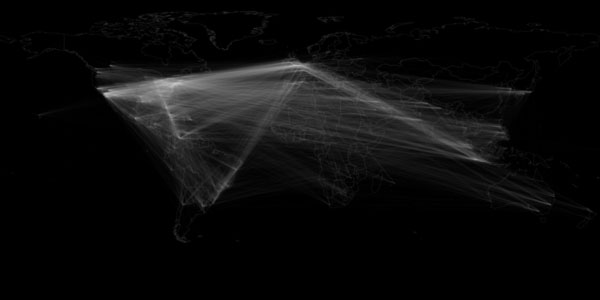
A map showing the location connections between retweets.

This map shows the location connections between users who retweet other users. Image via First Monday/Leetaru, et al. Click image for high-resolution version.

Research from 2012 showed Twitter users tended to follow people geographically close to them and those located in areas easily accessible by flight. That paper examined pairs of followers, but the University of Illinois team maintains that retweets and references to other users are better indicators than followers of how much a user pays attention to another user’s tweets.

What Do People Share on Twitter?
Mostly social media. More than half of all links in tweets go to six domains: Twitter, Instagram, Facebook, YouTube, ask.fm, and Tumblr. Only 7.8 percent of all links people share on Twitter reference English mainstream news. The most popular sources for English-language news on Twitter include the BBC, Huffington Post, New York Times, and Guardian.

People link to articles about close-by and far-away news at almost equal rates. The map below compares regional references on Twitter and in Google News’ RSS feed. Blue dots represent more georeferenced Twitter coverage, red dots represent more mainstream media coverage, and white dots represent equal coverage.

This map compares Twitter and mainstream media coverage of areas around the world.

The blue dots represent Twitter coverage of an area and the red dots represent mainstream media coverage of an area. Image via First Monday/Leetaru, et al. Click image for high-resolution version.

Twitter appears to cover more information on Latin America and Eastern Europe, while mainstream media covers Africa, South Asia, and East Asia more thoroughly.

The most influential users, based on Klout score, concentrate in Malaysia, Indonesia, France, Spain, the U.K., the U.S. and Venezuela. The least influential, meaning those whose content is least likely to spread around the Web, reside in Eastern Europe, the Middle East (especially Turkey), India, and Southeast Asia.

Want to see more Twitter visualizations? The company crunches its own data and posts visualizations on its Flickr page.

Social Network Alternatives

Courtesy of AJ Cann/Flickr

In May 2013, Facebook announced that it had 1.1 billion users, 665 million of which were active on the site each day. The three major global social networks (Facebook, Google+, and Twitter) have all experienced huge growth in the last few years. According to the GlobalWebIndex, of the global Internet population approximately 51% use Facebook on a monthly basis, 25% use Google+, and 21% use Twitter. Despite the rapid growth of these social networks, many users have become dissatisfied with their business models, political practices, constantly changing posting policies, and undemocratic forms of governance. Aside from the concerns over PRISM, Facebook has recently drawn attention for its blocking pictures of breastfeeding mothers or the company’s handling of rape joke memes spreading through their network. Activists and political dissidents in particular have found these social media sites stifling and sometimes dangerous, but often find themselves with few alternatives to spread their messages online.

As a result, several interesting social media alternatives have recently been created to address these concerns and protect both privacy and dissent online. While many social network projects have launched over the past few years, few alternatives remain in active development. Below is a curated list of the best current alternatives for people with moderate computers skills concerned with privacy, control of their information, and networking outside the control of governments or corporations.

Diaspora: This nonprofit, user-owned, social network consists of a group of independently owned “pods” that interoperate to form the network. Since its launch in 2010 by four students at New York University’s Courant Institute of Mathematical Sciences, Diaspora has been one of the most popular alternative social media sites. As of June 2013, Diaspora reports it has 405,551 registered accounts (which includes users on the main pod and connected people from other pods) and 2,270,599 estimated users on the most popular pod (estimated because that information is not public) participating in this distributed social network. Diaspora allows for pseudonyms, ensures users own their content, and because the network is distributed by other users who install the freeware and setup web servers, the network cannot easily be disrupted or its users surveilled.

App.net: In July 2012, this platform evolved beyond being a place for developers to showcase new apps and became a full-fledged social network. The design of App.net is fairly similar to Twitter, but with one big difference. Instead of selling user data to advertisers, the site requires users and developers to pay subscription fees for premium accounts ($5 monthly, $36 yearly, or $100 a year for developers). There are no ads on App.net, but more importantly for social activists and people concerned with controlling their data, App.net will only share information with third party vendors the service needs to work (like payment processors for accounts) and law enforcement (if proper legal channels are observed). When a user deletes something from App.net, the company makes sure it’s gone from their servers within two weeks. It’s not a completely private social network, but it’s close.

Tent.io: This Twitter-like (but not Twitter-clone) alternative offers many of the same advantages App.net boasts, but rests on an entirely different method for distributing information. Tent is an open Internet protocol, like email or TCP/IP, that can be used to run a Tent server (via Tent.is) or connect several social networks together. Tent.is offers users the ability to run their own server, lets them share anything, and is designed to help users migrate from other social medias. Tent can also be run as a Tor hidden service, which can allow activists to communicate without being traced, and because Tent is decentralized, it cannot be blocked the same way Twitter has been in several countries. Tent also touts itself as a better alternative even to email since users can change their address and the followers come with them. Tent also argues it fosters innovation since applications can be developed for Tent without needing to ask for permission from the protocol’s owners. The Tent protocol can be used with Tent.is or be used independently to grow other networks. Tent is a bit more technical than the other alternatives featured here, but its flexibility and expandability mean it’s likely to continue developing.

GlassBoard: Featuring a very simple and comprehensive privacy policy, GlassBoard is probably the easiest to use of the alternative social networks featured here. GlassBoard’s innovation in social networking is to make money by charging a small user fee rather than sell information to advertisers. Perhaps because they know many people have indicated they would not pay for access to a social network, even if it meant more control over their information, GlassBoard does offer a free account with some limitations, and premium accounts with more storage or access to APIs. GlassBoard also offers iPhone and Android apps, all user data is encrypted on GlassBoard’s servers, and they won’t sell your personal information for targeting ads. GlassBoard does not have privacy settings. Instead, everything a user does on the service is private and can only be seen by people they approve. While GlassBoard primarily focuses on providing businesses with a private communications network, anyone willing to have some storage limitations or pay a bit for a premium account can enjoy a very simple, secure, and mobile social network.

Identi.ca: Identi.ca is another micro-blogging service similar to Twitter, but offers many features Twitter does not such as XMPP support and the ability to freely export personal and “friend” data. Identi.ca enjoyed early success when more than 8,000 people registered for the service within the first 24 hours of its public launch in July 2008. For those concerned with controlling their information, Identi.ca will publish all posts under the Creative Commons Attribution 3.0 license by default, but paying customers have to option to choose a different license. In June 2013, Identi.ca began migrating to the pump.io software platform in order to offer more features, and its development is likely to continue. Setting up the free and open source software on a server requires a bit more technical skill than most of the other alternatives presented here, and joining might be delayed until the migration to pump.io finishes, but this open source social network is worth watching.

For those not ready to completely abandon Facebook, Twitter, or Google+ there are still a few options for managing how user data is used. Two good browswer add-ons for determining exactly where your data is going are Collusion for Mozilla Firefox and PrivacyScore for Google Chrome.  To keep Facebook, Google, and Twitter from tracking you (and to speed up your browser), the Disconnect extension works well with Firefox, Chrome, and Safari. Finally, to opt out of other advertising that tracks users, the Network Advertising Initiative’s website will show who is tracking a user’s browser and how to disable it.

Government “Bird Dogs” on the Loose in Saudi Arabia

In clashes between Saudi citizens and the state over ideology and technology, Twitter has become a highly contested space. Internet monitoring and censorship in the Kingdom is not new though. According to a 2009 report from the Open Net Initiative, “Saudi Arabia filters sites related to opposition political groups, human rights issues, and religious content deemed offensive to Muslims.” Freedom House published a report in 2012 putting Internet penetration in Saudi’s population of 29 million at 49%. It also stated that 51% of Saudis are active Twitter users, one of the highest usage rates in the world. In recent months, religious and political leaders as well as everyday Twitter users have taken to the ethereal skies of Twitter to express their views on how and by whom the social networking site should be used.

It is easy to adopt ornithological metaphors when talking about Twitter, and we can extend talk of birds in a particular way within the Arab Gulf context, where falconry  is a big deal. The sport has ancient roots and great cultural significance. Falcons are magnificent birds of prey, revered and respected in the region for their adaptability, speed, and hunting prowess. The birds, also called raptors, scan the desert sands for prey and swoop in for the kill with pinpoint accuracy. In the Arab Gulf, the falcon is elegance, beauty, and skill with wings.

“Sporting with the best: Hamad AlGhanem, Director, Breeder and Registrar General of the Arabian Saluki Centre, poses with a falcon and two of his favourite salukis. Falconry and saluki races are a part of Arab culture.”- Gulf News

The same regal attributes may or may not apply, however, to the little blue birds that soar in the Twittersphere. Saudi authorities, acting like government bird dogs, have been on the hunt for Twitter users lately.

In early May, Saudi religious police issued warnings that the social networking site was “a path to hell.”  Sheikh Abdul Latif Abdul Aziz al-Sheikh said Muslims who use Twitter have “lost this world and [their] afterlife.” Despite this warning, Saudis—including religious leaders—continue to use the platform. Just weeks after al-Sheikh’s pronouncement, Abdullah Mohammed al-Dawood, an ultraconservative cleric with an active Twitter following, used Twitter to post his views on women going to work in Saudi Arabia. His tweet encouraged men to “harass” women working in public places, so they would return to their homes. Public outrage in response to al-Dawood’s comment was swift and decidedly critical. Graphic suggestions about what punishment he deserved, including castration, circulated in local social media—including Twitter, where the hashtag “#arm_female_cashiers” was used in reaction to al-Dawood’s call to “#harass_female_cashiers”—and spread globally via major news sources.

Despite threats to body and soul, Saudi citizens, journalists and activists continue to retweet rather than retreat. In fact, according to a recent poll about people’s attitudes toward information sharing on the Internet, Saudis are among the most willing to share “everything.” This is not exactly divine revelation to progressive Saudi thinkers and leaders such as Saudi Prince Alwaleed bin Talal, who addressed Saudi Telecommunications directly from his Twitter account: trying to block social media platforms is a “losing war.”


Culture Memes as Creative Resistance on Tiananmen Square Anniversary

This is a guest post.

Ahead of last week’s anniversary of the 1989 Tiananmen Square protests, the Chinese government engaged in what has now become an expected annual crackdown on Internet freedom. This year, however, the government adopted more advanced and subtle means of censorship. Rather than blocking all search results for sensitive terms, websites such as Weibo are instead displaying carefully curated results that have little to do with the 1989 protests.

Although Chinese censorship is ever-more sophisticated, Internet users in China are finding creative ways to express themselves and commemorate the tragedy. Memes – spontaneous, humorous, grass-roots-style online satirical works – are a significant feature of the Chinese Internet, ranging from 2009’s Grass Mud Horse to memes involving sunflower seeds and self-portraits of people wearing sunglasses, both inspired by arrested Chinese dissidents. These memes take the form of photos, videos, animations, and texts that defy and ridicule Chinese authorities.

This year, Chinese Internet users created multiple variations of an iconic photograph from the 1989 protests, incorporating images ranging from yellow ducks to Legos. These images began to circulate through social media in China days before the June 4th anniversary as a way to bypass censorship, and gained momentum largely for their humor and brevity.

The famous photograph – known as “Tank Man” – of the 1989 protest has long been banned in Chinese cyberspace. The photo, featuring a man blocking a series of tanks during the Tiananmen Square protest on June 4, 1989, directly points to the dictatorship of Chinese government and has startled people worldwide.

Days before this year’s Tiananmen Square Anniversary, someone wittily replaced the four tanks in the original photograph with giant yellow ducks. The meme is based on a 54-foot-tall duck sculpture, created by a Dutch artist, that currently floats in Hong Kong’s Victoria Harbor.

The “tank man” picture is also photoshopped into a Lego man facing down three green Lego tanks. By embedding these images in posts instead of using banned keywords, Internet users can often escape automatic deletion.

Another picture showing a cow in front of a line of bulldozers is also getting past Weibo’s censors. While Weibo has blocked the words “big yellow duck” in response to the memes, the word “cow” appears to be uncensored.

While censors continue to add new words to the blocklist, Internet users continue to create new images, making it impossible for the government to shut down conversation about the Tiananmen Square protests entirely.