What happens when Artificial Intelligence becomes as smart as us? Avengers 2: Age of Ultron wants us to believe that, for the sake of protecting humanity, the robots will try to destroy humanity.
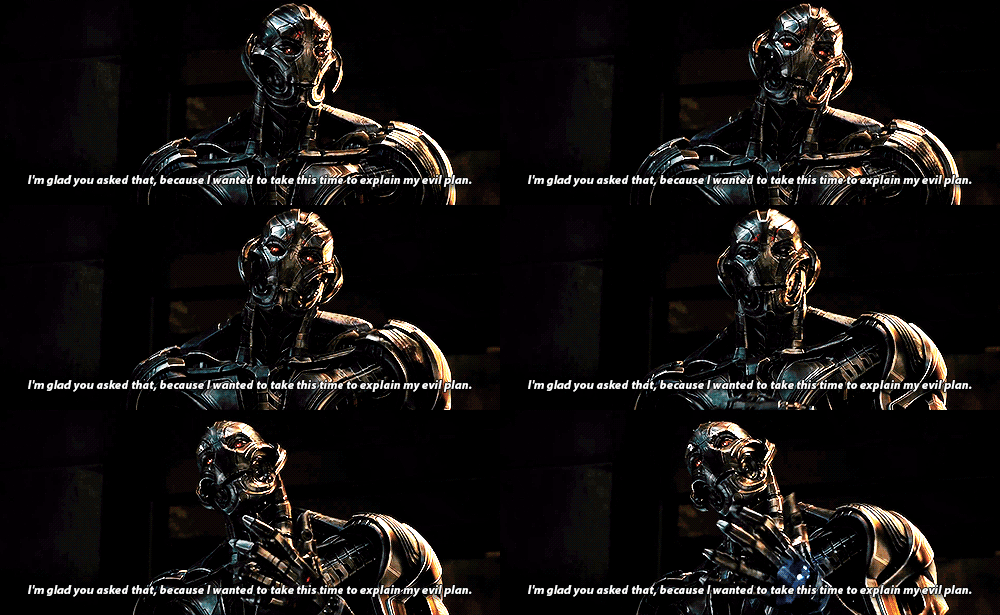
That makes sense.
As computers grow more and more advanced, we keep reaching points that we weren’t supposed to. Computers were not supposed to be able to do anything they weren’t explicitly told to do. Until they did. Computers were not supposed to be able to beat us at chess. Until they did. Computers were not supposed to be able to play and win at Go. Until they did.
Computers, however, have a vastly different style of learning, aptly named, machine learning. Humans learn in two ways: 1. Through experiences that allow humans to form connections and memories; 2. By intuitively connecting multiple different experiences in a subconscious way. Machines need to be more explicit. They learn by taking hundreds, if not billions, of input cases and parsing them to form judgements on past inputs and expected cases. Machines make educated guesses, based on previous decisions that users accepted, and calculate a probability for each potential output based on how potentially useful it is. The machine then outputs the best possible answer.
In my sophomore year, I took a class on Artificial Intelligence where we had to code a machine learning tic-tac-toe solver. The process was simple: create a structure that would parse through all the submitted test cases, calculate the frequencies/probabilities of winning for each case, and, while actually playing the game, run through all the possible moves and judge which one would likely lead to a victory. In this simple way, I was able to develop a tic-tac-toe AI that I could never beat (which, in all fairness, isn’t saying much because I’m terrible at tic-tac-toe).
We don’t really need to replicate human intelligence. Its long as we’re reaching this end goal of being able to solve problems, the process doesn’t matter. The actual biochemical processes of the human mind are irrelevant.
This also allows us to eschew fearing the Singularity. If the machines aren’t smart in the same way as humans, they will never reach the same type of self-awareness as humans and we can control their thoughts. So long as we limit the bounds of the artificial intelligence by focusing on the problems we want these machines to solve rather than getting them to solve them with “human” methods, we should be able to end up avoiding “self-awareness”.
We don’t need to fear technology so long as we continue to have control.


I really liked your point of computers always reaching points they weren’t supposed to reach. In a sense, we are always pushing and redefining boundaries. Certainly, the early internet community did not envision the internet to be as accessible and integrated as it is today. It’s scary to think of something as “unbounded” or “limitless”, and when we can not draw boundaries with certainty, the situation becomes much murkier and contentious.
This is a really interesting way of thinking about the Singularity – and about future developments in AI. But what if the “different” intelligence of the machines is “better” than our current human form of intelligence? The machines may not be smart in a human sense, but it could be possible for them to be smarter than us, using an altogether different type of intelligence.