Welcome, Class of 2010!

September 11th, 2006

Dear Incoming Freshmen:

On behalf of the Humanist Chaplaincy at Harvard, the Harvard Secular Society, and the broader, century-old Humanist community surrounding our university, welcome to Harvard.

If you are reading this, you’ve learned of our website at today’s “Freshmen Fair,” as we have not yet officially launched our site or this blog nationwide– something we will be doing in the coming weeks, so please continue to follow but don’t forward the links to your friends quite yet.

If you are interested in Humanism, freethought, agnosticism, or atheism: you’ve picked the right university. You are just beginning to discover a community that is about to have a wonderful year, and that can provide you with a wonderful ‘home  away from home’ for the next four years.

Given that we haven’t officially launched yet, I don’t want to say much more right now. But let me emphasize that I truly hope to get to know you individually over the course of the coming year and years. Please drop by my office in Memorial Church or email me to set up a meeting, at your earliest convienience. I will be delighted to hear your questions, concerns, or interests, or just listen to your story and share with you a little about the Chaplaincy’s.

Sincerely,

Greg M. Epstein
Humanist Chaplain of Harvard University

Another Designer

September 8th, 2006

Okay guys, here is a 2nd designer, Diane Connell of southern CA, USA. We are actually going to limit you to two choices because it is just slightly too exhausting for me to go chasing down every graphic designer on the planet that wants to doctor your photo because he/she believes deeply in Humanism.

So here is the question: Diane is more experienced than Elizabeth, whose stuff is below. But she will charge us 2x more. We could possibly afford her, but only if you think her design is much stronger. One thing in Diane’s favor is that later in the year, we will be needing much more professional flyers than what we need right now, and it seems that Diane has much more experience with this. But again, do we need her?

Keep in mind, again, that both designers are just supplying drafts. Professional designers generally take (& require) a lot of detailed feedback in order to do their best work. As far as Sean Bala’s interesting suggestion of including descriptions of the celebrities, we could direct people to HSS’s page on the (soon to debut) chaplaincy site, which could list them somewhere along with a link to celebatheists.com, instead of, as currently, just directing them to celebatheists. Or not.

Leave your comments, please!

HumanistHarvard.jpg

Trying out Graphic Designers

September 7th, 2006

So, the Chaplaincy now has 3-4 wonderful graphic designers competing to become our regular graphic designer for the year. This happened because I posted a description of us on elance.com and it turns out there are designers all over the world who are Humanists and would love this job because it would make their careers feel more meaningful. So, now we have to decide what we want, whose style we like. The designs below are all by the first of the designers, Elizabeth Tipping, a Humanist & atheist from the UK. Keep in mind she would charge around half of what a couple of the next designers you will see charge, and we do want to minimize spending if possible. I will hopefully post designs by other designers later in new entries.

If you are a Harvard student and want to give feedback on this in the next day or two, please send it to Amanda. I will be extremely busy and will barely have time to post the stuff for you to see. Amanda, after getting your feedback, will give me final feedback on which designer to go with.

Bear in mind: I know obviously the whole images may not be appearing here. That is just because I don’t have time to play on wordpress today & get it right. You guys are clever, I trust you’ll get the idea enough to choose wisely.

Finally, remember that these are all DRAFTS and we can ask for some changes over the weekend. We’re trying to choose the designer with the style we like.

Enjoy!
unknown.jpg

2nddraft copy.jpg

futuralt.jpg

1stdarftaqua.jpg

1stdraftblackwhite gradient.jpg

1stdraftyellowbackground.jpg

1stdraftbluebackground.jpg

Benefit Concert for ALL Civilian Victims of Mideast War

August 6th, 2006

I know many of us are very concerned about the ongoing violence in the Middle East, regardless of our political affiliations, and wish there was more that we could do to help.

I have been asked to participate in a benefit concert this Monday, August 7 for both Jewish and Arab/Muslim civilian victims of the current conflict in Israel, Lebanon, and Gaza. All donations will go to the International Red Cross.

The concert will feature many of Boston’s top performing artists, including top-notch artists from Muslim/Arab and Jewish backgrounds, working together to try to be of some help to the innocent victims on both sides of this conflict. (I will be reading some poetry in Hebrew and English, and possibly singing, though I don’t know what the final program looks like yet.) There is more information here: the event will take place at Emmanuel Church in the Back Bay, on Monday night August 7 at 8pm.

Here is the English translation of a poem I will be reading, by Yehuda Amichai, a passionate Humanist and the greatest Modern Hebrew poet:

Wildpeace

Not the peace of a cease-fire
not even the vision of the wolf and the lamb,
but rather
as in the heart when the excitement is over
and you can talk only about a great weariness.
I know that I know how to kill, that makes me an adult.
And my son plays with a toy gun that knows
how to open and close its eyes and say Mama.
A peace
without the big noise of beating swords into ploughshares,
without words, without
the thud of the heavy rubber stamp: let it be
light, floating, like lazy white foam.
A little rest for the wounds – who speaks of healing?
(And the howl of the orphans is passed from one generation
to the next, as in a relay race:
the baton never falls.)

Let it come
like wildflowers,
suddenly, because the field
must have it: wildpeace.

Exciting News: Mark Dates April 20-21, 2007

June 14th, 2006

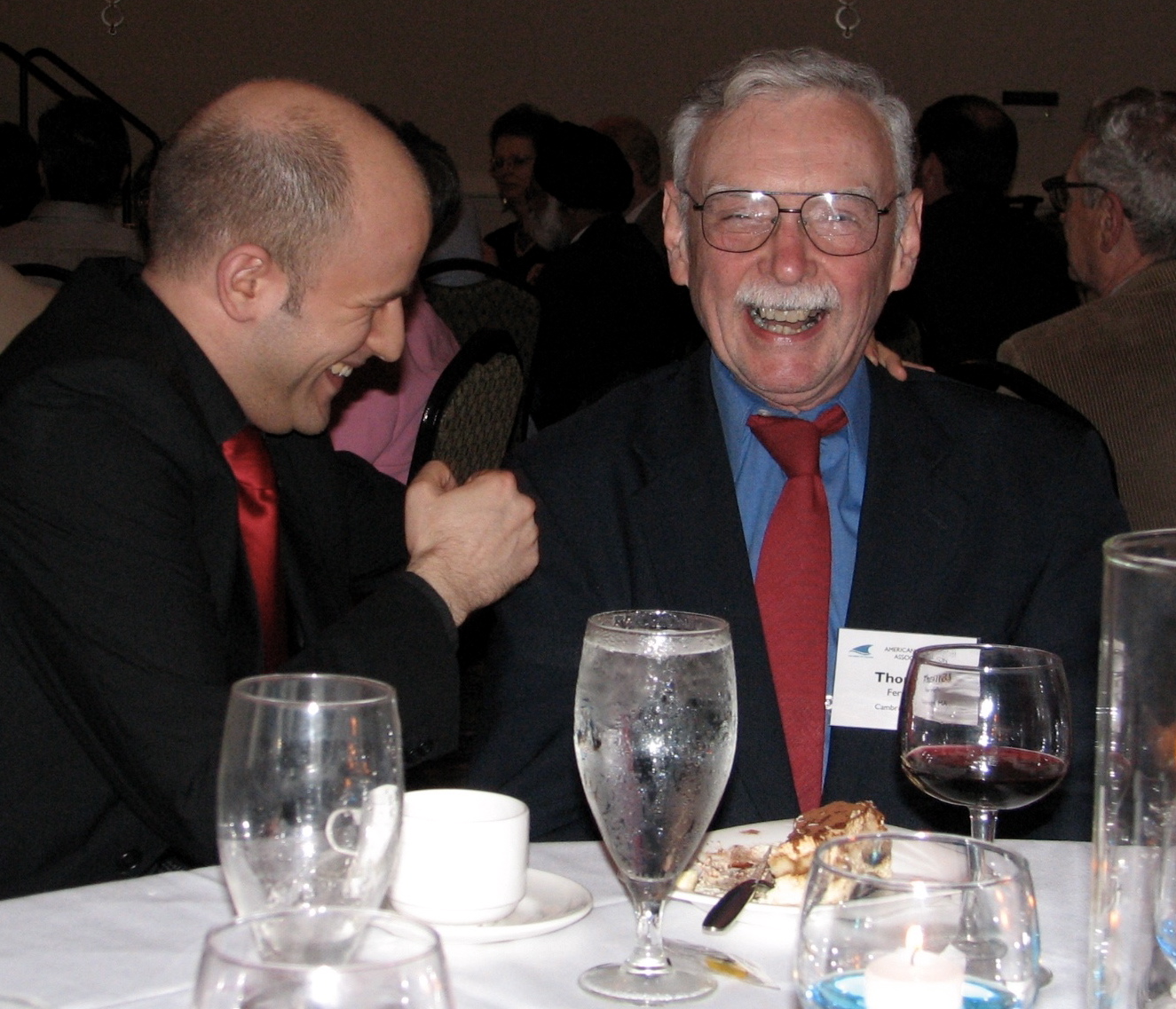
Three decades ago Tom Ferrick founded the Humanist Chaplaincy at Harvard University. Tom then led the Chaplaincy to become a permanent, endowed position at Harvard, and on April 20 and 21, 2007 we will celebrate 30 years of his service to Harvard and Humanism.

To honor Tom and his historic vision, Harvard will host a major Humanist symposium on the theme “dialogue between religions, cultures, and civilizations” where the Humanist Chaplaincy will lay out a bold new vision for the future of Humanism at Harvard and universities across the US.

I invite you to mark the dates—April 20 and 21, 2007—and visit Cambridge next spring for a wonderful celebration.

Finally, we need your help to make this event a major success! Below the photo are suggestions as to what you can do now…

DinnerEpsteinFerrick.jpg

*Send us your mailing address, along with emails and addresses of friends you think would be interested.

*Make a tax-deductable contribution to the Humanist Chaplaincy at Harvard, in honor of this special 30th Anniversary occasion, and/or encourage a friend/colleague/loved one to make a contribution. The symposium will require significant investment on top of our very small annual budget: we need your financial support now!

*Volunteer for a planning committee: Programming, Logistics, Alumni, and Publicity Committees are now being assembled.

***SAVE THE DATES and PLAN TO ATTEND! Seven decades of Humanist Harvard Alumni will be there, from Ambassador Carl Coon ’49, Vice President of the American Humanist Association, to members of the class of 2006. Don’t miss out, and tell your friends now.

Together, we can make this event one that will advance the ideals of Humanism far beyond Harvard, while increasing dialogue and understanding among all peoples.

Summer Recommendations

June 12th, 2006

At this time of year your schedule may be getting a bit lighter, meaning it is the perfect time for some Humanist summer listening, reading, and even viewing.
And in fact, one of the most common questions I get asked as Humanist Chaplain (after issues such as “What is Humanism?” and “What does a Humanist Chaplain do?” which I will address at a later date) is, what books, etc. do I recommend for learning more about Humanism? So here I will begin a very partial list to get you started:

Websites

One of the best ways to learn about Humanism is online– provided you don’t judge a website by its appearance. Numerous Humanist websites provide wonderful content, but graphically range from “not bad” to “fairly bad.” Now, I am a Humanist who appreciates an extremely attractive site, so I hope this will change before too long: if you or anyone you know is a brilliant web designer who would be willing to cut Humanist organizations a major break on price because of your belief in their mission, please contact me.

That being said, the most important thing about a site is content. Any of the sites in my “blogroll” are “labeled” and contain worthwhile information. (I know this is not exactly what a “blogroll” is for, but I am just learning how to use blogging software. “Bear with me” is probably something I’ll have to be repeating for months now.) At some point I may write more about each site, but for now let’s start by highlighting three pages you must read this summer if you’re looking to return to campus in the fall more knowledgeable about Humanism:

1) The Humanist Manifesto III. Several of you may have read this already, but it is one of those documents that can be reread from time to time. Put out by the American Humanist Association, as a 2003 update of their Humanist Manifestoes I & II (1933 and 1973, respectively) this is a one page summary of the philosophy of Humanism. Does it seem obscure? Not to the legions of Conservative Christian bloggers, pundits and yes, Fox News anchors who obsess over the Manifestoes, blaming them for everything pernicious in American society, from abortion rights to church-state separation to…well, Harvard.
(Here’s just one more among countless examples.)

2) The 2002 Amsterdam Declaration of the International Humanist and Ethical Union (IHEU).This is another excellent one-page summary of Humanist thought, put out by the international umbrella organization for the Humanist, secular, and non-theistic movements. The IHEU represents groups from India to Africa to Asia to the US & Europe, and is currently headquartered in London. Some of you with job/internship-hunts coming up on this side of the pond might be interested to note it boasts a new Bioethics Center at the United Nations in New York City.

3) The Humanist Manifesto 2000, by Paul Kurtz. Paul Kurtz may be the single most important theorist of Humanism of the past several decades. As you’ll notice, however, this Manifesto is not available online. That may be in part because the organizations Kurtz founded and still heads, the Council for Secular Humanism and the Center for Inquiry, are fairly marketing-savvy for Humanist organizations: they successfully emphasize selling books and magazines to a greater extent than other Humanist groups. Kurtz himself is now over eighty and has written almost enough to break into the elite “50+” category in Harvard’s Hollis library system; The Manifesto 2000, like most of his writing, is crisply written and offers a blistering challenge to traditional religion. (You can sample his writing here.) Why not list this first, then? Well, the answer would require a separate entry at some point, but the short version might begin by pointing out that not all Humanists would consider themselves “secular.” This is not a matter of theological beliefs: both secular and “religious” Humanists, (or ‘just plain’ Humanists) tend to believe the same things regarding the existence of gods, the nature of the universe, etc. (Granted I could address some of these same questions here in my own words, but as I don’t have time right now…go read the various Manifestoes and find out what those beliefs are!) But there tend to be some differences in the ways the secular Humanist movement and, for example, us American Humanist Association-types relate to religion and to religious believers and communities. Many feel that the AHA -style is more “tolerant” and “respectful” of religion, i.e. willing to build political coalitions with religious liberals on many issues. Non-secular approaches to Humanism also tend to be willing to build communities that serve Humanists and non-theists in some of the same ways that traditional religious communities serve their followers; by creating Humanist Chaplaincies, for example. So people looking for a more actively (some would say angrily) anti-religious Humanist approach tend to prefer secular Humanism, whereas people who are looking to express Humanism as one community within a pluralist world tend to be call themselves Humanists or even religious Humanists. Still, let me caution you that all of this is highly theoretical: many if not most Humanists do not feel bound by and indeed are hardly aware of the distinctions between these two types, just the way that most Presbyterians (much less most Protestants or most Christians) are not at all aware of the finer distinctions between the dozens of types within Presbyterianism as a denomination/movement, such as the Presbyterian Church in America (PCA), the Orthodox Presbyterian Church (OPC), the Evangelical Presbyterian Church (EPC), the Reformed Presbyterian Church, the Bible Presbyterian Church (BPC), or the Associate Reformed Presbyterian Church (ARP Synod)– to name but a few.

What kind of Humanist are you? (There are certainly a few other types I haven’t mentioned yet!) Feel free to take as much time as you need to figure that out. The Humanist Chaplaincy at Harvard was founded to provide a home away from home for all Humanist, agnostic, atheist, and non-religious members of the Harvard community.

Bonus: for those of you looking to do intensive reading on Humanism this summer and that want additional sources beyond these sites, Kurtz’s books, or anything else you might have to drag yourself to a bookstore or library for, check out the Continuum of Humanist Education, which provides high-quality online courses about many aspects of the Humanist world.

Books, Films, etc.

Well, the above exposition on websites took me a lot longer than I thought it would, so I’m not going to elaborate much here. ***For the comments section: what would you recommend to others (or to me, for that matter) in this category? What movies (American or foreign, feature or documentary) are of particular interest to Humanists? What songs/bands/musical artists? What fine artists, playwrights, choreographers, writers, etc.? We should be able to get a good list going at some point.***

Podcasts

Okay, to conclude (and maybe the podcasting “revolution” has thus far passed you by, but don’t underestimate what lengths of procrastination/infotainment/consumption a few moments of unstructured time in these climate-change induced dog days of summer will drive you to) check out an excellent Humanist podcast coming out of the Institute for Humanist Studies in Albany.

This month’s installment is about how Larry Jones, one of the world’s leading Humanists and atheists, posed under ‘deep cover’ as a right-wing leader of the Christian Coalition for four years, getting to meet Pat Robertson and George Bush while doing some espionage against right-wing ‘stealth candidates’ for school boards, etc. You might also try the February segment featuring Hemant Mehta,the young atheist/Humanist activist & grad student who has become a minor national celebrity after selling his soul on eBay, in a brilliant and poignant story broken by the Wall St. Journal and since covered by major media outlets around the world.

Welcome.

April 27th, 2006

Hi– welcome to my new weblog. Since taking over as Humanist Chaplain of Harvard in 2005 I’ve been swamped with requests for information about Humanism in general, and about my take on it in particular. Up to now I’ve often felt unable to respond sufficiently to those requests, so I’m hoping this site will be helpful! Please contact me with questions, comments, suggestions, and of course, criticism. I look forward to communicating with you.

Humanistically,

Rabbi Greg M. Epstein
Humanist Chaplain of Harvard University