G4C2008: “Interactive storytelling” 3x larger than games industry

Liveblogging Games for Change:

On the first panel this morning, Chris Crawford (Balance of Power) described his commitment to interpersonal games. (I was not aware of a game he created in the ’80s called “Gossip.”) Today he launched a new spin on Balance of Power in which states are represented as geopolitical “people” (I will post a link when I find it — the general site is StoryTron.).

The most interesting claim Chris made was that the market for “interactive storytelling” (a medium that is more relationship-based) will be 3x larger than the current games industry — that would be a $60B+ market. He observes that the existing industry is “creatively dead” or, synonymously, “marketing mature.”

GTA4: reintegrating the divided self

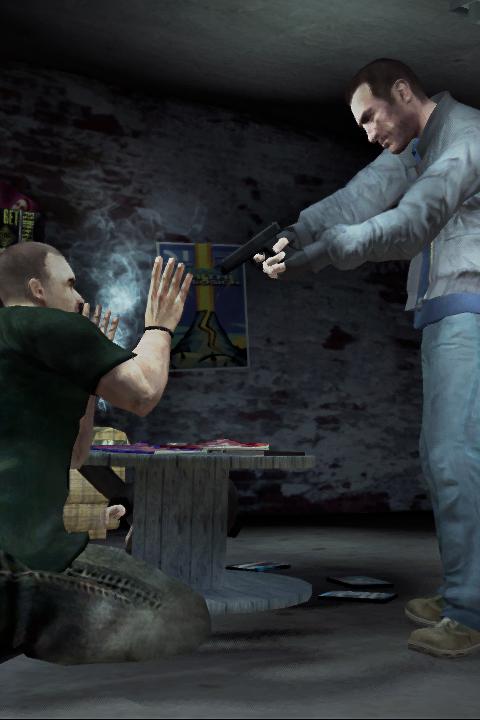
2 faces of NikoBy the close of our discussion about GTA4 on Wednesday, some of us expressed pessimism that computer games possessed any capacity to invigorate moral reasoning or reflection. Matthew remained hopeful, but expressed his dismay that the critical reception of GTA4 seems to set a ceiling, not a floor, for morally-deep games:

…The series cheered (and criticized) for glorifying violence has taken an unexpected turn: it’s gone legit. Oh sure, you’ll still blow up cop cars, run down innocent civilians, bang hookers, assist drug dealers and lowlifes and do many, many other bad deeds, but at a cost to main character Niko Bellic’s very soul. GTA IV gives us characters and a world with a level of depth previously unseen in gaming and elevates its story from a mere shoot-em-up to an Oscar-caliber drama. Every facet of Rockstar’s new masterpiece is worthy of applause…
IGN review by Hilary Goldstein

Maybe Niko loses his soul, and maybe you, the player, care. Or at least try to care. And so maybe through its long reach, however flawed, GTA4 also opens new frontiers to explore, and it becomes our duty to turn that perceived ceiling of possibility into a challenge.

Andrea Flores, responding to the recurring theme of “schizophrenia” throughout the discussion, brought in the idea of ritual, especially as described by anthropologists like Arnold Van Gennep and Victor Turner, to understand the interplay between real (the player) and game (the character). Like the “liminal space” of ritual, perhaps the “magic circle” of games offers a passage from one state to the next. If so, the tension among player, avatar, and character might well be something to exploit rather than bemoan; indeed, I find quite compelling the idea of the avatar as a “symbol” that the player manipulates to conduct the game-as-ritual.

From a positivist perspective, there is certainly much to learn from real players’ experience of the moral dimensions of a game like Grand Theft Auto. (Grand Theft Childhood is one place to start; the GoodPlay Project, where Andrea and Sam research, is another). From a normative and developer’s standpoint, there’s also so much to imagine, to build, and to test.

(gk)

GTA4: choice and consequence

Looking just at GTA4’s story, our playtesters also bemoaned the lack of meaningful consequences. Not only can Niko never die, in practical terms he never runs low on cash or any other resource. From a moral perspective, the most interesting – and therefore most disappointing – resource is Niko’s relationships. Among the player’s major tasks in this game is to nurture Niko’s relationship vis-à-vis his business associates, girlfriend(s), and above all, family. Though hardly innovative (see: dating games), the presence of a relationship mechanic in GTA, given its genre, is profound. The problem, according to our reviewers, is that the developers failed to realize the promise. You can have Niko improve his friendships by hanging out more with his buddies, and good relationships lead to in-game benefits (in other words, they matter), but except for a few notable moments, Niko’s commitments aren’t pitted against each other.

Perhaps the greatest enemy of meaningful choice is an overabundance of resources. If two options lead to the exact same results, there’s not much to distinguish the two. (Kant might disagree, but games and gamers have a strong utilitarian bias). Similarly, if resources are essentially infinite, choices that lead to varying amounts of resource awards are also essentially indistinguishable. Consider by contrast the Splinter Cell hostage scenario discussed in our last session: the player is forced to harm his reputation with one of his two employers no matter what he decides to do (though some choices are more Pareto-optimal than others).

To be fair, GTA4 does present several similar moments, but there don’t appear to be serious consequences of choosing between killing someone or letting him go. (Caveat: none of us has reached the ending yet, of which there are supposed to be two). Perhaps this means the player is free to make her own interpretation. Or, in the case of our reviewers, it ends up feeling empty.

LolaOverabundance has some interesting effects on gameplay. Consider the infamous GTA example of paying a prostitute for sex, and then killing her to get your money back. In GTA4, visiting such prostitutes restores Niko’s health when he’s injured, but it’s hardly the most efficient way to do so – buying a hot dog is both cheaper (in the game) and far more efficient (for the player). Thus while it’s still possible to pay a hooker for sex and then murder her to get your money back, the game mechanics give you no good reason to do so. In which case, why leave the mechanism in? It’s as if the developers just wanted to provoke and (as Peter surmises) invoke nostalgia. Then again, Kant would remind us that truly moral choice require immoral options.

As for relationships as a resource, Eric found that late in the game he had accumulated so many friends that he spent most of his playing time fending off phone calls and running stupid errands. This is realistic, to be sure (curse you, Facebook!), but a game that relies on the limited resource of a player’s own patience rather than something internal to the system is always at risk of inducing boredom. This seemed to be the experience of our playtesters, who bemoaned the lack of more meaningfully bounded gameplay. But GTA’s market success implies that the majority of mainstream gamers perhaps prize that wide berth of freedom, including the freedom to bore oneself.

GTA4: values at play

Mikhail FaustinGTA4, viewed strictly from a narrative, “playable movie” perspective, does offer a coherent moral worldview, one in which the bonds of kinship trumps other personal commitments. It’s not a universalist worldview but rather one tied strictly to, as Helen Haste emphasized, the conventions of a known and well-understood genre. Condemning any of the GTA games for “teaching” evil behavior would only make sense if players were unable to recognize genre play – a danger that some research suggests is both overrated but, perhaps, most possible for people who sit far outside the portrayed culture. As Helen pointed out, stories such as Hansel and Gretel convey their moral messages not because the audience confuses fantasy with reality, but they construct a system encompassing both worlds. (“The moral of the story” is abstracted from the specifics of the narrative: Hansel and Gretel doesn’t, I imagine, teach children about pushing old women into ovens!).

If GTA4’s characters take seriously their strong, maybe even stereotyped code of honor, there’s also a clash with the game’s sandbox recreation of New York City. Once the brutal edge of the Euphoria Engine wears off, Sam observed, the open-ended aspects of the game take on a cartoonish feel (Matt specifically cites South Park): running over pedestrians goes from sickening to interesting to flat-out convenient (given that the game’s physics make driving safely almost impossible). It’s another example of the game’s schizophrenia: what it tries to say departs from what you do.

(gk)

GTA4: ruleplaying vs. roleplaying

PoliceThe GTA formula melds two types of gameplay – a rules-based “sim” and a plot-based “story” – into a proven, potently popular, amalgam. Yet sim and story also sit in tension: is the player gaming the rules or the role? As with the character/avatar split, our playtesters felt torn between the two. The tension, it seems, proceeds from the fact that very little in sim mode feeds into story mode, and vice versa. For example: considerable energy goes into maintaining Niko’s relationship with his girlfriend. But having Niko dally with prostitutes seems never to affect that relationship. even though Eric both dreaded yet wanted to see such a plot twist unfold. If the game aspires to having a “social physics,” this is a part of the game where gravity stops working.

Of course, as Josh Diaz pointed out, meshing ruleplaying with roleplaying is no simple task as a matter of both design and computation. Theoretically, player choices within the open ruleset should affect the course of the story. Such a meshing eludes our current technology and technique. The more open the rules, the more possibilities a designer would have to account for – in a fully open system, the player might kill off a character who’s critical to the plot later. (Thus in many games the main characters are strangely immortal until the plotline needs them to die). The designers of GTA4 upped the challenge by erring on the side of openness. As Matthew points out, they stretched out the system to make the gameplay “bigger.”

What’s at stake here is that when critics and developers address the “morality” of a game, they’re generally talking about the game’s narrative level. At that level, the player’s avatar has killed another character. But the level of gameplay or system, the player might merely be engaging in manipulation of the game’s physics engine to score points. Playing Halo 3 with your buddies is more like playing tag than engaging in a street shootout, because the most literal on-screen narrative (guns and ammo) is far less important than the system (physics, teamwork). So well- or ill-intentioned efforts to inject “moral content” into a game can be undermined by the game system itself.

GTA’s critical and commercial success suggests that there’s something to learn from its design about weaving together story and system. For one thing, GTA does offer a way out of the problem of the “railroad” plotline that plagues the adventure game genre. Merely providing spatial movement in open but inert environments is a tease: look, but don’t touch. (This was one reason I couldn’t finish The Longest Journey). GTA took the opposite perspective: touch; better yet, trash! Given GTA’s origins as a “sandbox game,” this dimension of freedom is unsurprising. If there’s a failure of execution in GTA4, as our playtesters seem to feel, perhaps it’s because this legacy obligates Rockstar to offer an even stronger, and even more tightly-integrated, storyline. The game isn’t just competing with other diversions for the player’s attention; it’s also competing with itself.

So, then, a hypothesis: perhaps situating a linear story within a sim makes that story — and its moral dimensions — more palatable? And a corollary: maybe empty freedom makes story constraints all the more meaningful? After all, eventually most GTA4 players tire of stunt jumps and get back to advancing the career of Niko. And, as Matthew points out, GTA4 cleverly unlocks new “verbs” within the sim as the player advances the story, offering new dimensions of experimental freedom as the plot progresses, essentially offering rewards for going to the next stop on the plot’s train track.

(gk)

GTA4: character and avatar

Niko BellicGTA4 received strong critical acclaim for its gritty storyline and characters. Niko, the protagonist, isn’t a blank avatar for the player to inhabit and shape. Rather, he’s a character with a backstory, personality, and his own motivations. Have him kill someone on your way to an early mission and he expresses disappointment in himself, not unlike the hero of a Greek tragedy bemoaning the fate the gods have dealt him. The player is invited to respond to him as alternatively sympathetic and off-putting as his story and history unfolds.

Among the game mechanisms we’ve discussed that encourage moral engagement, probably the most difficult is offering opportunities for reflection. A character with his own views and a modicum of free will, potentially at odds with the player, could serve as a mirror to the player’s choices – a puppet that can question the puppeteer.

But despite the rich possibility in this schism between Niko-as-character and Niko-as-avatar, Doris found the experience “schizophrenic.” She found it hard to reconcile her own motivations with Niko’s. Sam concurred, despite going out of his way to “inhabit” Niko’s character. Matthew suggested that perhaps Niko and his story become a bit of an “ideological salad bar”: so as to appeal to the broadest spectrum of gamers, the writers create a character with an often-conflicting mix of motivations and traits, letting each player latch on to those aspects that explain the character’s actions and the story’s meaning in the most satisfying way.

(gk)

GTA4: our panel of reviewers plumb for moral meaning

grand theft auto IVWhen we first fired up Grand Theft Auto IV on Wednesday night, the gameplay experiences we demonstrated – running over pedestrians, being thrown out of your car, getting into a fistfight with random strangers – elicited gasps from our somewhat mixed audience of gamers and newbies. But I found it telling that, by the end of our conversation, even the newbies seemed to grasp the images for what they are: ragdoll physics played for gags. The short half-life of Euphoria illustrates Sam Gilbert’s chief complaint with the moral world of GTA4: “Through repetition, actions become meaningless… consequences are few and minor, and meaning and investment drips away.”

The next few posts are a reconstruction of the conversation our playtesters (Sam, Doris Rusch, Matthew Weise, together with Josh Diaz and Eric Robinson) had with the full group. (I should note that I (Gene Koo) have not played GTA4 yet to any serious extent, so I’m relying on y’all to correct my mistakes). I was particularly excited by the new folks at this gathering that included Helen Haste, Barry Fishman, and Scott Siedel, all of the Harvard Graduate School of Education and Dave Peth of WGBH.

  1. GTA4: character and avatar
  2. GTA4: ruleplaying vs. roleplaying
  3. GTA4: values at play
  4. GTA4: choice and consequence
  5. GTA4: reintegrating the divided self

Berkman@10 / WGBH workshop wrapup

"Evaluation" Working Group
Yesterday afternoon about 40 participants of the Berkman@10 conference met up to workshop a proposed WGBH transmedia TV show / online game. WGBH Project Director Blyth Lord set the scene with an overview of the project’s goals:

The series will show kids how to think more deeply and creatively about the world they live in, and to make choices based on what they discover.
We have three curricular objectives:

  1. To develop in children an understanding of systems and the pathways to environmental sustainability
  2. To model and encourage positive attitudes and scientific inquiry skills
  3. To connect children to nature

With that set of goals in mind, the workshop broke up into small teams to tackle the project’s big questions. Our brainstorms after the break…

(Big props to Shenja van der Graaf and all the conference organizers at Berkman; Gary Goldberger of Fablevision; Josh Diaz, Eitan Glinert, Marleigh Norton, Peter Rauch, Doris Rusch, and Jaroslav Svelch of GAMBIT Game Labs; Sam Gilbert of the Goodplay Project; and especially Blyth Lord and Marisa Wolsky of WGBH for making this workshop possible!)

– Gene Koo
Continue reading

Soul of the Machine: Awakening the moral conscience of impersonal systems

Ever since Ultima IV showed us how computer games might embrace virtue, I’ve longed for similar titles with moral depth. Over a year ago, Kent Quirk awoke me to the power that computer games offer and why they are so important right now. At a local Games for Change meetup, Kent showed off Melting Point, a game about climate change. What impressed me about Melting Point was that Kent wasn’t proselytizing for a particular policy or worldview but rather hoping players would understand the interplay of complex systems (climate and economy) and make up their own minds about what, if anything, we should do about it.

This made me realize that computer games can merge two important features — player choice and systems-modeling — to achieve something even more powerful: nurturing morally aware systems-thinking. In other words, I began to see games as a tool to enable people to see that the complex systems around us — whether global trade or ocean ecosystems — have moral consequences, and that we aren’t just idle observers but actors both within and over those systems.

And it’s at this very moment in human history that we, as a species, must learn to see ourselves as moral agents within systems.

Never before has humanity had the power to destroy each other and the world as we know it, whether in clouds of radiation or of carbon dioxide. Never before has so much of humanity been at the mercy not of human tyrants and local lords but of machine code and faraway tribunals. The world, as Max Weber predicted, is becoming an iron cage of systems and bureaucracies beyond human ken.

It’s beyond our common understanding because homo sapiens didn’t evolve to naturally grasp large, complex systems but rather small networks of people. As psychologists are steadily learning, scruples aren’t merely nice but actually hard-wired into our brains. Ask someone whether it’s right to push a big man in front of a runaway train to save the lives of five bystanders, and parts of our brains begin firing to tell us, “no.” But ask whether it’s OK to throw a switch that decides between the fate of a man on one track versus that of five on the other, and those same neurons stay quiet.

So our genetic code instructs us to treat our face-to-face relationships as potentially moral, but our innate moral sense may not extend into our systemic or mediated relationships. Bringing chicken soup to our sick neighbor strikes us as self-evidently virtuous, but shaping our nation’s health care policy — not so much, at least not until it begins affecting us personally. Viewing policy as a structure that embodies collective morality is learned, not instinctual.

Computer games offer at least two possible responses to our collective human predicament. First, they can open players’ eyes to the moral implications of systems by experimenting with them and witnessing the results. Games might offer moments of reflection and of epiphany, connecting personal morality with systemic awareness. A player might see how tweaking health care policies affects a family’s lives, or how environmental regulation could shape the destiny of a polar bear. Games might lead people to begin to see a soul within the machine.

And perhaps systems might begin to learn lessons from game design. Why must the computer systems that exercise more and more control over our daily lives be morally inert? If computer games — mere software — can lead players to weep, perhaps the mechanization of our world needn’t be soulless. If a global society demands that our interpersonal relations become abstracted into an iron cage of systems, can’t we re-envision such systems as a purposeful tool for realizing our collective moral vision?

Computer games won’t solve the problems that face humanity and our planet. But media, from cuneiform to newspapers to film, have always assisted humanity to reach new levels of moral self-realization and galvanize moral action. How fortuitous it may prove that computer games with their unique capacity for choice and systems-modeling should arise at this critical juncture of our evolution.

– Gene Koo

Berkman@10 workshop to feature WGBH transmedia video game

Berkman @ 10We’ll be running a very exciting workshop at the upcoming Berkman @ 10 Conference, where participants will have the opportunity to work on a proposed WGBH transmedia TV show / video game.

when

Friday, May 16
3:15-4:45 (This session will extend into coffee hour)

where

Langdell South

what you’ll do

After project leads from WGBH present the basic goals of the show, we will be breaking up into small teams to brainstorm game designs that will advance the presented goals. We’ll reconvene to hear these ideas and give each other feedback. We’ll then break up a second time to hash out the ideas further, and present our final suggestions.

who will be there

Our team of “valuable gamers” from MIT and Harvard will be facilitating the discussions, but more importantly, we’re looking forward to YOU joining in!

find out more

Latest information posted to our wiki.