Wii Fit and Games of Guilt

Most games play on a narrow range of human emotion, rarely straying from excitement, anxiety, or awe. So it’s worth noting when a game comes along that relies on a rather unusual feeling for an entertainment title: guilt.

(In using the term “guilt,” I am primarily drawing on our colloquial understanding of the term, the feeling of conflict between what one has done and what one believes one should have done, rather than any specific psychological or philosophical definition. I suspect much of our understanding of the word “guilt,” outside of the law, comes from marketing for diet products).

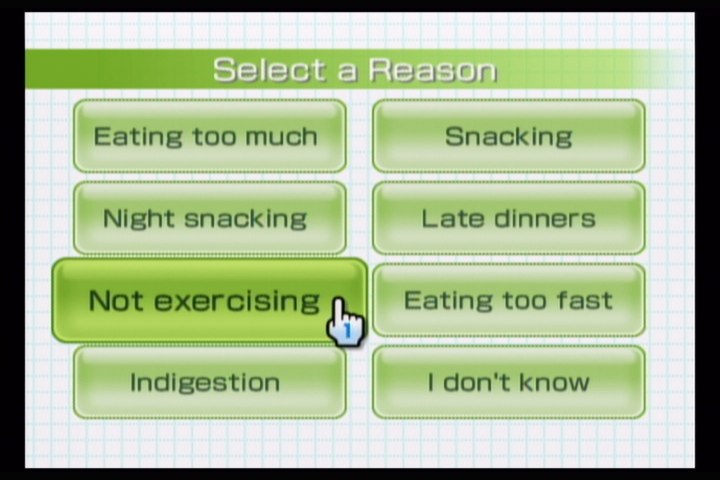
If Wii Fit succeeds in whipping American butts into shape, it will partially be through imparting a feeling of obligation to do some exercise every day. But it also courts danger in this regard: a nagging game can turn off a would-be exerciser as easily as its non-interactive predecessors. (How many treadmills became bulky clothes racks after the heat of zeal congealed into lethargic shame?). Serious commitments require both a carrot and a stick, but too much stick kills the fun.

Wii Fit employs a smörgåsbord of characters to engage players: there’s your Mii avatar, the diagram-y yoga instructors, and the anthropomorphized Wii Fit balance board. While the Mii gives some basic feedback (its shape changes as you gain/lose weight) and the yoga instructors provide tips and positive feedback, it’s the balance board that helps you set and keep your goals and chides you when you go astray.

The balance board character, a strangely expressive white rectangle, is no match for the average mom, but skip a day or two and does serve up a “You don’t call, you don’t write” routine:

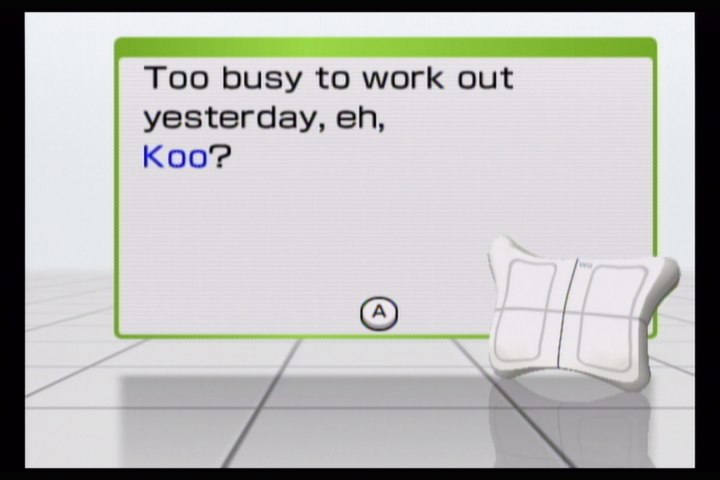
eh?

There’s no reasoning with the board on this matter. Go on a week-long business trip? Too bad – that smug little rectangle doesn’t offer excuse options. On the other hand, neither does it dwell, moving on with perfect cheer and letting bygones be bygones. Unlike a true nag, it never brings up your transgression again — the prick of guilt is instant and ephemeral. But it is there.

So Wii Fit, via the balance board character, “cares” whether you play with it or not, and whether you do so regularly. (Once you start, the game tracks but doesn’t mind which exercises you choose). A game that makes you feel guilty for ignoring it isn’t novel; pet simulators like Nintendogs also mark your absence, during which time your virtual puppy gets increasingly hungry, thirsty, and disheveled. The possibility of neglect, and the guilt that accompanies it, seems to stimulate some sense of care and responsibility.

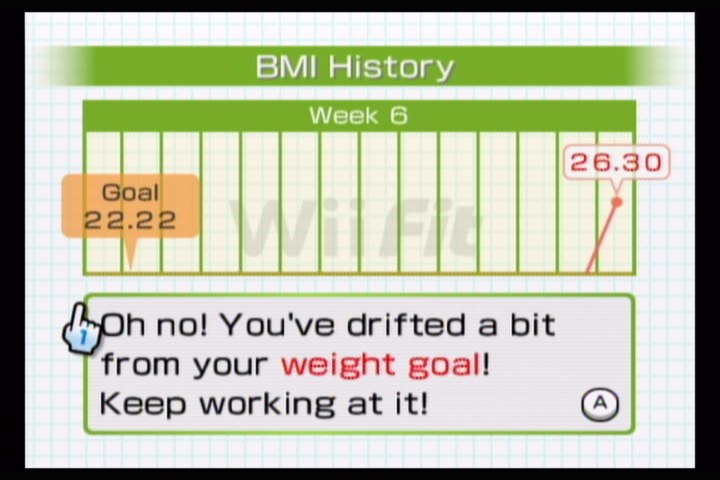
Wii Fit doesn’t merely concern itself with your decision to play; as an interactive title that attempts to change the user, it also attempts to address your other, probably more important choices. Consider this sequence, triggered when you gain too much weight vis-à-vis your stated goal:
Overweight 1 Overweight 2 Overweight 3 Overweight 4

We’ve often discussed reflection as a vital element of moral choice-making in games. On the scale of moral choices, staying healthy isn’t high up there (except for the ancient Greeks), but this device of asking the player to reflect on out-of-game, real-life decisions is worth considering for application in other games for change. Particularly notable is that it’s the player, not the software, who sets the goals in the first place. The Wii Fit is there to help keep you on the path that you’ve laid down for yourself.

Set a goal Reaching your Fit goal

Is this method of reflection effective as a mechanism for personal change? Or does it, together with the goal-setting and the nagging, only drive away those who have trouble staying on the bandwagon? We should start seeing some answers in the next few months.

– Gene Koo

G4C2008: Sandra Day O’Connor keynote

From the Games for Change conference program: “Justice O’Connor is working on several projects to foster national dialogue about the judiciary in our system of government. She has brought together experts at Georgetown Law School and Arizona State University to create Our Courts, which will be an online interactive civics curriculum for middle school students.”

Bob Kerrey’s introduction: we must reinforce “both the ideas and the commitments necessary to make democracy work… Being critical is not critical thinking”

Sandra Day O'Connor“I’ve become increasingly concenred about vitriolic attacks… on judges — that judges are activist… Now I always thought that an activist judge is someone who gets up in the morning and go to work.” “Public education is the only long-term solution to preserving an independent judiciary and the system of government we have.”

“The politicians are slowly learning how to communicate with and inspire the next generation — not only through rallies, speeches… young people are getting engaged with civic life through the Internet… and through these mechanisms young people can have leadership roles through tools that belong to their generation. First we need to engage young people that government has real impact on their lives, and that they can have a real impact on government.”
Continue reading

G4C2008: “the next big thing is games with meaning”

There is a market for meaning. – Christophe Watkins (Artificial Mind and Movement).

Notes from the “Moving Markets” panel at G4C…

Robert Nashak (Worldwide Casual Studios, EA) — we’re looking for emotional connection, and what better way to connect emotionally than to do something people care about?

Richard Lemarchand (Naughty Dog) — grow our audience, deeper narrative — story games that marry videogame play with rich storytelling, strong characters.
Continue reading

G4C2008: unveiling the “corporation for public gaming”

This is a Really Big Deal: Joan Ganz Cooney Center at Sesame Workshop is launching a new initiative around gaming; Dr. Michael Levine presented the new project.

Target audience: elementary kids, not as young as Sesame audience. How to blend affordances of digital media.

Signature programs: Research Innovation Fund (how new media applications can accelerate children’s learning), Cooney Prizes for Excellence in Digital Media (recognizing “half baked” ideas), Cooney Fellows Program, Advocacy & Dissemination Program.
Continue reading

G4C2008: philanthropic funding perspectives

Ben Stokes (MacArthur): It’s about “learning” (not “education”). Games are partly about learning, but they’re about a system of learning that we’re trying to understand.

Jessica Goldfin (Knight): Lead journalism into the 21th century. Good journalism is about democracy. See Knight challenge.

Arlene de Strulle (NSF): Cyber-learning initiative based on large investment in nation’s cyber-infrastructure. We need new ways of understanding the new learner — decentralized learning, anytime anywhere. We don’t know the cognitive implications of cyber-learning. Understanding science crucial to participating in cultural change.

Brad (Corporation for National & Community Service): Change — engaging citizens as problem-solvers.

Picking up Eric’s question from the last panel challenging assessment/evidence — What questions do we still need to answer?
Continue reading

G4C2008: assessing games for change

One the most important exchanges in this session was a challenge from Eric Zimmerman during Q&A as to whether foregrounding assessment hampers the cultural expression of the project. “How would you assess Maus?” Several in the audience applaused.

Shelly Pasnik (EDC): If assessment is about what we know, we need to be more sophisticated about describing what we know.

Karin Hillhouse (Ashoka) gave the example of Wired and the potential for changing hearts and minds. If Wired had been tested and focus-grouped it would never had been on the air.
Continue reading

G4C2008: Jim Gee vs. Eric Zimmerman

Gee: “World of complex systems that is biting us, and biting us bad.” e.g. peak oil => biofuel => no water / no food => failed states => end of global economy

Zimmerman: industry (19th century), information (20th), the Ludic Century (21st century systems)

Gee: Games not terribly good at delivering information, but at novel experiences: seeing the world in new ways. Continue reading

G4C2008: mini-TED

4 talks in 40 minutes.

Suzanna Samstag Oh (Global Contents Forum) — games for change (“practical games”) in Korea… need for psychological research.

Cindy Poremba (digital media theorist, Concordia University) — is there a game analog of film documentaries? e.g. embedding documents in Brother-in-Arms game. bringing evidentiary materials into a game to convey complexity, multiplicity. DocGames.com

Ken Perlin (Dp’t of Computer Science and Media Research Lab, NYU) — design factors (cognitive, emotional, socio-cultural), deployment context (integration, support), expanded definitions of educational outcomes including affective. Storytelling and entertainment’s power to transform. See ICED game corresponding to The Visitor.

Wendy Cohen (Manager of Community and Alliances, Participant Media) — see Participant’s “pro-social” mission. Now launching takepart. Looking for distribution avenue for games. wendy@takepart.com

G4C2008: alternate reality games for change

Puzzle solving != problem solving
Simulation for “what if” scenarios: direct the “what if” at social issues, values, concerns
Goal driven vs. purely narrative experience
TINAG vs. explicit game experience

World Without Oil: Rather than teaching that oil dependency is bad, instead ask how an oil shortage would affect your (real person’s) life.

ARGs are more self-aware as an active agent in culture — not a box off the shelf to be consumed. Also as inherently collaborative, interactive.

Content as most expensive, least interesting part of ARGs — get the players to create the content.

G4C2008: values at play lunch workshop

At lunch, Mary Flanagan walked us through a very simplified version of the Values at Play process. Each table of participants picked one “Value” card and then identified existing games that highlight that particular value. (Ours was “Privacy” — we came up with such games as poker and just about every other card game). This warmup was to help flex our minds around the ubiquitous presence of values in games. Then we drew a second card naming an existing game which we were to mod to include the value from Card 1 (we drew “Monopoly”).

Some of the designs I found most interesting coming out of this very brief process (maybe 10 minutes) explored the tensions around each value (e.g. setting up incentives to defect from cooperation to build conflict over the value). We didn’t come to a proposal for modding Monopoly to address privacy, but we played with mechanisms where both protecting and revealing information would give the player strategic advantages. Perhaps each player has a secret goal that, if accomplished, would grant that player bonus points at the end.

I found the Values @ Play process fascinating and rich, and hope to be able to play with it at one of our upcoming meetings.