You are viewing a read-only archive of the Blogs.Harvard network. Learn more.

f/k/a archives . . . real opinions & real haiku

December 6, 2008

encore: holiday haiku from Schenectady

Filed under: Haiku or Senryu,Schenectady Synecdoche — David Giacalone @ 4:46 pm

a holiday haiku stocking-stuffer from Schenectady . . .

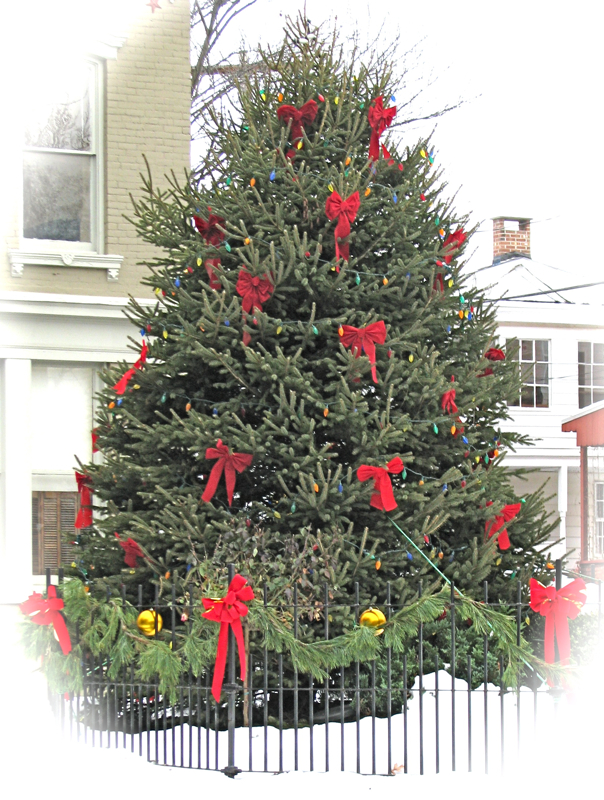
Stockade Christmas Tree at Lawrence Circle - Dec2009

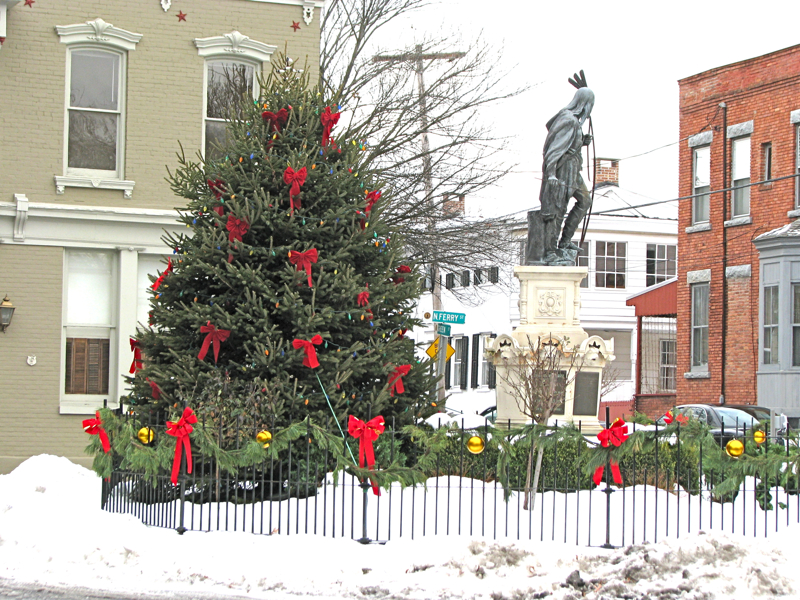
– 2009 Schenectady Stockade Christmas Tree –

Schenectady, NY, a haiku hotbed? It surprised me, too, when I first realized that two highly-respected haiku poets –- Hilary Tann and Yu Chang — were professors at Union College, right down the street from my home in Schenectady’s Stockade Historic District. We each came to Schenectady years ago from distance places — Yu from Taiwan, Hilary from South Wales and myself from an exotic place called Washington, D.C.

Hilary and Yu readily said yes, when I asked them a year ago to help me compile a holiday collection of “real” haiku and senryu as our Holiday Gift to f/k/a‘s readers and our “neighbors” in Schenectady and around the world.

The result was “Holiday Haiku from Schenectady” (pdf.) which has two dozen poems by the three of us, and which is formatted to be printed on two sides of a letter-size sheet and made into a tri-fold brochure.

Here are the poems for those who would rather scroll than click.  No matter which holidays you celebrate during this month of special days, may they be joyous for you and all your loved ones.

.. ..

wintry mix
we make a snow buddha
for Santa

– dag

[orig. haiga]

December rain
a starlet
sheds her tears

parting clouds
she checks the Christmas lights
one by one

red envelopes
the sound
of children’s laughter

three generations
peering down a gopher hole
winter solstice

Christmas snow
my father’s footsteps
bigger than mine

………… by Yu Chang

red bows decorate
the ‘Closed for the Season’
sign

Christmas Eve
we share the same
wrapping paper

replacing
the paperweight –
another snowstorm

Christmas service
the old carols
with no back-beat

sitting
where I sat as a child
I wait out the storm

Christmas lights
my eye is drawn
to the house with none

………………. by Hilary Tann

2009 Stockade Christmas Tree with Lawrence the Indian - Schenectady NY

setting up the creche –
the Baby’s name
uttered over and over

married a decade
she hides
the mistletoe

Nana serves
Grandma’s recipes –
Christmas Eve calamari

warm yule
the ice-fishing hole
mostly hole

empty cookie tin —
letting out last year’s
santa suit

frontdoor
to curb —
pine needles and tinsel

……………………….. by David Giacalone

New Year’s eve
a balloon
tied to an empty chair

new year’s day
a squirrel emerges
from the dumpster

……………………….. yc

twelfth night
a trail of pine needles
down the garden path

ht

Boxing Day drizzle —
the inflatable snowman
keeps smiling

gray sky
all the way home
from grandma’s house

New Year’s Eve
sleet and snow–
the old man takes baby steps

……………. dag

…. from the brochure “Holiday Haiku from Schenectady

– click for more Christmas Season Haiku by f/k/a‘s Honored Guest Poets –

– find Schenectady holiday spirit in the Gazette gallery of Stockade Doors


Arianna, a “blog post” is not a “blog”

Filed under: Haiku or Senryu,Procrastination Punditry — David Giacalone @ 11:05 am


. . . another pet peeve . . .

It’s bad enough that the f/k/a Gang lost our fight to ban the word “blog” as a substitute for “weblog,” as well as the battle to keep that ugly little word from being used as a verb.  Having no quioxtic need to smack our heads against walls or windmills, we’ve stop campaigning against the use of the term “blog” in those contexts, and have merely settled for avoiding it in our own writing as much as possible.  But, we’ve noticed lately that the sad, tiny verbal mutation is being utilized more and more by people who are talking about a “post” or “posting” or “blurb” or “piece” or “article” or “column” that has been written and put up [“posted”] on a weblog.

A high-profile example of that linguistic malpractice and “verbal abuse” two nights ago, by the omnipresent and nearly omnipotent Queen of Bloggers Herself, has provoked today’s plea that the practice be ended now. To wit:

On December 4, 2008, Charlie Rose interviewed Arianna Huffington, in conjunction with her new book “The Huffington Post Complete Guide to Blogging” (Simon & Schuster, by The editors of the Huffington Post, December 2, 2008, Paperback).  Although I always find Arianna Huffington‘s visits on Charlie’s show and at other television forums interesting, I have no idea who will find her slim volume on blogging worth the time or the asking price. (It is, in fact, doubled in size to its 240 pages by quite a few fattening appendices of slight value to the weblog neophyte.)  Nonetheless, she is looked to as an authority on “blogging” and thought of as a wordsmith.  So, I was annoyed to hear Ms. Huffington, more than once, using “blog” as a noun meaning the individual piece of writing that is posted in reverse chronological order, with its own permalink, and set of reader comments, on a weblog.

For example, when Charlie asked Arianna to explain what a link is, she replied “it means that I’ll write a blog — I wrote a blog about the book” and used a hyperlink . . . . .

That is simply not an acceptable use of the word “blog.”  For example, people using printing presses did not say they were producing a “press” instead of a book, article or pamphlet (and thankfully never said they were “pressing” when producing their product).  Likewise, a story or piece appearing in a newspaper is called an article, not a newspaper; and an entertainment or news episode appearing on a television is called a show, not a tv.   Turning “blog” into a synecdoche meaning any part of a weblog is a confusing and grating verbal practice.  And, we respectfully ask Arianna — especially as a leading advocate for bloggging — to stop doing it.

The Glossary in “The Huffington Post Complete Guide to Blogging” correctly offers these definitions, which suggest the writers can distinquish a blog from a post:

blogger — someone who writes blog posts.

blogging – writing a blog post.

But, it gives this rather ambiguous definition of the word “blog,” which could indeed be talking about a blog post, and which could use some editing:

blog –  derived from the term “web-log”: regularly updated account of events on a website, commonly listed in reverse chronological order.

Enough said (and enough time spent putting off further writing on excessive legal fees).  I’ll leave you with a true anecdote about the pervasiveness of the word “blog”, which happened less than 12 hours after hearing Arianna on the Charlie Rose Show:

While explaining to a group of strangers that I’ve spent quite a bit of my time the past few years working on my weblogs, a young women asked “what’s that, does that have something to do with a website?”   When I replied that a weblog is a blog, she indicated she now understood, but said — and the others in attendance seemed to agree — that she had no idea the word blog was derived from “web-log.”

Naturally, I then threw in a short version of my sermon against the word “blog”, saying that I try to stay with “weblog” as much as possible.  I added, of course, that Peter Merholz [who first created the term “blog” by shifting the syllabic break in “web-log” to “we-blog”] said he was just being silly and liked the fact that “it’s roughly onomatopoeic of vomiting.”

If you are a regular reader wondering where the haiku is today, here are a few before I go, starting with Ed Markowski and then a trio from the newest issue of The Heron’s Nest:

cobwebs sway
where the mistletoe hung…
lent begins

….. by ed markowski

jasmine in bloom —
termites swarm
from their nest

stump speech —
this black and white butterfly
in none of the field guides

…. by Carolyn Hall – The Heron’s Nest (Vol. X, No. 4, December 2008)

a still, starry night —
train tracks
wet with dew

…. by Michael Dylan Welch – The Heron’s Nest (Vol. X, No. 4, December 2008)

breakfast alone
except for that cricket
behind the fridge

… by David Giacalone – The Heron’s Nest (Vol. X, No. 4, December 2008)

December 5, 2008

Chief Kaz: cheap apology, cheesy chivalry

Filed under: Schenectady Synecdoche,viewpoint — David Giacalone @ 8:40 am

Schenectady’s Lesson for Civic Leaders: If a cop has the nickname “Sgt. Snow,” or even “Lt. Noriega,” don’t make him Chief of Police.

unseen eyes —
an apology made
behind dark shades

…. by dagosan

.. After years of tarnishing the reputation of the chronically-troubled Schenectady Police Department, its former police chief, Gregory Kaczmarek pled guilty on Tuesday to third degree criminal possession of cocaine (with intent to sell).  Six years after he retired his position under a cloud, he’s heading for two years in prison, with his stepson looking at three years (and his stepdaughter already doing 6 years for another drug bust), while his wife will spend six months in the County jail.  See,  “Ex-chief heading to prison: Schenectady’s Gregory Kaczmarek admits to drug charge” (Albany Times Union, Dec. 3, 2008); and “Kaz Family Plan” (Carl Strock’s Freestyle Blog, Dec. 2, 2008)

The story is well-known here in Schenectady, but I thought I’d give it some space here at f/k/a, as a civics lesson (or a shot of schadenfreude) for our readers, and because a little venting might help get the bad taste of Kaz’s career out of my mouth.  The convictions are part of a larger drug case that has already sent almost two dozen participants to prison.  Greg and Lisa Kaczmarek, who operated a pizza shop they called Capo di Pizza for a few years after he retired in 2002, were minor dealers and users.

Here are excerpts from the Schenectady Gazette’s Kaczmarek Timeline: that should give you a good idea of the odorific tale of Chief Kaz (and see “Kaczmarek: ‘I sincerely apologize’” (Schenectady Gazette, December 2, 2008) [words in brackets are my filler explanations]:

(more…)

December 4, 2008

a full, warm cup of ambrosia

Filed under: haijin-haikai news,Haiku or Senryu — David Giacalone @ 1:05 pm

.. Poet-editor-publisher Denis M. Garrison has recently produced his first batch of Ambrosia.  Ambrosia comes in many forms, but Denis’ version won’t make you immortal, or give you hay fever; and, it’s not that green squiggly stuff your Aunt Tootsie brought for dessert at Thanksgiving.

It is, however, “something with an especially delicious flavor or fragrance.”  To be more precise, and in Denis’ own words:

“This premiere issue of Ambrosia: Journal of Fine Haiku includes 100 top drawer haiku from twenty-eight leading poets from around the world. All these poets, while writing in English, respect the formal values of traditional Japanese haiku.

“Ambrosia holds that a haiku in English, to be fine, must have the traditional shape and duration of haiku, its metre and music, and exhibit aspects of traditional Japanese poetic aesthetics. We prefer haiku written in a natural, modern, English idiom with great care for the sound of the verse when spoken. Ambrosia’s haiku touch the reader powerfully.”

The new, quarterly Ambrosia haiku journal is published by Modern English Tanka Press.   It comes in print form (as a 4.25″ x 6.87″ paperback pocket book) and as a PDF ebook (a steal at $4.95), both of which can be ordered from Ambrosia‘s Lulu.com webpage.  You can subscribe to the print edition here.  However, we are most pleased to tell fellow lovers of genuine haiku that Ambrosia is also available for free as a digital online magazine.

In addition to numerous poems by our Honored Guest poet Laryalee Fraser (you’ll find them below), this first issue of Ambrosia features several poems from each of these poets: Hortensia Anderson, Susan Constable, Bill Kenney, Michael McClintoch, Jo McInerney, Kirsty Karkow, and Raffael de Gruttola, plus offerings from twenty other haijin.

lightning storm —
biting into the blackness
of licorice

…. by Laryalee Fraser – Ambrosia (Issue 1 – Autumn 2008)

In his Editor’s Note, Denis tells us: “Ambrosia considers the traditional poetic aesthetics of Japan as necessary, not in order to pay homage to the tradition, but because without their understanding and skillful use, writing haiku worth reading is difficult, if not impossible.” At a time when some editors seem to mistake artifice for originality, unusual for unique, contrived for creative, and juvenile for rejuvenating, the f/k/a Gang applauds Denis Garrison for reminding us that the haiku genre does indeed have a recognizable shape and scent, and for insisting on standards of quality.

Or, as our crankily frank Prof. Yabut might say:

They may be one breath long, but every brain fart is not a publishable haiku!

Thanks to Laryalee Fraser for sending me over to Ambrosia, and for penning these haiku, which can found in Ambrosia (Issue 1 – Autumn 2008).

dragonfly —
skirting the edge
of a heron’s stillness

frayed sunlight
between the pilings —
summer’s end

cornflowers —
between the clouds
a handful of sky

a rainbow
over autumn maples…
the laundry forgotten

drowsy morning…
the bird that belongs
to the song

…. by Laryalee FraserAmbrosia (Issue 1 – Autumn 2008)

p.s. If you prefer quirky commentary to quirky poetry, we remind you to get a virtual shot of hot caffeine at the BabyBarista weblog (see our prior post), which was selected this week for the 2008 ABA Journal Blawg 100.  It’s a daily soap opera about the “reality” of life as a junior barrister at the English Bar — with characters to love and loathe, and plenty of ethical and anthropological issues to ponder over a cup of java.  If you enjoy BabyBarista, like we do, please consider voting for it in the “Beauty Pageant” going on from now until Jan. 2, 2009, at the ABA Journal website, by heading over to the Quirky category.

[orig. haiga here]

lipstick on his
coffee mug –
steam rising

photo: ARTHUR GIACALONE
poem: DAVID GIACALONE

December 3, 2008

Value Pricing by lawyers raises many ethical red flags

Filed under: lawyer news or ethics,viewpoint — David Giacalone @ 9:25 am

This posting was originally entitled “some Value Billing issues for today’s ABA Ethics Teleconference” —

At noon Eastern Standard Time today, a 90-minute ABA ethics teleconference and audio webcast will take place, titled “Billing Pitfalls & Pratfalls: Avoiding the Ethical Issues that Snag Attorneys.”  It’s sponsored by the ABA Family Law Section and Professional Responsibility Center.   The description of the session includes this sentence:

“Our expert faculty will discuss hot topic issues relating to  . . .  billing based on ‘value pricing’.”

I’m hoping that the faculty, Mark Chinn (of Jackson, MS, Moderator),  Lori Nelson (of Salt Lake City, UT ), and Chaim Steinberger (of New York, NY), will spend considerable time on the topic of the fiduciary and ethical obligations of lawyers using value billing — especially on standards for avoiding unreasonably high fees.  The issues are most pertinent with regard to the kind of “average” or “Main Street” clients seen by family and divorce lawyers and mediators — clients who are not sophisticated in dealing with lawyers or purchasing legal services.

As used here, “value billing” or “value pricing” is a pricing method in which fees are set in advance of the provision of legal services, based on the client’s perception (guess) of the “value” of those future services, rather than on the lawyer’s time expended, other efforts, costs or risks. [see A. Shields]. Value Billing is distinguished from the more common alternative pricing practice of using a “fixed fee” that attempts to mirror the expected or average cost to the law firm for providing a particular discrete service.

We’ve been raising questions about some of the principles and tactics of value billing for almost five years, and have garnered virtually no analysis of the issues by legal ethics experts or other commentators beyond those with a financial stake in the concept of value billing (a/k/a, value pricing).  See, e.g., our posts starting with “Value Billing and Lawyer Ethics” (Jan 28, 2004), and culminating in  “broadening the hourly billing debate” (Aug. 18, 2008), through “smart clients care about . . . marketplace ‘value’” (Nov. 25, 2008).

As discussed in our prior posts, we’ve seen many red flags that call for ethics scrutiny and guidance, or raise fiduciary concerns regarding value billing/pricing.  For example, value billing proponents:

  • over and over tell lawyers (and other professionals) they deserve to earn higher fees than they can charge using hourly billing, and that they will indeed achieve such higher fees and greater profits by using value billing; meanwhile, most clients seek alternative pricing mechanisms in search of lower fees than generated under hourly billing.
  • argue that value pricing can and should be divorced from the time and effort expended and other costs incurred in providing services to a client; and
  • attack hourly billing, the profession’s predominant method for setting fees, and the corresponding, century-old ethical standards for reasonableness (time and effort expended), as themselves unethical — without offering any standard other than the client’s guess as to value prior to seeing the results of the services rendered.  Of course, we have fiduciary duties of fair dealing and full disclosure precisely because many clients lack the information to make such judgments about a lawyer’s fees, competence, and diligence. [see our post “chronomentrophobia,” on the ethics and practicalities of hourly billing and alternatives]
  • offer tips for reducing a client’s price sensitivity and increasing the lawyer’s leverage in order to charge premium fees, and for achieving higher prices by using information about the client gathered in confidential discussions — including financial status and personal characteristics (such as the client’s emotional condition, anxieties, obsessions, sense of urgency, credulity, etc.).
  • advise lawyers to engage in price discrimination among clients who are fully capable of paying fees in full — in order to charge higher fees to those perceived as able or willing to pay more, and therefore to cherry-pick the highest paying clients and prune-away lower-paying ones (rather than serving more buyers, which is the traditional argument justifying price discrimination).
  • boast that value billing allows lawyers to circumvent competitive market forces that prevent an increase in their hourly rate, and to avoid passing on to clients efficiency gains that would reduce the number of hours billed;
  • praise “Change Orders” as a way to charge ultra-premium fees for any unexpected or added tasks, by using the leverage over the client that the situation creates [click for our reply to Ron Baker’s Auto Mechanic analogy];
  • suggest that lawyers can expect to work fewer hours using value billing and still achieve increased profits.
  • use lots of glib mantras, metaphors and maxims — many of which seem specious or inapt.
  • suggest that giving a money-back guarantee is sufficient to remove any issue of excessive fees — although Rule 1.5 bans agreeing on an unreasonable fee, as well as collecting one, and clients should not have the burden of deciding when to demand a refund; nor should they pay a hidden premium because the fee comes with a refund guarantee.

Some or all of the above issues need to be discussed today by the panel — and, we hope, someday soon by the law professors at the two major ethics blawgs, The Legal Ethics Forum and The Legal Profession Blog, as well as those at Concurring Opinions, and the consumer advocates at Public Citizen’s CL&P weblog.

As family law and mediation practitioners, I hope the panel will comment on Matt Homann’s approach to value billing for a service such as divorce mediation.  Rather than offering a reasonable hourly or flat fee up front, Matt would ask:

“What do you think X would be worth to you?” And remember, “X” is not a contract, will, or deed, but rather peace of mind, security, or some other intangible benefit tied to the specific legal service you’ll be providing.”

[My response to this in a post back in April 2005: “Homann’s Value Billing approach turns the fiduciary relationship into an auction, where the single potential buyer is unaware of the seller’s knockdown price and has no way to judge whether the object for sale is a valuable antique or a fake. No matter the soothing words and good-feely ambiance, it comes down to playing on the consumers fears and sentiments and then saying “make me an offer.” ]

.. Traditionally, “value” has meant “a good product at a good price,” and has always taken into account competitive market forces that tend to bring price down to the seller’s cost.  That’s why computers cost less today than a decade ago, although buyers “need” or “value” them more now, as they have become central in our business and personal lives.  So, we need to be suspicious, I believe, of a new definition of value that is based on a buyer guessing in advance just how much a product is worth, without knowing the quality or quantity of the services to be performed or the actual results, and with no connection to what the service costs the seller to produce.  To say a fee is “reasonable” if the client agrees to pay it (or agrees to the subjective “value” of the service), makes the rule against unreasonable fees moot.  We need a better standard and guidelines when using value billing.  Don’t we?

update (Dec. 29, 2008): Ron Baker continues his defense of Value Pricing, and I respond, in a set of Comments appearing in a prior post on the topic of value billing.

December 1, 2008

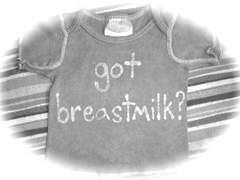
Cal. Milk Board wants TM for “got breastmilk?”

Filed under: lawyer news or ethics — David Giacalone @ 10:55 pm

&/or

A comment this evening by Jill Jalen goes a long way to solve the mystery raised in our post “got jugs?” (July 30, 2008).  Experts on breasts, babies, and trademark law — along with those interested in jugs and lawyer antics — all wondered why the California Milk Processor Board wanted Alaskan artist and breastfeeding advocate Barbara Holmes to stop using the slogan “got breastmilk?” on her onesies and infant t-shirts.  They said Holmes’ slogan infringed on their “got milk?” trademark, but that seemed unlikely.  Jill’s Comment brings things into better focus:  On October 6, 2008, the Board’s lawyers, Knox Lemmon Anapolsky LLP, filed a trademark application with the PTO for a mark that:

consists of the wording ‘got breastmilk?’ in all lower case letters in Phenix American font.”

According to the TARR status report for the as-yet-unassigned claim with the Serial Number 77586468, the Board intends to use the “got breastmilk?” mark with the following products:

  • baby blankets, children’s blankets and burp cloths
  • breast pads and breast-nursing pads
  • baby bottles, cups adapted for feeding babies and children, pacifiers, sippy cups, breast milk storage bottles, breast pumps and breast shields
  • baby backpacks and baby carriers worn on the body
  • clothing, namely, t-shirts, shirts, short-sleeved shirts, long-sleeved shirts, sweat shirts, infant bodysuits, pants, infant sleepers, hats, caps, cloth bibs, socks and infant onesies

When the story broke, a lot of folks ridiculed Knox Lemmon for making such a frivolous trademark dilution claim — arguing that there could be no confusion between the hand-written “got breastmilk?” logo used by Holmes and the well-known wording and font of “got milk?®.”  See “‘Got milk’ lawyers huff at Talkeetna artist’s parody” (Anchorage Daily News, July 25, 2008); via Overlawyered.com; and see “Legal Blog Watch;” Language Log; and Alaska Backwoods Lawyer.

Even this weblog said the “attack on Barbara Holmes and her onesies is silly as a matter of law and one more example that we’ve become an ‘overlawyered’ nation.”  However, we always caution others who mock the conduct of otherwise competent lawyers that we might not know all the pertinent facts (or motives), and that more information might indeed show us that dollars were at stake and the action was defensible.

That seems to be the case here – – the Milk Board apparently wanted to protect more than its “got milk?” franchise.  Nonetheless, if Stephen Byers and the other lawyers at Knox Lemmon had trouble with Holmes’ logo, they should be even more worried about this baby onesie product from The Mom’s Boutique in Oshkosh, Wisconsin, which appears to use the same font as the mark in the new application, as well as the original “got milk?” campaign:

.. baby onesie and t-shirt ..

Maybe trademark experts will help us determine whether the prior uses by the breastmilk advocates are a bar to the Milk Board’s application for a mark on “got breastmilk?”  Naturally, if this new product line is projected to be a cash cow, CMPB might be willing to use a little monetary suasion to obtain the rights to “got breastmilk?”.

dairy country…
in the pharmacy window
a breast pump display

… ed markowski – Bear Creek Haiku

silence
the baby finds
the breast

……………. by Yu Chang from Upstate Dim Sum

a winter cornucopia from The Heron’s Nest

Filed under: Haiku or Senryu — David Giacalone @ 12:16 pm

.. The Heron’s Nest (Vol. X, No. 4, December 2008)

Like the seasons, the haiku journal The Heron’s Nest returns with comforting regularity, showing us traditional and new ways to look at the world through one-breath poetry.  THN‘s editors have selected over a hundred unpublished haiku for this edition, and also included a lovingly-overflowing tribute to William J. Higginson.

A dozen of the new haiku are written by our Honored Guests.  This Gary Hotham haiku was one of the three “Editors’ Choice” poems:

more footsteps —
the broken branch
breaks again

………….. by Gary Hotham (Editors’ Choice selection)

Here are a half dozen more, as an appetizer:

New Year’s Day
our neighbors’ boots
in the mud room

late November
no leaves to break the fall
of heavy rain

… by Hilary Tann

split white birch
a beaver’s wake
reaches shore

…. by paul m.

icesnow —
the stab marks
of her pronged cane

…. by Roberta Beary

budding maples —
an updraft
of goldfinches

… by Barry George

the downpour ends
first one peep
then another

…. by George Swede

– all from The Heron’s Nest (Vol. X, No. 4, December 2008) –

The THN Tribute to William J. Higginson presents 60 poems by his admirers and students (which we all are), plus ten by Bill that appeared in The Heron’s Nest.

Here are tributes to Bill HIgginson by members of the f/k/a haijin family that you’ll find in the THN collection:

dusk
a half-ripe melon
frees itself from the vine

…. by Carolyn Hall

his passing . . .
the small fir collects
fallen leaves

….. by Tom Clausen

gray October
the poet’s voice
outlives him

….. by David Lanoue

full moon
and so my thoughts
turn to you

…. by Roberta Beary

sunset fades
from the highest peak —
autumn chill

…. by Laryalee Fraser

temple steps —
his shoes
in the autumn rain

….. by Hilary Tann

a memorial bell
tolls tolls and stops,
but his words . . .

…. by Alice Frampton

blue dragonfly
pine needles cover
the narrow path

…. by Peggy Willis Lyles

almost dry again
the drinking gourd . . .

….. by John Stevenson

— see our f/k/a tribute to Bill (Oct. 11, 2008)

.. .. ..   p.s. Speaking of corn and coping (and birds), Erik Turkewitz has a Thanksgiving-themed version of Blawg Review up today at his New York Personal Injury Lawyer weblog.  Blawg Review #188 is, of course, filled with links to Eric’s picks for the best recent posting on lawyer weblogs, set among his sub-theme of Arlo Guthrie and Alice’s Restaurant.  Since he and I differ on the utility of using themes for Blawg Review, Eric (after talking about copyright infringement) was gracious indeed — he re-published one of the senryu from our Thanksgiving Conversation post.

By the way, Eric pointed to Scott Greenfield’s fight against lawyer marketing and advertising at weblogs, which is a great excuse to end this post with a replica of this handy Proud No Marketing Weblog logo (which originally appeared at Gideon’s a public defender weblog, and was created by  the Urban Compass blog’s Heather Brandon of Hartford, CT; Gideon and Scott posted it in the original color with a red circle):

November 30, 2008

lawyer entitlement and the price of legal services

Filed under: lawyer news or ethics — David Giacalone @ 3:43 pm

? ? ? ? ? ? ?

It’s rare for the f/k/a Gang in our roles as Agent of Reality and Consumer Advocate within the legal profession (and broader legal services marketplace) to find a kindred spirit in the blawgisphere.  So, we were pleased when Scott Greenfield pointed his readers yesterday to Law21, the weblog of Canadian lawyer and journalist Jordan Furlong.  He sees Law21 as “an information hub for the extraordinary changes underway within the legal profession.”

What makes Jordan’s spirit akin to my own is not that we are likely to agree on every topic.  It’s that he is not afraid of the changes brought about by information technology and the dawning of a globalized marketplace, which allow and demand more choices for consumers.  He is not trying to prevent or delay those forces in order to preserve the ego, image, social status and (last but certainly not least) the income expectations of the legal profession.  His perspective is a happy contrast to many in the blawgisphere who purport to be future-oriented and the leading edge of law practice, but who spend their time trying to figure out ways to preserve, and even increase, lawyer income in the face of technological innovations and market forces that allow services to be provided more quickly and efficiently, by fewer lawyers and by more and more non-lawyers.

Jordan appears to realize — as does Richard Susskind, in books such as “The Future of Law: Facing the Challenges of Information Technology” and “The End of Lawyers? Rethinking the nature of legal services” — that the profession will have to adjust significantly to the realities of the digital era.  More important, he realizes that consumers are showing us by their choice of alternative sources and formats what is and is not valued about the way the “traditional” law firm provides solutions to client problems. The f/k/a Gang believes as a matter of principle that the legal consumer is king (and lawyers are merely the skilled-but-humble esquires holding the client’s shield).  I don’t know whether Jordan, who does after all work as the editor-in-chief of the Canadian Bar Association’s magazine National, agrees with that principle.  But, he seems to believe that a free marketplace supports the power of the consumer over the prerogatives of the provider — and, that a technological revolution is breaking down barriers that have too long protected the lawyer cartel from the forces of competition.

Two posts at Law21 got my attention yesterday, and are clearly connected: “the market doesn’t care” (Nov. 28, 2008) and  “De-coupling price from cost in legal sevices” (Nov. 26, 2008).   The primary points of “the market doesn’t care” are

(more…)

November 29, 2008

SnowmanCity, NY

Filed under: Procrastination Punditry,Schenectady Synecdoche — David Giacalone @ 8:02 pm

It was serendipity (not synecdoche) that brought me this afternoon to the counter of my favorite book and gift shop, The Open Door Bookstore, on the Jay Street pedestrian mall in downtown Schenectady.  I had just left our Central Public Library, two blocks away, and thought I’d stop in quickly at the Open Door for my only shopping of this post-Thanksgiving weekend.   While waiting for the woman ahead of me to wrangle a discount on a couple of children’s books, I was pleasantly surprised to see — prominently displayed on the main counter — a book written by freelance illustrator and cartoonist Bob Eckstein, which we had fondly discussed last February here at f/k/a (and which would make a great Holiday-Christmas gift for anybody with a sense of playfulness, love of history, or attraction to conversation-starting coffee-table books with lots of interesting pictures):

The History of the Snowman: From the Ice Age to the Flea Market” (2007)

Immediately thereafter, I was even more surprised by a flier in a display behind the book, showing a smiling Bob and announcing a related book signing event:

The Open Door Bookstore, Sunday, Dec. 7, 2008 1 pm

Book Presentation and Signing

Bob Eckstein signs, The History of the Snowman: From the Ice Age to the Flea Market. This fascinating holiday book includes a section on the Stockade. Mr Eckstein will give an illustrated  talk at the Schenectady County Public Library. From 1:45-3:15, there will be a book signing at the store.

Then, however, as I gazed at that slight smirk on Bob’s face, a little voice in my head whined: “Hey, I’ve plugged the book; I got the Schenectady Public Library to purchase a couple copies of it; and I’ve linked several times to Bob’s Today’s Snowman weblog.  So, why hasn’t he given me a heads-up (viz., a personal private invitation) for the library presentation and book signing?”

My next thought: “Well, I’ll show him.  I’ll write all about the events at my weblog, and show up next Sunday at both the Library and the store.”  Thus, was this posting inspired — at a time when I was really intending to write a much more serious piece about lawyers (proving that the holiday season has not dulled my procrastination skills).

Naturally, I shot over to Today’s Snowman to see what was happening in the world of flakey frozen aqueous sculpture. Now that we’re back to cold weather, Bob has started his monthly Snowman Contest up again (with “possible prizes” relating to his book and its marketing).  He continues to have Snowperson Personal Ads, while also answering Questions For the Snowman Expert.  And, of course, you’ll find regular posting about interesting snow-creature-related news and endless promotion of The Book (including links to a sneek peek and a chapter-by-chapter pictorial YouTube Preview).

Although Bob promised back in October to put his book tour schedule and itinerary up at his weblog, I couldn’t find it.  Maybe he doesn’t know he’s supposed to be in Schenectady on December 7th.

Could I have been unfair to Bob by fretting over the Snowman Snubbing of his biggest fan in Schenectady? (Even bigger, we’re sure, than the Older Family, who live in a nearby suburb and constructed The Great Rotterdam Snowman, which won the February 2008 Snowman Contest at Today’s Snowman; see our report and analysis.)

Since my Invitation might just be delayed in the mail, I’m going to throw in another marketing plug for Bob and the book:

..  .. History of the Snowman Mugs are now available from the website, and can be purchased at his book tour events for $10.

If you live near Schenectady, come and join my combination peaceful protest and fan club outing, next Sunday, December 7, 2008, at 11 PM, at 99 Clinton Street, in downtown Schenectady. [Our friends at the Rotterdam Internet Community are especially invited.] If you need another local tie-in, check our prior post, where we discuss at length the role purportedly played by snowmen in a pivotal piece of local history — the 1690 Schenectady Massacre. Until I read about it at Today’s Snowman, I had not known about those brave (if feckless) snowmen, who some say stood guard just a couple blocks from my home here in the historic Schenectady Stockade. [Learn more at Wikipedia.]

larger . . Eckstein displays a fine sketch from the book of the Stockade Snow Guards in a posting at his site, and retells the tale in Chapter 12 of The History of the Snowman, titled Early American Snowmen, 17th Century New World, Fresh Snow (at pp. 110 – 112, which can be read in full by scrolling down this preview of the book).  In The History of the Snowman, Bob asks: “Was the first snowman in America made in Schenectady, New York, on the eve of one of the bloodiest days in early American history?” He concludes: “We may never know whether this was the first American snowman, but the Schenectady Snowman is definitely the earliest reference to one

Well, I’ve procrastinated long enough to make it virtually impossible to finish my originally-intended posting this evening without a lot of sturm und drang.  What more could I ask of Bob Eckstein on a chilly, lonely Saturday night?  Thanks, Bob, and see you next Sunday!

p.s. I just this minute learned at Bob’s website that: “Bob is going to be on the radio talking about snowmen on 810AM Sunday at 9:15am (News Talk Radio WGY) in the upstate New York area (I kid you not).”  That’s The Joe Gallagher Show, which I usually wake up to on Saturday and Sunday mornings.

update (Nov. 30, 2008): We might have to adjust our motto that Whining Doesn’t Work, because Bob Eckstein put a post up late last night at his Freelancer’s Lament weblog, that could melt even a crusty old snowmudgeon’s heart:

“I hope to see many friends I’ve made online through the book, many who helped me on the book. I want to thank David Giacalone and Laura Lee Linder in particular for making me feel welcome to return to Schenectady in a few days. (Laura was helpful in the actual research of my book, The History of the Snowman and is very involved with The Schenectady County Historical Society and First Reformed Church of Schenectady. She is finishing a DVD on historical Schenectady. Further info on David just posted a generous write-up of my upcoming event and has a very cool website which is a unusual combination of haiku, law stuff and snowman interests. Right, you have to see it to believe it. I was just enjoying a piece about a sexy lawyers calendar!)”

In the Sidebar of Freelancer’s Lament, you will find the impressive (and growing) itinerary for Bob’s History of the Snowman tour, including radio interviews (such as one on Martha Stewart Radio, Dec. 5th at 7:15 AM).

update (Dec. 7, 2008): See “snowman historian blows into Schenectady.”

in the howling wind
under the full moon
the snowman, headless

…….. by George Swede from Almost Unseen
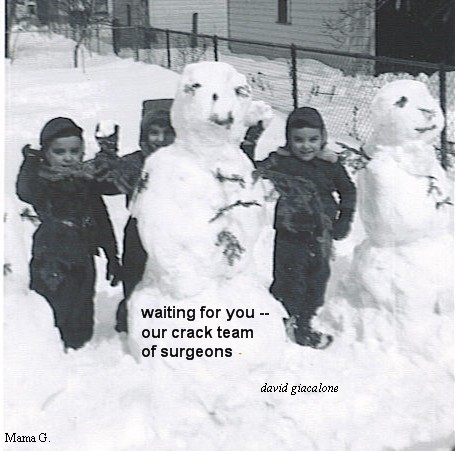
(photo by Mama G., 1953)

alongside
the smirking snowman
a hatless scarecrow

…………… by dagosan

naughty child–
instead of his chores
a snow Buddha

….. by Kobayashi Issa – translated by David G. Lanoue

November 28, 2008

let recession rekindle real holiday spirit

Filed under: viewpoint — David Giacalone @ 11:58 pm

.. Go, St. Nick! St. Nicholas v. Santa Claus ..  

Black Friday is almost at an end, and the f/k/a Gang is once again kicking off the holiday season with our annual lament over the over-commercialization of Christmas and the Holiday Season.  While many are bemoaning the signals of a reduction in consumer confidence/buying, we see a great silver lining in those black economic clouds:

Necessity does often gives birth to invention.  Our hope is that recession will be the midwife that helps America (and the rest of the Over-Commercialized Christmas World) create a re-birth in Christmas/Holiday spirit.  With a little effort and creativity, we can let financial necessity help re-invent a spirit that represents — even for the non-religious like myself — the selfless love of Jesus, and the compassion of the original St. Nicholas, rather than the consumption symbolized by Santa Claus.

Even before I read Scott’s piece this morning, “The Blackest of Fridays” at Simple Justice (Nov. 29, 2008), where he asserted:

“Consumerism, especially the crass king that makes it’s home on Long Island, is an evil.  No, not to enjoy material possessions per se, but to need them so desperately to enhance one’s self worth that one would risk the kids’ college or the house to get it.”

. . . and even before the news arrived that “Worker trampled to death at Long Island Wal-Mart during Black Friday stampede” (New York Daily News, by Joe Gould, Nov. 28, 2008), the Gang was searching our archives to recall what we said in other years about consumerism ruining Christmas.  (We’re often pleasantly surprised by our prior insight, idealism and eloquence!)

In the midst of that search, we stopped to check out a few recent articles that seemed  relevant and hopeful.  For example, the Washington Post brought good tidings that America’s economic crisis has already brought us one consumer blessing — a reduction in the amount of junk-mail from direct-mail marketeers, including fewer offers for new credit cards.  (See WaPo article, Nov.  7, 2008)  Even more encouraging, we ran across a couple of commentators who also saw the potential advantages of American belt-tightening:

  • According to Stephen S. Roach, the dive in disposable income and the bursting asset bubbles (leading to a reduction in “net asset extraction” through equity loans) may be bringing a beneficial “Dying of Consumption”  (New York Times, Nov. 28, 2008):

“[T]here is a deeper, potentially positive, meaning to all this: Consumers are now abandoning the asset-dependent spending and saving strategies they embraced during the bubbles of the past dozen years and moving back to more prudent income-based lifestyles.

“This is a painful but necessary adjustment.

“. . . The United States needs a very different set of policies to cope with its post-bubble economy. It would be a serious mistake to enact tax cuts aimed at increasing already excessive consumption. Americans need to save. They don’t need another flat-screen TV made in China.”

  • Meanwhile, the NYT‘s Ron Lieber envisions a “Leaner Holiday Gift Giving, Bountiful in Spirit” (Nov. 21, 2008).  Similar to our thoughts the past few days, Lieber hoped that “Of all years, this may be the one to stop the holiday gift madness — out of necessity for some of us or simply out of reason.”  His vision:

“[A]t a time when so many people have so much less than they did just a few months ago, there ought to be a way to ease the pressure on them and relieve the crushing social obligation that others feel to dole out to an ever-lengthening list of people

He calls for “an effort to make gift giving more meaningful than mandatory.”  For many that may mean spending less, but Lieber hopes that some of us will be able to spend more, by adding more philanthropy to our holiday giving.

Like Ron Lieber, I’m not at all sure exactly how to go about this transition-from-necessity to a saner, more “spiritual” holiday spirit.  We realize that some family members (can you say “Nana”?) may be very reluctant to spend and give less, while others are even more reluctant to receive less.  But, I am sure we should all be thinking of ways to use our worsened national financial situation to justify new buying and giving habits this holiday season — hopefully leading to new attitudes that will continue even if and when our ecomony and fortunes greatly improve.

We bet a leaner Christmas/Holiday Season for 2008 will teach all of us the lesson that fewer gifts — less giving and receiving —  doesn’t reduce holiday joy for parents or children, spouses or lovers, kith or kin, but somehow increases our satisfaction and sense of connection and well-being.

Finding new ways to express our love and affection, and making new commitment to help the less fortunate, may help us find our way back to the “true” holiday joy, cheer and peace we have tried so long to buy and consume into being.  Those of us who don’t have to cut back should do it in solidarity with those for whom it is a necessity — to take the pressure off of them.

Is this anti-consumerist scheme just the stingy ploy of an old curmudgeon — or of a Scrooge or Grinch who never liked Holiday Cheer in the first place?   Give it a try and see for yourself whether less isn’t indeed really more when it come to inspiring the true spirit of this Holiday Season.  Please share your suggestions on how to pull it off and the results of your efforts in our Comment section.

Below the fold (click “more”), we’ve excerpted some of our prior preaching on the subject of commercialization of Christmas (which we proudly call the Holiday Season, to embrace all the holidays and shades of belief that Americans celebrate every winter).

Christmas Eve –
bits of a price sticker
stuck on my finger

… by Michael Dylan Welch The Heron’s Nest (Sept. 2005)

wrapping and packing —  
she pastes on
a holiday smile

… by dagosan

(more…)

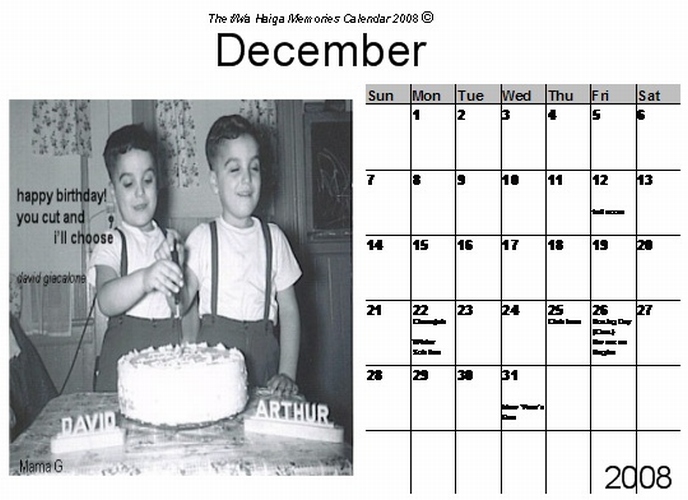
our haiga calendars for December 2008

Filed under: Haiga or Haibun — David Giacalone @ 11:48 am

November is almost gone, so we better tell you about our haiga calendars for December 2008.

As we’ve mentioned many times before, haiga are pictures (paintings, sketches, or photos) that include a subtly-linked haiku or similar poem (such as a senryu, which is like haiku but focuses on human nature). Last year, we created two free “haiga calendars” for 2008: the “artsy” Giacalone Bros. Haiga Calendar 2008 (with photos taken by my brother Arthur) and the nostalgic fka Haiga Memories Calendar 2008 (with most shots snapped in the 1950’s by Mama Giacalone).  The poetry is written by your Editor “dagosan”.

Here are thumbnails of the calendar pages for December, and the related poems:

round and round with you
dancing
on thin ice

..

happy birthday!
you cut and
I’ll choose

Click on “more” to go below the fold, where you will find larger images and links to the original haiga used for the December calendars.

.. check out our exploration of the saying ‘dancin’ on thin ice’ . .

(more…)

November 27, 2008

the charitable curmudgeon

Filed under: Haiku or Senryu,q.s. quickies — David Giacalone @ 9:20 am

We’ve long asserted around here, along with 60 Minutes commentator Andy Rooney and grump-expert Jon Winokur, that:

Curmudgeons are idealists at heart.

Scott Greenfield is one of my favorite fellow curmdugeons.  He makes a good case this Thanksgiving morning at his Simple Justice weblog that it is more important than ever in this season of economic distress that those able to do so give generously to charities, but “Give Wisely.”  A little curmudgeonly skepticism is needed when we choose our charities this year.  That means:

  • “Given that charities may well die this year from lack of donations, it is critical that you know that your contributions are being put to the use that you intend, to help the cause the charity purports to represent.  This may require a little digging, perhaps spending a few minutes to check out CharityWatch.org, the website of the American Institute of Philanthropy, to see what percentage of donations actually make it to the cause.  However, many smaller or local charities are not included, so you may have to do the legwork yourself.”  And,
  • “The mission of a charity may well be important and worthwhile, but it has to be viewed in relation to the irreparable harm that will result should the charity fail to fulfill its mission.  This year, it means that people will die for lack of food, shelter, medical care, warm clothing and other necessities of survival.  Not to denigrate many other worthy purposes, but imminent death trumps a lot of good causes.”  Therefore,
  • No matter how important other causes may be, and they are important, this is a year for charitable triage.”

Please open your hearts and your checkbooks, but please do it with your eyes wide open — do it with the idealistic cunning of a skeptical curmudgeon.

We already said sentimental stuff wishing everyone a Happy Thanksgiving yesterday.  All there is to do today, then, is offer a few haiku appetizers as a prelude to your feast of gratitude with your loved ones.

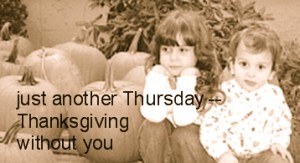
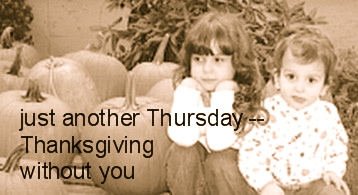
Thanksgiving
without him
three-quarter moon

… w.f. owen – Haiku Notebook (Lulu Press, 2007)

laid off
she asks the mall santa to
bring dad a job

snow
the beggar’s
bare hands

.. by Ed Markowski

in the glow
of the red maple
autumn’s end

…… by Roberta Beary (1st Place tie [Kigo], Shiki Kukai, Nov. 2008)

wet snow
another year weighs
on the century oak

….. by tom painting  (3rd place [Kigo], Shiki Kukai, Nov. 2008)

home for Thanksgiving —
my old bed
in the guest room

mom makes
grandma’s holiday soup –
steam and tears

… by dagosan

First snow
the white mounds of coal
beside the closed station

.. by Rebecca Lilly –  from A New Resonance 2 (2001); Brussels Sprout 9:3

cutting the moon cake
just like my mother
Mid Autumn Festival

……………………. Yu Chang from Upstate Dim Sum

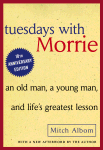
p.s. Looking for a little inspiration and nudge toward Thanksgiving gratitude?  See our post about Morrie Schwartz (of Tuesdays with Morrie fame), “self-pity: the opposite of Thanksgiving“.  I

On the other hand, if you need a curmudgeonly smile, check out and maybe even print out the amusing “Thanksgiving Guest Liability and Indemnification Agreement,” prepared by The Center for Consumer Freedom, who say “Don’t Let Lawyers Sue The Stuffing Out Of You This Thanksgiving” (Nov. 16, 2007; via Stephanie at Idealawg).

November 26, 2008

a little Thanksgiving conversation

Filed under: Haiku or Senryu,q.s. quickies — David Giacalone @ 12:01 am

The f/k/a Gang wishes a wonderful Thanksgiving holiday to all of our readers (regular, occasional, or inadvertent).   May your travels — across country or across town — be APAP (as pleasant as possible) and your feasting divine. Don’t forget to nurture an attitude of gratitude for all the good things in your life — and even for the trials that help make us better people.  And, guys, don’t forget to offer early and often to help with preparations and clean up.

men washing dishes – 
an early alarm ends
her Thanksgiving dream

Just in case conversation grinds to a halt around your dining table — and the Baby Boomer Raconteur in your family can’t remember the name of that movie he liked so much — here are a few topics that should liven things up and unloose a few tongues:

  • Should obese people who take up two airplane seats have to pay double the fare? This is a great question for Uncle Vito, between mouthfuls, while he’s reaching for that third helping of pumpkin pie.  As CBC reported last week, the Canadian “Top court backs free seat ruling for some disabled, obese travellers” (Nov. 20, 2008).  By rejecting an appeal by two airlines from a Canadian Transportation Agency ruling,

“The court’s decision means airlines must offer a “one person, one fare” policy . . . for people who are clinically obese and take up more than one seat.

Walter and Ted have been covering this topic for years at Overlawyered.com, and they can give you lots of tips for baiting the soft-hearted liberals in the family.  Meanwhile, you’ll find lots of tart, tasty zingers over at Simple Justice, where Scott Greenfield says “Obesity is Not a Crime, But Is It a Disability?” (Nov. 22, 2008).  Scott believes “this is a problem, both for the airline and the rest of us.” And he argues:

“No one suggests that obese people be prosecuted for being so fat, or spilling over into the next person’s airline seat.  

On the other hand, there is no rational basis to place the burden on society to make accommodations for the obese.  Are you prepared to be bumped from your flight because an obese person showed up at the airport with a ticket?”

In a similar vein, Prof. Ann Althouse offers more food for thought:

“If you get a free extra seat now, won’t people be clamoring to be considered one of the truly obese? Does some government agency certify that you are fat to the point of disability and thus entitled to accommodation?”

  • What the heck’s a Sex Offender? This one should wake up a few in-laws.  In an illuminating piece at his Once Fallen website, Derek Logue presents his stand-up routine called, “You Might Be a Sex-Offender, If. . . “, a compilation of real cases that have branded defendants as sex offenders for crimes that simply do not rise to that level.  Such as:
    • You might be a sex offender if… you ever paid for a prostitute in New York
    • You might be a sex offender if… you use a stolen credit card to hire a stripper in New York
    • You might be a sex offender if… You had sex with a teenager while you were a teen yourself

There are many more on Derek’s list.  The P.S.A.P. weblog aptly adds: “As a result of [a] deep and legitimate concern, however, our collection of sex offender laws have become draconian and self-defeating. They’ve become Draconian because they have been extended to cover “crimes”  that either should not be crimes in the first place or, even if they merit prohibition, the perps are by no means “sex offenders” (in any way outside of the ridiculously broad statutory definition).”

Before we brand them with a scarlet letter that restricts where they can live, hurts their job prospects and embarrasses them, P.S.A.P. rightly notes we need to stop and consider that:

“If we truly want the designation to have any shaming power, we must restrict its use to those offenses that are actually offensive.”

  • We’re Clueless on Civics (present company excluded, of course): G.W. U. law professor Jonathan Turley reported earlier this week that “Elected Officials Score Lower on Civics Tests Than Average Citizens (Who Score Lower than Basic Condiments)” (Nov. 23, 2008; and see the full report from AFP) via Simple Justice, which opines that we’re “Getting the Government We Deserve” ).  It’s a little dispiriting, but it presents all kinds of opportunities for one-ups-manship at the Thanksgiving table.  You can find the Civics Quiz here (from the Intercollegiate Studies Institute), and cherry pick the questions that stumped the most people, college graduates, and elected officials. How will your extended family do compared to:
    • the average American, who scored 49%
    • college-educated, who averaged 55%
    • elected officials, who averaged 44%

Prof. Turley notes that “Some 20 percent of elected officials believe that the electoral college as established to ‘supervise the first televised presidential debates’.”  But, offers a little solace: “our English cousins appear equally ill-informed on history.”

update (Dec. 1, 2008): Conversationalist Carl Strock of the Schenectady Gazette made “Flunking civics” his Thanksgiving column, and we’re grateful Carl snuck it into the free part of the Gazette‘s website.  Carl muses, “Today being Thanksgiving, let us give thanks that we live in a country as open as ours, where anyone can aspire to be president, whether he knows which branch of government the president belongs to or not.”

Below you will find a bunch of Thanksgiving senryu and haiku, which (along with the one near the top of this post) I wrote a year ago and would have forgotten about, if not for Mr. Google refreshing my recollection.

afterwords (Nov. 29, 2008):  Yes, these are a little late for Thanksgiving, but they should come handy throughout the Holiday Season left.

Thanksgiving rush –
not as late
as that flock of geese

wintry mix – 
a seatbelt protects each
Thanksgiving pie

bowed over
turkey and stuffing —
fewer, grayer heads

a third helping
of Thanksgiving politics
I bite my tongue

thanksgiving snow
gone too soon to make
that snow Buddha

… by dagosan –   from Magnapoets Japanese Form (November 20, 2007)

Finally, as we always say around here:  

November 25, 2008

smart clients care about bonuses and marketplace “value”

Filed under: lawyer news or ethics,viewpoint — David Giacalone @ 2:59 pm

. . . . from the desk of Prof. Yabut .

A few days ago, the kids who hang out at the “legal tabloid” Above the Law discovered that the major NYC law firm Cravath, Swaine & Moore was going to reduce the bonuses it pays its associates (newer, non-partner lawyers) by 50% this year — with the basic bonus for 1st-year associates (who are making a salary of $160,000 straight out of law school) set at $17,500 and seventh-year associates getting $30,000.  The America Lawyer confirmed it yesterday (Nov. 24), and the gnashing of young lawyer teeth has been heard around the world of BigLaw and the internet.

As of this morning, over 1400 Comments have been left at the original ATL post.  And, those numbers will surely swell, since Above the Law and then The American Lawyer brought news yesterday evening (Nov. 24, 2008) that Simpson Thacher, another top firm, was going to follow Cravath’s lead, with the white-shoed herd likely to join in the bonus-reduction stampede.

Nonetheless, the f/k/a Gang isn’t going to harp on either associate avarice or partner parsimony.  Instead, we want to discuss the debate that has arisen over the statement by Cravath’s representatives, as reported in American Lawyer, that many clients are applauding the reduction in bonuses.  Carolyn Elefant summarizes the controversy at Legal Blog Watch with a post that asks “Should firms cut bonuses in response to clients?” (Nov. 24, 2008):

“Though some might compliment law firms for taking clients’ views into account, others in the blogosphere suggest that clients have no business telling law firms how to run their business.”

The clients-bonuses debate (described and discussed below) highlights one of my primary concerns with the concept of “value billing” or “value pricing” by lawyers as espoused by the leading proponents of value billing [“VBPs”].

With value billing, fees are set in advance of the provision of legal services, based on the perceived “value” of those future services to the client, rather than on the lawyer’s efforts (especially, time expended), costs or risks [see A. Shields].  Separating “value” from a seller’s cost might be a nice tactic for extracting “premium” fees, but it is not what smart buyers (much less buyers owed fiduciary duties) expect in the marketplace.  Let me explain.

(more…)

« Newer PostsOlder Posts »

Powered by WordPress