You are viewing a read-only archive of the Blogs.Harvard network. Learn more.

f/k/a archives . . . real opinions & real haiku

March 6, 2008

History Detectives down the block

Filed under: Haiku or Senryu,q.s. quickies,Schenectady Synecdoche — David Giacalone @ 6:40 pm

update (Aug. 11, 2008): See our post “9 Front St. stars on History Detectives tonight

prior updates: You can see the Stockade Blockhouse Investigation on History Detectives on August 11, 2008 (at 9 PM on Schenectady’s WMHT-17; check its schedule for encore presentations). The Schenectady Daily Gazette covers the story again, in the article “Home’s link to past focus of PBS program” (Aug. 8, 2008).

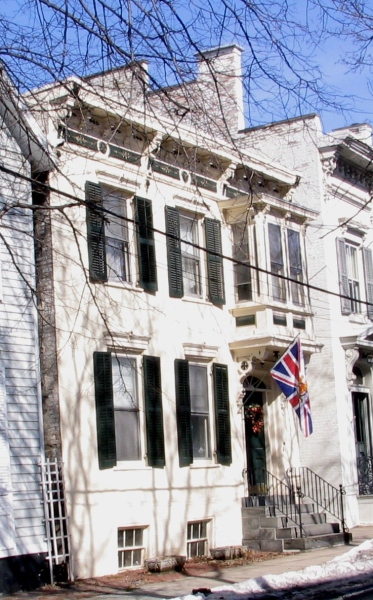
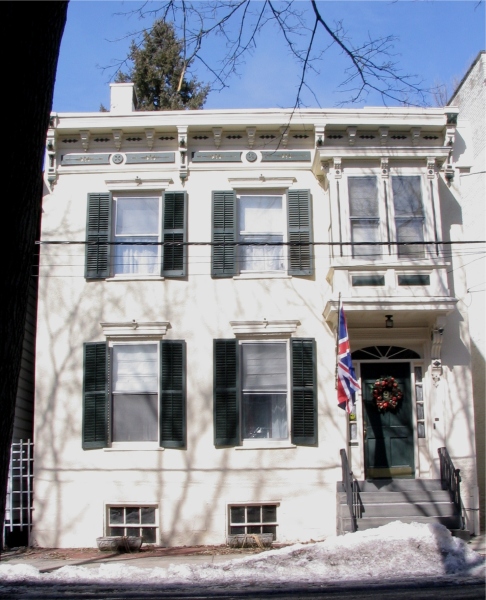
It started two years ago, when Schenectady City Historian Don Rittner glimpsed this blue stone outer wall through a lattice fence at 9 Front Street, in my Schenectady Historic Stockade District neighborhood. It resulted in a crew from the PBS program History Detectives filming a segment yesterday afternoon that will air this summer. See “PBS program digging into Stockade home’s past” (Schenectady Daily Gazette, by Justin Mason, March 5, 2008; photo of participants); and “PBS filming home in Stockade” (Albany Times Union, March 4, 2008)

the cold night
comes out of the stones
all morning

…….. by jim kacian – Presents of Mind (1996)

[large] As the Gazette reported yesterday, “Rittner now believes the stucco facade of Daniel Partington and Sharon Cole’s home is concealing a former British Army blockhouse that could be among the oldest structures in the county. And his work has caught the attention of a nationally syndicated program exploring extraordinary objects in everyday homes.” [Click here for a large photo of the hidden stonework that started Rittner’s investigation.]

Partington and Cole (who is a speech therapist and a native of the UK) had thought their home dated back to the 1890s, which is not very old by Stockade standards. But, a number of “peculiar discoveries” made them believe the building might be much older — including hand-hewn hemlock beams in the house’s basement, stonework that extended from the foundation to the attic, “where he found newspapers from the early 1820s wedged between the rocks,” and two-feet-thick exterior stone walls in a portion of the house.

Because stone is scarce in this part of the country, it was almost exclusively used for military fortifications. But, the origins of 9 Front Street may have been hidden by “improvements” over the years. As the Gazette article explains:

“An addition was built on the rear of the home and its exterior was almost completely covered with stucco, giving it a distinctly Victorian appearance. Rittner said the only thing that prevented the building’s stonework exterior from being completely obscured was the small, foot-wide space between the couple’s house and the building next door, which apparently prevented workers from applying the stucco.”

old wall–
for no particular reason
fireflies visit

….. by Kobayashi Issa, translated by David G. Lanoue

The Gazette article gives more details from this detective tale, along with speculation about the house, which might be the oldest building in Schenectady, and date back to a time when “British and Dutch traders maintained a very tentative foothold in the area.” The evidence was enough to bring History Detectives to Schenectady, with co-host Elyse Luray spending two days “reviewing Rittner’s work and examining the house for a 20-minute segment on the show,” which will air this summer, during its 6th season. Luray says:

“When this airs, the rest of the country will know that Schenectady was one of the first American frontiers. . . . You never know what you’ll find in your attic.”

I’m sorry that I learned about the filming too late yesterday afternoon to walk about four houses down the block to do some gawking. It inspired me, however, to take a few photos of the house for this posting (plus this one), and to dig up a handful of haiku that seemed to capture its/my mood.

the cloudburst
scrubs it clean…
the old house

one by one
even the cats come home…
cold nights

dawn–
through a hole in the wall
the cold

my house’s rear wall–
the dirty snow
holds on

thin wall–
with the moonlight comes
the cold

well hidden
by the spring mist…
grave tablet

…….. by Kobayashi Issa, translated by David G. Lanoue
a blue ceiling
where the roof-beams
have collapsed

drifted snow
the welcome disappears
from the doormat

falling leaves
the house comes
out of the woods

…….. by jim kacianPresents of Mind (1996)

– pbs History Detectives – with Elyse Luray

mid october
the shadow of a wrecking ball
on the stadium facade

……. by ed markowski

for sale
an old house with creaky stairs
and a cricket

…. by George Swede – Almost Unseen (Brooks Books, 2000)

update (08/08/08): Here’s coverage of the show from WMHT’s member magazine, Outlook (August 2008, at p. 4; pdf. download, with photo of Sharon and Dan in front of 9 Front St.):

HISTORY DETECTIVES: FRONT STREET BLOCKHOUSE airing Monday, August 11th from 9- 10 pm, explores when a couple in Schenectady, New York purchased their dream house in the town’s historic district, they believed their home was built for a middle class family in the late 19th century, like all other homes in their neighborhood. But four mysterious stone walls visible in the attic have led them to believe that this might not be the case.

HISTORY DETECTIVES host Elyse Luray travels to upstate New York to determine whether this unassuming structure may have helped ensure the survival of the town of schenectady, a 17th- and 18th-century vanguard Dutch outpost, as it fought France and her Indian allies for control of the lucrative fur trade. History Detectives: Front street Blockhouse

March 5, 2008

snowjob: lessons from the other big vote

Filed under: Haiku or Senryu,q.s. quickies,Schenectady Synecdoche — David Giacalone @ 1:34 pm

U.C. v. G.R.S.

One candidate was quite icy, showing little emotion, and was the early choice of “party” regulars; the other was a giant and media star, with a famously positive demeanor and message. In mid-February, as early voters cast their ballots, the rivals were only one vote apart. If Barack Obama’s strategists had paid attention over the weekend, the results last night might have been very different.

You see, when the votes were tallied early March 1st, it was a rout: the candidate with rustbelt, blue-collar appeal had 66% of the votes, while the favorite of the elite college crowd only attracted 29%. It seems they can party, and caucus, and rave (and even make lots of videos), but those younguns just don’t show up when and where it counts to actually vote.

388 (29%) . . . . . . . 874 (66%)

It didn’t matter that the winner had in fact disappeared before election day. The Today’s Snowman worldwide Snowman Contest for February 2008 demonstrated once again the fundamental importance of having a big, wide base and then getting that base to the polls to vote.

march thaw
the dirty snow on top
melts last

….. by dagosan

[orig.] Now, the story behind the last-minute electoral tidal wave that catapulted the Great Rotterdam Snowman to an overwhelming victory over the candidate from the University of Colorado can be told. As an article last week in the Schenectady Daily Gazette reported, Jeff Older of Donald Drive, in the Schenectady suburb of Rotterdam, NY, built the now departed GRS, with his kids, while Chris Moskoff and a group of 12 U.C. alumni built the contender from Aspen. ‘Great Snowman’ leads in online contest: Local entry battling Rocky Mountain foe” (Schenectady Daily Gazette, by Justin Mason, February 27, 2008). Bob Eckstein (author of The History of the Snowman) has tracked the battle between the UC Snowman and GRS, who were the main contenders in his Today’s Snowman weblog February Snowman Contest. See “University of Colorado Vs. Rotterdam” (Feb. 17, 2008); “The Finger Pointing Continues” (Feb. 27, 2008).

In our posting on Feb. 24th, we told f/k/a’s readers about the contest, noting that there had been mud-slinging, with the UC crowd insinuating that a dad and his kids could not have lifted the top sections of a snowman that they claimed to be 12-feet tall. [Older rebutted that slur in the Gazette, explaining that they had taken “an atypical approach in their creation by first building a towering snow cone and then carving out the snowman.” Indeed, Eckstein drove for eight hours to measure the snowman in person a few weeks ago, and validated it’s size at a dozen feet tall.]

naughty child–
instead of his chores
a snow Buddha

….. by Kobayashi Issa – translated by David G. Lanoue

What politics? As you surely have noticed, the f/k/a Gang has been a little antsy since we sworn off political and legal-ethics punditry back on Christmas Eve, with a bit too much time on our hands. Our three-part snowman (r)evolution series was one consequence of our idle minds, and led us to discover Eckstein book and weblog. While we might have promised not to post about politics (hmmm, we did, didn’t we), we never promised not to work on a campaign in the real world, nor in another part of cyberspace. So, when we saw that the UC Snowman and GRS were only one vote apart as of Feb. 21, 2008 (see “UC vs. Rotterdam Update“), and realized that our local candidate was being slurred, and facing a bunch of web-savvy elitists, while getting no publicity here in Schenectady County, Prof. Yabut decided he had to help even the playing field (or maybe tilt it a bit).

in the howling wind
under the full moon
the snowman, headless

…….. by George Swede from Almost Unseen

[larger photo] A quick check at the Rotterdam Community Internet Forum confirmed that no one had brought up the topic of their local Great Snowman at that busy website, as of the morning of February 24, 2008, with only 5 days remaining in the election. Therefore, shortly after completing our posting on the subject, Prof. Yabut emailed Jo-Ann Schrom, the Board Moderator, to tell her about this epic battle. In a couple of hours, a new topic page appeared at the Rotterdam forum, entitled “Vote for the Great Rotterdam Snowman.” It printed the text of a couple of Eckstein’s posts about the contest, and linked to the f/k/a piece. That attention attracted the Gazette reporter, and resulted in Main Stream Media coverage. The rest is, indeed, snowman electoral history. From a virtual tie, GRS supporters gave the Rotterdam giant a 2 to 1 landslide (which is not a word usually used in polite snowperson society). (update: March 6, 2008: the Daily Gazette‘s reports on the victory of GRS, posted here.)

one smirking snowman
and one
hatless scarecrow

…………… by dagosan

What lessons? This post is already too long, and we’ve sworn not to pundificate about politics this election season. So, you will all have to draw the obvious conclusions on your own — hopefully before the spring thaw melts away any additional smiling giants. (If you have the stomach and appetite for more political punditry today, we suggest checking out Prof. Ann Althouse, who has just taken a vow of “cruel neutrality,” which might indeed be worse than either benign or malignant neglect.)

p.s. Jeff Older, the creator of The Great Rotterdam Snowman has told Today’s Snowman that “Our goal next year is to go for the tallest snowman/snow-woman in the world.” And, speaking of audiacity and hope, Bob Eckstein leaked that Jeff also “plans to build a college campus, by himself, larger than the University of Colorado, once the weather warms up. Updates will be provided here exclusively at Today’s Snowman.”

snowBuddhaChadGS – speaking of super-delegates: [ original photo by Alison Shumway, via Chad]

he’s holding one
snowball…
the Buddha

…. by Kobayashi Issatranslated by David G. Lanoue

March 4, 2008

while we rudely nap: another visit to The Heron’s Nest

Filed under: Haiku or Senryu,q.s. quickies — David Giacalone @ 9:55 am

  The entire f/k/a Gang is taking another Mental Health Day off today — probably daydreaming of Sadie Hawkins Days past. Luckily, someone had already keyed in a bunch of new haiku by our Honored Guests, from the newest issue of The Heron’s Nest (Vol. X, No. 1, March 2008). So, please enjoy the work of our haijin hotties, while we nap (and scroll to the end of this post for a surprise visit from a Boomer icon):

icy morning
the twists and turns
of a child-proof cap

…………………. by Alice FramptonThe Heron’s Nest X:1 (March 2008)

Remembrance Day
traffic sounds crisscross
the bagpipes

darkening clouds
I press cold earth
on tulip bulbs

………. by Laryalee FraserThe Heron’s Nest X:1 (March 2008)

mid-morning
an ice-crack ricochets
across the river

storm clouds —
hearing the pauses
in the katydid’s song

…… by Hilary TannThe Heron’s Nest X:1 (March 2008)

needles of rain
the talk show guest
addresses my problem

dark comes early now —
we speak of the children
we didn’t have

……….. by carolyn hallThe Heron’s Nest X:1 (March 2008)

When we discovered yesterday that janisian.com had linked to our posting on shark-bitten lawyers, we thought we’d find a new band of loyal supporters, or perhaps a complaining group of two-faced barristers, or even determined heretics, at the other end of of Referer Link. Instead, we were pleasantly surprised to find the still-impishly irreverent, Grammy-winning, singer-songwriter, “Rude Girl,” and folkie-hipster Janis Ian musing (and dreaming) about defamation law, and the benefits of writing about dead people. (News and Updates, March 1, 2008).

It was fun clicking around Janis Ian.com, and inspiring to read about her Pear Foundation, which is named after Janis’ mother and works to create college scholarships for “returning students.” It was a little disconcerting to realize that Janis arrived on the scene as “Society’s Child” over forty years ago, just as I headed off to college and left behind my innocent childhood.

digital age —
aging digits
at the keyboard

……. by dagosan

fire-side poetry –
I turn to warm the left side
of my brain

………………… by Alice Frampton, from Raw NerVZ Haiku Volume VII No. 3

early March
the head of Mary
above the snow

water’s edge
the pull of the river
under ice

….. by Hilary Tann – from Upstate Dim Sum 2007/II

March 1, 2008

March comes in like a heron

Filed under: Haiku or Senryu — David Giacalone @ 2:18 pm

The Heron’s Nest (Vol. X, No. 1, March 2008)

first warm day
we check the mountainside
for wild goats

more war dead —
an uprooted tree
rides the storm tide

………….. by billie wilsonThe Heron’s Nest X:1 (March 2008)

It’s hard (but, not impossible) to think of a better way to counteract the record-low temperatures and blustery snowstorms that ushered out February and marked the arrival of March here in Schenectady, than finding a brand new edition of the The Heron’s Nest online this morning. As usual, it has over a hundred admirable new haiku (vetted by THN‘s fussy and trusty editors) to savor with your coffee or tea.

I’ve been thinking lately that I haven’t seen enough new work from our Honored Guests Randy Brooks and Billie Wilson, so I was especially pleased to find a pair from each of them in THN X:1, and they are included in this posting.

dark September day
stillborn given a name
for the funeral

October light
I open my ribs
to pray

………….. by randy brooksThe Heron’s Nest X:1 (March 2008)

In addition to Randy and Billie, this first issue from new Managing Editor John Stevenson, includes two poems each from quite few of our f/k/a family of poets: Gary Hotham, Hilary Tann, Laryalee Fraser, Carolyn Hall, Paul M., and even — much to her senryu-saturated surprise and to our pleasure — Roberta Beary. Yu Chang and Alice Fampton also snuck in a haiku each, along with this guy:

All Saints’ Day —
under the sheets
a ghost hides her stash

……………………. by David Giacalone – The Heron’s Nest X:1 (March 2008)

However, rather than doing my usual binge-posting, I’m going to invite you to take a look today at the new THN, and to come back over the next week, as I share more poems from their March 2008 edition.

– Don’t forget The Heron’s Nest Readers’ Choice Awards for 2007

p.s. I do not want the week to pass without mentioning the passing of William F. Buckley, Jr. See his NYT obit; and David Brooks’ column “Remembering the Mentor” (New York Times, Feb. 29, 2008), where Brooks tells how he wrote a parody of Buckley’s book Overdrive, when he was a young smart-aleck, and Buckley offered him a job because of it. Like Robert Semple, I have seldom agreed politically with Bill Buckley, but have always most appreciated the fact that “despite his uncompromising beliefs, Mr. Buckley was firmly committed to civil discourse and showed little appetite for the shrillness that plagues far too much of today’s political discourse.”

In her loving Washington Post tribute this week, Mona Charen quotes Lionel Trilling, who argued in the late 1940’s that conservatives didn’t have ideas so much as “irritable mental gestures,” and contrasts that stereotype with Bill Buckley, “the most gracious man alive.” I hope his life — and the outpouring from people of all ideological and political persuasions — will serve as a lesson to those who seem to believe that anger, ugliness, resentment and intolerance are persuasive or mandatory stances from which to address the public on matters of politics and ideology.

February 29, 2008

it’s Leap Day: ladies, make me an offer

Filed under: Haiku or Senryu,q.s. quickies — David Giacalone @ 11:30 am

froglegs It’s February 29, 2008. What does this “Leap Day” mean to you? For conservationists and amphibian-lovers, it’s the launch date for the Year of the Frog, a reminder that, since 1980, “at least 120 species of frogs, toads, salamanders and other amphibians have gone extinct; as many as half of the 6,000 remaining species may soon vanish unless immediate action is taken. ” (see “Leap Day: Doomesday Vault for Frogs“)

Leap Day —
the space where
a frog was

……………. by laryalee fraser
– borrowed, as amended, from this haiga

  • For loophole-loving lawyers over the centuries, it’s “not a real day and had no status in English law” (Sydney Morning Herald, Feb. 28, 2004) — fertile ground indeed for the creative defense lawyer or crafty draftsman.
  • For math and astronomy wonks, it’s an opportunity to explain again ad nauseum that “our solar year is 365.24219 days,” with all the resultant need for intercalary machinations and refinements.

frogpondF More to the point, for lonely ladies (or their impatient fathers) tired of waiting on that prince or other “fellas-ta-come-a-courtin,” and for their selective-but-traditionalist sisters impatient for Mr. Right to do the asking, “Leap Day is for (unconventional) lovers” — the one day when a woman could with society’s blessing propose to any man of her choosing. (see The Daily Green, Feb. 26, 2008) As the folks at Time & Date.com explain about February 29th:

Tradition, Folklore and Superstition

A tradition was introduced many centuries ago to allow women to propose to men during a leap year. This privilege of proposing was restricted to leap day in some areas. Leap day was sometimes known as “Bachelors’ Day”. A man was expected to pay a penalty, such as a gown or money, if he refused a marriage offer from a woman.

The tradition’s origin stemmed from an old Irish tale referring to St Bridget striking a deal with St Patrick . . .

running
right past me —
ms. sadie hawkins

………. by dagosan

For more particulars, see Wikipedia‘s discussion of Leap Year traditions, and check out Denis Kitchen’s description of Sadie Hawkins’ Day, on which all unmarried women could chase down Dogpatch bachelors and hogtie them into marriage. Although Al Capp always held the Sadie Hawkins Race in early November, in his Li’l Abner comic strip, it is now celebrated on (or confused with) February 29th by many Americans. Al Capp is gone, but unmarried women needing a little incentive, might want to check our the article “Hotels offer Leap Day proposal specials“(The Indy Star, Feb. 10, 2008).

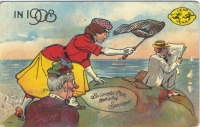
Be careful, Clara, that’s a fine Specimen.” (Leap Year postcard, 1908)

one gray moth
above the candle –
Leap Day ends

……. by dagosan

leap year day
she goes down
on one knee

………………. by roberta beary

froglegsFNaturally, the Leap Day tradition is also a boon or slight beacon of hope (and often a disappointment) for bashful bachelors, and those suffering chronically unrequited love (like this one, whose still in search of an Attractive Nuisance co-blogger). Of course, many such single guys have always been just too darn choosey, and I’m sure they’ve been lining up excuses just in case they need to say no to a Leap Day proposal. As noted above, any such rejection is subject to penalties. According to Wikipedia:

“Supposedly, a 1288 law by Queen Margaret of Scotland (then age five and living in Norway), required that fines be levied if a marriage proposal was refused by the man; compensation ranged from a kiss to £1 to a silk gown, in order to soften the blow.”

Let’s hope the fines will not be needed, and Leap Day brings happiness to members of both genders. Our ever-optimistic haikuEsq wrote rather late last night to a number of female haijin, pleading for them to submit a haiku or senryu to share here today in honor of Leap Day. You’ll find poems sprinkled throughout this post from a number of those fair ladies, along with a few plaintive ones by our sadsack dagosan. Many thanks to Alice, Roberta, and Laryalee.

As we receive (or conceive of) more Leap Day Ku, we’ll add them to this posting. Meanwhile, you single folk shouldn’t let Leap Day slip by without letting the (unmarried) object of your affections know your feelings.

together . . . frogpond
first light
of the extra day

…………. by alice frampton

the frog
and the lady –
eyeing that mosquito

………. by dagosan

leaping into
the sound of no —
frog prince

………………….. by laryalee fraser

froglegshe tells her
he’s already married
…leap year day

………………. by roberta beary

almost March 1st
the Leap Day Bachelor
re-checks his email

…………. by dagosan

afterglow (4 PM):

the short month
a leap day longer–
he says yes

lunch date
I dare him to mention
Sadie Hawkins’ Day

……………………. by peggy willis lyles

aftermath (March 1, 2008):

leap day
the peach tones
of her nakedness

………… by Ed Markowski

March 1st snow —
the old horny toad
wakes alone

…………….. by dagosan

much more than an afterthought (March 3, 2008):

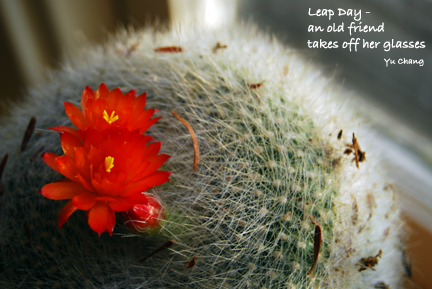
Leap Day –
an old friend
takes off her glasses

……….. by Yu Chang – photo haiga orig. posted at Magnapoets JF (March 2, 2008)

update (March 3, 2008): Thanks to our friend David Fischer at Antitrust Review for including this posting in Blawg Review #149, which contains an extensive compilation of the best recent antitrust-&-competition-related materials, as well as everything else of merit, to be found in the blawgiverse. We are pleased that our open rivalry with Antitrust Review for top Google ratings relating to “antitrust humor and sexiness” did not prevent David from pointing to our Leap Day presentation. We’re a little concerned, though, that he placed this very serious piece of sociology and advocacy in the category “The Lighter Side”.

February 26, 2008

snowman (r)evolution – Part III: snobesity

Filed under: Haiku or Senryu,q.s. quickies — David Giacalone @ 6:41 pm

. . . As demonstrated on our lawns, and in cartoons, comic strips, and movies, Americans have long imbued their snowmen with the same frailties, foibles and fate as humans.

a little dizzy
after chemo — replacing
the snowman’s head

………………… by dagosan

Through our snowmen, in addition to the shenanigans perpetrated by Calvin & Hobbes, we have depicted:

Our fear of death (which is quite unlike the acceptance of impermanence symbolized by snow buddhas), as demonstrated by

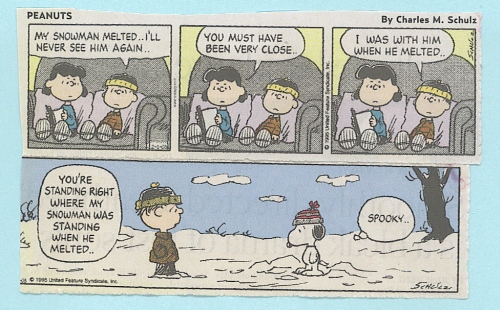
Linus‘ poignant mourning in Peanuts over his melted snowman (which was reprised just this month in the Schenectady Daily Gazette), and the search for immortality depicted in Charles Addams

Snowman in Freezer. [See more of his work in a series of holiday cards from from Pomegranate.com.]

snow turns to rain –
our Buddha’s visit
cut short

………………….. by dagosan

Our evil side – as seen

[“Thaw!”] – in the mundane mendacity of John Callahan’s fleeing, frosty bank-robber, who will surely spend a stretch in the cooler, even if defended by Calvin & Hobbes fan, and criminal defense lawyer, Scott Greenfield. (You can find “Thaw!” in the classic Callahan collection, “Do Not Disturb Any Further,” Harper/Quill 1990). [By the way, the cover of Do Not Disturb Any Further has graced my kitchen wall (and an occasional doorknob) for almost two decades.]

sudden blast of wind –
she borrows the snowman’s
hat and gloves

…………………….. by dagosan

He’s Road Chill” – or, the long-simmering, soul-numbing vengeance evidenced on January 11, 2008, in Crankshaft‘s chilling vehicular (snow)manslaughter scene.

– and, the all-consuming malevolent presence in the upcoming movie Indiana Jones and the Kingdom of the Crystal Skull (via Bob at Today’s Snowman)

Our Towering Tackiness:

Everywhere you look across our land, we are now confronted by the very-American (and sadly, also –British), plague of inflatable snowmen. They loom over our lawns and in our public spaces. As Bob Eckstein, author of ”The History of the Snowman,” told USA Weekend (“5 things you need to know about Snowmen,” Dec. 16, 2007):

Every 8-foot-high blow-up snowman is a lost opportunity of a God-given gift we all have: artistic expression.”

Boxing Day drizzle
the inflatable snowman
keeps smiling

…………… by dagosan

Their/Our Obesity

What is, however, particularly worrisome for me, is the fact that Americans have — over the past few decades and ever-increasingly — actually started to make thinner snowpersons, while taking on the most obvious characteristic of their traditional snowmen icons: We’ve turned into a nation of apple- and pear-shaped fatties. Sadly, though, when exposed to a little sun, we seem not to shrink but to expand further, double-scoop ice-cream or sno-cone in hand.

This snobesity affects not just our men, but also our women and children, who’d rather let little motors inflate their snowmen, while packing on pounds that shorten their own breaths and lifespans. (For a very scary consequence, see, “Study: Stroke Risk Triples for Women Ages 35 to 54,” All Things Considered, February 21, 2008, interview of Dr. Amy Towfighi — The risk is now greater for women than men in that age group, with the apparent cause being excess weight, shown by an increase in waist size of more than two inches since a similar study only a decade ago. My earlier concern for Baby-Boomer daddies constructing snowmen must now, therefore, extend to even younger mommies.)

a sparrow chirping
in his lap…
snow Buddha

………. by Kobayashi Issa, translated by David G. Lanoue

Denial/Delusion: The USA Weekend article on snowmen (“5 things you need to know,” Dec. 16, 2007) demonstrated another troublesome all-American habit (including, Italo-American, if my female relatives are any indication): the delusional belief that you can somehow work-off snowman-size appetites with exercise. Thus, the article says:

4. Constructing one can be a good workout. Calories burned per hour in building a snowman: 238.

Sorry, friends, but it is really hard to work off the effects of any particular snack or dessert with activity — especially in a world where a single cookie often constitutes a few hundred calories (and a mere 200 extra calories a day will add 20 pounds to your body in a year). That’s true because the activity has to burn more calories than you would have otherwise burned (create a net calorie deficit), in order to counter the effects of a particular splurge.

snack break —
no hot cocoa
for the half-built snowman

…………. by dagosan

Let me give you an example from a recent sordid, eating-disorder episode of my own: About a week ago, despite my frequently deriding the fact that our local convenience chain, Stewart’s Shops, markets its 1200-calorie pints of ice cream as “Spooners” meant to be an individual snack, I brought home not a Spooner but a full, 64-oz. half-gallon container of their Peanut Butter Pandemonium ice cream. And, then, I spent about a half hour eating it all by myself.

Yes, I’m appalled (and a little ashamed), too. For your information, Stewart’s Pandemonium is a lot like Perry’s Light Panda Paws (except it has the full complement of milk fat) — as Stewart’s explains: “This vanilla ice cream is loaded with peanut butter cups, peanut butter and fudge swirls.” I had always assumed that Pandemonium was meant to grab fans of Panda Paws, but Stewart’s originally called it Peter Butter Pan, when introduced in December 2005, in conjunction with the road-show production of “Peter Pan” at Proctor’s, Schenectady’s wonderful refurbished theater. But, I indeed digress.

A half-gallon of Peanut Butter Pandemonium contains 16 so-called “individual servings” of ice cream, at 210 calories per serving, for a total of 3360 calories. If I wanted to counteract that many calories, I’d have to do a lot of snowman-making. The 238-calories per hour suggested in USA Weekend comes to 14 hours of snowmen creation. That number is daunting enough but, as indicated above, we really need to count net or additional calories burned.

As “Calories Burned During activity and exercise,” from the Community Health department of Tooele County, Utah, reminds us: “Everything you do burns calories from sleeping to breathing to flipping on a light switch.” Just sleeping burns 60 calories an hour for the average person; watching TV burns 75, and an hour of “mall-type shopping” burns 110 calories. Indeed, although an hour of vigorously playing squash uses 650 calories, just “Impatiently (nervously) standing in line (body twitching, stamping feet)” burns – 140 per hour.

Brain Work; study, desk job, accounting, computer work, heavy concentrating, some moving around” – burns 110 calories per hour.

For numbers that correspond with your size, see “Calories Burned During Exercise,” from NutriStrategy, which gives information for persons weighing 130, 155 and 190 pounds, and indicates that a 190-pounder burns about 50% more than 130-pounder. A 155-pounder like myself burns 211 calories in an hour of cooking/food preparation.

Therefore, if I’m going to work off that half-gallon of Pandemonium, the above numbers and analysis suggest that I’m going to need to substitute 27 hours of snowman-making for a similar amount of time that I would have spent here at my computer working on this weblog. Of course, if Mama G. or a pretty neighbor offers me a cup of hot cocoa to warm up my freezing old body, I’ll need to add another hour sculpting Frosty.

Yep, this three-part series on Snowmen (which started here, and then went there) has just about worn me out. As I sit here, Schenectady and most of eastern New York State is getting a wonderful new blanket of snow. If I’m lucky, my neighbors will treat me to a party-full of new snowmen in the morning, and I’ll get to adopt one or two to keep in hats, and eyes and noses, as February wanes. May you create or espy, and totally enjoy, a few of your own.

he’s holding one
snowball…
the Buddha

……………… by Kobayashi Issa, translated by David G. Lanoue

first snow…
the children’s hangers
clatter in the closet

……………… by Michael Dylan Welch – from The Open Window (click for orig. photo-poem)

p.s. Wallace Stevens is the most famous poet-lawyer. But, I have to admit: his poem The Snow Man is way over my head and underscores my preference for really short poems.

February 24, 2008

snowman (r)evolution – Part II

Filed under: Haiku or Senryu,q.s. quickies — David Giacalone @ 3:56 pm

The History of the Snowman(2007; cover detail)

My promise (in Part I) to continue the snowman concept this weekend here at f/k/a, is smacking up uncomfortably with my general promise to stop spending so much time working online and on weblogs. Like some of our chronic little wintry-mix storms this winter, I think I’ll slip in a quickie posting now, messing up my personal traffic flow, and threaten to come back later this evening after everyone is safe on their sofa or futon of choice (perhaps with the Oscar ceremony on as background noise; click here for Part III).

warm spell —
their Christmas puppy laps up
our snow buddha

……. by dagosan

Since I posted on Friday evening, I made the “mistake” of discovering the recently-released book called “The History of the Snowman: From the Ice Age to the Flea Market,” by Bob Eckstein (Simon & Schuster, 2007); along with its official website, the Today’s Snowman weblog; and the enjoyable chapter-by-chapter pictorial YouTube Preview of the book. That cover detail at the top of the post should be excuse enough for the resulting expansion of my Snowman Evolution theme. If you’re at all intrigued by these primitive, frosty folk-statuary, Eckstein’s book and website offer much information (often witty) and distraction for a wintry day (and probably also for a summer day while slurping a snow-cone). In addition to some great photos of snow-person art (for example):
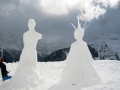
– Swiss Alp Couple, see larger at Today’s Snowman.

and the ability to vote on your favorite snowman in a (sometimes raucously rivalrous and mud-slinging) monthly contest, you’ll find Sidebar features such as Ask the Snowman Expert. To my amazement, I had to go to Today’s Snowman to discover The Great Rotterdam Snowman, which exists in all its glory only a few miles away from me as I type, in the Schenectady suburb of Rotterdam, is purportedly built by a lawyer (identity unknown as yet to me; update: it’s Jeff Older, who apparently is not a lawyer, but does work with an Albany law firm), and 12 feet tall (if not 14):

The Great Rotterdam [NY] Snowman, via Today’s Snowman weblog

update (March 5, 2008):  The Great Rotterdam Snowman won the February 2008 Snowman Contest at Today’s Snowman; see our report  and analysis. An article in the Schenectady Gazette helped boost GRS to victory.

Perhaps more amazing for this lover of snowpersons and resident of the Schenectady Historic Stockade District, the site of the 1690 Schenectady Massacre, I was not aware of the role played by snowmen in that pivotal piece of local history, until referred to it by Today’s Snowman. The Schenectady Massacre was an attack against the tiny village of Schenectady, in the Dutch colony of New York on February 8, 1690. It was carried out by a party of over 200 French and Sault and Algonquin Indian raiders. As explained at Wikipedia:

“Late on February 8, when a scouting party reported that no one was guarding the stockade at Schenectady, a decision was made to attack at once, despite the bitter cold. The original target was Fort Orange (present day Albany), but when Schenectady was discovered to be defenseless the raiding party decided to attack here instead.

“The local legend is that Schenectady and Albany had somewhat of a rivalry. Albany tended to gloat about its size over the smaller settlement of Schenectady. Therefore, when Albany sent a warning to the settlement about an approaching raiding party, Schenectady decided to show it wouldn’t be fooled by their ‘fake’ words of warning. Schenectady’s children built a snowman as the guard, which greeted the French and Algonquin raiding party the night of February 8th.”

[larger] Eckstein displays a fine sketch of the feckless SnowGuards in a posting at his site, and retells the tale in Chapter 12 of The History of the Snowman (pp. 110 – 112). In the book, author Eckstein asks”Was the first snowman in America made in Schenectady, New York, on the eve of one of the bloodiest days in early American history?” He concludes: “We may never know whether this was the first American snowman, but the Schenectady Snowman is definitely the earliest reference to one.”

update (Nov. 29, 2008): I just declared Schenectady “SnowmanCity, NY“, since Bob is coming to make a presentation at our Library and a Book Signing at the Open Door Bookstore, on Sunday, December 7, 2008.

a neighborhood
with no front yards –
not a snowman in sight

………. by dagosan

The story of the snowman and the Massacre that occurred down the block makes my plaintive poem above seem even sadder than when I wrote it two years ago. But, it gives me a great excuse for finally thanking Owen McLaughlin and Jennifer Murray for building this Snow Dude right outside my window, at the corner of Cucumber Alley and Washington Avenue, last year (see Stockade Spy, April 2007):

Rare sighting: a Stockade Snowman

Owen and Jennifer made their snowman especially magical by changing his hat and glasses frequently during his short stay. I do not know who built another rare Stockade snowperson down the block in January 2008, but I was entranced by a lovely model of the Statue of Liberty, and saddened that her predictably short life was shortened considerably by a dreadful spell of 50-degree weather last month.

January thaw
Snow Liberty leaves
a salad in the mud

…… by dagosan (haiga photo by Mama G, 1953)

sunrise —
nothing on the snowman
stops the drip

……. by Gary Hotham

Easter rain
you can tell
it was a snowman

……………….. by John Stevenson – Pilgrimage, 2006

Enough for now. I must salvage some daylight and perhaps scout for more snowmen. First, though I want to thank those who organized yesterday’s Winter Festival in Schenectady’s Central Park (see the Sunday Gazette, Feb. 24, 2008). I must say, however, that I was disappointed to find neither a Snow Bocce event (despite our example), nor a snowman-making contest or exhibit, despite a few inches of packable snow on Friday.

Try back late this evening (or, maybe tomorrow) for a little more snowman musing. [It took a couple days, but the last of this series, Part III, went up on Feb. 26, 2008; called “snobesity,” it depicts how “Americans have long imbued their snowmen with the same frailties, foibles and fate as human” — including our broadening butts.]

after snowfall
a Buddha on the lawn
with coal eyes

……………. by Jim Kacian- from Presents of Mind

February 22, 2008

my snowman (r)evolution

Filed under: Haiku or Senryu — David Giacalone @ 9:47 pm

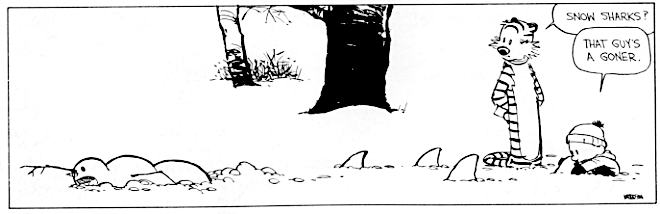
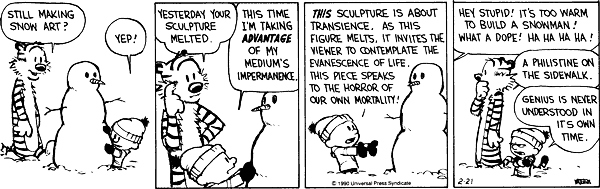
– click to see the entire  Snow Shark cartoon and the snowman oeuvre of Bill Watterson’s Calvin and Hobbes.

No, we haven’t resumed our legal-ethics or political punditry. Indeed, more than ever, I’m resolved to only post items that I enjoy compiling, creating, sharing. And, right now, that means having fun with the snowman theme.

one smirking snowman
and one
hatless scarecrow

…………… by dagosan

in the howling wind
under the full moon
the snowman, headless

…….. by George Swede from Almost Unseen

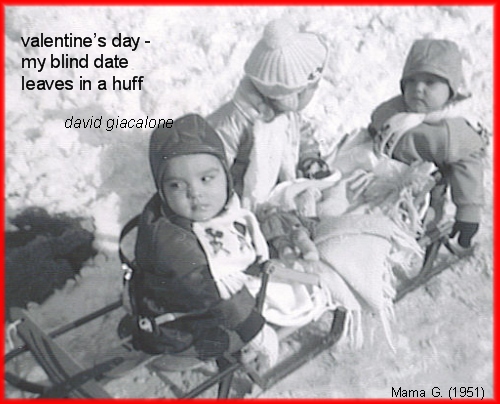
over 50 winters of Giacalone snowmen

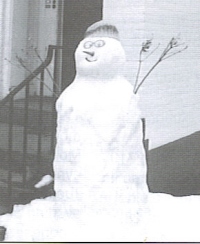
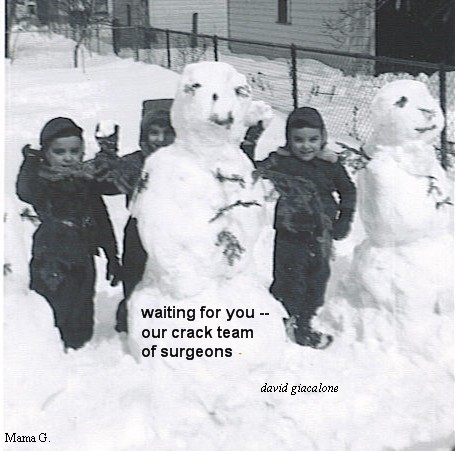
Snowmen have always delighted me (especially after being reminded, as an adult, by both Calvin & Hobbes and Snow Buddha of the layers of symbolism and mischief to be found in these homemade, temporary statuary). The photos above were taken half a century apart. One features Your Editor (a/k/a dagosan) with his siblings proudly displaying snowmen largely constructed by Mama G (larger here). The other is my niece, Elisabeth, which she built with her dad.

naughty child–
instead of his chores
a snow Buddha

….. by Kobayashi Issa – translated by David G. Lanoue

A few months ago, my brother Arthur, who lives in the Buffalo Snow Belt region, was bemoaning his fate as a Baby Boomer, who came late to parenthood and has two children in grammar school who still need major assistance constructing their snowmen. He pointed out how much work — bending, rolling, lugging, lifting — is involved in making two snowmen at a time. [In fact, according to USA Weekend, “5 Things You Need to Know about Snowmen,” Dec. 14, 2007), it takes 10 billion snowflakes to build the average snowman. That’s heavy, man.]

Last Thanksgiving, I mentioned Arthur’s complaint to Mama G. She scoffed, pointing out that she always had to make three snowmen at a time. Being my mother’s son, and despite a lifetime not defending my older-twin brother, I immediately reminded her that Arthur and his knees are three decades older than she was the last time she made three snowmen. Then, weary just thinking of all that labor, the defense rested, point made and taken.

small sad face
in the puddle —
last weekend’s snowman

…………….. by david giacalone – Simply Haiku V4N3; a procession of ripples anthology (p. 18)

– from dagosan’s haiku diary: poems that include the words: “snowman;” or “snowman’s“, or “snow buddha.”

winter fog
i stub my toe
on the snowman

below zero…
sparrows peck
the snowman’s nose

………… by ed markowski
“below zero” – Simply Haiku (Summer 2006, vol. 4 no. 2)

Coming later this Weekend: More Snowmen Tales and Haiku –

This theme proved too expansive to be contained in our posting.   Please see “snowman (r)evolution (Part ii).”

February 20, 2008

two wonderous freebies

Filed under: Haiku or Senryu,q.s. quickies — David Giacalone @ 6:55 pm

free, rare & pretty darn cool! 

It’s not just another internet rumor. At the popular Concurring Opinions weblog, Prof. Daniel J. Solove just proclaimed a phenomenon as rare and as welcome as a total lunar eclipse: His recently-published, timely and critically-acclaimed book The Future of Reputation: Gossip, Rumor, and Privacy on the Internet (2007) is now available for free download. (see our review from Nov. 8, 2007) They’ve even provided Questions for Discussion for academic classes or book-reading groups.

As Daniel explains:

Of course, I’d love it if you bought a copy, but if I can’t convince you to buy it, then I hope you’ll at least read it for free online.

I think that it is great that Yale University Press is allowing me to do this. I hope more publishers decide to let their authors do this in the future — especially academic presses, whose mission is not just to make a profit but to help spread ideas.

The book is licensed under a Creative Commons license — it can be used for non-commercial uses.

first glass of wine
Google keeps asking
“Did you mean . . . . ?”

…………………………………. by dagosan

We may have no control over celestial events, but the free-viewing of important academic books is within the control of publishers and authors, and I hope Solove’s example is widely-followed. Thanks to Dan Solove for choosing access over potential profits.

audaciously
he critiques
the eclipse

……………… by Kobayashi Issa, translated by David G. Lanoue

[larger image, by Lloyd Overcash] Hunter's Moon sm:

Meanwhile, also at Concurring Opinions, Prof. Devan Desai reminds us today that there will be a total eclipse of the moon this evening — between 10 and 11 PM, EST.

See: NASA Eclipse Home Page for details about tonight and lunar eclipses in general. And check out Mr. Eclipse.com, for a guide to photographing eclipses by Fred Espenak.

lunar eclipse umpireS
i fall for
the hidden ball trick

…………………. by ed markowskitinywords (Aug. 29, 2007)

You may recall that the f/k/a Gang was inspired by the last full lunar eclipse, in October 2004, which coincided with the then-rare World Series appearance of the Boston Red Sox. We hope to practice taking some digital photos tonight — if the clouds and wind-chill cooperate. And might produce a new one-breath poem or two, under the influence of a breath-taking lunar event. Let us know your eclipse experiences tonight.

Blood Moon
so orange!
tawny, she corrects

…………………. by dagosan

February 18, 2008

we like Lawyer Lincoln

Filed under: Haiku or Senryu,q.s. quickies — David Giacalone @ 11:37 am

topHatAbe We are still avoiding new lawyer-themed punditry here at f/k/a. But, this is Presidents’ Day, and our admiration for that lanky lawyer from Illinois, Abraham Lincoln, makes the Gang want to remind you of prior posting we’ve done about him and his attitudes toward lawyering, litigation, life, etc. So please take a look at:

the great lord
forced off his horse…
cherry blossoms

. . ………. by Kobyashi Issa, translated by David G. Lanoue

If you’re looking for new content here at f/k/a, how about some Sports senryu by a pair of our Honored Guest Poets, from this newest issue of Simply Haiku (Vol. 6 no. 1, Spring 2008):

AM radio dial — baseballG
lights up with the roar
of a ball game

on seventeen he
hits the sand he hits the sand
he hits he hits hits….

………………… by Barry George
“on seventeen” from Modern Haiku 36:3

last second field goal…
for the fifth straight week
my bookie wins

up from Pawtucket
his error in slow-mo
on the centerfield scoreboard

after confession baseballG
father shows us
how to throw a spitter

…………………… by Ed Markowski

February 17, 2008

spring comes early at Simply Haiku (along with a little haiga controversy)

Filed under: Haiga or Haibun,Haiku or Senryu,viewpoint — David Giacalone @ 10:17 pm

Gray on gray is the predominant color scheme in Upstate New York this time of year. My friend Yu Chang lives here in Schenectady (teaching electrical engineering at Union College and bringing the haiku spirit to all he does), so he knows that fact all too well. Nonetheless, if you stopped at the website of Simply Haiku Journal this weekend, you would have found a colorful reminder of the promise of Spring (beginning with the cover photo by Carol Raisfeld). Indeed, the Spring 2008 issue of Simply Haiku (Vol. 6:1) includes a portfolio of modern photo-haiga by Yu, which are guaranteed to overcome any light-deprivation-sadd-ness you might be suffering during the ides of February. [Haiga is a haiku-related genre that combines a painting, photo or other graphic image with a “linked” poem.]
If you’re more than a bit tired of grayscale, just click the link next to these b&w thumbnails from two of the haiga by Yu, to feel the magic of Spring:

[orig. haiga]

spring —
pink robe
at her ankles

…………………

[orig. haiga]

May morning
a window
ajar

…………………. by Yu Chang, from Modern Haiga in Simply Haiku Journal (Spring 2008, Vol. 6:1)

In addition to four other pictures by Yu Chang, you’ll find many more antitdotes to wintry grays and whites in the new issue of Simply Haiku — including haiga images from Pris Campbell and Collin Barber, as well as Carol Raisfeld and Ashe. And, for some forward-looking commentary, check out George Swede’s last “Tracks in the Sand” column, where he talks about his new duties as editor of Frogpond.

mid-argument–
a bumblebee
stumbles in clover

………………………………….. by Matt Morden – Stumbles in Clover (2007)

Despite trying to avoid stressful online arguments lately, I don’t feel that I can in good conscience refer you to the Modern Haiga at Simply Haiku without raising an important issue concerning the essence of haiga excellence. Beyond my chronic complaint over the use of far too many “tell-em”/”psyku” poems (which tell you rather than “showing” you what is on the poet’s mind), I’ve been seeing far too many haiga that incorporate what I call “label-ku” — poems that describe what is happening in the accompanying graphic image, rather than being “subtly linked” to that image; the haiku appears to be a caption or title describing the image.

My introduction to modern haiga came through the intervention and inspiration of my friend Aurora Antonovic, who is the Haiga Editor at Simply Haiku (and much more). She encouraged me to try my hand at creating photo haiga (resulting, e.g., in this portfolio at SH). From the start, Aurora made it clear to me: quality haiga have subtly-linked poems. As she says in her Introduction to Modern Haiga at Simply Haiku:

Haiga, of course, is poem-art, but it is so much more than a three or five-line poem accompanying an image. The poem must not merely describe the image, nor is it to be confused as a slogan, but rather as an integral part of the whole. . . .

Work must possess simplicity, modesty, minimalism, beauty, and truth. Both image and haiku must be strong enough to stand alone, but together, form a completely new and enhancing artistic expression that would not have been possible otherwise.

The haiku and image need not be overtly associated with the other. In fact, the subtlest and gentlest associations often work best.

Here’s a haiga that fits Aurora’s description, from Simply Haiku (Spring 2008):

[orig. haiga]

village common
showers of snow melt
on someone’s cobs

……………. by Matt Morden

Because I’ve taken Aurora’s words to heart, I have been rather disheartened by some of the haiga selected for inclusion in Simply Haiku and other well-known haiga forums over the past year — journals that set the standard and teach by example. There have been far too many “label-ku-haiga.” As I suggested with tell-ems, I believe that haiga editors should be sending promising haiga that include label-ku back for a re-write, rather than putting them into top-tier publications — no matter how respected the haijin might be who submitted the piece.

Rather than point here to the work of a haijin who I do not know well and do not admire, I’m going to link to the new SH portfolio by one of our f/k/a family favorites, Matt Morden [see our rave review of his recent haiku collection Stumbles in Clover, from Snapshot Press]. At his weblog, Morden Haiku, Matt habitually illustrates his fine haiku with intriguing, often gorgeous, photography. Or, we might say, he uses intriguing haiku and senryu to help describe or explain his fine pictures.

Nowhere at Morden Haiku does Matt call his work haiga. I have always assumed that Matt did not use that term, because he does not consider the mere combination of a picture (no matter how artistically successful) with a poem that describes it (again, no matter how artistically successful) to be sufficent to create a haiga (at least not journal-worthy haiga that lives up to the Morden name for haikai excellence). Therefore, when I saw Matt’s name included in the Modern Haiga section of the new Simply Haiku, I was thrilled — anticipating great haiga that would fuse his fantastic photography and haiku-writing skills, and show us neophytes (as well as haiga veterans) how to create the “new and enhancing artistic expression” that is the goal of haiga, through the subtle linkage between words and image.

Sadly — and I truly hate to say this, because I have long admired his poetry (and photography) and Matt has so often said encouraging and generous things about my own — I was disappointed when I clicked through his new haiga portfolio. Except for the one haiga shown above, the selections simply failed to offer “subtle or gentle” associations between the words and often striking images. Because of the source — created by Matt Morden and selected by Aurora Antonovic for Simply Haiku — I am afraid that publishing such haiga gives the wrong signals, or gravely confusing ones, about what makes great haiga.

Sure, it’s possible that I’m too simple-minded, new to the genre, or definition-bound, to understand the subtleties in the concept of “subtle linkage.” If so, I humbly seek more instruction and explanation. It cannot simply be that “label-ku” [called “captional style” haiga by some experts] are acceptable if the picture or the words are each individually superb, or somehow offer many layers of interpretation and meaning. Every first-rate photo and first-rate poem is packed with myriad layers — or the potential to evoke them from the reader/audience. For me, the subtle link is at the core of the best haiga. Without it, we have illustrated haiku, not publication-worthy haiga.

I can find beautiful photos and excellent haiku in many places. When I go to the best haiga journals (which receive untold numbers of haiga from which to choose for publication), I expect much more than label-ku. To my haijin friends, Matt and Aurora, I apologize for raising this issue and giving us all more agita; I know you are both more than capable of withstanding the bite of this little gadfly. I will listen with an open, “beginner’s mind” to your responses, and to those of other haiga lovers, creators, and editors.

update (Feb. 19, 2008): With his usual class, Matt Morden has pointed his readers to this posting, saying: “Those of you who worry that an ingratiating culture of mutual congratulation may eventually lead to English-langauge haiku eating itself, will enjoy the folks at f/k/a‘s critique of my own attempts at something that may resemble haiga.” Of course, I’m still hoping he’ll weigh in on the questions I’ve raised about the essence of quality haiga and using captional-style haiku with photographs.

[orig. haiga]

metropolitan museum
i join the line
to mesopotopia

………… by Yu Chang, Simply Haiku (Spring 2008)

Afterthoughts (Feb. 19, 2008): Unlike myself, the folks at HaigaOnline have given a lot of thought to the theory of image-poem linkage in haiga. For example, see “HAI + GA: Exercises in Linking Test and Image,” written by its editor Linda Papanicolaou, for the journal’s current edition (Issue 8-2, autumn/winter 2007). You are hereby encouraged to peruse and muse over Linda’s Haiga Workshop essay and associated display of photos and haiku. It begins:

“Modern haiga encompasses a wide range of approaches and styles, but every artist works towards the same goal—an art that’s more than the sum of its parts. The secret is in the link: how the text and the image relate to one another. In good haiga, both haiku and image should be able to stand on their own aesthetically, yet in juxtaposition with each other find new, deeper or richer resonance. The haiku does not simply describe the image—there’s a shift that creates openness in their relationship. This allows readers to engage and complete the meaning through their own experience.”

Linda is very reluctant to have “shoulds” and “musts” — believing it is better to show than to tell about haiga linkage theory and practice. As she says, “However one chooses to name the various modes of linking, the only real way to learn how they apply to haiga would be to choose a photo and haiku it in as many ways as possible.” Therefore, using four pictures taken by photographer-poet Ray Rasmussen, the Workshop — with nine participating authors experienced in haikai linkage — has “assembled the haiga in flash slideshows that give each text its turn with the image,” and includes a comparison chart to use as you click on the thumbnails and page through the workshop results. It’s an intriguing and helpful exercise.

Linda tells us:

“In the end, indeed, we found that the poetry of haiga depends on an open relationship between text and image. As one participant said, ‘I like the idea of the haiku capturing the mood of the haiga without repeating exactly what’s in the photo.”

February 16, 2008

magnapoets journal: congratulations A to Z

Filed under: haijin-haikai news,Haiku or Senryu — David Giacalone @ 11:23 am

The premiere print edition of the Magnapoets Journal (January 2008) arrived yesterday, courtesy of its Editor-in-Chief and publisher (our friend) Aurora Antonovic, who is “a Canadian writer, editor and visual artist” acclaimed for her work in many poetic and literary forms. Along with Nick Zegarac, who is also a writer/editor, graphics artist and weblogger, Aurora launched the online MagnaPoets cluster of weblogs in early 2007, “covering every literary category” and presenting “some of the best modern poets.” With this print edition of Magnapoets, Antonovic and Zegarac continue their mission of “taking over the world one poem at a time,” and deserve thanks and congratulations for their efforts.

The first print issue of MagnaPoets has a gorgeous, glossy cover photograph of Mont Blanc by Milorad Pavic. The semiannual journal is magazine-sized, (8.5″ x 11″), with over 30 pages, and features “all forms of poetry, short stories, interviews, and essays.” Its $5 price per issue in Canada and U.S.A. — that’s $10 for a one-year subscription, and not the memorable typo [$120] shown on the last page (which I enjoyed too much not to mention here) — seems like a very good deal for readers interested in quality modern poetry and other short literary forms.  Word from MP Central is that Volume One has been selling out rapidly in college bookstores and other locations throughout North America.  You can find subscription information here.

In this issue, you’ll find “poetry from Joseph Armstead, an’ya, Kirsty Karkow, Peggy Willis Lyles, Margarita Engle, Taylor Graham, Gilda Kreuter, and more. Featuring an interview with former U.S. Poet Laureate Robert Pinsky.”

The 15 haiku and senryu included in the premiere issue (edited by Matt Morden), include this pair by f/k/a‘s Peggy Lyles:

cemetery road
the pines almost ready
to harvest again

bath water
resurrects the daisises__
solstice moon

………………………… by Peggy Willis Lyles, MagnaPoets Journal (Vol. I:1, Jan. 2008)

February 15, 2008

lawrence and the flamingos – a Stockade Valentine mystery

Filed under: Haiku or Senryu,q.s. quickies,Schenectady Synecdoche — David Giacalone @ 5:32 pm

[Daily Gazette, Marc Schultz, larger photo]

Valentine stroll
neither lover mentions
the pink flamingos

…………. by dagosan

Did you get flocked on Valentine’s Day? If you live in The Stockade, a tiny historic district in Schenectady, New York, it’s really hard not to get flocked by a flamboyance of pink flamingos on February 14 — and (virtually) no one knows who’s doing the flocking. As described in today’s Schenectady Daily Gazette, fourteen pink flamingos appeared overnight within the small traffic circle monument to Lawrence the Indian, and were gone when the sun set. See “Pink flamingos make annual appearance: Stockade residents have grown fond of Valentine’s Day tradition” (February 15, 2008). Reporter Kathleen Moore explains:

“Welcome to the Stockade’s Valentine’s Day mystery.

“For nearly a decade, someone has decorated Lawrence the Indian with pink flamingos on Feb. 14. Most have no idea who does it or why the day of love is being celebrated with one of the tackiest decorations available in stores today.”

At the Gazette Online website, you’ll find more details and some humorous speculation, but you will not learn the identity of the impish Mohawk-flockers. The only clue is cryptic: “The covert decorators are actually two middle-aged men, who asked for anonymity since they’ve kept their identities a secret for so long.” [Indeed, although he was recently sighted lurking in and around the Stockade with another middle-aged gent, and he has demonstrated a rather warped attitude about Valentine’s Day at his weblog, the mysteriously anonymous Editor of Blawg Review denies planting the pink plastic fowl, but wishes he had thought of it first.] As to their motives, one of the aging delinquent flamingo herders says:

“The goal was to show residents that change could be good,” . . . .

And, his cohort in crime said, “It was sort of a hoot.”

Currently, you can find quite a few additional pictures of the 2008 Stockade flamingo episode at the homepage of the Stockade Neighborhood Association.

follow-up-dates (February 13, 2009): See our post “Valentine flamingos return to the Stockade,” which has many new photos; and see more coverage, with lots of photos, of the 2011 Stockade Flamingos and the 2010 Stockade Flamingos, at our sister weblog “suns along the Mohawk.”

Why make Valentine’s Day into Flamingo Day? We get no satisfactory explanation in the Gazette. However, as a dateless denizen of the Stockade, I can appreciate the reaction of two interviewed Stockadians, when asked by the Gazette reporter:

Newcomer Katy Nestor, who came upon the flamingos on her way to Arthur’s Market, said the birds could be the last resort for the dateless. “If you can, you spend Valentine’s with the ones you love … if you have nobody, come be with the flamingos,” she said. “It’s great. They’re cute.”

Joyce Wachala, co-owner of Arthur’s Market, said the flamingos are particularly welcomed by single residents. “A lot of people down here are single. Valentine’s Day is so hard for people — and this is so nice,” she said. “I think it’s adorable.”

winter sunset
in the shrimp boat’s wake
pink pelicans

spring rain the cat’s pink nipples

……. by Carolyn Hall –
“spring rain” – 2003 Henderson Haiku Competition, Hon. Men.; Frogpond XXVII: 1
“winter sunset” – The Heron’s Nest (II:5, May 2000)

follow-up-date (February 13, 2009): See our post “Valentine flamingos return to the Stockade,” which has many new photos.

With the subject-matter vacuum left at f/k/a by our no-politics and no-legal-ethics pledge, Your Editor decided to dig deeper into the whole flamingo and pink theme. It seems that getting flocked by pink flamingos is not merely a Schenectady activity, although it has not apparently been associated with Valentine’s Day nor reached the level of “tradition” elsewhere. The folks at Get Flocked.com explain:

“Flocks of Flamingos are a great way to celebrate a special occasion such as a birthday or anniversary. Flamingo Flocking is a great way to raise funds for your church, group, or organization. By the pair or by the flock… Flamingos are just fun.”

Of course, Get Flocked only sells the Genuine “Don Featherstone” design pink flamingo. Much like my own Valentine date situation, this demand for classic quality has caused a large availability problem. You see, the Union Products Co., which produced Featherstone’s pink plastic icons for almost half a century, closed in 2006. (See “RIP: Pink Flamingo, 1957-2006” (South Florida Sun-Sentinel, October 20, 2006; listen to NPR coverage, Oct. 31, 2006) As a result, they’re even Out of Stock at Get Flocked (but you can settle for a substitute at eBay).

Nevertheless, do not despair. The f/k/a Gang has some suggestions for anyone still hoping to get flocked by pink flamingos in the afterglow of Valentine’s Day.

mother-in-law
at the tip of her swizzle stick
pink flamingo

visit home
the pink flamingo’s
cracked wing

……………………………. by Roberta Bearyspecially commissioned by f/k/a

  • (Feb. 16, 2008 update/insert): Our Honored Guest and friend Ed Markowski swooped in overnight with his own flock of flamingo poems for our Lawrence Flamingo Celebration. Here are a trio; check our Comments section below for more:

mobile home park
apple blossoms settle
on a pink flamingo

[Ed. Note: one poem temporarily removed.]

two pink flamingos
& a waitress named Sally…
summer begins

  • If money is no object, we sighted a pair of genuine Featherstone flamingos (along with a warning against fake signature versions from China), at Amazon.com for over $100; but another pair of knockoffs for $12.

For the more intellectual and history-oriented flamingo buffs, we suggest the book “The Original Pink Flamingos: Splendor on the Grass” (Schiffer Publishing, 1999, 98 pp., Paperback), which is co-authored by Don Featherstone, the designer of the most famous lawn ornament of our times (with apologies to the Virgin in a Bathtub). The book’s description notes:

“In 1957, Don Featherstone sculptured the first three-dimensional pink plastic flamingo, thereby making affordable bad taste accessible to the American public” –from Pink Flamingos. This is the tale of a wonderful bird, named by his creator phoenicopteris ruber plasticus; a new avian species, now known to all as “Pink Plastic Flamingo.”

“. . . If you’re a believer, or even a skeptic, take a look, see for yourself. This book is one of a kind, the documentation of American genius, homage to an icon, or, perhaps, a rare opportunity to observe a culturally tolerated symbol of taste gone awry. It’s great fun!”

Kitsch collectors should click this link for Pink Flamingos Gift Set (Running Press Mini Kits), for a pair of desktop mini flamingos with their own patch of lawn, and “a book celebrating America’s beloved bauble of bad taste as a symbol of kitschy fun in the sun.”

Also, from Get Flocked get a cap, t-shirt or other apparel.

pink mitten
at the curb –
warming one small red hand

historic district —
an old sidewalk trips up
the blossom gazer

another year
without learning their names –
trees with pink blossoms

………………………….. by dagosan

Or, perhaps this pair in flamingo pink [formerly] at Target is more up your alley (or, another flamingo bikini beauty from SwimHut).

parting her pink robe
–daybreak

……………… by Yu Chang, from A New Resonance (1999).

And, last but — certainly around here — not least, enjoy a flock of poems by our Honored Guest Poets, and dagosan, bathed in the hue of pink:

new lover
pink light sleeps
Amsterdam awakens

….. by pamela miller ness – from pink light, sleeping (chapbook, 24 p, Small Poetry Press, Concord, CA, 1998)

new pink sneakers –
grandma’s porch step
still creaks

………… by Laryalee Fraser – clouds peak #2

footbridge
pink clouds
between the boulders

…….. by Yu Chang – from Upstate Dim Sum

pink begonias
deepening
the grey fall

…………………….. by Barry George at simply haiku

country stop sign–
the pink glow of sunset
through .22 holes

…………. by Lee Gurga from Fresh Scent (Brooks Books, 1998)

st. patrick’s day
the foreman hands out
pink slips

………….. by ed markowski

in the pink dusk
with pimples
moon

…….. by David G. Lanoue from Dewdrop World (2005)

trespassing –
three pink tulips
in an unkempt yard

pink clouds in the crotch
of the bare oak
the street-walker stares

white to pink–
clouds repainted
while we sip our wine

………………………. by dagosan

breathing space—
the deepening pink
of alpenglow

sunny morning —
pink tulips in bloom
on the preschool’s walls

……………………… by Billie Wilson – The Haiku Society of America Newsletter XIX:1 (2004)

easter brunch sunglassesR
his daughter’s hair
a new shade of pink

……………………… by Roberta Beary, The Unworn Necklace (2007)

a present, a present
a New Year’s present!
her pink cheeks

…………….. by Kobayashi Issa,
translated by David G. Lanoue

it’s pink! it’s purple!
sunset inspires
more bickering

……………….. by david giacalone, Frogpond Vol. XXVIII, #2 (2005)
[haiga photo: Arthur Giacalone; see the haiga here]

faint pink lips
where someone kissed
the window

…………….. by David G. Lanoue from Haiku Guy: a novel

(more…)

February 13, 2008

not really in a valentine mood

Filed under: Haiga or Haibun,Haiku or Senryu,q.s. quickies — David Giacalone @ 1:03 pm

update/lowdown (Feb. 15, 2008):

Feb. 15
he buys himself
a half-priced heart

………………… by dagosan

Afterthought (9 PM; Feb. 13): An article in today’s New York Times has helped me understand that there are far worse things in life than dining alone on Valentine’s Day. See “I Love You, but You Love Meat” (by Kate Murphy, Feb. 13, 2008). This excerpt may or may not whet your appetite and open your heart to the Diety of Dietary Differences:

“Sharing meals has always been an important courtship ritual and a metaphor for love. But in an age when many people define themselves by what they will eat and what they won’t, dietary differences can put a strain on a romantic relationship. The culinary camps have become so balkanized that some factions consider interdietary dating taboo.

“No-holds-barred carnivores, for example, may share the view of Anthony Bourdain, who wrote in his book “Kitchen Confidential” that “vegetarians, and their Hezbollah-like splinter faction, the vegans … are the enemy of everything good and decent in the human spirit.”

“Returning the compliment, many vegetarians say they cannot date anyone who eats meat. Vegans, who avoid eating not just animals but animal-derived products, take it further, shivering at the thought of kissing someone who has even sipped honey-sweetened tea.”

a single
mimosa
– hold the toast

………………. by dagosan

2HeartsV Another ya-ya-less Valentine’s Day. Sigh. Regular readers of this weblog will recall our love-hate relationship with the holiday made for lovers. See

Valentine’s Day –
I forget to get
the garbage out

…………..……. by Tom ClausenUpstate Dim Sum (2005/II)

Heimliched out of me
pink candy heart
wordless now

…………… by Randy Brooks from School’s Out

At our postings linked above, we’ve presented an assortment of Valentine-related haiku and senryu, and you will surely find something to fit almost every V-Day perspective. Of course, when it comes to mixed feelings about love and romance, nobody says it better than lawyer-poet Roberta Beary. Sometimes referred to as “Cheery Beary” by her habitually-romantic husband Frank Stella, Roberta came through for Valentine’s Day 2008, with this little haibun [short prose with a linked poem] from the brand new edition of Modern Haiku (Vol. 39:1, Winter 2008):

What I Mean Is heartarrowV

everyone knows everything old people know only the good die young and kids know parents don’t know it all and teachers know students wait until the day before the project is due and you and i both know that love doesn’t conquer anything in fact it doesn’t even come close

as if it mattered
i pocket
a red leaf

………………………………… by Roberta Beary, Modern Haiku 39:1 (2008)

This might be a good time to remind husbands of Joshua Foer’s 2006 Valentine op/ed piece, “A kiss isn’t just a kiss,” in the International Herald Tribune (Feb. 13, 2006), where he points out:

“A study conducted during the 1980’s found that men who kiss their wives before leaving for work live longer, get into fewer car accidents and have a higher income than married men who don’t.

“So put down this newspaper and pucker up. It does a body good.”

valentine’s day
we do nothing
different

valentine’s day
the sensous curves
of a snow drift

…………. by ed markowski mail neg

Valentine’s Day —
the new sign says
“Thin Ice”

February 14
a handful of cards
from relatives

alone at home –
the hermit counts
his Valentine savings

………………………… by dagosan

As I said in 2005, George Swede’s quiet moments of romance are more my style (even when I am home alone on Valentine’s Day):

at the height
of the argument the old couple
pour each other tea

almost unseen embraceGS
among the tangled driftwood
naked lovers

on the face
that last night called me names
morning sunbeam

sunrise
I forget my side
of the argument

…………………… by George Swede from Almost Unseen: Selected Haiku of George Swede

p.s. On the other hand, an article in today’s New York Times makes me glad I’m no longer representing children in custody disputes in family and divorce court. See “Religion Joins Custody Cases, to Judges’ Unease” (NYT, Feb. 13, 2008)

custody hearing
seeing his arms cross
i uncross mine

…………………………………. by roberta bearypocket change; and New Resonance 2

update (Feb. 14, 2008): It’s shocking for regular folks, but — as I learned in law school and Family Court — some lawyers can’t distinguish between “unfun” and “unfair.”

« Newer PostsOlder Posts »

Powered by WordPress