 A recent article in the Schenectady Daily Gazette about police using too much sick leave and comp time to avoid the busiest patrol shifts caused a jarring bit of guilt on my part. Clearly, I’ve been shirking my duties on the haiku quality control beat, in the 6 months since issuing my fragnum opus “too many tell-ems: psyku lower haiku quality.”
You may recall that I’ve been lamenting the escalating trend of haiku journals publishing “tell-ems”, in which the poet “tells” what is on his or her mind (stating an insight or intellectual conclusion, or naming an emotional state) rather than “showing” us through images based on sensory experiences. As I said last May:
They may in fact constitute wonderful insights into the world, humanity, or the poet’s psyche. A few might belong in a list of the wisest epigrams or wittiest bon mots. Some readers might think they are excellent free verse poems despite their brevity. Nevertheless, psyku do not belong in our finest haiku journals and anthologies as examples of the best haiku or senryu being written in English — even if their authors are among the most respected haijin alive and the poem is structured to look or feel like haiku.
Sadly, despite voluminous research and quotes from a multitude of leading haiku scholars and luminaries, my complaints have been no more successful than similar attempts at this weblog to uphold the quality of legal services and viability of lawyer ethical rules and standards. Although I have recently sworn off lawyer punditry and playing the role of the conscience of the profession, I’m going to persevere a bit longer in pestering the haiku community about the dangers of “psyku” — especially, because the gap between my views and those of leading editors and awards-judges seems to be increasing, while my pleasure in reading many haiku journals, collections and anthologies is rapidly declining.
 [orig.] Anchovies on the side: Some in the haiku community of poets, editors, scholars and readers might believe that tell-ems and the whole “psyku genre” are like literary anchovies — just a matter of an acquired taste (rather than of quality or definition), an option that deserves to remain on the menu of the best journals. If they are merely a matter of taste, tell-ems are a haikai flavor I am simply not willing to ingest, while waiting for my taste buds to be subdued, converted or numbed. Nor, as with anchovies, am I willing to succumb to pressure from purportedly more-adventurous or sophisticated peers, and to order up publications that contain tell-ems, with the understanding that I’ll just ignore them, eat around them, or place them to the side.
Every tell-em in a leading haiku journal, or in the winner’s circle of a kukai or award ceremony, is taking the spot that could have contained a better poem, while leaving an unwanted aftertaste and the growing risk of one-breath reflux on a tide of half-baked, three-line pseudo-tanka.

The anchovy analogy came to mind recently when I ran across one of my all-time favorite senryu in the course of a book review:
first date–
the little pile
of anchovies. ……………… by Roberta Beary – from The Unworn Necklace (Snapshots Press, 2007); Frogpond (Winter 2007), 1st Place, Haiku Society of America’s 2006 Gerald Brady Senryu Contest
This poem works so well as haiku/senryu because Roberta took a familiar concept (that could easily have resulted in a poetic cliche) and deftly illustrates it for us, rather than spelling it out. She tells us what was experienced, not what she thought about, or what we should conclude on the subject. She leaves it up to the reader to fill in blanks and ellipses with insights, or empathy, or questions about what was on her mind and on her lips that night.
In the hands of a lesser poet — or one who was simply not willing to take the time to invoke “the first-date anchovy experience” with a sensory image rather than a mere explanatory phrase — we could have wound up with an epigrammatic “insight,” a wry-ku bon mot such as:
i know the rule:
no first-date
anchovies
Or, perhaps a palpably inferior, regretful “sigh-ku,” like: 
no goodnight kiss —
why did I have anchovies
on our first date?
 The Beary Anchovy example seems to me to be a great teaching tool: an example that reminds us that the best haiku and senryu do not merely embody an interesting notion written in 17 syllables or less. The challenge of haiku — the task in crafting the highest quality haiku, at least as it has been practiced over the past few decades by those writing in the English language — is to share an experienced moment of insight, awe or heightened awareness and connection, by showing not telling.
As I said in my original tell-em essay,
Crafting the right juxtaposition of sensory images to evince the insight the haiku poet wants to share or suggest is not always easy, even for the best haijin. That’s actually my point: doing it right can be difficult, requiring special skill, creativity and focused effort. Taking the shortcut of direct explanation makes the poem — however else it might succeed — a second-rate haiku.
A tell-em is built on a lesser aspiration and gives the reader a lesser, restricted role in the overall exerperience of the poem.
Angry Anchovies logo

I’m still reluctant to draw direct attention to any particular psyku examples that I find in print or online. Although I’ve been willing to aggravate lawyers at this weblog over the past few years, I am not eager to alienate haijin — whose skin often seems considerably thinner than that of my legal brethren. Indeed, the perpetrators of some rather prominent tell-ems are in fact among my favorite poets, and even my best friends.
Nonetheless, I thought I might use anchovy parody poems to playfully illustrate the pitfalls of the tell-em phenomenon. For example, the Grand Prix winner of a recent A-Bomb memorial contest inspired me to pen this fishy shadow version of an anti-war “haiku”:
first date turmoil —
anchovies stifle the wishing
of the aging matchmaker.
Yes, the original poem was almost this loaded and awkward (and in fact read like a sentence written on three lines, and actually ended with a period).
Similarly, I don’t know what the HSA Executive Committee was eating when it chose the “best” poem from a recent issue of Frogpond, but it sure gave me indigestion. Although the original was written by one of the most honored and talented haijin on the planet, it precipitated the following, analogous small-fish “sighku/psyku” nightmare:
date’s end —
what made me think I needed
anchovies
 As I encounter tell-ems in high places, I will probably craft more anchovy parodies, so watch this space for updates. Of course, I’d much prefer that haiku poets and editors heed my plea from last May:
If only to spare themselves the pain of reviewing the ever-rising flood of wryku and sighku by the less talented [and more pompous] among us, editors should draw the line and exclude (or segregate) tell-ems. They shouldn’t be shy about returning a poem to its author with a note saying “nice idea with good potential; please see if you can convert this psyku into a genuine, first-rate haiku by substituting a sensory image for your explanatory phrase.” If it happens often enough, haijin will submit fewer tell-ems and produce better poetry — and our journals will contain noticeably better haiku.
update (April 10, 2008): As I mentioned, in our posting on the 2008 Anita Sadler Weiss Awards, one of the honored poems — which is favorably compared to a couple of classic poems that solely use sensory images — has won a place among our anchovie-ku:
between constellations
and anchovies
all I don’t know
That last line turned an interesting poem into an instantly trite psyku — half a haiku attached to a cliche. I can’t imagine how this poem — by an author of many fine haiku — garnered so much praise. And, despite not wanting to offend the cream of the haiku community, I humbly offer my dissent.
 Almost lost in the pile of Christmas packages that arrived at my door last week was a thick envelope that helps prove the old saw “better late then never.” It contained a copy of “flower of another country: the
  As expected, most of our f/k/a Honored Guests participated in this year’s HSA Members’ Anthology. Here, in alphabetical order, are the 19 poems submitted by the f/k/a family and selected by the editors of flower of another country:
 p.s. If you’re still in the holiday mood, you can find year-end and New Year poems by our Honored Guests by
  Don’t forget: Our holiday gifts to you: Two 12-page, printable 2008 calendars, the kitschy
  Thanks to a thoughtful haijin friend, one present under dagosan’s Christmas Tree was “
 Nine of the 53 poets featured in Lanterns are
 Tonight I might just be putting the Curmudge into Christmas, and the grin into



 “There are people who will never vote for me. It breaks my heart, but it’s true.”
 . . . . . the f/k/a Gang interrupts this Dear Hillary letter to announce the end of political and (especially) law-related punditry at our weblog. Sure, we’ve said this before — see, e.g., our May 2004 post “
 So, as of today, there will be no new posting here that looks or sounds like legal ethics or political punditry. Other than continuing to highlight new poetry by our two-dozen fine Honored Guests, I’m not sure just what I will do at this space — although the short-lived
  As for Election 2008, I’ll let
  Elfin Fun: This is the time of year to think about friends old and new, and wish you could be lots of places at once (often, not where you actually are). Thanks to my First Niece (
 – Elf, I Need Somebody! Speaking of snow and friends, see/hear
 Recalling special moments with friends, renewing old acquaintances, and catching up on their news, are some of the best things about the Holiday Season. In the haiku community, the recently published anthology from Red Moon Press called


 It’s not often these days that I find myself thinking “this haiku book isn’t big enough.” But, that’s definitely my response to echoes 1. Three poems each from the 70 New Resonance Poets is simply not enough. I know haiku publishers have to worry about budgets, but echoes 1 would have been far more satisfying for me, if each of these poets got a two-page spread, featuring a half dozen poems or more. Or, at the very least, another poem was squeezed in and the Christmas Letter-esque litany of achievements shortened or moved to an appendix. Despite that traditional family-holiday gripe, I say from the heart that
 The
The  [
[
 For more holiday spirit, don’t forget the f/k/a





 As you might have guessed, the inspiration for this topic was
 “Treating people with respect rather than contempt makes good business sense, although it won’t always be enough to help save a troubled company. We can never know what the future will bring to our organizations and our lives. But if you work with other people, you know with 100% certainty that your days will be filled with face-to-face and phone conversations, email exchanges, meetings, and other kinds of human interactions—and that your moments, hours, and days at work will be more meaningful, peaceful, and fun if you work in a place where the no-asshole rule reigns supreme.”


 Holiday spirits are put to the test in mid-December at family courts across the nation, as divorced or separated parents battle over how and where their children spend various portions of the holiday season. While serving as law guardian for many children caught in the middle of such disputes, I saw how often the parents placed their own emotional/ego needs ahead of the needs of the children — and, how often lawyers made things worse by stoking the yuletide fires. The
 Here are my own
  .
. The Wall Street Journal and the blawgiverse have once again discovered the issue of Lawyer Depression. It started with Sue Shellenbarger’s Work & Family column for WSJ, on Dec. 13, 2007, titled “
 More important: It seems that too many of the proffered “causes” for lawyer depression seek to blame the system, with the individual lawyer as the victim, rather than focusing on the responsibility of each lawyer to understand his or her own values and take the steps necessary to find, shape, create a career position that jibes with those values. For example, you can’t complain about a crushing billable-hours quota — which is meant to generate a certain amount of fees from your work — if you are not willing to work for less income (elsewhere, if necessary). Far too many lawyers entered into the profession because they wanted wealth and status. The fact that so many realize how hollow those goals are, and how seldom they lead to personal satisfaction, is a good thing. I’ve come to believe that depression [Mr. D] is our psyche telling us “you’re not living right. Know your priorities and act on them.”
 Speaking of the potential for Lawyer Cognitive Disonance, here are a couple examples from current stories in the news:
 It’s estimated that one-third of all lawyers carry no malpractice insurance. The unified California Bar proposed last year that — since clients in general believe lawyers have such insurance and consider it important, the profession likes to tout that we do, and (heck) we are supposed to be fiduciaries — California lawyers should let clients know in writing when they do not have malpractice coverage. They quickly ran into a firestorm of opposition — led by the very bar groups that love to call themselves “consumer” and “justice” lawyers — because (gosh) lawyers without malpractice insurance might have lower self-esteem. (see our
  Meanwhile, in Florida, the
 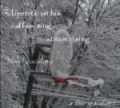 lipstick on his
 The Ides of December have once again betrayed our budding/brooding holiday spirits. Tens of millions of Americans, from Missouri to Maine, are waking today to the many horrors of a winter Nor’easter. See “
 As often happens around here, the f/k/a Gang ganged up on me last night, not long after I
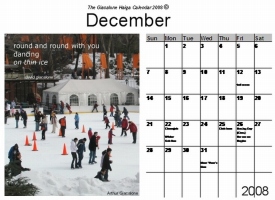
 The f/k/a Gang has had a lot of fun over the past year creating and sharing

 Whether we’re reporting on
 Hiring a Stripper Could Get You a Sex Offender Label: If James “Jed” Conboy, the D.A. in next-door Montgomery County gets his way, 22-year-old Greg L. Soucia will be slapped with the label Sex Offender for “using a stolen credit card to hire strippers.” The Gazette explains, in “
 To Help Your Favorite Holiday Hostess: We usually only “do” haiku-like poetry around here, but I really want to share a poem I discovered yesterday. It’s from the book