You are viewing a read-only archive of the Blogs.Harvard network. Learn more.

f/k/a archives . . . real opinions & real haiku

November 15, 2007

not your typical mid-argument murder (or was it?)

Filed under: Haiku or Senryu,q.s. quickies — David Giacalone @ 2:38 pm

Put this tale in my Only in Schenectady (I Hope) File:

John McKeraghan’s obituary says that he “passed away unexpectedly Oct. 25, 2007 at Ellis Hospital, Schenectady.” (“John J. McKeraghan, 23,” cnylink.com, Oneonta, NY, Oct. 25, 2007). McKeraghan was a 23-three-year-old, self-employed welder, from Earlville, NY, who had moved back to Schenectady a couple months earlier. His death was surely “unexpected” and shocking for his family and friends, but was not surprising — after he was stabbed in the back by a friend (32-year old Joseph Bell) during an argument that Thursday night in Schenectady.

   While murder is a rare result, it’s surely not unusual for two young men dating two sisters to have words and issues.  One of the men living behind the other’s apartment building in a van might create more opportunities for conflict to arise; and the stress of a life that includes frequent meals at the City Mission could aggravate their other issues.   Still, this mid-argument murder seems especially sad and tragic, when you consider what the men were ostensibly arguing about: how to care for the long-time girlfriend of the murder victim, while she was having an epileptic seizure. (See “Police say bad blood led to stabbing death,” WNYT13, Oct. 26, 2007)

mid-argument–
a bumblebee
stumbles in clover

………………….. by Matt Morden – from Stumbles in Clover (Snapshot Press, 2007; order form); orig. pub. The Heron’s Nest (Oct. 2001)

According to the Albany Times Union (Oct. 27, 2007): “Less than 24 hours after police say he plunged a kitchen knife into the back of a young man who was assisting a sick woman, a bleary-eyed Joseph Bell Jr. insisted Friday the slaying was an accident.”

Confessed murderer Joseph Bell

“This is for the record,” Bell . . announced to a reporter and two correction officers in an interview at the Schenectady County Jail. “I didn’t mean to kill him. I just wanted scare to him. One thing led to another and that happened. I’m sorry that happened.”

Police and witness told the TU:

“Shortly before 6:30 Thursday night, McKeraghan’s ex-girlfriend, 39-year-old Bette Lewinski, suffered a seizure on the back porch of Bell’s Summit Avenue home, according to police and Lewinski. McKeraghan, familiar with Lewinski’s illness, came to her aid, she said.

“For reasons that remained unclear Friday, McKeraghan and Bell quarreled over whether Lewinski should be treated inside or outside the home, Schenectady County District Attorney Robert M. Carney said.”

” . . . The dispute allegedly culminated with Bell grabbing the knife and stabbing McKeraghan once in the back.”

The article notes that McKeraghan had just returned to the home after having dinner at the City Mission on Hamilton Street, where an altercation between Bell and another person “may have agitated Bell before the incident.” Ms. Lewinski [referred to in press accounts as his girlfriend, ex-girlfriend, fiancee and ex-fiancee] would not discuss what had triggered the fight, “other than saying there had been a rivalry between McKeraghan and Bell, who police said was dating Lewinski’s sister.”

There was a candlelight vigil held outside the apartment building the night after the murder, with much praise for the victim. “He was a beautiful, wonderful person and he didn’t deserve what he got,” a tearful Lewinski said of McKeraghan. “We came here to start a new life, and his ended before it got started.” Lawrence McWalker, who helps maintain the apartment building, said he knew the two men haven’t been getting along, but didn’t think one would end up allegedly killing the other over how to help someone.

“Joe and John they’d take their shirts off for anybody, they’d help anybody, it’s just real sad,” [McWalker] said.

mid-argument
the touch of a child’s hair
soft from rain

death register
nothing fills the silence
as the ink dries

quiet afternoon
the office ant escapes
the office spider

mountain wind
the stillness of a lamb
gathering crows

…………………………………….. by Matt Morden
“death register” & “quiet afternoon” – Stumbles in Clover
“mountain wind” – New Resonance 2

Coming Soon to f/k/a: A field-full of poems from our friend Matt Morden‘s first full-volume collection of haiku and senryu — Stumbles in Clover (Snapshot Press, 2007), whose title poem can be found near the top of this posting. Trust me, you won’t want to wait for my mini-review before ordering this even-better-than-expected haiku tome. Many selected haiku have appeared at f/k/a over the past three years. Use our search box or click on the links on Matt’s archive page to find them. And, find much more Morden at his weblog Morden Haiku.

mid-argument –
Her Honor
catches me staring

two squirrels race down
the fire escape –
mid-argument, we smile

mid-argument
the senior partner has
a senior minute

……………………………………………….. dagosan

It may be of small consolation to the loved one’s of John McKeraghan, but I’d like to pass on some tips on how to treat a seizure victim, in his memory. Reading the story of his death made me aware that I would not know what to do for someone having an epileptic seizure. Click for the Epilepsy Foundation description of seizure/convulsion. Here are some guidelines for its treatment:

First Aid for Generalized Tonic-Clonic Seizures

* Prevent further injury. Place something soft under the head, loosen tight clothing, and clear the area of sharp or hard objects.
* Do not force objects into the person’s mouth.
* Do not restrain the person’s movements unless they place him or her in danger.
* Turn the person on his or her side to open the airway and allow secretions to drain.
* Stay with the person until the seizure ends.
* Do not pour any liquids into the person’s mouth or offer any food, drink, or medication until he or she is fully awake.
* If the person does not resume breathing after the seizure, start cardiopulmonary resuscitation.
* Let the person rest until he or she is fully awake.
* Be reassuring and supportive when consciousness returns.

* Note: A convulsive seizure is usually not a medical emergency unless it lasts longer than five minutes, or a second seizure occurs soon after the first, or the person is pregnant, injured, diabetic, or not breathing easily. In these situations the person should be taken to an emergency medical facility.

For more information, see “How to Treat Someone Having an Epileptic Seizure” from eHow.com’s Health Editor, who adds:

Overall Tips & Warnings

* Check to see if the person has any medical identification readily available that indicates that she has epilepsy. Some people wear special jewelry, such as bracelets, that are clearly visible for these situations.
* Call 911 immediately if you believe this is the first time the person has ever had an epileptic seizure, if the person is in immediate physical danger, such as in a swimming pool or body of water, or if the person is pregnant. You should also seek immediate emergency care for the person if the seizure’s length is longer than five minutes or if a second seizure occurs while the person is still unconscious.

Finally, if you are a visual learner, see the video on First Aid Basics for Seizure, by First Aid instructor Amy Pearson.

at the height
of the argument the old couple
pour each other tea

……………….. George Swede – Almost Unseen (Brooks Books, 2000)

November 14, 2007

not impressed yet by U.S. lawyers re Pakistan

Filed under: lawyer news or ethics — David Giacalone @ 10:42 am

nycb.org

You may recall that the f/k/a Gang called last week for the American legal profession to demonstrate its support for the brave Pakistani lawyers, who have been standing up in the streets against President Pervez Musharraf’s suspension of the legal system and constitution. Happily, according to American Bar Association President William H. Neukom, “The crisis in Pakistan . . . has sparked an unprecedented firestorm of concern among American lawyers.” (emphasis added) Indeed, the ABA has called for lawyers to stage rallies across the USA to show solidarity with their Pakistani brethren and the rule of law. “ABA Leads Lawyers in Nationwide Display of Solidarity with Pakistanis” (Nov. 13, 2007). There will be a silent protest rally by lawyers today in Washington, D.C. at noon. [update (3 PM est): At the foot of the post you’ll find my reactions to the lawyers rally at noon in Albany, NY, which I attended, and to the one in Washington, D.C.]

………………………….. prof. yabut rallies    

Yesterday (Nov. 13, 2007), here in New York State, we got to see what such concern and calls to arms can do. The New York City Bar had urged its 22,000 members to a rally that was also sponsored by the New York State Bar Association and the New York County Lawyers’ Association, and other organizations, “in rallying support for the lawyers and judges affected by the emergency rule in Pakistan.” Indeed:

On the steps of the New York Supreme Court in Manhattan, “Catherine Christian, president of the New York County Lawyers’ Association, said Pakistani lawyers ‘are showing the world what it means to be a lawyer — fighting for liberty and an independent legal system.'” And, “Kathryn Madigan, president of the New York State Bar Association, also called for lawyers to speak ‘with one voice in defense of the rule of law” in Pakistan.” “Lawyers Rally at N.Y. Courthouse to Support Pakistan’s Attorneys” (New York Law Journal, by Daniel Wise, Nov. 14, 2007)

But, before you applaud too loudly, and try to guess how many New York lawyers showed up for that Courthouse rally, and for another one staged by the National Lawyers Guild at the Pakistani Consulate, let me remind you:

  • there are 147,000 active and resident lawyers in New York State, the vast majority of whom work in and around NYC
  • many, many thousands of lawyers have offices within a block or two of the Manhattan Supreme Court building and many hundreds work or had business in that building yesterday
  • the weather was gorgeous for the ides of November in NYC — maybe the best November 13th since weather records were kept, with the greatest risk to attendees being a little autumnal sunburn

noYabutsSN Well, it appears that fewer than 800 hundred lawyers took part yesterday in the two Pakistan solidarity rallies. Sadly, I do not believe it was because no one knew (did Musharaff jam everyone’s Blackberries and cellphones?) or because the protests were “splintered.” Everyone just had higher priorities at lunchtime on a lovely autumn day in Manhattan. Seems to me, curiosity alone should have ensured more than a triple-digit body count.

Will D.C-area lawyers, and those converging from around the country on the Nation’s Capital for the protest, make a better show of solidarity today around the U.S. Supreme Court at Noon today? There are 45,000 active and resident lawyers in the District of Columbia, which you may recall is a tiny piece of real estate. The weather isn’t as nice as New York’s was yesterday: there’s a 30% chance of showers, but the rain should hold off until after 4 PM, and there’s a rather moderate high of 55 degrees forcasted. On the other hand, I could find no mention of the rally on the D.C. Bar’s News page (but was very impressed to hear that author David Baldacci would be speaking at a bar dinner on Nov. 16th). You can find out details about the D.C. lawyer rally here.

I’ve got to be honest: so far, I am not impressed by our stand-up American Bar; but sadly also not surprised (see last week’s “first let’s compare all the lawyers: Pakistani and American“).

[AP photo/Susan Walsh] “Mohammad Akram Sheikh, a senior advocate and past president of the Supreme Court of Pakistan bar, right, participates, with members of the American Bar Association, in a rally protesting Pakistan near the Supreme Court in Washington, Wednesday, Nov. 14, 2007.” “Lawyers March for Pakistani Colleagues” (AP/Examiner, Nov. 14, 2007) And, see “Lawyers March on Washington Today in Solidarity with Jailed Pakistani Colleagues” (ABAJournalNews, Nov. 14, 2007)

update (3 PM est): First, I want to thank every member of the legal profession and academia who showed up at the rallies at noon today across the country — whether it was in Albany, NY; Seattle, WA; Washington, D.C.; Oklahoma City, OK; Raleigh, NC; or many other mini-“protests.” Second, I want to send up another BARonx Cheer in protest of all of the lawyers who could not take the time to walk a block or two to the nearest courthouse rally in their town.

The Albany, NY, rally took place on the front steps of the highest court in the State. I drove about 18 miles from Schenectady to be there. When it started, about 30 people were there, and a few more straggled in later. The weather was “fair & breezy,” with the temperature in the low 50’s. Unlike in Raleigh today, not one representative of the judicial system was in attendance, as far as I could tell. Basically, members of all the likely-suspect groups were there (and I was pleased to see them) — New York Civil Liberties Union (although its spokesperson said he was only speaking in his personal capacity), the The Albany Chapter of the National Lawyers Guild, and the Center for Law and Justice. The graybeards from Albany Law School also had a contingent, along with a handful of ALS students.

ProfYabutS I was happy that the speakers took the US Administration to task for its lukewarm reactions to the Pakistani crisis. However, to be honest, I was a bit turned off by the self-congratulatory air of some who attended, and by the refusal to say anything negative about the vast numbers of private and government sector lawyers who work in Albany but could not be bothered to show up. The NYCLU rep said he was thrilled with the turnout. I was not.

Here are a few quick thoughts and feelings:

  • the New York State Bar Association headquarters is a block from the site of today’s Court of Appeals [that’s our highest court] rally in Albany. NYSBA has 118 staff members. Where were they?
  • Albany Law School is the alma mater of the majority of lawyers in the Capital Region. I wish its alumnus could have been infected by the spirit of the professors who showed up, and the handful of students (whose young professor was on hand and had “strongly enouraged” them to join the rally).
  • It was dispiriting that one Baby Boomer lawyer who was in attendance with a sign (did not catch his name for sure and don’t want to mis-identify him), seemed to have bought-in to the Bar Association Propaganda on the meaning of Shakespeare’s “kill all the lawyers” line. He even asked me, when I raised the issue, whether I understood its context. I told him I had actually even read the next line. It would be great if he would read our post “Shakespeare and Lawyers”, as well as last week’s post, but he said weblogs were not a place he hangs out, when I handed him the URL to this site. He assumed that I was not a lawyer, but I confessed that I am.

It’s great that there are a small core of leftish lawyers and law professors out there actively supporting the Pakistani lawyers and the rule of law — and doing something about it every day. But, no matter how much they might want to believe the mainstream American bar cares enough to do anything, I still say “show me the evidence,” while the Bar as a Whole continue sto be more into “show me the money.”

yinyang David Lat at Above the Law tried to boost crowd numbers at yesterday’s Manhattan rally. Given his vast audience of young lawyers, I’m even more disappointed in the turnout than earlier today. David posted earlier this afternoon, noting that Eric Turkewitz was far more pleased than I about the turnout in NYC. I guess Eric had lower expectations than I. There I go again being a damn optimist and crusty pessimist at the same time.

The Washington DC Rally was pretty anemic, when you think about how many lawyers were in that compact city around noon today. Terry Carter, writing for the ABA Journal, reports “More than 300 lawyers marched today on Washington in solidarity with lawyers arrested in Pakistan.” Writing for the organization that sponsored the march, Carter says “They were among thousands of U.S. lawyers galvanized by photo and video images of Pakistani lawyers battling in the streets in protest of the state of emergency—de facto martial law—imposed by Gen. Pervez Musharraf.” See “Lawyers March on Washington Today in Solidarity with Jailed Pakistani Colleagues” (ABAJournalNews, Nov. 14, 2007); and “Lawyers March for Pakistani Colleagues” (AP/Examiner, Nov. 14, 2007) . If this represents the “unprecedented firestorm of concern among American lawyers” touted by ABA President, I’d hate to see what an indifferent bar would[n’t] do. I’d like to believe this part of Carter’s ABAJournal piece, but I am skeptical about the make-up of the Washington marchers:

“The diversity of the type of lawyers that attended was far greater than I expected,” says Nancy Prager, an intellectual property lawyer in D.C. “I only met one full-time human rights attorney, and she was from the ABA.” The rest, Prager says, were corporate attorneys, litigators, white-collar crime practitioners and defense lawyers.

Prager says she was moved to join the march when she heard of the crackdown in Pakistan. She wondered: “Would most lawyers stand up if they knew they could be at the receiving end of a bullet—not a brief?

“The solidarity that we showed was heartening.”

Some apologists for the no-shows will surely say that “if things were really bad here in the USA, and the rule of law in serious jeopardy, lawyers would place themselves and their careers at risk in America’s streets.” But, right now, I can only repeat what I said last week:

I’d love to think the Bar as a whole — as opposed to a relatively few activists who toil mostly at the fringes of the profession — would be leading the fight against tyranny here in the United States of America, but you’d have to be naive to expect it.

I’m still betting that most American lawyers will talk a good game against tyranny, but — when push comes to shove — act to protect their wallets and future job prospects first. They’ll look a lot more like the targets of Shakespeare’s Cade Rebellion than like the revisionist heroes the bar associations like to talk about as the last great defenders of justice and the rule of law. Please, please, prove me wrong, Bar America, by sticking your neck out right now — no matter who you might offend — for the American Constitution.

update (Nov. 15, 2007): See “Ruly lawyers take to the streets,” by Robert Ambrogi for LegalBlogWatch. Bob wasn’t as disappointed as I:

“I am one who criticized these rallies for being splintered, but, unlike Giacalone, I am impressed nevertheless. Would I have liked to see more lawyers show up? Of course. But as the ABA Journal‘s Carter writes, it is almost unheard of for large groups of lawyers to march in protest of anything. To see hundreds of lawyers turn out in cities across the U.S. is a credit to all lawyers, even those who did not attend. The president of the New York State Bar Association, Kathryn Grant Madigan, put it well when she told the Wall Street Journal,”This is unusual for lawyers, but it’s the essence of what we’re about.”

You can find a lengthy Comment by me at Legal Blog Watch (two, if Bob doesn’t delete the one with typos). In sum: If it is “the essence of what it means to be a lawyer,” we shouldn’t make excuses for those who can’t be bothered to do such an easy thing as show up at a rally at lunchtime on a nice fall day. If I had paid more attention to Bob’s sentence saying that having hundreds of lawyers attend rallies “is a credit to all lawyers, even those who did not attend,” I would have strongly demurred. We in the legal profession have for far too long said the bad deeds of a tiny number of us should not affect the image of the entire profession. For the life of me, I do not see how the not very arduous good deeds of an even tinier percentage should somehow affect how we ourselves or the public regards lawyers.

hawk flight Apologies to those who count on f/k/a for a regular serving of haiku. Events have kept me from finding new poems to post today. I just realized, looking at my posting on Nov. 14, 2005, that two years ago today I was ending a short trip to D.C. (which was my home for two decades, starting with college, and still where my heart and many great friends reside), and driving from the Potomac back to the Mohawk River. Here are a few haiku and senryu I posted late that evening:


heading home –
one hawk
floats over the Beltway

entering New York:
another autumn hill
distracts me

………………………………….. by dagosan

old stomping grounds
the river still follows
its path

his headstone
rises with the moon
above the silence

……………….. by Andrew Riutta – from Full Moon Magazine (2005)

November 13, 2007

ladybugs on my mind

Filed under: Haiku or Senryu,q.s. quickies — David Giacalone @ 12:46 pm

[SCCL] I did not go to bed planning to think — much less write — about ladybugs today. But a segment of NatureWatch, which was playing in the background on my local public radio station this morning has placed that famous genus of beetle on my mind all day. You can find today’s NatureWatch podcast called “Lady Beetle” on or through the NatureWatch homepage (Nov. 13, 2007), and at PRX.org. It notes that “Few insects create a warm place in the human heart, but one small beetle has found its way into legends, nursery rhymes, and even superstition.” And, that this “Beetle of Our Lady” is considered a harbinger of good weather, good luck, and a bountiful harvest.

It seems that farmers have long been grateful for the crop-saving appetite of ladybugs for aphids and other crop-eating pests. Although I shouldn’t have been surprised, I was, to learn that the “Lady” in ladybug refers to the Blessed Virgin Mary. See “Our Lady’s Bug,” by Bro. John M. Samaha, SM, for an interesting rendition of ladybug history.

In her 2002 article at Tarot Canada, “Our Lady’s Beetle or God Almighty’s Cow,” Cheryl Lynne Bradley gives a very useful summary of ladybug/ladybeetle hisotry and lore. For example, she reports:

A single ladybug can consume more than 2,000 aphids in its lifetime. There are more than 5,200 species of ladybeetles in the world and some 290,000 different species of beetles, more than any other kind of animal. . . .

Ladybeetles can control significant pest problems in gardens, orchards and on farms. To English farmers, a ladybeetle signals a good harvest while in the vineyards of France, a ladybeetle is a sign of good weather. Medieval European tradition held that ladybeetles were sent from heaven to save the crops. They were referred to as Our Lady’s beetle. It was later shortened to lady’s beetle, then simply ladybeetle. They have also been called God Almighty’s Cow. Our Lady refers to the Christian Virgin Mary and superstition holds that to kill one will bring ill luck.

  It is considered a blessing to have one land on you as long as you don’t brush it away – the redder the beetle the better your luck will be.

she leans
a little closer
ladybug on my palm

………………. Yu Chang – Upstate Dim Sum 

ladybug descending
this windwhipt blade of grass
last blaze of sun

…………. pamela miller ness – – Summerday, Puget Sound sequence

Speaking of pests and red things, I was going to tell you today about Eric Turkewitz’s debate, at his New York Personal Injury Law weblog, with Avis over whether he could use the image of its trademark in a post discussing the auto rental firm’s support for the Graves Amendment, which was recently held by one court to be unconstitutional. The amendment “granted immunity to car rental and leasing companies from state laws that would hold them vicariously liable when the renters/lessors were negligent and injured someone.” In a Comment at Eric’s weblog, lawyer Fred Grumman, Associate General Counsel, of Avis Budget Group, Inc., had accused Eric of being ignorant of trademark law and of infringing his employer’s trademark. Check out Eric’s reply and the links to other weblawgers who have opined on this topic. (via Stephen Albainy-Jenei at Patent Baristas)

letting her
walk all over me
ladybug

. . …………………….. by Tom Clausen – being there (Swamp Press, 2005)

Finally, if you’re a law firm or lawyer, one way to make your own good luck is to read and ponder the entire Richard Susskind End of Lawyers series, at TimesOnline (prior post). The fourth of 6 installments was posted yesterday, “Outside investors will demand a very different type of law firm” (Nov. 12, 2007). In it, Susskind notes that market researchers have reported that “reported 60 per cent of [UK] citizens would prefer to obtain legal services from common high street brands (supermarkets and banks, for example) than from solicitors in private practice.” He speculates on the many changes that mass-market retailers — unwedded to business practices of the past — would make.

“If it were possible to start afresh and build legal businesses from the ground up, surely the hard-nosed investors would not replicate traditional legal service. They might buy a firm for its brand name but would no doubt bring to bear a more contemporary suite of tools and techniques for managing the delivery of legal services.

mosquito2f “The new wave of investors and managers will surely find that individual law firms are over-resourced; and, further, that the legal profession itself is over-resourced. They will quickly recognise that, within and beyond law firms, there is enormous duplication of effort and reinvention of the wheel; and, in turn, that there are too many lawyers and too few smart systems.”

Susskind continues that “there would be no reason to suppose that investors would restrict themselves to legal services for consumers. It is wrong-headed to think, as so many lawyers do, that the greatest impact would be felt amongst those who undertake high volume, low margin work.” Instead, commercial lawyers need to understand that their:

“clients’ loyalty to conventional firms will be limited if new legal businesses emerge that offer quicker, more convenient, lower cost alternatives to low- and high-value work that seem to be more geared to the interests of clients and are more business-like in their constitution.”

backyard moon
mosquitos
rush the poem

………………….…. by David G. Lanoue – from Haiku Guy

November 12, 2007

should we e-shame Derek Buckner (the cyber-peddler not the City-painter)?

Filed under: Haiku or Senryu,viewpoint — David Giacalone @ 1:25 pm

In his new book The Future of Reputation: Gossip, Rumor, and Privacy on the_ Internet (Yale Press 2007; which f/k/a reviewed at length on Nov. 8, 2007), GWU law professor Daniel J. Solove asserts that “People should avoid Internet shaming,” and bloggers should “ask permission before speaking about others’ private lives.” Dan worries that, even if truthful, internet shaming is inappropriate because it becomes a permanent Scarlet Letter that can limit the target’s future opportunities and chance for rehabilitation, and can result in punishment that is out of proportion to the “crime.”

……………………………………………. (Daily Mail)


unaware of the thief’s
eyes, melons
cooling in water

………………………. Kobayashi Issa, translated by David G. Lanoue

On the other hand, in the post “e-shaming and lawyer conduct” (March 2005), I’ve suggested that using the internet to focus attention on a person’s misdeeds — if truthful and done with enough detail to avoid presenting a misleading context — might have a deterrent effect on unwanted behavior, while giving useful information to people who might be considering a relationship with the shamee-target of the accusations.

In addition, if the conduct in question involves commerce — and especially internet-assisted commerce — or (as with lawyers or politicians) a special position of government-assisted trust or authority, the person has taken the matter out of the realm of his or her “private life.” Therefore, I’m going to tell you the story of my highly unsatisfactory consumer interaction with an internet seller named Derek Daniel Buckner of St. Louis, Pelvey, Arnold, and many other addresses in the State of Missouri, USA. It includes a description of my mistakes as on online consumer, along with some tips and links for avoiding internet sales fraud (and, naturally, a spattering of one-breath poetry). Let us know in the Comments section whether you think my giving this account is appropriate and helpful — and, whether forever is too long for this information to haunt Mr. Buckner.

the world today–
even for mountain chestnuts
a night watchman!

………………………. Kobayashi Issa, written 1822, translated by David G. Lanoue

update (Nov. 16, 2007):  Good News: “derek buckner delivers (after an e-shaming push)” (Nov. 16, 2007).  It looks like this posting worked to solve my consumer problem.  But this post is going to stay as is for at least two years; click the link above for details, and why I believe a Sunset Clause makes sense.

Are you considering the purchase of a product online from Missouri “powerseller” Derek Buckner, who has sold under the name “db liquidations” on Craigslist, and elsewhere (often wholesaling shoes), and as “wrestling_king” at eBay? He calls himself “midwestpokerplayer” on his MySpace.com page (where the married, 28-year-old declares “…Damn It Feels Good To Be A Gangsta’ “), and “DDak” at the “Christian-based” ForU.ms; he’s plain “derekbuckner” at PokerSource.com. His date of birth appears to be June 18, 1979. [Please Note: I’m not referring to the Brooklyn painter Derek Buckner, but very much like the look of his urban landscapes.]

This mug is up at Derek’s MySpace site.

Before doing business with Derek, you might want to read this posting. I wish someone had written something similar to this online, or that I had spent more time digging up information about Derek, before I sent him a check on October 1, 2007, for a set of Spanish language instruction dvds. To date, as discussed in inordinate detail below, I have not received them, Mr. Buckner is no longer at the address he gave me, and he has closed down his email account, with a general message to all buyers that all merchandise was shipped as of October 25, 2007.

……………….. “Once a Thief” (movie soundtrack)

the thief
is just as he is…
hazy moon

…………………………… Kobayashi Issa, translated by David G. Lanoue

Here’s what happened: After at least three decades saying I wanted to learn Spanish, I finally started a Spanish for Beginners Adult Ed class the last week of September, and went online looking for inexpensive student resources that I could use at home. I had only recently heard about Destinos, the 1992 PBS tv series, produced by WGBH in Boston (and apparently still running in late-night slots on many public tv stations). It seemed like a great way to learn Spanish, and I wondered if it might be available in dvd or VHS versions.

Why Destinos? Presented in the 52 half-hour installments, Destinos is an immersion-style Introduction to Spanish, structured as a “telenovela” (Spanish soap opera), with native speakers in many countries participating in an entertaining story purportedly filled with adventure, mystery and romance. As WGBH describes the plot, “The story begins with a wealthy Mexican patriarch, nearing the end of his life, who reveals a secret he has kept from his family for years. Raquel Rodriguez, a mexican-American lawyer, is hired to help him learn the answers to some important questions.”

The good news: The series has been taken under the wing of the Annenberg Media education project (which originally helped fund it), and is indeed available in both dvd and VHS. The bad news was the price, which was far beyond my budget:

$468 for the 12 dvds at LanguageQuest

[below the fold you will find the rest of this melodramatic story, along with some consumer tips and links, and a few more haiku and senryu.]

(more…)

November 11, 2007

veterans day: memory, gratitude, responsibility

Filed under: Haiku or Senryu,q.s. quickies — David Giacalone @ 11:49 pm

pawn pawn horiz Blawg Review has posted its customary remembrance of Veterans Day (“Lest We Forget,” Nov. 11, 2007) — “to thank those who served and honor those who gave so much on our behalf.” (And see, “Americans Gather to Mark Veterans Day,” NPR, Nov. 11, 2007) It is also a time for our leaders to to acknowledge that the decision to send brave young men and women into the horrors of war must be made — if we truly respect the sacrifices of those who have gone before — as truly the last resort.

a handful of pawns
protects the king –
Veterans Day
………………………… dagosan

pawn horiz Twenty-five years ago today the Vietnam Memorial was dedicated in Washington, D.C. “Vietnam Memorial Turns 25 Thousands of Veterans Join in March to Mark the Anniversary Of the Wall’s Dedication and to Honor Those Named on It” (Washington Post, Nov. 11, 2007) Deciding to oppose that war, as a young man in college, was an important milestone in my life. But feeling the tears roll down my cheeks the first time I visited the Vietnam Memorial, was just as important in shaping my understanding of our nation and myself.

Remembrance Day cometB
—my insignificant wince
at the misdirected poppy pin

old folks’ home
the square of light
crosses the room

………………………………….…….. by michael dylan welch
“Remembrance Day” – The Heron’s Nest (Dec. 2005)
“old folks’ home” – Open Window [photo-haiku pairs]

WWII
papa still
won’t talk about it

LissaTulipTapsS full-size haiga, MagnaPoets

taps’ last echo –
the vietnam protestor
wipes a tear

…………………….. dagosan

remembrance day silence
no end to the north wind
that bends the pines

……………  by matt morden – Morden Haiku (Nov. 11, 2007)

Update (Nov. 12, 2007): While I was resting up from watching hundreds of participants in yesterday’s 32nd Annual 15K Stockade-athon run through my lovely Schenectady Historic Stockade neighborhood Sunday morning [including former Stockader Frank Connors, who came from Vermont for the race], Eric Turkewitz of the New York Personal Injury Law weblog was assembling a marathon-length version of Blawg Review #134 (Nov. 11, 2007), which he built around the theme of lawyers running the NYC Marathon. If Veterans Day Monday gives you a bit of spare time for blawg consumption, stroll over to Blawg Review #134 and jog your brain.

November 9, 2007

great lawyers: pessimist or bi-palettal?

Filed under: Haiku or Senryu,q.s. quickies — David Giacalone @ 2:11 pm

My favorite lawyer-haijin, Roberta Beary [“see “roberta beary’s gems, ” Oct. 9, 2007], sent me an email this morning with the subject “you picked the right profession!” Inside was a copy of “Except in One Career, Our Brains Seem Built for Optimism,” from today’s Wall Street Journal Online (November 9, 2007). I had recently mentioned to Roberta that — given how often I am intrigued by posting at Language Log — I perhaps should have studied linguistics, rather than the law. However, last night, I sent her a link to this LL piece, and wondered whether I could possibly deal with all the b.s. that one also finds in that discipline.

mid-argument
the senior partner
has a senior minute

………………………………………….. by dagosan

The WSJ article tells us that “Yet, in the palette of human temperament, a rose-colored view of the future is the dominant hue, regardless of culture or nationality. Psychologists puzzle over this basic bias for the bright side.” It drew Roberta’s attention, and made her think of her fellow Sicilian curmudgeon, because the “One Career” referred to in the headline is law. Thus, we’re told:

All in all, [Dr. Martin Seligman of the University of Pennsylvania] said, optimists tend to do better in life than their talents alone might suggest.

Except lawyers.

Surveying law students at the University of Virginia, he found that pessimists got better grades, were more likely to make law review and, upon graduation, received better job offers. There was no scientific reason. “In law,” he said, “pessimism is considered prudence.”

My immediate reaction was to remind myself of all the studies that showed how pessimists were far more accurate in their predictions than optimists. Thus, as for the legal profession, I told myself:

Of course the best lawyers are pessimists, you cannot be good at issue-spotting –much less be a useful advisor — unless you can imagine bad things happening.

At that point, however, my “but on the other hand” personality kicked in, and reminded me:

To be truly good at issue-spotting and at giving excellent advice (as a good consigliere must to survive), you need to be able to envision both good and bad outcomes, and all those in between.

Then, I recalled my first bit of public self-analysis (at my high school graduation in 1967), where I confessed to being a “pessimistic optimist” and “loving cynic” — willing to love my country enough to tear things down and rebuild when necessary. (prior post) I have no doubt that having both tendencies (besides driving myself and my loved ones nuts) helped to make me a successful legal adviser in many positions over the years — and often got me to stay up late looking for more supporting precedent the night before a brief was due.

So, maybe pessimism does equal prudence and helps a lawyer (or law student) succeed. But, it seems to me that the full- or bi-palettal lawyer should be even more successful — if he or she remembers to take that little pill every day.

twilight
the words of his letter
darker and darker

heatwave sunglassesG
waiting for him to tell me
what i already know

talking divorce
he pours his coffee
then mine

first snow
at every window
a child’s face

beary ……………………….. by Roberta Beary
“heatwave” & “talking divorce” – The Unworn Necklace (2007)
“twilight” – Woodnotes #29; A New Resonance 2

casual Friday
the senior partner
unbuttons his vest

mid-argument –
opposing counsel crosses
her legs

………………………………………….. by dagosan

I must be an optimist. I actually believe the great new service from CatalogChoice.org might work (and improve my life, while saving lots of trees and transportation costs). Here’s how they describe themselves:

“Catalog Choice is a free service that lets you decline paper catalgos you no longer wish to receive. Reduce the amount of unsolicited mail in your mailbox, while helping to preserve the environment.

You can bet that, as soon as I can possibly find a moment of spare time, I shall head over to CatalogChoice and click away all that pesky junk mail. [also see the TreeHugger weblog]

[art by AA] Further proof of rosy-colored attitude: I even checked out the newest edition of Roadrunner Haiku Journal today (November 2007, Vol. VII, 4). There are still far too many psyku and other forms of “tell-ems” for my taste, but here are a pair of interesting new poems from two of our f/k/a Honored Guests:

bird me catch me

……………………………….John Stevenson

after
the boiling point
a robin’s song

………………………………. by Laryalee Fraser

November 8, 2007

let’s gossip about The Future of Reputation

Filed under: Book Reviews,Haiku or Senryu,lawyer news or ethics — David Giacalone @ 9:09 pm

Daniel J. Solove , the Godfather of Cyber-Privacy, recently made a few fortunate webloggers an offer many of us couldn’t refuse: a free copy of his new book in exchange for a review at our weblog. The George Washington U. Law professor, who is a prime contributor to the popular and critically-acclaimed Concurring Opinions weblog, didn’t let my frank review of the novel Anonymous Lawyer, nor my coining of the word e-shaming, deter him from sending me a copy of The Future of Reputation: Gossip, Rumor, and Privacy on the Internet (Yale Univ. Press, October 2007; download Chapter 1 here for free; now the full text is available for free here).

When the snappily-covered book arrived over the weekend, Solove’s part of the deal was fully performed and I was stuck (also thrilled to see it was a thin volume). So, thus, and to wit, here is my review of The Future of Reputation, which “offers a fascinating account of how the Internet is transforming gossip, the way we shame others, and our ability to protect our own reputations,” and whose author “contends: unless we establish a balance between privacy and free speech, we may discover that the freedom of the Internet makes us less free.”

The Future of Reputation (Yale Univ. Press, Oct. 2007)

When I’m “reviewing” a book — whether orally for a friend or online for mass consumption — I implicitly start with two questions: 1) Was my time spent reading the book a good investment? and 2) Who (if anyone) is likely to benefit from (or enjoy) reading it?

The answer to #1 is easy: I’m glad I read this book cover-to-cover (well, okay, I skipped most of the footnotes). Although I’ve thought about many of the topics before, and discussed a few here at f/k/a, Dan Solove’s The Future of Reputation brings together the themes in useful and interesting ways, showing important connections and ramifications, and making me want to talk about them with friends (and foes) and to find solutions to the problems he raises. For example, now that it is all-too-easy to do: “Should people’s social transgressions follow them on a digital rap sheet that can never be expunged?” And, if your answer is “no”, what can and should the law do about it?

sleuthSm More important, having read his book, I want to sound the alarm Dan has raised, and I can now cite a respected and knowledgeable law professor if credentials are helpful. As Seton Hall Law Professor Frank Pasquale says in his post “Solove’s Future of Reputation” (October 17th, 2007):

“The lasting contribution of FutureRep is that Solove dons his other scholarly hat–as an interpreter of the humanities–to give us reasons why we should want to protect our privacy–and respect that of others.”

Confession: I even enjoyed reading many of the reviews of FoR, and I’m going to quote from and point to a few of them in this post. Inspiring thoughtful reviews is often the sign of a valuable book. The Future of Reputation is doing that, and many members of the public who wouldn’t be likely to pick up and peruse the volume will benefit from their summaries of the issues and themes, as well as their constructive criticism and suggestions for further study and inquiry. I hope Dan will continue to compile links to the better reviews and discussion at Concurring Opinions. [Update (Nov.10, 2007): Today, Dan started summarizing and responding to weblog reviews of FofR, including ours, here at Concurring Opinions.]

digital age
aging digits
on the keyboard

…………………………………. by dagosan

Question #2 takes a bit more thought. Here’s my answer to “Who (if anyone) is likely to benefit from (or enjoy) reading it?”

  • Everyone Who Cares About Kids (including future-oblivious young adults): If your child(ren), students, or young relatives post information about themselves online, or have friends who do, you need to read this book — and then perhaps read the kids The Future of Reputation Riot Act. Prof. Solove, using examples that are bizarre enough to keep youngsters interested, has a message that needs to be grasped by folk who often have little comprehension or care about the longterm consequences of today’s actions (think, e.g., tattoo sleeves):

magglass “From the dawn of time, people have gossiped, circulated rumors, and shamed others. These social practices are now moving over to the Internet, where they are taking on new dimensions. They transform from forgettable whispers within small local groups to a widespread and permanent chronicle of people’s lives. An entire generation is growing up in a very different world, one where people will accumulate detailed records beginning with childhood that will stay with them for life wherever they go. .”

As criminal defense lawyer Scott H. Greenfield ably states at Simple Justice (“Book Review: The Future of Reputation,” Oct. 30, 2007):

“The first half of the book is quite a cautionary tale, to be read and digested by anyone who posts online, or knows anyone who posts online, or doesn’t know anyone and rarely leaves the house. The point is, no one is safe, and Dan backs up the claim with example after example. The only reason the stories are funny is because they aren’t about you. Yet.”

And, Kathleen Fitzpatrick got Solove’s message and issues this warning in her Barnes & Noble review of The Future of Reputation:

erasingSF Bizarrely, the threat that we faced in childhood, that some stupid thing we’d done in third grade would be placed on our “permanent record,” suddenly has the potential to be real — and available to anyone with a few minutes, a web browser, and access to Google.

Of course, it’s the stupid things we did when old enough to know better, but not wise enough to restrain ourselves, that should really worry us.

  • Libertarians and Free-Speech Absolutists who believe that, when it comes to speech, having No Laws and No Norms always increases our freedom and liberty: Prof. Solove argues that “protecting privacy — and restricting free speech in some cases — can actually advance the reasons why we protect free speech in the first place.” He notes that “this seems paradoxical, [and] some explanation is in order,” and thus spends a good many pages persuasively showing that “privacy often furthers the same goals as free speech” — including the enhancement of personal autonomy, democratic discussion and debate, and achieving truth in the marketplace of ideas.

. Therefore, The Future of Reputation insists that a balancing of free speech and privacy issues is necessary, and “speech of private concern should be given less protection than speech of public concern.” Among the many pertinent points made by Solove in FofR, you’ll find:

Invidual Autonomy Requires Privacy: “The disclosure of personal information [even when true] can severely inhibit a person’s autonomy and self-development. . . . Privacy allows people to be free from worrying about what everybody else will think, and this is liberating and important to free choice.”

Preserve the Privacy Torts: “Several scholars think that the Supreme Court should abolish the privacy torts when they conflict with free speech. . . . There are compelling reasons, however, why the Supreme Court is right not to eliminate the privacy torts, especially the public-disclosure torts.”

erasingSF Permanent Shaming Stifles Freedom: Beyond a tendency to impose excessive punishment for the “crime,” the indelible Digital Scarlet Letter — which can now be attached through internet gossiping and exposure of misdeeds — can greatly limit the freedom of shamed individuals. “Shame’s tendency to lead to withdrawal and alienation makes it troubling. Without allowing a wrongdoer to reenter community life, shame becomes quite destructive. Wrongdoers are not educated or simply taught a lesson. Their reputation is wounded, and they are left without a chance to become part of the community again.” This alienation hurts the subject of shame, as well as the society that loses the fruits of his or her full participation and contributions.

Our society and our Constitution protect speech for policy reasons — to promote certain goals and values — not because free speech is a deified (or reified) goal in itself. Therefore, I hope free-speech absolutists and those tending in that direction will attend to this book. If they bring an open mind to the discussion, they’ll benefit, and so will the rest of us.

  • Techno-Fatalists & Digi-Philes who accept every new form of privacy invasion as merely “the price of progress” (or of free enterprise), who are hypnotized into paralysis by repetition of the word “transparency,” or who believe there is nothing we can do about it: These folks need to read and heed Dan Solove’s warnings and his suggested solutions (and, like a good professor, he repeats them often to help them sink in). As a society, we can nurture appropriate norms and evolve news ones. As citizens of a Republic, and committed legal experts, judges and law makers, we can find workable legal solutions to at least some of the problems.

the gossip
her yard fills
with leaves

…………………………. byTom Painting – from his chapbook piano practice

In her review for the New York Sun, “The Web As Knitting Circle” (November 1, 2007) Christine Rosen says “As Mr. Solove’s thoughtful book reminds us, our technologies give us a heretofore-unknown level of control over information. But when it comes to our ability to manage information about ourselves — including the basic human need to defend our reputations — this control can prove illusory.” Solove doesn’t solve all the legal and social problems and threats to privacy, but Prof. Pasquale puts it well:

“His recommendations subtly weave together proposed changes in law, norms, and technology to help tame the reputational ramifications of persistently searchable, replicable, and unaccountable data stores.”

  • CyberLaw Nerds and Groupies: As sentences like the one immediately above, suggest, this bunch gets pretty excited thinking about the intersection of technologies and law. Pasquale even called FofR “a fun read,” and Solove admits to being “giddy with excitement” over the issues raised by the evolving internet. It’s easy to spot this crowd, and this book is obviously for them — but, forget about waiting for Christmas to send it as a gift. They’ll have it read, and thoroughly highlighted, long before then.
  • Anyone who cares about her or his own Reputation (and has ever made a mistake, revealed too much, or been lied about or misunderstood by family, friends or foe): If you don’t understand that gossip online is much more dangerous than old-fashioned rumor-spreading and idle chitchat over coffee or on the phone, you need to read this book. Ditto, if you think that staying offline yourself insulates you from the problems raised by Dan Solove. As the book’s Synopsis suggests, if you care about your reputation, you need to consider:

What information about you is available on the Internet?

What if it’s wrong, humiliating, or true but regrettable?

Will it ever go away?

Once you’ve thought about it, you will surely agree with Dan Solove that (1) there must be a broadened scope of protection for privacy. It cannot merely be a binary question, where anything said or done in public automatically forfeits all privacy rights. In the age of the internet, our concept of protected privacy must take into account “a cluster of nuanced expectations of accessibility, confidentiality, and control.”

And (2) the law must “address the problems productively yet with moderation.” Neither “The Libertarian Approach” (with its great reluctance to hinder the flow of information) nor The Authoritarian Approach (“designed to employ strict controls over the spread of information”) is appropriate. The law would take a moderate path and “help shape the norms that govern the circulation of information.” However, Solove stresses that the law “works best when it can hover as a threat in the background but allow most problems to be worked out informally.”

  • Legal Policy Wonks: This book is the perfect playground and mosh pit for guys and gals who enjoy designing or critiquing statutory (or common law) legal solutions to important societal problems. Dan Solove has suggested an ample variety of potential legal changes (with lots of details both offered and lacking) to keep the wonks up late at night debating the proposals — talking them out, fleshing them out, or throwing them out. Of course, law students and professors, lawyers and legislative staffers, come readily to mind. But, you don’t need a law degree to be intrigued by the proposals in The Future of Reputation, and to have a contribution to make in the discussion this book should inspire and provoke. While admitting that “the law is far from a magic elixir,” Solove’s Suggestions for better protecting privacy and reputation include:
  • denying webloggers immunity under Section 230 of the Communications Decency Act, for defamatory statements posted by commentors, once the target puts the weblog proprietor on notice of the defamation and asks for a take-down
  • greatly expanding the right/duty of confidentiality for information that is private and not newsworthy
  • requiring, in order to avoid inappropriate and excessively expensive lawsuits, that “a plaintiff first exhaust informal mechanisms for dealing with the problem,” and
  • limiting monetary damages
  • borrowing lessons from copyright law in how to control the spread of information

first glass of wine
Google keeps asking
“Did you mean . . . . ”

…………………………………. by dagosan

It’s rare that I want a non-fiction book to be longer, but The Future of Reputation would have been more satisfying if it went into more depth on many of the issues it raises (and especially on the solutions offered) — if only in appendices for readers needing further explanation. For example:

Dan speaks of wanting the law to “cast a wider net, yet have a less painful bite,” and of using the law to shape norms rather than imposing direct prohibitions. But, laws that create wider nets of responsibility and impose new restrictions are unlikely to be effective if their “bite” doesn’t draw some blood or leave a scar. Likewise, new norms usually only make an impression and change behavior when there is a genuine downside to ignoring their prescriptions and proscriptions.

I assume Dan doesn’t want to give specifics that would scare away the freedom-loving, often self-absorbed denizens of the internet he is trying to convert into responsible citizens. But, without more detail and discussion of how laws and legal principles would be shaped — so as to impose discipline on the likes of bloggers, angry consumers, jilted lovers, and social network entrepeneurs — practical-minded lawyers, judges and law-makers are left unconvinced that the Moderate Approach will really have significant moderating effects.

The Future of Reputation says “The law should increase its recognition of duties of confidentiality.” Dan writes:

“When we share information with friends, family, and even strangers, an implicit expectation often exists that they will keep it to themselves. The law should protect and reinforce these expectations. More broadly, the law should afford people greater control over their personal information.”

Frankly, being told that lawyers and doctors have to keep confidences, so the rest of us should, too, is not sufficient explanation. The law has created limited rules of professional confidentiality because we as a society have something to gain from clients, patients, and penitents being fully truthful with lawyers and doctors and priests. Despite this, those confidentiality protections are often circumscribed, limited in application, and under attack. [We don’t even require blanket confidentiality now within a marriage, but merely allow a spouse to invoke it when being asked to divulge information about the other spouse.] The lawyer-client analogy simply doesn’t get us very far. There does not seem to be an analogous reason to motivate individuals to tell the whole truth about their personal situations to families, lovers, and friends. Before imposing penalties for the disclosure of “confidential” information, we need more justification and more details on how it might work in practice.

I’d also wish Dan helped us understand better whether it is possible to ever remove information completely from the Internet. Can search engines resurrect old gossip from

Although he notes that gossip can have benefits and isn’t always hurtful, Dan Solove pretty much wants to remove gossip from the internet (or at least give affected individuals the power to have it removed), and says “People should avoid Internet shaming,” and bloggers should “ask permission before speaking about others’ private lives” or “posting pictures.” I’d like working definitions of terms such as “gossip,” “shaming” and “private lives,” and more explanation of just how the law would/could differentiate between “newsworthy” facts about the lives of individuals and “personal information” that we can insist be kept private and off the internet. Both gossip and shaming can play useful or neutral roles [see our prior posts “good gossip bad gossip” (Nov. 7, 2007) and “e-shaming and lawyer conduct” (March 2005)]. Until we understand better what Dan wants to ban from cyberspace, I can only embrace his proposals very tentatively.

searching my name —
she finds an advocate and
a sex offender

……………………………………………. by dagosan

Like Kathleen Fitzpatrick, I believe it’s “a bit jarring when, late in the book, Solove points to current copyright law as a model for how private information might be controlled. In her Barnes & Noble review, she notes that:

umpireS “[Solove] acknowledges that the ‘balance of freedom and control’ in copyright law ‘has been the subject of considerable debate and controversy,’ but he doesn’t consider the difference between the control of information for profit-making purposes and for purposes of maintaining personal privacy. Copyright law and privacy issues make odd bedfellows; is the suggestion that we ‘own’ the details of our private lives?”

I’m not a copyright expert (nor even a neophyte), but I believe that body of law offers no protection to facts qua facts — it doesn’t protect information, it protects the artist’s creative “work”. We need more input on how copyright law might inform privacy law. Perhaps some experts in that field will review the book and help us sort it out.

Likewise, Scott H. Greenfield ‘s doubts about requiring an attempt at alternative dispute resolution prior to bringing a lawsuit to protect internet privacy rights seem justified (and I was a mediation pioneer and strong advocate of avoiding litigation). In his book review at Simple Justice, Scott says:

“Boiled down, Dan would require putative plaintiffs and defendants to engage in informal efforts to resolve problems (mediation and/or arbitration) before litigation. How would one compel this? Who would mediate? What would happen with the ongoing ruination of a person’s life while they were awaiting an appointment with a mediator? There are no answers.”

To those questions, I would add: Are we going to require telephonic or internet-based ADR, for parties who do not (miraculously) happen to live in the same area? I also wonder if Prof. Solove has considered how the typical injured person will afford the expense of mediation, not to mention the much more formalized option of arbitration. We need more flesh on these bones before concluding that Dan’s middle ground approach will offer any real deterrent to those who injure the reputation or invade the privacy of others in cyberspace.

Wishing The Future of Reputation had more explication and specification in no way keeps me from recommending it strongly to both those who understand the dangers it describes and, especially, to those who don’t. Scott Greenberg captured my own feelings last week:

“While The Future of Reputation may not produce any iable cure, it is more than worthwhile to read to understand and appreciate the illness. Reputation makes it evident that we who live in the age of the internet have much more at risk than we realize, and to the extent it’s possible, it is up to us, our friends and acquaintances, and even our enemies, to create a new set of norms that will allow us to survive with some vestige of privacy, and maybe even some dignity, intact. For this alone, Reputation is important and should be read by parents, children, and especially anyone who thinks this could never touch them.”

Thanks to Dan Solove for sending me The Future of Reputation. I hope he’ll use the book’s website as a place to answer some of the questions raised by his reviewers, and perhaps to present proposals made and developed by others. The stakes are high, and I’m going to be driving my kith and kin crazy over the holiday season telling them about the issues raised in The Future of Reputation. Someday, they’ll thank me and Dan for sounding the alert.

ashamed– honest flip
eating then going to bed
I hear the winter prayers

……………………………………… by ISSA, translated by David G. Lanoue

empty bottle
a few words
I would like to take back

……………………………..……… by John StevensonQuiet Enough (2004)

phone old p.s. For other f/k/a posts treating issues raised in The Future of Reputation, see “e-shaming and lawyer conduct” (March 2005); “Ethics for the Web? Lean Don’t Lie” (January 19, 2004); “did shakespeare want to kill all the journalists? bloggers?” (Nov. 8, 2004); and “the heedless snowman” (Dec. 27, 2004)

Afterthoughts & Updates:

(Nov. 9, 2007): Add corporate General Counsel to the list of folks who should buy this book and make its contents widely know. See “GCs to Employees: Think Before You Send” (Fulton County Daily Report/Law.com, Nov. 9, 2007). Due to electronic discovery, the message for employees from their GCs is: “E-mails, text messages, BlackBerry communications all are potential time bombs if not worded thoughtfully and with discipline. . . . [A]bove all . . . never say anything in an e-mail that you wouldn’t want to see displayed on a giant screen in a court room in front of a judge and jury even years from now.”

November 7, 2007

good gossip bad gossip (good gumbah bad gumbah)

Filed under: Haiku or Senryu,viewpoint — David Giacalone @ 3:10 pm

the gossip
her yard fills
with leaves

…………………………. from Tom Painting’s chapbook piano practice

If my stamina holds out (and I decide to skip doing my Spanish for Beginners homework for this evening’s Adult Ed class), I’ll be posting a review of Dan Solove’s book The Future of Reputation: Gossip, Rumor, and Privacy on the Internet (Yale Univ. Press, Oct. 2007) sometime this afternoon evening week lifecycle [find the review here]. One reason I can’t seem to wrap up the review, is that the book keeps leading me to so many interesting topics. For instance, the history of the concept and the word “gossip.” In The Future of Reputation, Prof. Solove points out that “Gossip is often thought of as unseemly, but it has both good and bad qualities.” He continues:

“As the philosopher Aaron Ben Ze’ev observes, ‘Gossip is engaged in for pleasure, not for the purpose of hurting someone.’ . . . Indeed, much gossip isn’t malicious, and it is something that most of us engage in. Although people quickly denounce gossip, it remains ubiquitous. According to one study, about two-thirds of all conversations involve gossip, and as one writer [Keith Devlin] sums it up, ‘What people talk about is mostly other people’.”

Solove explains how gossip is used to shape reputations and help enforce societal norms. He (rightly) worries that the internet has transformed gossip and shaming from “forgettable whispers within small local groups to a widespread and permanent chronicle of people’s lives.” In this post, I’m wondering just how something that is natural and usually enjoyable, and that we all do (usually without guilt or even a reason to feel guilty) has come to have such a negative reputation.

Gossip: the Movie (2000) Gossip: the Movie Poster

The quick and widespread denunciation of gossip that Solove describes has apparently been going on for a very long time (or, is that just the typical historically-myopic assumption of a modern American?). The universal Bad Rap on Gossip became even more mysterious for me, yesterday, when I decided to get a better grasp of the many meanings of the word gossip, and headed to some online dictionaries. You see, that’s when I discovered its etymology.

dictionaryG If you click on Dictionary.com, you’ll see the many meanings of the word gossip. Here’s a typical listing, from The American Heritage® Dictionary of the English Language (Fourth Edition, 2000):

gossip: N. 1. Rumor or talk of a personal, sensational, or intimate nature. 2. A person who habitually spreads intimate or private rumors or facts. 3. Trivial, chatty talk or writing. 4. A close friend or companion. 5. Chiefly British A godparent.

The first three meanings were expected. But #3 and #4 were surprising. A gossip is “a close friend or companion,” and in Britain the term is sometimes used to denote one’s godparent. As often happens when I peruse a dictionary, I immediately looked for the word’s etymology and learned from the American Heritage Dictionary that gossip came from:

Middle English godsib, gossip, godparent, from Old English godsibb : god, god; see god + sibb, kinsman; see s(w)e- in Appendix I.

Similarly, Wiktionary explained, “From Old English godsibb, where it meant “godparent”. Later it came to mean a person who is your friend or companion. Since friends do a lot of talking the modern meaning of ‘idle talking’ has stuck.” This intrigued me enough to seek out the listing for “gossip” at the marvelous Online Etymology Dictionary, which told me:

gossip: O.E. godsibb “godparent,” from God + sibb “relative” (see sibling). Extended in M.E. to “any familiar acquaintance” (1362), especially to woman friends invited to attend a birth, later to “anyone engaging in familiar or idle talk” (1566). Sense extended 1811 to “trifling talk, groundless rumor.” The verb meaning “to talk idly about the affairs of others” is from 1627.

So, “a gossip” went from being a friend you would choose to serve as godparent to your child to “A person who habitually spreads intimate or private rumors or facts.” With little or no due process, I might add. How strange. And, how strangely like the word “gumbah”. which was treated at length here at f/k/a in the post “goomba goombah gumba gumbah” (April 1, 2006; which was indeed given that title to attract various search engine queries and spellings).

The American Heritage Dictionary has this entry for gumbah:

NOUN: Slang A companion or associate, especially an older friend who acts as a patron, protector, or adviser. ETYMOLOGY: Probably alteration of Italian compare, godfather, from Medieval Latin compater. See compadre.

Of course, you do not have to be a fan of Mario Puzo novels or Godfather movies or the Sopranos to know that “gumbah” no longer has such congenial connotations. As we said in our posting:

There is a very good discussion of the meaning of “gumbah” at The Maven’s Word of the Day (April 4, 1997). Maven says there are three basic “senses” of the term:

The earliest sense found in English is ‘a friend or associate’. This is first found in the mid 1950s, and seems to have been popularized by Rocky Graziano . .

The second, and most familiar, sense is ‘a mafia boss; a mafioso’, or broadly ‘any organized crime figure’. The first known use of this sense is in Mario Puzo’s 1969 novel The Godfather, the origin, of course, of the movie: [Hollywood producer Jack Woltz tells Ed Hagen:] “I don’t care how many guinea Mafia goombahs come out of the woodwork.”

Finally, the English-only sense is ‘a stupid person’, first found in the 1950s but not common until the 1980s. This is presumably based on stereotyped portrayals of low-level mafiosi as ignorant, loutish types.

In our prior post, I also noted that: Like many words, the context is important in deciding whether “goombah” is being used in a respectful-affectionate or derogatory manner. Your editor grew up among people who called close, longtime family friends goombahs — the kind of people you would want to be the godparent at the Baptism, or sponsor at the Confirmation, of your child. I always thought of its source, the Italian word “compare“, as meaning a person “with my father”: someone who has been a part of a close circle of one’s parents’ and grandparents’ friends for a long time.” [But, note, even this Homeboy nods, and I admit saying that Antonin Scalia was “willing to act like a tasteless goombah in public,” while discussing his little Sicilian chin-flip flap back in March 2006.]

empty bottle
a few words
I would like to take back

…………………..……… by John StevensonQuiet Enough (2004)

Sadly, if I call a friend a gumbah now, he or she is probably going to feel offended (or onlookers will think I had hurled an insult, and expect a duel, or an apology), unless I append a large dose of explanation. The situation is even more extreme for the word “gossip” — probably even in Britain, where I bet it is not used often anymore to refer to a godparent. What does this tell us about the evolution of our society — words that once denoted the closest of friends have come to have only negative meanings and connotations? Et tu, Brute?

on the face
that last night called me names
morning sunbeam

………………………. by George Swede – Almost Unseen (2000)

I’m not sure if we can salvage the word gumbah. Almost certainly, there is not much hope at all for rehabilitating “gossip,” either. However, don’t be surprised when– as my poet friend in Toronto often does — you accuse me of gossiping, I readily plead guilty. And, because I try to confine my gossip to the entertaining, non-malicious, and only mildly-intimate variety, I will refuse to feel any guilt at all. Of course, I reserve the right to condemn mean-spirited, broadly-distributed, hurtful gossip — and to decide which is which. Capice, Gumbah?

magglass For further study, see Prof. Mark Liberman at Language Log, who has a very interesting look at the purported differences between the sexes when it comes to gossiping. See “Guess what!” (Feb. 20, 2007) Besides reporting that men gossip just as much as women, he notes that women often deride the poor gossiping skills of men, who don’t give enough detail or feedback (as in, “Guess what, guess what?!”, “NO!, really?!” and “Oh my GOD!”). Mark turns a nice phrase, with “rather than bonding by picking nits out of one another’s fur, we bond by picking nits in one another’s behavior.”

afterthought (Nov. 14, 2007): Backtracking from a search engine hit at this weblog, I discovered a short, informative piece by Australian psychologist (and former geologist) Beth McHugh, titled “Gossip can be good for you” (Feb. 15, 2006) McHugh differentiates between malicious lies and “vicious bitching matches,” that constitute “bad gossip,” and “good gossip.” She notes that men do indeed gossip as much as women, but that adolescents gossip the most (using gossip as a “powerful way of cementing bonds between individual adolescents”). She and states:

But even out there in the adult world, social psychologists report that gossip is also beneficial in creating lasting bonds. Gossip has been shown to:

1. Strengthen relationships between friends and work colleagues

2. Reinforce shared values

3. Offer increased feelings of “connectedness” and community spirit

4. Assist in controlling the poor behavior of others, particularly in an office situation

5. Offers a sense of status by being included in the “gossip circle”

their laughter
is not about me
but would sound
just like that
if it was

……………………… by John StevensonQuiet Enough (2004)

p.s. On a related topic: I’ve been meaning to point you to the NYT article “F.T.C. Member Vows Tighter Controls of Online Ads” (New York Times, by Louise Story, Nov. 2, 2007). “Because of the increased tracking of people’s Internet activities by marketing firms, a member of the Federal Trade Commission vowed to exert more controls over online ads. . . Jon Leibowitz, the commissioner, said he was concerned about ads being shown to children online and about the tactics advertisers are using to collect data about people.” Click to see Com’r Leibowitz’s speech, “So Private, So Public: Individuals, The Internet & The Paradox Of Behavioral Marketing,” given to the FTC Town Hall Meeting on “Ehavioral Advertising: Tracking, Targeting & Technology” (Nov. 1, 2007; webcast)

And, see “Mobile phone firms plan to find out what you’re talking about . . . and tell advertisers” (London Times, Oct. 27, 2007; via Barrister Blog Weekly News, Nov. 7, 2007)

November 6, 2007

first, let’s compare all the lawyers: Pakistani and American

Filed under: Haiku or Senryu,lawyer news or ethics — David Giacalone @ 1:17 pm

…. Pakistani Lawyers v. Police [WashPost photo}

If I wore one, I’d be taking my hat off this morning to the Pakistani lawyers who’ve been literally standing up by the thousands — despite the very real immediate risk of physical injury and arrest — “demanding an end to emergency rule and vowing to keep up their dissent until President Pervez Musharraf resigns.” “Lawyers Take On Musharraf” Thousands Demonstrate In Cities Across Pakistan” (Washington Post, Nov. 6, 2007) Also see, “Power of Attorneys” (Slate, Nov. 6, 2007); “Pakistan Fires Top Court, Lawyers Protest There and Elsewhere” (ABAJournalNews, Nov. 5, 2007); and, for direct perspective and news see the Pak Lawyer weblog (via UAlberta Law Faculty Blog).
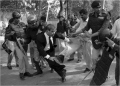
In “Pakistan Attempts to Crush Protests by Lawyers” (Nov. 6, 2007), the New York Times reports today that:

“At one point, lawyers and police officers clashed in a pitched battle, with lawyers standing on the roof of the High Court throwing stones at the police below, and the police hurling them back. Some of the lawyers were bleeding from the head, and some passed out in clouds of tear gas.”

And WaPo exclaims:

“While some political opponents and rights activists also participated in the protests — the most significant since Musharraf declared emergency rule Saturday — it was the lawyers who dominated.”

NYT photo, via Daily Kos

How are American lawyers responding to the sight of their Pakistani brethren putting their backs into the effort, and their backsides at risk, for the cause of constitutional government? Mostly, it seems they are patting themselves on the back for being part of such a noble profession — often by whining about, or again misinterpreting, William Shakespeare’s famous quotation: “First thing we do, let’s kill all the lawyers.” [from King Henry VI, Part II, IV, ii]. See, e.g., Mark Cohen at the Minnesota Lawyer Blog; with “What Shakespeare really thought of lawyers;” Steve Day’s “First let’s kill the lawyers in Pakistan,” at his The Last Chance Democracy Cafe (Nov. 6, 2007); criminal defense lawyer Scott Greenfield at Simple Justce, “The First Thing We Do, Let’s Kill All The Lawyers” (Nov. 6, 2007); and Legal Times Senior Editor Douglas McCollam, “When Liberty is on the line” (Nov. 14, 2007).

podiumSN For the un-lawyered version of the meaning and context of Shakespeare’s JD-icide quote, see our post “Shakespeare and Lawyers: the Bar’s propaganda”  (March 1, 2004), which rebuts the bar association party line that Shakespeare was celebrating the important role lawyers play in maintaining the rule of law and the fruits of civilization. The conversation between Jack Cade and Dick the Butcher is not a discussion on how to plot to win a rebellion against lawful government. Cade is proclaiming what he will do “when I am king.” In the context of the Cade and Tyler uprisings, lawyers were seen as protecting the privileged and corrupt establishment, as part of the resistance to needed social change and justice. For example, working for their masters, lawyers helped to return peasants to servitude or serfdom, by finding faults in deeds of manumission.

Whatever William Shakespeare actually felt about the legal profession, a good part of his audience would have enjoyed hearing Dick the Butcher’s idea for improving society once their rebellion was successful.

Pakistani lawyers are indeed acting to support the regime of constitutional law (a bit tardily, some might point out, since Musharraf has always been a military dictator). But, who in the USA would want to bet the ranch (or the Constitution) on the American legal profession putting itself on the line en masse? Which lawyers would be out there confronting the military police, risking a bloody head, a night in jail, and a blot on their resumes?

  • Would it be the younger generation that seems to support civil disobedience in defense of justice, so long as you don’t actually get punished for it? The self-proclaimed idealists of Generation S, who mistake sedentary symbolic gestures (“slacktivism“) for activism? [see, e.g., this prior post]
  • The graduates of our most elite schools, who almost always seem to choose the golden manacles, allied with big business, and take money over happiness and a balanced life?
  • The psycho-babbling warriors who are leading the revolution against billable hours, but expect larger fees and higher profits for their efforts?
  • The “consumer” and “justice” trial lawyers who will battle nasty businesses and tort-feasors as your champion, so long as you hand over one-third or more of your damages (no matter how little lawyering it takes to win)?

I’d love to think the Bar as a whole — as opposed to a relatively few activists who toil mostly at the fringes of the profession — would be leading the fight against tyranny here in the United States of America, but you’d have to be naive to expect it.

ABA President William Neukom did come out with a Statement yesterday urging “President Musharraf to rescind these actions immediately,” and noting that “shutting down a nation’s lawful institutions of justice will hurt, not help, the fight against terrorism.” But, even from a safe distance in America, Neukom and the ABA won’t even ask for civil disobedience, but instead call “on all governments, bar associations and other civil society organizations to support the rule of law, by using every peaceful, legal means to persuade President Musharraf to restore justice to the people of Pakistan.” “ABA President Neukom Urges Restoration of Justice to Pakistani People” (Nov. 5, 2007; emphasis added)

Although shanikka at Daily Kos also played on the Shakespeare-Kill-Lawyers theme yesterday (Nov. 5, 2007), I think she got it right: for the past seven years in the USA, it has “in large measure” been lawyers standing in the way of the current Administration trading in our Constitution in the name of fighting terrorism. Shanikka notes:

“Sure, here in America lawyers not yet literally sitting in the streets before a phalanx of military thugs, or pushing back against barricades being propped up by jack-booted military thugs, as they were in Pakistan in March, 2007 and are again today. But for the past seven years, lawyers have been in the courts, been in the blogs, and been in the forefront of fighting back, through the insistence on our Constitution and rule of law, against Bush’s own campaign to weaken our country’s Constitutional principles and our rights as citizens and non-citizens all in the name of his War on Terror.”

But, the profession cannot as a whole take credit for the work of a relatively few lawyers. Nor should it feel a lot of pride because so many lefty lawyer-webloggers have devoted so many pixels to skewering the Bush Administration. Recall, instead, (1) all those with law degrees who’ve offered knee-jerk defenses based more on political and ideological necessity than legal principle, and (2) all those who have said nothing and done even less.

Shanikka urges (emphasis mine):

“So the next time you get the opportunity hug a lawyer. Especially a public interest lawyer. She or he might just be the one who threatens to throw eggs someday if anyone tries here what they are (sadly) succeeding with in Pakistan right now.

So, don’t just hug a lawyer, or feel special pride as a lawyer, because the Pakistani legal profession is willing to put its bodies on the line to uphold its principles. I’m still betting that most American lawyers will talk a good game against tyranny, but — when push comes to shove — act to protect their wallets and future job prospects first. They’ll look a lot more like the targets of Shakespeare’s Cade Rebellion than like the revisionist heroes the bar associations like to talk about as the last great defenders of justice and the rule of law. Please, please, prove me wrong, Bar America, by sticking your neck out right now — no matter who you might offend — for the American Constitution.

Afterthoughts:

(2 PM, Nov. 6) Michael Melcher at The Creative Lawyer, “Pakistan’s lawyers show us how it’s done” (Nov. 6, 2007), has a post worth reading. Among other things, he notes that the Pakistani lawyers don’t know how this will turn out, but are “doing what feels right for now;” points out that “in a chaotic situation, attention to basic principles — like a belief in the rule of law — can guide action;” and asks “Would I do the same? I don’t know. But I hope so.”

even on the little islands
Buddha’s law…
swallows

………………………… by Kobayashi Issa, translated by David G. Lanoue

(7:30 PM EST): My often-missed weblogging friend George Wallace, posted a longer-than-usual piece this afternoon at his award-winning Fool in the Forest. Although he starts with a little Islamic-Lawyer/Buddhist-Monk joke, George gets serious about “a looming danger to our own Constitution,” that comes “armed not with teargas and truncheons or other obvious tools of tyranny, but with far more dangerous weapons: Good Intentions and Broad Bipartisan Support.” It’s H.R. 1955: The Violent Radicalization and Homegrown Terrorism Prevention Act of 2007. Echoing our cry above, George says:

[I]t is our role as lawyers to watch over our laws and to protect the Constitution that underlies those laws and the nation. If not on this issue, then on another: “stick your neck out right now — no matter who you might offend — for the American Constitution.”

update (Nov. 14, 2007): See our post “not impressed yet by US lawyers re Pakistan

Japan’s Haiku Master, Kobayashi Issa, didn’t know about Constitutions, but he defended, lived, and wrote about his version of Buddha’s Law:

world of Buddha’s law–
even a dog on winter
pilgrimage

world of Buddha’s law–
the snake strips
his clothes

flitting butterfly
thus is Buddha’s law
in this world

float, sea slug–
Buddha’s law permeates
this world!

spreading as far
as Hokkaido
Buddha’s law and blossoms

………………………… by Kobayashi Issa, translated by David G. Lanoue

November 5, 2007

what’s a “lunch-pail lawyer”?

Filed under: Haiku or Senryu,lawyer news or ethics,Schenectady Synecdoche — David Giacalone @ 1:15 am

I like to call myself a lunch pail lawyer.” Rich McNally

Rich McNally is a lawyer who’s running, as a Democrat, to become the District Attorney of Rensselaer County, New York (which includes the City of Troy, here in the NY Capital Region). His opponent is Republican Greg Cholakis. The current District Attorney, Republican Patricia A. DeAngelis, is leaving the office in disgrace (see our post from Jan. 2006, “admonish D.A. DeAngelis“). The most remarkable thing about the McNally-Cholakis race is that both candidates are amply experienced and well-respected — due mostly to the fact that the Rensselaer County Republican Party machine, dominated by Senate Majority Leader Joe Bruno, has finally (“out of desperation“) chosen someone other than a politically-connected hack or spoiled scion to run for the office.

McNally vs. Cholakis [The Troy Record]

As TU columnist Fred LeBrun put it last May, “[E]ither way, Rensselaer County won’t be embarrassed by its district attorney. Isn’t that remarkable?”

For the record, the Albany Times Union endorsed Cholakis last week, saying “While we recognize the value of Mr. McNally’s experience, in our view the more important issue is which candidate offers the best hope of restoring order, trust and integrity to the district attorney’s office. On that basis, we endorse Greg Cholakis.” And, The Troy Record endorsed Cholakis this morning, preferring his plan to serve solely in an administrative role and no longer try cases, as well as his “passion for justice” and “progressive ideas,” but stating that “When Rensselaer County voters go to the polls on Tuesday, they will find two decent, capable men vying for the position of county district attorney.”] update (Nov. 6, 2007, 11:50 PM): With all precincts reporting, Cholakis leads by only 213 out of 36,683 votes (Albany Times Union); The Troy Record reports there are 2000 uncounted absentee ballots that will decide the election. update (Nov. 7, 10 PM): The race is still too close to call, but tallying mistakes were discovered that put McNally 202 votes ahead of Cholakis. see FoxNews23. update (Nov. 9, 2007) see Troy Record, “McNally has edge in DA’s race – for now.”

final election update (Nov. 16, 2007): McNally wins! See our post “McNally to be the Lunch Pail D.A.

Indeed, I wouldn’t be writing about the race now, except that my interest has been aroused by a phrase I kept hearing in McNally’s tv ads and seeing in newspaper stories. Rich McNally keeps saying:

I like to call myself a lunch pail lawyer.”

A fan of interesting turns-of-phrase, and all-around curious guy, I decided that I just had to discover what the unfamiliar term meant. However, when I Googled “lunch pail lawyer,” there were only four results, all relating to McNally’s campaign. It didn’t help that a reporter at the Troy Record got tripped up on a homonym and had McNally referring to himself, at the candidate debate, as a “lunch pale lawyer.” (“District attorney candidates square off,” by Danielle Sanzone, October 4, 2007). That rendition, with its suggestion of a Casper Milquetoasty kind of D.A., could not be what McNally had in mind — especially since both candidates have been far too professionally-dignified for McNally to be pulling the ethnic card against Cholakis with his self-sobriquet.

Of course, I do not even want to speculate on what a “lunch pal lawyer” might be.

coming to lunch
on the sleeping man…
mosquito

the farmer’s lunch
dangles…
on the scarecrow

……………………………………. by Kobyashi Issa, translated by David G. Lanoue

With little else to go on from within the legal profession, I decided to go directly to the source. At his campaign website, Rich McNally explains his use of the term:

“I like to call myself a lunch pail lawyer.

“The work of the prosecutor starts with the fundamentals.

“Hot dog lawyering and courtroom histrionics are the mark of an unprepared prosecutor. Blather and bluster do not win convictions; good sound case building, diligent preparation and vigilant watch for the unexpected wins convictions.” (And see, Times Union, “McNally launches bid for Rensselaer County DA,” June 12, 2007)

  • He has also said: “[Being district attorney is] a lawyer’s job. It’s not grandstanding. I call myself a lunch-pail lawyer, and what I mean by that is that I don’t want to be seeking headlines. I don’t want to be a media star. I want to be like the guy that plows the road in the winter. You’re not going to know my name unless I’m not getting the job done.” “Rensselaer Co. DA race is one to watch” (WNYT.com, Oct. 30, 2007)

Frankly, Rich’s explanations left me with an unclear picture and more questions — especially after visiting The LunchBox Pad (and its timeline); the Smithsonian’s Taking America to Lunch exhibit; Aladdin Company; Wholepop.com’s “Pailentology: a history of the lunchbox“; and The Lunch Pail fast food diner (with its photo album); and after finding this little item at McNally Books and eBay. For example:

lunch alone
without a book
i read my mind

…………………………..…………………… by tom clausen

…………………………… Gunsmoke?

Or Return of the Jedi, instead?

easter snow
a piece of egg shell
in the sandwich

…………………………………… by DeVar Dahl from A Piece of Egg Shell (Magpie Haiku Press, 2004)

last sandwich
from the loaf
the two ends

……………………………… by Tom Clausen – Upstate Dim Sum (2005/II)

  • Or, although McNally contrasts himself with D.A. DeAngelis, and insists he will follow the rule of law, with justice more important than any convictions rate, is he secretly a Kiss lunch pail (1977) lawyer, or heavy-metal, Marilyn Manson “I’ve got my lunchbox and I’m armed real well!” kinda guy?

lunch at the zoo
even among gorillas
some who sit apart

…………. by Peggy Lyles from To Hear the Rain (Brooks Books, 2002)

– Or, maybe a Knight Rider prosecutor (1981)?

. . . . . but surely not a Rambo

business lunch
starts with a compliment –
he raises his knife

………………………………….. by dagosan

Of course, when a candidate uses a phrase repeatedly in his ads, he is counting on the public drawing on its own understanding of the phrase. Undaunted in my quest, and wondering what connotations the term might have for voters, I soon discovered while Googling that “lunch pail player” is a sports cliche. Web surfing allowed me to compensate a bit for my sport-less lifestyle, and to learn that “lunch pail player” is used in many contexts, including:

  • hockeyIslanders Glenn Healy: “He was not blessed with Patrick Roy, or Dominick Hasek stats, but you can see that he was a blue-collar lunch pail player, who always gave his 110% every time he stepped out on the ice.
  • baseballG Baseball: 1) Arthur Rhodes is a “lunch pail player…meaning he gives all he can, and more…” 2) Per the PawtucketTimes.com (April 4, 2007), Jim Rice — “arguably baseball’s most dominant offensive force during his heyday” — “never looked for the spotlight. He was a superstar who acted like a lunch pail player.”
  • Football: 1) Jonathan Goodwin, 6-2, 290, Michigan is a “Lunch-pail player who plays well in space and can take on linebackers. Typical Michigan lineman . . . Isn’t real explosive or athletic. [from Sporting News] 2) NY Giants Jim Burt (per the New York Times) —

quarterback“Jim Burt,” said Coach Bill Parcells, ”runs two quarts low.” To which Burt replies, ”Bill Parcells runs a little low, too.” Actually, Burt is one of the coach’s favorites. Despite a new contract that will pay him $325,000 this year, Burt is a blue-collar, lunch-pail player whose success has come from hard work. That has been his hallmark since his first days with the Giants as an undersized rookie free agent.

3) Buffalo Bills ninth-year man Jason Whittle, whom Buffalo signed to a one-year, $1 million deal in free agency. . . is definitely not great, but he’s a so-called lunch-pail guy who does whatever the coaches ask, and he normally fares at least decently. 4) Per NorthJerseySports.com, “Looking at him, high schooler Cervini is not the eye-candy quarterback. He’s not 6-foot-3, 215 pounds (more like 5-11, 190), he’s doesn’t have the rifle arm, and he’s not a 4.5 40-yard dash guy. He is what coaches like to call a lunch-pail player, the type who will outwork you and maximize his potential.

  • basketball – 1) San Antonio spurs: Their nominal center Fabrico Oberto has become an indispensable lunch-pail player who sets perfect screens and seals off his man under the basket. 2) Lunch Pail Player of the Year (Blue Collar Athlete)–Mike Allocco-South Plainfield; 3) And, NBADraft.net says that

bballGuys “Adrien is the definition of a lunch pail player. He fights for every rebound, every loose ball, and puts his heart into everything he does on the court .”

4) And girl’s hoop MVP from Pinole Valley Marnique Arnold . . . is a classic lunch pail player, doing all the dirty work for the Spartans. She can score, rebound, handle the ball and play defense, but it’s her all-out hustle that really stood out.

boy shooting baskets–
deep snow piled
all around him

………………………. by lee gurga from Fresh Scent

  • tennis – Jim Courier [Tennis.com, “40 Greatest Players,” May 2006, photo by Michael Cole/Getty Images]

“The small-town roots, the baseball cap, the nose-to-the-grindstone work ethic— Jim Courier was red-blooded Americanism personified. He used his inside-out forehand to muscle the ball around the court like no player before him. Courier made you tired just watching the effort he put into his strokes. Not surprisingly, his blue-collar game gave rise to the knock that he wasn’t talented but simply worked hard. “That’s the biggest compliment anyone could give me,” the Florida native once said. . . . Yet the image of Courier as the lunch-pail player endures, especially when he went up against flashier rivals like Andre Agassi. It was easy to imagine Courier muttering beneath those sarcastic smirks, “You can have the girls and jets. I’m here to win. Now get out of my way.” –JAMES MARTIN

Finally, outside of the sports context, we see this analysis of Misha Siegfried, guitarist for the Milawaukee rock band Fire on Your Sleeve:

“[U]nderstated guitar lines are not a display of pyrotechnics, because they do not have to be. Siegfried is a ‘lunch pail’ player: nothing too fancy, but plays all the right notes. ‘I’m all about the nuance,. Siegfried says.” (OnMilwaukee.com]

touchdown
momentum shifts
to the bookie

Indiana farm
one tractor
three hoops

……………………………. ed markowski

Tracking the public’s use of the term has given me a better understanding of the “lunch pail” moniker. It symbolizes hard work, out of the spotlight, without flash. And, always with deep blue-collar roots.

Of course, before the first true kids’ lunch box came out, “a lunch pail wasn’t chic — on the contrary, it was a sign you were far enough down the pay scale that you didn’t have time or money for a decent hot noontime meal.” See Paileontology.

As the Smithsonian’s Lunch Box exhibit explained, in Taking America to Lunch, “American industrial workers have often carried their lunch in plain metal buckets. Since the mid-19th century, miners, factory workers, dock hands, and other laborers have used sturdy dinner pails to hold hard-boiled eggs, vegetables, meat, coffee, pie, and other hardy fare. In 1904, “thermos” vacuum bottles began keeping workers’ drinks hot or cold until the noon whistle blew.”

This interpretation underscores the original sneaking suspicion that I had about Rich McNally’s embrace of his lunch pail credentials and aspirations: he’s contrasting his humble roots with the privileged background of his opponent. Greg Cholakis has served 14 years as a staffer in the county Office of the Public Defender. But, he goes to work in a courthouse named after his father, and his sister is currently a Family Court judge. As the Albany Times Union pointed out:

“Yes, his father, Gus, was a highly successful district attorney, and later a well-respected federal judge.

“That gives him name recognition, but Greg Cholakis, in our view, isn’t running on his family name.”

Rich McNally lives in the pleasant Village of Valley Falls with his lawyer-wife and two young children. He graduated twenty years ago from St. John’s University School of Law, has a comfortable private practice with Holbrook, Johnston, Tate & McNally, in Hoosick Falls, and was recently President of Rensselaer County Bar Association (2005 – 2006). He also stays fit with the very middle-class/professional pasttimes of “cycling, swimming, skiing, and hiking and winter mountaineering.” (see his resume) Nonetheless, McNally — a native of far-away Syracuse, NY — can’t match the aura of Rensselear royalty that goes with the Cholakis name — especially since it is a name synonymous with integrity and lawyering excellence.

So, the “lunch-pail lawyer” designation is surely a bid to win over the blue collar voter in Rensselear County — those who feel left out of the economic optimism that goes with the TechValley designation and the County slogan, “A Climate for Growth.” Here’s how McNally describes his background, on the About page of his website (prior to introducing the “lunch pail” theme):

I come from a family of eight children; I have five sisters and two brothers; Our parents worked hard to provide for us. Raising eight children was not easy. We weren’t by any stretch of the term “wealthy”.

And what I learned most from my parents is that hard work and self reliance are their own reward. Don’t rely on the laurels of those who came before you. That is vanity.

There’s nothing cynical about this approach (and it surely fits in with the base of the Democratic Party). Furthermore, our profession and our clients would surely be much better off if we had more lawyers with the work ethic of the “lunch pail lawyer.” And, there is no doubt that a District Attorney’s office needs a lot of assistants with those attitudes and habits.

I’m not sure, however, that a District Attorney should limit himself or herself to that nose-to-the-grindstone lead prosecutor role, or to a steady diet of “out-of-the-spotlight” self-effacement. Rich McNally says he wants to be actively involved with the community and that “We all have a tremendous responsibility to give our young citizens the sense that they belong.” A little razzle-dazzle and star power — especially when accompanied by the reality of honest sweat and integrity — could go a long way toward making the community proud of its prosecutorial team and secure in the hands and heart of its chief law enforcement official. Maybe baseball great Cal Ripken is a helpful role model:

“Ripken came to work every day. He’s the iron man who shattered a record no one thought could be broken — 2,632 consecutive games. He was never a lunch pail player — he was an all star, has a World Series ring and so on — but work was what it is all about. Not flash, not a super homerun season, not a special chair in the clubhouse, not grand juries and mistresses, just work — excellent work, sometimes great work, often clutch work, but work.” (from the BioHealth Investor weblog, July 10, 2007)

What’s a “lunch pail lawyer”? Your definitions, along with examples of lawyers who personify the notion, would be appreciated. If the pundits are right, Greg Cholakis will be the next Rensselear County District Attorney, so we may not get a chance to see how Rich McNally would personify that designation as D.A. He will, I hope, nonetheless continue to show us how lunch pail lawyering gets the job done right for his private and public clients.

I’ve enjoyed exploring the notion, and hope you have, too.

Afterthought (Nov. 9, 2007): Troy, NY, where the new D.A. of Rensselear County will have his office, is the home of Sam Wilson, the meat-packer who became known as Uncle Sam to the soldiers who ate his rations during the War (and later famous as the recruiter who so badly Wants You). Given Troy’s historic connection to luncheon meats, I was hoping to locate an Uncle Sam lunch pail for Rich McNally. So far, no luck — despite discovering that Uncle Sam helped out with a Safe Kid’s Lunch Box Campaign back in April 2006, and finding lots of Uncle Sam collectibles, (from costumes, to cash registers, to life-sized Stand-ups, to salt-n-pepper shakers). My hopes were falsely raised by this YouTube clip of the band Lunch Box doing their song “Uncle Sam.” Unless our readers can point Rich to a ready-made version, he’s going to have to use a little Blue Collar hustle and Make His Own lunch box, using drawings, photos or decals of Uncle Sam (perhaps with some help from the Sesame St. gang).

a three-engine freight train
delays lunch –
two stomachs rumble

…………………………………………………. by dagosan

[“Buccaneer” the first domed lunch box]

p.s. There are a lot of great memories for Baby Boomers at several lunch-box-oriented websites, such as The LunchBox Pad; the Smithsonian’s Taking America to Lunch exhibit; and Wholepop.com’s “Pailentology: a history of the lunchbox“. Check out, for example, the Lunch Box Pad IQ Test and Glossary.

You don’t have to be Walter or Ted at Overlawyered.com to be intrigued with the myth/riddle of the Florida Metal Lunch Box Law. See Bryan Los’ article at LunchBoxPad.com, “Florida Lunch Box Legislation: Law or Lore?“, which begins, “Anyone who collects lunch boxes has frequently come head-on with the fact, or so-called fact, that in 1972 Florida banned the sale of steel lunch boxes. This fact has been widely accepted, and to my knowledge, never proved or disproved.” It continues:

“The story goes… In 1971-72, a concerned group of parents, mostly mothers, decided that metal lunch boxes could actually be used as weapons in school-yard brawls. Losing sleep over the fact that their son/daughter may be on the receiving end of a Bobby Sherman lunch box assault, these parents got petitions signed, and marched all the way up to the Florida State Legislature, and demanded ‘safety legislation’ be passed.”

With a little lunch-pail-law-student research effort, I bet there’s a fine law review article waiting to be uncovered inside those rusty old lunch buckets.

Disney School Bus (1957) – the biggest seller of all time.

Update (Nov. 29, 2007): I’m pleased to report that Rich McNally sent me a friendly and informative email on Nov. 22, 2007, that answers some of the questions asked above:

Fun Stuff David. The term “lunch pail lawyer” was coined about 15 years ago. A bunch of us get together around the holidays and enjoy a little holiday cheer. We call ourselves the Downtown Troy Lunch Pail Bar Association, we meet once annually, or as requested by the various members. Membership is by invitation only.

We are all hard working stiffs who get the job done without a lot of razzle dazzle, no 1-800-Law etc guys in this bunch. We stole the phrase from John Madden, the footbal coach/commentator.

s/ Rich McNally

FYI I have a Coleman mini cooler type lunch box.

For more on Rich’s lunch pail of choice, click here.

November 4, 2007

SORRy in Schenectady

Filed under: Haiku or Senryu,q.s. quickies,Schenectady Synecdoche — David Giacalone @ 10:20 am

to Petta, DiCerbo & Hughes: SORRY, GUYS, I’m a Democrat, but . . .

. . . I remember your votes this past summer in favor of the Schenectady County SORR laws (Sex Offender Residency Restrictions) — both their initial passage and your decision, upon reflection, to confirm the basic residence ban and establish a horse-behind-the-cart Sex Offender Council to study the issue. [see, e.g., Schenectady’s PanderPols Vote to Evict Sex Offenders (June 13, 2007), and Schenectady’s (d)evolving Sex Offender Law (Aug. 23, 2007)]. You say “Schenectady is Moving in the Right Direction,” but “Sex Offenders Keep Moving” is not a legislative record that should make you proud. Frankly, there is nothing else that comes to mind when I try to figure out just what you’ve done for our County over the past four years that entitles you to re-election.

Reluctantly, I’ve concluded that your SORR votes are reason enough to withhold my vote on Tuesday, as you seek re-election to the County Legislature, and I hope other Democrats will join in — showing up at the voting booth but sending our silent message of “no confidence” and “No thanks for SORR.” I’m probably not willing to vote for your Republican opponent, but I will not pull the lever under your names on Election Day.

— Paul Michael Petta was apparently all set to vote against SORR early on the day the vote was taken last June. He somehow had his arm twisted, however, by Legislative Chair Susan Savage and meekly voted for the ineffective and counterproductive laws.

Affable Vince DiCerbo voted to retain the residency restrictions, despite knowing they are bad policy and likely to be counterproductive. As I said in August about Vince: “One Albany politician’s political posturing provoked a Schenectady politician to change position and vote for a law that he admits is bad in theory. A sad example for our children, and for impressionable adults.”

— In voting for SORR, Gary Hughes stressed his desire to protect children. Governing by cliche and slogans is not good enough, Gary.

I hope this Just Say No to SORR protest will give Vince, Mike and Gary some ammunition the next time they need to defend positions opposed to the high-handed methods and low-EQ policies of their leader Susan Savage. More important, I hope — if they somehow still need further incentives– that it is the nudge that will bring them to choose a new Legislative Chairman this January, under Sec. 2.06.8 of the County Charter. We citizen-members of the Democratic Party in Schenectady County want our elected leaders to start acting like Real Democrats — in their policies and their procedures, as members of the County Legislature.

erasingS By the Way: The Schenectady County Democratic Party‘s official website promises “detailed information” about the candidates, but clicking on the above links gets you a photo and one word of detail about each of the incumbents. A In fact, it is the same word for each candidate: “dedicated.” In practice, dedicated to keeping Susan Savage happy seems to be the theme. We need to let them know that their strategy is wrongheaded, and growing a spine for standing up against Susan would be advantageous. [Note to SCDP’s webmaster: the gentlemen above are members of the County Legislature, not the “County Board.”]

Here’s a Sunday antidote to stale, rudderless, spine-challenged Schenectady pols: some new, hearty poetry by Schenectady’s most-honored haiku poet, Union College’s Professor Yu Chang:

unmarked grave
butterflies in and out of
the long grass

Thanksgiving
I promise to take care
on the road

home theatre
a squirrel just left
the feeder

video chat —
touching the gap
in her baby teeth

blue heron
all paddles
at rest

…………………………………………… by Yu Chang – from Update Dim Sum (2007/II)

November 2, 2007

death schmeath (and funeral schmuneral)

Filed under: Haiku or Senryu,viewpoint — David Giacalone @ 1:25 pm

[Tres Calaveras from Ladislao Loera]

November 2nd is celebrated as Dia de Los Muertos — the Day of the Dead — in Mexico and throughout the Southwestern United States, while November 1st is Dia de Los Angelitos, a day to remember children who have died (see our prior post on Dias de Los Muertos, from 2005)   Graphic artist Ladislao Loera explains the related rituals:

“Pictures of the deceased are placed on Dia de los Muertos altars with their favorite food and drink. Candles to light their way home, and soap and water to freshen-up after their long trip back are also often placed on altars. Trinkets they were fond of, symbols they would understand, and gifts are left to communicate to them that they are always in the hearts of those they left behind, and that they are still part of the family even though they aren’t physically with us any longer.”

That’s an interesting — and healthy — contrast to the fearful ways in which Euro-centric peoples relate to death. Even when we do remember the dead, it is often with dread, with a fervent need to worry about and pray/bargain for their salvation, or with a bit of self-pity for our own losses associated with their dying. For example, the superficially similar custom of the Celts, described in The Writer’s Almanac‘s mini-history of Halloween (October 31, 2007), had them putting “food and wine on their doorstep for the spirits of family members who had come back to visit the home.” But, the gesture seems to have been more one of appeasement — to avoid mistreatment — rather than welcome.

Day of the Dead –
grandma passes grandpa
the olive platter

…………………………….. by dagosan [Nov. 4, 2005]

The Smithsonian’s National Museum of the American Indian has this description of the spirit of Los Dias de los Muertos:

“Although many cultures see death as a cause for sadness rather than celebration, the cultures that observe Los Dias de Los Muertos do not: Death is not seen as something to be faced with fear but as the doorway to other levels of existence. It is believed that during Los Dias de Los Muertos the souls of the dead return to visit the living – a cause for celebation — just like the welcome given a dear friend or relative who visits after a long time away.

Our fear and/or denial of death has many ramifications in the West. One is the surprisingly-widespread failure to write or update a will, despite a great dislike of governmental intrusion in the distribution of our posthumous estate (see our nudge to write your will at shlep, on Sept. 11, 2006). It also means that very few people give serious thought, and even fewer give definitive voice, to their wishes as to their own funeral or memorial service.

That’s why I applaud Idealawg‘s Stephanie West Allen’s creation of Create a Great Funeral Day, which she celebrates on October 30th. Indeed, I believe it would be a socially useful and psycho-spiritually healthy custom to throw Create a Great Funeral parties for friends and family (or, to call it a seminar or retreat and do it with work colleagues) on October 30th, or around the Days of the Dead.

Stephanie says there are “So many advantages to designing your own funeral or memorial service, regardless or your age or state of health! These advantages and benefits include:”

•A gift to your family and other loved ones •A gift to yourself •An expression of your personality, values and life •A new awareness •Improved long-term choices •Better day-to-day decisions •A fresh perspective

To help you organize and follow-through with creating your great service, Stephanie has developed “a step-by-step guide to walk you through the process of planning — a complete funeral or memorial service designing workshop in a book.” See “Creating Your Own Funeral or Memorial Service: A Workbook” (1998; reviewed at Wills, Trusts & Estates Prof Blog) She and I invite you to click through the preview of the downloadable book at Lulu.com, to learn more about how and why we should each work out a detailed personal Funeral Or Memorial Service [FOMS]. To get you started, here’s a checklist of things to think about:

— Your Trustee, Purpose or Purposes of My FOMS, A Funeral or a Memorial Service?,
— A Final Rite, Your Body, The Role of the Funeral Director, Structure of My FOMS,
— Music, Readings, Eulogy, Passing On Roles, Life Storytelling, Plants and Flowers,


— Ceremony, People of My FOMS, Pallbearers, Order, Program, Dress, FOMS Procession,
— Social Event, When Will My FOMS Be Held?, Physical Location, Geographical Location,
— Guest Book, Memory Display, Altar, Photos or Tapes of My FOMS, Invitations, Difficult Situations,
— Computer Technology, Cost of My FOMS,

This post is meant to be a nag and nudge for myself. If I’m still unmarried (or living alone) at my death, I especially owe it to my family and friends to leave guidance for them. At this point, I’ve done little focused thinking about my FOMS, and mostly know what I do not want:

  • no religious ceremony, and certainly no Catholic/Christian Burial Mass (I have not considered myself a Catholic since circa 1970, and I most certainly do not consider myself to be some spiritually-miserable wretch of a sinner, unworthy to be in the presence of the Creator)
  • no large array of flowers (save the money for your favorite charity, please)
  • no organized prayers (or votive candles) meant to buy my way out of Purgatory or somehow spare me from eternal damnation (a just God does not base such things on how many prayers others say for my poor soul; I’ll take my chances based on the life I’ve led)
  • but– don’t get me wrong — I in no way want to discourage individuals who really want to pray in my memory, or for my immortal soul from doing so, at the times and places of their choosing

Otherwise, I confess that I have not yet thought things through (e.g., where to be laid to rest — which city, much less which cemetery). Except, I surely hope that one or more of my talented friends will sing “excitable boyWarren Zevon‘s farewell song “Keep Me in Your Heart for Awhile” at my service (on dvd). Including these lines:

Sometimes when you’re doing simple things around the house
Maybe you’ll think of me and smile

You know I’m tied to you like the buttons on your blouse
Keep me in your heart for awhile

DAGself

Hold me in your thoughts, take me to your dreams
Touch me as I fall into view
When the winter comes keep the fires lit
And I will be right next to you

What about you? You’ve got some thinkin’ and some ‘splainin’ to do — for your own sake and that of your kith and kin. Yes, you!

“Get ready, get ready diabloLoera
for death!”
cherry blossoms

timing his death
extremely well…
the Buddha

………………………… by Kobayashi Issa, translated by David G. Lanoue

cherry blossoms
the one that falls
on mother’s headstone

eulogy…
an amber crow sits behind
the altar glass

father’s eulogy…
it’s not the first commandment
i’ve shattered

. . . . . …………….. . . by ed markowski diabloLoeraN

home from the funeral
hands in the dishwater suds
sister-to-sister

black panites–
she lifts one leg,
then an eyebrow

estate auction–
can’t get my hand back out
of the cookie jar

…………….. by Randy Brooks, from School’s Out (Press Here, 1999)

dia de los muertos —
the anorexic looks
envious

…………………………………………………… dagosan

p.s. Matters of Life and Death (almost): Ed at Blawg Review reminds us all to vote for the Best Law Blog in the 2007 weblog poll. While, I want to remind you to spend some time with the newest edition of The Complete Lawyer (Vol. 3 #6, November 2007), with its focus this time on Viewing the Law in 2020. Especially thoughtful (and somewhat related to this post) is “Elder Law Attorneys Can Help Humanize The Future Of Health Care,” by Florida Elder Law attorney Charles F. Robinson. Charlie says there are three ways elder lawyers can help: Take personal financial responsibility; become politically active and be visible. He also explains:

“Elder law attorneys and estate planners must budget long-term care into client estate and financial plans. Once a person makes age 60, she or he has a 60% likelihood of needing long-term care. Instead of planning for death, as we traditionally have, we need to plan for life, taking into account the strong probability that each client will have chronic illness. It is foolish to believe that government benefits will adequately provide for seniors and the disabled by the year 2020.”

November 1, 2007

treats or tricks for Schenectady?

Filed under: Haiku or Senryu,q.s. quickies — David Giacalone @ 7:56 pm

GE finally has good news for Old Dorp*: For several decades now, a GE press conference was a scary prospect for the people and economy of Schenectady, New York — with its workforce plummeting from over 40,000 to about 3000. Yesterday, GE Energy had a very big treat for the city that was General Electric’s birthplace and the company’s former corporate headquarters. As Newsday.com/AP reported in “GE to add jobs in NY as energy product sales grow” (October 31, 2007):

“Changing course after years of eliminating jobs in New York, General Electric Co. announced Wednesday that the company is adding 500 new positions and investing more than $39 million in Schenectady.

“GE pledged to complete the new hiring by 2011. The new jobs will be in engineering support and will pay an average of $75,000 a year.”

“Helping GE to grow here, [are] $7.5 million in state and local incentives,” according to the AP report. (See also, CapitalNews9, GE to add 500 jobs in Schenectady,” Oct. 31, 2007) Therefore, every local and state politician who could conceivably claim credit was on stage with GE Energy Power Generation President Steve Bolze early on Halloween 2007. Schenectady Mayor Brian U. Stratton, who is facing re-election in less than a week, said:

“The most important thing is symbolically. You’re seeing a major investment and a strategic decision by GE to put this operation, which could have gone anywhere – to Atlanta, Florida, the south — and it’s coming right here.”


Schenectady County Legislature Chairwoman Susan Savage (who has seen her popularity drop considerably, due to her highly-partisan, high-handed, noncollaborative form of leadership — and her relentless pursuit of sex offenders) touted: “That’s 500 houses that will be sold, that will add to our intellectual base in the Capital Region as well, to restaurants, to businesses, to Proctor’s, to all those different components in our community, this is a big win.” In a small City where the loss of tens of thousands of solidly-middle-class blue color jobs and upper-middle-class research, professional and management jobs, dimmed the lights in every social and economic corner, gaining 500 high-end jobs is a big morale booster — a good start toward turning on the lights again in The City that Lights the World. The fact that the jobs are in the “green” renewable energy sector is also a big plus.

st. patrick’s day
the foreman hands out
pink slips

no more a buddha
no less a buddha…
jack-o-lantern

laid off
she asks the mall santa to
bring dad a job

………………………………. by ed markowski

In commentary on our local NPR station this afternoon, “Globalization and Schenectady” (Nov. 1, 2007), Robert Ward points out that “Those new jobs at GE are the type that represent American workers’ comparative advantage over workers elsewhere. But as Tom Friedman of the New York Times and other observers have pointed out, our advantage in educating engineers and other high-tech workers won’t last if we don’t work harder to keep it.” (They also help prove Friedman’s point that going green is good business.) Ward concludes with words worth repeating here:

“In the coming presidential campaign, we’ll hear more about globalization and very likely we’ll hear more about the potential risks than we hear about the likely rewards. During that debate, it’s worth keeping in mind the reality that globalization can be good for Schenectady, and for other cities like it around the country. But we can’t take that as a given. Globalization won’t necessarily be good for us, unless we keep our competitive edge in the type of high-skilled jobs they’re celebrating in Schenectady today.”

This is not a big enough treat to give us a tummy ache or threaten tooth decay. But it surely whets our appetite for more.

* “OLD DORP”? We explained the Schenectady sobriquet “Old Dorp” in a prior post: Probably because the name Schenectady is tough on headline writers, our City is often called “Dorp” or “Old Dorp,” from the Dutch word for village or hamlet. I just learned from Encarta, that “dorp” is especially used in South Africa to refer to a village “perceived as backward or unappealing.”

Upstate Dim Sum (2007/II) – A Biannual Anthology of Haiku and Senryu by the Route 9 Haiku Group

first light
dewdrops at each point
of the grape leaf

golden threads
on the kitchen floor
our neighbor’s gift of corn

early winter –
forgetting my gloves
at the pump

theatre entrance –
a broken branch
reattached with string

………………………………………… by Hilary Tann – from Update Dim Sum (2007/II)

TannTreeG You just got a sample (directly above) of another Schenectady treat that arrived at my home on Halloween — the newest edition of the Upstate Dim Sum (2007/II) haiku anthology. Not only is its editor Schenectady resident (and f/k/a Honored Guest and goombah friend) Yu Chang, but many of the poems inside are penned by his fellow Professor Hilary Tann of Union College, which is right down the road from my place, in the heart of Schenectady. Find out more about the Wales native and music composer in our “introducing Hilary Tann” (Dec. 5, 2005)

missing …
bright faces
on the supermarket door

summer drought
the shape of the rapids
in the river

………………………………….. by Hilary Tann – from Update Dim Sum (2007/II)


Little Italy, Schenectady, NY [original image here]

Schenectady’s Little Italy is Still a Trick, Not a Treat: I sure hope nobody headed over to Schenectady’s La Piccola Italia for Halloween 2007, dressed in Old-World costumes and hoping to meld into the ambiance of our “Italian Heritage District.” Schenectady’s Little Italy has been promoted by the county’s Metroplex development agency and local pols aplenty (plus one or two enterprising “businessmen”) for more than seven years. (Click for Metroplex’s Little Italy General Project Plan.) In May 2005, I attended the official dedication of the Little Italy “Gateway” on N. Jay Street in Schenectady (see “all punditry is local (today anyway)” and scroll down to “Chutzpah in Little Italy”), and wrote:

My skepticism over local efforts to create a Little Italy where none was apparent was covered here at f/k/a in March – “Schmittle Italy“. Nonetheless, I wanted to see if there’s been any progress — beyond the new $900,000 “streetscape” [sidwalks, bricks] and gateway monument. The politicians at the dedication thanked a lot of people and talked about our “tourist attraction,” but I saw nothing to brag about, even after walking both sides of the entire one-block Italian heritage district. It still has lots of boarded up windows [with unpainted plywood] and not one building that anyone I can think of would call charming. After five years of planning and effort, Schenectady’s Little Italy continues to consist of one restaurant (Cornell’s, lured there with a large development finance package), one bakery [Perreca’s], and one tiny spumoni/sandwich shop [Civitello’s].

  • Also, there’s the problem that the City of Troy has a real Little Italy (see Little Italy Troy.com), comprising an entire intact, organically-grown, neighborhood, with restaurants, specialty shops, Italian markets, bocce courts, and great architecture within and nearby. It is only 14 miles away from Schenectady’s so-called Little Italy.

More than two years later, there are still no signs of progress — no reasons to believe that Schenectady’s Little Italy is worth a trip (not even from my home, half a mile away — except for Perreca’s toralle pepper sticks). Since the f/k/a Gang hates being alone in its pessimism (no matter how warranted), we were cheered recently to see the front-page article “Little Italy Area looks bigger on paper: Ambitious plan had lured only 3 Italian businesses,” in the Schenectady Daily Gazette (Oct. 21, 2007). We did, however, want to correct the headline — only one business has been lured to Little Italy, the other two have been there for over a century.

Indeed, despite being constantly filled with happily-stuffed customers, the Gazette reports that Cornell’s Restaurant — which was sweet-talked away from its successful location across town, by a finance package it could not refuse — is in great financial distress, due to an unmanageable debt load. Even worse, the restaurant owes the state over $150,000 in sales taxes arrears. (see “Cornell’s Restaurant works out plan to pay back taxes to state” (The Business Review [Albany, NY], Oct. 12, 2007)

So, no, it’s not an overdose of Halloween candy that has given me an advanced case of agita this evening, as I think about Metroplex and Little Italy. It’s the word’s of Metroplex Development Authority Chairman Ray Gillen, who told the Gazette that Little Italy is not a failed project.

They have branded the area and marketed the area,” he said.

Ray, Ray, Ray. Imagine that your branding and marketing has worked. Imagine that the brandee consumer or tourist goes out of his or her way and arrives at Schenectady’s Little Italy — perhaps bringing along an ancient Nana and Papa for a special outing. Now, imagine the inevitable disappointment and aggravation of discovering a Little Italy where there is No There There [An Italian translation of that phrase would be much appreciated.] Will they ever return to Schenectady’s Little Italy? Will they ever again believe any hype coming from Metroplex, or the City or County Tourist Offices, and our Chamber of Commerce? Or, will they curse (and maybe spit upon) the day they heard of La Piccola Italia and walked its million-dollar bricks — and then drive 14 miles to a real Little Italy in Troy? Trick me once. . . . .

And, Ray, don’t even get me started on how insulting it is that you and the other drum-beaters (who either get paid to tout Metroplex projects, or hope to get votes or riches from them), want people to believe that the dreary little block-long “district” you’ve created by fiat and with labels embodies the cultural heritage of my Italian ancestors.

Even old curmudgeons who never studied Urban Development 101, know that you need to listen to the common-sense wisdom of people like City Council member Barbara Blanchard, former president of the Schenectady Heritage Foundation, who diplomatically told the Gazette that the Little Italy idea faced challenges from the start.

“The most successful places exist organically, and they become popular because they are loaded with services and products that come from that culture already. It is hard to impose that on a place,” she said. “In Schenectady, Italian is not unique — there is so much of it. There are lots of good Italian restaurants and Cornell’s is one of them, but it is one of many.”

A Little Italy concept requires more than restaurants to succeed, Blanchard said: “It is a plus, but it does not make Little Italy the one special place to go for Italian.”

Our so-called Little Italy didn’t even have a restaurant when the idea was embraced by Metroplex. Now, it has a restaurant that just might fold, absent the “investment” of some serious cash by Metroplex to bale it out. Please, Mr. Gillen, cut your/our losses. And, cut the b.s. about the rosy future of Schenectady’s La Piccola Italia once surrounding project come to full fruition. It’s okay to say you made a big mistake. If you can find a translator in Little Italy, try saying in it Italian, too.

p.s. Maybe I’m being too negative about the progress and prospects of our La Piccola Italia. A new business did recently open just a few feet up South Street from the Little Italy strip. It advertises itself as being “in Schenectady’s Little Italy,” and it was touted in the literature for The Little Italy 2nd Annual Street Fest (held September 8, 2007):

“Kids and adults alike will enjoy the tiny hotdogs from Little Italy’s newest restaurant, ‘Dinky Dogs’.”

The establishment’s star attraction, The Dinky Dog, comes with “the works”, which “means meat sauce, mustard & onions.” The menu at this table-less “restaurant” also includes Hamburgers, Cheeseburgers, Sausage Burgers (Sindoni Sausage), Chicken Wings, Boneless Wings, French Fries, and Onion Rings. That creaking sound I hear must be my little old Southern Italian grandparents rising from their graves and rushing over for some Dinky Dog delights. ‘”ay, itsa justa like da olda country!”

under nana’s afghan –
dreaming homemade
bread and meatballs

…………………………………. by dagosan [Nov 30, 2004]

« Newer Posts

Powered by WordPress