You are viewing a read-only archive of the Blogs.Harvard network. Learn more.

f/k/a archives . . . real opinions & real haiku

March 5, 2006

psst: want some Taboo Haiku?

Filed under: pre-06-2006 — David Giacalone @ 7:47 pm

On an Oscar night that features a few taboos of its own, I now

have a copy of Taboo Haiku: An International Selection (Richard

Krawiec, ed., Avisson Press, Greensboro, 2005) in my hot, achy, 

little hands — thanks to haijin-lawyer and f/k/a-friend roberta beary. 

The anthology features haiku, senryu and haibun from over seventy

poets. 


TabooHaikuCover


Here’s how the primary editor (poet & author — e.g., Faith in What?)

Richard Krawiec explained this ambitious project, when seeking 

submissions two years ago:


Haiku masters have written poems on every aspect of

life.  But often publishers have been reluctant to print 

haiku dealing with controversial themes such as sexu-

ality, violence, bodily funtions, etc.


Taboo Haiku is a mass-market anthology that will

feature the finest international Haiku dealing with the

themes that often go unexplored in mainstream haiku

publications.


We are looking for poems that will move readers emo-

tionally as well as stimulate them intellectually.  Poems

that will make readers pull back their heads and say,

“Whoa!”  Poems that are good, but don’t quite fit any-

where.  Poems that challenge.


me in one hand

a belt in the other

dads sings a lullaby


    roberta beary

                                                                                                TabooHaikuCoverN


In his introduction to Taboo Haiku, Kracwiez notes that “In many  

of the poems in this anthology, the writers have willingly exposed

their own moral and ethical flaws.  They’ve been willing to risk re-

vealing themselves in public.” He continues: 


“Editing this anthology has brought its own, ad-

mittedly minor, risks for me, too.  I teach a lot

of writing residencies in the public schools, often

working with children in the elementary grades. 

On two occasions I lost jobs because a teacher

googled me and found my name associated with

this book.  The fact that I was involved in an adult-

oriented project apprarently made it “taboo” to hire

me to teach children.”

The 104-page book contains many intriguing haiku and senryu,

plus a handful of haibun.  I think Krawiec has achieved his hope —

an anthology that “stands apart” by reaching out:


boy writing neg


“to an audience beyond people who already

study and admire this particular poetic form;

[that] will reach out to everyone who enjoys

poetry for what it has to say about the human

condition.”

Krawiec is a member of the North Carolina Haiku Society,

and you can find a brief review of Taboo Haiku on the NCHS

website. ” The book sells for  $15, plus $2 postage and hand-

ling for single copies, add p&h $1 for each additional copy. 


They can be ordered directly from the publisher

at:


Avisson Press
3007 Taliaferro Road
Greensboro, NC 27408

                                                                                      erasingS

Here are a few selections from Taboo Haiku by some of

f/k/a’s Honored Guest poets:


the most popular

swin teacher at the Y

– his tight speedo


after dark

the shape her hands make

of me


     jim kacian


figure drawing class —

in the model’s deepest shadow

a thin white string


      lee gurga


embrace small


staring

back up   the open eyes

of the suicide


lost love —

          I turn back from the tracks

          going up her arm


      andrew riutta  


by candlelight

an entire generation

drips down her thigh


      ed markowski  


tiny check Dealing with matters of taste and taboo is complicated.  For me,

the forum involved is relevant.  There are many poems in Taboo

Haiku that I enjoy and appreciate, but would not (at least not to-

night) post here at f/k/a.  It’s not that I’m personally offended by

them, but that I do not want to offend readers who come here

expecting materials that are perhaps intellectually challenging (and,

at times, annoying) but not profane or unduly vulgar.    I hope you

don’t find my cautiousness offensive.


help with mistakes 


afterthought: It’s been a taboo around here to

complain about a haiku book we feature.  But, I’m feeling liberated

tonight and have to get two things off my chest:


tiny check To Richard Krawiec: An anthology with over 70 contributors

needs an Index, so that readers (and weblog editors) can

readily find the work of particular poets.  That’s especially

true when only part of the volume has an alphabetical format.


tiny check To Avisson Press: Get a website!  It takes about — oh — 15

minutes to set up a free weblog from lots of sources.  Then,

tell people about your publications at the website, and about

how to order them.


If I smoked, I’d have a cigarette about now.


                                                                                                   HornHulkJusticeS

                                                                                                       by greg horn


update (March 7, 2006): A little taboo law: Yesterday, Howard Bashman


law requiring an adult who has oral copulation with a minor to register with

police as a sex offender is unconstitutional because no such requirement

exists for adults who have sexual intercourse with minors: Today’s ruling,

by a 6-1 margin, can be accessed here.”


p.s. On an apparently unrelated topic: The f/k/a/ Gang apologizes to

readers who have subscribed to us through Bloglines.com.  For some

reason, none of our posts have turned up on Bloglines since Feb. 8th. 

Neither their service reps, nor I, nor even Hal Roberts, the ever-helpful

weblog Webmaster at Harvard, can figure out what went wrong.  Hap-

pily, our RSS feed seems to be coming in loud and clear at other 

RSS filters.  If anybody can help fix this, please contact your humble 

f/k/a editor. 


                                                                                                          TabooHaikuCover


March 4, 2006

trust, germs, depression, and other lawyerly issues

Filed under: pre-06-2006 — David Giacalone @ 9:10 pm

There are a number of stories and ideas that I want to discuss
here, before they become stale or misplaced.
“fiveDollarBill”
tiny check Making Economists Behave: How often have you been annoyed or
bemused by economic purists, who praise or pan a proposed idea
based on whether it fits their model of economic logic, no matter what
appears to be happening in real life (e.g., our trivializing economics).
Well, the brand new edition of Harvard Magazine has some ammunition
(or solace) for those of us who prefer to deal with the real world and real
people, instead of homo economis.
In “The Marketplace of Perceptions” Behavioral economics explains why
we procrastinate, buy, borrow, and grab chocolate on the spur of the
moment,” (Harvard Magazine, by Craig Lambert, March-April 2006), we
get a brief history of the rise of behavioral economics and its arguments
against Economic Man — the human actor who “makes logical, rational,
self-interested decisions that weigh costs against benefits and maximize
value and profit to himself.,” and who simply does not exist outside classi-
cal economic theory.
honest flip
The article explains that human being are in actuality quite vulnerable
to how the decision-maker describes the choices to himself and, therefore,
to how they are framed by the presenter.  Noting that “persuasion is not edu-
cation,” it asks what the framing concept means in the consumer marketplace
and in politics.  It ends with the hope that “The models of behavioral econ-
omics could help design a society with more compassion for creatures
whose strengths and weaknesses evolved in much simpler conditions.”
“tinyredcheck” I found the Sidebar Games of Trust and Betrayal especially
interesting.  In it, associate professor of public policy Iris Bohnet,
of the Kennedy School of Government, explains that humans are
not merely risk averse, they are trust averse — and, therefore, very
vulnerable to betrayal.  Because of this, people tend to be more
willing to take a risk when the agent of uncertainty is nature than
when the agent is another person. Feeling betrayed is a deeper
hurt than suffering an economic loss.
wolf dude neg
The piece left me wondering if this fear of trusting and betrayal
might help explain why so many nonlawyers have such negative
feelings about lawyers.  When you loudly proclaim yourself to be a
trusted agent and protector, your failure to meet expectations and
keep promises becomes a matter of personal betrayal, not merely
an incidence of a customer dissatisfaction.
spiltBucketG


I first learned about the Clorox Co. study comparing professions to


determine the “germiest jobs” from BenefitsCounsel.   It has been


duly noted elsewhere.  Although no one could be surprised that


teachers have the germiest workplaces, many were surprised


that Accountants were the next germiest, but lawyers were the


least germy out of the ten jobs studied.  I want to raise two points:


– First, why would it be that the “desks and pens of lawyers


had the lowest levels of germs”?  Assuming that germs come


from handling things, contact with humans, and food, can we


conclude that: lawyers don’t use their pens much (or keep more


than they need on their desk)?  that they don’t often touch


or interact with other humans?  that they eat at their desks a


lot less than other professionals?


– Second, I went to the Clorox press page for the study and


found only this dyspeptic disclaimer: “Disclaimer The inf-


ormation contained in this document reflected management’s


estimates, assumptions and projections when it was published.


However, Clorox has not updated it since then and makes no


representation, express or implied, that the information is still


current or complete. The company is under no obligation to up-


date any part of this document.”  That sure makes me feel


warm and fuzzy as a consumer.  Even more, it makes me so


happy that I never had to think about or write such drivel as


part of my law practice.


jailbird neg


David Tarvin at Omaha Law and Stan Sipple at Huskerblawgs raised some


good questions last month, after 56-year-old lawyer Attorney Tom Gleason


was charged with stealing as much as $60,000 from clients (ketvNews, Feb.


2, 2006).  Gleason’s lawyer has stated that his client suffers from psychiatric


problems, including acute depression and will voluntarily surrender his license.


What makes the case more than a typical lawyer-thief matter is the fact that


Gleason — contrary to the Nebraska Supreme Court’s policy of automatic dis-


barment over misappropriated funds — had been merely suspended from practice


back in 1995, when he was also charged with misappropriating client funds.  The


Court found special mitigating factors, because Gleason was suffering from depres-


sion, had sought treatment prior to having charges brought against him, was coop-


erating fully, and was deemed to be unlikely to repeat his unethical behavior.


tiny check Tarvin says this will now make it harder for other lawyers to show mitigating


circumstances in disciplinary hearings.  Sipple says the case shows the


Court can’t adequately regulate lawyers and  “It’s time an outside state


agency starts disciplining attorneys, one subject to the greater priority the


Courts should have of protecting the public” [rather than protecting the


image of lawyers].


HouseCards


Of course, one case of recidivism does not prove self-regulation doesn’t work.


Nonetheless, what we said three years ago is still true (if you add three years):


Thirty-three years after a blue ribbon panel of the American Bar


Association declared the lawyer discipline system to be in a


“scandalous situation,” and over a decade after a follow-up ABA


report in 1992 found that the system was still “too slow, too secret,


too soft, and too self-regulated” there is very little improvement.


ethicalEsq has consistently supported establishing the reforms urged by the


group HALT, including “Replac[ing] the failed system of self-regulation —


lawyers policing lawyers — with disciplinary panels on which non-lawyers have


a majority voice.”  Or, as we discussed here, following the new structure in the


UK might be more effective.   It entails “the establishment of a new Commis-


sioner for legal services complaints, stripping the Law Society of England and


Wales of its ancient right to regulate the profession.”


“tinyredcheck” HALT issued Lawyer Discipline Report Cards to each


state in 2002.  Nebraska received a mediocre C-minus, ranking


it in the 28th spot.  Nebraka’s system got a D+ for Adequacy of


Discipline Imposed.


less than eq s


When mitigating circumstances can justify (even more than the usual) leniency


is a difficult question.  As our prior post, Mitigate This?, states, the policy adop-


ted in the District of Columbia seems about right. — “issues of disability and in-


capacity . . . can significantly affect the choice of an appropriate disciplinary


sanction”, with proof of rehabilitation being very important.  However, if the lawyer


fails to establish that the disability is substantially related to the misconduct, the


lack of a “but for” nexus to the misconduct makes the disability irrelevant. [see


In re Lopes, 770 A.2d 561, 2001]


tiny check It is difficult for me to see how depression can be said to


mitigate stealing from a client. The effects of depression, and


side effects from medication, can certainly lead to missed dead-


lines and similar neglect of clients.  But, depression does not cause


dishonesty and thievery, even if it does lead to lower income and


thus a greater temptation to misappopriate funds. [see Lopes, supra]


[thanks to Walter Olson for telling me about the Nebraska story]


graph up gray


With the economy improving for college graduates, fewer people are


applying to law schools. (Columbia Daily Spectator, March 1, 2006;


via jd2b)  I believe our nation will be better-served if more of its best-


and-brightest seek careers outside the legal profession.  Elite minds


are not needed to perform the vast majority of legal services. Although


there may be many reasons for the drop in law school applications


(4.6 percent last year and 9.5 percent this year), I like the one given


by Laura Rosner, Columbia College ’06.  According to the Spectator:


“She said that she never wanted to practice law and realized


that her interest lay more in political economy and government.


Additionally, she said she was influenced by a group interview


session she attended for Georgetown Law School.


” ‘Seeing the type of people there, these people are really ob-


noxious, I’m not enjoying this at all, and if this is what the core


classes of law school are going to be like … then forget it, this


is really not what I want,’ Rosner said.”


“scrabbleE”


tiny check Finally, I wish the folks at Blawgr well with their new lawyer forum.


And, I respect their decision to keep the “blawg v. blog” debate off of


their website.  However, I must say, here at my website, that the de-


cision to spell their name without the “e” in the “er” suffix — no matter


how humorous or ironic their intent — looks like a sad attempt to be


hip and timely.  Instead, it will only result in a site that dates itself as


born in the e-less malaise of late 2005 and early 2006.  (see our prior


p.s. Yesterday, someone in Charleston, West Virginia, Googled


billionaire plaintiff’s attorney Evan Schaeffer> and ended up at


this weblog.  Last August, I referred to Evan as a “Prospective (and

contingent) Vioxx billionaire plaintiff’s lawyer.”  My apologies to any-


one whose expectations were raised recklessly. Of course, should


my optimism bring Evan some successful business opportunities,


I’ll expect him to remember his Schenectady friend in some appro-


priate manner.


“lipsG”   Randy Brooks never forgets his e’s, p’s or q’s, and


always writes with diligence and zeal.  Here are two very


recent poems and two from his 1999 book School’s Out:


tongue out


the boy guides a new airplane


round and round


I nibble


behind her ear. . .


she stirs the batter


all tongue


the clam in the fire’s


hiss


sisters bent over


the heating vent


adult talk below


“tongue out” – The Heron’s Nest (VIII: 1, March 2006)


“I nibble” – frogpond (XXIX: 1, Winter 2006)


“all tongue”  & “sisters bent over” – School’s Out (1999)


wolf dude negF


March 3, 2006

heavy breathing over “heavy hitting” lawyers

Filed under: pre-06-2006,Uncategorized — David Giacalone @ 11:36 pm

[Editor’s Note:  Please excuse all of the formatting problems below.  A change in webservers made a mess of many of our early posts.  We just don’t have the time to re-do thousands of postings, many (like this one) with very complicated formatting.  So, please bear with us.]

As Carolyn Elefant (“More Bar Silliness: Heavy Hitter is Misleading“) and Ben Cowgill (“Heavy hitters: here, there and everywhere“) both reported and analyzed today (March 3, 2006), the regulators of Nevada lawyer advertising have outdone even the most harebrained of the bar’s dignity police. (see our post “MO says legal consumers are really stupid“)
“heavyHitterLerner” Glen Lerner, Heavy Hitter
As the Las Vegas Review Journal reported, p/i lawyer Glen Lerner has been told by the Nevada State Bar that Lerner he cannot advertise himself as “The Heavy Hitter” anymore.  Instead:
at bat flip neg He can merely be “a heavy hitter.” “The bar told me by calling myself “The Heavy Hitter,” it was false and misleading because it was stating I’m the only heavy hitter,” Lerner said. “It’s beyond ridiculous.”
Yes, yes it is.  As I commented at My Shingle, Ernie Svenson may have to start calling his weblog “Ernie An Attorney.”  But, seriously, I’m not at all sure that the Supreme Court will find the issue as easy as Lerner’s attorney Dominic P. Gentile suggests. According to the Review Journal, “Gentile said the U.S. Supreme Court has made clear that if speech such as Lerner’s is accurate and not misleading, then it is protected.”  The question is whether the Court will accede to the Bar’s expertise on just what is misleading or deceptive in the context of choosing attorney services.
It’s not at all clear that this Supreme Court will take as realistic a position as the Federal Trade Commission.  In 2002, the FTC staff told the Alabama Supreme Court that “it is best for consumers if concerns about misleading advertising are addressed by adopting restrictions on advertising that are tailored to prevent unfair or deceptive acts or practices. . . . [I]mposing overly broad restrictions that prevent the communication of truthful and nondeceptive information is likely to inhibit competition and to frustrate informed consumer choice.”
.. Martin, Harding & Mazzotti – “The Heavy Hitters“
Finally, Ben Cowgill asks “Why am I reminded of the book by Kentucky native Philip K. Howard, The Death of Common Sense?”  I agree that this type of lawyer advertising makes no sense from the perspective of true consumer protection.  But, it makes a lot of sense if — as I contend — the Bar’s real purpose is to create an atmosphere where there is far less lawyer advertising, because they have an enormous emotional investment in the mythic importance and “dignity” of the profession, and an enormous aversion to competition.
update (March 6, 2006):  California solo p/i lawyer Jonathan G. Stein seems to be rallying a posse for the Diginity Police at his The Practice weblog. Complaining that ads like Lerner’s Heavy Hitter commercials make all lawyers look bad, he says the market won’t regulate such marketing.  He concludes:
“[I]f you don’t think that this makes all of us look bad, you are wrong. It gives everyone a black eye. And the only way to stop it is through regulation (and remember, I am a free market economist by education).
Carolyn Elefant has a well-crafted reply today called “Watch What You Wish for.” (via Home Office Lawyer)   Carolyn makes a lot of good points (with examples of marketing Stein praises that Nevada regulators just might deem to be deceptive), and asserts :” I know that the present system isn’t perfect.  But I’ll take free speech and the attendant mess that goes with it any day over regulation by a group of lawyers.”
Ms. Elefant has it right. I’d love to know what kind of regulation Stein would endorse.  If he wants to assure a “dignified” image for lawyers, he should realize that the public has more respect for someone acting tacky than for someone acting pompous.  If he agrees with the Nevada Bar’s specious approach to “deception”  he should indeed worry about what he wishes for.
Someone looking at Stein’s weblog might think that the tagline “Helping law students and lawyers learn everything they wanted to know about law practice management” (emphasis added) promises rather more than it can deliver.  Looking at his law firm website, a consumer seeing an “about us” link might think that this solo firm has more than one lawyer, while his “Law Offices” declaration belies his one location. And, a regulator might question Stein’s definition of a “neighborhood law firm.”  Also, a real “free market economist” might take umbrage at Stein’s touting that part of his educational background.
There are lots of slippery slopes out there once the concept of “deception” is divorced from reality and reasonable consumer reactions, and is instead left in the hands of regulators who mostly don’t much like advertising.

RumpolePenge

afterthought (Noon, March 3): Early this morning, I finished listening to the audiobook of John Mortimer’s 2004 novel Rumpole and the Penge Bungalow Murders. Throughout this enjoyable memoir of Rumpole’s first big case, he is chided by Queen’s Inns and Equity Court versions of the bar’s dignity police – pompous Heads of Chamber, like Wynset and Ballard, worried more about their own perquisites and appearing in “the finest traditions of our great profession” than in working diligently to keep a client from the death sentence or in helping to nurture the career of a young “white wig” lawyer.


RumpolePengeUK

UK audio version

Rumpole, of course, refuses to see his role as being “a safe pair of hands” wearing the correct color of pants.   Yes, he never does become rich or famous, or even Head of Chambers, but he serves his clients and profession with his zeal and his soul intact.
tiny check In the haiku world, you can find true heavy-hitter haijin in the Haiku Society of America’s journal, Frogpond.  For example, our mail carrier brought the newest Frogpond (XXIX: 1) to my mailbox today, and it contains this pair from Michael Dylan Welch:
update (March 10, 2006): Is Walter Olson a secret member of the Dignity Police Posse?
foul-up follow-up (March 15, 2006): n.y. heavy hitters get dumped: who you gonna sue?
update (March 27, 2006): In the Syracuse and Rochester region of Upstate New York, the firm of Alexander & Catalano has the Heavy Hitters franchise.  In a recent article, in the Central New York Business Journal (“State Bar Association tackles attorney advertising practices,” March 18, 2006),  James Alexander responds to the crackdown on lawyer advertising proposed by the NYS Bar Association (NYSBA Press Release, Feb. 1, 2006):
“I think lawyers are very sensitized to advertising by other lawyers,” he says, estimating that about two-thirds of complaints about advertising are lodged by lawyers. “There are many lawyers who don’t approve of advertising and think it should only be done in their idea of a dignified manner.” The problem arises when different lawyers have different opinions of what constitutes a dignified manner.
at bat neg “Our avertising tends to be friendly and entertaining, for the most part, and informative,” Alexander says of the television spots that appear on all major network affiliates and cable stations in Central New York. (Alexander and his partner Catalano are often shown with baseball bats to illustrate their slogan.) Other may not agree, but it doesn’t mean the advertising is inappropriate or misleading, he says.
roses on the casket
shaking
at the lowering
wedding reception —
the weight of her bottle
on the lip of my cup

frogpond (XXIX: 1, Winter 2006)

bonus: one by michael from the newest edition of The Heron’s Nest:
beached kelp –
we examine
each other?s life lines
The Heron’s Nest (VIII: 1, March 2006)
dodoG

quick, count to six

Filed under: pre-06-2006 — David Giacalone @ 1:29 am

A few days ago, we told you the tale of our Schenectady Spider-man’s

jail break.  Edwin Ortiz got out of a recreation yard fence and did some

fancy rooftop jumping to make his escape.  Somehow, Ortiz’s escape

was not discovered for two hours — despite his having been marked

down as “counted” six times on his tier, after he supposedly returned

from recreation.


tiny check Ortiz was a known flight risk and had been on “extraordin-

ary watch,” according to Sheriff Harry.Buffardi, who faces re-

election this year.

The names of the responsible guards were finally released on Wednesday,

along with the news that they were being fired.  (Schenectady [NY] Gazette,

“Sheriff fires 2 after jail escape,” March 2, 2006, reproduced here, reply 15;

Albany Times Union, “2 guards lose jobs after jail escape,” March 2, 2006)


                                                                                          jailFence


Sheriff Harry Buffardi announced that he had fired Deputies Gerald Treacy

and Jayme Paul, after they completed interviews with the State Depart-

ment of Corrections.  Non-criminal, disciplinary actions were also filed alleg-

ing that they failed to make proper counts and engaged in other actions that

wasted time and energy in discovering the escape.   Paul failed to notice that

Ortiz escaped from the rec yard and was not among those returning from the

yard.  Paul also went through the gate from which Ortiz made his escape, but

never noticed that Ortiz left it “grossly deformed.”  Teacy reported that he saw/

counted Ortiz six times after Ortiz had escaped, and then delayed reporting

the disappearance once he realized Ortiz was not present.


When he was interviewed after being re-captured, Ortiz said it wasn’t 

Deputy Paul’s fault for not noticing his absence or getaway.


2+3g 


According to Gazette reporter Steven Cook:


“There were supposed to be six inmates on Ortiz’s

tier, Buffardi emphasized.


” ‘I don’t think it’s a difficult or tremendous burden

for us to require a count to six people,‘ Buffardi said.”

The County Sheriff’s Benevolent Association said it wouldn’t have com-

ments on the firing until after the Department of Corrections issued its

report.  Paul and Treacy were not available for comments, but could grieve

the disciplinary charges and take them to an arbitrator.   Buffardi said he

did not want to make it sound like the deputies did not usually do their jobs,

but that there was enough “gross negligence” to warrant firing them.  Paul

was hired in April 2004; Treacy has been on the job for 5 years.


blackboardAdd


Joseph Suhrada, a Republican county legislator and frequent critic

of the sheriff, said Treacy and Paul were being used as scapegoats

to take heat for the sheriff. Suhrada also questioned why it wasn’t

until two hours after Ortiz was noticed missing that surrounding police

agencies were alerted to the escape.  “Whoever made that decision

should be fired,” Suhrada said. [Times Union]


“tinyredcheck”  Here are a half dozen haiku from our

Alaska haijin friend, Alice Framption.  That’s right,

3 plus 3. 


Lenten rose
I let loose
his hand


fog all day
the whiteness
in my ears


his Christmas package . . .

the icy steps

of the post office


in the sickroom

winter sunlight

on the mountain picture


“snowflakeSN”


blossoms . . .
I dust off the last
jar of cherries


eviction notice —
a moth ricochets
in the lampshade


“Lenten rose” Haiku Canada Newsletter

“his Christmas package” – The Heron’s Nest (March 2006) 


“fog all day” – Frogpond XXIV:2; World Haiku Assn

“in the sickroom” – Stone Frog; New Resonance 3

“blossoms”- winner, 2006 Vancouver Cherry Blossom Festival

“eviction notice” —  The Heron’s Nest (March 2004) 


                                                                                                       jailNeg


March 2, 2006

wedgie opportunity: poor advice for associates from Juris’ CEO

Filed under: pre-06-2006 — David Giacalone @ 9:41 am


Wedge” (Feb. 24, 2006), Bob Coffield of Health Care Law Blog pointed to a

posting that day by Tom Collins, calling it “Great advice for everyone — not

just law firm associates.”  Collins was the founder of Endata and is the CEO

of Juris, Inc., which he says is  “the leading brand of law office business soft-

ware for midsize law firms.”


“slicingThePie”


Admission: It’s hard for me to avoid skepticism about a weblog

named MorePartnerIncome. However, my mediation practice

gave me lots of practice in maintaining objectivity and withholding

judgment, so I tried to read the Collins post with an open mind.


The Collins’ post is titled “Achievement Concepts for the Young Attorney“, and 

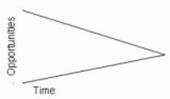
it focuses on the concept of the Opportunity Wedge.  After taking Bob Coffield’s

advice to “consider” it, I’ve come to a serious conclusion: From the perspective

of law firm management and career development/balance for young lawyers, it is

both very scary and very silly.


                                                                               Opportunity greater than eq s

                                                                                                                           less than eq s Time


Because I want to go through Collins’ piece closely, and you deserve the chance

to read it as first written, I’m going to present the short essay here:


Achievement Concepts for the Young Attorney


by Tom Collins, MorePartnerIncome, Fri 24 Feb 2006


Instill these concepts in your young team members, and they will increase


per-partner income and firm success.


Opportunity Wedge: There are two certainties in life


  • Change is constant.


  • We are always judged by others


OWg


What we are is determined by how others see us. The Opportunity Wedge

illustrates that life is a journey involving constant change.  


At birth, our opportunities are the greatest. We can become a bum or a great


achiever.  Our final destination is determined by our own decisions and actions. 


As we journey through life, one decision after another narrows the alternate op-


portunities available to us.  For those who have already sacrificed their best op-


portunities through bad decisions, the opportunity wedge is an unpleasant and


fatalistic concept. Thus, I am always reluctant to introduce the Opportunity Wedge


to an audience.  But for the young associates entering the firm, it is an important


concept for their mentor to convey.  Where the associate goes from here will be


determined by the associate?s own decisions and actions.  Make the right decisions,


and the future is a bright one.  We are the captains of our own destiny. 


It is an organization?s culture (its core beliefs) that gives that organization its character


and personality. The Opportunity Wedge is a part of ours and the following catch


phrases and short descriptions identify others. I recommend them to you.


Make My day: You are the person who decides what kind of day


     you will have.


Pros Play Hurt: Show up and play your best.


Keep on the Gas: Don?t let up just because you are almost there.


Presentation Counts: A cake is one thing; one with icing is altogether


     another.


Finish, Don?t Quit: Achievers bring things to a conclusion.


Listen to be Heard: Great conversationalists ask and let others talk.


Dress for Success: Clothes may not make the man, but they make


    an impression.


It Is All About Giving: Relationships are built by helping others.


Two Words to Use: ?Thank you.?  ?You?re welcome.?  ?I?m sorry.?


People Bank: Save them; they pay a great return.


Smile: People can hear yours.


Humor: It is disarming.  laughing man small


Miss Manners: Behavior counts.


Persevere: Never throw in the towel.


Standing 8: Take the time to refocus.


Play Offense: Act, don?t react.


True Believer: Be a ?can? vs. a ?can?t? person.


Practice/practice: Stars aren?t made?they practiced.


We, Not I:  Great things are accomplished through others.


Collaboration Trumps Competition: Personal contribution is valuable,


    but it took collaboration to build the Pyramids.


“tinyredcheck” Ignoring some of the harmless aphorisms for a moment, does this all sound inspiring and


helpful to you as a partner or associate in a law firm?  Is there one word about personal


and professional fulfillment? life balance? finding your own values and practicing them within


the profession?  bringing professional ethics into your practice life?  putting the client’s inter-


ests (rather than the firm’s) first?


tiny check Frankly, if you are a young lawyer in a firm that has adopted the OW   OWsv 


(appropriate acronymn, yes?), you need to ask whether you belong there.


If you blindly buy into the OW concept, you might want to consider flipping


it over and wearing it as a hat.  Read on to see why.


sleuthSm


Let’s quickly go piece by piece through Collins’ “Achievement Concepts for the Young


Attorney.” I’ll give my reaction, while you ask yourself just what the young attorney might


hope to achieve by following the concepts.


– Instill these concepts in your young team members, and they will increase


per-partner income and firm success.-   


Ed.: Clearly the firm doesn’t show this sentence to the young associate.


– Opportunity Wedge: There are two certainties in life


  • Change is constant.


  • We are always judged by others –

Ed.: There seem to be quite a few other certainties but, yes, change is constant,


even when it seems as if everyday is the same and you’re in a rut.  The potential


for change is, of course, the potential for creating new, better opportunities.  Always


being judged by others might be a certainty for human beings, but what that means


for the young attorney remains to be seen — except, we should keep in mind that


trying to please others and live up to their expectations is what brings many thought-


lessly into the legal profession and keeps them at jobs not suitable for them (see our


1L of a decision).  Let’s see what Tom Collins thinks about such judgments.


OWs


– What we are is determined by how others see us. –    


Ed: I’m an old guy by weblog standards, but this notion seems mighty old-fashioned

to me — as in feudalism or maybe an exotic caste system.  What we are is deter-

mined by what we do, what values and priorities we choose to live by, what talents

and personality traits we choose to nurture, what friends we make and cultivate, and

much more.


– The Opportunity Wedge illustrates that life is a journey involving constant

change. –    


           Ed:.  I’m no great illustrator or creative artist, but the Opportunity Wedge

image used by Tom Collins seems to “illustrate” virtually nothing.  I’m not even

sure if a ceaseless reduction in “opportunities” over time is actually a “change.”


– At birth, our opportunities are the greatest. We can become a bum or a great


achiever.  Our final destination is determined by our own decisions and actions. 


As we journey through life, one decision after another narrows the alternate op-


portunities available to us. –


Ed.:  Call me a silly optimist — or perhaps a practical realist — but, it seems to me that,


for many members of our society, opportunities appear quite limited at birth, and for the


vast majority, they look rather mediocre, with little or no chance to be “a great achiever.”


Nevertheless, with choices and commitment, opportunities can grow — even beyond those


that seem the most obvious at the time one graduates from law school or is shunted aside


by a law firm.  We can create new and better opportunities even past middle age.


tiny check Tom Collins seems to be imaging a world where you enter one career track and stay


there for the rest of your working life (unless thrown out, I guess).  In the 21st Century,


people will change jobs, and even careers or professions, often — or, need to be ready


and able to do so.


                                                                                                             pawn horiz


– For those who have already sacrificed their best opportunities through bad decisions,


the opportunity wedge is an unpleasant and fatalistic concept. Thus, I am always


reluctant to introduce the Opportunity Wedge to an audience.  But for the young


associates entering the firm, it is an important concept for their mentor to convey. –


Ed.: So, fatalism is an important concept to convey?  Having no options, keeps the


sheep docile.


– Where the associate goes from here will be determined by the associate?s own


decisions and actions.  Make the right decisions, and the future is a bright one. –


laughing man small  Ed.:  This is a joke, right?  Who has less control within a law


firm than an associate?   Which “right decisions” ensure a “bright future”?


– We are the captains of our own destiny. –


Ed.:  Nice royal “we” hear.  Even many equity partners have a shaky hold on their


own destiny within a law firm.  Only if you look to the future, keep your options open,


and are willing to make hard decisions concerning leaving a firm, can you have a good


grasp on your own destiny (still, of course, with no guarantees).


– It is an organization?s culture (its core beliefs) that gives that organization its character


and personality. The Opportunity Wedge is a part of ours . . –


Ed.: A prospective associate should find out whether a firm subscribes to the OW   “questionDudeS”


concept — if the firm does, its “character and personality” may be fixated on maximizing


partner income and maximizing associate obeisance and “performance.”


tiny check On Feb. 27, Mr. Collins had a post on Associate Salary in Mid-sized Law Firms.


He advises (emphasis added):


“Given the continuing rise in Associate compensation ($75,000 to $145,000


depending on firm size and location), it is now more important than ever to set


targets and measure performance in order to ensure that the firm?s investment


will generate a profitable return. 


“All the talk of balanced life aside, law firms have to fund operations from current


performance.  Associates have to pay their way.  That means setting targets for


revenue production and holding new additions accountable.” 


tiny check As for Collins’ aphorism list, many that are positive or harmless seem quite obvious,


 and many others suffer from the same myopia as the OW.  The following ones, however, appear


rather ironic, given the primary goal of Tom Collins’ weblog: 


Make My day: You are the person who decides what kind of day


  you will have.


It Is All About Giving: Relationships are built by helping others.


We, Not I:  Great things are accomplished through others.


Collaboration Trumps Competition: Personal contribution is


valuable, but it took collaboration to build the Pyramids.


I especially like the last one.  If I’m not mistaken, the pyramids were built with the “collaboration”


of slaves (many of whom died during the process), and were constructed for the honor and glory


of one human being, who deemed himself to be a god, and accumulated obscene amounts of


treasures and wealth.  Hmm.


watch step sign


Sorry, Tom and Bob, the Opportunity Wedge looks (and probably feels) much more like a


Wedgie Opportunity.   Whether the young lawyer is subjected to the humiliation of an under-


wear wedgie, or is merely under the heel of a partner’s wedgie boot, OW! is the likely outcome


for the associate.   Life and careers look a lot more like decision trees than like Collins’ Wedge.


Perhaps the better analogy is to a Scrabble board — where a shoot off a deadend position can


branch into new opportunities for triple-word scores, creativity and personal satisfaction, with a


large element of luck thrown in.


Let’s hope all those mid-sized firms that use Jurist, Inc. software don’t also subscribe to the


Jurist OW concept.  Just to be safe, though, job seekers or current associates should do a


little probing.  You have choices.


solstice sunset

beside dad’s pink slip 

her christmas list


christmas evening

the goose she raised

all summer


ed markowski 


the great lord’s wood fire
rises
first


translated by David G. Lanoue

                                                                                                                                   OWsv


March 1, 2006

don’t give up THN for Lent

Filed under: pre-06-2006 — David Giacalone @ 10:43 pm

As I promised yesterday, the first edition of The Heron’s Nest

for this year went online today – Volume VIII: 1 (March 2006).

In it, you will find 12 pages of haiku, by 99 haijin. Please, don’t

give up THN (or f/k/a) for Lent.


 Naturally, many of our Honored Guests Poets can be found in the newest edition. Gary Hotham had two of his haiku selected:


garden path —

the same weeds

in their country


no old habits —

the newborn’s

cry


gary hotham – The Heron’s Nest (VIII:1, March 2006)

“garden path” & “no old habits — “


“thnLogoF” Because she is an associate editor for THN, the

poems of Peggy Lyles do not appear on its pages. To make

up for that sacrifice, you can enjoy four haiku from Peggy, right

here, that seem to fit right in on the day after Fat Tuesday:


chasing butterflies . . .

the girl with Wednesday’s ashes

on her brow


no thought

of air until

that blue feather’s drift


umbrella vert


passion flower

your faith

or mine?


distant jazz

a calla lily

catches rain


Peggy Lyles, from To Hear the Rain (Brooks Books, 2002)

deskCalG

« Newer Posts

Powered by WordPress