You are viewing a read-only archive of the Blogs.Harvard network. Learn more.
Skip to content

Labor histories

Ingmar Bergman, in his introduction to Four Screenplays:

There is an old story of how the cathedral of Chartres was struck by lightning and burned to the ground. Then thousands of people came from all points of the compass, like a giant procession of ants, and together they began to rebuild the cathedral on its old site. They worked until the building was completed — master builders, artists, laborers, clowns, noblemen, priests, burghers. But they all remained anonymous, and no one knows to this day who built the cathedral of Chartres.

Bertolt Brecht, ‘Fragen eines lesenden Arbeiters’ [‘Questions from a Worker who Reads,’ trans. Michael Hamburger]:

Who built Thebes of the seven gates?
In the books you will find the name of kings.
Did the kings haul up the lumps of rock?
And Babylon, many times demolished.
Who raised it up so many times? In what houses
Of gold-glittering Lima did the builders live?
Where, the evening that the Wall of China was finished
Did the masons go? Great Rome
Is full of triumphal arches. Who erected them? Over whom
Did the Caesars triumph? Had Byzantium, much praised in song,
Only palaces for its inhabitants? Even in fabled Atlantis
The night the ocean engulfed it
The drowning still bawled for their slaves.

The young Alexander conquered India.
Was he alone?
Caesar beat the Gauls.
Did he not have even a cook with him?
Philip of Spain wept when his armada
Went down. Was he the only one to weep?
Frederick the Second won the Seven Years’ War. Who
Else won it?

Every page a victory.
Who cooked the feast for the victors?
Every ten years a great man.
Who paid the bill?

So many reports.
So many questions.

Symphonic forms

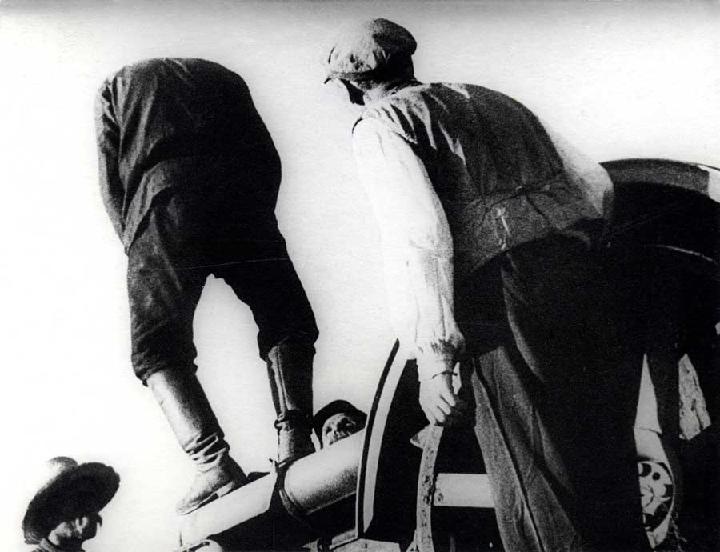
dovzhenko zemlya still

[A still from Земля]

Chinese National Symphony Orchestra at Boston’s Symphony Hall.

Kiarostami’s A Taste of Cherry and Dovzhenko’s Земля [Earth] at the Harvard Film Archive.  Labor and land preoccupy both; and in each, a visual symphony of tractors. One is reminded of Russian cinema’s obsession with the sun-baked, dirt-caked, beard-bristling face — eyes always squinting at sun, faces yanked every which way in a primitive yawp, self-torn, encrusted with tears.

Requiem revival

Last night: Boston Baroque performing Cherubini’s long-neglected Requiem in C minor, paired with Beethoven’s Eroica.  The Sanctus sounded just like the one from Bach’s Mass in B Minor, while the Lacrimosa was lifted straight from the same section in Mozart’s Requiem.  The pre-concert lecture by NEC musicologist Helen Greenwald acknowledged other echoes but perplexingly not these most obvious ones.

Recent viewings

Fidelio at the Met. Karita Mattila sang Leonore’s role gorgeously, and she was impressively spry as Fidelio, too, scampering around the stage with boyish aplomb, scooting up and down ladders, bearing groceries. Apart from the limpid quartet in the opening act and the arpeggiated vocal mountaineering of the ‘Abscheulicher!’ duet in the final act, it can be hard to believe Beethoven really wrote this work for voices. It often feels more like a serial tone-poem. As drama, very little happens. The opening subplot flourish has often been criticized, but a naïve opera-goer might expect, might even wish for, even more subplots, or at least discernible turns in action. Unfortunately the production on my night of attendance was Heppner-less; marginally less unfortunately, it was also Levine-less (he’s out of commission this season due to a fall in Boston). Florestan’s role, respectably donned by Richard Margison, is also uncomfortably difficult. When we first hear him he is holding on for dear death — yet the singer must still capture the strength beneath. Interesting above all thematically may be the opera’s wishful solution to the dyad-vs.-collectivity quandary: here, conjugal love actually clears the way to pan-human fellowship.

Alex Ross’s review some months back in The New Yorker of some opera recordings features a phrase I’m insanely fond of: ‘a Heldentenor in heat.’

Claire Denis’ L’Intrus (France, 2004) at the Brattle. Find me a review that does not proclaim this film’s ‘enigmatic’ qualities, or call for an uncritical, non-interpretive, pleasure-taking stance. (Stephen Holden somewhat dissatisfyingly asserts that ‘The best way to enjoy The Intruder is surrender to its poetry without demanding cut-and-dried explanations.’ Zizek is right again that there’s something conscriptive and commanding in the very notion of enjoyment.) Or, they resort to the other poor overtasked critical lifeboat: cinematic intertextuality. The film seems more concerned with ownership — of one’s body, one’s progeny, and of land (and vice versa — land’s ownership of you, i.e., citizenship). Claire Denis, the director, knows and speaks of this as the reviewers do not (though Lim in the Voice does a decent job).

Peter Watkins’ The War Game (UK, 1966) at the Harvard Film Archive.

Zizek! (USA, 2005) at the Brattle. The film follows Slavoj from a talk at the University of Buenos Aires to a talk at Columbia to a talk at Deitch Projects to a talk at the Brattle Theatre — but would have done well to give more room to his run-on sentences and less to cameos by its own director, Astra Taylor. The best part may be at the beginning, where Zizek points out the violence of love — of romantic selection, to the exclusion of the world — the point that love is not love of the world but of the particular torn out from the world. There’s also the nice moment when he describes himself as a monster, in opposition to academics eager to portray themselves as all too human beneath the skin. Robespierre’s desire for a revolution without a revolution gets compared to leftist academics’ reluctance to give up their bourgeois comforts. Sounds familiar. But ticklish subjects all.

Irrigations

the conversation toilet

I’ve long been haunted by toilet scenes in two particular films — Coppola’s The Conversation and (less famously) Andrzej Zulawski‘s The Possessed. It was nice to discover, then, that artist Margaret Morgan has compiled some other cinematic toilet scenes in her video Toilet Training — which, she writes, ‘began as a response to my research on the importance of plumbing in a history of early twentieth century art — from Marcel Duchamp to Adolf Loos.’ Nicer still to find that Zizek has already summed up the matter:

[T]he domain to where excrement vanishes after we flush the toilet is effectively one of the metaphors of the horrifyingly sublime ‘beyond’ of the primordial, preontological chaos into which things disappear. […] Lacan was right in claiming that we pass from animals to humans the moment an animal has problems with what to do with its excrement, the moment that waste turns into an excess that annoys the animal. What is ‘Real’ in the scene from The Conversation is thus not primarily the horrifying and disgusting stuff reemerging from the toilet sink, but rather the toilet’s drain itself, the hold that serves as the passage to a different ontological order. The similarity between the empty toilet sink before the remainders of the murder reemerge from it and Kasimir Malevich’s The Black Square on the White Surface is significant here: does the look from above into the toilet sink not reproduce almost the same minimalist visual scheme, a black (or, at least, darker) square of water framed by the white surface of the sink itself? Again, we of course know that the excrement that disappears is somewhere in the sewage network; what is here ‘real’ is the topological hole or torsion that bends the space of our reality so that we perceive / imagine excrement as disappearing into an alternative dimension that is not part of our everyday reality. [from ‘Why Is Reality Always Multiple?’ in Enjoy Your Symptom!]

What Zizek’s characteristically sensible, savvy gloss doesn’t mention is another aspect of the horror: the visually conspicuous possibility that the ‘topological hole or torsion’ leads not to another dimension but back into the body. For what is the flush if not an image of one hole vacuuming up what another hole has just ejected? The horror is that the holes may be commutable, that there’s no relief, no ridding, to be had. The very contours of the toilet bowl, after all, seem oddly biomorphic (Duchamp’s urinal isn’t without its sculptural finesse) — like the negative space of some human organ.

The whirls and eddies in Hitchcock’s Psycho and Vertigo are of course cognate images, as Zizek goes on to address. The best part of his analysis, however, concerns labor:

While watching this scene [of Norman Bates’ cleaning the bathroom] recently, I caught myself nervously noticing that the bathroom was not properly cleaned — two small stains on the side of the bathtub remained! I almost wanted to shout, Hey, it’s not yet over, finish the job properly! Is it not that Psycho points here toward today’s ideological perception in which work itself (manual labor as opposed to ‘symbolic’ activity), and not sex, becomes the site of obscene indecency to be concealed from the public eye? The tradition, going back to Richard Wagner’s Rheingold and Fritz Lang’s Metropolis, in which the working process takes place underground, in dark caves, today culminates in the millions of anonymous workers sweating in third world factories, from Chinese gulags to Indonesian or Brazilian assembly lines; in their invisibility, the West can itself afford to babble on about the ‘disappearing working class.’ yet what is crucial in this tradition is the equation of labor with crime, the idea that labor — hard work — is originally an indecent criminal activity to be hidden from the public eye. [ibid.]

METROPOLITAN OPERA | Carmen

Carmen was the first opera I knew and loved, before its tunes became too familiar and the eager young self dismissed it as unsophisticated. Last night, in the Zeffirelli production first staged at the Met in 1996, I began to rediscover its musical as well as dramatic intelligence. My memory of Don Jose, formed upon the Migenes-Domingo film version many years ago, before I could read its English subtitles, had been as the hot-blooded paramour Carmen ultimately loved just as much. But Bizet’s opera offers no such certainty: Don Jose seems all but marginal to the tale, in fact, albeit constantly pushing himself back into it, sacrificing everything for the centrality in Carmen’s life he will never have—precisely because he has sacrificed and thereby compromised his role—whereas Escamillo the toreador (superbly sung by Ildar Abdrazakov!) is all role and no compromise. Mistaking a life in shambles for persistence of love, Don Jose can assert his existence only through the decisive act of murder—a childish pointing of the finger, a tantrum that could not go the extra step of sublimation. Carmen does prize freedom above all, not from men but to love, even as audiences might wish to believe she sings against her own heart—that somehow this time it’s different, that we’re wiser to her emotions than she can be. Love is easy, she sings: as soon as you think you’ve lost it, there it is again. This openness—radically vital and for her vitally sustainable—is a serious stance, as haunting as Isolde’s monomaniacal steadfastness, and puts the audience to shame for daring less.

Cigarette girls: fascinating; a whole song praising the pleasures of the cigarette! (Richard Klein of course notes this.) Carmen is part of the underground economy even as she has worked, too, in a legitimate factory….

Irina Mishura as Carmen could have used more sass and sauciness. Her voice was almost too rich to suggest impetuosity. But sets were stunning, switching between civic spaces—the Seville square with its corner café, market, spare yet gorgeous Cezanne-esque backdrop of rooftops—and the mountain clearing and grotto of Carmen and her company—criminal hideout, palatially wild. Lots of pageantry, especially in the final Act, with assorted potentates striding and sometimes horseback-riding across stage.

Yet: one feels that French is a sub-optimal language for opera.

Golden poverty

Federico Garcia Lorca, “Imagination, Inspiration, Evasion,” circa 1928:

The mechanics of poetic imagination are always the same: a concentration, a leap, a flight, a return with the treasure, and a classification and selection of what has been brought back. The poet dominates his imagination and sends it wherever he wants. When he is not happy with its services he punishes it and sends it back, just as the hunter punishes the dog who is too slow in bringing him the bird. Sometimes the hunt is splendid, but the most beautiful birds and the brightest lights almost always get away….

Visible reality, the facts of the world and of the human body, are much more full of subtle nuances, and are much more poetic than what imagination discovers. One notices this often in the struggle between scientific reality and imaginative myth, in which—thank God—science wins. For science is a thousand times more lyrical than any theogony….

The poet strolls through his imagination, limited by it. He hears the flowing of great rivers. His forehead feels the cool of the reeds that tremble in the midst of nowhere. He wants to hear the dialogue of the insects beneath the boughs. He wants to penetrate the current of the sap in the dark silence of great tree trunks. He wants to understand the Morse alphabet spoken by the heart of the sleeping girl.

He wants. We all want. But this is his sin: to want. One shouldn’t want, one should love. And so he fails. Because when he tries to express the poetic truth of any of these motifs, he will have to make use of plastic analogies that will never be sufficiently expressive, for the imagination cannot reach those depths.

As long as he does not try to free himself from the world, the poet can live happily in his golden poverty…. Poetry doesn’t need skilled practitioners, she needs lovers, and she lays down brambles and shards of glass for the hands that search for her with love.

Untimely meditations

We know something about Wittgenstein’s architectural designs, and about Schoenberg’s paintings. Perhaps there’s a book to be written on philosophers who composed music: Rousseau, Nietzsche, Adorno.

More on Nietzsche: in this month’s Atlantic Monthly, Terry Castle’s brief omnibus review of “astonishing memoirs by (and about) deeply repellent people” recommends Forgotten Fatherland: The Search for Elisabeth Nietzsche. Its author, Ben McIntyre, “took a boat trip into the Paraguayan jungle in 1991 in search of the surviving inhabitants of Nueva Germania — an abortive ‘Aryan’ colony founded in the late nineteenth century by the ghastly Elisabeth Nietzsche, racist sister of the philosopher. He found a weird village of unreconstructed white supremacists — inbred, half mad, many of them still speaking a kind of zombie German — and heard some curious and frightening stories Josef Mengele. A true-life Heart of Darkness.” As Friedrich’s posthumous PR, the book argues, Elisabeth retrofitted his ideas for an unambiguously anti-semitic agenda and secured for him a place in the Nazi canon Nietzsche himself (in his later years, at least) would have denounced. For no good reason, imagining this village in the jungle brings to mind Fitzcarraldo; if anyone were to make a film about all this, Herzog should.

Twelve of one

Saw a TV commercial the other day for this ensemble which I found mildly disturbing. Maybe because the sight of such synchronized strummings and smiles is bound to fire up some Asian-fetishist’s duodecuplet fantasy; maybe because those who order the Eastern Energy CD/DVD (officially released today and already scoring a sales rank of 15 on Amazon.com) receive as bonus gift a fold-out “pocket photo album,” one “girl” per page; or, preposterous marketing tactics aside, maybe just because these conservatory-trained musicians from the PRC deserve more than to simulate Yanni on a pentatonic scale or rearrange Riverdance for Chinese instruments (in fact the basis for one of the group’s tracks). There’s good reason of course to applaud any well-received effort to popularize and internationalize traditional Chinese music, but this particular project seems tailored to visual consumption far more than aural exposure. If this seems gratuitously negative, let me be very, very positive about the Chinese Music Ensemble of New York, e.g., this compilation.

More positivity concerning the PRC: hereby recommending the transcript of Wen Jiabao’s shrewd, bar-raising speech at Harvard Business School back in December 2003, which I attended, lucking out on a lottery, and should have posted on long ago.

From 01450 to 10031

“It was a great party — if you’ve never been to a party before.” Several though not all of the following recent excursions brought to mind those words by Truman Capote.

Lakeside barbecue in Groton, Mass., at a plush and cozily posh house at the edge of the woods, rented for the year by a trio of graduate students living the rustic writerly life. An impressive though not all covetable existence. Pleasant as intrastate tourism, even if socially we never left Cambridge. Neat-o New England trivia of the sort I’ve come to take for granted: a great-great-grandson of Ralph Waldo Emerson owns the house. Party population: c. 16.

Keg party of baffling decency in Livingston, NJ, in the company of recent Brown graduates and twentysomething Goan-Americans. The suburban wilds of New Jersey were still all new to me, and the experience felt distinctly cinematic, faintly B-moviesque. In effect a college reunion for many, it hosted small pockets of rekindling drama at the pool table, by the beer-pong table, along the carpeted stairs. More ethnography. Party population: c. 60.

Harlem block party on Hamilton Place, where a couple of hip-hop DJs rocked the streets well into the evening hours and during which, not surprisingly, even (or especially) elementary-school kids danced better than anyone getting down at, say, Redline. In spite of steady gentrification and gorgeous brownstones — townhouse prices have nearly doubled in the last three years — Hamilton Heights seems to remain primarily low-income. No non-black, non-Latino residents showed up at this event, anyway, although I spotted one white guy looking on from an adjacent block while talking on his cell-phone — ever the reliable prop. Harlem Week occasioned concurrent festivities elsewhere uptown. Party population: c. 150.

In lieu of catching Talib Kweli and Kurtis Blow at Hot 97’s Harlem Week live broadcast, however — not to mention Nas for free at Summerstage — I spent yesterday afternoon watching India Day performances on Madison and 23rd. Model-turned-actor (and ex-beau of model-turned-actress Bipasha Basu) Dino Morea appeared alongside composer A.R. Rahman as guest of honor. Dressed head-to-toe in distressed denim (why o why), Morea bounced about the stage shouting “I love you all!” until asked to freestyle to a song from one of his movies — whereupon his usually choreographed-for feet fidgeted and ran out of ideas. Rahman, on the other hand, was stingy with stage time and barely addressed the crowd: furnished with a Yamaha keyboard, he launched into “Vande Mataram” at the top of his strained lungs, then reluctantly, half-heartedly, sang a signature snatch from “Dil Se Re” only after the audience begged for an encore. As usual, youth performances were more memorable; the finale featured the most graceful bhangra dancers I’ve ever seen. Flag-waving and rallying cries (“Bharat mata ki jai!” “Hindustan zindabad!”) filled the gaps between acts. Party population: c. 800.