Author Archives: rosefield

Chapter 46: Stop Him!

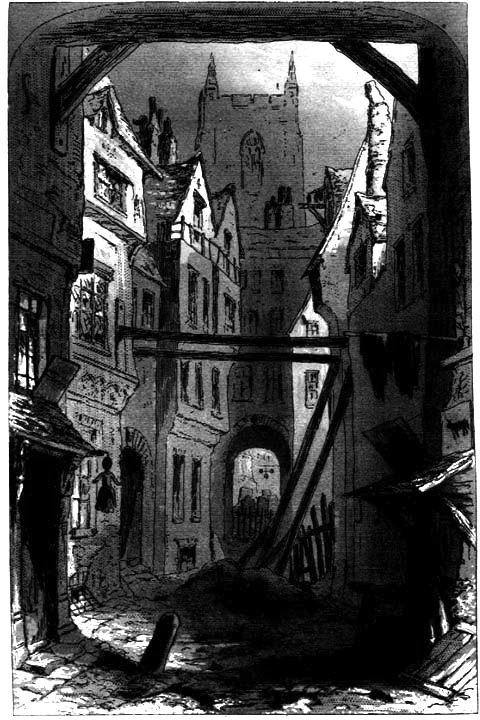
Darkness rests upon Tom-All-Alone’s. Dilating and dilating since the sun went down last night, it has gradually swelled until it fills every void in the place. For a time there were some dungeon lights burning, as the lamp of life hums in Tom-all-Alone’s, heavily, heavily, in the nauseous air, and winking—as that lamp, too, winks in Tom-all-Alone’s—at many horrible things. But they are blotted out. The moon has eyed Tom with a dull cold stare, as admitting some puny emulation of herself in his desert region unfit for life and blasted by volcanic fires; but she has passed on and is gone. The blackest nightmare in the infernal stables grazes on Tom-all-Alone’s, and Tom is fast asleep.

Much mighty speech-making there has been, both in and out of Parliament, concerning Tom, and much wrathful disputation how Tom shall be got right. Whether he shall be put into the main road by constables, or by beadles, or by bell-ringing, or by force of figures, or by correct principles of taste, or by high church, or by low church, or by no church; whether he shall be set to splitting trusses of polemical straws with the crooked knife of his mind or whether he shall be put to stone-breaking instead. In the midst of which dust and noise there is but one thing perfectly clear, to wit, that Tom only may and can, or shall and will, be reclaimed according to somebody’s theory but nobody’s practice. And in the hopeful meantime, Tom goes to perdition head foremost in his old determined spirit.

But he has his revenge. Even the winds are his messengers, and they serve him in these hours of darkness. There is not a drop of Tom’s corrupted blood but propagates infection and contagion somewhere. It shall pollute, this very night, the choice stream (in which chemists on analysis would find the genuine nobility) of a Norman house, and his Grace shall not be able to say nay to the infamous alliance. There is not an atom of Tom’s slime, not a cubic inch of any pestilential gas in which he lives, not one obscenity or degradation about him, not an ignorance, not a wickedness, not a brutality of his committing, but shall work its retribution through every order of society up to the proudest of the proud and to the highest of the high. Verily, what with tainting, plundering, and spoiling, Tom has his revenge.

It is a moot point whether Tom-all-Alone’s be uglier by day or by night, but on the argument that the more that is seen of it the more shocking it must be, and that no part of it left to the imagination is at all likely to be made so bad as the reality, day carries it. The day begins to break now; and in truth it might be better for the national glory even that the sun should sometimes set upon the British dominions than that it should ever rise upon so vile a wonder as Tom.

A brown sunburnt gentleman, who appears in some inaptitude for sleep to be wandering abroad rather than counting the hours on a restless pillow, strolls hitherward at this quiet time. Attracted by curiosity, he often pauses and looks about him, up and down the miserable by-ways. Nor is he merely curious, for in his bright dark eye there is compassionate interest; and as he looks here and there, he seems to understand such wretchedness and to have studied it before.

On the banks of the stagnant channel of mud which is the main street of Tom-all-Alone’s, nothing is to be seen but the crazy houses, shut up and silent. No waking creature save himself appears except in one direction, where he sees the solitary figure of a woman sitting on a door-step. He walks that way. Approaching, he observes that she has journeyed a long distance and is footsore and travel-stained. She sits on the door-step in the manner of one who is waiting, with her elbow on her knee and her head upon her hand. Beside her is a canvas bag, or bundle, she has carried. She is dozing probably, for she gives no heed to his steps as he comes toward her.

The broken footway is so narrow that when Allan Woodcourt comes to where the woman sits, he has to turn into the road to pass her. Looking down at her face, his eye meets hers, and he stops.

“What is the matter?”

“Nothing, sir.”

“Can’t you make them hear? Do you want to be let in?”

“I’m waiting till they get up at another house—a lodging-house—not here,” the woman patiently returns. “I’m waiting here because there will be sun here presently to warm me.”

“I am afraid you are tired. I am sorry to see you sitting in the street.”

“Thank you, sir. It don’t matter.”

A habit in him of speaking to the poor and of avoiding patronage or condescension or childishness (which is the favourite device, many people deeming it quite a subtlety to talk to them like little spelling books) has put him on good terms with the woman easily.

“Let me look at your forehead,” he says, bending down. “I am a doctor. Don’t be afraid. I wouldn’t hurt you for the world.”

He knows that by touching her with his skilful and accustomed hand he can soothe her yet more readily. She makes a slight objection, saying, “It’s nothing”; but he has scarcely laid his fingers on the wounded place when she lifts it up to the light.

“Aye! A bad bruise, and the skin sadly broken. This must be very sore.”

“It do ache a little, sir,” returns the woman with a started tear upon her cheek.

“Let me try to make it more comfortable. My handkerchief won’t hurt you.”

“Oh, dear no, sir, I’m sure of that!”

He cleanses the injured place and dries it, and having carefully examined it and gently pressed it with the palm of his hand, takes a small case from his pocket, dresses it, and binds it up. While he is thus employed, he says, after laughing at his establishing a surgery in the street, “And so your husband is a brickmaker?”

“How do you know that, sir?” asks the woman, astonished.

“Why, I suppose so from the colour of the clay upon your bag and on your dress. And I know brickmakers go about working at piecework in different places. And I am sorry to say I have known them cruel to their wives too.”

The woman hastily lifts up her eyes as if she would deny that her injury is referable to such a cause. But feeling the hand upon her forehead, and seeing his busy and composed face, she quietly drops them again.

“Where is he now?” asks the surgeon.

“He got into trouble last night, sir; but he’ll look for me at the lodging-house.”

“He will get into worse trouble if he often misuses his large and heavy hand as he has misused it here. But you forgive him, brutal as he is, and I say no more of him, except that I wish he deserved it. You have no young child?”

The woman shakes her head. “One as I calls mine, sir, but it’s Liz’s.”

“Your own is dead. I see! Poor little thing!”

By this time he has finished and is putting up his case. “I suppose you have some settled home. Is it far from here?” he asks, good-humouredly making light of what he has done as she gets up and curtsys.

“It’s a good two or three and twenty mile from here, sir. At Saint Albans. You know Saint Albans, sir? I thought you gave a start like, as if you did.”

“Yes, I know something of it. And now I will ask you a question in return. Have you money for your lodging?”

“Yes, sir,” she says, “really and truly.” And she shows it. He tells her, in acknowledgment of her many subdued thanks, that she is very welcome, gives her good day, and walks away. Tom-all-Alone’s is still asleep, and nothing is astir.

Yes, something is! As he retraces his way to the point from which he descried the woman at a distance sitting on the step, he sees a ragged figure coming very cautiously along, crouching close to the soiled walls—which the wretchedest figure might as well avoid—and furtively thrusting a hand before it. It is the figure of a youth whose face is hollow and whose eyes have an emaciated glare. He is so intent on getting along unseen that even the apparition of a stranger in whole garments does not tempt him to look back. He shades his face with his ragged elbow as he passes on the other side of the way, and goes shrinking and creeping on with his anxious hand before him and his shapeless clothes hanging in shreds. Clothes made for what purpose, or of what material, it would be impossible to say. They look, in colour and in substance, like a bundle of rank leaves of swampy growth that rotted long ago.

Allan Woodcourt pauses to look after him and note all this, with a shadowy belief that he has seen the boy before. He cannot recall how or where, but there is some association in his mind with such a form. He imagines that he must have seen it in some hospital or refuge, still, cannot make out why it comes with any special force on his remembrance.

He is gradually emerging from Tom-all-Alone’s in the morning light, thinking about it, when he hears running feet behind him, and looking round, sees the boy scouring towards him at great speed, followed by the woman.

“Stop him, stop him!” cries the woman, almost breathless. “Stop him, sir!”

He darts across the road into the boy’s path, but the boy is quicker than he, makes a curve, ducks, dives under his hands, comes up half-a-dozen yards beyond him, and scours away again. Still the woman follows, crying, “Stop him, sir, pray stop him!” Allan, not knowing but that he has just robbed her of her money, follows in chase and runs so hard that he runs the boy down a dozen times, but each time he repeats the curve, the duck, the dive, and scours away again. To strike at him on any of these occasions would be to fell and disable him, but the pursuer cannot resolve to do that, and so the grimly ridiculous pursuit continues. At last the fugitive, hard-pressed, takes to a narrow passage and a court which has no thoroughfare. Here, against a hoarding of decaying timber, he is brought to bay and tumbles down, lying gasping at his pursuer, who stands and gasps at him until the woman comes up.

“Oh, you, Jo!” cries the woman. “What? I have found you at last!”

“Jo,” repeats Allan, looking at him with attention, “Jo! Stay. To be sure! I recollect this lad some time ago being brought before the coroner.”

“Yes, I see you once afore at the inkwhich,” whimpers Jo. “What of that? Can’t you never let such an unfortnet as me alone? An’t I unfortnet enough for you yet? How unfortnet do you want me fur to be? I’ve been a-chivied and a-chivied, fust by one on you and nixt by another on you, till I’m worritted to skins and bones. The inkwhich warn’t MY fault. I done nothink. He wos wery good to me, he wos; he wos the only one I knowed to speak to, as ever come across my crossing. It ain’t wery likely I should want him to be inkwhiched. I only wish I wos, myself. I don’t know why I don’t go and make a hole in the water, I’m sure I don’t.”

He says it with such a pitiable air, and his grimy tears appear so real, and he lies in the corner up against the hoarding so like a growth of fungus or any unwholesome excrescence produced there in neglect and impurity, that Allan Woodcourt is softened towards him. He says to the woman, “Miserable creature, what has he done?”

To which she only replies, shaking her head at the prostrate figure more amazedly than angrily, “Oh, you Jo, you Jo. I have found you at last!”

“What has he done?” says Allan. “Has he robbed you?”

“No, sir, no. Robbed me? He did nothing but what was kind-hearted by me, and that’s the wonder of it.”

Allan looks from Jo to the woman, and from the woman to Jo, waiting for one of them to unravel the riddle.

“But he was along with me, sir,” says the woman. “Oh, you Jo! He was along with me, sir, down at Saint Albans, ill, and a young lady, Lord bless her for a good friend to me, took pity on him when I durstn’t, and took him home—”

Allan shrinks back from him with a sudden horror.

“Yes, sir, yes. Took him home, and made him comfortable, and like a thankless monster he ran away in the night and never has been seen or heard of since till I set eyes on him just now. And that young lady that was such a pretty dear caught his illness, lost her beautiful looks, and wouldn’t hardly be known for the same young lady now if it wasn’t for her angel temper, and her pretty shape, and her sweet voice. Do you know it? You ungrateful wretch, do you know that this is all along of you and of her goodness to you?” demands the woman, beginning to rage at him as she recalls it and breaking into passionate tears.

The boy, in rough sort stunned by what he hears, falls to smearing his dirty forehead with his dirty palm, and to staring at the ground, and to shaking from head to foot until the crazy hoarding against which he leans rattles.

Allan restrains the woman, merely by a quiet gesture, but effectually.

“Richard told me—” He falters. “I mean, I have heard of this—don’t mind me for a moment, I will speak presently.”

He turns away and stands for a while looking out at the covered passage. When he comes back, he has recovered his composure, except that he contends against an avoidance of the boy, which is so very remarkable that it absorbs the woman’s attention.

“You hear what she says. But get up, get up!”

Jo, shaking and chattering, slowly rises and stands, after the manner of his tribe in a difficulty, sideways against the hoarding, resting one of his high shoulders against it and covertly rubbing his right hand over his left and his left foot over his right.

“You hear what she says, and I know it’s true. Have you been here ever since?”

“Wishermaydie if I seen Tom-all-Alone’s till this blessed morning,” replies Jo hoarsely.

“Why have you come here now?”

Jo looks all round the confined court, looks at his questioner no higher than the knees, and finally answers, “I don’t know how to do nothink, and I can’t get nothink to do. I’m wery poor and ill, and I thought I’d come back here when there warn’t nobody about, and lay down and hide somewheres as I knows on till arter dark, and then go and beg a trifle of Mr. Snagsby. He wos allus willin fur to give me somethink he wos, though Mrs. Snagsby she was allus a-chivying on me—like everybody everywheres.”

“Where have you come from?”

Jo looks all round the court again, looks at his questioner’s knees again, and concludes by laying his profile against the hoarding in a sort of resignation.

“Did you hear me ask you where you have come from?”

“Tramp then,” says Jo.

“Now tell me,” proceeds Allan, making a strong effort to overcome his repugnance, going very near to him, and leaning over him with an expression of confidence, “tell me how it came about that you left that house when the good young lady had been so unfortunate as to pity you and take you home.”

Jo suddenly comes out of his resignation and excitedly declares, addressing the woman, that he never known about the young lady, that he never heern about it, that he never went fur to hurt her, that he would sooner have hurt his own self, that he’d sooner have had his unfortnet ed chopped off than ever gone a-nigh her, and that she wos wery good to him, she wos. Conducting himself throughout as if in his poor fashion he really meant it, and winding up with some very miserable sobs.

Allan Woodcourt sees that this is not a sham. He constrains himself to touch him. “Come, Jo. Tell me.”

“No. I dustn’t,” says Jo, relapsing into the profile state. “I dustn’t, or I would.”

“But I must know,” returns the other, “all the same. Come, Jo.”

After two or three such adjurations, Jo lifts up his head again, looks round the court again, and says in a low voice, “Well, I’ll tell you something. I was took away. There!”

“Took away? In the night?”

“Ah!” Very apprehensive of being overheard, Jo looks about him and even glances up some ten feet at the top of the hoarding and through the cracks in it lest the object of his distrust should be looking over or hidden on the other side.

“Who took you away?”

“I dustn’t name him,” says Jo. “I dustn’t do it, sir.

“But I want, in the young lady’s name, to know. You may trust me. No one else shall hear.”

“Ah, but I don’t know,” replies Jo, shaking his head fearfully, “as he DON’T hear.”

“Why, he is not in this place.”

“Oh, ain’t he though?” says Jo. “He’s in all manner of places, all at wanst.”

Allan looks at him in perplexity, but discovers some real meaning and good faith at the bottom of this bewildering reply. He patiently awaits an explicit answer; and Jo, more baffled by his patience than by anything else, at last desperately whispers a name in his ear.

“Aye!” says Allan. “Why, what had you been doing?”

“Nothink, sir. Never done nothink to get myself into no trouble, ‘sept in not moving on and the inkwhich. But I’m a-moving on now. I’m a-moving on to the berryin ground—that’s the move as I’m up to.”

“No, no, we will try to prevent that. But what did he do with you?”

“Put me in a horsepittle,” replied Jo, whispering, “till I was discharged, then giv me a little money—four half-bulls, wot you may call half-crowns—and ses ‘Hook it! Nobody wants you here,’ he ses. ‘You hook it. You go and tramp,’ he ses. ‘You move on,’ he ses. ‘Don’t let me ever see you nowheres within forty mile of London, or you’ll repent it.’ So I shall, if ever he doos see me, and he’ll see me if I’m above ground,” concludes Jo, nervously repeating all his former precautions and investigations.

Allan considers a little, then remarks, turning to the woman but keeping an encouraging eye on Jo, “He is not so ungrateful as you supposed. He had a reason for going away, though it was an insufficient one.”

“Thankee, sir, thankee!” exclaims Jo. “There now! See how hard you wos upon me. But ony you tell the young lady wot the genlmn ses, and it’s all right. For YOU wos wery good to me too, and I knows it.”

“Now, Jo,” says Allan, keeping his eye upon him, “come with me and I will find you a better place than this to lie down and hide in. If I take one side of the way and you the other to avoid observation, you will not run away, I know very well, if you make me a promise.”

“I won’t, not unless I wos to see HIM a-coming, sir.”

“Very well. I take your word. Half the town is getting up by this time, and the whole town will be broad awake in another hour. Come along. Good day again, my good woman.”

“Good day again, sir, and I thank you kindly many times again.”

She has been sitting on her bag, deeply attentive, and now rises and takes it up. Jo, repeating, “Ony you tell the young lady as I never went fur to hurt her and wot the genlmn ses!” nods and shambles and shivers, and smears and blinks, and half laughs and half cries, a farewell to her, and takes his creeping way along after Allan Woodcourt, close to the houses on the opposite side of the street. In this order, the two come up out of Tom-all-Alone’s into the broad rays of the sunlight and the purer air.

Librivox Recording: Chapter 46

(Image: “Tom All Alone’s”)

Chapter 45: In Trust

One morning when I had done jingling about with my baskets of keys, as my beauty and I were walking round and round the garden I happened to turn my eyes towards the house and saw a long thin shadow going in which looked like Mr. Vholes. Ada had been telling me only that morning of her hopes that Richard might exhaust his ardour in the Chancery suit by being so very earnest in it; and therefore, not to damp my dear girl’s spirits, I said nothing about Mr. Vholes’s shadow.

Presently came Charley, lightly winding among the bushes and tripping along the paths, as rosy and pretty as one of Flora’s attendants instead of my maid, saying, “Oh, if you please, miss, would you step and speak to Mr. Jarndyce!”

It was one of Charley’s peculiarities that whenever she was charged with a message she always began to deliver it as soon as she beheld, at any distance, the person for whom it was intended. Therefore I saw Charley asking me in her usual form of words to “step and speak” to Mr. Jarndyce long before I heard her. And when I did hear her, she had said it so often that she was out of breath.

I told Ada I would make haste back and inquired of Charley as we went in whether there was not a gentleman with Mr. Jarndyce. To which Charley, whose grammar, I confess to my shame, never did any credit to my educational powers, replied, “Yes, miss. Him as come down in the country with Mr. Richard.”

A more complete contrast than my guardian and Mr. Vholes I suppose there could not be. I found them looking at one another across a table, the one so open and the other so close, the one so broad and upright and the other so narrow and stooping, the one giving out what he had to say in such a rich ringing voice and the other keeping it in in such a cold-blooded, gasping, fish-like manner that I thought I never had seen two people so unmatched.

“You know Mr. Vholes, my dear,” said my guardian. Not with the greatest urbanity, I must say.

Mr. Vholes rose, gloved and buttoned up as usual, and seated himself again, just as he had seated himself beside Richard in the gig. Not having Richard to look at, he looked straight before him.

“Mr. Vholes,” said my guardian, eyeing his black figure as if he were a bird of ill omen, “has brought an ugly report of our most unfortunate Rick.” Laying a marked emphasis on “most unfortunate” as if the words were rather descriptive of his connexion with Mr. Vholes.

I sat down between them; Mr. Vholes remained immovable, except that he secretly picked at one of the red pimples on his yellow face with his black glove.

“And as Rick and you are happily good friends, I should like to know,” said my guardian, “what you think, my dear. Would you be so good as to—as to speak up, Mr. Vholes?”

Doing anything but that, Mr. Vholes observed, “I have been saying that I have reason to know, Miss Summerson, as Mr. C.’s professional adviser, that Mr. C.’s circumstances are at the present moment in an embarrassed state. Not so much in point of amount as owing to the peculiar and pressing nature of liabilities Mr. C. has incurred and the means he has of liquidating or meeting the same. I have staved off many little matters for Mr. C., but there is a limit to staving off, and we have reached it. I have made some advances out of pocket to accommodate these unpleasantnesses, but I necessarily look to being repaid, for I do not pretend to be a man of capital, and I have a father to support in the Vale of Taunton, besides striving to realize some little independence for three dear girls at home. My apprehension is, Mr. C.’s circumstances being such, lest it should end in his obtaining leave to part with his commission, which at all events is desirable to be made known to his connexions.”

Mr. Vholes, who had looked at me while speaking, here emerged into the silence he could hardly be said to have broken, so stifled was his tone, and looked before him again.

“Imagine the poor fellow without even his present resource,” said my guardian to me. “Yet what can I do? You know him, Esther. He would never accept of help from me now. To offer it or hint at it would be to drive him to an extremity, if nothing else did.”

Mr. Vholes hereupon addressed me again.

“What Mr. Jarndyce remarks, miss, is no doubt the case, and is the difficulty. I do not see that anything is to be done. I do not say that anything is to be done. Far from it. I merely come down here under the seal of confidence and mention it in order that everything may be openly carried on and that it may not be said afterwards that everything was not openly carried on. My wish is that everything should be openly carried on. I desire to leave a good name behind me. If I consulted merely my own interests with Mr. C., I should not be here. So insurmountable, as you must well know, would be his objections. This is not a professional attendance. This can he charged to nobody. I have no interest in it except as a member of society and a father—AND a son,” said Mr. Vholes, who had nearly forgotten that point.

It appeared to us that Mr. Vholes said neither more nor less than the truth in intimating that he sought to divide the responsibility, such as it was, of knowing Richard’s situation. I could only suggest that I should go down to Deal, where Richard was then stationed, and see him, and try if it were possible to avert the worst. Without consulting Mr. Vholes on this point, I took my guardian aside to propose it, while Mr. Vholes gauntly stalked to the fire and warmed his funeral gloves.

The fatigue of the journey formed an immediate objection on my guardian’s part, but as I saw he had no other, and as I was only too happy to go, I got his consent. We had then merely to dispose of Mr. Vholes.

“Well, sir,” said Mr. Jarndyce, “Miss Summerson will communicate with Mr. Carstone, and you can only hope that his position may be yet retrievable. You will allow me to order you lunch after your journey, sir.”

“I thank you, Mr. Jarndyce,” said Mr. Vholes, putting out his long black sleeve to check the ringing of the bell, “not any. I thank you, no, not a morsel. My digestion is much impaired, and I am but a poor knife and fork at any time. If I was to partake of solid food at this period of the day, I don’t know what the consequences might be. Everything having been openly carried on, sir, I will now with your permission take my leave.”

“And I would that you could take your leave, and we could all take our leave, Mr. Vholes,” returned my guardian bitterly, “of a cause you know of.”

Mr. Vholes, whose black dye was so deep from head to foot that it had quite steamed before the fire, diffusing a very unpleasant perfume, made a short one-sided inclination of his head from the neck and slowly shook it.

“We whose ambition it is to be looked upon in the light of respectable practitioners, sir, can but put our shoulders to the wheel. We do it, sir. At least, I do it myself; and I wish to think well of my professional brethren, one and all. You are sensible of an obligation not to refer to me, miss, in communicating with Mr. C.?”

I said I would be careful not to do it.

“Just so, miss. Good morning. Mr. Jarndyce, good morning, sir.” Mr. Vholes put his dead glove, which scarcely seemed to have any hand in it, on my fingers, and then on my guardian’s fingers, and took his long thin shadow away. I thought of it on the outside of the coach, passing over all the sunny landscape between us and London, chilling the seed in the ground as it glided along.

Of course it became necessary to tell Ada where I was going and why I was going, and of course she was anxious and distressed. But she was too true to Richard to say anything but words of pity and words of excuse, and in a more loving spirit still—my dear devoted girl!—she wrote him a long letter, of which I took charge.

Charley was to be my travelling companion, though I am sure I wanted none and would willingly have left her at home. We all went to London that afternoon, and finding two places in the mail, secured them. At our usual bed-time, Charley and I were rolling away seaward with the Kentish letters.

It was a night’s journey in those coach times, but we had the mail to ourselves and did not find the night very tedious. It passed with me as I suppose it would with most people under such circumstances. At one while my journey looked hopeful, and at another hopeless. Now I thought I should do some good, and now I wondered how I could ever have supposed so. Now it seemed one of the most reasonable things in the world that I should have come, and now one of the most unreasonable. In what state I should find Richard, what I should say to him, and what he would say to me occupied my mind by turns with these two states of feeling; and the wheels seemed to play one tune (to which the burden of my guardian’s letter set itself) over and over again all night.

At last we came into the narrow streets of Deal, and very gloomy they were upon a raw misty morning. The long flat beach, with its little irregular houses, wooden and brick, and its litter of capstans, and great boats, and sheds, and bare upright poles with tackle and blocks, and loose gravelly waste places overgrown with grass and weeds, wore as dull an appearance as any place I ever saw. The sea was heaving under a thick white fog; and nothing else was moving but a few early ropemakers, who, with the yarn twisted round their bodies, looked as if, tired of their present state of existence, they were spinning themselves into cordage.

But when we got into a warm room in an excellent hotel and sat down, comfortably washed and dressed, to an early breakfast (for it was too late to think of going to bed), Deal began to look more cheerful. Our little room was like a ship’s cabin, and that delighted Charley very much. Then the fog began to rise like a curtain, and numbers of ships that we had had no idea were near appeared. I don’t know how many sail the waiter told us were then lying in the downs. Some of these vessels were of grand size—one was a large Indiaman just come home; and when the sun shone through the clouds, making silvery pools in the dark sea, the way in which these ships brightened, and shadowed, and changed, amid a bustle of boats pulling off from the shore to them and from them to the shore, and a general life and motion in themselves and everything around them, was most beautiful.

The large Indiaman was our great attraction because she had come into the downs in the night. She was surrounded by boats, and we said how glad the people on board of her must be to come ashore. Charley was curious, too, about the voyage, and about the heat in India, and the serpents and the tigers; and as she picked up such information much faster than grammar, I told her what I knew on those points. I told her, too, how people in such voyages were sometimes wrecked and cast on rocks, where they were saved by the intrepidity and humanity of one man. And Charley asking how that could be, I told her how we knew at home of such a case.

I had thought of sending Richard a note saying I was there, but it seemed so much better to go to him without preparation. As he lived in barracks I was a little doubtful whether this was feasible, but we went out to reconnoitre. Peeping in at the gate of the barrack-yard, we found everything very quiet at that time in the morning, and I asked a sergeant standing on the guardhouse-steps where he lived. He sent a man before to show me, who went up some bare stairs, and knocked with his knuckles at a door, and left us.

“Now then!” cried Richard from within. So I left Charley in the little passage, and going on to the half-open door, said, “Can I come in, Richard? It’s only Dame Durden.”

He was writing at a table, with a great confusion of clothes, tin cases, books, boots, brushes, and portmanteaus strewn all about the floor. He was only half dressed—in plain clothes, I observed, not in uniform—and his hair was unbrushed, and he looked as wild as his room. All this I saw after he had heartily welcomed me and I was seated near him, for he started upon hearing my voice and caught me in his arms in a moment. Dear Richard! He was ever the same to me. Down to—ah, poor poor fellow!—to the end, he never received me but with something of his old merry boyish manner.

“Good heaven, my dear little woman,” said he, “how do you come here? Who could have thought of seeing you! Nothing the matter? Ada is well?”

“Quite well. Lovelier than ever, Richard!”

“Ah!” he said, leaning back in his chair. “My poor cousin! I was writing to you, Esther.”

So worn and haggard as he looked, even in the fullness of his handsome youth, leaning back in his chair and crushing the closely written sheet of paper in his hand!

“Have you been at the trouble of writing all that, and am I not to read it after all?” I asked.

“Oh, my dear,” he returned with a hopeless gesture. “You may read it in the whole room. It is all over here.”

I mildly entreated him not to be despondent. I told him that I had heard by chance of his being in difficulty and had come to consult with him what could best be done.

“Like you, Esther, but useless, and so NOT like you!” said he with a melancholy smile. “I am away on leave this day—should have been gone in another hour—and that is to smooth it over, for my selling out. Well! Let bygones be bygones. So this calling follows the rest. I only want to have been in the church to have made the round of all the professions.”

“Richard,” I urged, “it is not so hopeless as that?”

“Esther,” he returned, “it is indeed. I am just so near disgrace as that those who are put in authority over me (as the catechism goes) would far rather be without me than with me. And they are right. Apart from debts and duns and all such drawbacks, I am not fit even for this employment. I have no care, no mind, no heart, no soul, but for one thing. Why, if this bubble hadn’t broken now,” he said, tearing the letter he had written into fragments and moodily casting them away, by driblets, “how could I have gone abroad? I must have been ordered abroad, but how could I have gone? How could I, with my experience of that thing, trust even Vholes unless I was at his back!”

I suppose he knew by my face what I was about to say, but he caught the hand I had laid upon his arm and touched my own lips with it to prevent me from going on.

“No, Dame Durden! Two subjects I forbid—must forbid. The first is John Jarndyce. The second, you know what. Call it madness, and I tell you I can’t help it now, and can’t be sane. But it is no such thing; it is the one object I have to pursue. It is a pity I ever was prevailed upon to turn out of my road for any other. It would be wisdom to abandon it now, after all the time, anxiety, and pains I have bestowed upon it! Oh, yes, true wisdom. It would be very agreeable, too, to some people; but I never will.”

He was in that mood in which I thought it best not to increase his determination (if anything could increase it) by opposing him. I took out Ada’s letter and put it in his hand.

“Am I to read it now?” he asked.

As I told him yes, he laid it on the table, and resting his head upon his hand, began. He had not read far when he rested his head upon his two hands—to hide his face from me. In a little while he rose as if the light were bad and went to the window. He finished reading it there, with his back towards me, and after he had finished and had folded it up, stood there for some minutes with the letter in his hand. When he came back to his chair, I saw tears in his eyes.

“Of course, Esther, you know what she says here?” He spoke in a softened voice and kissed the letter as he asked me.

“Yes, Richard.”

“Offers me,” he went on, tapping his foot upon the floor, “the little inheritance she is certain of so soon—just as little and as much as I have wasted—and begs and prays me to take it, set myself right with it, and remain in the service.”

“I know your welfare to be the dearest wish of her heart,” said I. “And, oh, my dear Richard, Ada’s is a noble heart.”

“I am sure it is. I—I wish I was dead!”

He went back to the window, and laying his arm across it, leaned his head down on his arm. It greatly affected me to see him so, but I hoped he might become more yielding, and I remained silent. My experience was very limited; I was not at all prepared for his rousing himself out of this emotion to a new sense of injury.

“And this is the heart that the same John Jarndyce, who is not otherwise to be mentioned between us, stepped in to estrange from me,” said he indignantly. “And the dear girl makes me this generous offer from under the same John Jarndyce’s roof, and with the same John Jarndyce’s gracious consent and connivance, I dare say, as a new means of buying me off.”

“Richard!” I cried out, rising hastily. “I will not hear you say such shameful words!” I was very angry with him indeed, for the first time in my life, but it only lasted a moment. When I saw his worn young face looking at me as if he were sorry, I put my hand on his shoulder and said, “If you please, my dear Richard, do not speak in such a tone to me. Consider!”

He blamed himself exceedingly and told me in the most generous manner that he had been very wrong and that he begged my pardon a thousand times. At that I laughed, but trembled a little too, for I was rather fluttered after being so fiery.

“To accept this offer, my dear Esther,” said he, sitting down beside me and resuming our conversation, “—once more, pray, pray forgive me; I am deeply grieved—to accept my dearest cousin’s offer is, I need not say, impossible. Besides, I have letters and papers that I could show you which would convince you it is all over here. I have done with the red coat, believe me. But it is some satisfaction, in the midst of my troubles and perplexities, to know that I am pressing Ada’s interests in pressing my own. Vholes has his shoulder to the wheel, and he cannot help urging it on as much for her as for me, thank God!”

His sanguine hopes were rising within him and lighting up his features, but they made his face more sad to me than it had been before.

“No, no!” cried Richard exultingly. “If every farthing of Ada’s little fortune were mine, no part of it should be spent in retaining me in what I am not fit for, can take no interest in, and am weary of. It should be devoted to what promises a better return, and should be used where she has a larger stake. Don’t be uneasy for me! I shall now have only one thing on my mind, and Vholes and I will work it. I shall not be without means. Free of my commission, I shall be able to compound with some small usurers who will hear of nothing but their bond now—Vholes says so. I should have a balance in my favour anyway, but that would swell it. Come, come! You shall carry a letter to Ada from me, Esther, and you must both of you be more hopeful of me and not believe that I am quite cast away just yet, my dear.”

I will not repeat what I said to Richard. I know it was tiresome, and nobody is to suppose for a moment that it was at all wise. It only came from my heart. He heard it patiently and feelingly, but I saw that on the two subjects he had reserved it was at present hopeless to make any representation to him. I saw too, and had experienced in this very interview, the sense of my guardian’s remark that it was even more mischievous to use persuasion with him than to leave him as he was.

Therefore I was driven at last to asking Richard if he would mind convincing me that it really was all over there, as he had said, and that it was not his mere impression. He showed me without hesitation a correspondence making it quite plain that his retirement was arranged. I found, from what he told me, that Mr. Vholes had copies of these papers and had been in consultation with him throughout. Beyond ascertaining this, and having been the bearer of Ada’s letter, and being (as I was going to be) Richard’s companion back to London, I had done no good by coming down. Admitting this to myself with a reluctant heart, I said I would return to the hotel and wait until he joined me there, so he threw a cloak over his shoulders and saw me to the gate, and Charley and I went back along the beach.

There was a concourse of people in one spot, surrounding some naval officers who were landing from a boat, and pressing about them with unusual interest. I said to Charley this would be one of the great Indiaman’s boats now, and we stopped to look.

The gentlemen came slowly up from the waterside, speaking good-humouredly to each other and to the people around and glancing about them as if they were glad to be in England again. “Charley, Charley,” said I, “come away!” And I hurried on so swiftly that my little maid was surprised.

It was not until we were shut up in our cabin-room and I had had time to take breath that I began to think why I had made such haste. In one of the sunburnt faces I had recognized Mr. Allan Woodcourt, and I had been afraid of his recognizing me. I had been unwilling that he should see my altered looks. I had been taken by surprise, and my courage had quite failed me.

But I knew this would not do, and I now said to myself, “My dear, there is no reason—there is and there can be no reason at all—why it should be worse for you now than it ever has been. What you were last month, you are to-day; you are no worse, you are no better. This is not your resolution; call it up, Esther, call it up!” I was in a great tremble—with running—and at first was quite unable to calm myself; but I got better, and I was very glad to know it.

The party came to the hotel. I heard them speaking on the staircase. I was sure it was the same gentlemen because I knew their voices again—I mean I knew Mr. Woodcourt’s. It would still have been a great relief to me to have gone away without making myself known, but I was determined not to do so. “No, my dear, no. No, no, no!”

I untied my bonnet and put my veil half up—I think I mean half down, but it matters very little—and wrote on one of my cards that I happened to be there with Mr. Richard Carstone, and I sent it in to Mr. Woodcourt. He came immediately. I told him I was rejoiced to be by chance among the first to welcome him home to England. And I saw that he was very sorry for me.

“You have been in shipwreck and peril since you left us, Mr. Woodcourt,” said I, “but we can hardly call that a misfortune which enabled you to be so useful and so brave. We read of it with the truest interest. It first came to my knowledge through your old patient, poor Miss Flite, when I was recovering from my severe illness.”

“Ah! Little Miss Flite!” he said. “She lives the same life yet?”

“Just the same.”

I was so comfortable with myself now as not to mind the veil and to be able to put it aside.

“Her gratitude to you, Mr. Woodcourt, is delightful. She is a most affectionate creature, as I have reason to say.”

“You—you have found her so?” he returned. “I—I am glad of that.” He was so very sorry for me that he could scarcely speak.

“I assure you,” said I, “that I was deeply touched by her sympathy and pleasure at the time I have referred to.”

“I was grieved to hear that you had been very ill.”

“I was very ill.”

“But you have quite recovered?”

“I have quite recovered my health and my cheerfulness,” said I. “You know how good my guardian is and what a happy life we lead, and I have everything to be thankful for and nothing in the world to desire.”

I felt as if he had greater commiseration for me than I had ever had for myself. It inspired me with new fortitude and new calmness to find that it was I who was under the necessity of reassuring him. I spoke to him of his voyage out and home, and of his future plans, and of his probable return to India. He said that was very doubtful. He had not found himself more favoured by fortune there than here. He had gone out a poor ship’s surgeon and had come home nothing better. While we were talking, and when I was glad to believe that I had alleviated (if I may use such a term) the shock he had had in seeing me, Richard came in. He had heard downstairs who was with me, and they met with cordial pleasure.

I saw that after their first greetings were over, and when they spoke of Richard’s career, Mr. Woodcourt had a perception that all was not going well with him. He frequently glanced at his face as if there were something in it that gave him pain, and more than once he looked towards me as though he sought to ascertain whether I knew what the truth was. Yet Richard was in one of his sanguine states and in good spirits and was thoroughly pleased to see Mr. Woodcourt again, whom he had always liked.

Richard proposed that we all should go to London together; but Mr. Woodcourt, having to remain by his ship a little longer, could not join us. He dined with us, however, at an early hour, and became so much more like what he used to be that I was still more at peace to think I had been able to soften his regrets. Yet his mind was not relieved of Richard. When the coach was almost ready and Richard ran down to look after his luggage, he spoke to me about him.

I was not sure that I had a right to lay his whole story open, but I referred in a few words to his estrangement from Mr Jarndyce and to his being entangled in the ill-fated Chancery suit. Mr. Woodcourt listened with interest and expressed his regret.

“I saw you observe him rather closely,” said I, “Do you think him so changed?”

“He is changed,” he returned, shaking his head.

I felt the blood rush into my face for the first time, but it was only an instantaneous emotion. I turned my head aside, and it was gone.

“It is not,” said Mr. Woodcourt, “his being so much younger or older, or thinner or fatter, or paler or ruddier, as there being upon his face such a singular expression. I never saw so remarkable a look in a young person. One cannot say that it is all anxiety or all weariness; yet it is both, and like ungrown despair.”

“You do not think he is ill?” said I.

No. He looked robust in body.

“That he cannot be at peace in mind, we have too much reason to know,” I proceeded. “Mr. Woodcourt, you are going to London?”

“To-morrow or the next day.”

“There is nothing Richard wants so much as a friend. He always liked you. Pray see him when you get there. Pray help him sometimes with your companionship if you can. You do not know of what service it might be. You cannot think how Ada, and Mr. Jarndyce, and even I—how we should all thank you, Mr. Woodcourt!”

“Miss Summerson,” he said, more moved than he had been from the first, “before heaven, I will be a true friend to him! I will accept him as a trust, and it shall be a sacred one!”

“God bless you!” said I, with my eyes filling fast; but I thought they might, when it was not for myself. “Ada loves him—we all love him, but Ada loves him as we cannot. I will tell her what you say. Thank you, and God bless you, in her name!”

Richard came back as we finished exchanging these hurried words and gave me his arm to take me to the coach.

“Woodcourt,” he said, unconscious with what application, “pray let us meet in London!”

“Meet?” returned the other. “I have scarcely a friend there now but you. Where shall I find you?”

“Why, I must get a lodging of some sort,” said Richard, pondering. “Say at Vholes’s, Symond’s Inn.”

“Good! Without loss of time.”

They shook hands heartily. When I was seated in the coach and Richard was yet standing in the street, Mr. Woodcourt laid his friendly hand on Richard’s shoulder and looked at me. I understood him and waved mine in thanks.

And in his last look as we drove away, I saw that he was very sorry for me. I was glad to see it. I felt for my old self as the dead may feel if they ever revisit these scenes. I was glad to be tenderly remembered, to be gently pitied, not to be quite forgotten.

Librivox Recording: Chapter 45

Chapter 44: The Letter and the Answer

My guardian called me into his room next morning, and then I told him what had been left untold on the previous night. There was nothing to be done, he said, but to keep the secret and to avoid another such encounter as that of yesterday. He understood my feeling and entirely shared it. He charged himself even with restraining Mr. Skimpole from improving his opportunity. One person whom he need not name to me, it was not now possible for him to advise or help. He wished it were, but no such thing could be. If her mistrust of the lawyer whom she had mentioned were well-founded, which he scarcely doubted, he dreaded discovery. He knew something of him, both by sight and by reputation, and it was certain that he was a dangerous man. Whatever happened, he repeatedly impressed upon me with anxious affection and kindness, I was as innocent of as himself and as unable to influence.

“Nor do I understand,” said he, “that any doubts tend towards you, my dear. Much suspicion may exist without that connexion.”

“With the lawyer,” I returned. “But two other persons have come into my mind since I have been anxious. Then I told him all about Mr. Guppy, who I feared might have had his vague surmises when I little understood his meaning, but in whose silence after our last interview I expressed perfect confidence.

“Well,” said my guardian. “Then we may dismiss him for the present. Who is the other?”

I called to his recollection the French maid and the eager offer of herself she had made to me.

“Ha!” he returned thoughtfully. “That is a more alarming person than the clerk. But after all, my dear, it was but seeking for a new service. She had seen you and Ada a little while before, and it was natural that you should come into her head. She merely proposed herself for your maid, you know. She did nothing more.”

“Her manner was strange,” said I.

“Yes, and her manner was strange when she took her shoes off and showed that cool relish for a walk that might have ended in her death-bed,” said my guardian. “It would be useless self-distress and torment to reckon up such chances and possibilities. There are very few harmless circumstances that would not seem full of perilous meaning, so considered. Be hopeful, little woman. You can be nothing better than yourself; be that, through this knowledge, as you were before you had it. It is the best you can do for everybody’s sake. I, sharing the secret with you—”

“And lightening it, guardian, so much,” said I.

“—will be attentive to what passes in that family, so far as I can observe it from my distance. And if the time should come when I can stretch out a hand to render the least service to one whom it is better not to name even here, I will not fail to do it for her dear daughter’s sake.”

I thanked him with my whole heart. What could I ever do but thank him! I was going out at the door when he asked me to stay a moment. Quickly turning round, I saw that same expression on his face again; and all at once, I don’t know how, it flashed upon me as a new and far-off possibility that I understood it.

“My dear Esther,” said my guardian, “I have long had something in my thoughts that I have wished to say to you.”

“Indeed?”

“I have had some difficulty in approaching it, and I still have. I should wish it to be so deliberately said, and so deliberately considered. Would you object to my writing it?”

“Dear guardian, how could I object to your writing anything for ME to read?”

“Then see, my love,” said he with his cheery smile, “am I at this moment quite as plain and easy—do I seem as open, as honest and old-fashioned—as I am at any time?”

I answered in all earnestness, “Quite.” With the strictest truth, for his momentary hesitation was gone (it had not lasted a minute), and his fine, sensible, cordial, sterling manner was restored.

“Do I look as if I suppressed anything, meant anything but what I said, had any reservation at all, no matter what?” said he with his bright clear eyes on mine.

I answered, most assuredly he did not.

“Can you fully trust me, and thoroughly rely on what I profess, Esther?”

“Most thoroughly,” said I with my whole heart.

“My dear girl,” returned my guardian, “give me your hand.”

He took it in his, holding me lightly with his arm, and looking down into my face with the same genuine freshness and faithfulness of manner—the old protecting manner which had made that house my home in a moment—said, “You have wrought changes in me, little woman, since the winter day in the stage-coach. First and last you have done me a world of good since that time.”

“Ah, guardian, what have you done for me since that time!”

“But,” said he, “that is not to be remembered now.”

“It never can be forgotten.”

“Yes, Esther,” said he with a gentle seriousness, “it is to be forgotten now, to be forgotten for a while. You are only to remember now that nothing can change me as you know me. Can you feel quite assured of that, my dear?”

“I can, and I do,” I said.

“That’s much,” he answered. “That’s everything. But I must not take that at a word. I will not write this something in my thoughts until you have quite resolved within yourself that nothing can change me as you know me. If you doubt that in the least degree, I will never write it. If you are sure of that, on good consideration, send Charley to me this night week—’for the letter.’ But if you are not quite certain, never send. Mind, I trust to your truth, in this thing as in everything. If you are not quite certain on that one point, never send!”

“Guardian,” said I, “I am already certain, I can no more be changed in that conviction than you can be changed towards me. I shall send Charley for the letter.”

He shook my hand and said no more. Nor was any more said in reference to this conversation, either by him or me, through the whole week. When the appointed night came, I said to Charley as soon as I was alone, “Go and knock at Mr. Jarndyce’s door, Charley, and say you have come from me—’for the letter.'” Charley went up the stairs, and down the stairs, and along the passages—the zig-zag way about the old-fashioned house seemed very long in my listening ears that night—and so came back, along the passages, and down the stairs, and up the stairs, and brought the letter. “Lay it on the table, Charley,” said I. So Charley laid it on the table and went to bed, and I sat looking at it without taking it up, thinking of many things.

I began with my overshadowed childhood, and passed through those timid days to the heavy time when my aunt lay dead, with her resolute face so cold and set, and when I was more solitary with Mrs. Rachael than if I had had no one in the world to speak to or to look at. I passed to the altered days when I was so blest as to find friends in all around me, and to be beloved. I came to the time when I first saw my dear girl and was received into that sisterly affection which was the grace and beauty of my life. I recalled the first bright gleam of welcome which had shone out of those very windows upon our expectant faces on that cold bright night, and which had never paled. I lived my happy life there over again, I went through my illness and recovery, I thought of myself so altered and of those around me so unchanged; and all this happiness shone like a light from one central figure, represented before me by the letter on the table.

I opened it and read it. It was so impressive in its love for me, and in the unselfish caution it gave me, and the consideration it showed for me in every word, that my eyes were too often blinded to read much at a time. But I read it through three times before I laid it down. I had thought beforehand that I knew its purport, and I did. It asked me, would I be the mistress of Bleak House.

It was not a love letter, though it expressed so much love, but was written just as he would at any time have spoken to me. I saw his face, and heard his voice, and felt the influence of his kind protecting manner in every line. It addressed me as if our places were reversed, as if all the good deeds had been mine and all the feelings they had awakened his. It dwelt on my being young, and he past the prime of life; on his having attained a ripe age, while I was a child; on his writing to me with a silvered head, and knowing all this so well as to set it in full before me for mature deliberation. It told me that I would gain nothing by such a marriage and lose nothing by rejecting it, for no new relation could enhance the tenderness in which he held me, and whatever my decision was, he was certain it would be right. But he had considered this step anew since our late confidence and had decided on taking it, if it only served to show me through one poor instance that the whole world would readily unite to falsify the stern prediction of my childhood. I was the last to know what happiness I could bestow upon him, but of that he said no more, for I was always to remember that I owed him nothing and that he was my debtor, and for very much. He had often thought of our future, and foreseeing that the time must come, and fearing that it might come soon, when Ada (now very nearly of age) would leave us, and when our present mode of life must be broken up, had become accustomed to reflect on this proposal. Thus he made it. If I felt that I could ever give him the best right he could have to be my protector, and if I felt that I could happily and justly become the dear companion of his remaining life, superior to all lighter chances and changes than death, even then he could not have me bind myself irrevocably while this letter was yet so new to me, but even then I must have ample time for reconsideration. In that case, or in the opposite case, let him be unchanged in his old relation, in his old manner, in the old name by which I called him. And as to his bright Dame Durden and little housekeeper, she would ever be the same, he knew.

This was the substance of the letter, written throughout with a justice and a dignity as if he were indeed my responsible guardian impartially representing the proposal of a friend against whom in his integrity he stated the full case.

But he did not hint to me that when I had been better looking he had had this same proceeding in his thoughts and had refrained from it. That when my old face was gone from me, and I had no attractions, he could love me just as well as in my fairer days. That the discovery of my birth gave him no shock. That his generosity rose above my disfigurement and my inheritance of shame. That the more I stood in need of such fidelity, the more firmly I might trust in him to the last.

But I knew it, I knew it well now. It came upon me as the close of the benignant history I had been pursuing, and I felt that I had but one thing to do. To devote my life to his happiness was to thank him poorly, and what had I wished for the other night but some new means of thanking him?

Still I cried very much, not only in the fullness of my heart after reading the letter, not only in the strangeness of the prospect—for it was strange though I had expected the contents—but as if something for which there was no name or distinct idea were indefinitely lost to me. I was very happy, very thankful, very hopeful; but I cried very much.

By and by I went to my old glass. My eyes were red and swollen, and I said, “Oh, Esther, Esther, can that be you!” I am afraid the face in the glass was going to cry again at this reproach, but I held up my finger at it, and it stopped.

“That is more like the composed look you comforted me with, my dear, when you showed me such a change!” said I, beginning to let down my hair. “When you are mistress of Bleak House, you are to be as cheerful as a bird. In fact, you are always to be cheerful; so let us begin for once and for all.”

I went on with my hair now, quite comfortably. I sobbed a little still, but that was because I had been crying, not because I was crying then.

“And so Esther, my dear, you are happy for life. Happy with your best friends, happy in your old home, happy in the power of doing a great deal of good, and happy in the undeserved love of the best of men.”

I thought, all at once, if my guardian had married some one else, how should I have felt, and what should I have done! That would have been a change indeed. It presented my life in such a new and blank form that I rang my housekeeping keys and gave them a kiss before I laid them down in their basket again.

Then I went on to think, as I dressed my hair before the glass, how often had I considered within myself that the deep traces of my illness and the circumstances of my birth were only new reasons why I should be busy, busy, busy—useful, amiable, serviceable, in all honest, unpretending ways. This was a good time, to be sure, to sit down morbidly and cry! As to its seeming at all strange to me at first (if that were any excuse for crying, which it was not) that I was one day to be the mistress of Bleak House, why should it seem strange? Other people had thought of such things, if I had not. “Don’t you remember, my plain dear,” I asked myself, looking at the glass, “what Mrs. Woodcourt said before those scars were there about your marrying—”

Perhaps the name brought them to my remembrance. The dried remains of the flowers. It would be better not to keep them now. They had only been preserved in memory of something wholly past and gone, but it would be better not to keep them now.

They were in a book, and it happened to be in the next room—our sitting-room, dividing Ada’s chamber from mine. I took a candle and went softly in to fetch it from its shelf. After I had it in my hand, I saw my beautiful darling, through the open door, lying asleep, and I stole in to kiss her.

It was weak in me, I know, and I could have no reason for crying; but I dropped a tear upon her dear face, and another, and another. Weaker than that, I took the withered flowers out and put them for a moment to her lips. I thought about her love for Richard, though, indeed, the flowers had nothing to do with that. Then I took them into my own room and burned them at the candle, and they were dust in an instant.

On entering the breakfast-room next morning, I found my guardian just as usual, quite as frank, as open, and free. There being not the least constraint in his manner, there was none (or I think there was none) in mine. I was with him several times in the course of the morning, in and out, when there was no one there, and I thought it not unlikely that he might speak to me about the letter, but he did not say a word.

So, on the next morning, and the next, and for at least a week, over which time Mr. Skimpole prolonged his stay. I expected, every day, that my guardian might speak to me about the letter, but he never did.

I thought then, growing uneasy, that I ought to write an answer. I tried over and over again in my own room at night, but I could not write an answer that at all began like a good answer, so I thought each night I would wait one more day. And I waited seven more days, and he never said a word.

At last, Mr. Skimpole having departed, we three were one afternoon going out for a ride; and I, being dressed before Ada and going down, came upon my guardian, with his back towards me, standing at the drawing-room window looking out.

He turned on my coming in and said, smiling, “Aye, it’s you, little woman, is it?” and looked out again.

I had made up my mind to speak to him now. In short, I had come down on purpose. “Guardian,” I said, rather hesitating and trembling, “when would you like to have the answer to the letter Charley came for?”

“When it’s ready, my dear,” he replied.

“I think it is ready,” said I.

“Is Charley to bring it?” he asked pleasantly.

“No. I have brought it myself, guardian,” I returned.

I put my two arms round his neck and kissed him, and he said was this the mistress of Bleak House, and I said yes; and it made no difference presently, and we all went out together, and I said nothing to my precious pet about it.

Librivox Recording: Chapter 44

Chapter 43: Esther’s Narrative

It matters little now how much I thought of my living mother who had told me evermore to consider her dead. I could not venture to approach her or to communicate with her in writing, for my sense of the peril in which her life was passed was only to be equalled by my fears of increasing it. Knowing that my mere existence as a living creature was an unforeseen danger in her way, I could not always conquer that terror of myself which had seized me when I first knew the secret. At no time did I dare to utter her name. I felt as if I did not even dare to hear it. If the conversation anywhere, when I was present, took that direction, as it sometimes naturally did, I tried not to hear: I mentally counted, repeated something that I knew, or went out of the room. I am conscious now that I often did these things when there can have been no danger of her being spoken of, but I did them in the dread I had of hearing anything that might lead to her betrayal, and to her betrayal through me.

It matters little now how often I recalled the tones of my mother’s voice, wondered whether I should ever hear it again as I so longed to do, and thought how strange and desolate it was that it should be so new to me. It matters little that I watched for every public mention of my mother’s name; that I passed and repassed the door of her house in town, loving it, but afraid to look at it; that I once sat in the theatre when my mother was there and saw me, and when we were so wide asunder before the great company of all degrees that any link or confidence between us seemed a dream. It is all, all over. My lot has been so blest that I can relate little of myself which is not a story of goodness and generosity in others. I may well pass that little and go on.

When we were settled at home again, Ada and I had many conversations with my guardian of which Richard was the theme. My dear girl was deeply grieved that he should do their kind cousin so much wrong, but she was so faithful to Richard that she could not bear to blame him even for that. My guardian was assured of it, and never coupled his name with a word of reproof. “Rick is mistaken, my dear,” he would say to her. “Well, well! We have all been mistaken over and over again. We must trust to you and time to set him right.”

We knew afterwards what we suspected then, that he did not trust to time until he had often tried to open Richard’s eyes. That he had written to him, gone to him, talked with him, tried every gentle and persuasive art his kindness could devise. Our poor devoted Richard was deaf and blind to all. If he were wrong, he would make amends when the Chancery suit was over. If he were groping in the dark, he could not do better than do his utmost to clear away those clouds in which so much was confused and obscured. Suspicion and misunderstanding were the fault of the suit? Then let him work the suit out and come through it to his right mind. This was his unvarying reply. Jarndyce and Jarndyce had obtained such possession of his whole nature that it was impossible to place any consideration before him which he did not, with a distorted kind of reason, make a new argument in favour of his doing what he did. “So that it is even more mischievous,” said my guardian once to me, “to remonstrate with the poor dear fellow than to leave him alone.”

I took one of these opportunities of mentioning my doubts of Mr. Skimpole as a good adviser for Richard.

“Adviser!” returned my guardian, laughing, “My dear, who would advise with Skimpole?”

“Encourager would perhaps have been a better word,” said I.

“Encourager!” returned my guardian again. “Who could be encouraged by Skimpole?”

“Not Richard?” I asked.

“No,” he replied. “Such an unworldly, uncalculating, gossamer creature is a relief to him and an amusement. But as to advising or encouraging or occupying a serious station towards anybody or anything, it is simply not to be thought of in such a child as Skimpole.”

“Pray, cousin John,” said Ada, who had just joined us and now looked over my shoulder, “what made him such a child?”

“What made him such a child?” inquired my guardian, rubbing his head, a little at a loss.

“Yes, cousin John.”

“Why,” he slowly replied, roughening his head more and more, “he is all sentiment, and—and susceptibility, and—and sensibility, and—and imagination. And these qualities are not regulated in him, somehow. I suppose the people who admired him for them in his youth attached too much importance to them and too little to any training that would have balanced and adjusted them, and so he became what he is. Hey?” said my guardian, stopping short and looking at us hopefully. “What do you think, you two?”

Ada, glancing at me, said she thought it was a pity he should be an expense to Richard.

“So it is, so it is,” returned my guardian hurriedly. “That must not be. We must arrange that. I must prevent it. That will never do.”

And I said I thought it was to be regretted that he had ever introduced Richard to Mr. Vholes for a present of five pounds.

“Did he?” said my guardian with a passing shade of vexation on his face. “But there you have the man. There you have the man! There is nothing mercenary in that with him. He has no idea of the value of money. He introduces Rick, and then he is good friends with Mr. Vholes and borrows five pounds of him. He means nothing by it and thinks nothing of it. He told you himself, I’ll be bound, my dear?”

“Oh, yes!” said I.

“Exactly!” cried my guardian, quite triumphant. “There you have the man! If he had meant any harm by it or was conscious of any harm in it, he wouldn’t tell it. He tells it as he does it in mere simplicity. But you shall see him in his own home, and then you’ll understand him better. We must pay a visit to Harold Skimpole and caution him on these points. Lord bless you, my dears, an infant, an infant!”

In pursuance of this plan, we went into London on an early day and presented ourselves at Mr. Skimpole’s door.

He lived in a place called the Polygon, in Somers Town, where there were at that time a number of poor Spanish refugees walking about in cloaks, smoking little paper cigars. Whether he was a better tenant than one might have supposed, in consequence of his friend Somebody always paying his rent at last, or whether his inaptitude for business rendered it particularly difficult to turn him out, I don’t know; but he had occupied the same house some years. It was in a state of dilapidation quite equal to our expectation. Two or three of the area railings were gone, the water-butt was broken, the knocker was loose, the bell-handle had been pulled off a long time to judge from the rusty state of the wire, and dirty footprints on the steps were the only signs of its being inhabited.

A slatternly full-blown girl who seemed to be bursting out at the rents in her gown and the cracks in her shoes like an over-ripe berry answered our knock by opening the door a very little way and stopping up the gap with her figure. As she knew Mr. Jarndyce (indeed Ada and I both thought that she evidently associated him with the receipt of her wages), she immediately relented and allowed us to pass in. The lock of the door being in a disabled condition, she then applied herself to securing it with the chain, which was not in good action either, and said would we go upstairs?

We went upstairs to the first floor, still seeing no other furniture than the dirty footprints. Mr. Jarndyce without further ceremony entered a room there, and we followed. It was dingy enough and not at all clean, but furnished with an odd kind of shabby luxury, with a large footstool, a sofa, and plenty of cushions, an easy-chair, and plenty of pillows, a piano, books, drawing materials, music, newspapers, and a few sketches and pictures. A broken pane of glass in one of the dirty windows was papered and wafered over, but there was a little plate of hothouse nectarines on the table, and there was another of grapes, and another of sponge-cakes, and there was a bottle of light wine. Mr. Skimpole himself reclined upon the sofa in a dressing-gown, drinking some fragrant coffee from an old china cup—it was then about mid-day—and looking at a collection of wallflowers in the balcony.

He was not in the least disconcerted by our appearance, but rose and received us in his usual airy manner.

“Here I am, you see!” he said when we were seated, not without some little difficulty, the greater part of the chairs being broken. “Here I am! This is my frugal breakfast. Some men want legs of beef and mutton for breakfast; I don’t. Give me my peach, my cup of coffee, and my claret; I am content. I don’t want them for themselves, but they remind me of the sun. There’s nothing solar about legs of beef and mutton. Mere animal satisfaction!”

“This is our friend’s consulting-room (or would be, if he ever prescribed), his sanctum, his studio,” said my guardian to us.

“Yes,” said Mr. Skimpole, turning his bright face about, “this is the bird’s cage. This is where the bird lives and sings. They pluck his feathers now and then and clip his wings, but he sings, he sings!”

He handed us the grapes, repeating in his radiant way, “He sings! Not an ambitious note, but still he sings.”

“These are very fine,” said my guardian. “A present?”

“No,” he answered. “No! Some amiable gardener sells them. His man wanted to know, when he brought them last evening, whether he should wait for the money. ‘Really, my friend,’ I said, ‘I think not—if your time is of any value to you.’ I suppose it was, for he went away.”

My guardian looked at us with a smile, as though he asked us, “Is it possible to be worldly with this baby?”

“This is a day,” said Mr. Skimpole, gaily taking a little claret in a tumbler, “that will ever be remembered here. We shall call it Saint Clare and Saint Summerson day. You must see my daughters. I have a blue-eyed daughter who is my Beauty daughter, I have a Sentiment daughter, and I have a Comedy daughter. You must see them all. They’ll be enchanted.”

He was going to summon them when my guardian interposed and asked him to pause a moment, as he wished to say a word to him first. “My dear Jarndyce,” he cheerfully replied, going back to his sofa, “as many moments as you please. Time is no object here. We never know what o’clock it is, and we never care. Not the way to get on in life, you’ll tell me? Certainly. But we DON’T get on in life. We don’t pretend to do it.”

My guardian looked at us again, plainly saying, “You hear him?”

“Now, Harold,” he began, “the word I have to say relates to Rick.”

“The dearest friend I have!” returned Mr. Skimpole cordially. “I suppose he ought not to be my dearest friend, as he is not on terms with you. But he is, I can’t help it; he is full of youthful poetry, and I love him. If you don’t like it, I can’t help it. I love him.”

The engaging frankness with which he made this declaration really had a disinterested appearance and captivated my guardian, if not, for the moment, Ada too.

“You are welcome to love him as much as you like,” returned Mr. Jarndyce, “but we must save his pocket, Harold.”

“Oh!” said Mr. Skimpole. “His pocket? Now you are coming to what I don’t understand.” Taking a little more claret and dipping one of the cakes in it, he shook his head and smiled at Ada and me with an ingenuous foreboding that he never could be made to understand.

“If you go with him here or there,” said my guardian plainly, “you must not let him pay for both.”

“My dear Jarndyce,” returned Mr. Skimpole, his genial face irradiated by the comicality of this idea, “what am I to do? If he takes me anywhere, I must go. And how can I pay? I never have any money. If I had any money, I don’t know anything about it. Suppose I say to a man, how much? Suppose the man says to me seven and sixpence? I know nothing about seven and sixpence. It is impossible for me to pursue the subject with any consideration for the man. I don’t go about asking busy people what seven and sixpence is in Moorish—which I don’t understand. Why should I go about asking them what seven and sixpence is in Money—which I don’t understand?”

“Well,” said my guardian, by no means displeased with this artless reply, “if you come to any kind of journeying with Rick, you must borrow the money of me (never breathing the least allusion to that circumstance), and leave the calculation to him.”

“My dear Jarndyce,” returned Mr. Skimpole, “I will do anything to give you pleasure, but it seems an idle form—a superstition. Besides, I give you my word, Miss Clare and my dear Miss Summerson, I thought Mr. Carstone was immensely rich. I thought he had only to make over something, or to sign a bond, or a draft, or a cheque, or a bill, or to put something on a file somewhere, to bring down a shower of money.”

“Indeed it is not so, sir,” said Ada. “He is poor.”

“No, really?” returned Mr. Skimpole with his bright smile. “You surprise me.

“And not being the richer for trusting in a rotten reed,” said my guardian, laying his hand emphatically on the sleeve of Mr. Skimpole’s dressing-gown, “be you very careful not to encourage him in that reliance, Harold.”

“My dear good friend,” returned Mr. Skimpole, “and my dear Miss Simmerson, and my dear Miss Clare, how can I do that? It’s business, and I don’t know business. It is he who encourages me. He emerges from great feats of business, presents the brightest prospects before me as their result, and calls upon me to admire them. I do admire them—as bright prospects. But I know no more about them, and I tell him so.”

The helpless kind of candour with which he presented this before us, the light-hearted manner in which he was amused by his innocence, the fantastic way in which he took himself under his own protection and argued about that curious person, combined with the delightful ease of everything he said exactly to make out my guardian’s case. The more I saw of him, the more unlikely it seemed to me, when he was present, that he could design, conceal, or influence anything; and yet the less likely that appeared when he was not present, and the less agreeable it was to think of his having anything to do with any one for whom I cared.

Hearing that his examination (as he called it) was now over, Mr. Skimpole left the room with a radiant face to fetch his daughters (his sons had run away at various times), leaving my guardian quite delighted by the manner in which he had vindicated his childish character. He soon came back, bringing with him the three young ladies and Mrs. Skimpole, who had once been a beauty but was now a delicate high-nosed invalid suffering under a complication of disorders.

“This,” said Mr. Skimpole, “is my Beauty daughter, Arethusa—plays and sings odds and ends like her father. This is my Sentiment daughter, Laura—plays a little but don’t sing. This is my Comedy daughter, Kitty—sings a little but don’t play. We all draw a little and compose a little, and none of us have any idea of time or money.”

Mrs. Skimpole sighed, I thought, as if she would have been glad to strike out this item in the family attainments. I also thought that she rather impressed her sigh upon my guardian and that she took every opportunity of throwing in another.

“It is pleasant,” said Mr. Skimpole, turning his sprightly eyes from one to the other of us, “and it is whimsically interesting to trace peculiarities in families. In this family we are all children, and I am the youngest.”

The daughters, who appeared to be very fond of him, were amused by this droll fact, particularly the Comedy daughter.

“My dears, it is true,” said Mr. Skimpole, “is it not? So it is, and so it must be, because like the dogs in the hymn, ‘it is our nature to.’ Now, here is Miss Summerson with a fine administrative capacity and a knowledge of details perfectly surprising. It will sound very strange in Miss Summerson’s ears, I dare say, that we know nothing about chops in this house. But we don’t, not the least. We can’t cook anything whatever. A needle and thread we don’t know how to use. We admire the people who possess the practical wisdom we want, but we don’t quarrel with them. Then why should they quarrel with us? Live and let live, we say to them. Live upon your practical wisdom, and let us live upon you!”

He laughed, but as usual seemed quite candid and really to mean what he said.

“We have sympathy, my roses,” said Mr. Skimpole, “sympathy for everything. Have we not?”

“Oh, yes, papa!” cried the three daughters.

“In fact, that is our family department,” said Mr. Skimpole, “in this hurly-burly of life. We are capable of looking on and of being interested, and we DO look on, and we ARE interested. What more can we do? Here is my Beauty daughter, married these three years. Now I dare say her marrying another child, and having two more, was all wrong in point of political economy, but it was very agreeable. We had our little festivities on those occasions and exchanged social ideas. She brought her young husband home one day, and they and their young fledglings have their nest upstairs. I dare say at some time or other Sentiment and Comedy will bring THEIR husbands home and have THEIR nests upstairs too. So we get on, we don’t know how, but somehow.”

She looked very young indeed to be the mother of two children, and I could not help pitying both her and them. It was evident that the three daughters had grown up as they could and had had just as little haphazard instruction as qualified them to be their father’s playthings in his idlest hours. His pictorial tastes were consulted, I observed, in their respective styles of wearing their hair, the Beauty daughter being in the classic manner, the Sentiment daughter luxuriant and flowing, and the Comedy daughter in the arch style, with a good deal of sprightly forehead, and vivacious little curls dotted about the corners of her eyes. They were dressed to correspond, though in a most untidy and negligent way.

Ada and I conversed with these young ladies and found them wonderfully like their father. In the meanwhile Mr. Jarndyce (who had been rubbing his head to a great extent, and hinted at a change in the wind) talked with Mrs. Skimpole in a corner, where we could not help hearing the chink of money. Mr. Skimpole had previously volunteered to go home with us and had withdrawn to dress himself for the purpose.

“My roses,” he said when he came back, “take care of mama. She is poorly to-day. By going home with Mr. Jarndyce for a day or two, I shall hear the larks sing and preserve my amiability. It has been tried, you know, and would be tried again if I remained at home.”

“That bad man!” said the Comedy daughter.

“At the very time when he knew papa was lying ill by his wallflowers, looking at the blue sky,” Laura complained.

“And when the smell of hay was in the air!” said Arethusa.

“It showed a want of poetry in the man,” Mr. Skimpole assented, but with perfect good humour. “It was coarse. There was an absence of the finer touches of humanity in it! My daughters have taken great offence,” he explained to us, “at an honest man—”

“Not honest, papa. Impossible!” they all three protested.

“At a rough kind of fellow—a sort of human hedgehog rolled up,” said Mr. Skimpole, “who is a baker in this neighbourhood and from whom we borrowed a couple of arm-chairs. We wanted a couple of arm-chairs, and we hadn’t got them, and therefore of course we looked to a man who HAD got them, to lend them. Well! This morose person lent them, and we wore them out. When they were worn out, he wanted them back. He had them back. He was contented, you will say. Not at all. He objected to their being worn. I reasoned with him, and pointed out his mistake. I said, ‘Can you, at your time of life, be so headstrong, my friend, as to persist that an arm-chair is a thing to put upon a shelf and look at? That it is an object to contemplate, to survey from a distance, to consider from a point of sight? Don’t you KNOW that these arm-chairs were borrowed to be sat upon?’ He was unreasonable and unpersuadable and used intemperate language. Being as patient as I am at this minute, I addressed another appeal to him. I said, ‘Now, my good man, however our business capacities may vary, we are all children of one great mother, Nature. On this blooming summer morning here you see me’ (I was on the sofa) ‘with flowers before me, fruit upon the table, the cloudless sky above me, the air full of fragrance, contemplating Nature. I entreat you, by our common brotherhood, not to interpose between me and a subject so sublime, the absurd figure of an angry baker!’ But he did,” said Mr. Skimpole, raising his laughing eyes in playful astonishment; “he did interpose that ridiculous figure, and he does, and he will again. And therefore I am very glad to get out of his way and to go home with my friend Jarndyce.”

It seemed to escape his consideration that Mrs. Skimpole and the daughters remained behind to encounter the baker, but this was so old a story to all of them that it had become a matter of course. He took leave of his family with a tenderness as airy and graceful as any other aspect in which he showed himself and rode away with us in perfect harmony of mind. We had an opportunity of seeing through some open doors, as we went downstairs, that his own apartment was a palace to the rest of the house.

I could have no anticipation, and I had none, that something very startling to me at the moment, and ever memorable to me in what ensued from it, was to happen before this day was out. Our guest was in such spirits on the way home that I could do nothing but listen to him and wonder at him; nor was I alone in this, for Ada yielded to the same fascination. As to my guardian, the wind, which had threatened to become fixed in the east when we left Somers Town, veered completely round before we were a couple of miles from it.

Whether of questionable childishness or not in any other matters, Mr. Skimpole had a child’s enjoyment of change and bright weather. In no way wearied by his sallies on the road, he was in the drawing-room before any of us; and I heard him at the piano while I was yet looking after my housekeeping, singing refrains of barcaroles and drinking songs, Italian and German, by the score.

We were all assembled shortly before dinner, and he was still at the piano idly picking out in his luxurious way little strains of music, and talking between whiles of finishing some sketches of the ruined old Verulam wall to-morrow, which he had begun a year or two ago and had got tired of, when a card was brought in and my guardian read aloud in a surprised voice, “Sir Leicester Dedlock!”

The visitor was in the room while it was yet turning round with me and before I had the power to stir. If I had had it, I should have hurried away. I had not even the presence of mind, in my giddiness, to retire to Ada in the window, or to see the window, or to know where it was. I heard my name and found that my guardian was presenting me before I could move to a chair.

“Pray be seated, Sir Leicester.”

“Mr. Jarndyce,” said Sir Leicester in reply as he bowed and seated himself, “I do myself the honour of calling here—”

“You do ME the honour, Sir Leicester.”

“Thank you—of calling here on my road from Lincolnshire to express my regret that any cause of complaint, however strong, that I may have against a gentleman who—who is known to you and has been your host, and to whom therefore I will make no farther reference, should have prevented you, still more ladies under your escort and charge, from seeing whatever little there may be to gratify a polite and refined taste at my house, Chesney Wold.”

“You are exceedingly obliging, Sir Leicester, and on behalf of those ladies (who are present) and for myself, I thank you very much.”

“It is possible, Mr. Jarndyce, that the gentleman to whom, for the reasons I have mentioned, I refrain from making further allusion—it is possible, Mr. Jarndyce, that that gentleman may have done me the honour so far to misapprehend my character as to induce you to believe that you would not have been received by my local establishment in Lincolnshire with that urbanity, that courtesy, which its members are instructed to show to all ladies and gentlemen who present themselves at that house. I merely beg to observe, sir, that the fact is the reverse.”

My guardian delicately dismissed this remark without making any verbal answer.

“It has given me pain, Mr. Jarndyce,” Sir Leicester weightily proceeded. “I assure you, sir, it has given—me—pain—to learn from the housekeeper at Chesney Wold that a gentleman who was in your company in that part of the county, and who would appear to possess a cultivated taste for the fine arts, was likewise deterred by some such cause from examining the family pictures with that leisure, that attention, that care, which he might have desired to bestow upon them and which some of them might possibly have repaid.” Here he produced a card and read, with much gravity and a little trouble, through his eye-glass, “Mr. Hirrold—Herald—Harold—Skampling—Skumpling—I beg your pardon—Skimpole.”

“This is Mr. Harold Skimpole,” said my guardian, evidently surprised.

“Oh!” exclaimed Sir Leicester, “I am happy to meet Mr. Skimpole and to have the opportunity of tendering my personal regrets. I hope, sir, that when you again find yourself in my part of the county, you will be under no similar sense of restraint.”

“You are very obliging, Sir Leicester Dedlock. So encouraged, I shall certainly give myself the pleasure and advantage of another visit to your beautiful house. The owners of such places as Chesney Wold,” said Mr. Skimpole with his usual happy and easy air, “are public benefactors. They are good enough to maintain a number of delightful objects for the admiration and pleasure of us poor men; and not to reap all the admiration and pleasure that they yield is to be ungrateful to our benefactors.”

Sir Leicester seemed to approve of this sentiment highly. “An artist, sir?”

“No,” returned Mr. Skimpole. “A perfectly idle man. A mere amateur.”

Sir Leicester seemed to approve of this even more. He hoped he might have the good fortune to be at Chesney Wold when Mr. Skimpole next came down into Lincolnshire. Mr. Skimpole professed himself much flattered and honoured.

“Mr. Skimpole mentioned,” pursued Sir Leicester, addressing himself again to my guardian, “mentioned to the housekeeper, who, as he may have observed, is an old and attached retainer of the family—”

(“That is, when I walked through the house the other day, on the occasion of my going down to visit Miss Summerson and Miss Clare,” Mr. Skimpole airily explained to us.)

“—That the friend with whom he had formerly been staying there was Mr. Jarndyce.” Sir Leicester bowed to the bearer of that name. “And hence I became aware of the circumstance for which I have professed my regret. That this should have occurred to any gentleman, Mr. Jarndyce, but especially a gentleman formerly known to Lady Dedlock, and indeed claiming some distant connexion with her, and for whom (as I learn from my Lady herself) she entertains a high respect, does, I assure you, give—me—pain.”

“Pray say no more about it, Sir Leicester,” returned my guardian. “I am very sensible, as I am sure we all are, of your consideration. Indeed the mistake was mine, and I ought to apologize for it.”

I had not once looked up. I had not seen the visitor and had not even appeared to myself to hear the conversation. It surprises me to find that I can recall it, for it seemed to make no impression on me as it passed. I heard them speaking, but my mind was so confused and my instinctive avoidance of this gentleman made his presence so distressing to me that I thought I understood nothing, through the rushing in my head and the beating of my heart.

“I mentioned the subject to Lady Dedlock,” said Sir Leicester, rising, “and my Lady informed me that she had had the pleasure of exchanging a few words with Mr. Jarndyce and his wards on the occasion of an accidental meeting during their sojourn in the vicinity. Permit me, Mr. Jarndyce, to repeat to yourself, and to these ladies, the assurance I have already tendered to Mr. Skimpole. Circumstances undoubtedly prevent my saying that it would afford me any gratification to hear that Mr. Boythorn had favoured my house with his presence, but those circumstances are confined to that gentleman himself and do not extend beyond him.”

“You know my old opinion of him,” said Mr. Skimpole, lightly appealing to us. “An amiable bull who is determined to make every colour scarlet!”

Sir Leicester Dedlock coughed as if he could not possibly hear another word in reference to such an individual and took his leave with great ceremony and politeness. I got to my own room with all possible speed and remained there until I had recovered my self-command. It had been very much disturbed, but I was thankful to find when I went downstairs again that they only rallied me for having been shy and mute before the great Lincolnshire baronet.

By that time I had made up my mind that the period was come when I must tell my guardian what I knew. The possibility of my being brought into contact with my mother, of my being taken to her house, even of Mr. Skimpole’s, however distantly associated with me, receiving kindnesses and obligations from her husband, was so painful that I felt I could no longer guide myself without his assistance.

When we had retired for the night, and Ada and I had had our usual talk in our pretty room, I went out at my door again and sought my guardian among his books. I knew he always read at that hour, and as I drew near I saw the light shining out into the passage from his reading-lamp.

“May I come in, guardian?”

“Surely, little woman. What’s the matter?”

“Nothing is the matter. I thought I would like to take this quiet time of saying a word to you about myself.”

He put a chair for me, shut his book, and put it by, and turned his kind attentive face towards me. I could not help observing that it wore that curious expression I had observed in it once before—on that night when he had said that he was in no trouble which I could readily understand.

“What concerns you, my dear Esther,” said he, “concerns us all. You cannot be more ready to speak than I am to hear.”

“I know that, guardian. But I have such need of your advice and support. Oh! You don’t know how much need I have to-night.”

He looked unprepared for my being so earnest, and even a little alarmed.

“Or how anxious I have been to speak to you,” said I, “ever since the visitor was here to-day.”

“The visitor, my dear! Sir Leicester Dedlock?”

“Yes.”

He folded his arms and sat looking at me with an air of the profoundest astonishment, awaiting what I should say next. I did not know how to prepare him.

“Why, Esther,” said he, breaking into a smile, “our visitor and you are the two last persons on earth I should have thought of connecting together!”

“Oh, yes, guardian, I know it. And I too, but a little while ago.”

The smile passed from his face, and he became graver than before. He crossed to the door to see that it was shut (but I had seen to that) and resumed his seat before me.

“Guardian,” said I, “do you remember, when we were overtaken by the thunder-storm, Lady Dedlock’s speaking to you of her sister?”

“Of course. Of course I do.”

“And reminding you that she and her sister had differed, had gone their several ways?”

“Of course.”

“Why did they separate, guardian?”

His face quite altered as he looked at me. “My child, what questions are these! I never knew. No one but themselves ever did know, I believe. Who could tell what the secrets of those two handsome and proud women were! You have seen Lady Dedlock. If you had ever seen her sister, you would know her to have been as resolute and haughty as she.”

“Oh, guardian, I have seen her many and many a time!”

“Seen her?”

He paused a little, biting his lip. “Then, Esther, when you spoke to me long ago of Boythorn, and when I told you that he was all but married once, and that the lady did not die, but died to him, and that that time had had its influence on his later life—did you know it all, and know who the lady was?”

“No, guardian,” I returned, fearful of the light that dimly broke upon me. “Nor do I know yet.”

“Lady Dedlock’s sister.”

“And why,” I could scarcely ask him, “why, guardian, pray tell me why were THEY parted?”

“It was her act, and she kept its motives in her inflexible heart. He afterwards did conjecture (but it was mere conjecture) that some injury which her haughty spirit had received in her cause of quarrel with her sister had wounded her beyond all reason, but she wrote him that from the date of that letter she died to him—as in literal truth she did—and that the resolution was exacted from her by her knowledge of his proud temper and his strained sense of honour, which were both her nature too. In consideration for those master points in him, and even in consideration for them in herself, she made the sacrifice, she said, and would live in it and die in it. She did both, I fear; certainly he never saw her, never heard of her from that hour. Nor did any one.”

“Oh, guardian, what have I done!” I cried, giving way to my grief; “what sorrow have I innocently caused!”

“You caused, Esther?”

“Yes, guardian. Innocently, but most surely. That secluded sister is my first remembrance.”

“No, no!” he cried, starting.

“Yes, guardian, yes! And HER sister is my mother!”

I would have told him all my mother’s letter, but he would not hear it then. He spoke so tenderly and wisely to me, and he put so plainly before me all I had myself imperfectly thought and hoped in my better state of mind, that, penetrated as I had been with fervent gratitude towards him through so many years, I believed I had never loved him so dearly, never thanked him in my heart so fully, as I did that night. And when he had taken me to my room and kissed me at the door, and when at last I lay down to sleep, my thought was how could I ever be busy enough, how could I ever be good enough, how in my little way could I ever hope to be forgetful enough of myself, devoted enough to him, and useful enough to others, to show him how I blessed and honoured him.

Librivox Recording: Chapter 43

(Image: “Sir Leicester Dedlock”)

Chapter 42: In Mr. Tulkinghorn’s Chambers

From the verdant undulations and the spreading oaks of the Dedlock property, Mr. Tulkinghorn transfers himself to the stale heat and dust of London. His manner of coming and going between the two places is one of his impenetrabilities. He walks into Chesney Wold as if it were next door to his chambers and returns to his chambers as if he had never been out of Lincoln’s Inn Fields. He neither changes his dress before the journey nor talks of it afterwards. He melted out of his turret-room this morning, just as now, in the late twilight, he melts into his own square.

Like a dingy London bird among the birds at roost in these pleasant fields, where the sheep are all made into parchment, the goats into wigs, and the pasture into chaff, the lawyer, smoke-dried and faded, dwelling among mankind but not consorting with them, aged without experience of genial youth, and so long used to make his cramped nest in holes and corners of human nature that he has forgotten its broader and better range, comes sauntering home. In the oven made by the hot pavements and hot buildings, he has baked himself dryer than usual; and he has in his thirsty mind his mellowed port-wine half a century old.

The lamplighter is skipping up and down his ladder on Mr. Tulkinghorn’s side of the Fields when that high-priest of noble mysteries arrives at his own dull court-yard. He ascends the door-steps and is gliding into the dusky hall when he encounters, on the top step, a bowing and propitiatory little man.

“Is that Snagsby?”

“Yes, sir. I hope you are well, sir. I was just giving you up, sir, and going home.”

“Aye? What is it? What do you want with me?”

“Well, sir,” says Mr. Snagsby, holding his hat at the side of his head in his deference towards his best customer, “I was wishful to say a word to you, sir.”

“Can you say it here?”

“Perfectly, sir.”

“Say it then.” The lawyer turns, leans his arms on the iron railing at the top of the steps, and looks at the lamplighter lighting the court-yard.

“It is relating,” says Mr. Snagsby in a mysterious low voice, “it is relating—not to put too fine a point upon it—to the foreigner, sir!”

Mr. Tulkinghorn eyes him with some surprise. “What foreigner?”

“The foreign female, sir. French, if I don’t mistake? I am not acquainted with that language myself, but I should judge from her manners and appearance that she was French; anyways, certainly foreign. Her that was upstairs, sir, when Mr. Bucket and me had the honour of waiting upon you with the sweeping-boy that night.”

“Oh! Yes, yes. Mademoiselle Hortense.”

“Indeed, sir?” Mr. Snagsby coughs his cough of submission behind his hat. “I am not acquainted myself with the names of foreigners in general, but I have no doubt it WOULD be that.” Mr. Snagsby appears to have set out in this reply with some desperate design of repeating the name, but on reflection coughs again to excuse himself.

“And what can you have to say, Snagsby,” demands Mr. Tulkinghorn, “about her?”

“Well, sir,” returns the stationer, shading his communication with his hat, “it falls a little hard upon me. My domestic happiness is very great—at least, it’s as great as can be expected, I’m sure—but my little woman is rather given to jealousy. Not to put too fine a point upon it, she is very much given to jealousy. And you see, a foreign female of that genteel appearance coming into the shop, and hovering—I should be the last to make use of a strong expression if I could avoid it, but hovering, sir—in the court—you know it is—now ain’t it? I only put it to yourself, sir.”

Mr. Snagsby, having said this in a very plaintive manner, throws in a cough of general application to fill up all the blanks.

“Why, what do you mean?” asks Mr. Tulkinghorn.

“Just so, sir,” returns Mr. Snagsby; “I was sure you would feel it yourself and would excuse the reasonableness of MY feelings when coupled with the known excitableness of my little woman. You see, the foreign female—which you mentioned her name just now, with quite a native sound I am sure—caught up the word Snagsby that night, being uncommon quick, and made inquiry, and got the direction and come at dinner-time. Now Guster, our young woman, is timid and has fits, and she, taking fright at the foreigner’s looks—which are fierce—and at a grinding manner that she has of speaking—which is calculated to alarm a weak mind—gave way to it, instead of bearing up against it, and tumbled down the kitchen stairs out of one into another, such fits as I do sometimes think are never gone into, or come out of, in any house but ours. Consequently there was by good fortune ample occupation for my little woman, and only me to answer the shop. When she DID say that Mr. Tulkinghorn, being always denied to her by his employer (which I had no doubt at the time was a foreign mode of viewing a clerk), she would do herself the pleasure of continually calling at my place until she was let in here. Since then she has been, as I began by saying, hovering, hovering, sir”—Mr. Snagsby repeats the word with pathetic emphasis—”in the court. The effects of which movement it is impossible to calculate. I shouldn’t wonder if it might have already given rise to the painfullest mistakes even in the neighbours’ minds, not mentioning (if such a thing was possible) my little woman. Whereas, goodness knows,” says Mr. Snagsby, shaking his head, “I never had an idea of a foreign female, except as being formerly connected with a bunch of brooms and a baby, or at the present time with a tambourine and earrings. I never had, I do assure you, sir!”

Mr. Tulkinghorn had listened gravely to this complaint and inquires when the stationer has finished, “And that’s all, is it, Snagsby?”

“Why yes, sir, that’s all,” says Mr. Snagsby, ending with a cough that plainly adds, “and it’s enough too—for me.”

“I don’t know what Mademoiselle Hortense may want or mean, unless she is mad,” says the lawyer.

“Even if she was, you know, sir,” Mr. Snagsby pleads, “it wouldn’t be a consolation to have some weapon or another in the form of a foreign dagger planted in the family.”

“No,” says the other. “Well, well! This shall be stopped. I am sorry you have been inconvenienced. If she comes again, send her here.”

Mr. Snagsby, with much bowing and short apologetic coughing, takes his leave, lightened in heart. Mr. Tulkinghorn goes upstairs, saying to himself, “These women were created to give trouble the whole earth over. The mistress not being enough to deal with, here’s the maid now! But I will be short with THIS jade at least!”

So saying, he unlocks his door, gropes his way into his murky rooms, lights his candles, and looks about him. It is too dark to see much of the Allegory overhead there, but that importunate Roman, who is for ever toppling out of the clouds and pointing, is at his old work pretty distinctly. Not honouring him with much attention, Mr. Tulkinghorn takes a small key from his pocket, unlocks a drawer in which there is another key, which unlocks a chest in which there is another, and so comes to the cellar-key, with which he prepares to descend to the regions of old wine. He is going towards the door with a candle in his hand when a knock comes.

“Who’s this? Aye, aye, mistress, it’s you, is it? You appear at a good time. I have just been hearing of you. Now! What do you want?”

He stands the candle on the chimney-piece in the clerk’s hall and taps his dry cheek with the key as he addresses these words of welcome to Mademoiselle Hortense. That feline personage, with her lips tightly shut and her eyes looking out at him sideways, softly closes the door before replying.

“I have had great deal of trouble to find you, sir.”

“HAVE you!”

“I have been here very often, sir. It has always been said to me, he is not at home, he is engage, he is this and that, he is not for you.”

“Quite right, and quite true.”

“Not true. Lies!”

At times there is a suddenness in the manner of Mademoiselle Hortense so like a bodily spring upon the subject of it that such subject involuntarily starts and fails back. It is Mr. Tulkinghorn’s case at present, though Mademoiselle Hortense, with her eyes almost shut up (but still looking out sideways), is only smiling contemptuously and shaking her head.

“Now, mistress,” says the lawyer, tapping the key hastily upon the chimney-piece. “If you have anything to say, say it, say it.”

“Sir, you have not use me well. You have been mean and shabby.”

“Mean and shabby, eh?” returns the lawyer, rubbing his nose with the key.

“Yes. What is it that I tell you? You know you have. You have attrapped me—catched me—to give you information; you have asked me to show you the dress of mine my Lady must have wore that night, you have prayed me to come in it here to meet that boy. Say! Is it not?” Mademoiselle Hortense makes another spring.

“You are a vixen, a vixen!” Mr. Tulkinghorn seems to meditate as he looks distrustfully at her, then he replies, “Well, wench, well. I paid you.”

“You paid me!” she repeats with fierce disdain. “Two sovereign! I have not change them, I re-fuse them, I des-pise them, I throw them from me!” Which she literally does, taking them out of her bosom as she speaks and flinging them with such violence on the floor that they jerk up again into the light before they roll away into corners and slowly settle down there after spinning vehemently.

“Now!” says Mademoiselle Hortense, darkening her large eyes again. “You have paid me? Eh, my God, oh yes!”

Mr. Tulkinghorn rubs his head with the key while she entertains herself with a sarcastic laugh.

“You must be rich, my fair friend,” he composedly observes, “to throw money about in that way!”

“I AM rich,” she returns. “I am very rich in hate. I hate my Lady, of all my heart. You know that.”

“Know it? How should I know it?”

“Because you have known it perfectly before you prayed me to give you that information. Because you have known perfectly that I was en-r-r-r-raged!” It appears impossible for mademoiselle to roll the letter “r” sufficiently in this word, notwithstanding that she assists her energetic delivery by clenching both her hands and setting all her teeth.

“Oh! I knew that, did I?” says Mr. Tulkinghorn, examining the wards of the key.

“Yes, without doubt. I am not blind. You have made sure of me because you knew that. You had reason! I det-est her.” Mademoiselle folds her arms and throws this last remark at him over one of her shoulders.

“Having said this, have you anything else to say, mademoiselle?”

“I am not yet placed. Place me well. Find me a good condition! If you cannot, or do not choose to do that, employ me to pursue her, to chase her, to disgrace and to dishonour her. I will help you well, and with a good will. It is what YOU do. Do I not know that?”

“You appear to know a good deal,” Mr. Tulkinghorn retorts.

“Do I not? Is it that I am so weak as to believe, like a child, that I come here in that dress to rec-eive that boy only to decide a little bet, a wager? Eh, my God, oh yes!” In this reply, down to the word “wager” inclusive, mademoiselle has been ironically polite and tender, then as suddenly dashed into the bitterest and most defiant scorn, with her black eyes in one and the same moment very nearly shut and staringly wide open.

“Now, let us see,” says Mr. Tulkinghorn, tapping his chin with the key and looking imperturbably at her, “how this matter stands.”

“Ah! Let us see,” mademoiselle assents, with many angry and tight nods of her head.

“You come here to make a remarkably modest demand, which you have just stated, and it not being conceded, you will come again.”

“And again,” says mademoiselle with more tight and angry nods. “And yet again. And yet again. And many times again. In effect, for ever!”

“And not only here, but you will go to Mr. Snagsby’s too, perhaps? That visit not succeeding either, you will go again perhaps?”

“And again,” repeats mademoiselle, cataleptic with determination. “And yet again. And yet again. And many times again. In effect, for ever!”

“Very well. Now, Mademoiselle Hortense, let me recommend you to take the candle and pick up that money of yours. I think you will find it behind the clerk’s partition in the corner yonder.”

She merely throws a laugh over her shoulder and stands her ground with folded arms.

“You will not, eh?”

“No, I will not!”

“So much the poorer you; so much the richer I! Look, mistress, this is the key of my wine-cellar. It is a large key, but the keys of prisons are larger. In this city there are houses of correction (where the treadmills are, for women), the gates of which are very strong and heavy, and no doubt the keys too. I am afraid a lady of your spirit and activity would find it an inconvenience to have one of those keys turned upon her for any length of time. What do you think?”

“I think,” mademoiselle replies without any action and in a clear, obliging voice, “that you are a miserable wretch.”

“Probably,” returns Mr. Tulkinghorn, quietly blowing his nose. “But I don’t ask what you think of myself; I ask what you think of the prison.”

“Nothing. What does it matter to me?”

“Why, it matters this much, mistress,” says the lawyer, deliberately putting away his handkerchief and adjusting his frill; “the law is so despotic here that it interferes to prevent any of our good English citizens from being troubled, even by a lady’s visits against his desire. And on his complaining that he is so troubled, it takes hold of the troublesome lady and shuts her up in prison under hard discipline. Turns the key upon her, mistress.” Illustrating with the cellar-key.

“Truly?” returns mademoiselle in the same pleasant voice. “That is droll! But—my faith!—still what does it matter to me?”

“My fair friend,” says Mr. Tulkinghorn, “make another visit here, or at Mr. Snagsby’s, and you shall learn.”

“In that case you will send me to the prison, perhaps?”

“Perhaps.”

It would be contradictory for one in mademoiselle’s state of agreeable jocularity to foam at the mouth, otherwise a tigerish expansion thereabouts might look as if a very little more would make her do it.

“In a word, mistress,” says Mr. Tulkinghorn, “I am sorry to be unpolite, but if you ever present yourself uninvited here—or there—again, I will give you over to the police. Their gallantry is great, but they carry troublesome people through the streets in an ignominious manner, strapped down on a board, my good wench.”

“I will prove you,” whispers mademoiselle, stretching out her hand, “I will try if you dare to do it!”

“And if,” pursues the lawyer without minding her, “I place you in that good condition of being locked up in jail, it will be some time before you find yourself at liberty again.”

“I will prove you,” repeats mademoiselle in her former whisper.

“And now,” proceeds the lawyer, still without minding her, “you had better go. Think twice before you come here again.”

“Think you,” she answers, “twice two hundred times!”

“You were dismissed by your lady, you know,” Mr. Tulkinghorn observes, following her out upon the staircase, “as the most implacable and unmanageable of women. Now turn over a new leaf and take warning by what I say to you. For what I say, I mean; and what I threaten, I will do, mistress.”

She goes down without answering or looking behind her. When she is gone, he goes down too, and returning with his cobweb-covered bottle, devotes himself to a leisurely enjoyment of its contents, now and then, as he throws his head back in his chair, catching sight of the pertinacious Roman pointing from the ceiling.

Librivox Recording: Chapter 42

Chapter 41: In Mr. Tulkinghorn’s Room

Mr. Tulkinghorn arrives in his turret-room a little breathed by the journey up, though leisurely performed. There is an expression on his face as if he had discharged his mind of some grave matter and were, in his close way, satisfied. To say of a man so severely and strictly self-repressed that he is triumphant would be to do him as great an injustice as to suppose him troubled with love or sentiment or any romantic weakness. He is sedately satisfied. Perhaps there is a rather increased sense of power upon him as he loosely grasps one of his veinous wrists with his other hand and holding it behind his back walks noiselessly up and down.

There is a capacious writing-table in the room on which is a pretty large accumulation of papers. The green lamp is lighted, his reading-glasses lie upon the desk, the easy-chair is wheeled up to it, and it would seem as though he had intended to bestow an hour or so upon these claims on his attention before going to bed. But he happens not to be in a business mind. After a glance at the documents awaiting his notice—with his head bent low over the table, the old man’s sight for print or writing being defective at night—he opens the French window and steps out upon the leads. There he again walks slowly up and down in the same attitude, subsiding, if a man so cool may have any need to subside, from the story he has related downstairs.

The time was once when men as knowing as Mr. Tulkinghorn would walk on turret-tops in the starlight and look up into the sky to read their fortunes there. Hosts of stars are visible to-night, though their brilliancy is eclipsed by the splendour of the moon. If he be seeking his own star as he methodically turns and turns upon the leads, it should be but a pale one to be so rustily represented below. If he be tracing out his destiny, that may be written in other characters nearer to his hand.

As he paces the leads with his eyes most probably as high above his thoughts as they are high above the earth, he is suddenly stopped in passing the window by two eyes that meet his own. The ceiling of his room is rather low; and the upper part of the door, which is opposite the window, is of glass. There is an inner baize door, too, but the night being warm he did not close it when he came upstairs. These eyes that meet his own are looking in through the glass from the corridor outside. He knows them well. The blood has not flushed into his face so suddenly and redly for many a long year as when he recognizes Lady Dedlock.

He steps into the room, and she comes in too, closing both the doors behind her. There is a wild disturbance—is it fear or anger?—in her eyes. In her carriage and all else she looks as she looked downstairs two hours ago.

Is it fear or is it anger now? He cannot be sure. Both might be as pale, both as intent.

“Lady Dedlock?”

She does not speak at first, nor even when she has slowly dropped into the easy-chair by the table. They look at each other, like two pictures.

“Why have you told my story to so many persons?”

“Lady Dedlock, it was necessary for me to inform you that I knew it.”

“How long have you known it?”

“I have suspected it a long while—fully known it a little while.”

“Months?”

“Days.”

He stands before her with one hand on a chair-back and the other in his old-fashioned waistcoat and shirt-frill, exactly as he has stood before her at any time since her marriage. The same formal politeness, the same composed deference that might as well be defiance; the whole man the same dark, cold object, at the same distance, which nothing has ever diminished.

“Is this true concerning the poor girl?”

He slightly inclines and advances his head as not quite understanding the question.

“You know what you related. Is it true? Do her friends know my story also? Is it the town-talk yet? Is it chalked upon the walls and cried in the streets?”

So! Anger, and fear, and shame. All three contending. What power this woman has to keep these raging passions down! Mr. Tulkinghorn’s thoughts take such form as he looks at her, with his ragged grey eyebrows a hair’s breadth more contracted than usual under her gaze.

“No, Lady Dedlock. That was a hypothetical case, arising out of Sir Leicester’s unconsciously carrying the matter with so high a hand. But it would be a real case if they knew—what we know.”

“Then they do not know it yet?”

“No.”

“Can I save the poor girl from injury before they know it?”

“Really, Lady Dedlock,” Mr. Tulkinghorn replies, “I cannot give a satisfactory opinion on that point.”

And he thinks, with the interest of attentive curiosity, as he watches the struggle in her breast, “The power and force of this woman are astonishing!”

“Sir,” she says, for the moment obliged to set her lips with all the energy she has, that she may speak distinctly, “I will make it plainer. I do not dispute your hypothetical case. I anticipated it, and felt its truth as strongly as you can do, when I saw Mr. Rouncewell here. I knew very well that if he could have had the power of seeing me as I was, he would consider the poor girl tarnished by having for a moment been, although most innocently, the subject of my great and distinguished patronage. But I have an interest in her, or I should rather say—no longer belonging to this place—I had, and if you can find so much consideration for the woman under your foot as to remember that, she will be very sensible of your mercy.”

Mr. Tulkinghorn, profoundly attentive, throws this off with a shrug of self-depreciation and contracts his eyebrows a little more.

“You have prepared me for my exposure, and I thank you for that too. Is there anything that you require of me? Is there any claim that I can release or any charge or trouble that I can spare my husband in obtaining HIS release by certifying to the exactness of your discovery? I will write anything, here and now, that you will dictate. I am ready to do it.”

And she would do it, thinks the lawyer, watchful of the firm hand with which she takes the pen!

“I will not trouble you, Lady Dedlock. Pray spare yourself.”

“I have long expected this, as you know. I neither wish to spare myself nor to be spared. You can do nothing worse to me than you have done. Do what remains now.”

“Lady Dedlock, there is nothing to be done. I will take leave to say a few words when you have finished.”

Their need for watching one another should be over now, but they do it all this time, and the stars watch them both through the opened window. Away in the moonlight lie the woodland fields at rest, and the wide house is as quiet as the narrow one. The narrow one! Where are the digger and the spade, this peaceful night, destined to add the last great secret to the many secrets of the Tulkinghorn existence? Is the man born yet, is the spade wrought yet? Curious questions to consider, more curious perhaps not to consider, under the watching stars upon a summer night.

“Of repentance or remorse or any feeling of mine,” Lady Dedlock presently proceeds, “I say not a word. If I were not dumb, you would be deaf. Let that go by. It is not for your ears.”

He makes a feint of offering a protest, but she sweeps it away with her disdainful hand.

“Of other and very different things I come to speak to you. My jewels are all in their proper places of keeping. They will be found there. So, my dresses. So, all the valuables I have. Some ready money I had with me, please to say, but no large amount. I did not wear my own dress, in order that I might avoid observation. I went to be henceforward lost. Make this known. I leave no other charge with you.”

“Excuse me, Lady Dedlock,” says Mr. Tulkinghorn, quite unmoved. “I am not sure that I understand you. You want—”

“To be lost to all here. I leave Chesney Wold to-night. I go this hour.”

Mr. Tulkinghorn shakes his head. She rises, but he, without moving hand from chair-back or from old-fashioned waistcoat and shirt-frill, shakes his head.

“What? Not go as I have said?”

“No, Lady Dedlock,” he very calmly replies.

“Do you know the relief that my disappearance will be? Have you forgotten the stain and blot upon this place, and where it is, and who it is?”

“No, Lady Dedlock, not by any means.”

Without deigning to rejoin, she moves to the inner door and has it in her hand when he says to her, without himself stirring hand or foot or raising his voice, “Lady Dedlock, have the goodness to stop and hear me, or before you reach the staircase I shall ring the alarm-bell and rouse the house. And then I must speak out before every guest and servant, every man and woman, in it.”

He has conquered her. She falters, trembles, and puts her hand confusedly to her head. Slight tokens these in any one else, but when so practised an eye as Mr. Tulkinghorn’s sees indecision for a moment in such a subject, he thoroughly knows its value.

He promptly says again, “Have the goodness to hear me, Lady Dedlock,” and motions to the chair from which she has risen. She hesitates, but he motions again, and she sits down.

“The relations between us are of an unfortunate description, Lady Dedlock; but as they are not of my making, I will not apologize for them. The position I hold in reference to Sir Leicester is so well known to you that I can hardly imagine but that I must long have appeared in your eyes the natural person to make this discovery.”

“Sir,” she returns without looking up from the ground on which her eyes are now fixed, “I had better have gone. It would have been far better not to have detained me. I have no more to say.”

“Excuse me, Lady Dedlock, if I add a little more to hear.”

“I wish to hear it at the window, then. I can’t breathe where I am.”

His jealous glance as she walks that way betrays an instant’s misgiving that she may have it in her thoughts to leap over, and dashing against ledge and cornice, strike her life out upon the terrace below. But a moment’s observation of her figure as she stands in the window without any support, looking out at the stars—not up—gloomily out at those stars which are low in the heavens, reassures him. By facing round as she has moved, he stands a little behind her.

“Lady Dedlock, I have not yet been able to come to a decision satisfactory to myself on the course before me. I am not clear what to do or how to act next. I must request you, in the meantime, to keep your secret as you have kept it so long and not to wonder that I keep it too.”

He pauses, but she makes no reply.

“Pardon me, Lady Dedlock. This is an important subject. You are honouring me with your attention?”

“I am.”

“Thank you. I might have known it from what I have seen of your strength of character. I ought not to have asked the question, but I have the habit of making sure of my ground, step by step, as I go on. The sole consideration in this unhappy case is Sir Leicester.”

“Then why,” she asks in a low voice and without removing her gloomy look from those distant stars, “do you detain me in his house?”

“Because he IS the consideration. Lady Dedlock, I have no occasion to tell you that Sir Leicester is a very proud man, that his reliance upon you is implicit, that the fall of that moon out of the sky would not amaze him more than your fall from your high position as his wife.”

She breathes quickly and heavily, but she stands as unflinchingly as ever he has seen her in the midst of her grandest company.

“I declare to you, Lady Dedlock, that with anything short of this case that I have, I would as soon have hoped to root up by means of my own strength and my own hands the oldest tree on this estate as to shake your hold upon Sir Leicester and Sir Leicester’s trust and confidence in you. And even now, with this case, I hesitate. Not that he could doubt (that, even with him, is impossible), but that nothing can prepare him for the blow.”

“Not my flight?” she returned. “Think of it again.”

“Your flight, Lady Dedlock, would spread the whole truth, and a hundred times the whole truth, far and wide. It would be impossible to save the family credit for a day. It is not to be thought of.”

There is a quiet decision in his reply which admits of no remonstrance.

“When I speak of Sir Leicester being the sole consideration, he and the family credit are one. Sir Leicester and the baronetcy, Sir Leicester and Chesney Wold, Sir Leicester and his ancestors and his patrimony”—Mr. Tulkinghorn very dry here—”are, I need not say to you, Lady Dedlock, inseparable.”

“Go on!”

“Therefore,” says Mr. Tulkinghorn, pursuing his case in his jog-trot style, “I have much to consider. This is to be hushed up if it can be. How can it be, if Sir Leicester is driven out of his wits or laid upon a death-bed? If I inflicted this shock upon him to-morrow morning, how could the immediate change in him be accounted for? What could have caused it? What could have divided you? Lady Dedlock, the wall-chalking and the street-crying would come on directly, and you are to remember that it would not affect you merely (whom I cannot at all consider in this business) but your husband, Lady Dedlock, your husband.”

He gets plainer as he gets on, but not an atom more emphatic or animated.

“There is another point of view,” he continues, “in which the case presents itself. Sir Leicester is devoted to you almost to infatuation. He might not be able to overcome that infatuation, even knowing what we know. I am putting an extreme case, but it might be so. If so, it were better that he knew nothing. Better for common sense, better for him, better for me. I must take all this into account, and it combines to render a decision very difficult.”

She stands looking out at the same stars without a word. They are beginning to pale, and she looks as if their coldness froze her.

“My experience teaches me,” says Mr. Tulkinghorn, who has by this time got his hands in his pockets and is going on in his business consideration of the matter like a machine. “My experience teaches me, Lady Dedlock, that most of the people I know would do far better to leave marriage alone. It is at the bottom of three fourths of their troubles. So I thought when Sir Leicester married, and so I always have thought since. No more about that. I must now be guided by circumstances. In the meanwhile I must beg you to keep your own counsel, and I will keep mine.”

“I am to drag my present life on, holding its pains at your pleasure, day by day?” she asks, still looking at the distant sky.

“Yes, I am afraid so, Lady Dedlock.”

“It is necessary, you think, that I should be so tied to the stake?”

“I am sure that what I recommend is necessary.”

“I am to remain on this gaudy platform on which my miserable deception has been so long acted, and it is to fall beneath me when you give the signal?” she said slowly.

“Not without notice, Lady Dedlock. I shall take no step without forewarning you.”

She asks all her questions as if she were repeating them from memory or calling them over in her sleep.

“We are to meet as usual?”

“Precisely as usual, if you please.”

“And I am to hide my guilt, as I have done so many years?”

“As you have done so many years. I should not have made that reference myself, Lady Dedlock, but I may now remind you that your secret can be no heavier to you than it was, and is no worse and no better than it was. I know it certainly, but I believe we have never wholly trusted each other.”

She stands absorbed in the same frozen way for some little time before asking, “Is there anything more to be said to-night?”

“Why,” Mr. Tulkinghorn returns methodically as he softly rubs his hands, “I should like to be assured of your acquiescence in my arrangements, Lady Dedlock.”

“You may be assured of it.”

“Good. And I would wish in conclusion to remind you, as a business precaution, in case it should be necessary to recall the fact in any communication with Sir Leicester, that throughout our interview I have expressly stated my sole consideration to be Sir Leicester’s feelings and honour and the family reputation. I should have been happy to have made Lady Dedlock a prominent consideration, too, if the case had admitted of it; but unfortunately it does not.”

“I can attest your fidelity, sir.”

Both before and after saying it she remains absorbed, but at length moves, and turns, unshaken in her natural and acquired presence, towards the door. Mr. Tulkinghorn opens both the doors exactly as he would have done yesterday, or as he would have done ten years ago, and makes his old-fashioned bow as she passes out. It is not an ordinary look that he receives from the handsome face as it goes into the darkness, and it is not an ordinary movement, though a very slight one, that acknowledges his courtesy. But as he reflects when he is left alone, the woman has been putting no common constraint upon herself.

He would know it all the better if he saw the woman pacing her own rooms with her hair wildly thrown from her flung-back face, her hands clasped behind her head, her figure twisted as if by pain. He would think so all the more if he saw the woman thus hurrying up and down for hours, without fatigue, without intermission, followed by the faithful step upon the Ghost’s Walk. But he shuts out the now chilled air, draws the window-curtain, goes to bed, and falls asleep. And truly when the stars go out and the wan day peeps into the turret-chamber, finding him at his oldest, he looks as if the digger and the spade were both commissioned and would soon be digging.

The same wan day peeps in at Sir Leicester pardoning the repentant country in a majestically condescending dream; and at the cousins entering on various public employments, principally receipt of salary; and at the chaste Volumnia, bestowing a dower of fifty thousand pounds upon a hideous old general with a mouth of false teeth like a pianoforte too full of keys, long the admiration of Bath and the terror of every other community. Also into rooms high in the roof, and into offices in court-yards, and over stables, where humbler ambition dreams of bliss, in keepers’ lodges, and in holy matrimony with Will or Sally. Up comes the bright sun, drawing everything up with it—the Wills and Sallys, the latent vapour in the earth, the drooping leaves and flowers, the birds and beasts and creeping things, the gardeners to sweep the dewy turf and unfold emerald velvet where the roller passes, the smoke of the great kitchen fire wreathing itself straight and high into the lightsome air. Lastly, up comes the flag over Mr. Tulkinghorn’s unconscious head cheerfully proclaiming that Sir Leicester and Lady Dedlock are in their happy home and that there is hospitality at the place in Lincolnshire.

Librivox Recording: Chapter 41

Chapter 40: National and Domestic

England has been in a dreadful state for some weeks. Lord Coodle would go out, Sir Thomas Doodle wouldn’t come in, and there being nobody in Great Britain (to speak of) except Coodle and Doodle, there has been no government. It is a mercy that the hostile meeting between those two great men, which at one time seemed inevitable, did not come off, because if both pistols had taken effect, and Coodle and Doodle had killed each other, it is to be presumed that England must have waited to be governed until young Coodle and young Doodle, now in frocks and long stockings, were grown up. This stupendous national calamity, however, was averted by Lord Coodle’s making the timely discovery that if in the heat of debate he had said that he scorned and despised the whole ignoble career of Sir Thomas Doodle, he had merely meant to say that party differences should never induce him to withhold from it the tribute of his warmest admiration; while it as opportunely turned out, on the other hand, that Sir Thomas Doodle had in his own bosom expressly booked Lord Coodle to go down to posterity as the mirror of virtue and honour. Still England has been some weeks in the dismal strait of having no pilot (as was well observed by Sir Leicester Dedlock) to weather the storm; and the marvellous part of the matter is that England has not appeared to care very much about it, but has gone on eating and drinking and marrying and giving in marriage as the old world did in the days before the flood. But Coodle knew the danger, and Doodle knew the danger, and all their followers and hangers-on had the clearest possible perception of the danger. At last Sir Thomas Doodle has not only condescended to come in, but has done it handsomely, bringing in with him all his nephews, all his male cousins, and all his brothers-in-law. So there is hope for the old ship yet.

Doodle has found that he must throw himself upon the country, chiefly in the form of sovereigns and beer. In this metamorphosed state he is available in a good many places simultaneously and can throw himself upon a considerable portion of the country at one time. Britannia being much occupied in pocketing Doodle in the form of sovereigns, and swallowing Doodle in the form of beer, and in swearing herself black in the face that she does neither—plainly to the advancement of her glory and morality—the London season comes to a sudden end, through all the Doodleites and Coodleites dispersing to assist Britannia in those religious exercises.

Hence Mrs. Rouncewell, housekeeper at Chesney Wold, foresees, though no instructions have yet come down, that the family may shortly be expected, together with a pretty large accession of cousins and others who can in any way assist the great Constitutional work. And hence the stately old dame, taking Time by the forelock, leads him up and down the staircases, and along the galleries and passages, and through the rooms, to witness before he grows any older that everything is ready, that floors are rubbed bright, carpets spread, curtains shaken out, beds puffed and patted, still-room and kitchen cleared for action—all things prepared as beseems the Dedlock dignity.

This present summer evening, as the sun goes down, the preparations are complete. Dreary and solemn the old house looks, with so many appliances of habitation and with no inhabitants except the pictured forms upon the walls. So did these come and go, a Dedlock in possession might have ruminated passing along; so did they see this gallery hushed and quiet, as I see it now; so think, as I think, of the gap that they would make in this domain when they were gone; so find it, as I find it, difficult to believe that it could be without them; so pass from my world, as I pass from theirs, now closing the reverberating door; so leave no blank to miss them, and so die.

Through some of the fiery windows beautiful from without, and set, at this sunset hour, not in dull-grey stone but in a glorious house of gold, the light excluded at other windows pours in rich, lavish, overflowing like the summer plenty in the land. Then do the frozen Dedlocks thaw. Strange movements come upon their features as the shadows of leaves play there. A dense justice in a corner is beguiled into a wink. A staring baronet, with a truncheon, gets a dimple in his chin. Down into the bosom of a stony shepherdess there steals a fleck of light and warmth that would have done it good a hundred years ago. One ancestress of Volumnia, in high-heeled shoes, very like her—casting the shadow of that virgin event before her full two centuries—shoots out into a halo and becomes a saint. A maid of honour of the court of Charles the Second, with large round eyes (and other charms to correspond), seems to bathe in glowing water, and it ripples as it glows.

But the fire of the sun is dying. Even now the floor is dusky, and shadow slowly mounts the walls, bringing the Dedlocks down like age and death. And now, upon my Lady’s picture over the great chimney-piece, a weird shade falls from some old tree, that turns it pale, and flutters it, and looks as if a great arm held a veil or hood, watching an opportunity to draw it over her. Higher and darker rises shadow on the wall—now a red gloom on the ceiling—now the fire is out.

All that prospect, which from the terrace looked so near, has moved solemnly away and changed—not the first nor the last of beautiful things that look so near and will so change—into a distant phantom. Light mists arise, and the dew falls, and all the sweet scents in the garden are heavy in the air. Now the woods settle into great masses as if they were each one profound tree. And now the moon rises to separate them, and to glimmer here and there in horizontal lines behind their stems, and to make the avenue a pavement of light among high cathedral arches fantastically broken.

Now the moon is high; and the great house, needing habitation more than ever, is like a body without life. Now it is even awful, stealing through it, to think of the live people who have slept in the solitary bedrooms, to say nothing of the dead. Now is the time for shadow, when every corner is a cavern and every downward step a pit, when the stained glass is reflected in pale and faded hues upon the floors, when anything and everything can be made of the heavy staircase beams excepting their own proper shapes, when the armour has dull lights upon it not easily to be distinguished from stealthy movement, and when barred helmets are frightfully suggestive of heads inside. But of all the shadows in Chesney Wold, the shadow in the long drawing-room upon my Lady’s picture is the first to come, the last to be disturbed. At this hour and by this light it changes into threatening hands raised up and menacing the handsome face with every breath that stirs.

“She is not well, ma’am,” says a groom in Mrs. Rouncewell’s audience-chamber.

“My Lady not well! What’s the matter?”

“Why, my Lady has been but poorly, ma’am, since she was last here—I don’t mean with the family, ma’am, but when she was here as a bird of passage like. My Lady has not been out much, for her, and has kept her room a good deal.”

“Chesney Wold, Thomas,” rejoins the housekeeper with proud complacency, “will set my Lady up! There is no finer air and no healthier soil in the world!”

Thomas may have his own personal opinions on this subject, probably hints them in his manner of smoothing his sleek head from the nape of his neck to his temples, but he forbears to express them further and retires to the servants’ hall to regale on cold meat-pie and ale.

This groom is the pilot-fish before the nobler shark. Next evening, down come Sir Leicester and my Lady with their largest retinue, and down come the cousins and others from all the points of the compass. Thenceforth for some weeks backward and forward rush mysterious men with no names, who fly about all those particular parts of the country on which Doodle is at present throwing himself in an auriferous and malty shower, but who are merely persons of a restless disposition and never do anything anywhere.

On these national occasions Sir Leicester finds the cousins useful. A better man than the Honourable Bob Stables to meet the Hunt at dinner, there could not possibly be. Better got up gentlemen than the other cousins to ride over to polling-booths and hustings here and there, and show themselves on the side of England, it would be hard to find. Volumnia is a little dim, but she is of the true descent; and there are many who appreciate her sprightly conversation, her French conundrums so old as to have become in the cycles of time almost new again, the honour of taking the fair Dedlock in to dinner, or even the privilege of her hand in the dance. On these national occasions dancing may be a patriotic service, and Volumnia is constantly seen hopping about for the good of an ungrateful and unpensioning country.

My Lady takes no great pains to entertain the numerous guests, and being still unwell, rarely appears until late in the day. But at all the dismal dinners, leaden lunches, basilisk balls, and other melancholy pageants, her mere appearance is a relief. As to Sir Leicester, he conceives it utterly impossible that anything can be wanting, in any direction, by any one who has the good fortune to be received under that roof; and in a state of sublime satisfaction, he moves among the company, a magnificent refrigerator.

Daily the cousins trot through dust and canter over roadside turf, away to hustings and polling-booths (with leather gloves and hunting-whips for the counties and kid gloves and riding-canes for the boroughs), and daily bring back reports on which Sir Leicester holds forth after dinner. Daily the restless men who have no occupation in life present the appearance of being rather busy. Daily Volumnia has a little cousinly talk with Sir Leicester on the state of the nation, from which Sir Leicester is disposed to conclude that Volumnia is a more reflecting woman than he had thought her.

“How are we getting on?” says Miss Volumnia, clasping her hands. “ARE we safe?”

The mighty business is nearly over by this time, and Doodle will throw himself off the country in a few days more. Sir Leicester has just appeared in the long drawing-room after dinner, a bright particular star surrounded by clouds of cousins.

“Volumnia,” replies Sir Leicester, who has a list in his hand, “we are doing tolerably.”

“Only tolerably!”

Although it is summer weather, Sir Leicester always has his own particular fire in the evening. He takes his usual screened seat near it and repeats with much firmness and a little displeasure, as who should say, I am not a common man, and when I say tolerably, it must not be understood as a common expression, “Volumnia, we are doing tolerably.”

“At least there is no opposition to YOU,” Volumnia asserts with confidence.

“No, Volumnia. This distracted country has lost its senses in many respects, I grieve to say, but—”

“It is not so mad as that. I am glad to hear it!”

Volumnia’s finishing the sentence restores her to favour. Sir Leicester, with a gracious inclination of his head, seems to say to himself, “A sensible woman this, on the whole, though occasionally precipitate.”

In fact, as to this question of opposition, the fair Dedlock’s observation was superfluous, Sir Leicester on these occasions always delivering in his own candidateship, as a kind of handsome wholesale order to be promptly executed. Two other little seats that belong to him he treats as retail orders of less importance, merely sending down the men and signifying to the tradespeople, “You will have the goodness to make these materials into two members of Parliament and to send them home when done.”

“I regret to say, Volumnia, that in many places the people have shown a bad spirit, and that this opposition to the government has been of a most determined and most implacable description.”

“W-r-retches!” says Volumnia.

“Even,” proceeds Sir Leicester, glancing at the circumjacent cousins on sofas and ottomans, “even in many—in fact, in most—of those places in which the government has carried it against a faction—”

(Note, by the way, that the Coodleites are always a faction with the Doodleites, and that the Doodleites occupy exactly the same position towards the Coodleites.)

“—Even in them I am shocked, for the credit of Englishmen, to be constrained to inform you that the party has not triumphed without being put to an enormous expense. Hundreds,” says Sir Leicester, eyeing the cousins with increasing dignity and swelling indignation, “hundreds of thousands of pounds!”

If Volumnia have a fault, it is the fault of being a trifle too innocent, seeing that the innocence which would go extremely well with a sash and tucker is a little out of keeping with the rouge and pearl necklace. Howbeit, impelled by innocence, she asks, “What for?”

“Volumnia,” remonstrates Sir Leicester with his utmost severity. “Volumnia!”

“No, no, I don’t mean what for,” cries Volumnia with her favourite little scream. “How stupid I am! I mean what a pity!”

“I am glad,” returns Sir Leicester, “that you do mean what a pity.”

Volumnia hastens to express her opinion that the shocking people ought to be tried as traitors and made to support the party.

“I am glad, Volumnia,” repeats Sir Leicester, unmindful of these mollifying sentiments, “that you do mean what a pity. It is disgraceful to the electors. But as you, though inadvertently and without intending so unreasonable a question, asked me ‘what for?’ let me reply to you. For necessary expenses. And I trust to your good sense, Volumnia, not to pursue the subject, here or elsewhere.”

Sir Leicester feels it incumbent on him to observe a crushing aspect towards Volumnia because it is whispered abroad that these necessary expenses will, in some two hundred election petitions, be unpleasantly connected with the word bribery, and because some graceless jokers have consequently suggested the omission from the Church service of the ordinary supplication in behalf of the High Court of Parliament and have recommended instead that the prayers of the congregation be requested for six hundred and fifty-eight gentlemen in a very unhealthy state.

“I suppose,” observes Volumnia, having taken a little time to recover her spirits after her late castigation, “I suppose Mr. Tulkinghorn has been worked to death.”

“I don’t know,” says Sir Leicester, opening his eyes, “why Mr. Tulkinghorn should be worked to death. I don’t know what Mr. Tulkinghorn’s engagements may be. He is not a candidate.”

Volumnia had thought he might have been employed. Sir Leicester could desire to know by whom, and what for. Volumnia, abashed again, suggests, by somebody—to advise and make arrangements. Sir Leicester is not aware that any client of Mr. Tulkinghorn has been in need of his assistance.

Lady Dedlock, seated at an open window with her arm upon its cushioned ledge and looking out at the evening shadows falling on the park, has seemed to attend since the lawyer’s name was mentioned.

A languid cousin with a moustache in a state of extreme debility now observes from his couch that man told him ya’as’dy that Tulkinghorn had gone down t’ that iron place t’ give legal ‘pinion ’bout something, and that contest being over t’ day, ‘twould be highly jawlly thing if Tulkinghorn should ‘pear with news that Coodle man was floored.

Mercury in attendance with coffee informs Sir Leicester, hereupon, that Mr. Tulkinghorn has arrived and is taking dinner. My Lady turns her head inward for the moment, then looks out again as before.

Volumnia is charmed to hear that her delight is come. He is so original, such a stolid creature, such an immense being for knowing all sorts of things and never telling them! Volumnia is persuaded that he must be a Freemason. Is sure he is at the head of a lodge, and wears short aprons, and is made a perfect idol of with candlesticks and trowels. These lively remarks the fair Dedlock delivers in her youthful manner, while making a purse.

“He has not been here once,” she adds, “since I came. I really had some thoughts of breaking my heart for the inconstant creature. I had almost made up my mind that he was dead.”

It may be the gathering gloom of evening, or it may be the darker gloom within herself, but a shade is on my Lady’s face, as if she thought, “I would he were!”

“Mr. Tulkinghorn,” says Sir Leicester, “is always welcome here and always discreet wheresoever he is. A very valuable person, and deservedly respected.”

The debilitated cousin supposes he is “‘normously rich fler.”

“He has a stake in the country,” says Sir Leicester, “I have no doubt. He is, of course, handsomely paid, and he associates almost on a footing of equality with the highest society.”

Everybody starts. For a gun is fired close by.

“Good gracious, what’s that?” cries Volumnia with her little withered scream.

“A rat,” says my Lady. “And they have shot him.”

Enter Mr. Tulkinghorn, followed by Mercuries with lamps and candles.

“No, no,” says Sir Leicester, “I think not. My Lady, do you object to the twilight?”

On the contrary, my Lady prefers it.

“Volumnia?”

Oh! Nothing is so delicious to Volumnia as to sit and talk in the dark.

“Then take them away,” says Sir Leicester. “Tulkinghorn, I beg your pardon. How do you do?”

Mr. Tulkinghorn with his usual leisurely ease advances, renders his passing homage to my Lady, shakes Sir Leicester’s hand, and subsides into the chair proper to him when he has anything to communicate, on the opposite side of the Baronet’s little newspaper-table. Sir Leicester is apprehensive that my Lady, not being very well, will take cold at that open window. My Lady is obliged to him, but would rather sit there for the air. Sir Leicester rises, adjusts her scarf about her, and returns to his seat. Mr. Tulkinghorn in the meanwhile takes a pinch of snuff.

“Now,” says Sir Leicester. “How has that contest gone?”

“Oh, hollow from the beginning. Not a chance. They have brought in both their people. You are beaten out of all reason. Three to one.”

It is a part of Mr. Tulkinghorn’s policy and mastery to have no political opinions; indeed, NO opinions. Therefore he says “you” are beaten, and not “we.”

Sir Leicester is majestically wroth. Volumnia never heard of such a thing. ‘The debilitated cousin holds that it’s sort of thing that’s sure tapn slongs votes—giv’n—Mob.

“It’s the place, you know,” Mr. Tulkinghorn goes on to say in the fast-increasing darkness when there is silence again, “where they wanted to put up Mrs. Rouncewell’s son.”

“A proposal which, as you correctly informed me at the time, he had the becoming taste and perception,” observes Sir Leicester, “to decline. I cannot say that I by any means approve of the sentiments expressed by Mr. Rouncewell when he was here for some half-hour in this room, but there was a sense of propriety in his decision which I am glad to acknowledge.”

“Ha!” says Mr. Tulkinghorn. “It did not prevent him from being very active in this election, though.”

Sir Leicester is distinctly heard to gasp before speaking. “Did I understand you? Did you say that Mr. Rouncewell had been very active in this election?”

“Uncommonly active.”

“Against—”

“Oh, dear yes, against you. He is a very good speaker. Plain and emphatic. He made a damaging effect, and has great influence. In the business part of the proceedings he carried all before him.”

It is evident to the whole company, though nobody can see him, that Sir Leicester is staring majestically.

“And he was much assisted,” says Mr. Tulkinghorn as a wind-up, “by his son.”

“By his son, sir?” repeats Sir Leicester with awful politeness.

“By his son.”

“The son who wished to marry the young woman in my Lady’s service?”

“That son. He has but one.”

“Then upon my honour,” says Sir Leicester after a terrific pause during which he has been heard to snort and felt to stare, “then upon my honour, upon my life, upon my reputation and principles, the floodgates of society are burst open, and the waters have—a—obliterated the landmarks of the framework of the cohesion by which things are held together!”

General burst of cousinly indignation. Volumnia thinks it is really high time, you know, for somebody in power to step in and do something strong. Debilitated cousin thinks—country’s going—Dayvle—steeple-chase pace.

“I beg,” says Sir Leicester in a breathless condition, “that we may not comment further on this circumstance. Comment is superfluous. My Lady, let me suggest in reference to that young woman—”

“I have no intention,” observes my Lady from her window in a low but decided tone, “of parting with her.”

“That was not my meaning,” returns Sir Leicester. “I am glad to hear you say so. I would suggest that as you think her worthy of your patronage, you should exert your influence to keep her from these dangerous hands. You might show her what violence would be done in such association to her duties and principles, and you might preserve her for a better fate. You might point out to her that she probably would, in good time, find a husband at Chesney Wold by whom she would not be—” Sir Leicester adds, after a moment’s consideration, “dragged from the altars of her forefathers.”

These remarks he offers with his unvarying politeness and deference when he addresses himself to his wife. She merely moves her head in reply. The moon is rising, and where she sits there is a little stream of cold pale light, in which her head is seen.

“It is worthy of remark,” says Mr. Tulkinghorn, “however, that these people are, in their way, very proud.”

“Proud?” Sir Leicester doubts his hearing.

“I should not be surprised if they all voluntarily abandoned the girl—yes, lover and all—instead of her abandoning them, supposing she remained at Chesney Wold under such circumstances.”

“Well!” says Sir Leicester tremulously. “Well! You should know, Mr. Tulkinghorn. You have been among them.”

“Really, Sir Leicester,” returns the lawyer, “I state the fact. Why, I could tell you a story—with Lady Dedlock’s permission.”

Her head concedes it, and Volumnia is enchanted. A story! Oh, he is going to tell something at last! A ghost in it, Volumnia hopes?

“No. Real flesh and blood.” Mr. Tulkinghorn stops for an instant and repeats with some little emphasis grafted upon his usual monotony, “Real flesh and blood, Miss Dedlock. Sir Leicester, these particulars have only lately become known to me. They are very brief. They exemplify what I have said. I suppress names for the present. Lady Dedlock will not think me ill-bred, I hope?”

By the light of the fire, which is low, he can be seen looking towards the moonlight. By the light of the moon Lady Dedlock can be seen, perfectly still.

“A townsman of this Mrs. Rouncewell, a man in exactly parallel circumstances as I am told, had the good fortune to have a daughter who attracted the notice of a great lady. I speak of really a great lady, not merely great to him, but married to a gentleman of your condition, Sir Leicester.”

Sir Leicester condescendingly says, “Yes, Mr. Tulkinghorn,” implying that then she must have appeared of very considerable moral dimensions indeed in the eyes of an iron-master.

“The lady was wealthy and beautiful, and had a liking for the girl, and treated her with great kindness, and kept her always near her. Now this lady preserved a secret under all her greatness, which she had preserved for many years. In fact, she had in early life been engaged to marry a young rake—he was a captain in the army—nothing connected with whom came to any good. She never did marry him, but she gave birth to a child of which he was the father.”

By the light of the fire he can be seen looking towards the moonlight. By the moonlight, Lady Dedlock can be seen in profile, perfectly still.

“The captain in the army being dead, she believed herself safe; but a train of circumstances with which I need not trouble you led to discovery. As I received the story, they began in an imprudence on her own part one day when she was taken by surprise, which shows how difficult it is for the firmest of us (she was very firm) to be always guarded. There was great domestic trouble and amazement, you may suppose; I leave you to imagine, Sir Leicester, the husband’s grief. But that is not the present point. When Mr. Rouncewell’s townsman heard of the disclosure, he no more allowed the girl to be patronized and honoured than he would have suffered her to be trodden underfoot before his eyes. Such was his pride, that he indignantly took her away, as if from reproach and disgrace. He had no sense of the honour done him and his daughter by the lady’s condescension; not the least. He resented the girl’s position, as if the lady had been the commonest of commoners. That is the story. I hope Lady Dedlock will excuse its painful nature.”

There are various opinions on the merits, more or less conflicting with Volumnia’s. That fair young creature cannot believe there ever was any such lady and rejects the whole history on the threshold. The majority incline to the debilitated cousin’s sentiment, which is in few words—”no business—Rouncewell’s fernal townsman.” Sir Leicester generally refers back in his mind to Wat Tyler and arranges a sequence of events on a plan of his own.

There is not much conversation in all, for late hours have been kept at Chesney Wold since the necessary expenses elsewhere began, and this is the first night in many on which the family have been alone. It is past ten when Sir Leicester begs Mr. Tulkinghorn to ring for candles. Then the stream of moonlight has swelled into a lake, and then Lady Dedlock for the first time moves, and rises, and comes forward to a table for a glass of water. Winking cousins, bat-like in the candle glare, crowd round to give it; Volumnia (always ready for something better if procurable) takes another, a very mild sip of which contents her; Lady Dedlock, graceful, self-possessed, looked after by admiring eyes, passes away slowly down the long perspective by the side of that nymph, not at all improving her as a question of contrast.

Librivox Recording: Chapter 40

(Image: “Sunset in the long drawing-room at Chesney Wold”)

Chapter 39: Attorney and Client

The name of Mr. Vholes, preceded by the legend Ground-Floor, is inscribed upon a door-post in Symond’s Inn, Chancery Lane—a little, pale, wall-eyed, woebegone inn like a large dust-binn of two compartments and a sifter. It looks as if Symond were a sparing man in his way and constructed his inn of old building materials which took kindly to the dry rot and to dirt and all things decaying and dismal, and perpetuated Symond’s memory with congenial shabbiness. Quartered in this dingy hatchment commemorative of Symond are the legal bearings of Mr. Vholes.

Mr. Vholes’s office, in disposition retiring and in situation retired, is squeezed up in a corner and blinks at a dead wall. Three feet of knotty-floored dark passage bring the client to Mr. Vholes’s jet-black door, in an angle profoundly dark on the brightest midsummer morning and encumbered by a black bulk-head of cellarage staircase against which belated civilians generally strike their brows. Mr. Vholes’s chambers are on so small a scale that one clerk can open the door without getting off his stool, while the other who elbows him at the same desk has equal facilities for poking the fire. A smell as of unwholesome sheep blending with the smell of must and dust is referable to the nightly (and often daily) consumption of mutton fat in candles and to the fretting of parchment forms and skins in greasy drawers. The atmosphere is otherwise stale and close. The place was last painted or whitewashed beyond the memory of man, and the two chimneys smoke, and there is a loose outer surface of soot everywhere, and the dull cracked windows in their heavy frames have but one piece of character in them, which is a determination to be always dirty and always shut unless coerced. This accounts for the phenomenon of the weaker of the two usually having a bundle of firewood thrust between its jaws in hot weather.

Mr. Vholes is a very respectable man. He has not a large business, but he is a very respectable man. He is allowed by the greater attorneys who have made good fortunes or are making them to be a most respectable man. He never misses a chance in his practice, which is a mark of respectability. He never takes any pleasure, which is another mark of respectability. He is reserved and serious, which is another mark of respectability. His digestion is impaired, which is highly respectable. And he is making hay of the grass which is flesh, for his three daughters. And his father is dependent on him in the Vale of Taunton.

The one great principle of the English law is to make business for itself. There is no other principle distinctly, certainly, and consistently maintained through all its narrow turnings. Viewed by this light it becomes a coherent scheme and not the monstrous maze the laity are apt to think it. Let them but once clearly perceive that its grand principle is to make business for itself at their expense, and surely they will cease to grumble.

But not perceiving this quite plainly—only seeing it by halves in a confused way—the laity sometimes suffer in peace and pocket, with a bad grace, and DO grumble very much. Then this respectability of Mr. Vholes is brought into powerful play against them. “Repeal this statute, my good sir?” says Mr. Kenge to a smarting client. “Repeal it, my dear sir? Never, with my consent. Alter this law, sir, and what will be the effect of your rash proceeding on a class of practitioners very worthily represented, allow me to say to you, by the opposite attorney in the case, Mr. Vholes? Sir, that class of practitioners would be swept from the face of the earth. Now you cannot afford—I will say, the social system cannot afford—to lose an order of men like Mr. Vholes. Diligent, persevering, steady, acute in business. My dear sir, I understand your present feelings against the existing state of things, which I grant to be a little hard in your case; but I can never raise my voice for the demolition of a class of men like Mr. Vholes.” The respectability of Mr. Vholes has even been cited with crushing effect before Parliamentary committees, as in the following blue minutes of a distinguished attorney’s evidence. “Question (number five hundred and seventeen thousand eight hundred and sixty-nine): If I understand you, these forms of practice indisputably occasion delay? Answer: Yes, some delay. Question: And great expense? Answer: Most assuredly they cannot be gone through for nothing. Question: And unspeakable vexation? Answer: I am not prepared to say that. They have never given ME any vexation; quite the contrary. Question: But you think that their abolition would damage a class of practitioners? Answer: I have no doubt of it. Question: Can you instance any type of that class? Answer: Yes. I would unhesitatingly mention Mr. Vholes. He would be ruined. Question: Mr. Vholes is considered, in the profession, a respectable man? Answer:”—which proved fatal to the inquiry for ten years—”Mr. Vholes is considered, in the profession, a MOST respectable man.”

So in familiar conversation, private authorities no less disinterested will remark that they don’t know what this age is coming to, that we are plunging down precipices, that now here is something else gone, that these changes are death to people like Vholes—a man of undoubted respectability, with a father in the Vale of Taunton, and three daughters at home. Take a few steps more in this direction, say they, and what is to become of Vholes’s father? Is he to perish? And of Vholes’s daughters? Are they to be shirt-makers, or governesses? As though, Mr. Vholes and his relations being minor cannibal chiefs and it being proposed to abolish cannibalism, indignant champions were to put the case thus: Make man-eating unlawful, and you starve the Vholeses!

In a word, Mr. Vholes, with his three daughters and his father in the Vale of Taunton, is continually doing duty, like a piece of timber, to shore up some decayed foundation that has become a pitfall and a nuisance. And with a great many people in a great many instances, the question is never one of a change from wrong to right (which is quite an extraneous consideration), but is always one of injury or advantage to that eminently respectable legion, Vholes.

The Chancellor is, within these ten minutes, “up” for the long vacation. Mr. Vholes, and his young client, and several blue bags hastily stuffed out of all regularity of form, as the larger sort of serpents are in their first gorged state, have returned to the official den. Mr. Vholes, quiet and unmoved, as a man of so much respectability ought to be, takes off his close black gloves as if he were skinning his hands, lifts off his tight hat as if he were scalping himself, and sits down at his desk. The client throws his hat and gloves upon the ground—tosses them anywhere, without looking after them or caring where they go; flings himself into a chair, half sighing and half groaning; rests his aching head upon his hand and looks the portrait of young despair.

“Again nothing done!” says Richard. “Nothing, nothing done!”

“Don’t say nothing done, sir,” returns the placid Vholes. “That is scarcely fair, sir, scarcely fair!”

“Why, what IS done?” says Richard, turning gloomily upon him.

“That may not be the whole question,” returns Vholes, “The question may branch off into what is doing, what is doing?”

“And what is doing?” asks the moody client.

Vholes, sitting with his arms on the desk, quietly bringing the tips of his five right fingers to meet the tips of his five left fingers, and quietly separating them again, and fixedly and slowly looking at his client, replies, “A good deal is doing, sir. We have put our shoulders to the wheel, Mr. Carstone, and the wheel is going round.”

“Yes, with Ixion on it. How am I to get through the next four or five accursed months?” exclaims the young man, rising from his chair and walking about the room.

“Mr. C.,” returns Vholes, following him close with his eyes wherever he goes, “your spirits are hasty, and I am sorry for it on your account. Excuse me if I recommend you not to chafe so much, not to be so impetuous, not to wear yourself out so. You should have more patience. You should sustain yourself better.”

“I ought to imitate you, in fact, Mr. Vholes?” says Richard, sitting down again with an impatient laugh and beating the devil’s tattoo with his boot on the patternless carpet.

“Sir,” returns Vholes, always looking at the client as if he were making a lingering meal of him with his eyes as well as with his professional appetite. “Sir,” returns Vholes with his inward manner of speech and his bloodless quietude, “I should not have had the presumption to propose myself as a model for your imitation or any man’s. Let me but leave the good name to my three daughters, and that is enough for me; I am not a self-seeker. But since you mention me so pointedly, I will acknowledge that I should like to impart to you a little of my—come, sir, you are disposed to call it insensibility, and I am sure I have no objection—say insensibility—a little of my insensibility.”

“Mr. Vholes,” explains the client, somewhat abashed, “I had no intention to accuse you of insensibility.”

“I think you had, sir, without knowing it,” returns the equable Vholes. “Very naturally. It is my duty to attend to your interests with a cool head, and I can quite understand that to your excited feelings I may appear, at such times as the present, insensible. My daughters may know me better; my aged father may know me better. But they have known me much longer than you have, and the confiding eye of affection is not the distrustful eye of business. Not that I complain, sir, of the eye of business being distrustful; quite the contrary. In attending to your interests, I wish to have all possible checks upon me; it is right that I should have them; I court inquiry. But your interests demand that I should be cool and methodical, Mr. Carstone; and I cannot be otherwise—no, sir, not even to please you.”

Mr. Vholes, after glancing at the official cat who is patiently watching a mouse’s hole, fixes his charmed gaze again on his young client and proceeds in his buttoned-up, half-audible voice as if there were an unclean spirit in him that will neither come out nor speak out, “What are you to do, sir, you inquire, during the vacation. I should hope you gentlemen of the army may find many means of amusing yourselves if you give your minds to it. If you had asked me what I was to do during the vacation, I could have answered you more readily. I am to attend to your interests. I am to be found here, day by day, attending to your interests. That is my duty, Mr. C., and term-time or vacation makes no difference to me. If you wish to consult me as to your interests, you will find me here at all times alike. Other professional men go out of town. I don’t. Not that I blame them for going; I merely say I don’t go. This desk is your rock, sir!”

Mr. Vholes gives it a rap, and it sounds as hollow as a coffin. Not to Richard, though. There is encouragement in the sound to him. Perhaps Mr. Vholes knows there is.

“I am perfectly aware, Mr. Vholes,” says Richard, more familiarly and good-humouredly, “that you are the most reliable fellow in the world and that to have to do with you is to have to do with a man of business who is not to be hoodwinked. But put yourself in my case, dragging on this dislocated life, sinking deeper and deeper into difficulty every day, continually hoping and continually disappointed, conscious of change upon change for the worse in myself, and of no change for the better in anything else, and you will find it a dark-looking case sometimes, as I do.”

“You know,” says Mr. Vholes, “that I never give hopes, sir. I told you from the first, Mr. C., that I never give hopes. Particularly in a case like this, where the greater part of the costs comes out of the estate, I should not be considerate of my good name if I gave hopes. It might seem as if costs were my object. Still, when you say there is no change for the better, I must, as a bare matter of fact, deny that.”

“Aye?” returns Richard, brightening. “But how do you make it out?”

“Mr. Carstone, you are represented by—”

“You said just now—a rock.”

“Yes, sir,” says Mr. Vholes, gently shaking his head and rapping the hollow desk, with a sound as if ashes were falling on ashes, and dust on dust, “a rock. That’s something. You are separately represented, and no longer hidden and lost in the interests of others. THAT’S something. The suit does not sleep; we wake it up, we air it, we walk it about. THAT’S something. It’s not all Jarndyce, in fact as well as in name. THAT’S something. Nobody has it all his own way now, sir. And THAT’S something, surely.”

Richard, his face flushing suddenly, strikes the desk with his clenched hand.

“Mr. Vholes! If any man had told me when I first went to John Jarndyce’s house that he was anything but the disinterested friend he seemed—that he was what he has gradually turned out to be—I could have found no words strong enough to repel the slander; I could not have defended him too ardently. So little did I know of the world! Whereas now I do declare to you that he becomes to me the embodiment of the suit; that in place of its being an abstraction, it is John Jarndyce; that the more I suffer, the more indignant I am with him; that every new delay and every new disappointment is only a new injury from John Jarndyce’s hand.”

“No, no,” says Vholes. “Don’t say so. We ought to have patience, all of us. Besides, I never disparage, sir. I never disparage.”

“Mr. Vholes,” returns the angry client. “You know as well as I that he would have strangled the suit if he could.”

“He was not active in it,” Mr. Vholes admits with an appearance of reluctance. “He certainly was not active in it. But however, but however, he might have had amiable intentions. Who can read the heart, Mr. C.!”

“You can,” returns Richard.

“I, Mr. C.?”

“Well enough to know what his intentions were. Are or are not our interests conflicting? Tell—me—that!” says Richard, accompanying his last three words with three raps on his rock of trust.

“Mr. C.,” returns Vholes, immovable in attitude and never winking his hungry eyes, “I should be wanting in my duty as your professional adviser, I should be departing from my fidelity to your interests, if I represented those interests as identical with the interests of Mr. Jarndyce. They are no such thing, sir. I never impute motives; I both have and am a father, and I never impute motives. But I must not shrink from a professional duty, even if it sows dissensions in families. I understand you to be now consulting me professionally as to your interests? You are so? I reply, then, they are not identical with those of Mr. Jarndyce.”

“Of course they are not!” cries Richard. “You found that out long ago.”

“Mr. C.,” returns Vholes, “I wish to say no more of any third party than is necessary. I wish to leave my good name unsullied, together with any little property of which I may become possessed through industry and perseverance, to my daughters Emma, Jane, and Caroline. I also desire to live in amity with my professional brethren. When Mr. Skimpole did me the honour, sir—I will not say the very high honour, for I never stoop to flattery—of bringing us together in this room, I mentioned to you that I could offer no opinion or advice as to your interests while those interests were entrusted to another member of the profession. And I spoke in such terms as I was bound to speak of Kenge and Carboy’s office, which stands high. You, sir, thought fit to withdraw your interests from that keeping nevertheless and to offer them to me. You brought them with clean hands, sir, and I accepted them with clean hands. Those interests are now paramount in this office. My digestive functions, as you may have heard me mention, are not in a good state, and rest might improve them; but I shall not rest, sir, while I am your representative. Whenever you want me, you will find me here. Summon me anywhere, and I will come. During the long vacation, sir, I shall devote my leisure to studying your interests more and more closely and to making arrangements for moving heaven and earth (including, of course, the Chancellor) after Michaelmas term; and when I ultimately congratulate you, sir,” says Mr. Vholes with the severity of a determined man, “when I ultimately congratulate you, sir, with all my heart, on your accession to fortune—which, but that I never give hopes, I might say something further about—you will owe me nothing beyond whatever little balance may be then outstanding of the costs as between solicitor and client not included in the taxed costs allowed out of the estate. I pretend to no claim upon you, Mr. C., but for the zealous and active discharge—not the languid and routine discharge, sir: that much credit I stipulate for—of my professional duty. My duty prosperously ended, all between us is ended.”

Vholes finally adds, by way of rider to this declaration of his principles, that as Mr. Carstone is about to rejoin his regiment, perhaps Mr. C. will favour him with an order on his agent for twenty pounds on account.

“For there have been many little consultations and attendances of late, sir,” observes Vholes, turning over the leaves of his diary, “and these things mount up, and I don’t profess to be a man of capital. When we first entered on our present relations I stated to you openly—it is a principle of mine that there never can be too much openness between solicitor and client—that I was not a man of capital and that if capital was your object you had better leave your papers in Kenge’s office. No, Mr. C., you will find none of the advantages or disadvantages of capital here, sir. This,” Vholes gives the desk one hollow blow again, “is your rock; it pretends to be nothing more.”

The client, with his dejection insensibly relieved and his vague hopes rekindled, takes pen and ink and writes the draft, not without perplexed consideration and calculation of the date it may bear, implying scant effects in the agent’s hands. All the while, Vholes, buttoned up in body and mind, looks at him attentively. All the while, Vholes’s official cat watches the mouse’s hole.

Lastly, the client, shaking hands, beseeches Mr. Vholes, for heaven’s sake and earth’s sake, to do his utmost to “pull him through” the Court of Chancery. Mr. Vholes, who never gives hopes, lays his palm upon the client’s shoulder and answers with a smile, “Always here, sir. Personally, or by letter, you will always find me here, sir, with my shoulder to the wheel.” Thus they part, and Vholes, left alone, employs himself in carrying sundry little matters out of his diary into his draft bill book for the ultimate behoof of his three daughters. So might an industrious fox or bear make up his account of chickens or stray travellers with an eye to his cubs, not to disparage by that word the three raw-visaged, lank, and buttoned-up maidens who dwell with the parent Vholes in an earthy cottage situated in a damp garden at Kennington.

Richard, emerging from the heavy shade of Symond’s Inn into the sunshine of Chancery Lane—for there happens to be sunshine there to-day—walks thoughtfully on, and turns into Lincoln’s Inn, and passes under the shadow of the Lincoln’s Inn trees. On many such loungers have the speckled shadows of those trees often fallen; on the like bent head, the bitten nail, the lowering eye, the lingering step, the purposeless and dreamy air, the good consuming and consumed, the life turned sour. This lounger is not shabby yet, but that may come. Chancery, which knows no wisdom but in precedent, is very rich in such precedents; and why should one be different from ten thousand?

Yet the time is so short since his depreciation began that as he saunters away, reluctant to leave the spot for some long months together, though he hates it, Richard himself may feel his own case as if it were a startling one. While his heart is heavy with corroding care, suspense, distrust, and doubt, it may have room for some sorrowful wonder when he recalls how different his first visit there, how different he, how different all the colours of his mind. But injustice breeds injustice; the fighting with shadows and being defeated by them necessitates the setting up of substances to combat; from the impalpable suit which no man alive can understand, the time for that being long gone by, it has become a gloomy relief to turn to the palpable figure of the friend who would have saved him from this ruin and make HIM his enemy. Richard has told Vholes the truth. Is he in a hardened or a softened mood, he still lays his injuries equally at that door; he was thwarted, in that quarter, of a set purpose, and that purpose could only originate in the one subject that is resolving his existence into itself; besides, it is a justification to him in his own eyes to have an embodied antagonist and oppressor.

Is Richard a monster in all this, or would Chancery be found rich in such precedents too if they could be got for citation from the Recording Angel?

Two pairs of eyes not unused to such people look after him, as, biting his nails and brooding, he crosses the square and is swallowed up by the shadow of the southern gateway. Mr. Guppy and Mr. Weevle are the possessors of those eyes, and they have been leaning in conversation against the low stone parapet under the trees. He passes close by them, seeing nothing but the ground.

“William,” says Mr. Weevle, adjusting his whiskers, “there’s combustion going on there! It’s not a case of spontaneous, but it’s smouldering combustion it is.”

“Ah!” says Mr. Guppy. “He wouldn’t keep out of Jarndyce, and I suppose he’s over head and ears in debt. I never knew much of him. He was as high as the monument when he was on trial at our place. A good riddance to me, whether as clerk or client! Well, Tony, that as I was mentioning is what they’re up to.”

Mr. Guppy, refolding his arms, resettles himself against the parapet, as resuming a conversation of interest.

“They are still up to it, sir,” says Mr. Guppy, “still taking stock, still examining papers, still going over the heaps and heaps of rubbish. At this rate they’ll be at it these seven years.”

“And Small is helping?”

“Small left us at a week’s notice. Told Kenge his grandfather’s business was too much for the old gentleman and he could better himself by undertaking it. There had been a coolness between myself and Small on account of his being so close. But he said you and I began it, and as he had me there—for we did—I put our acquaintance on the old footing. That’s how I come to know what they’re up to.”

“You haven’t looked in at all?”

“Tony,” says Mr. Guppy, a little disconcerted, “to be unreserved with you, I don’t greatly relish the house, except in your company, and therefore I have not; and therefore I proposed this little appointment for our fetching away your things. There goes the hour by the clock! Tony”—Mr. Guppy becomes mysteriously and tenderly eloquent—”it is necessary that I should impress upon your mind once more that circumstances over which I have no control have made a melancholy alteration in my most cherished plans and in that unrequited image which I formerly mentioned to you as a friend. That image is shattered, and that idol is laid low. My only wish now in connexion with the objects which I had an idea of carrying out in the court with your aid as a friend is to let ’em alone and bury ’em in oblivion. Do you think it possible, do you think it at all likely (I put it to you, Tony, as a friend), from your knowledge of that capricious and deep old character who fell a prey to the—spontaneous element, do you, Tony, think it at all likely that on second thoughts he put those letters away anywhere, after you saw him alive, and that they were not destroyed that night?”

Mr. Weevle reflects for some time. Shakes his head. Decidedly thinks not.

“Tony,” says Mr. Guppy as they walk towards the court, “once again understand me, as a friend. Without entering into further explanations, I may repeat that the idol is down. I have no purpose to serve now but burial in oblivion. To that I have pledged myself. I owe it to myself, and I owe it to the shattered image, as also to the circumstances over which I have no control. If you was to express to me by a gesture, by a wink, that you saw lying anywhere in your late lodgings any papers that so much as looked like the papers in question, I would pitch them into the fire, sir, on my own responsibility.”

Mr. Weevle nods. Mr. Guppy, much elevated in his own opinion by having delivered these observations, with an air in part forensic and in part romantic—this gentleman having a passion for conducting anything in the form of an examination, or delivering anything in the form of a summing up or a speech—accompanies his friend with dignity to the court.

Never since it has been a court has it had such a Fortunatus’ purse of gossip as in the proceedings at the rag and bottle shop. Regularly, every morning at eight, is the elder Mr. Smallweed brought down to the corner and carried in, accompanied by Mrs. Smallweed, Judy, and Bart; and regularly, all day, do they all remain there until nine at night, solaced by gipsy dinners, not abundant in quantity, from the cook’s shop, rummaging and searching, digging, delving, and diving among the treasures of the late lamented. What those treasures are they keep so secret that the court is maddened. In its delirium it imagines guineas pouring out of tea-pots, crown-pieces overflowing punch-bowls, old chairs and mattresses stuffed with Bank of England notes. It possesses itself of the sixpenny history (with highly coloured folding frontispiece) of Mr. Daniel Dancer and his sister, and also of Mr. Elwes, of Suffolk, and transfers all the facts from those authentic narratives to Mr. Krook. Twice when the dustman is called in to carry off a cartload of old paper, ashes, and broken bottles, the whole court assembles and pries into the baskets as they come forth. Many times the two gentlemen who write with the ravenous little pens on the tissue-paper are seen prowling in the neighbourhood—shy of each other, their late partnership being dissolved. The Sol skilfully carries a vein of the prevailing interest through the Harmonic nights. Little Swills, in what are professionally known as “patter” allusions to the subject, is received with loud applause; and the same vocalist “gags” in the regular business like a man inspired. Even Miss M. Melvilleson, in the revived Caledonian melody of “We’re a-Nodding,” points the sentiment that “the dogs love broo” (whatever the nature of that refreshment may be) with such archness and such a turn of the head towards next door that she is immediately understood to mean Mr. Smallweed loves to find money, and is nightly honoured with a double encore. For all this, the court discovers nothing; and as Mrs. Piper and Mrs. Perkins now communicate to the late lodger whose appearance is the signal for a general rally, it is in one continual ferment to discover everything, and more.

Mr. Weevle and Mr. Guppy, with every eye in the court’s head upon them, knock at the closed door of the late lamented’s house, in a high state of popularity. But being contrary to the court’s expectation admitted, they immediately become unpopular and are considered to mean no good.

The shutters are more or less closed all over the house, and the ground-floor is sufficiently dark to require candles. Introduced into the back shop by Mr. Smallweed the younger, they, fresh from the sunlight, can at first see nothing save darkness and shadows; but they gradually discern the elder Mr. Smallweed seated in his chair upon the brink of a well or grave of waste-paper, the virtuous Judy groping therein like a female sexton, and Mrs. Smallweed on the level ground in the vicinity snowed up in a heap of paper fragments, print, and manuscript which would appear to be the accumulated compliments that have been sent flying at her in the course of the day. The whole party, Small included, are blackened with dust and dirt and present a fiendish appearance not relieved by the general aspect of the room. There is more litter and lumber in it than of old, and it is dirtier if possible; likewise, it is ghostly with traces of its dead inhabitant and even with his chalked writing on the wall.

On the entrance of visitors, Mr. Smallweed and Judy simultaneously fold their arms and stop in their researches.

“Aha!” croaks the old gentleman. “How de do, gentlemen, how de do! Come to fetch your property, Mr. Weevle? That’s well, that’s well. Ha! Ha! We should have been forced to sell you up, sir, to pay your warehouse room if you had left it here much longer. You feel quite at home here again, I dare say? Glad to see you, glad to see you!”

Mr. Weevle, thanking him, casts an eye about. Mr. Guppy’s eye follows Mr. Weevle’s eye. Mr. Weevle’s eye comes back without any new intelligence in it. Mr. Guppy’s eye comes back and meets Mr. Smallweed’s eye. That engaging old gentleman is still murmuring, like some wound-up instrument running down, “How de do, sir—how de—how—” And then having run down, he lapses into grinning silence, as Mr. Guppy starts at seeing Mr. Tulkinghorn standing in the darkness opposite with his hands behind him.

“Gentleman so kind as to act as my solicitor,” says Grandfather Smallweed. “I am not the sort of client for a gentleman of such note, but he is so good!”

Mr. Guppy, slightly nudging his friend to take another look, makes a shuffling bow to Mr. Tulkinghorn, who returns it with an easy nod. Mr. Tulkinghorn is looking on as if he had nothing else to do and were rather amused by the novelty.

“A good deal of property here, sir, I should say,” Mr. Guppy observes to Mr. Smallweed.

“Principally rags and rubbish, my dear friend! Rags and rubbish! Me and Bart and my granddaughter Judy are endeavouring to make out an inventory of what’s worth anything to sell. But we haven’t come to much as yet; we—haven’t—come—to—hah!”

Mr. Smallweed has run down again, while Mr. Weevle’s eye, attended by Mr. Guppy’s eye, has again gone round the room and come back.

“Well, sir,” says Mr. Weevle. “We won’t intrude any longer if you’ll allow us to go upstairs.”

“Anywhere, my dear sir, anywhere! You’re at home. Make yourself so, pray!”

As they go upstairs, Mr. Guppy lifts his eyebrows inquiringly and looks at Tony. Tony shakes his head. They find the old room very dull and dismal, with the ashes of the fire that was burning on that memorable night yet in the discoloured grate. They have a great disinclination to touch any object, and carefully blow the dust from it first. Nor are they desirous to prolong their visit, packing the few movables with all possible speed and never speaking above a whisper.

“Look here,” says Tony, recoiling. “Here’s that horrible cat coming in!”

Mr. Guppy retreats behind a chair. “Small told me of her. She went leaping and bounding and tearing about that night like a dragon, and got out on the house-top, and roamed about up there for a fortnight, and then came tumbling down the chimney very thin. Did you ever see such a brute? Looks as if she knew all about it, don’t she? Almost looks as if she was Krook. Shoohoo! Get out, you goblin!”

Lady Jane, in the doorway, with her tiger snarl from ear to ear and her club of a tail, shows no intention of obeying; but Mr. Tulkinghorn stumbling over her, she spits at his rusty legs, and swearing wrathfully, takes her arched back upstairs. Possibly to roam the house-tops again and return by the chimney.

“Mr. Guppy,” says Mr. Tulkinghorn, “could I have a word with you?”

Mr. Guppy is engaged in collecting the Galaxy Gallery of British Beauty from the wall and depositing those works of art in their old ignoble band-box. “Sir,” he returns, reddening, “I wish to act with courtesy towards every member of the profession, and especially, I am sure, towards a member of it so well known as yourself—I will truly add, sir, so distinguished as yourself. Still, Mr. Tulkinghorn, sir, I must stipulate that if you have any word with me, that word is spoken in the presence of my friend.”

“Oh, indeed?” says Mr. Tulkinghorn.

“Yes, sir. My reasons are not of a personal nature at all, but they are amply sufficient for myself.”

“No doubt, no doubt.” Mr. Tulkinghorn is as imperturbable as the hearthstone to which he has quietly walked. “The matter is not of that consequence that I need put you to the trouble of making any conditions, Mr. Guppy.” He pauses here to smile, and his smile is as dull and rusty as his pantaloons. “You are to be congratulated, Mr. Guppy; you are a fortunate young man, sir.”

“Pretty well so, Mr. Tulkinghorn; I don’t complain.”

“Complain? High friends, free admission to great houses, and access to elegant ladies! Why, Mr. Guppy, there are people in London who would give their ears to be you.”

Mr. Guppy, looking as if he would give his own reddening and still reddening ears to be one of those people at present instead of himself, replies, “Sir, if I attend to my profession and do what is right by Kenge and Carboy, my friends and acquaintances are of no consequence to them nor to any member of the profession, not excepting Mr. Tulkinghorn of the Fields. I am not under any obligation to explain myself further; and with all respect for you, sir, and without offence—I repeat, without offence—”

“Oh, certainly!”

“—I don’t intend to do it.”

“Quite so,” says Mr. Tulkinghorn with a calm nod. “Very good; I see by these portraits that you take a strong interest in the fashionable great, sir?”

He addresses this to the astounded Tony, who admits the soft impeachment.

“A virtue in which few Englishmen are deficient,” observes Mr. Tulkinghorn. He has been standing on the hearthstone with his back to the smoked chimney-piece, and now turns round with his glasses to his eyes. “Who is this? ‘Lady Dedlock.’ Ha! A very good likeness in its way, but it wants force of character. Good day to you, gentlemen; good day!”

When he has walked out, Mr. Guppy, in a great perspiration, nerves himself to the hasty completion of the taking down of the Galaxy Gallery, concluding with Lady Dedlock.

“Tony,” he says hurriedly to his astonished companion, “let us be quick in putting the things together and in getting out of this place. It were in vain longer to conceal from you, Tony, that between myself and one of the members of a swan-like aristocracy whom I now hold in my hand, there has been undivulged communication and association. The time might have been when I might have revealed it to you. It never will be more. It is due alike to the oath I have taken, alike to the shattered idol, and alike to circumstances over which I have no control, that the whole should be buried in oblivion. I charge you as a friend, by the interest you have ever testified in the fashionable intelligence, and by any little advances with which I may have been able to accommodate you, so to bury it without a word of inquiry!”

This charge Mr. Guppy delivers in a state little short of forensic lunacy, while his friend shows a dazed mind in his whole head of hair and even in his cultivated whiskers.

Librivox Recording: Chapter 39

(Image: “Attorney and Client”)

Chapter 38: A Struggle

When our time came for returning to Bleak House again, we were punctual to the day and were received with an overpowering welcome. I was perfectly restored to health and strength, and finding my housekeeping keys laid ready for me in my room, rang myself in as if I had been a new year, with a merry little peal. “Once more, duty, duty, Esther,” said I; “and if you are not overjoyed to do it, more than cheerfully and contentedly, through anything and everything, you ought to be. That’s all I have to say to you, my dear!”

The first few mornings were mornings of so much bustle and business, devoted to such settlements of accounts, such repeated journeys to and fro between the growlery and all other parts of the house, so many rearrangements of drawers and presses, and such a general new beginning altogether, that I had not a moment’s leisure. But when these arrangements were completed and everything was in order, I paid a visit of a few hours to London, which something in the letter I had destroyed at Chesney Wold had induced me to decide upon in my own mind.

I made Caddy Jellyby—her maiden name was so natural to me that I always called her by it—the pretext for this visit and wrote her a note previously asking the favour of her company on a little business expedition. Leaving home very early in the morning, I got to London by stage-coach in such good time that I got to Newman Street with the day before me.

Caddy, who had not seen me since her wedding-day, was so glad and so affectionate that I was half inclined to fear I should make her husband jealous. But he was, in his way, just as bad—I mean as good; and in short it was the old story, and nobody would leave me any possibility of doing anything meritorious.

The elder Mr. Turveydrop was in bed, I found, and Caddy was milling his chocolate, which a melancholy little boy who was an apprentice—it seemed such a curious thing to be apprenticed to the trade of dancing—was waiting to carry upstairs. Her father-in-law was extremely kind and considerate, Caddy told me, and they lived most happily together. (When she spoke of their living together, she meant that the old gentleman had all the good things and all the good lodging, while she and her husband had what they could get, and were poked into two corner rooms over the Mews.)

“And how is your mama, Caddy?” said I.

“Why, I hear of her, Esther,” replied Caddy, “through Pa, but I see very little of her. We are good friends, I am glad to say, but Ma thinks there is something absurd in my having married a dancing-master, and she is rather afraid of its extending to her.”

It struck me that if Mrs. Jellyby had discharged her own natural duties and obligations before she swept the horizon with a telescope in search of others, she would have taken the best precautions against becoming absurd, but I need scarcely observe that I kept this to myself.

“And your papa, Caddy?”

“He comes here every evening,” returned Caddy, “and is so fond of sitting in the corner there that it’s a treat to see him.”

Looking at the corner, I plainly perceived the mark of Mr. Jellyby’s head against the wall. It was consolatory to know that he had found such a resting-place for it.

“And you, Caddy,” said I, “you are always busy, I’ll be bound?”

“Well, my dear,” returned Caddy, “I am indeed, for to tell you a grand secret, I am qualifying myself to give lessons. Prince’s health is not strong, and I want to be able to assist him. What with schools, and classes here, and private pupils, AND the apprentices, he really has too much to do, poor fellow!”

The notion of the apprentices was still so odd to me that I asked Caddy if there were many of them.

“Four,” said Caddy. “One in-door, and three out. They are very good children; only when they get together they WILL play—children-like—instead of attending to their work. So the little boy you saw just now waltzes by himself in the empty kitchen, and we distribute the others over the house as well as we can.”

“That is only for their steps, of course?” said I.

“Only for their steps,” said Caddy. “In that way they practise, so many hours at a time, whatever steps they happen to be upon. They dance in the academy, and at this time of year we do figures at five every morning.”

“Why, what a laborious life!” I exclaimed.

“I assure you, my dear,” returned Caddy, smiling, “when the out-door apprentices ring us up in the morning (the bell rings into our room, not to disturb old Mr. Turveydrop), and when I put up the window and see them standing on the door-step with their little pumps under their arms, I am actually reminded of the Sweeps.”

All this presented the art to me in a singular light, to be sure. Caddy enjoyed the effect of her communication and cheerfully recounted the particulars of her own studies.

“You see, my dear, to save expense I ought to know something of the piano, and I ought to know something of the kit too, and consequently I have to practise those two instruments as well as the details of our profession. If Ma had been like anybody else, I might have had some little musical knowledge to begin upon. However, I hadn’t any; and that part of the work is, at first, a little discouraging, I must allow. But I have a very good ear, and I am used to drudgery—I have to thank Ma for that, at all events—and where there’s a will there’s a way, you know, Esther, the world over.” Saying these words, Caddy laughingly sat down at a little jingling square piano and really rattled off a quadrille with great spirit. Then she good-humouredly and blushingly got up again, and while she still laughed herself, said, “Don’t laugh at me, please; that’s a dear girl!”

I would sooner have cried, but I did neither. I encouraged her and praised her with all my heart. For I conscientiously believed, dancing-master’s wife though she was, and dancing-mistress though in her limited ambition she aspired to be, she had struck out a natural, wholesome, loving course of industry and perseverance that was quite as good as a mission.

“My dear,” said Caddy, delighted, “you can’t think how you cheer me. I shall owe you, you don’t know how much. What changes, Esther, even in my small world! You recollect that first night, when I was so unpolite and inky? Who would have thought, then, of my ever teaching people to dance, of all other possibilities and impossibilities!”

Her husband, who had left us while we had this chat, now coming back, preparatory to exercising the apprentices in the ball-room, Caddy informed me she was quite at my disposal. But it was not my time yet, I was glad to tell her, for I should have been vexed to take her away then. Therefore we three adjourned to the apprentices together, and I made one in the dance.

The apprentices were the queerest little people. Besides the melancholy boy, who, I hoped, had not been made so by waltzing alone in the empty kitchen, there were two other boys and one dirty little limp girl in a gauzy dress. Such a precocious little girl, with such a dowdy bonnet on (that, too, of a gauzy texture), who brought her sandalled shoes in an old threadbare velvet reticule. Such mean little boys, when they were not dancing, with string, and marbles, and cramp-bones in their pockets, and the most untidy legs and feet—and heels particularly.

I asked Caddy what had made their parents choose this profession for them. Caddy said she didn’t know; perhaps they were designed for teachers, perhaps for the stage. They were all people in humble circumstances, and the melancholy boy’s mother kept a ginger-beer shop.

We danced for an hour with great gravity, the melancholy child doing wonders with his lower extremities, in which there appeared to be some sense of enjoyment though it never rose above his waist. Caddy, while she was observant of her husband and was evidently founded upon him, had acquired a grace and self-possession of her own, which, united to her pretty face and figure, was uncommonly agreeable. She already relieved him of much of the instruction of these young people, and he seldom interfered except to walk his part in the figure if he had anything to do in it. He always played the tune. The affectation of the gauzy child, and her condescension to the boys, was a sight. And thus we danced an hour by the clock.

When the practice was concluded, Caddy’s husband made himself ready to go out of town to a school, and Caddy ran away to get ready to go out with me. I sat in the ball-room in the interval, contemplating the apprentices. The two out-door boys went upon the staircase to put on their half-boots and pull the in-door boy’s hair, as I judged from the nature of his objections. Returning with their jackets buttoned and their pumps stuck in them, they then produced packets of cold bread and meat and bivouacked under a painted lyre on the wall. The little gauzy child, having whisked her sandals into the reticule and put on a trodden-down pair of shoes, shook her head into the dowdy bonnet at one shake, and answering my inquiry whether she liked dancing by replying, “Not with boys,” tied it across her chin, and went home contemptuous.

“Old Mr. Turveydrop is so sorry,” said Caddy, “that he has not finished dressing yet and cannot have the pleasure of seeing you before you go. You are such a favourite of his, Esther.”

I expressed myself much obliged to him, but did not think it necessary to add that I readily dispensed with this attention.

“It takes him a long time to dress,” said Caddy, “because he is very much looked up to in such things, you know, and has a reputation to support. You can’t think how kind he is to Pa. He talks to Pa of an evening about the Prince Regent, and I never saw Pa so interested.”

There was something in the picture of Mr. Turveydrop bestowing his deportment on Mr. Jellyby that quite took my fancy. I asked Caddy if he brought her papa out much.

“No,” said Caddy, “I don’t know that he does that, but he talks to Pa, and Pa greatly admires him, and listens, and likes it. Of course I am aware that Pa has hardly any claims to deportment, but they get on together delightfully. You can’t think what good companions they make. I never saw Pa take snuff before in my life, but he takes one pinch out of Mr. Turveydrop’s box regularly and keeps putting it to his nose and taking it away again all the evening.”

That old Mr. Turveydrop should ever, in the chances and changes of life, have come to the rescue of Mr. Jellyby from Borrioboola-Gha appeared to me to be one of the pleasantest of oddities.

“As to Peepy,” said Caddy with a little hesitation, “whom I was most afraid of—next to having any family of my own, Esther—as an inconvenience to Mr. Turveydrop, the kindness of the old gentleman to that child is beyond everything. He asks to see him, my dear! He lets him take the newspaper up to him in bed; he gives him the crusts of his toast to eat; he sends him on little errands about the house; he tells him to come to me for sixpences. In short,” said Caddy cheerily, “and not to prose, I am a very fortunate girl and ought to be very grateful. Where are we going, Esther?”

“To the Old Street Road,” said I, “where I have a few words to say to the solicitor’s clerk who was sent to meet me at the coach-office on the very day when I came to London and first saw you, my dear. Now I think of it, the gentleman who brought us to your house.”

“Then, indeed, I seem to be naturally the person to go with you,” returned Caddy.

To the Old Street Road we went and there inquired at Mrs. Guppy’s residence for Mrs. Guppy. Mrs. Guppy, occupying the parlours and having indeed been visibly in danger of cracking herself like a nut in the front-parlour door by peeping out before she was asked for, immediately presented herself and requested us to walk in. She was an old lady in a large cap, with rather a red nose and rather an unsteady eye, but smiling all over. Her close little sitting-room was prepared for a visit, and there was a portrait of her son in it which, I had almost written here, was more like than life: it insisted upon him with such obstinacy, and was so determined not to let him off.

Not only was the portrait there, but we found the original there too. He was dressed in a great many colours and was discovered at a table reading law-papers with his forefinger to his forehead.

“Miss Summerson,” said Mr. Guppy, rising, “this is indeed an oasis. Mother, will you be so good as to put a chair for the other lady and get out of the gangway.”

Mrs. Guppy, whose incessant smiling gave her quite a waggish appearance, did as her son requested and then sat down in a corner, holding her pocket handkerchief to her chest, like a fomentation, with both hands.

I presented Caddy, and Mr. Guppy said that any friend of mine was more than welcome. I then proceeded to the object of my visit.

“I took the liberty of sending you a note, sir,” said I.

Mr. Guppy acknowledged the receipt by taking it out of his breast-pocket, putting it to his lips, and returning it to his pocket with a bow. Mr. Guppy’s mother was so diverted that she rolled her head as she smiled and made a silent appeal to Caddy with her elbow.

“Could I speak to you alone for a moment?” said I.

Anything like the jocoseness of Mr. Guppy’s mother just now, I think I never saw. She made no sound of laughter, but she rolled her head, and shook it, and put her handkerchief to her mouth, and appealed to Caddy with her elbow, and her hand, and her shoulder, and was so unspeakably entertained altogether that it was with some difficulty she could marshal Caddy through the little folding-door into her bedroom adjoining.

“Miss Summerson,” said Mr. Guppy, “you will excuse the waywardness of a parent ever mindful of a son’s appiness. My mother, though highly exasperating to the feelings, is actuated by maternal dictates.”

I could hardly have believed that anybody could in a moment have turned so red or changed so much as Mr. Guppy did when I now put up my veil.

“I asked the favour of seeing you for a few moments here,” said I, “in preference to calling at Mr. Kenge’s because, remembering what you said on an occasion when you spoke to me in confidence, I feared I might otherwise cause you some embarrassment, Mr. Guppy.”

I caused him embarrassment enough as it was, I am sure. I never saw such faltering, such confusion, such amazement and apprehension.

“Miss Summerson,” stammered Mr. Guppy, “I—I—beg your pardon, but in our profession—we—we—find it necessary to be explicit. You have referred to an occasion, miss, when I—when I did myself the honour of making a declaration which—”

Something seemed to rise in his throat that he could not possibly swallow. He put his hand there, coughed, made faces, tried again to swallow it, coughed again, made faces again, looked all round the room, and fluttered his papers.

“A kind of giddy sensation has come upon me, miss,” he explained, “which rather knocks me over. I—er—a little subject to this sort of thing—er—by George!”

I gave him a little time to recover. He consumed it in putting his hand to his forehead and taking it away again, and in backing his chair into the corner behind him.

“My intention was to remark, miss,” said Mr. Guppy, “dear me—something bronchial, I think—hem!—to remark that you was so good on that occasion as to repel and repudiate that declaration. You—you wouldn’t perhaps object to admit that? Though no witnesses are present, it might be a satisfaction to—to your mind—if you was to put in that admission.”

“There can be no doubt,” said I, “that I declined your proposal without any reservation or qualification whatever, Mr. Guppy.”

“Thank you, miss,” he returned, measuring the table with his troubled hands. “So far that’s satisfactory, and it does you credit. Er—this is certainly bronchial!—must be in the tubes—er—you wouldn’t perhaps be offended if I was to mention—not that it’s necessary, for your own good sense or any person’s sense must show ’em that—if I was to mention that such declaration on my part was final, and there terminated?”

“I quite understand that,” said I.

“Perhaps—er—it may not be worth the form, but it might be a satisfaction to your mind—perhaps you wouldn’t object to admit that, miss?” said Mr. Guppy.

“I admit it most fully and freely,” said I.

“Thank you,” returned Mr. Guppy. “Very honourable, I am sure. I regret that my arrangements in life, combined with circumstances over which I have no control, will put it out of my power ever to fall back upon that offer or to renew it in any shape or form whatever, but it will ever be a retrospect entwined—er—with friendship’s bowers.” Mr. Guppy’s bronchitis came to his relief and stopped his measurement of the table.

“I may now perhaps mention what I wished to say to you?” I began.

“I shall be honoured, I am sure,” said Mr. Guppy. “I am so persuaded that your own good sense and right feeling, miss, will—will keep you as square as possible—that I can have nothing but pleasure, I am sure, in hearing any observations you may wish to offer.”

“You were so good as to imply, on that occasion—”

“Excuse me, miss,” said Mr. Guppy, “but we had better not travel out of the record into implication. I cannot admit that I implied anything.”

“You said on that occasion,” I recommenced, “that you might possibly have the means of advancing my interests and promoting my fortunes by making discoveries of which I should be the subject. I presume that you founded that belief upon your general knowledge of my being an orphan girl, indebted for everything to the benevolence of Mr. Jarndyce. Now, the beginning and the end of what I have come to beg of you is, Mr. Guppy, that you will have the kindness to relinquish all idea of so serving me. I have thought of this sometimes, and I have thought of it most lately—since I have been ill. At length I have decided, in case you should at any time recall that purpose and act upon it in any way, to come to you and assure you that you are altogether mistaken. You could make no discovery in reference to me that would do me the least service or give me the least pleasure. I am acquainted with my personal history, and I have it in my power to assure you that you never can advance my welfare by such means. You may, perhaps, have abandoned this project a long time. If so, excuse my giving you unnecessary trouble. If not, I entreat you, on the assurance I have given you, henceforth to lay it aside. I beg you to do this, for my peace.”

“I am bound to confess,” said Mr. Guppy, “that you express yourself, miss, with that good sense and right feeling for which I gave you credit. Nothing can be more satisfactory than such right feeling, and if I mistook any intentions on your part just now, I am prepared to tender a full apology. I should wish to be understood, miss, as hereby offering that apology—limiting it, as your own good sense and right feeling will point out the necessity of, to the present proceedings.”

I must say for Mr. Guppy that the snuffling manner he had had upon him improved very much. He seemed truly glad to be able to do something I asked, and he looked ashamed.

“If you will allow me to finish what I have to say at once so that I may have no occasion to resume,” I went on, seeing him about to speak, “you will do me a kindness, sir. I come to you as privately as possible because you announced this impression of yours to me in a confidence which I have really wished to respect—and which I always have respected, as you remember. I have mentioned my illness. There really is no reason why I should hesitate to say that I know very well that any little delicacy I might have had in making a request to you is quite removed. Therefore I make the entreaty I have now preferred, and I hope you will have sufficient consideration for me to accede to it.”

I must do Mr. Guppy the further justice of saying that he had looked more and more ashamed and that he looked most ashamed and very earnest when he now replied with a burning face, “Upon my word and honour, upon my life, upon my soul, Miss Summerson, as I am a living man, I’ll act according to your wish! I’ll never go another step in opposition to it. I’ll take my oath to it if it will be any satisfaction to you. In what I promise at this present time touching the matters now in question,” continued Mr. Guppy rapidly, as if he were repeating a familiar form of words, “I speak the truth, the whole truth, and nothing but the truth, so—”

“I am quite satisfied,” said I, rising at this point, “and I thank you very much. Caddy, my dear, I am ready!”

Mr. Guppy’s mother returned with Caddy (now making me the recipient of her silent laughter and her nudges), and we took our leave. Mr. Guppy saw us to the door with the air of one who was either imperfectly awake or walking in his sleep; and we left him there, staring.

But in a minute he came after us down the street without any hat, and with his long hair all blown about, and stopped us, saying fervently, “Miss Summerson, upon my honour and soul, you may depend upon me!”

“I do,” said I, “quite confidently.”

“I beg your pardon, miss,” said Mr. Guppy, going with one leg and staying with the other, “but this lady being present—your own witness—it might be a satisfaction to your mind (which I should wish to set at rest) if you was to repeat those admissions.”

“Well, Caddy,” said I, turning to her, “perhaps you will not be surprised when I tell you, my dear, that there never has been any engagement—”

“No proposal or promise of marriage whatsoever,” suggested Mr. Guppy.

“No proposal or promise of marriage whatsoever,” said I, “between this gentleman—”

“William Guppy, of Penton Place, Pentonville, in the county of Middlesex,” he murmured.

“Between this gentleman, Mr. William Guppy, of Penton Place, Pentonville, in the county of Middlesex, and myself.”

“Thank you, miss,” said Mr. Guppy. “Very full—er—excuse me—lady’s name, Christian and surname both?”

I gave them.

“Married woman, I believe?” said Mr. Guppy. “Married woman. Thank you. Formerly Caroline Jellyby, spinster, then of Thavies Inn, within the city of London, but extra-parochial; now of Newman Street, Oxford Street. Much obliged.”

He ran home and came running back again.

“Touching that matter, you know, I really and truly am very sorry that my arrangements in life, combined with circumstances over which I have no control, should prevent a renewal of what was wholly terminated some time back,” said Mr. Guppy to me forlornly and despondently, “but it couldn’t be. Now COULD it, you know! I only put it to you.”

I replied it certainly could not. The subject did not admit of a doubt. He thanked me and ran to his mother’s again—and back again.

“It’s very honourable of you, miss, I am sure,” said Mr. Guppy. “If an altar could be erected in the bowers of friendship—but, upon my soul, you may rely upon me in every respect save and except the tender passion only!”

The struggle in Mr. Guppy’s breast and the numerous oscillations it occasioned him between his mother’s door and us were sufficiently conspicuous in the windy street (particularly as his hair wanted cutting) to make us hurry away. I did so with a lightened heart; but when we last looked back, Mr. Guppy was still oscillating in the same troubled state of mind.

Librivox Recording: Chapter 38

Chapter 37: Jarndyce and Jarndyce

If the secret I had to keep had been mine, I must have confided it to Ada before we had been long together. But it was not mine, and I did not feel that I had a right to tell it, even to my guardian, unless some great emergency arose. It was a weight to bear alone; still my present duty appeared to be plain, and blest in the attachment of my dear, I did not want an impulse and encouragement to do it. Though often when she was asleep and all was quiet, the remembrance of my mother kept me waking and made the night sorrowful, I did not yield to it at another time; and Ada found me what I used to be—except, of course, in that particular of which I have said enough and which I have no intention of mentioning any more just now, if I can help it.

The difficulty that I felt in being quite composed that first evening when Ada asked me, over our work, if the family were at the house, and when I was obliged to answer yes, I believed so, for Lady Dedlock had spoken to me in the woods the day before yesterday, was great. Greater still when Ada asked me what she had said, and when I replied that she had been kind and interested, and when Ada, while admitting her beauty and elegance, remarked upon her proud manner and her imperious chilling air. But Charley helped me through, unconsciously, by telling us that Lady Dedlock had only stayed at the house two nights on her way from London to visit at some other great house in the next county and that she had left early on the morning after we had seen her at our view, as we called it. Charley verified the adage about little pitchers, I am sure, for she heard of more sayings and doings in a day than would have come to my ears in a month.

We were to stay a month at Mr. Boythorn’s. My pet had scarcely been there a bright week, as I recollect the time, when one evening after we had finished helping the gardener in watering his flowers, and just as the candles were lighted, Charley, appearing with a very important air behind Ada’s chair, beckoned me mysteriously out of the room.

“Oh! If you please, miss,” said Charley in a whisper, with her eyes at their roundest and largest. “You’re wanted at the Dedlock Arms.”

“Why, Charley,” said I, “who can possibly want me at the public-house?”

“I don’t know, miss,” returned Charley, putting her head forward and folding her hands tight upon the band of her little apron, which she always did in the enjoyment of anything mysterious or confidential, “but it’s a gentleman, miss, and his compliments, and will you please to come without saying anything about it.”

“Whose compliments, Charley?”

“His’n, miss,” returned Charley, whose grammatical education was advancing, but not very rapidly.

“And how do you come to be the messenger, Charley?”

“I am not the messenger, if you please, miss,” returned my little maid. “It was W. Grubble, miss.”

“And who is W. Grubble, Charley?”

“Mister Grubble, miss,” returned Charley. “Don’t you know, miss? The Dedlock Arms, by W. Grubble,” which Charley delivered as if she were slowly spelling out the sign.

“Aye? The landlord, Charley?”

“Yes, miss. If you please, miss, his wife is a beautiful woman, but she broke her ankle, and it never joined. And her brother’s the sawyer that was put in the cage, miss, and they expect he’ll drink himself to death entirely on beer,” said Charley.

Not knowing what might be the matter, and being easily apprehensive now, I thought it best to go to this place by myself. I bade Charley be quick with my bonnet and veil and my shawl, and having put them on, went away down the little hilly street, where I was as much at home as in Mr. Boythorn’s garden.

Mr. Grubble was standing in his shirt-sleeves at the door of his very clean little tavern waiting for me. He lifted off his hat with both hands when he saw me coming, and carrying it so, as if it were an iron vessel (it looked as heavy), preceded me along the sanded passage to his best parlour, a neat carpeted room with more plants in it than were quite convenient, a coloured print of Queen Caroline, several shells, a good many tea-trays, two stuffed and dried fish in glass cases, and either a curious egg or a curious pumpkin (but I don’t know which, and I doubt if many people did) hanging from his ceiling. I knew Mr. Grubble very well by sight, from his often standing at his door. A pleasant-looking, stoutish, middle-aged man who never seemed to consider himself cozily dressed for his own fire-side without his hat and top-boots, but who never wore a coat except at church.

He snuffed the candle, and backing away a little to see how it looked, backed out of the room—unexpectedly to me, for I was going to ask him by whom he had been sent. The door of the opposite parlour being then opened, I heard some voices, familiar in my ears I thought, which stopped. A quick light step approached the room in which I was, and who should stand before me but Richard!

“My dear Esther!” he said. “My best friend!” And he really was so warm-hearted and earnest that in the first surprise and pleasure of his brotherly greeting I could scarcely find breath to tell him that Ada was well.

“Answering my very thoughts—always the same dear girl!” said Richard, leading me to a chair and seating himself beside me.

I put my veil up, but not quite.

“Always the same dear girl!” said Richard just as heartily as before.

I put up my veil altogether, and laying my hand on Richard’s sleeve and looking in his face, told him how much I thanked him for his kind welcome and how greatly I rejoiced to see him, the more so because of the determination I had made in my illness, which I now conveyed to him.

“My love,” said Richard, “there is no one with whom I have a greater wish to talk than you, for I want you to understand me.”

“And I want you, Richard,” said I, shaking my head, “to understand some one else.”

“Since you refer so immediately to John Jarndyce,” said Richard, “—I suppose you mean him?”

“Of course I do.”

“Then I may say at once that I am glad of it, because it is on that subject that I am anxious to be understood. By you, mind—you, my dear! I am not accountable to Mr. Jarndyce or Mr. Anybody.”

I was pained to find him taking this tone, and he observed it.

“Well, well, my dear,” said Richard, “we won’t go into that now. I want to appear quietly in your country-house here, with you under my arm, and give my charming cousin a surprise. I suppose your loyalty to John Jarndyce will allow that?”

“My dear Richard,” I returned, “you know you would be heartily welcome at his house—your home, if you will but consider it so; and you are as heartily welcome here!”

“Spoken like the best of little women!” cried Richard gaily.

I asked him how he liked his profession.

“Oh, I like it well enough!” said Richard. “It’s all right. It does as well as anything else, for a time. I don’t know that I shall care about it when I come to be settled, but I can sell out then and—however, never mind all that botheration at present.”

So young and handsome, and in all respects so perfectly the opposite of Miss Flite! And yet, in the clouded, eager, seeking look that passed over him, so dreadfully like her!

“I am in town on leave just now,” said Richard.

“Indeed?”

“Yes. I have run over to look after my—my Chancery interests before the long vacation,” said Richard, forcing a careless laugh. “We are beginning to spin along with that old suit at last, I promise you.”

No wonder that I shook my head!

“As you say, it’s not a pleasant subject.” Richard spoke with the same shade crossing his face as before. “Let it go to the four winds for to-night. Puff! Gone! Who do you suppose is with me?”

“Was it Mr. Skimpole’s voice I heard?”

“That’s the man! He does me more good than anybody. What a fascinating child it is!”

I asked Richard if any one knew of their coming down together. He answered, no, nobody. He had been to call upon the dear old infant—so he called Mr. Skimpole—and the dear old infant had told him where we were, and he had told the dear old infant he was bent on coming to see us, and the dear old infant had directly wanted to come too; and so he had brought him. “And he is worth—not to say his sordid expenses—but thrice his weight in gold,” said Richard. “He is such a cheery fellow. No worldliness about him. Fresh and green-hearted!”

I certainly did not see the proof of Mr. Skimpole’s worldliness in his having his expenses paid by Richard, but I made no remark about that. Indeed, he came in and turned our conversation. He was charmed to see me, said he had been shedding delicious tears of joy and sympathy at intervals for six weeks on my account, had never been so happy as in hearing of my progress, began to understand the mixture of good and evil in the world now, felt that he appreciated health the more when somebody else was ill, didn’t know but what it might be in the scheme of things that A should squint to make B happier in looking straight or that C should carry a wooden leg to make D better satisfied with his flesh and blood in a silk stocking.

“My dear Miss Summerson, here is our friend Richard,” said Mr. Skimpole, “full of the brightest visions of the future, which he evokes out of the darkness of Chancery. Now that’s delightful, that’s inspiriting, that’s full of poetry! In old times the woods and solitudes were made joyous to the shepherd by the imaginary piping and dancing of Pan and the nymphs. This present shepherd, our pastoral Richard, brightens the dull Inns of Court by making Fortune and her train sport through them to the melodious notes of a judgment from the bench. That’s very pleasant, you know! Some ill-conditioned growling fellow may say to me, ‘What’s the use of these legal and equitable abuses? How do you defend them?’ I reply, ‘My growling friend, I DON’T defend them, but they are very agreeable to me. There is a shepherd—youth, a friend of mine, who transmutes them into something highly fascinating to my simplicity. I don’t say it is for this that they exist—for I am a child among you worldly grumblers, and not called upon to account to you or myself for anything—but it may be so.'”

I began seriously to think that Richard could scarcely have found a worse friend than this. It made me uneasy that at such a time when he most required some right principle and purpose he should have this captivating looseness and putting-off of everything, this airy dispensing with all principle and purpose, at his elbow. I thought I could understand how such a nature as my guardian’s, experienced in the world and forced to contemplate the miserable evasions and contentions of the family misfortune, found an immense relief in Mr. Skimpole’s avowal of his weaknesses and display of guileless candour; but I could not satisfy myself that it was as artless as it seemed or that it did not serve Mr. Skimpole’s idle turn quite as well as any other part, and with less trouble.

They both walked back with me, and Mr. Skimpole leaving us at the gate, I walked softly in with Richard and said, “Ada, my love, I have brought a gentleman to visit you.” It was not difficult to read the blushing, startled face. She loved him dearly, and he knew it, and I knew it. It was a very transparent business, that meeting as cousins only.

I almost mistrusted myself as growing quite wicked in my suspicions, but I was not so sure that Richard loved her dearly. He admired her very much—any one must have done that—and I dare say would have renewed their youthful engagement with great pride and ardour but that he knew how she would respect her promise to my guardian. Still I had a tormenting idea that the influence upon him extended even here, that he was postponing his best truth and earnestness in this as in all things until Jarndyce and Jarndyce should be off his mind. Ah me! What Richard would have been without that blight, I never shall know now!

He told Ada, in his most ingenuous way, that he had not come to make any secret inroad on the terms she had accepted (rather too implicitly and confidingly, he thought) from Mr. Jarndyce, that he had come openly to see her and to see me and to justify himself for the present terms on which he stood with Mr. Jarndyce. As the dear old infant would be with us directly, he begged that I would make an appointment for the morning, when he might set himself right through the means of an unreserved conversation with me. I proposed to walk with him in the park at seven o’clock, and this was arranged. Mr. Skimpole soon afterwards appeared and made us merry for an hour. He particularly requested to see little Coavinses (meaning Charley) and told her, with a patriarchal air, that he had given her late father all the business in his power and that if one of her little brothers would make haste to get set up in the same profession, he hoped he should still be able to put a good deal of employment in his way.

“For I am constantly being taken in these nets,” said Mr. Skimpole, looking beamingly at us over a glass of wine-and-water, “and am constantly being bailed out—like a boat. Or paid off—like a ship’s company. Somebody always does it for me. I can’t do it, you know, for I never have any money. But somebody does it. I get out by somebody’s means; I am not like the starling; I get out. If you were to ask me who somebody is, upon my word I couldn’t tell you. Let us drink to somebody. God bless him!”

Richard was a little late in the morning, but I had not to wait for him long, and we turned into the park. The air was bright and dewy and the sky without a cloud. The birds sang delightfully; the sparkles in the fern, the grass, and trees, were exquisite to see; the richness of the woods seemed to have increased twenty-fold since yesterday, as if, in the still night when they had looked so massively hushed in sleep, Nature, through all the minute details of every wonderful leaf, had been more wakeful than usual for the glory of that day.

“This is a lovely place,” said Richard, looking round. “None of the jar and discord of law-suits here!”

But there was other trouble.

“I tell you what, my dear girl,” said Richard, “when I get affairs in general settled, I shall come down here, I think, and rest.”

“Would it not be better to rest now?” I asked.

“Oh, as to resting NOW,” said Richard, “or as to doing anything very definite NOW, that’s not easy. In short, it can’t be done; I can’t do it at least.”

“Why not?” said I.

“You know why not, Esther. If you were living in an unfinished house, liable to have the roof put on or taken off—to be from top to bottom pulled down or built up—to-morrow, next day, next week, next month, next year—you would find it hard to rest or settle. So do I. Now? There’s no now for us suitors.”

I could almost have believed in the attraction on which my poor little wandering friend had expatiated when I saw again the darkened look of last night. Terrible to think it had in it also a shade of that unfortunate man who had died.

“My dear Richard,” said I, “this is a bad beginning of our conversation.”

“I knew you would tell me so, Dame Durden.”

“And not I alone, dear Richard. It was not I who cautioned you once never to found a hope or expectation on the family curse.”

“There you come back to John Jarndyce!” said Richard impatiently. “Well! We must approach him sooner or later, for he is the staple of what I have to say, and it’s as well at once. My dear Esther, how can you be so blind? Don’t you see that he is an interested party and that it may be very well for him to wish me to know nothing of the suit, and care nothing about it, but that it may not be quite so well for me?”

“Oh, Richard,” I remonstrated, “is it possible that you can ever have seen him and heard him, that you can ever have lived under his roof and known him, and can yet breathe, even to me in this solitary place where there is no one to hear us, such unworthy suspicions?”

He reddened deeply, as if his natural generosity felt a pang of reproach. He was silent for a little while before he replied in a subdued voice, “Esther, I am sure you know that I am not a mean fellow and that I have some sense of suspicion and distrust being poor qualities in one of my years.”

“I know it very well,” said I. “I am not more sure of anything.”

“That’s a dear girl,” retorted Richard, “and like you, because it gives me comfort. I had need to get some scrap of comfort out of all this business, for it’s a bad one at the best, as I have no occasion to tell you.”

“I know perfectly,” said I. “I know as well, Richard—what shall I say? as well as you do—that such misconstructions are foreign to your nature. And I know, as well as you know, what so changes it.”

“Come, sister, come,” said Richard a little more gaily, “you will be fair with me at all events. If I have the misfortune to be under that influence, so has he. If it has a little twisted me, it may have a little twisted him too. I don’t say that he is not an honourable man, out of all this complication and uncertainty; I am sure he is. But it taints everybody. You know it taints everybody. You have heard him say so fifty times. Then why should HE escape?”

“Because,” said I, “his is an uncommon character, and he has resolutely kept himself outside the circle, Richard.”

“Oh, because and because!” replied Richard in his vivacious way. “I am not sure, my dear girl, but that it may be wise and specious to preserve that outward indifference. It may cause other parties interested to become lax about their interests; and people may die off, and points may drag themselves out of memory, and many things may smoothly happen that are convenient enough.”

I was so touched with pity for Richard that I could not reproach him any more, even by a look. I remembered my guardian’s gentleness towards his errors and with what perfect freedom from resentment he had spoken of them.

“Esther,” Richard resumed, “you are not to suppose that I have come here to make underhanded charges against John Jarndyce. I have only come to justify myself. What I say is, it was all very well and we got on very well while I was a boy, utterly regardless of this same suit; but as soon as I began to take an interest in it and to look into it, then it was quite another thing. Then John Jarndyce discovers that Ada and I must break off and that if I don’t amend that very objectionable course, I am not fit for her. Now, Esther, I don’t mean to amend that very objectionable course: I will not hold John Jarndyce’s favour on those unfair terms of compromise, which he has no right to dictate. Whether it pleases him or displeases him, I must maintain my rights and Ada’s. I have been thinking about it a good deal, and this is the conclusion I have come to.”

Poor dear Richard! He had indeed been thinking about it a good deal. His face, his voice, his manner, all showed that too plainly.

“So I tell him honourably (you are to know I have written to him about all this) that we are at issue and that we had better be at issue openly than covertly. I thank him for his goodwill and his protection, and he goes his road, and I go mine. The fact is, our roads are not the same. Under one of the wills in dispute, I should take much more than he. I don’t mean to say that it is the one to be established, but there it is, and it has its chance.”

“I have not to learn from you, my dear Richard,” said I, “of your letter. I had heard of it already without an offended or angry word.”

“Indeed?” replied Richard, softening. “I am glad I said he was an honourable man, out of all this wretched affair. But I always say that and have never doubted it. Now, my dear Esther, I know these views of mine appear extremely harsh to you, and will to Ada when you tell her what has passed between us. But if you had gone into the case as I have, if you had only applied yourself to the papers as I did when I was at Kenge’s, if you only knew what an accumulation of charges and counter-charges, and suspicions and cross-suspicions, they involve, you would think me moderate in comparison.”

“Perhaps so,” said I. “But do you think that, among those many papers, there is much truth and justice, Richard?”

“There is truth and justice somewhere in the case, Esther—”

“Or was once, long ago,” said I.

“Is—is—must be somewhere,” pursued Richard impetuously, “and must be brought out. To allow Ada to be made a bribe and hush-money of is not the way to bring it out. You say the suit is changing me; John Jarndyce says it changes, has changed, and will change everybody who has any share in it. Then the greater right I have on my side when I resolve to do all I can to bring it to an end.”

“All you can, Richard! Do you think that in these many years no others have done all they could? Has the difficulty grown easier because of so many failures?”

“It can’t last for ever,” returned Richard with a fierceness kindling in him which again presented to me that last sad reminder. “I am young and earnest, and energy and determination have done wonders many a time. Others have only half thrown themselves into it. I devote myself to it. I make it the object of my life.”

“Oh, Richard, my dear, so much the worse, so much the worse!”

“No, no, no, don’t you be afraid for me,” he returned affectionately. “You’re a dear, good, wise, quiet, blessed girl; but you have your prepossessions. So I come round to John Jarndyce. I tell you, my good Esther, when he and I were on those terms which he found so convenient, we were not on natural terms.”

“Are division and animosity your natural terms, Richard?”

“No, I don’t say that. I mean that all this business puts us on unnatural terms, with which natural relations are incompatible. See another reason for urging it on! I may find out when it’s over that I have been mistaken in John Jarndyce. My head may be clearer when I am free of it, and I may then agree with what you say to-day. Very well. Then I shall acknowledge it and make him reparation.”

Everything postponed to that imaginary time! Everything held in confusion and indecision until then!

“Now, my best of confidantes,” said Richard, “I want my cousin Ada to understand that I am not captious, fickle, and wilful about John Jarndyce, but that I have this purpose and reason at my back. I wish to represent myself to her through you, because she has a great esteem and respect for her cousin John; and I know you will soften the course I take, even though you disapprove of it; and—and in short,” said Richard, who had been hesitating through these words, “I—I don’t like to represent myself in this litigious, contentious, doubting character to a confiding girl like Ada.”

I told him that he was more like himself in those latter words than in anything he had said yet.

“Why,” acknowledged Richard, “that may be true enough, my love. I rather feel it to be so. But I shall be able to give myself fair-play by and by. I shall come all right again, then, don’t you be afraid.”

I asked him if this were all he wished me to tell Ada.

“Not quite,” said Richard. “I am bound not to withhold from her that John Jarndyce answered my letter in his usual manner, addressing me as ‘My dear Rick,’ trying to argue me out of my opinions, and telling me that they should make no difference in him. (All very well of course, but not altering the case.) I also want Ada to know that if I see her seldom just now, I am looking after her interests as well as my own—we two being in the same boat exactly—and that I hope she will not suppose from any flying rumours she may hear that I am at all light-headed or imprudent; on the contrary, I am always looking forward to the termination of the suit, and always planning in that direction. Being of age now and having taken the step I have taken, I consider myself free from any accountability to John Jarndyce; but Ada being still a ward of the court, I don’t yet ask her to renew our engagement. When she is free to act for herself, I shall be myself once more and we shall both be in very different worldly circumstances, I believe. If you tell her all this with the advantage of your considerate way, you will do me a very great and a very kind service, my dear Esther; and I shall knock Jarndyce and Jarndyce on the head with greater vigour. Of course I ask for no secrecy at Bleak House.”

“Richard,” said I, “you place great confidence in me, but I fear you will not take advice from me?”

“It’s impossible that I can on this subject, my dear girl. On any other, readily.”

As if there were any other in his life! As if his whole career and character were not being dyed one colour!

“But I may ask you a question, Richard?”

“I think so,” said he, laughing. “I don’t know who may not, if you may not.”

“You say, yourself, you are not leading a very settled life.”

“How can I, my dear Esther, with nothing settled!”

“Are you in debt again?”

“Why, of course I am,” said Richard, astonished at my simplicity.

“Is it of course?”

“My dear child, certainly. I can’t throw myself into an object so completely without expense. You forget, or perhaps you don’t know, that under either of the wills Ada and I take something. It’s only a question between the larger sum and the smaller. I shall be within the mark any way. Bless your heart, my excellent girl,” said Richard, quite amused with me, “I shall be all right! I shall pull through, my dear!”

I felt so deeply sensible of the danger in which he stood that I tried, in Ada’s name, in my guardian’s, in my own, by every fervent means that I could think of, to warn him of it and to show him some of his mistakes. He received everything I said with patience and gentleness, but it all rebounded from him without taking the least effect. I could not wonder at this after the reception his preoccupied mind had given to my guardian’s letter, but I determined to try Ada’s influence yet.

So when our walk brought us round to the village again, and I went home to breakfast, I prepared Ada for the account I was going to give her and told her exactly what reason we had to dread that Richard was losing himself and scattering his whole life to the winds. It made her very unhappy, of course, though she had a far, far greater reliance on his correcting his errors than I could have—which was so natural and loving in my dear!—and she presently wrote him this little letter:

My dearest cousin,

Esther has told me all you said to her this morning. I write this to repeat most earnestly for myself all that she said to you and to let you know how sure I am that you will sooner or later find our cousin John a pattern of truth, sincerity, and goodness, when you will deeply, deeply grieve to have done him (without intending it) so much wrong.

I do not quite know how to write what I wish to say next, but I trust you will understand it as I mean it. I have some fears, my dearest cousin, that it may be partly for my sake you are now laying up so much unhappiness for yourself—and if for yourself, for me. In case this should be so, or in case you should entertain much thought of me in what you are doing, I most earnestly entreat and beg you to desist. You can do nothing for my sake that will make me half so happy as for ever turning your back upon the shadow in which we both were born. Do not be angry with me for saying this. Pray, pray, dear Richard, for my sake, and for your own, and in a natural repugnance for that source of trouble which had its share in making us both orphans when we were very young, pray, pray, let it go for ever. We have reason to know by this time that there is no good in it and no hope, that there is nothing to be got from it but sorrow.

My dearest cousin, it is needless for me to say that you are quite free and that it is very likely you may find some one whom you will love much better than your first fancy. I am quite sure, if you will let me say so, that the object of your choice would greatly prefer to follow your fortunes far and wide, however moderate or poor, and see you happy, doing your duty and pursuing your chosen way, than to have the hope of being, or even to be, very rich with you (if such a thing were possible) at the cost of dragging years of procrastination and anxiety and of your indifference to other aims. You may wonder at my saying this so confidently with so little knowledge or experience, but I know it for a certainty from my own heart.

Ever, my dearest cousin, your most affectionate

Ada

This note brought Richard to us very soon, but it made little change in him if any. We would fairly try, he said, who was right and who was wrong—he would show us—we should see! He was animated and glowing, as if Ada’s tenderness had gratified him; but I could only hope, with a sigh, that the letter might have some stronger effect upon his mind on re-perusal than it assuredly had then.

As they were to remain with us that day and had taken their places to return by the coach next morning, I sought an opportunity of speaking to Mr. Skimpole. Our out-of-door life easily threw one in my way, and I delicately said that there was a responsibility in encouraging Richard.

“Responsibility, my dear Miss Summerson?” he repeated, catching at the word with the pleasantest smile. “I am the last man in the world for such a thing. I never was responsible in my life—I can’t be.”

“I am afraid everybody is obliged to be,” said I timidly enough, he being so much older and more clever than I.

“No, really?” said Mr. Skimpole, receiving this new light with a most agreeable jocularity of surprise. “But every man’s not obliged to be solvent? I am not. I never was. See, my dear Miss Summerson,” he took a handful of loose silver and halfpence from his pocket, “there’s so much money. I have not an idea how much. I have not the power of counting. Call it four and ninepence—call it four pound nine. They tell me I owe more than that. I dare say I do. I dare say I owe as much as good-natured people will let me owe. If they don’t stop, why should I? There you have Harold Skimpole in little. If that’s responsibility, I am responsible.”

The perfect ease of manner with which he put the money up again and looked at me with a smile on his refined face, as if he had been mentioning a curious little fact about somebody else, almost made me feel as if he really had nothing to do with it.

“Now, when you mention responsibility,” he resumed, “I am disposed to say that I never had the happiness of knowing any one whom I should consider so refreshingly responsible as yourself. You appear to me to be the very touchstone of responsibility. When I see you, my dear Miss Summerson, intent upon the perfect working of the whole little orderly system of which you are the centre, I feel inclined to say to myself—in fact I do say to myself very often—THAT’S responsibility!”

It was difficult, after this, to explain what I meant; but I persisted so far as to say that we all hoped he would check and not confirm Richard in the sanguine views he entertained just then.

“Most willingly,” he retorted, “if I could. But, my dear Miss Summerson, I have no art, no disguise. If he takes me by the hand and leads me through Westminster Hall in an airy procession after fortune, I must go. If he says, ‘Skimpole, join the dance!’ I must join it. Common sense wouldn’t, I know, but I have NO common sense.”

It was very unfortunate for Richard, I said.

“Do you think so!” returned Mr. Skimpole. “Don’t say that, don’t say that. Let us suppose him keeping company with Common Sense—an excellent man—a good deal wrinkled—dreadfully practical—change for a ten-pound note in every pocket—ruled account-book in his hand—say, upon the whole, resembling a tax-gatherer. Our dear Richard, sanguine, ardent, overleaping obstacles, bursting with poetry like a young bud, says to this highly respectable companion, ‘I see a golden prospect before me; it’s very bright, it’s very beautiful, it’s very joyous; here I go, bounding over the landscape to come at it!’ The respectable companion instantly knocks him down with the ruled account-book; tells him in a literal, prosaic way that he sees no such thing; shows him it’s nothing but fees, fraud, horsehair wigs, and black gowns. Now you know that’s a painful change—sensible in the last degree, I have no doubt, but disagreeable. I can’t do it. I haven’t got the ruled account-book, I have none of the tax-gathering elements in my composition, I am not at all respectable, and I don’t want to be. Odd perhaps, but so it is!”

It was idle to say more, so I proposed that we should join Ada and Richard, who were a little in advance, and I gave up Mr. Skimpole in despair. He had been over the Hall in the course of the morning and whimsically described the family pictures as we walked. There were such portentous shepherdesses among the Ladies Dedlock dead and gone, he told us, that peaceful crooks became weapons of assault in their hands. They tended their flocks severely in buckram and powder and put their sticking-plaster patches on to terrify commoners as the chiefs of some other tribes put on their war-paint. There was a Sir Somebody Dedlock, with a battle, a sprung-mine, volumes of smoke, flashes of lightning, a town on fire, and a stormed fort, all in full action between his horse’s two hind legs, showing, he supposed, how little a Dedlock made of such trifles. The whole race he represented as having evidently been, in life, what he called “stuffed people”—a large collection, glassy eyed, set up in the most approved manner on their various twigs and perches, very correct, perfectly free from animation, and always in glass cases.

I was not so easy now during any reference to the name but that I felt it a relief when Richard, with an exclamation of surprise, hurried away to meet a stranger whom he first descried coming slowly towards us.

“Dear me!” said Mr. Skimpole. “Vholes!”

We asked if that were a friend of Richard’s.

“Friend and legal adviser,” said Mr. Skimpole. “Now, my dear Miss Summerson, if you want common sense, responsibility, and respectability, all united—if you want an exemplary man—Vholes is THE man.”

We had not known, we said, that Richard was assisted by any gentleman of that name.

“When he emerged from legal infancy,” returned Mr. Skimpole, “he parted from our conversational friend Kenge and took up, I believe, with Vholes. Indeed, I know he did, because I introduced him to Vholes.”

“Had you known him long?” asked Ada.

“Vholes? My dear Miss Clare, I had had that kind of acquaintance with him which I have had with several gentlemen of his profession. He had done something or other in a very agreeable, civil manner—taken proceedings, I think, is the expression—which ended in the proceeding of his taking ME. Somebody was so good as to step in and pay the money—something and fourpence was the amount; I forget the pounds and shillings, but I know it ended with fourpence, because it struck me at the time as being so odd that I could owe anybody fourpence—and after that I brought them together. Vholes asked me for the introduction, and I gave it. Now I come to think of it,” he looked inquiringly at us with his frankest smile as he made the discovery, “Vholes bribed me, perhaps? He gave me something and called it commission. Was it a five-pound note? Do you know, I think it MUST have been a five-pound note!”

His further consideration of the point was prevented by Richard’s coming back to us in an excited state and hastily representing Mr. Vholes—a sallow man with pinched lips that looked as if they were cold, a red eruption here and there upon his face, tall and thin, about fifty years of age, high-shouldered, and stooping. Dressed in black, black-gloved, and buttoned to the chin, there was nothing so remarkable in him as a lifeless manner and a slow, fixed way he had of looking at Richard.

“I hope I don’t disturb you, ladies,” said Mr. Vholes, and now I observed that he was further remarkable for an inward manner of speaking. “I arranged with Mr. Carstone that he should always know when his cause was in the Chancellor’s paper, and being informed by one of my clerks last night after post time that it stood, rather unexpectedly, in the paper for to-morrow, I put myself into the coach early this morning and came down to confer with him.”

“Yes,” said Richard, flushed, and looking triumphantly at Ada and me, “we don’t do these things in the old slow way now. We spin along now! Mr. Vholes, we must hire something to get over to the post town in, and catch the mail to-night, and go up by it!”

“Anything you please, sir,” returned Mr. Vholes. “I am quite at your service.”

“Let me see,” said Richard, looking at his watch. “If I run down to the Dedlock, and get my portmanteau fastened up, and order a gig, or a chaise, or whatever’s to be got, we shall have an hour then before starting. I’ll come back to tea. Cousin Ada, will you and Esther take care of Mr. Vholes when I am gone?”

He was away directly, in his heat and hurry, and was soon lost in the dusk of evening. We who were left walked on towards the house.

“Is Mr. Carstone’s presence necessary to-morrow, Sir?” said I. “Can it do any good?”

“No, miss,” Mr. Vholes replied. “I am not aware that it can.”

Both Ada and I expressed our regret that he should go, then, only to be disappointed.

“Mr. Carstone has laid down the principle of watching his own interests,” said Mr. Vholes, “and when a client lays down his own principle, and it is not immoral, it devolves upon me to carry it out. I wish in business to be exact and open. I am a widower with three daughters—Emma, Jane, and Caroline—and my desire is so to discharge the duties of life as to leave them a good name. This appears to be a pleasant spot, miss.”

The remark being made to me in consequence of my being next him as we walked, I assented and enumerated its chief attractions.

“Indeed?” said Mr. Vholes. “I have the privilege of supporting an aged father in the Vale of Taunton—his native place—and I admire that country very much. I had no idea there was anything so attractive here.”

To keep up the conversation, I asked Mr. Vholes if he would like to live altogether in the country.

“There, miss,” said he, “you touch me on a tender string. My health is not good (my digestion being much impaired), and if I had only myself to consider, I should take refuge in rural habits, especially as the cares of business have prevented me from ever coming much into contact with general society, and particularly with ladies’ society, which I have most wished to mix in. But with my three daughters, Emma, Jane, and Caroline—and my aged father—I cannot afford to be selfish. It is true I have no longer to maintain a dear grandmother who died in her hundred and second year, but enough remains to render it indispensable that the mill should be always going.”

It required some attention to hear him on account of his inward speaking and his lifeless manner.

“You will excuse my having mentioned my daughters,” he said. “They are my weak point. I wish to leave the poor girls some little independence, as well as a good name.”

We now arrived at Mr. Boythorn’s house, where the tea-table, all prepared, was awaiting us. Richard came in restless and hurried shortly afterwards, and leaning over Mr. Vholes’s chair, whispered something in his ear. Mr. Vholes replied aloud—or as nearly aloud I suppose as he had ever replied to anything—”You will drive me, will you, sir? It is all the same to me, sir. Anything you please. I am quite at your service.”

We understood from what followed that Mr. Skimpole was to be left until the morning to occupy the two places which had been already paid for. As Ada and I were both in low spirits concerning Richard and very sorry so to part with him, we made it as plain as we politely could that we should leave Mr. Skimpole to the Dedlock Arms and retire when the night-travellers were gone.

Richard’s high spirits carrying everything before them, we all went out together to the top of the hill above the village, where he had ordered a gig to wait and where we found a man with a lantern standing at the head of the gaunt pale horse that had been harnessed to it.

I never shall forget those two seated side by side in the lantern’s light, Richard all flush and fire and laughter, with the reins in his hand; Mr. Vholes quite still, black-gloved, and buttoned up, looking at him as if he were looking at his prey and charming it. I have before me the whole picture of the warm dark night, the summer lightning, the dusty track of road closed in by hedgerows and high trees, the gaunt pale horse with his ears pricked up, and the driving away at speed to Jarndyce and Jarndyce.

My dear girl told me that night how Richard’s being thereafter prosperous or ruined, befriended or deserted, could only make this difference to her, that the more he needed love from one unchanging heart, the more love that unchanging heart would have to give him; how he thought of her through his present errors, and she would think of him at all times—never of herself if she could devote herself to him, never of her own delights if she could minister to his.

And she kept her word?

I look along the road before me, where the distance already shortens and the journey’s end is growing visible; and true and good above the dead sea of the Chancery suit and all the ashy fruit it cast ashore, I think I see my darling.

Librivox Recording: Chapter 37