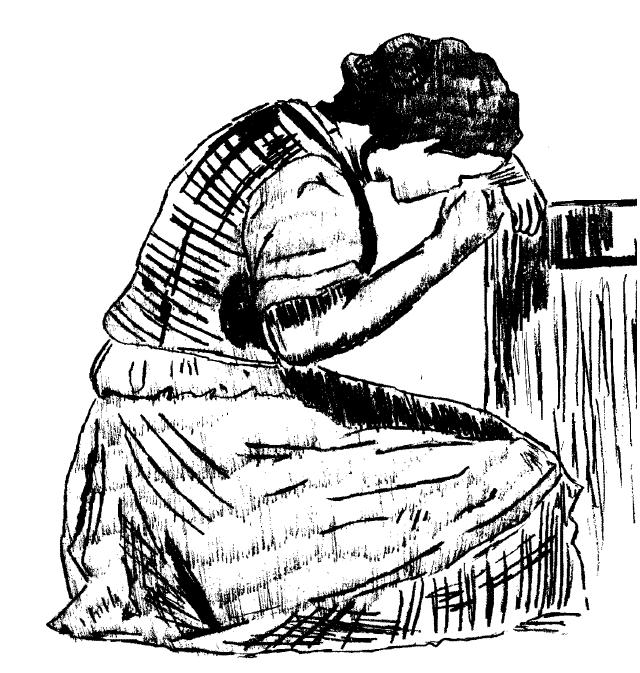
For my first project, I concentrated on an important issue that was discussed from Week 3. “Read the Qur’an and weep. If you do not weep naturally, force yourself to weep.” Many say that weeping is a language that is universally understood by all cultures around the world. When a person weeps, we know that he has been internally touched in some way either positively or negatively. This same idea is essential in the religion of Islam. In order for an individual to truly connect with the Islam faith, he must shed tears and weep. These tears represent the genuine commitment of the individual. For my project, I decided to do a sketch of an individual weeping; however, the difficult part was figuring out a way of showing the many sides of weeping in the Islam religion. I decided to first do the drawing in black and white because I did not want color to take away from the story of individual. I drew a woman, who is kneeling down as she cries on her hands. I decided to have the woman kneeling because a lot of the artwork that we have seen in class about submission has the individual either kneeling or lying down. Since the overall theme of weeping deals with submission, I believed it was important to incorporate it. I also made the individual a female because the theme of weeping transcends through all genders, races, cultures, etc. Even the Prophet Muhammad goes through this process. “the eyes of the Messenger of God were shedding tears. The Prophet listened to the Qur’an reading of Abu Musa and remarked, “This man is bestowed with the sweet voice of the prophet David.” It is also important to note that I did not draw any facial features. The purpose of the drawing is not to identify the individual; however, it is to appreciate the fact that this individual is submitting herself to God and committing to the word through her tears.
Archive for March, 2012
Tears of Faith
Friday, March 9th, 2012The Many Meanings of Art
Friday, March 9th, 2012One of the main themes of Week 6 was the various methods of Islamic art interpretation. For my project, I decided to sketch one of the most intriguing hidden images that is used around the world. At first glance, it might seem as though it is a picture of an old woman with a draping over her head; however, if you take another look, you can also see a young woman looking away. The reason why I decided to draw this is because many different scholars have their own opinions about the interpretation of Islamic art. We discussed several of these scholars in section. For example, in Islamic Art and Spirituality, Nasr emphasizes the fact that Islamic art is connected to an artist’s spirituality. In other words, an artist’s spirituality is represented through his artwork. On the other hand, in The Topkapi Scroll, Necipoglu argues that the situation at the time influences a viewer’s perspective of the artwork. My own sketch can be connected to this theme. What makes the individual interpret the artwork as an old woman as opposed to a young woman? Is it because the individual had a spiritual moment that enabled him to only see the old woman? Or is the individual a victim of the harsh journey of love and sees the young lady because it reminds him of his ex-lover? At first, a piece of art might look one way; however, with a second glance, its interpretation can have a whole new meaning.
Listen
Friday, March 9th, 2012You must read out loud
To understand its meaning
Allah must be heard
“The written text is an aid to the oral tradition, and that to achieve full mastery, one must ultimately depend on what one hears.” There is a popular saying that seeing is believing; however, in the Islamic faith, this phrase is changed. In Islam, hearing is believing. For my project, I wrote a haiku poem about the importance of speaking the word orally. In the poem I state “You must read out loud/ to understand its meaning/ Allah must be heard.” It is important to note that I decided to write this poem as a haiku because I really wanted to emphasize the fact that it was not necessarily the amount of words that would determine whether or not the poem had an impact on the reader. It is not until the reader listens to the words that he can truly appreciate its essence. This ideology dates back to the time of the Prophet Muhammad. The revelations were revealed to Muhammad by the angel Gabriel orally. Nothing was written; instead, Muhammad listened to the words that were given to him. He taught his followers through his voice not with a book. It was not until his words were written down to form the Qur’an that words even became apparent. Even with this in mind, many train their entire lives in order to be able to memorize the Qur’an. Why? It is not because they are interested in the words; instead, they wish to capture that essential sound that forms the basis of the Islamic faith.
Hello world!
Friday, March 9th, 2012Welcome to Weblogs at Harvard Law School. This is your first post. Edit or delete it, then start blogging!

