Archive for May, 2014

Blog Post 6

Thursday, May 8th, 2014

2014-05-07 21.42.10

For my sixth blog post, I decided to illustrate the scene of Ayaz’s sickness from “The Conference of Birds” by Farid Attar, where the king is sitting by the bedside of his love. The story carries a lot of symbolic meaning which can be translated to relate to the major themes of the Islam. In the poem, we see that Ayaz, the servant, is “afflicted with the Evil Eye”. The idea of the evil eye can serve as a symbol of the devil’s temptation which would define Ayaz as the people or as Adam from the Garden of Eden which in turn defines the king as God and the messenger as an angel of God. The interpretation is justified by the action of the king in the poem where he tells the messenger to deliver the message “what tears of sympathy I daily shed…that I endure his suffering…and hardly comprehend I am the king” These words symbolize the idea of God’s undying love for his children which is why God endures the consequence of men’s sin. Later in the poem, it is seen in the poem that the king arrives faster than the messenger to Ayaz which also symbolizes the omnipresence of God as well as his love for the people. To demonstrate this idea through a blog post, I depicted the scene of the king bent over the bed of Ayaz, obsessing over him while the messenger is crouching because he is apologetic due to his lateness. I also included some elements such as a shadowed face on Ayaz to show his afflicted sin and light on the king to symbolize “good” of the king.
Blog Post 5

Thursday, May 8th, 2014

2014-05-07 21.42.52

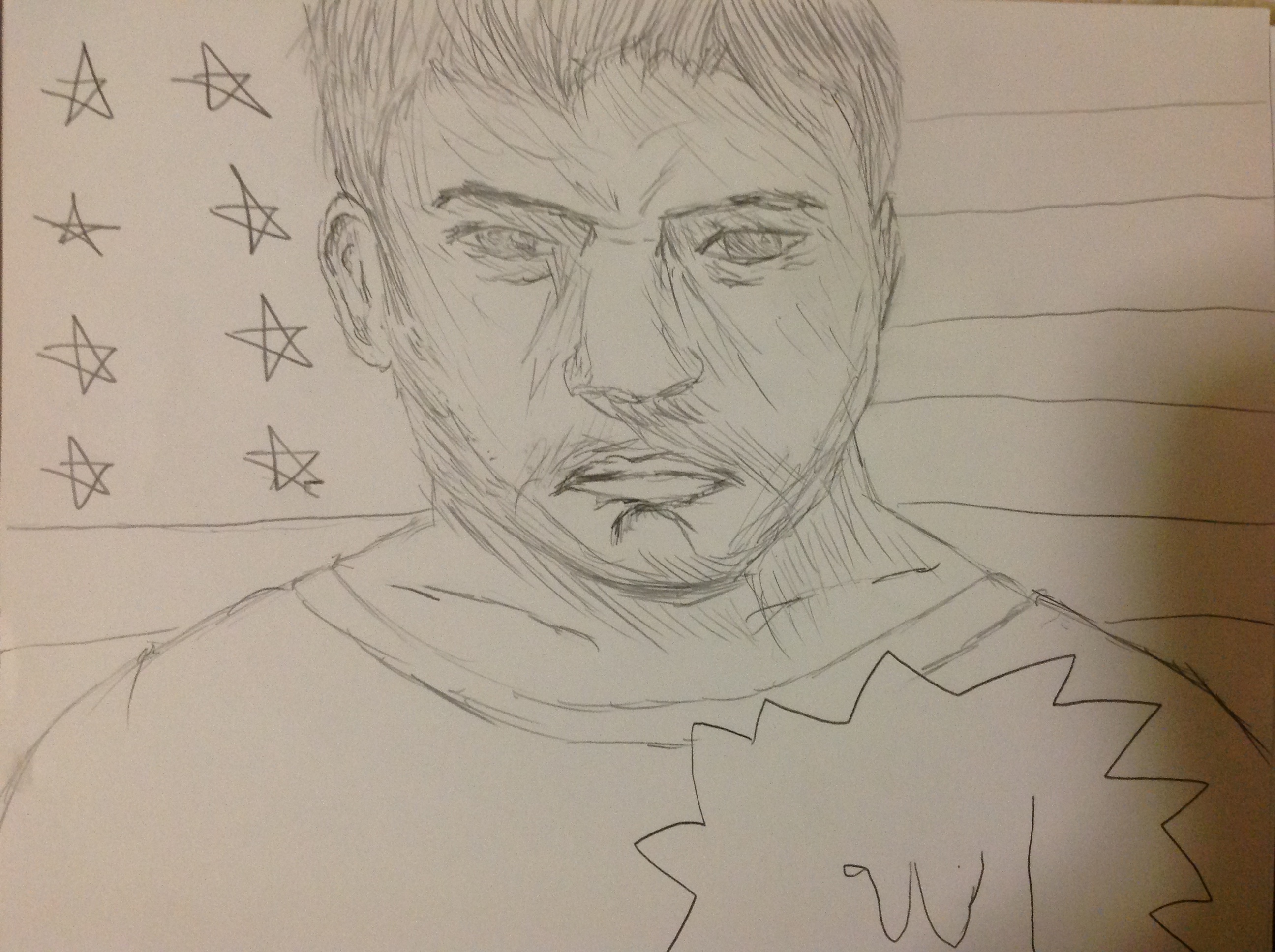
For my fifth blog post, I decided that the idea of conflicting identities that was presented in the reading “The Reluctant Fundamentalist” by Mohsin Hamid was interesting because it outlined the idea of an internal struggle which most people shrug off as no big deal. In the book, we see that the protagonist, Changez, is a American by culture and appearance, but throughout the book, he struggles with his muslim internality to determine his true identity as a person in society. Another interesting aspect is the idea that even at Princeton where the student body was supposed to be diverse, he felt out of place because he was from a “different” socioeconomical background. These factors lead to the conflicted nature of Changez which Mohsin perfectly embodies in the scene with him watching the news of the 9/11 bombing where it says, “But at that moment, my thoughts were not with the victims of the attack–death on television moves me most when it is fictitious and happens to characters with whom I have built up relationships over multiple episodes– no, I was caught up in the symbolism of it all, the fact that someone had so visibly brought America to her knees.” His response gives a certain awestruck vibe which could spur from his conflicted identity. In my pencil sketch rendition, I decided to illustrate this conflicted personality with a sketch of a person who looks a little Pakistani that is standing in front of an American flag to symbolize his American culture but with the Arabic word “Allah” on his heart to symbolize his inner heritage as a muslim which conflicts with his identity.

Blog Post 4

Thursday, May 8th, 2014

2014-05-05 23.12.25

For my fourth blog entry, I have decided on an unusual medium which is in the form of a comic strip. I intended this comic strip because I had wanted to describe the power of the Ghazul and the uniqueness of it. The different panels all symbolize different couplets to show that each couplet is free standing not relying on the others to make sense. According to the Elizabeth Gray’s “Green Sea of Heaven”, the couplets are intentionally made to stand alone in order to create a sense of ambiguity which in turn serves to make the Ghazul prone to many different interpretations of the relationships that take place within the Ghazul. With this in mind, I created the scenes of Rumi’s Ghazul, “Andak Andak” using the text in a calligraphic art form in order to depict the scenes described by the couplets. The couplets then come together to create the final picture which is symbolized by the comic strip. The story is very ambiguous when a single frame is analyzed by itself, but upon inspection of all the frames we can see that the first frame depicts the first couplet which talks about the drunkards congregating . The people as we can see are holding what seem to be wine glasses congregating . Then the next frame depicts the second couplet which talks about the “heart-cherishers”  coming from the garden, which I had depicted by showing a person walking holding a heart. The following frames each depict a single couplet with their respective meanings attached to the calligraphic text.